Deepfix: Statistical Post-editing of Statistical Machine Translation Using
Deep Syntactic Analysis
Rudolf Rosa and David Mareˇcek and Aleˇs Tamchyna Charles University in Prague, Faculty of Mathematics and Physics
Institute of Formal and Applied Linguistics Malostransk´e n´amˇest´ı 25, Prague
{rosa,marecek,tamchyna}@ufal.mff.cuni.cz
Abstract
Deepfix is a statistical post-editing sys-tem for improving the quality of statis-tical machine translation outputs. It at-tempts to correct errors in verb-noun va-lency using deep syntactic analysis and a simple probabilistic model of valency. On the English-to-Czech translation pair, we show that statistical post-editing of statis-tical machine translation leads to an im-provement of the translation quality when helped by deep linguistic knowledge.
1 Introduction
Statistical machine translation (SMT) is the cur-rent state-of-the-art approach to machine transla-tion – see e.g. Callison-Burch et al. (2011). How-ever, its outputs are still typically significantly worse than human translations, containing vari-ous types of errors (Bojar, 2011b), both in lexical choices and in grammar.
As shown by many researchers, e.g. Bojar (2011a), incorporating deep linguistic knowledge directly into a translation system is often hard to do, and seldom leads to an improvement of trans-lation output quality. It has been shown that it is often easier to correct the machine translation out-puts in a second-stage post-processing, which is usually referred to as automatic post-editing.
Several types of errors can be fixed by employ-ing rule-based post-editemploy-ing (Rosa et al., 2012b), which can be seen as being orthogonal to the sta-tistical methods employed in SMT and thus can capture different linguistic phenomena easily.
But there are still other errors that cannot be cor-rected with hand-written rules, as there exist many linguistic phenomena that can never be fully de-scribed manually – they need to be handled statis-tically by automastatis-tically analyzing large-scale text corpora. However, to the best of our knowledge,
English Czech
[image:1.595.313.519.207.268.2]go to the doctor j´ıt k doktorovi dative case go to the centre j´ıt do centra genitive case go to a concert j´ıt na koncert accusative case go for a drink j´ıt na drink accusative case go up the hill j´ıt na kopec accusative case
Table 1: Examples of valency of the verb ‘to go’ and ‘j´ıt’. For Czech, the morphological cases of the nouns are also indicated.
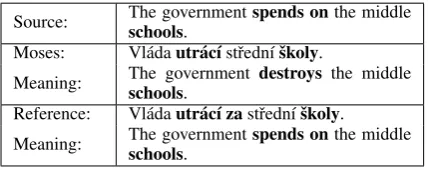
Source: The governmentschools. spends onthe middle Moses: Vl´adautr´ac´ıstˇredn´ıˇskoly.
Meaning: The governmentschools. destroys the middle Reference: Vl´adautr´ac´ı zastˇredn´ıˇskoly. Meaning: The governmentschools. spends onthe middle
Table 2: Example of a valency error in output of Moses SMT system.
there is very little successful research in statistical post-editing (SPE) of SMT (see Section 2).
In our paper, we describe a statistical approach to correcting one particular type of English-to-Czech SMT errors – errors in the verb-noun va-lency. The term valency stands for the way in which verbs and their arguments are used together, usually together with prepositions and morpholog-ical cases, and is described in Section 4. Several examples of the valency of the English verb ‘to go’ and the corresponding Czech verb ‘j´ıt’ are shown in Table 1.
We conducted our experiments using a state-of-the-art SMT system Moses (Koehn et al., 2007). An example of Moses making a valency error is translating the sentence ‘The government spends on the middle schools.’, adapted from our devel-opment data set. As shown in Table 2, Moses translates the sentence incorrectly, making an er-ror in the valency of the ‘utr´acet – ˇskola’ (‘spend – school’) pair. The missing preposition changes the meaning dramatically, as the verb ‘utr´acet’ is
[image:1.595.310.525.326.411.2]ysemous and can mean ‘to spend (esp. money)’ as well as ‘to kill, to destroy (esp. animals)’.
Our approach is to use deep linguistic analysis to automatically determine the structure of each sentence, and to detect and correct valency errors using a simple statistical valency model. We de-scribe our approach in detail in Section 5.
We evaluate and discuss our experiments in Section 6. We then conclude the paper and pro-pose areas to be researched in future in Section 7.
2 Related Work
The first reported results of automatic post-editing of machine translation outputs are (Simard et al., 2007) where the authors successfully performed statistical post-editing (SPE) of rule-based ma-chine translation outputs. To perform the post-editing, they used a phrase-based SMT system in a monolingual setting, trained on the outputs of the rule-based system as the source and the human-provided reference translations as the target, to achieve massive translation quality improvements. The authors also compared the performance of the post-edited rule-based system to directly using the SMT system in a bilingual setting, and reported that the SMT system alone performed worse than the post-edited rule-based system. They then tried to post-edit the bilingual SMT system with another monolingual instance of the same SMT system, but concluded that no improvement in quality was observed.
The first known positive results in SPE of SMT are reported by Oflazer and El-Kahlout (2007) on English to Turkish machine translation. The authors followed a similar approach to Simard et al. (2007), training an SMT system to post-edit its own output. They use two iterations of post-editing to get an improvement of 0.47 BLEU points (Papineni et al., 2002). The authors used a rather small training set and do not discuss the scalability of their approach.
To the best of our knowledge, the best results re-ported so far for SPE of SMT are by B´echara et al. (2011) on French-to-English translation. The au-thors start by using a similar approach to Oflazer and El-Kahlout (2007), getting a statistically sig-nificant improvement of 0.65 BLEU points. They then further improve the performance of their system by adding information from the source side into the post-editing system by concatenat-ing some of the translated words with their source
[image:2.595.308.527.61.94.2]Direction Baseline SPE Context SPE en→cs 10.85±0.47 10.70±0.44 10.73±0.49 cs→en 17.20±0.53 17.11±0.52 17.18±0.54
Table 3: Results of SPE approach of B´echara et al. (2011) evaluated on English-Czech SMT.
words, eventually reaching an improvement of 2.29 BLEU points. However, similarly to Oflazer and El-Kahlout (2007), the training data used are very small, and it is not clear how their method scales on larger training data.
In our previous work (Rosa et al., 2012b), we explored a related but substantially different area ofrule-based post-editing of SMT. The resulting system, Depfix, manages to significantly improve the quality of several SMT systems outputs, using a set of hand-written rules that detect and correct grammatical errors, such as agreement violations. Depfix can be easily combined with Deepfix,1 as
it is able to correct different types of errors.
3 Evaluation of Existing SPE Approaches
First, we evaluated the utility of the approach of B´echara et al. (2011) for the English-Czech lan-guage pair. We used 1 million sentence pairs from CzEng 1.0 (Bojar et al., 2012b), a large English-Czech parallel corpus. Identically to the paper, we split the training data into 10 parts, trained 10 sys-tems (each on nine tenths of the data) and used them to translate the remaining part. The second step was then trained on the concatenation of these translations and the target side of CzEng. We also implemented thecontextualvariant of SPE where words in the intermediate language are annotated with corresponding source words if the alignment strength is greater than a given threshold. We lim-ited ourselves to the threshold value 0.8, for which the best results are reported in the paper. We tuned all systems on the dataset of WMT11 (Callison-Burch et al., 2011) and evaluated on the WMT12 dataset (Callison-Burch et al., 2012).
Table 3 summarizes our results. The reported confidence intervals were estimated using boot-strap resampling (Koehn, 2004). SPE did not lead to any improvements of BLEU in our experiments. In fact, SPE even slightly decreased the score (but
1Depfix (Rosa et al., 2012b) performs rule-based
the difference is statistically insignificant in all cases).
We conclude that this method does not improve English-Czech translation, possibly because our training data is too large for this method to bring any benefit. We therefore proceed with a more complex approach which relies on deep linguistic knowledge.
4 Deep Dependency Syntax, Formemes, and Valency
4.1 Tectogrammatical dependency trees
Tectogrammatical treesare deep syntactic depen-dency trees based on the Functional Generative Description (Sgall et al., 1986). Each node in a tectogrammatical tree corresponds to a content word, such as a noun, a full verb or an adjec-tive; the node consists of the lemma of the con-tent word and several other attributes. Functional words, such as prepositions or auxiliary verbs, are not directly present in the tectogrammatical tree, but are represented by attributes of the respective content nodes. See Figure 1 for an example of two tectogrammatical trees (for simplicity, most of the attributes are not shown).
In our work, we only use one of the many attributes of tectogrammatical nodes, called
formeme (Duˇsek et al., 2012). A formeme is a string representation of selected morpho-syntactic features of the content word and selected auxiliary words that belong to the content word, devised to be used as a simple and efficient representation of the node.
A noun formeme, which we are most interested in, consists of three parts (examples taken from Figure 1):
1. The syntactic part-of-speech –nfor nouns. 2. The preposition if the noun has one (empty
otherwise), as inn:on+Xorn:za+4. 3. A form specifier.
• In English, it typically marks the subject
or object, as in n:subj. In case of a noun accompanied by a preposition, the third part is alwaysX, as inn:on+X.
• In Czech, it denotes the morphologi-cal case of the noun, represented by its number (from 1 to 7 as there are seven cases in Czech), as in n:1 and
n:za+4.
t-tree zone=en
government
n:subj
spend
v:fin
middle
adj:attr
school
n:on+X
t-tree zone=cs
vláda
n:1
utrácet
v:fin
střední
adj:attr
škola
[image:3.595.342.494.65.198.2]n:za+4
Figure 1: Tectogrammatical trees for the sentence ‘The government spends on the middle schools.’ – ‘Vl´ada utr´ac´ı za stˇredn´ı ˇskoly.’; only lemmas and formemes of the nodes are shown.
Adjectives and nouns can also have the
adj:attrandn:attrformemes, respectively, meaning that the node is in morphological agree-ment with its parent. This is especially important in Czech, where this means that the word bears the same morphological case as its parent node.
4.2 Valency
The notion of valency (Tesni`ere and Fourquet, 1959) is semantic, but it is closely linked to syn-tax. In the theory of valency, each verb has one or more valency frames. Each valency frame de-scribes a meaning of the verb, together with argu-ments (usually nouns) that the verb must or can have, and each of the arguments has one or several fixed forms in which it must appear. These forms can typically be specified by prepositions and mor-phological cases to be used with the noun, and thus can be easily expressed by formemes.
For example, the verb ‘to go’, shown in Ta-ble 1, has a valency frame that can be expressed asn:subj go n:to+X, meaning that the sub-ject goes to some place.
The valency frames of the verbs ‘spend’ and ‘utr´acet’ in Figure 1 can be written as
n:subj spend n:on+Xandn:1 utr´acet n:za+4; the subject (in Czech this is a noun in nominative case) spends on an object (in Czech, the preposition ‘za’ plus a noun in accusative case).
performed are still of the verb-noun valency type. Still, we keep the traditional notion of verb-noun valency throughout the text, especially to be able to always refer to the parent as “the verb” and to the child as “the noun”.
5 Our Approach
5.1 Valency models
To be able to detect and correct valency errors, we created statistical models of verb-noun valency. We model the conditional probability of the noun argument formeme based on several features of the verb-noun pair. We decided to use the following two models:
P(fn|lv, fEN) (1)
P(fn|lv, ln, fEN) (2)
where:
• fn is the formeme of the Czech noun
argu-ment, which is being modelled
• lvis the lemma of the Czech parent verb
• lnis the lemma of the Czech noun argument
• fEN is the formeme of the English noun
aligned to the Czech noun argument
The input is first processed by the model (1), which performs more general fixes, in situations where the (lv, fEN) pair rather unambiguously
de-fines the valency frame required.
Then model (2) is applied, correcting some er-rors of the model (1), in cases where the noun argument requires a different valency frame than is usual for the (lv, fEN) pair, and making some
more fixes in cases where the correct valency frame required for the (lv, fEN) pair was too
am-biguous to make a correction according to model (1), but the decision can be made once information aboutlnis added.
We computed the models on the full training set of CzEng 1.0 (Bojar et al., 2012b) (roughly 15 mil-lion sentences), and smoothed the estimated prob-abilities with add-one smoothing.
5.2 Deepfix
We introduce a new statistical post-editing system, Deepfix, whose input is a pair of an English sen-tence and its Czech machine translation, and the output is the Czech sentence with verb-noun va-lency errors corrected.
The Deepfix pipeline consists of several steps:
1. the sentences are tokenized, tagged and lem-matized (a lemma and a morphological tag is assigned to each word)
2. corresponding English and Czech words are aligned based on their lemmas
3. deep-syntax dependency parse trees of the sentences are built, the nodes in the trees are labelled with formemes
4. improbable noun formemes are replaced with correct formemes according to the valency model
5. the words are regenerated according to the new formemes
6. the regenerating continues recursively to chil-dren of regenerated nodes if they are in morphological agreement with their parents (which is typical for adjectives)
To decide whether the formeme of the noun is incorrect, we query the valency model for all pos-sible formemes and their probabilities. If an alter-native formeme probability exceeds a fixed thresh-old, we assume that the original formeme is incor-rect, and we use the alternative formeme instead.
For our example sentence, ‘The government spends on the middle schools.’ – ‘Vl´ada utr´ac´ı za stˇredn´ı ˇskoly.’, we query the model (2) and get the following probabilities:
• P(n:4|utr´acet, ˇskola, n:on+X) = 0.07 (the original formeme)
• P(n:za+4|utr´acet, ˇskola, n:on+X) = 0.89 (the most probable formeme)
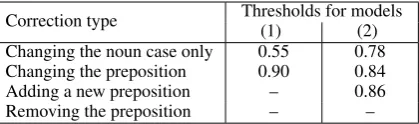
The threshold for this change type is 0.86, is exceeded by the n:za+4 formeme and thus the change is performed: ‘ˇskoly’ is replaced by ‘za ˇskoly’.
5.3 Tuning the Thresholds
Correction type Thresholds for models(1) (2) Changing the noun case only 0.55 0.78 Changing the preposition 0.90 0.84 Adding a new preposition – 0.86 Removing the preposition – –
Table 4: Deepfix thresholds
change to the preposition can also involve chang-ing the morphological case of the noun, as each preposition typically requires a certain morpho-logical case.
For some combinations of a change type and a model, as in case of the preposition removing, we never perform a fix because we observed that it nearly never improves the translation. E.g., if a verb-noun pair can be correct both with and with-out a preposition, the preposition-less variant is usually much more frequent than the prepositional variant (and thus is assigned a much higher prob-ability by the model). However, the preposition often bears a meaning that is lost by removing it – in Czech, which is a relatively free-word-order language, the semantic roles of verb arguments are typically distinguished by prepositions, as op-posed to English, where they can be determined by their relative position to the verb.
5.4 Implementation
The whole Deepfix pipeline is implemented in Treex, a modular NLP framework (Popel and ˇZabokrtsk´y, 2010) written in Perl, which provides wrappers for many state-of-the-art NLP tools. For the analysis of the English sentence, we use the Morˇce tagger (Spoustov´a et al., 2007) and the MST parser (McDonald et al., 2005). The Czech sentence is analyzed by the Featurama tagger2and
the RUR parser (Rosa et al., 2012a) – a parser adapted to parsing of SMT outputs. The word alignment is created by GIZA++ (Och and Ney, 2003); the intersection symmetrization is used.
6 Evaluation
6.1 Automatic Evaluation
We evaluated our method on three datasets: WMT10 (2489 parallel sentences), WMT11 (3003 parallel sentences), and WMT12 (3003 parallel sentences) by Callison-Burch et al. (2010; 2011; 2012). For evaluation, we used outputs of a state-of-the-art SMT system, Moses (Koehn et al.,
2http://featurama.sourceforge.net/
2007), tuned for English-to-Czech translation (Bo-jar et al., 2012a). We used the WMT10 dataset and its Moses translation as our development data to tune the thresholds. In Table 5, we report the achieved BLEU scores (Papineni et al., 2002), NIST scores (Doddington, 2002), and PER (Till-mann et al., 1997).
The improvements in automatic scores are low but consistently positive, which suggests that Deepfix does improve the translation quality. However, the changes performed by Deepfix are so small that automatic evaluation is unable to re-liably assess whether they are positive or negative – it can only be taken as an indication.
6.2 Manual Evaluation
To reliably assess the performance of Deepfix, we performed manual evaluation on the WMT12 dataset translated by the Moses system.
The dataset was evenly split into 4 parts and each of the parts was evaluated by one of two an-notators (denoted “A” and “B”). For each sentence that was modified by Deepfix, the annotator de-cided whether the Deepfix correction had a posi-tive (“improvement”) or negaposi-tive (“degradation”) effect on the translation quality, or concluded that this cannot be decided (“indefinite”) – either be-cause both of the sentences are correct variants, or because both are incorrect.3
The results in Table 6 prove that the overall ef-fect of Deepfix is positive: it modifies about 20% of the sentence translations (569 out of 3003 sen-tences), improving over a half of them while lead-ing to a degradation in only a quarter of the cases. We measured the inter-annotator agreement on 100 sentences which were annotated by both an-notators. For 60 sentence pairs, both of the anno-tators were able to select which sentence is better, i.e. none of the annotators used the “indefinite” marker. The inter-annotator agreement on these 60 sentence pairs was 97%.4
3The evaluation was done in a blind way, i.e. the
annota-tors did not know which sentence is before Deepfix and which is after Deepfix. They were also provided with the source En-glish sentences and the reference human translations.
4If all 100 sentence pairs are taken into account, requiring
Dataset BaselineBLEU score (higher is better)Deepfix Difference BaselineNIST score (higher is better)Deepfix Difference BaselinePER (lower is better)Deepfix Difference
WMT10* 15.66 15.74 +0.08 5.442 5.470 +0.028 58.44% 58.26% -0.18
WMT11 16.39 16.42 +0.03 5.726 5.737 +0.011 57.17% 57.09% -0.08
WMT12 13.81 13.85 +0.04 5.263 5.283 +0.020 60.04% 59.91% -0.13
Table 5: Automatic evaluation of Deepfix on outputs of the Moses system on WMT10, WMT11 and WMT12 datasets. *Please note that WMT10 was used as the development dataset.
Part Annotator Changed sentences Improvement Degradation Indefinite
1 A 126 57 (45%) 35 (28%) 34 (27%)
2 B 112 62 (55%) 29 (26%) 21 (19%)
3 A 150 88 (59%) 29 (19%) 33 (22%)
4 B 181 114 (63%) 42 (23%) 25 (14%)
[image:6.595.79.527.62.115.2]Total 569 321 (56%) 135 (24%) 113 (20%)
Table 6: Manual evaluation of Deepfix on outputs of Moses Translate system on WMT12 dataset.
6.3 Discussion
When a formeme change was performed, it was usually either positive or at least not harmful (sub-stituting one correct variant for another correct variant).
However, we also observed a substantial amount of cases where the change of the formeme was incorrect. Manual inspection of a sample of these cases showed that there can be several rea-sons for a formeme change to be incorrect:
• incorrect analysis of the Czech sentence
• incorrect analysis of the English sentence
• the original formeme is a correct but very rare variant
The most frequent issue is the first one. This is to be expected, as the Czech sentence is often er-roneous, whereas the NLP tools that we used are trained on correct sentences; in many cases, it is not even clear what a correct analysis of an incor-rect sentence should be.
7 Conclusion and Future Work
On the English-Czech pair, we have shown that statistical post-editing of statistical machine trans-lation outputs is possible, even when translating from a morphologically poor to a morphologi-cally rich language, if it is grounded by deep lin-guistic knowledge. With our tool, Deepfix, we have achieved improvements on outputs of two state-of-the-art SMT systems by correcting verb-noun valency errors, using two simple probabilis-tic valency models computed on large-scale data. The improvements have been confirmed by man-ual evaluation.
We encountered many cases where the per-formance of Deepfix was hindered by errors of the underlying tools, especially the taggers, the parsers and the aligner. Because the use of the RUR parser (Rosa et al., 2012a), which is partially adapted to SMT outputs parsing, lead to a reduc-tion of the number of parser errors, we find the ap-proach of adapting the tools for this specific kind of data to be promising.
We believe that our method can be adapted to other language pairs, provided that there is a pipeline that can analyze at least the target lan-guage up to deep syntactic trees. Because we only use a small subset of information that a tectogram-matical tree provides, it is sufficient to use only simplified tectogrammatical trees. These could be created by a small set of rules from shallow-syntax dependency trees, which can be obtained for many languages using already existing parsers.
Acknowledgments
This research has been supported by the 7th FP project of the EC No. 257528 and the project 7E11042 of the Ministry of Education, Youth and Sports of the Czech Republic.
Data and some tools used as a prerequisite for the research described herein have been pro-vided by the LINDAT/CLARIN Large Infrastruc-tural project, No. LM2010013 of the Ministry of Education, Youth and Sports of the Czech Repub-lic.
References
Hanna B´echara, Yanjun Ma, and Josef van Genabith. 2011. Statistical post-editing for a statistical MT
system. MT Summit XIII, pages 308–315.
Ondˇrej Bojar, Bushra Jawaid, and Amir Kamran. 2012a. Probes in a taxonomy of factored
phrase-based models. InProceedings of the Seventh
Work-shop on Statistical Machine Translation, pages 253– 260, Montr´eal, Canada. Association for Computa-tional Linguistics.
Ondˇrej Bojar, Zdenˇek ˇZabokrtsk´y, Ondˇrej Duˇsek, Pe-tra Galuˇsˇc´akov´a, Martin Majliˇs, David Mareˇcek, Jiˇr´ı Marˇs´ık, Michal Nov´ak, Martin Popel, and Aleˇs Tam-chyna. 2012b. The joy of parallelism with CzEng 1.0. InProceedings of the 8th International Confer-ence on Language Resources and Evaluation (LREC 2012), pages 3921–3928, ˙Istanbul, Turkey. Euro-pean Language Resources Association.
Ondˇrej Bojar. 2011a. Rich morphology and what can we expect from hybrid approaches to MT. In-vited talk at International Workshop on Using Lin-guistic Information for Hybrid Machine Translation (LIHMT-2011), November.
Ondˇrej Bojar. 2011b. Analyzing error types in
English-Czech machine translation.Prague Bulletin
of Mathematical Linguistics, 95:63–76, March. Chris Callison-Burch, Philipp Koehn, Christof Monz,
Kay Peterson, Mark Przybocki, and Omar Zaidan. 2010. Findings of the 2010 joint workshop on sta-tistical machine translation and metrics for machine translation. InProceedings of the Joint Fifth Work-shop on Statistical Machine Translation and Metric-sMATR, pages 17–53, Uppsala, Sweden, July. Asso-ciation for Computational Linguistics.
Chris Callison-Burch, Philipp Koehn, Christof Monz, and Omar Zaidan. 2011. Findings of the 2011 workshop on statistical machine translation. In Pro-ceedings of the Sixth Workshop on Statistical Ma-chine Translation, pages 22–64, Edinburgh, Scot-land, July. Association for Computational Linguis-tics.
Chris Callison-Burch, Philipp Koehn, Christof Monz, Matt Post, Radu Soricut, and Lucia Specia. 2012. Findings of the 2012 workshop on statistical
ma-chine translation. In Proceedings of the Seventh
Workshop on Statistical Machine Translation, pages 10–51, Montr´eal, Canada, June. Association for Computational Linguistics.
George Doddington. 2002. Automatic evaluation of machine translation quality using n-gram co-occurrence statistics. InProceedings of the second international conference on Human Language Tech-nology Research, pages 138–145. Morgan Kauf-mann Publishers Inc.
Ondˇrej Duˇsek, Zdenˇek ˇZabokrtsk´y, Martin Popel, Mar-tin Majliˇs, Michal Nov´ak, and David Mareˇcek.
2012. Formemes in English-Czech deep
syntac-tic MT. In Proceedings of the Seventh Workshop
on Statistical Machine Translation, pages 267–274, Montr´eal, Canada. Association for Computational Linguistics.
Philipp Koehn, Hieu Hoang, Alexandra Birch, Chris Callison-Burch, Marcello Federico, Nicola Bertoldi, Brooke Cowan, Wade Shen, Christine Moran, Richard Zens, Chris Dyer, Ondˇrej Bojar, Alexandra Constantin, and Evan Herbst. 2007. Moses: Open source toolkit for statistical machine translation. In
ACL 2007, Proceedings of the 45th Annual Meet-ing of the Association for Computational LMeet-inguis- Linguis-tics Companion Volume Proceedings of the Demo and Poster Sessions, pages 177–180, Prague, Czech Republic, June. Association for Computational Lin-guistics.
Philipp Koehn. 2004. Statistical significance tests for machine translation evaluation. InProc. of EMNLP, Barcelona, Spain.
Ryan McDonald, Koby Crammer, and Fernando Pereira. 2005. Online large-margin training of
dependency parsers. In Proceedings of the 43rd
Annual Meeting on Association for Computational Linguistics, pages 91–98. Association for Computa-tional Linguistics.
Franz Josef Och and Hermann Ney. 2003. A sys-tematic comparison of various statistical alignment
models. Computational Linguistics, 29(1):19–51.
Kemal Oflazer and Ilknur Durgar El-Kahlout. 2007. Exploring different representational units in English-to-Turkish statistical machine translation. InProceedings of the Second Workshop on Statisti-cal Machine Translation, pages 25–32. Association for Computational Linguistics.
Kishore Papineni, Salim Roukos, Todd Ward, and Wei-Jing Zhu. 2002. BLEU: a method for automatic
evaluation of machine translation. In ACL 2002,
Proceedings of the 40th Annual Meeting of the As-sociation for Computational Linguistics, pages 311– 318, Philadelphia, Pennsylvania.
Martin Popel and Zdenˇek ˇZabokrtsk´y. 2010.
Tec-toMT: modular NLP framework. InProceedings of
the 7th international conference on Advances in nat-ural language processing, IceTAL’10, pages 293– 304, Berlin, Heidelberg. Springer-Verlag.
Rudolf Rosa, Ondˇrej Duˇsek, David Mareˇcek, and Mar-tin Popel. 2012a. Using parallel features in pars-ing of machine-translated sentences for correction of
grammatical errors. InProceedings of Sixth
Work-shop on Syntax, Semantics and Structure in Statis-tical Translation (SSST-6), ACL, pages 39–48, Jeju, Korea. ACL.
Rudolf Rosa, David Mareˇcek, and Ondˇrej Duˇsek. 2012b. DEPFIX: A system for automatic correction
of Czech MT outputs. InProceedings of the
pages 362–368, Montr´eal, Canada. Association for Computational Linguistics.
Petr Sgall, Eva Hajiˇcov´a, and Jarmila Panevov´a. 1986.
The meaning of the sentence in its semantic and pragmatic aspects. Springer.
Michel Simard, Cyril Goutte, and Pierre Isabelle. 2007. Statistical phrase-based post-editing. In Hu-man Language Technologies 2007: The Conference of the North American Chapter of the Association for Computational Linguistics; Proceedings of the Main Conference, pages 508–515, Rochester, New York, April. Association for Computational Linguis-tics.
Drahom´ıra Spoustov´a, Jan Hajiˇc, Jan Votrubec, Pavel
Krbec, and Pavel Kvˇetoˇn. 2007. The best of
two worlds: Cooperation of statistical and
rule-based taggers for Czech. In Proceedings of the
Workshop on Balto-Slavonic Natural Language Pro-cessing 2007, pages 67–74, Praha, Czechia. Uni-verzita Karlova v Praze, Association for Computa-tional Linguistics.
Lucien Tesni`ere and Jean Fourquet. 1959.El´ements de syntaxe structurale. ´Editions Klincksieck, Paris.
Christoph Tillmann, Stephan Vogel, Hermann Ney,
Alex Zubiaga, and Hassan Sawaf. 1997.