Migration, Social Capital, Financial
Capital: How Migrants’ Family Relations
Serve Internationally
Zubair, Muhammad and Bögenhold, Dieter
Alpen-Adria-Universität Klagenfurt
2017
Online at
https://mpra.ub.uni-muenchen.de/83116/
Migration, Social Capital, Financial Capital:
How Migrants
’
Family Relations Serve Internationally
Muhammad Zubair and Dieter Bögenhold
Muhammad Zubair is a doctoral student at the Alpen-Adria-Universität Klagenfurt, Department of Sociology, Faculty of Management and Economics, Universitätsstrasse 65-67, 9020 Klagenfurt,
Austria
m1zubair(at)edu.aau.at
Dieter Bögenhold is Professor of Sociology at the Department of Sociology, Faculty of Management and
Abstract
Migration is a global phenomenon and has gained worldwide recognition for its socioeco-nomic impacts on host and home country. According to the literature, one of the most important emanations of migration are remittances. They facilitate poverty reduction, ed-ucation improvement, entrepreneurial investments and even the economic evolution of the home state. Globally, India and Pakistan are in the top ten money receiving-countries. This paper provides an overview about migration, and the worldwide remittance flow of mi-grants from India and Pakistan to their home countries. We sought to make a nonlinear model by dividing remittance per person with the number of immigrants from India and Pakistan worldwide, also focusing on the ratio of male and female immigrants in the pop-ulation. The results show that remittance change exponentially over the years. This in-crease is stronger in the case of India than Pakistan and, more interestingly, gender ratios have influenced remittance per year.
1. Introduction
The history of migration started from the beginning of human life. People migrate from one region to another for better lifestyle and due to poverty. International migration clas-sified mostly the movement, resettlement or relocation of an individual or a person from their native country to settle or live in another country. It can be either permanently or temporarily (Lee, 1966). According to Lee (1966), people move getting away wars and persecution, additionally in search of land, resources, opportunities and the fantasy of a better life.
Remittances are the transfers from foreign workers in home country, which are generally made from foreign workers to their family residing in home countries. Remittances from international immigrants to developing (home) countries consider being the largest source of financial inflow. In 2015, remittance inflow to developing countries estimated $431.6 billion where the highest remittance inflow (72,2US$) was recorded in India, while Pakistan is the eighth largest worker remittance (20,1 US$) receiving country (World Bank, 2016, p. 13).
The main purpose of this study is to examine the determinants of remittance flow in both top remittance receiving developing countries India and Pakistan per person and to check the gender share. This study tries to contribute to the research gap in terms of remittance per person share and gender role between India and Pakistan. In the past, studies are conducted to various aspects of migration and impact of remittance such as household, poverty reduction and economic growth, but they do not cover per person remittance share and the role of gender in it. Pradhan, Upadhyay and Upadhyaya, (2008) find out remittance have a positive but small impact on growth. Aggarwal, Demirgüc-Kunt and Martinez Peria, (2006) found that remittances in developing countries have a significant effect on bank deposits. Gupta (2006) in his study which was conducted during 1975-2003 result shows that remittances inflow affected by the economic environment in home countries and it seemed to be countercyclical in India. Zachariah and Rajan, (2008) conducted a survey the end use of remittances by households in Kerala, a state in India, which shows that remit-tance have a very positive impact on household consumptions and economic growth at regional level. In case of Pakistan, many studies have been conducted to investigate the effect of remittances on the economy. Qayyum, Javid and Arif, (2008) examined the inflow of foreign remittances and its effects on the economic growth of Pakistan and poverty. Rahman (2009) investigated the stated relationship for four countries including Pakistan. Javid, Arif and Qayyum (2012) focused on the inflow of remittances and its effect on eco-nomic growth and poverty in Pakistan. The main focused countries in this study are India and Pakistan.
According to United Nations, ‘‘World population prospects’’ (2015, p. 23), both India and
role worldwide. They have very strong ethnic groups in the host society and rich family networks. However, they are mostly linked with the family residing in the home country and they are sending money back home to improve the family household situation.
Remittances are playing a very vital role as a growing external source of capital for in the economy of the developing countries. According to the International Monetary Fund (IMF) statistics, India and Pakistan are two most remittance receiving developing countries worldwide, which shows that the remittance is not only playing a role to improve the poor condition, health and education of their families back home, but also in the GDP of their host countries. Finally, remittances provide evidence of diverse worldwide existing social networks (Bögenhold 2013) which hold families together. Those family bonds give prove of transnational forces of social activities. The ties serve as a social capital at micro and macro levels (Coleman 1988, Putnam et al. 1933, Ostrom 2010).
In this paper, we make a nonlinear model to calculate the foreign remittance per person from worldwide to India and Pakistan and examine the role of gender using the same pro-cedure. The numbers of immigrants from India are higher compared to Pakistan. Statistics show that immigrants from Pakistan were sending more money per year before 1990 how-ever, after that, immigrants from India surpassed them. Both functions, from India and Pakistan, follow exponential distributions, where there is an exponential increase in money being sent back to home countries. We also correlate the variables and found that they are behaving in the similar way. In the final section, this study found some interesting results between male and female foreign remittance to Pakistan and India.
2. Literature Review
The term immigrant is generally defined in the following way: “Migrant is a person who
moves from one country to another country with the target or goal of taking up his
resi-dence there for an appropriate period of time” (Faist 2000, p. 18). People have moved
from pre-memorable times, pilgrims, paddlers, merchants and colonizers. From a world-wide perspective, currently numerous people are permanently on the move, being global migration a key component of an advanced open society (Massey et al. 1993; Kourtit and Nijkamp 2011, 167). The word migration has many definitions because different research-ers defined migration in different ways. Migration is broadly defined as a change of place or temporary residence or permanent. (Lee 1966). International migration is mostly classi-fied as the movement, resettlement or relocation of an individual or group of people from their native country to settle or live in another country (Bögenhold 2014).
reasons (labour, demand, promising opportunities, etc.) since the resources in their home country are too scarce to meet their needs. Inequality of income is a chronic problem of poor countries that leads to migration (Stark, 2006).
Waldinger et al. (1990) supposed that people migrate temporarily as labourers or workers but sometimes it can also be permanent or sojourning immigration status in developed host societies. The Southeast Asian region has had a long history of conflict, war and internal divisiveness, as a result, there are a large number of people migrated to foreign countries for a better lifestyle. The people from the Southeast Asian are very diverse in culture, religion, and linguistics. A few studies show that there are some diverse experiences for ethnic minority immigrants and these experiences are based on the host country where they live (Koning and Verver, 2013; Ma et al., 2012; Inal et al., 2012). Particularly, it con-sists of religions such as Hindu, Christianity, Buddhist and Islam (Pempel, 2005, p. 1). On the other hand, these groups are very strong in the family business. According to (Hamilton & Dana et al, 2008) migrant groups are a very strong linkage to the culture, especially in which people grew up.
The past 40 years’ studies show that immigrants often tend to create new ventures (Dana,
2007). International migration rapid increase in developed countries and immigrant’s
con-tribution in the host country economy is the main reason of studies, especially immigrant’s
contribution as an entrepreneur in the labour market. (Wong & Primecz, 2011; Head & Ries, 1998; Dana 1993). Immigration and entrepreneurship are so very much typical for the twenty-first century (Dana, 2007). Dana (1997) in his study on ‘‘the origin of
self-employ-ment’’ introduced the term describing entrepreneurs involved in bounded entrepreneur-ship.
The immigrants from India and Pakistan have migrated to the developed nations due to diverse socioeconomic reasons and they develop a global diaspora in their host countries. They show to become well settled and recognized ethnic groups in the whole world with tremendous development implications (Burki, 2011a). In the United States, Indian immi-grants are well known as professional and working in highly skilled occupations. In 1990s, Indians immigrants found attraction in the United States because of the information tech-nology boom in the American economy. Looking at immigrants from India, self-employment often proves to be positive and desirable for them (Dana; 1993). According to Pio. E and Dana. L. P (2014) in an empirical study of Indian entrepreneurs in Christchurch, New Zea-land, found that there is a deeper understanding of self-employed people of Indian ethnic-ity than being in the formal sector. Findings also indicate that the Indians in this study showed a great significance to financial security for themselves and their families. Ethnic entrepreneurship is a process of recognizing opportunities in the host country market, while undertaking innovative, insecure and dangerous activities by people not from the country of residence, which is an effort to ensure own prosperity and for the family (Ramadani et al., 2014). According to Ramadani et al. (2014) in his study found that the women entre-preneurs are also an important resource within the business sector.
can also say that it is a visible product. Remittance is the best factor to measure the migration experience. The primary impact of migration is the growth in income of recipient country residents through the remittances (McKenzie and Sasin, 2007). It is also noted that a growing amount of remittances due to better economic situation and employment oppor-tunities in the developed countries boosted the migration and makes an easier choice for people to migrate. The main factors supporting migration in a global world is the difference in expected earnings adjusted for migration cost (Borjas, G. 1991; Stark and Taylor, 1991).
Remittances are generally classified as a share of a migrant’s earnings sent from the
immi-grant's host country to the home country or place of origin. Once people move to other countries, many of them send money back to families and friends in their countries of origin known as remittances. The term remittance is mostly related to transfers sent by migrant workers in host countries, but it is also important that migrants and refugees having no benefit from the legal status of migrant workers also send remittances to home countries (Nair, 2009). Remittances are not only playing a vital role in many labour exporting coun-tries in the shape of foreign exchange but also is a key factor for migrants for the consumer and investment behaviour of household. Remittances have become an important source of external financing for the developing countries (Anzoategui et al., 2014). Therefore, lit-erature distinguishes also between monetary and social remittances as agents of develop-ment (Mavroudi & Nagel 2016, 104-109). Mainly remittances are being used for investdevelop-ment purposes by rural households (Lucas & Stark, 1985, Ledesma & Piracha, 2004). According to Arif (2009), foreign remittances are the main source of income and poverty reduction for migrants, their households and their communities residing in home country in many parts of the developing world. Migrant remittances contribute significantly to development and living conditions in those countries receiving those funds and some special policies can enhance remittance transfers and investments, in encouraging circular migration. (De Haas, 2005):
Here in below mentioned table, we can see the numbers of Indian and Pakistani Immigrants worldwide and remittance flow per year.
3. Methods
The descriptive statistics are presented in the following tables. Table 1 shows the overall number of immigrants from India and Pakistan per continent. In this paper, we used overall number of immigrants in the world to calculate remittance per person. Table 2 shows the change of remittance in last seven years, while table 3 depicts the change of the number of migrants from India and Pakistan from 1960 to 2013.
Table (1): Immigrants worldwide population from India and Pakistan
Country Asia Europe USA Africa Oceania
India 14,089,175 6,300,000 5,326,882 2,784,182 730,070 Pakistan 328,489 2,134,234 1,204,474 123,081 64,000
Source: Own calculation from Ministry of Overseas Pakistanis and Human Resource Development (2016) and Non-resident Indians online (2016)
Table (2): Remittance (US$) flow to India and Pakistan
Country 2009 2010 2011 2012 2013 2014 2015
India 49.20 53.48 62.50 68.82 69.97 70.39 68,91
Pakistan 8.72 9.69 12.26 14.01 14.63 17.07 19,26
Source: Own calculation from World Bank (2016).
Table (3): Worldwide immigrants from India and Pakistan from 1960-2013
Country 1960 1970 1980 1990 2000 2010 2013
India 9.411,0 00
9.182,000 8.845,000 7.493,000 6.411,000 5.436,000 5.338,000
Pakistan 6.350,0 00
5.106,000 5.013,000 6.556,000 4.243,000 4.302,000 4.081,000
Source: Own calculation from Migration Policy Institute (2016).
[image:8.595.57.515.279.348.2] [image:8.595.53.515.429.514.2] [image:8.595.49.542.579.671.2]these two countries, see Table 3. Data is also grouped as per the gender of the immigrants from each country and is used to investigate its influence on remittance rates. In the first step, we measure the correlation between the variables, which comprise of remittance, the number of immigrants, ratio of male and female immigrants and year. This helps in deducing the key variables involved in the model. In the second step, we derive a nonlinear model to explain the change of remittance over the years and gender population. In the following sections, we explain the nonlinear model in details followed by the results ob-tained from this model.
Figure 1: Remittance per person between India and Pakistan
4. Statistical analysis
the behaviour of remittance over time. The results of this model are usually presented over a time scale where one can see the change in the dependent variable over its independent counterpart.
In this study, we derive nonlinear curves of remittance over years, separately for India and Pakistan. Additionally, we also investigate how the ratio of men and women influence the remittance over time. The dependent variable in the model is remittance per person. It is calculated as remittance per year divided by the worldwide number of immigrants per country, for that year. The independent variables in the model are times in years and the ratio of male and female immigrants. Time spans from 1975 to 2013, granularity in years, whereas, the ratio is calculated as the number of worldwide female immigrants divided by number of worldwide male immigrants, per country. The aim of this model is not to make a prediction, but to investigate the differences in remitting behaviour specific to India and Pakistan.
The thorough statistical analysis of the data reveals the following GSM model
0
Remittance = f year by( , Country)GenderRatio. (1)
Equation (1) illustrates the applied model in the study, where Remittance is the dependent variable, 0 is the intercept of the model, f is the nonlinear function over the years and
by argument specifies that this function is applied in each country (India and Pakistan),
Gender Ratio is the ratio of female and male immigrant population that influences the amount of remittance.
5. Results
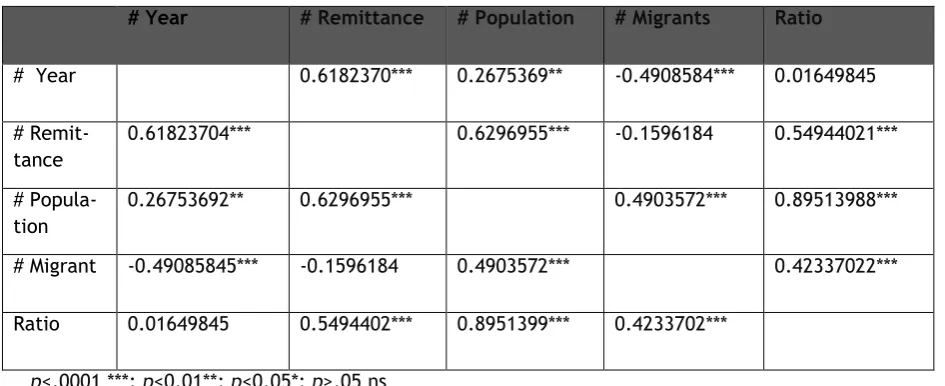
[image:10.595.53.526.561.754.2]Data analysis and model building are performed using R, which is a powerful tool for sta-tistical computing and graphical representation (R core team, 2016). In the first step, we present the calculated correlation (denoted by r) between the main variables in Table 4. Results show that we have multiple variables having significant correlation.
Table 4: The correlation matrix imputing the significance of key variables
# Year # Remittance # Population # Migrants Ratio
# Year 0.6182370*** 0.2675369** -0.4908584*** 0.01649845
# Remit-tance
0.61823704*** 0.6296955*** -0.1596184 0.54944021***
# Popula-tion
0.26753692** 0.6296955*** 0.4903572*** 0.89513988***
# Migrant -0.49085845*** -0.1596184 0.4903572*** 0.42337022***
Ratio 0.01649845 0.5494402*** 0.8951399*** 0.4233702***
It is observed that the remittance correlates positively with time (r = 0.61, p < .001) showing that remittance tends to increase over time. The size of the population of the country also has a similar positive correlation with remittance (r = 0.62, p < .001), indicating that more populated the country is, more remittance is being accumulated. Fi-nally, remittance and the ratio of the number of men and women in the immigrant popu-lation are also positively correlated (r = 0.54, p < .001), though not as strong as in earlier cases, showing that populations with equal number of women and men acquire more re-mittance. Results also show that immigrant populations negatively correlate with the year (r = -.49, a = < .001), stating that there is a decline in the number of immigrants from these countries in the world over the years.
In the second step, we applied the model illustrated in equation (1) using mgcv package in R (see Wood 2006; 2011). The variable used in the model explained approximately 85% of the data variance (measured by the R2 - coefficient of determination). Figure 2 shows the
[image:11.595.142.448.439.732.2]effect of remittance over the years in India and Pakistan. Results show that the Pakistan was sending more money back in the early 1970s and 1980s. Starting from 1990s, there is a slight decline of remittance in the case of Pakistan, while India had a constant increase of remittance during the 1970s and 1980s. For both countries, the remittance started in-creasing exponentially, where this increase of remittance came sooner for India than for Pakistan. That is, in the beginning of the 90s immigrants from India started sending more money back home, while this increase started around 2001 in the case of Pakistan. The figure shows, that remittance in the case of India has a larger increase than Pakistan, however, both countries have similar trend over time.
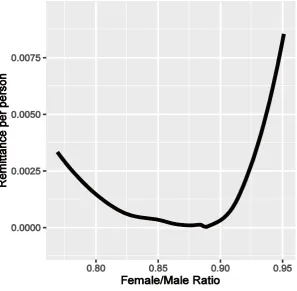
Figure 3 plots the effect of gender ratio on remittance. Lower values indicate more men compared with women in the population, while values closer to one indicate equal amount of men and women in the population. Results show that remittance function follows slightly U-shaped trend. The populations with predominantly male immigrant populations, in both countries, tend to send relatively more money back to their home countries; however, we can see by the shaded areas in the graph that the function here has more uncertainty. In other words, the first part of the function observes more variability in remittance. More interestingly, results show that the populations that are almost equal in the amount of men and women send the largest amount of money back home. This is indicated by the ratio that is close to one, meaning equal number of women and men, and at this part of the graph, we can see an increase of remittance being sent to the home country. Compared with the first part of the function, this part is less variable and better estimated.
Figure: 3 Remittance per person per gender ration from India and Pakistan together.
6. Discussion and Conclusion
migration is good for the immigrants and thousands of researchers found that immigrants are playing a very vital role in the host economies. India and Pakistan are two developing countries of South-East Asia. Both countries have a very vast experience of migration. Im-migrants from India and Pakistan are found in all continents, they are all types of immi-grants, highly qualified people, skilled workers and refugees. They are also playing an im-portant role as entrepreneurs. India is also one of the top students sending country world-wide.
People from India and Pakistan are moving from home countries because of low wages, poverty and political issues. They are well established having global diasporas. The immi-grants from Pakistan and India are linked with families residing in home countries and fre-quently send a considerable amount of money back to their families. This helps to improve financial positions, education improvement and health facilities of concerned families. Ac-cording to the statistics, India and Pakistan are two among the top ten countries receiving highest foreign remittance. This remittance is not only playing a role for households, but in the GDP of the both countries as well. In this study, we examined the remittance flow to both India and Pakistan. Before 1990, Pakistani immigrants sent more money to home country compared to India, but later the number of Pakistani immigrants went down. The reasons for that are not yet studied, but a rough guess would include reasons such as ter-rorism and international migration policies as well. On contrary to Pakistan, after 1990, Indian immigrants sent more money and are still on top. In this study, according to available data, we find some interesting results that the male and female immigrants from both countries in shape of equal numbers are sending more money, compared to more male migrants. In future studies that reason behind that will be thoroughly investigated and future research could be, comparing remittance consumption behaviour in home country of both Pakistani and Indian Diaspora.
References:
Adams, R. H. and A. Cuecuecha (2010). "Remittances, household expenditure and in-vestment in Guatemala." World Development Vol. 38, No. 11, pp. 1626-1641.
Adams, R. H. and A. Cuecuecha (2013). "The impact of remittances on investment and poverty in Ghana." World Development Vol. 50, pp. 24-40.
Aggarwal, Reena, Demirguc-Kunt, Asli and Martinez Peria, Maria Soledad (2006). “Do
Work-ers' Remittances Promote Financial Development?” World Bank Policy Research Working
Paper No. 3957. Available at SSRN: http://ssrn.com/abstract=923264
Anzoategui, D., Demirgüç-Kunt, A., & Pería, M. S. M. (2014). Remittances and financial inclusion: evidence from El Salvador. World bank Paper series: wps 5839.
Arif, G., M. (2009). Economic and social impacts of remittances on households: The case of Pakistani migrants working in Saudi Arabia. Pakistan Institute of Development Economics. Islamabad.
Bögenhold, D. (2013). Social Network Analysis and the Sociology of Economics: Filling a Blind Spot with the Idea of Social Embeddedness. The American Journal of Economics and Sociology, Vol. 72 No. 2, pp. 293-318.
Bögenhold, D. (2014). Migration. A. Scull, J. G. Golson (eds.). Cultural Sociology of Mental Illness. Vol. 1, pp. 535-537 CQ Press and /Sage, New York & London.
Borjas, G. J. (1990). Friends or strangers: the impact of immigrants on the US economy, Basic Books, New York.
Brzozowski, J. (2012). International migration and economic development. estudos avan-çados, Vol. 26, No. 75, pp. 137-156.
Burki, S.J. (2011a) South Asia in the New World Order: The Role of Regional Cooperation, Routledge, Abingdon.
Coleman, J. (1988) ‘Social capital in the creation of human capital’, The American Jou
r-nal of Sociology, Vol. 94, pp.95–120.
Dana, L.P. (1993) ‘towards a synthesis: a model of immigrant and ethnic entrepreneurship: case studies of business creation among immigrants in Montreal’, Journal of Small Business
and Entrepreneurship, Vol. 10, No. 4, pp.16–31.
Dana, L.P. (1997) ‘The origins of self-employment’, Canadian Journal of Administrative
Sciences, Vol. 14, No. 1, pp.99–104.
Dana, L.P. and Morris, M. (2007) ‘Towards a synthesis: a model of immigrant and ethnic
entrepreneurship’, in Dana, L.P. (Ed.): Handbook of Research on Ethnic Minority
Entrepre-neurship, p.803, Edward Elgar Publishing, Cheltenham.
De Haas, H. (2005) ‘International migration, remittances and development: myths and
facts’, Third World Quarterly, Vol. 26, No. 8, pp.1269–1284.
Faist, T. (2000) The Volume and Dynamics of International Migration and Transnational Social Spaces, Oxford University Press, Oxford.
Hamilton, R., Dana, L.P. and Benfell, C. (2008) ‘Changing cultures: an international study
of migrant entrepreneurs’, Journal of Enterprising Culture, Vol. 16, No. 1, pp.89–105.
Head, K. and Ries, J. (1998) ‘Immigration and trade creation: econometric evidence from
Canada’, Canadian Journal of Economics, Vol. 31, No. 1, pp.47–62.
Inal, G., Al Ariss, A. and Forson, C. (2012) ‘Self-employment as a career strategy for eth-nic minorities: the case of Turkish-Cypriots in Britain’, Journal of Management Develop-ment, Vol. 32, No. 2, pp.166–181.
Javid, M., Arif, U. and Qayyum, A. (2012) ‘Impact of remittances on economic growth and
poverty’, Academic Research International, Vol. 2, No. 1, pp.433–447.
Koning, J. and Verver, M. (2013) ‘Historicizing the ‘ethnic’ in ethnic entrepreneurship:
the case of the ethnic Chinese in Bangkok’, Entrepreneurship and Regional Development,
Vol. 25, Nos. 5–6, pp.325–348.
Kourtit, K. and Nijkamp, P. (2011) ‘Strategic choice analysis by expert panels for migra-tion impact assessment’, Internamigra-tional Journal of Business and Globalisamigra-tion, Vol. 7, No.
2, pp.166–194.
Lee, E.S. (1966) ‘A theory of migration’, Demography, Vol. 3, No. 1, pp.47–57.
León-Ledesma, M. and Piracha, M. (2004) ‘International migration and the role of
remit-tances in Eastern Europe’, International Migration, Vol. 42, No. 4, pp.65–83.
Lucas, R.E. and Stark, O. (1985) ‘Motivations to remit: evidence from Botswana’, The
Journal of Political Economy, Vol. 93, No. 5, pp.901–918.
Ma, Z., Zhao, S., Wang, T. and Lee, Y. (2012) ‘An overview of contemporary ethnic
entrepreneurship studies: themes and relationships’, International Journal of
Entrepre-neurial Behaviour and Research, Vol. 19, No. 1, pp.32–52.
Massey, D.S., Arango, J., Hugo, G., Kouaouci, A., Pellegrino, A. and Taylor, J.E. (1993)
‘Theories of international migration: a review and appraisal’, Population and
Develop-ment Review, Vol. 19, No. 3, pp.431–466.
Mavroudi, E. and Nagel, C. (2016) Global Migration: Patterns, Processes, and Politics, Routledge, London and New York.
McKenzie, D. and Sasin, M.J. (2007) Migration, Remittances, Poverty, and Human Capital: Conceptual and Empirical Challenges, Policy Research Working Paper 4272, The World Bank Washington, DC.
Migration Policy Institute (2016) International Migrants by Country of Destination, 1960– 2015 [online]
http://www.migrationpolicy.org/programs/data-hub/charts/international-migrantscoun-try-destination-1960 2015? width=1000&height=850&iframe=true (accessed 18.05.2017).
Nair, R.P. (2009) The Impacts of Gender and Remittance on Household’s Expenditure Pat-tern in Nepal, Unpublished Graduate Thesis, Graduate school of arts and science, Wash-ington, DC.
Non-resident Indians online since 1997 [online] http://www.nriol.com/indiandias-pora/statisticsindians- abroad.asp (accessed 18.05.2017).
Pempel, T.J. (2005) Remapping East Asia: The Construction of a Region, pp.1–10, Cornell University Press Ithaca and London.
Pio, E. and Dana, L.P. (2014) ‘An empirical study of Indian entrepreneurs in Christchurch,
New Zealand’, Int. J. Entrepreneurship and Small Business, Vol. 22, No. 1, pp.17–35.
Pradhan, G., Upadhyay, M. and Upadhyaya, K. (2008) ‘Remittances and economic growth
in developing countries’, The European Journal of Development Research, September,
Vol. 20, No. 3, pp.497–506.
Putnam, R.D., Leonardi, R. and Nanetti, R.Y. (1993) Making Democracy Work: Civic Tradi-tions in Modern Italy, Princeton University Press, Princeton.
Qayyum, A., Javid, M. and Arif, U. (2008) Impact of Remittances on Economic Growth and Poverty: Evidence from Pakistan, MPRA papers.
Rahman, M. (2009) ‘Contributions of exports, FDI, and expatriates’ remittances to real
GDP of Bangladesh, India, Pakistan, and Sri Lanka’, South Western Economic Review, Vol.
36, No. 1, pp.141–154.
Ramadani, V., Rexhepi, G., Gërguri-Rashiti, S., Ibraimi, S. and Dana, L.P. (2014) ‘Ethnic entrepreneurship in Macedonia: the case of Albanian entrepreneurs’, International Jour-nal of Entrepreneurship and Small Business, Vol. 23, No. 3, pp.313–335.
Stark, O. (2006) ‘Inequality and migration: a behavioural link’, Economics Letters, Vol.
91, No. 1, pp.146–152.
Stark, O. and Taylor, J.E. (1991) ‘Migration incentives, migration types: the role of
rela-tive deprivation’, The Economic Journal, Vol. 101, No. 408, pp.1163–1178.
United Nations (2016) ‘Department of economics and social affairs: population division’,
World Population Prospects 2015 revision [online] http://www.un.org/en/develop-ment/desa/population/events/other/10/index.shtml (accessed 18.05.2017).
Waldinger, R. (1989) ‘Immigration and urban change’, Annual Review of Sociology, Vol.
15, pp.211–232.
Wong, L. and Primecz, H. (2011) ‘Chinese migrant entrepreneurs in Budapest: changing
en-trepreneurial effects and forms’, Journal of Asia Business Studies, Vol. 5, No 1, pp.61–76.
Wood, S. (2006) Generalized Additive Models: an Introduction with R. CRC Press, Taylor and Francis group, USA.
Wood, S.N. (2011) ‘Fast stable restricted maximum likelihood and marginal likelihood
es-timation of semiparametric generalized linear models’, Journal of the Royal Statistical
Society: Series B (Statistical Methodology), Vol. 73, No. 1, pp.3–36.
World Bank (2016a) Migration and remittance data: Annual Remittances Data (updated as of October 2016) [online] https://www.worldbank.org/en/topic/migrationremittancesdi-asporaissues/brief/migration-remittances-data (accessed 18.05.2017).
World Bank (2016b) Migration and Factbook 2016 [online]
http://econ.worldbank.org/WBSITE/EXTERNAL/EXTDEC/EXTDECPROSPECTS/0,,content-MDK:21352016~pagePK:64165401~piPK:64165026~theSitePK:476883,00.html
(accessed 18.05.2017).