Deciphering Foreign Language by Combining Language Models and
Context Vectors
Malte Nuhn and Arne Mauser∗and Hermann Ney Human Language Technology and Pattern Recognition Group
RWTH Aachen University, Germany
<surname>@cs.rwth-aachen.de
Abstract
In this paper we show how to train statis-tical machine translation systems on real-life tasks using only non-parallel monolingual data from two languages. We present a mod-ification of the method shown in (Ravi and Knight, 2011) that is scalable to vocabulary sizes of several thousand words. On the task shown in (Ravi and Knight, 2011) we obtain better results with only 5% of the computa-tional effort when running our method with an n-gram language model. The efficiency improvement of our method allows us to run experiments with vocabulary sizes of around 5,000 words, such as a non-parallel version of the VERBMOBIL corpus. We also report re-sults using data from the monolingual French and English GIGAWORDcorpora.
1 Introduction
It has long been a vision of science fiction writers and scientists to be able to universally communi-cate in all languages. In these visions, even previ-ously unknown languages can be learned automati-cally from analyzing foreign language input.
In this work, we attempt to learn statistical trans-lation models from only monolingual data in the source and target language. The reasoning behind this idea is that the elements of languages share sta-tistical similarities that can be automatically identi-fied and matched with other languages.
This work is a big step towards large-scale and large-vocabulary unsupervised training of statistical translation models. Previous approaches have faced constraints in vocabulary or data size. We show how
∗
Author now at Google Inc.,[email protected].
to scale unsupervised training to real-life transla-tion tasks and how large-scale experiments can be done. Monolingual data is more readily available, if not abundant compared to true parallel or even just translated data. Learning from only monolin-gual data in real-life translation tasks could improve especially low resource language pairs where few or no parallel texts are available.
In addition to that, this approach offers the op-portunity to decipher new or unknown languages and derive translations based solely on the available monolingual data. While we do tackle the full unsu-pervised learning task for MT, we make some very basic assumptions about the languages we are deal-ing with:
1. We have large amounts of data available in source and target language. This is not a very strong assumption as books and text on the in-ternet are readily available for almost all lan-guages.
2. We can divide the given text in tokens and sentence-like units. This implies that we know enough about the language to tokenize and sentence-split a given text. Again, for the vast majority of languages, this is not a strong re-striction.
3. The writing system is one-dimensional left-to-right. It has been shown (Lin and Knight, 2006) that the writing direction can be determined separately and therefore this assumption does not pose a real restriction.
Previous approaches to unsupervised training for SMT prove feasible only for vocabulary sizes up to around 500 words (Ravi and Knight, 2011) and data
sets of roughly 15,000 sentences containing only about4 tokens per sentence on average. Real data as it occurs in texts such as web pages or news texts does not meet any of these characteristics.
In this work, we will develop, describe, and evaluate methods for large vocabulary unsupervised learning of machine translation models suitable for real-world tasks. The remainder of this paper is structured as follows: In Section 2, we will review the related work and describe how our approach ex-tends existing work. Section 3 describes the model and training criterion used in this work. The im-plementation and the training of this model is then described in Section 5 and experimentally evaluated in Section 6.
2 Related Work
Unsupervised training of statistical translations sys-tems without parallel data and related problems have been addressed before. In this section, we will re-view previous approaches and highlight similarities and differences to our work. Several steps have been made in this area, such as (Knight and Yamada, 1999), (Ravi and Knight, 2008), or (Snyder et al., 2010), to name just a few. The main difference of our work is, that it allows for much larger vocab-ulary sizes and more data to be used than previous work while at the same time not being dependent on seed lexica and/or any other knowledge of the lan-guages.
Close to the methods described in this work, Ravi and Knight (2011) treat training and transla-tion without parallel data as a deciphering prob-lem. Their best performing approach uses an EM-Algorithm to train a generative word based trans-lation model. They perform experiments on a Spanish/English task with vocabulary sizes of about 500 words and achieve a performance of around
20BLEUcompared to70 BLEUobtained by a sys-tem that was trained on parallel data. Our work uses the same training criterion and is based on the same generative story. However, we use a new training procedure whose critical parts have constant time and memory complexity with respect to the vocab-ulary size so that our methods can scale to much larger vocabulary sizes while also being faster.
In a different approach, Koehn and Knight (2002)
induce a bilingual lexicon from only non-parallel data. To achieve this they use a seed lexicon which they systematically extend by using orthographic as well as distributional features such as context, and frequency. They perform their experiments on non-parallel German-English news texts, and test their mappings against a bilingual lexicon. We use a greedy method similar to (Koehn and Knight, 2002) for extending a given lexicon, and we implicitly also use the frequency as a feature. However, we perform fully unsupervised training and do not start with a seed lexicon or use linguistic features.
Similarly, Haghighi et al. (2008) induce a one-to-one translation lexicon only from non-parallel monolingual data. Also starting with a seed lexi-con, they use a generative model based on canoni-cal correlation analysis to systematicanoni-cally extend the lexicon using context as well as spelling features. They evaluate their method on a variety of tasks, ranging from inherently parallel data (EUROPARL)
to unrelated corpora (100k sentences of the GIGA -WORDcorpus). They report F-measure scores of the induced entries between 30 to 70. As mentioned above, our work neither uses a seed lexicon nor or-thographic features.
3 Translation Model
In this section, we describe the statistical training criterion and the translation model that is trained us-ing monolus-ingual data. In addition to the mathemat-ical formulation of the model we describe approxi-mations used.
Throughout this work, we denote the source lan-guage words as f and target language words as e. The source vocabulary isVf and we write the size of this vocabulary as|Vf|. The same notation holds for the target vocabulary withVeand|Ve|.
As training criterion for the translation model’s parametersθ, Ravi and Knight (2011) suggest
arg max
θ
Y
f X
e
P(e)·pθ(f|e)
(1)
translation model that still contains all basic phe-nomena of a generic translation process. We formu-late the translation process with the same generative story presented in (Ravi and Knight, 2011):
1. Stochastically generate the target sentence ac-cording to ann-gram language model.
2. Insert NULLtokens between any two adjacent positions of the target string with uniform prob-ability.
3. For each target token ei (including NULL)
choose a foreign translation fi (including NULL) with probabilityPθ(fi|ei).
4. Locally reorder any two adjacent foreign words fi−1, fiwith probabilityP(SWAP) = 0.1. 5. Remove the remaining NULLtokens.
In practice, however, it is not feasible to deal with the full parameter tablePθ(fi|ei)which models the lexicon. Instead we only allow translation models where for eachsourcewordf the number of words e0 withP(f|e0)6= 0is below some fixed value. We will refer to this value as the maximum number of candidates of the translation model and denote it withNC. Note that for a givenethis does not nec-essarily restrict the number of entriesP(f0|e) 6= 0. Also note that with a fixed value of NC, time and memory complexity of the EM step isO(1)with re-spect to|Ve|and|Vf|.
In the following we divide the problem of maxi-mizing Equation 1 into two parts:
1. Determining a set of active lexicon entries.
2. Choosing the translation probabilities for the given set of active lexicon entries.
The second task can be achieved by running the EM algorithm on the restricted translation model. We deal with the first task in the following section.
4 Monolingual Context Similarity
As described in Section 3 we need some mecha-nism to iteratively choose an active set of translation candidates. Based on the assumption that some of the active candidates and their respective probabili-ties are already correct, we induce new active candi-dates. In the context of information retrieval, Salton et al. (1975) introduce a document space where each
document identified by one or more index terms is represented by a high dimensional vector of term weights. Given two vectors v1 and v2 of two
doc-uments it is then possible to calculate a similarity coefficient between those given documents (which is usually denoted ass(v1, v2)). Similar to this we
represent source and target words in a high dimen-sional vector space of target word weights which we call context vectorsand use a similarity coefficient to find possible translation pairs. We first initialize these context vectors using the following procedure:
1. Using only the monolingual data for the target language, prepare the context vectorsvei with
entriesvei,ej:
(a) Initialize allvei,ej = 0
(b) For each target sentenceE: For each wordeiinE:
For each wordej 6=eiinE: vei,ej =vei,ej + 1.
(c) Normalize each vector vei such that P
ej
(vei,ej)2 != 1holds.
Using the notationei = ej :vei,ej, . . . these vectors might for example look like
work= (early: 0.2, late: 0.1, . . .)
time= (early: 0.2, late: 0.2, . . .).
2. Prepare context vectors vfi,ej for the source language using only the monolingual data for the source language and the translation model’s current parameter estimateθ:
(a) Initialize allvfi,ej = 0
(b) Let E˜θ(F) denote the most probable translation of the foreign sentence F ob-tained by using the current estimateθ. (c) For each source sentenceF:
For each wordfiinF:
For each word ej 6= Eθ(fi)1 in Eθ(F):
vfi,ej =vfi,ej+ 1
(d) Normalize each vector vfi such that
P
ej
(vfi,ej)2 != 1holds.
1
Adapting the notation described above, these vectors might for example look like
Arbeit= (early: 0.25, late: 0.05, . . .)
Zeit= (early: 0.15, late: 0.25, . . .)
Once we have set up the context vectors ve and vf, we can retrieve translation candidates for some source wordf by finding those wordse0 that maxi-mize the similarity coefficients(ve0, vf), as well as
candidates for a given target wordeby finding those wordsf0that maximizes(ve, vf0). In our
implemen-tation we use the Euclidean distance
d(ve, vf) =||ve−vf||2. (2)
asdistancemeasure.2 The normalization of context vectors described above is motivated by the fact that the context vectors should be invariant with respect to the absolute number of occurrences of words.3
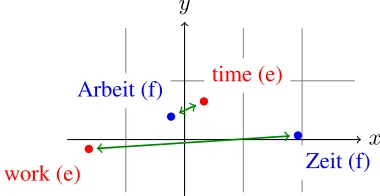
Instead of just finding the best candidates for a given word, we are interested in an assignment that involves all source and target words, minimizing the sum of distances between the assigned words. In case of a one-to-one mapping the problem of assign-ing translation candidates such that the sum of dis-tances is minimal can be solved optimally in poly-nomial time using thehungarian algorithm(Kuhn, 1955). In our case we are dealing with a many-to-many assignment that needs to satisfy the max-imum number of candidates constraints. For this, we solve the problem in a greedy fashion by simply choosing the best pairs(e, f)first. As soon as a tar-get word eor source wordf has reached the limit of maximum candidates, we skip all further candi-dates for that worde(orf respectively). This step involves calculating and sorting all |Ve| · |Vf| dis-tances which can be done in timeO(V2·log(V)), withV = max(|Ve|,|Vf|). A simplified example of this procedure is depicted in Figure 1. The example already shows that the assignment obtained by this algorithm is in general not optimal.
2We then obtain pairs(e, f)thatminimized. 3
This gives the same similarity ordering as using un-normalized vectors with the cosine similarity measure
ve·vf
||ve||2·||vf||2 which can be interpreted as measuring the cosine of the angle between the vectors, see (Manning et al., 2008). Still it is noteworthy that this procedure is not equivalent to the tf-IDFcontext vectors described in (Salton et al., 1975).
x y
time (e)
Arbeit (f)
[image:4.612.329.519.62.160.2]work (e) Zeit (f)
Figure 1: Hypothetical example for a greedy one-to-one assignment of translation candidates. The optimal assign-ment would contain (time,Zeit) and (work,Arbeit).
5 Training Algorithm and Implementation
Given the model presented in Section 3 and the methods illustrated in Section 4, we now describe how to train this model.
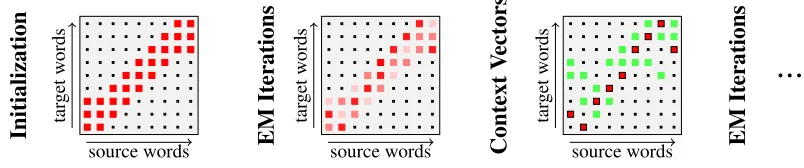
As described in Section 4, the overall procedure is divided into two alternating steps: After initializa-tion we first perform EM training of the translainitializa-tion model for20-30iterations using a2-gram or3-gram language model in the target language. With the ob-tained best translations we induce new translation candidates using context similarity. This procedure is depicted in Figure 2.
5.1 Initialization
LetNC be the maximum number of candidates per source word we allow,VeandVf be the target/source vocabulary andr(e)andr(f)the frequency rank of a source/target word. Each wordf ∈ Vf with fre-quency rank r(f) is assigned to all words e ∈ Ve with frequency rank
r(e)∈[ start(f),end(f) ] (3)
where
start(f) = max(0,min |Ve| −Nc,
|Ve|
|Vf|
·r(f)−Nc 2
)
(4)
end(f) = min (start(f) +Nc,|Ve|). (5)
This defines a diagonal beam4 when visualizing the lexicon entries in a matrix where both source and target words are sorted by their frequency rank. However, note that the result of sorting by frequency
4The diagonal has some artifacts for the highest and lowest
Initialization tar
get
w
ords
source words EM
Iterations
tar
get
w
ords
source words Context
V
ectors
tar
get
w
ords
source words EM
Iterations
[image:5.612.111.513.64.148.2]. . .
Figure 2: Visualization of the training procedure. The big rectangles represent word lexica in different stages of the training procedure. The small rectangles represent word pairs(e, f)for whicheis a translation candidate off, while dots represent word pairs(e, f)for which this is not the case. Source and target words are sorted by frequency so that the most frequent source words appear on the very left, and the most frequent target words appear at the very bottom.
and thus the frequency ranks are not unique when there are words with the same frequency. In this case, we initially obtain some not further specified frequency ordering, which is then kept throughout the procedure.
This initialization proves useful as we show by taking an IBM1 lexicon P(f|e) extracted on the parallel VERBMOBILcorpus (Wahlster, 2000): For each wordewe calculate the weighted rank differ-ence
∆ravg(e) =X
f
P(f|e)· |(r(e)−r(f)| (6)
and count how many of those weighted rank dif-ferences are smaller than a given value NC
2 . Here
we see that for about1%of the words the weighted rank difference lies withinNC = 50, and even about
3%forNC = 150respectively. This shows that the initialization provides a first solid guess of possible translations.
5.2 EM Algorithm
The generative story described in Section 3 is im-plemented as a cascade of a permutation, insertion, lexicon, deletion and language model finite state transducers using OpenFST (Allauzen et al., 2007). Our FST representation of the LM makes use of failure transitions as described in (Allauzen et al., 2003). We use the forward-backward algorithm on the composed transducers to efficiently train the lex-icon model using the EM algorithm.
5.3 Context Vector Step
Given the trained parametersθfrom the previous run of the EM algorithm we set the context vectorsve
andvf up as described in Section 4. We then calcu-late and sort all|Ve|·|Vf|distances which proves fea-sible in a few CPU hours even for vocabulary sizes of more than 50,000 words. This is achieved with the GNUSORTtool, which uses external sorting for
sorting large amounts of data.
To set up the new lexicon we keep the bNC 2 c
best translations for each source word with respect toP(e|f), which we obtained in the previous EM run. Experiments showed that it is helpful to also limit the number of candidates per target words. We therefore prune the resulting lexicon using P(f|e)
to a maximum ofbNC0
2 ccandidates per target word
afterwards. Then we fill the lexicon with new can-didates using the previously sorted list of candidate pairs such that the final lexicon has at most NC candidates per source word and at most NC0 can-didates per target word. We setNC0 to some value NC0 > NC. All experiments in this work were run withNC0 = 300. Values ofNC0 ≈NC seem to pro-duce poorer results. Not limiting the number of can-didates per target word at all also typically results in weaker performance. After the lexicon is filled with candidates, we initialize the probabilities to be uni-form. With this new lexicon the process is iterated starting with the EM training.
6 Experimental Evaluation
Name Lang. Sent. Words Voc.
OPUS Spanish 13,181 39,185 562
English 19,770 61,835 411
VERBMOBIL German 27,861 282,831 5,964
English 27,862 294,902 3,723
GIGAWORD French 100,000 1,725,993 68,259
English 100,000 1,788,025 64,621
Table 1: Statistics of the corpora used in this paper.
being approximately15to20times faster than their n-gram based approach.
After that we apply our method to a non-parallel version of the German/English VERBMOBILcorpus,
which has a vocabulary size of 6,000 words on the German side, and 3,500 words on the target side and which thereby is approximately one order of magni-tude larger than the previous OPUSexperiment.
We finally run our system on a subset of the non-parallel French/English GIGAWORD corpus, which has a vocabulary size of 60,000 words for both French and English. We show first interesting re-sults on such a big task.
In case of the OPUS and VERBMOBIL corpus, we evaluate the results using BLEU(Papineni et al., 2002) and TER (Snover et al., 2006) to reference translations. We report all scores in percent. For BLEUhigher values are better, for TER lower
val-ues are better. We also compare the results on these corpora to a system trained on parallel data.
In case of the GIGAWORD corpus we show
lexi-con entries obtained during training.
6.1 OPUSSubtitle Corpus
6.1.1 Experimental Setup
We apply our method to the corpus described in Table 6. This exact corpus was also used in (Ravi and Knight, 2011). The best performing methods in (Ravi and Knight, 2011) use the full411×579
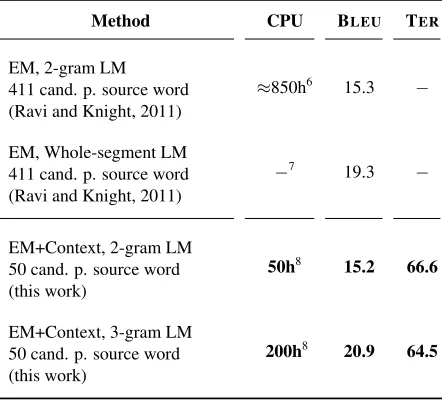
lexicon model and apply standard EM training. Us-ing a2-gram LM they obtain 15.3 BLEU and with a whole segment LM, they achieve19.3 BLEU. In comparison to this baseline we run our algorithm withNC = 50candidates per source word for both, a2-gram and a3-gram LM. We use30EM iterations
between each context vector step. For both cases we run7EM+Context cycles.
[image:6.612.75.297.60.179.2]6.1.2 Results
Figure 3 and Figure 4 show the evolution of BLEU
and TERscores for applying our method using a2
-gram and a3-gram LM.
In case of the2-gram LM (Figure 3) the transla-tion quality increases until it reaches a plateau after
5 EM+Context cycles. In case of the 3-gram LM (Figure 4) the statement only holds with respect to TER. It is notable that during the first iterations TER
only improves very little until a large chunk of the language unravels after the third iteration. This be-havior may be caused by the fact that the corpus only provides a relatively small amount of context infor-mation for each word, since sentence lengths are3-4
words on average.
0 1 2 3 4 5 6 7 8 8
10 12 14
16 Full EM best (BLEU)
Iteration
B
L
E
U
66 68 70 72 74 76 78 80
T
E
R
BLEU
[image:6.612.317.536.315.475.2]TER
Figure 3: Results on the OPUScorpus with a2-gram LM,
NC = 50, and30EM iterations between each context
vector step. The dashed line shows the best result using a 2-gram LM in (Ravi and Knight, 2011).
Table 2 summarizes these results and compares them with (Ravi and Knight, 2011). Our 3-gram based method performs by 1.6 BLEU better than their best system which is a statistically significant improvement at95%confidence level. Furthermore, Table 2 compares the CPU time needed for training. Our3-gram based method is15-20times faster than running the EM based training procedure presented in (Ravi and Knight, 2011) with a3-gram LM5.
5(Ravi and Knight, 2011) only report results using a2-gram
0 1 2 3 4 5 6 7 8 8
10 12 14 16 18 20 22 24
Full EM best (BLEU)
Iteration
B
L
E
U
64 66 68 70 72
T
E
R
BLEU
TER
Figure 4: Results on the OPUScorpus with a3-gram LM,
NC = 50, and30EM iterations between each context
vector step. The dashed line shows the best result using a whole-segment LM in (Ravi and Knight, 2011)
Method CPU BLEU TER
EM, 2-gram LM 411 cand. p. source word (Ravi and Knight, 2011)
≈850h6 15.3 −
EM, Whole-segment LM 411 cand. p. source word (Ravi and Knight, 2011)
−7
19.3 −
EM+Context, 2-gram LM 50 cand. p. source word (this work)
50h8 15.2 66.6
EM+Context, 3-gram LM 50 cand. p. source word (this work)
[image:7.612.78.296.56.214.2]200h8 20.9 64.5
Table 2: Results obtained on the OPUScorpus.
To summarize: Our method is significantly faster thann-gram LM based approaches and obtains bet-ter results than any previously published method.
6Estimated by running full EM using the2-gram LM using
our implementation for90Iterations yielding15.2BLEU.
7≈
4,000h when running full EM using a3-gram LM, using our implementation. Estimated by running only the first itera-tion and by assuming that the final result will be obtained after 90iterations. However, (Ravi and Knight, 2011) report results using a whole segment LM, assigningP(e) > 0only to se-quences seen in training. This seems to work for the given task but we believe that it can not be a general replacement for higher ordern-gram LMs.
8
Estimated by running our method for5×30iterations.
6.2 VERBMOBILCorpus
6.2.1 Experimental Setup
The VERBMOBIL corpus is a German/English corpus dealing with short sentences for making ap-pointments. We prepared a non-parallel subset of the original VERBMOBIL(Wahlster, 2000) by split-ting the corpus into two parts and then selecsplit-ting only the German side from the first half, and the English side from the second half such that the target side is not the translation of the source side. The source and target vocabularies of the resulting non-parallel corpus are both more than9times bigger compared to the OPUS vocabularies. Also the total amount of word tokens is more than5 times larger compared to the OPUScorpus. Table 6 shows the statistics of this corpus. We run our method for5EM+Context cycles (30 EM iterations each) using a2-gram LM. After that we run another five EM+Context cycles using a3-gram LM.
6.2.2 Results
Our results on the VERBMOBILcorpus are sum-marized in Table 3. Even on this more complex task our method achieves encouraging results: The
Method BLEU TER
5×30Iterations EM+Context
50 cand. p. source word,2-gram LM 11.7 67.4
+5×30Iterations EM+Context
50 cand. p. source word,3-gram LM 15.5 63.2
Table 3: Results obtained on the VERBMOBILcorpus.
translation quality increases from iteration to itera-tion until the algorithm finally reaches 11.7 BLEU
using only the 2-gram LM. Running further five cycles using a 3-gram LM achieves a final perfor-mance of15.5BLEU. Och (2002) reports results of
48.2 BLEUfor a single-word based translation sys-tem and 56.1 BLEU using the alignment template approach, both trained on parallel data. However, it should be noted that our experiment only uses50%
[image:7.612.76.297.289.489.2]Iter. e p(f1|e) f1 p(f2|e) f2 p(f3|e) f3 p(f4|e) f4 p(f5|e) f5
1. the 0.43 la 0.31 l’ 0.11 une 0.04 le 0.04 les
2. several 0.57 plusieurs 0.21 les 0.09 des 0.03 nombreuses 0.02 deux
3. where 0.63 o`u 0.17 mais 0.06 indique 0.04 pr´ecise 0.02 appelle
4. see 0.49 ´eviter 0.09 effet 0.09 voir 0.05 envisager 0.04 dire
5. January 0.25 octobre 0.22 mars 0.09 juillet 0.07 aoˆut 0.07 janvier
− Germany 0.24 Italie 0.12 Espagne 0.06 Japon 0.05 retour 0.05 Suisse
Table 4: Lexicon entries obtained by running our method on the non-parallel GIGAWORD corpus. The first column shows in which iteration the algorithm found the first correct translationsf (compared to a parallely trained lexicon) among the top 5 candidates
6.3 GIGAWORD
6.3.1 Experimental Setup
This setup is based on a subset of the monolingual GIGAWORD corpus. We selected 100,000 French
sentences from the news agencyAFP and 100,000 sentences from the news agencyXinhua. To have a more reliable set of training instances, we selected only sentences with more than7tokens. Note that these corpora form true non-parallel data which, be-sides the length filtering, were not specifically pre-selected or pre-processed. More details on these non-parallel corpora are summarized in Table 6. The vocabularies have a size of approximately 60,000 words which is more than 100 times larger than the vocabularies of the OPUS corpus. Also it incor-porates more than25 times as many tokens as the OPUScorpus.
After initialization, we run our method with NC = 150 candidates per source word for20 EM iterations using a2-gram LM. After the first context vector step withNC = 50 we run another 4×20
iterations withNC = 50with a2-gram LM.
6.3.2 Results
Table 4 shows example lexicon entries we ob-tained. Note that we obtained these results by us-ing purely non-parallel data, and that we neither used a seed lexicon, nor orthographic features to as-sign e.g. numbers or proper names: All results are obtained using 2-gram statistics and the context of words only. We find the results encouraging and think that they show the potential of large-scale un-supervised techniques for MT in the future.
7 Conclusion
We presented a method for learning statistical ma-chine translation models from non-parallel data. The key to our method lies in limiting the translation model to a limited set of translation candidates and then using the EM algorithm to learn the probabil-ities. Based on the translations obtained with this model we obtain new translation candidates using a context vector approach. This method increased the training speed by a factor of 10-20 compared to methods known in literature and also resulted in a 1.6 BLEU point increase compared to previ-ous approaches. Due to this efficiency improvement we were able to tackle larger tasks, such as a non-parallel version of the VERBMOBIL corpus having a nearly10 times larger vocabulary. We also had a look at first results of our method on an even larger Task, incorporating a vocabulary of 60,000 words. We have shown that, using a limited set of trans-lation candidates, we can significantly reduce the computational complexity of the learning task. This work serves as a big step towards large-scale unsu-pervised training for statistical machine translation systems.
Acknowledgements
References
Cyril Allauzen, Mehryar Mohri, and Brian Roark. 2003. Generalized algorithms for constructing sta-tistical language models. InProceedings of the 41st Annual Meeting on Association for Computational Linguistics-Volume 1, pages 40–47. Association for Computational Linguistics.
Cyril Allauzen, Michael Riley, Johan Schalkwyk, Woj-ciech Skut, and Mehryar Mohri. 2007. Openfst: A general and efficient weighted finite-state transducer library. In Jan Holub and Jan Zd´arek, editors,CIAA, volume 4783 ofLecture Notes in Computer Science, pages 11–23. Springer.
Arthur P. Dempster, Nan M. Laird, and Donald B. Ru-bin. 1977. Maximum likelihood from incomplete data via the EM algorithm.Journal of the Royal Statistical Society, B, 39.
Aria Haghighi, Percy Liang, T Berg-Kirkpatrick, and Dan Klein. 2008. Learning Bilingual Lexicons from Monolingual Corpora. InProceedings of ACL08 HLT, pages 771–779. Association for Computational Lin-guistics.
Kevin Knight and Kenji Yamada. 1999. A computa-tional approach to deciphering unknown scripts. In
ACL Workshop on Unsupervised Learning in Natural Language Processing, number 1, pages 37–44. Cite-seer.
Philipp Koehn and Kevin Knight. 2002. Learning a translation lexicon from monolingual corpora. In Pro-ceedings of the ACL02 workshop on Unsupervised lex-ical acquisition, number July, pages 9–16. Association for Computational Linguistics.
Harold W. Kuhn. 1955. The Hungarian method for the assignment problem. Naval Research Logistic Quar-terly, 2:83–97.
Shou-de Lin and Kevin Knight. 2006. Discovering the linear writing order of a two-dimensional ancient hieroglyphic script. Artificial Intelligence, 170:409– 421, April.
Christopher D. Manning, Prabhakar Raghavan, and Hin-rich Schuetze. 2008. Introduction to Information Re-trieval. Cambridge University Press, 1 edition, July. Franz J. Och. 2002. Statistical Machine Translation:
From Single-Word Models to Alignment Templates. Ph.D. thesis, RWTH Aachen University, Aachen, Ger-many, October.
Kishore Papineni, Salim Roukos, Todd Ward, and Wei-Jing Zhu. 2002. Bleu: a method for automatic eval-uation of machine translation. InProceedings of the 40th Annual Meeting on Association for Computa-tional Linguistics, ACL ’02, pages 311–318, Strouds-burg, PA, USA. Association for Computational Lin-guistics.
Sujith Ravi and Kevin Knight. 2008. Attacking decipher-ment problems optimally with low-order n-gram mod-els. In Proceedings of the Conference on Empirical Methods in Natural Language Processing, EMNLP ’08, pages 812–819, Stroudsburg, PA, USA. Associ-ation for ComputAssoci-ational Linguistics.
Sujith Ravi and Kevin Knight. 2011. Deciphering for-eign language. In Proceedings of the 49th Annual Meeting of the Association for Computational Linguis-tics: Human Language Technologies, pages 12–21, Portland, Oregon, USA, June. Association for Com-putational Linguistics.
Gerard M. Salton, Andrew K. C. Wong, and Chang S. Yang. 1975. A vector space model for automatic in-dexing.Commun. ACM, 18(11):613–620, November. Matthew Snover, Bonnie Dorr, Richard Schwartz,
Lin-nea Micciulla, and John Makhoul. 2006. A Study of Translation Edit Rate with Targeted Human Anno-tation. InProceedings of the 7th Conference of the Association for Machine Translation in the Americas, pages 223–231, Cambridge, Massachusetts, USA, Au-gust.
Benjamin Snyder, Regina Barzilay, and Kevin Knight. 2010. A statistical model for lost language decipher-ment. In48th Annual Meeting of the Association for Computational Linguistics, number July, pages 1048– 1057.
J¨org Tiedemann. 2009. News from OPUS - A collec-tion of multilingual parallel corpora with tools and in-terfaces. In N. Nicolov, K. Bontcheva, G. Angelova, and R. Mitkov, editors, Recent Advances in Natural Language Processing, volume V, pages 237–248. John Benjamins, Amsterdam/Philadelphia, Borovets, Bul-garia.