Head-driven Transition-based Parsing with Top-down Prediction
Katsuhiko Hayashi†, Taro Watanabe‡, Masayuki Asahara§, Yuji Matsumoto† †Nara Institute of Science and Technology
Ikoma, Nara, 630-0192, Japan
‡National Institute of Information and Communications Technology
Sorakugun, Kyoto, 619-0289, Japan
§National Institute for Japanese Language and Linguistics
Tachikawa, Tokyo, 190-8561, Japan
[email protected], [email protected] [email protected], [email protected]
Abstract
This paper presents a novel top-down head-driven parsing algorithm for data-head-driven pro-jective dependency analysis. This algorithm handles global structures, such as clause and coordination, better than shift-reduce or other bottom-up algorithms. Experiments on the English Penn Treebank data and the Chinese CoNLL-06 data show that the proposed algo-rithm achieves comparable results with other data-driven dependency parsing algorithms.
1 Introduction
Transition-based parsing algorithms, such as shift-reduce algorithms (Nivre, 2004; Zhang and Clark, 2008), are widely used for dependency analysis be-cause of the efficiency and comparatively good per-formance. However, these parsers have one major problem that they can handle only local information. Isozaki et al. (2004) pointed out that the drawbacks of shift-reduce parser could be resolved by incorpo-rating top-down information such as root finding.
This work presents an O(n2) top-down head-driven transition-based parsing algorithm which can parse complex structures that are not trivial for shift-reduce parsers. The deductive system is very similar to Earley parsing (Earley, 1970). The Earley predic-tion is tied to a particular grammar rule, but the pro-posed algorithm is data-driven, following the current trends of dependency parsing (Nivre, 2006; McDon-ald and Pereira, 2006; Koo et al., 2010). To do the prediction without any grammar rules, we introduce a weighted prediction that is to predict lower nodes from higher nodes with a statistical model.
To improve parsing flexibility in deterministic parsing, our top-down parser uses beam search al-gorithm with dynamic programming (Huang and Sagae, 2010). The complexity becomesO(n2 ∗b)
wherebis the beam size. To reduce prediction er-rors, we propose a lookahead technique based on a FIRST function, inspired by the LL(1) parser (Aho and Ullman, 1972). Experimental results show that the proposed top-down parser achieves competitive results with other data-driven parsing algorithms.
2 Definition of Dependency Graph
A dependency graph is defined as follows.
Definition 2.1 (Dependency Graph) Given an in-put sentence W = n0. . .nn where n0 is a spe-cial root node $, a directed graph is defined as
GW = (VW, AW) whereVW = {0,1, . . . , n}is a set of (indices of) nodes andAW ⊆VW ×VW is a
set of directed arcs. The set of arcs is a set of pairs (x, y)wherexis a head andyis a dependent ofx.
x→∗ldenotes a path fromxtol. A directed graph
GW = (VW, AW)iswell-formedif and only if:
• There is no nodexsuch that(x,0)∈AW.
• If(x, y) ∈ AW then there is no nodex′ such that(x′, y)∈AW andx′ ̸=x.
• There is no subset of arcs{(x0, x1),(x1, x2), . . . ,(xl−1, xl)} ⊆AW such thatx0=xl.
These conditions are refered toROOT, SINGLE-HEAD, and ACYCLICITY, and we call an well-formeddirected graph as adependency graph.
Definition 2.2 (PROJECTIVITY) A dependency graphGW = (VW, AW)isprojectiveif and only if,
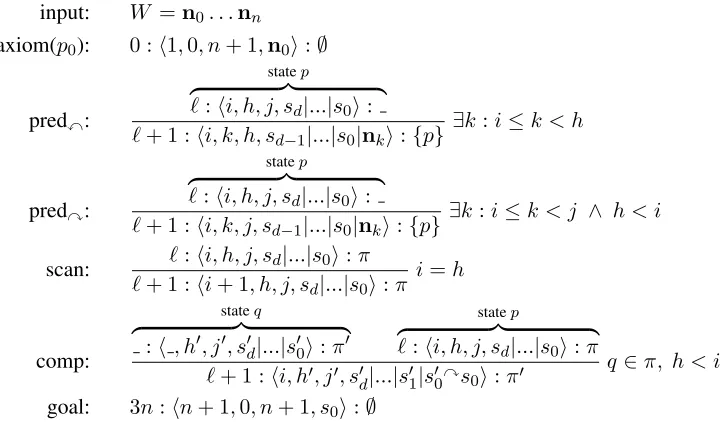
input: W =n0. . .nn
axiom(p0): 0 :⟨1,0, n+ 1,n0⟩:∅
predx:
statep
z }| {
ℓ:⟨i, h, j, sd|...|s0⟩:
ℓ+ 1 :⟨i, k, h, sd−1|...|s0|nk⟩:{p} ∃
k:i≤k < h
predy:
statep
z }| {
ℓ:⟨i, h, j, sd|...|s0⟩:
ℓ+ 1 :⟨i, k, j, sd−1|...|s0|nk⟩:{p} ∃k :i≤k < j ∧ h < i
scan: ℓ:⟨i, h, j, sd|...|s0⟩:π
ℓ+ 1 :⟨i+ 1, h, j, sd|...|s0⟩:π i=h
comp:
stateq
z }| {
:⟨ , h′, j′, s′d|...|s′0⟩:π′
statep
z }| {
ℓ:⟨i, h, j, sd|...|s0⟩:π
ℓ+ 1 :⟨i, h′, j′, s′d|...|s1′|s′0ys0⟩:π′ q∈π, h < i
[image:2.612.127.491.73.284.2]goal: 3n:⟨n+ 1,0, n+ 1, s0⟩:∅
Figure 1: The non-weighted deductive system of top-down dependency parsing algorithm: means “take anything”.
for every arc(x, y)∈AW and nodelinx < l < y
ory < l < x, there is a pathx→∗lory→∗ l.
The proposed algorithm in this paper is for projec-tive dependency graphs. If a projecprojec-tive dependency graph is connected, we call it a dependency tree, and if not, adependency forest.
3 Top-down Parsing Algorithm
Our proposed algorithm is a transition-based algo-rithm, which uses stack and queue data structures. This algorithm formally uses the following state:
ℓ:⟨i, h, j, S⟩:π
whereℓis a step size,S is a stack of treessd|...|s0
wheres0 is a top tree and d is a window size for
feature extraction,iis an index of node on the top of the input node queue,his an index of root node ofs0, j is an index to indicate the right limit (j −
1inclusive) of predy, andπ is a set of pointers to
predictor states, which are states just before putting the node inhonto stackS. In the deterministic case,
πis a singleton set except for the initial state. This algorithm has four actions, predictx(predx), predicty(predy), scan and complete(comp). The deductive system of the top-down algorithm is shown in Figure 1. The initial statep0is a state ini-tialized by an artificial root noden0. This algorithm
applies one action to each state selected from appli-cable actions in each step. Each of three kinds of actions, pred, scan, and comp, occursntimes, and this system takes3nsteps for a complete analysis.
Action predxputsnkonto stackSselected from the input queue in the range, i ≤ k < h, which is to the left of the rootnhin the stack top. Similarly,
action predy puts a node nk onto stack S selected
from the input queue in the range,h < i≤ k < j, which is to the right of the rootnh in the stack top.
The nodenion the top of the queue is scanned if it
is equal to the root nodenhin the stack top. Action comp creates a directed arc(h′, h)from the rooth′
ofs′0 on a predictor stateq to the root hofs0 on a current statepifh < i1.
The precondition i < hof action predx means that the input nodes in i ≤ k < hhave not been predicted yet. Predx, scan and predy do not con-flict with each other since their preconditionsi < h,
i = h and h < i do not hold at the same time. However, this algorithm faces a predy-comp con-flict because both actions share the same precondi-tion h < i, which means that the input nodes in 1 ≤k ≤ hhave been predicted and scanned. This
1
In a single root tree, the special root symbol$0has exactly
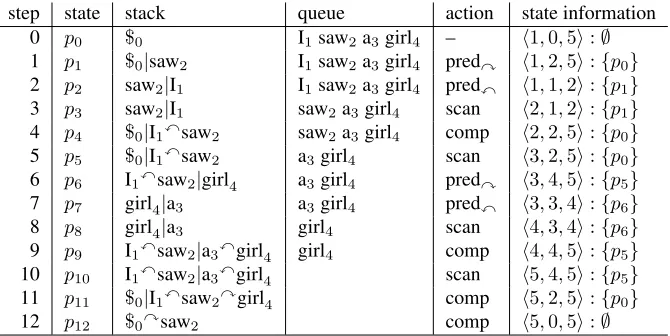
step state stack queue action state information 0 p0 $0 I1saw2a3girl4 – ⟨1,0,5⟩:∅ 1 p1 $0|saw2 I1saw2a3girl4 predy ⟨1,2,5⟩:{p0} 2 p2 saw2|I1 I1saw2a3girl4 predx ⟨1,1,2⟩:{p1} 3 p3 saw2|I1 saw2a3girl4 scan ⟨2,1,2⟩:{p1} 4 p4 $0|I1xsaw2 saw2a3girl4 comp ⟨2,2,5⟩:{p0} 5 p5 $0|I1xsaw2 a3girl4 scan ⟨3,2,5⟩:{p0} 6 p6 I1xsaw2|girl4 a3girl4 predy ⟨3,4,5⟩:{p5} 7 p7 girl4|a3 a3girl4 predx ⟨3,3,4⟩:{p6}
[image:3.612.140.475.57.225.2]8 p8 girl4|a3 girl4 scan ⟨4,3,4⟩:{p6} 9 p9 I1xsaw2|a3xgirl4 girl4 comp ⟨4,4,5⟩:{p5} 10 p10 I1xsaw2|a3xgirl4 scan ⟨5,4,5⟩:{p5} 11 p11 $0|I1xsaw2ygirl4 comp ⟨5,2,5⟩:{p0} 12 p12 $0ysaw2 comp ⟨5,0,5⟩:∅
Figure 2: Stages of the top-down deterministic parsing process for a sentence “I saw a girl”. We follow a convention and write the stack with its topmost element to the right, and the queue with its first element to the left. In this example, we set the window sizedto1, and write the descendants of trees on stack elementss0ands1within depth1.
parser constructs left and right children of a head node in a left-to-right direction by scanning the head node prior to its right children. Figure 2 shows an example for parsing a sentence “I saw a girl”.
4 Correctness
To prove the correctness of the system in Figure 1 for theprojectivedependency graph, we use the proof strategy of (Nivre, 2008a). The correct deduc-tive system is bothsoundandcomplete.
Theorem 4.1 The deductive system in Figure 1 is correct for the class of dependency forest.
Proof 4.1 To show soundness, we show thatGp0 =
(VW,∅), which is a directed graph defined by the
axiom, is well-formed and projective, and that every transition preserves this property.
• ROOT: The node 0is a root in Gp0, and the
node0is on the top of stack ofp0. The two pred
actions put a word onto the top of stack, and predict an arc from root or its descendant to the child. The comp actions add the predicted arcs which include no arc of(x,0).
• SINGLE-HEAD: Gp0 is single-head. A node
yis no longer in stack and queue after a comp action creates an arc(x, y). The nodeycannot make any arc(x′, y)after the removal.
• ACYCLICITY:Gp0 is acyclic. A cycle is cre-ated only if an arc(x, y)is added when there is a directed pathy →∗ x. The nodex is no
longer in stack and queue when the directed pathy→∗xwas made by adding an arc(l, x). There is no chance to add the arc(x, y)on the directed pathy→∗x.
• PROJECTIVITY: Gp0 is projective. Projec-tivity is violated by adding an arc(x, y)when there is a node linx < l < y ory < l < x
with the path to or from the outside of the span
x andy. When predy creates an arc relation fromxtoy, the nodeycannot be scanned be-fore all nodeslinx < l < yare scanned and completed. When predx creates an arc rela-tion fromxtoy, the nodeycannot be scanned before all nodesk ink < y are scanned and completed, and the nodex cannot be scanned before all nodes lin y < l < xare scanned and completed. In those processes, the nodel
inx < l < yor y < l < xdoes not make a path to or from the outside of the spanxandy, and a pathx→∗ lory→∗lis created.2
To show completeness, we show that for any sen-tenceW, and dependency forestGW = (VW, AW), there is a transition sequenceC0,msuch thatGpm =
GW by an inductive method.
• If |W| = 1, the projective dependency graph forW isGW = ({0},∅)andGp0 =GW.
• Assume that the claim holds for sentences with length less or equal to t, and assume that
.
. . . s2.h
. . . . . . . . .. ... . . . . s1.h
. . . . . . . . . . .. . . . . . ... . . . . . s1.l
. . . ... . . . . .. . . . . . ... . . . . . s1.r
. . . ... . . . . . . s0.h
. . . . . . . . . . .. . . . . . ... . . . . . s0.l
. . . ... . . . . .. . . . . . ... . . . . . s0.r
[image:4.612.79.294.54.130.2]. . . ... . .
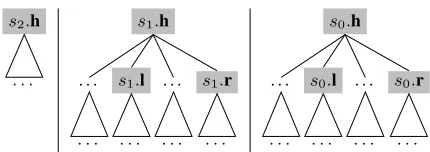
Figure 3: Feature window of trees on stackS: The win-dow sizedis set to2. Eachx.h,x.landx.rdenotes root, left and right child nodes of a stack elementx.
A−t=AW− {(x, y)|x=t∨y=t}. IfGW is a dependency forest, thenGW′ is also a depen-dency forest. It is obvious that there is a transi-tion sequence for constructingGW except arcs which have a nodetas a head or a dependent2. There is a state pq = q : ⟨i, x, t + 1⟩ :
for i and x (0 ≤ x < i < t+ 1). When
x is the head of t, predy to t creates a state
pq+1=q+ 1 :⟨i, t, t+ 1⟩:{pq}. At least one nodeyini≤y < tbecomes the dependent of
tby predx and there is a transition sequence for constructing a tree rooted byy. After con-structing a subtree rooted bytand spaned from
ito t, t is scaned, and then comp creates an arc fromxtot. It is obvious that the remaining transition sequence exists. Therefore, we can construct a transition sequenceC0,msuch that
Gpm =GW.2
The deductive sysmtem in Figure 1 is both sound and complete. Therefore, it is correct.2
5 Weighted Parsing Model
5.1 Stack-based Model
The proposed algorithm employs a stack-based model for scoring hypothesis. The cost of the model is defined as follows:
cs(i, h, j, S) =θs·fs,act(i, h, j, S) (1)
whereθsis a weight vector,fsis a feature function, andactis one of the applicable actions to a stateℓ:
⟨i, h, j, S⟩ :π. We use a set of feature templates of (Huang and Sagae, 2010) for the model. As shown in Figure 3, left children s0.l and s1.l of trees on
2
This transition sequence is defined forGW′, but it is pos-sible to be regarded as the definition forGW as long as the transition sequence is indifferent from the nodet.
Algorithm 1Top-down Parsing with Beam Search
1: inputW =n0, . . . ,nn
2: start← ⟨1,0, n+ 1,n0⟩
3: buf[0]← {start} 4: forℓ←1. . .3ndo 5: hypo← {}
6: foreachstateinbuf[ℓ−1]do 7: foract←applicableAct(state)do 8: newstates←actor(act, state) 9: addAllnewstatestohypo 10: add topbstates tobuf[ℓ]fromhypo 11: return best candidate frombuf[3n]
stack for extracting features are different from those of Huang and Sagae (2010) because in our parser the left children are generated from left to right.
As mentioned in Section 1, we apply beam search and Huang and Sagae (2010)’s DP techniques to our top-down parser. Algorithm 1 shows the our beam search algorithm in which top most b states are preserved in a buffer buf[ℓ] in each step. In line10of Algorithm 1, equivalent states in the step
ℓare merged following the idea of DP. Two states
⟨i, h, j, S⟩and⟨i′, h′, j′, S′⟩in the stepℓare equiv-alent, notated⟨i, h, j, S⟩ ∼ ⟨i′, h′, j′, S′⟩, iff
fs,act(i, h, j, S) =fs,act(i′, h′, j′, S′). (2)
When two equivalent predicted states are merged, their predictor states in π get combined. For fur-ther details about this technique, readers may refer to (Huang and Sagae, 2010).
5.2 Weighted Prediction
The step0in Figure 2 shows an example of predic-tion for a head node “$0”, where the node “saw2” is
selected as its child node. To select a probable child node, we define a statistical model for the prediction. In this paper, we integrate the cost from a graph-based model (McDonald and Pereira, 2006) which directly models dependency links. The cost of the 1st-order model is defined as the relation between a child nodecand a head nodeh:
cp(h,c) =θp·fp(h,c) (3)
whereθpis a weight vector andfpis a features
func-tion. Using the costcp, the top-down parser selects a probable child node in each prediction step.
.
.
. .
h
. . . . . . . . . . . .
[image:5.612.308.539.334.673.2]..l1. . ... . . ..l.l ..r.1 . ... . . ..rm.
Figure 4: An example of tree structure: Eachh,l andr
denotes head, left and right child nodes.
predyin Figure 1. Therefore, the parser may predict many nodes as an appropriate child from a single state, causing many predicted states. This may cause the beam buffer to be filled only with the states, and these may exclude other states, such as scanned or completed states. Thus, we limit the number of pre-dicted states from a single state byprediction size
implicitly in line10of Algorithm 1.
To improve the prediction accuracy, we introduce a more sophisticated model. The cost of the sibling 2nd-order model is defined as the relationship be-tweenc,hand a sibling nodesib:
cp(h,sib,c) =θp·fp(h,sib,c). (4)
The1st- and sibling2nd-order models are the same as McDonald and Pereira (2006)’s definitions, ex-cept the cost factors of the sibling2nd-order model. The cost factors for a tree structure in Figure 4 are defined as follows:
cp(h,−,l1) +
l−1 ∑
y=1
cp(h,ly,ly+1)
+cp(h,−,r1) + m∑−1
y=1
cp(h,ry,ry+1).
This is different from McDonald and Pereira (2006) in that the cost factors for left children are calcu-lated from left to right, while those in McDonald and Pereira (2006)’s definition are calculated from right to left. This is because our top-down parser gener-ates left children from left to right. Note that the cost of weighted prediction model in this section is incrementally calculated by using only the informa-tion on the current state, thus the condiinforma-tion of state merge in Equation 2 remains unchanged.
5.3 Weighted Deductive System
We extend deductive system to a weighted one, and introduce forward cost and inside cost (Stolcke,
1995; Huang and Sagae, 2010). The forward cost is the total cost of a sequence from an initial state to the end state. The inside cost is the cost of a top trees0
in stackS. We define these costs using a combina-tion of stack-based model and weighted prediccombina-tion model. The forward and inside costs of the combi-nation model are as follows:
{
cfw =cfw s +cfwp
cin =cins +cinp (5)
wherecfw
s andcins are a forward cost and an inside
cost for stack-based model, andcfw
p andcinp are a
for-ward cost and an inside cost for weighted prediction model. We add the following tuple of costs to a state:
(cfws , cins, cfwp , cinp).
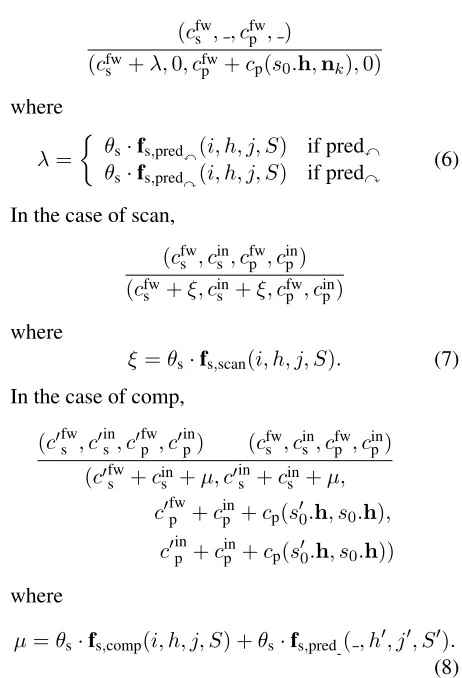
For each action, we define how to efficiently cal-culate the forward and inside costs3, following Stol-cke (1995) and Huang and Sagae (2010)’s works. In either case of predxor predy,
(cfw
s , , cfwp , )
(cfw
s +λ,0, cfwp +cp(s0.h,nk),0)
where
λ=
{
θs·fs,pred
x(i, h, j, S) if predx
θs·fs,predy(i, h, j, S) if predy
(6)
In the case of scan,
(cfw
s , cins, cfwp , cinp)
(cfw
s +ξ, cins +ξ, cfwp , cinp)
where
ξ=θs·fs,scan(i, h, j, S). (7)
In the case of comp,
(c′fws , c′ins, c′fwp , c′inp) (cfw
s , cins, cfwp , cinp)
(c′fws +cin
s +µ, c′ins +cins +µ, c′fwp +cinp +cp(s′0.h, s0.h),
c′inp +cinp +cp(s′0.h, s0.h))
where
µ=θs·fs,comp(i, h, j, S) +θs·fs,pred( , h′, j′, S′).
(8)
Pred takes either predxor predy. Beam search is performed based on the following linear order for the two statespandp′ at the same step, which have (cfw, cin)and(c′fw, c′in)respectively:
p≻p′iffcfw < c′fworcfw=c′fw∧cin< c′in. (9)
We prioritize the forward cost over the inside cost since forward cost pertains to longer action sequence and is better suited to evaluate hypothesis states than inside cost (Nederhof, 2003).
5.4 FIRST Function for Lookahead
Top-down backtrack parser usually reduces back-tracking by precomputing the set FIRST(·)(Aho and Ullman, 1972). We define the set FIRST(·)for our top-down dependency parser:
FIRST(t’) ={ld.t|ld∈lmdescendant(Tree,t’)
Tree∈Corpus}(10)
where t’ is a POS-tag, Tree is a correct depen-dency tree which exists in Corpus, a function lmdescendant(Tree,t’)returns the set of the leftmost descendant node ld of each nodes in Tree whose POS-tag is t’, and ld.t denotes a POS-tag of ld. Though our parser does not backtrack, it looks ahead when selecting possible child nodes at the prediction step by using the function FIRST. In case of predx:
∀k:i≤k < h∧ni.t∈FIRST(nk.t) statep
z }| {
ℓ:⟨i, h, j, sd|...|s0⟩:
ℓ+ 1 :⟨i, k, h, sd−1|...|s0|nk⟩:{p}
whereni.t is a POS-tag of the nodenion the top of
the queue, andnk.t is a POS-tag in kth position of
an input nodes. The case for predyis the same. If there are no nodes which satisfy the condition, our top-down parser creates new states for all nodes, and pushes them intohypoin line9of Algorithm 1.
6 Time Complexity
Our proposed top-down algorithm has three kinds of actions which are scan, comp and predict. Each scan and comp actions occursntimes when parsing a sentence with the lengthn. Predict action also oc-cursntimes in which a child node is selected from
a node sequence in the input queue. Thus, the algo-rithm takes the following times for prediction:
n+ (n−1) +· · ·+ 1 =
n ∑
i
i= n(n+ 1) 2 . (11)
Asn2for prediction is the most dominant factor, the time complexity of the algorithm isO(n2)and that
of the algorithm with beam search isO(n2∗b).
7 Related Work
Alshawi (1996) proposed head automaton which recognizes an input sentence top-down. Eisner and Satta (1999) showed that there is a cubic-time parsing algorithm on the formalism of the head automaton grammars, which are equivalently con-verted into split-head bilexical context-free gram-mars (SBCFGs) (McAllester, 1999; Johnson, 2007). Although our proposed algorithm does not employ the formalism of SBCFGs, it creates left children before right children, implying that it does not have spurious ambiguities as well as parsing algorithms on the SBCFGs. Head-corner parsing algorithm (Kay, 1989) creates dependency tree top-down, and in this our algorithm has similar spirit to it.
Yamada and Matsumoto (2003) applied a shift-reduce algorithm to dependency analysis, which is known as arc-standard transition-based algorithm (Nivre, 2004). Nivre (2003) proposed another transition-based algorithm, known as arc-eager al-gorithm. The arc-eager algorithm processes right-dependent top-down, but this does not involve the prediction of lower nodes from higher nodes. There-fore, the arc-eager algorithm is a totally bottom-up algorithm. Zhang and Clark (2008) proposed a com-bination approach of the transition-based algorithm with graph-based algorithm (McDonald and Pereira, 2006), which is the same as our combination model of stack-based and prediction models.
8 Experiments
time accuracy complete root
McDonald05,06 (2nd) 0.15 90.9, 91.5 37.5, 42.1 –
Koo10 (Koo and Collins, 2010) – 93.04 – –
Hayashi11 (Hayashi et al., 2011) 0.3 92.89 – –
2nd-MST∗ 0.13 92.3 43.7 96.0
Goldberg10 (Goldberg and Elhadad, 2010) – 89.7 37.5 91.5
Kitagawa10 (Kitagawa and Tanaka-Ishii, 2010) – 91.3 41.7 –
Zhang08 (Sh beam 64) – 91.4 41.8 –
Zhang08 (Sh+Graph beam 64) – 92.1 45.4 –
Huang10 (beam+DP) 0.04 92.1 – –
Huang10∗(beam 8, 16, 32+DP) 0.03, 0.06, 0.10 92.3, 92.27, 92.26 43.5, 43.7, 43.8 96.0, 96.0, 96.1
Zhang11 (beam 64) (Zhang and Nivre, 2011) – 93.07 49.59 –
[image:7.612.74.538.57.212.2]top-down∗(beam 8, 16, 32+pred 5+DP) 0.07, 0.12, 0.22 91.7, 92.3, 92.5 45.0, 45.7,45.9 94.5, 95.7, 96.2 top-down∗(beam 8, 16, 32+pred 5+DP+FIRST) 0.07, 0.12, 0.22 91.9, 92.4,92.6 45.0, 45.3, 45.5 95.1, 96.2,96.6
Table 1: Results for test data: Time measures the parsing time per sentence in seconds. Accuracy is an unlabeled attachment score, complete is a sentence complete rate, and root is a correct root rate.∗indicates our experiments.
0 0.2 0.4 0.6 0.8 1
0 10 20 30 40 50 60 70
parsing time (cpu sec)
length of input sentence "shift-reduce"
[image:7.612.327.527.263.319.2]"2nd-mst" "top-down"
Figure 5: Scatter plot of parsing time against sentence length, comparing with top-down, 2nd-MST and shift-reduce parsers (beam size:8, pred size:5)
we used the information of words and fine-grained POS-tags for features. We also implemented and ex-perimented Huang and Sagae (2010)’s arc-standard shift-reduce parser. For the2nd-order Eisner-Satta algorithm, we used MSTParser (McDonald, 2012).
We used an early update version of averaged per-ceptron algorithm (Collins and Roark, 2004) for training of shift-reduce and top-down parsers. A set of feature templates in (Huang and Sagae, 2010) were used for the stack-based model, and a set of feature templates in (McDonald and Pereira, 2006) were used for the2nd-order prediction model. The weighted prediction and stack-based models of top-down parser were jointly trained.
8.1 Results for English Data
During training, we fixed the prediction size and beam size to5and 16, respectively, judged by
[image:7.612.71.272.269.400.2]pre-accuracy complete root oracle (sh+mst) 94.3 52.3 97.7 oracle (top+sh) 94.2 51.7 97.6 oracle (top+mst) 93.8 50.7 97.1 oracle (top+sh+mst) 94.9 55.3 98.1
Table 2: Oracle score, choosing the highest accuracy parse for each sentence on test data from results of top-down (beam8, pred5) and shift-reduce (beam 8) and MST(2nd) parsers in Table 1.
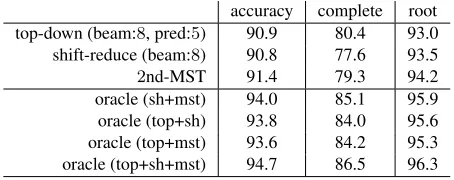
accuracy complete root top-down (beam:8, pred:5) 90.9 80.4 93.0 shift-reduce (beam:8) 90.8 77.6 93.5
2nd-MST 91.4 79.3 94.2
oracle (sh+mst) 94.0 85.1 95.9 oracle (top+sh) 93.8 84.0 95.6 oracle (top+mst) 93.6 84.2 95.3 oracle (top+sh+mst) 94.7 86.5 96.3
Table 3: Results for Chinese Data (CoNLL-06)
liminary experiments on development data. After 25 iterations of perceptron training, we achieved 92.94 unlabeled accuracy for top-down parser with the FIRST function and 93.01 unlabeled accuracy for shift-reduce parser on development data by set-ting the beam size to8for both parsers and the pre-diction size to5 in top-down parser. These trained models were used for the following testing.
[image:7.612.312.539.386.476.2]No.717 Little Lily , as Ms. Cunningham calls7herself in the book , really was14 n’t ordinary .
shift-reduce 2 7 2 2 6 4 14 7 7 11 9 7 14 0 14 14 14
2nd-MST 2 14 2 2 6 7 4 7 7 11 9 2 14 0 14 14 14
top-down 2 14 2 2 6 7 4 7 7 11 9 2 14 0 14 14 14
correct 2 14 2 2 6 7 4 7 7 11 9 2 14 0 14 14 14
No.127 resin , used to make garbage bags , milk jugs , housewares , toys and meat packaging25 , among other items .
shift-reduce 25 9 9 13 11 15 13 25 18 25 25 25 25 25 25 25 7 25 25 29 27 4
2nd-MST 29 9 9 13 11 15 13 29 18 29 29 29 29 25 25 25 29 25 25 29 7 4
top-down 7 9 9 13 11 15 25 25 18 25 25 25 25 25 25 25 13 25 25 29 27 4 correct 7 9 9 13 11 15 25 25 18 25 25 25 25 25 25 25 13 25 25 29 27 4
Table 4: Two examples on which top-down parser is superior to two bottom-up parsers: In correct analysis, the boxed portion is the head of the underlined portion. Bottom-up parsers often mistake to capture the relation.
parser on the correct root measure. In step0, top-down parser predicts a child node, a root node of a complete tree, using little syntactic information, which may lead to errors in the root node selection. Therefore, we think that it is important to seek more suitable features for the prediction in future work.
Figure 5 presents the parsing time against sen-tence length. Our proposed top-down parser is the-oretically slower than shift-reduce parser and Fig-ure 5 empirically indicates the trends. The domi-nant factor comes from the score calculation, and we will leave it for future work. Table 2 shows the oracle score for test data, which is the score of the highest accuracy parse selected for each sen-tence from results of several parsers. This indicates that the parses produced by each parser are differ-ent from each other. However, the gains obtained by the combination of top-down and2nd-MST parsers are smaller than other combinations. This is because top-down parser uses the same features as2nd-MST parser, and these are more effective than those of stack-based model. It is worth noting that as shown in Figure 5, ourO(n2∗b)(b= 8) top-down parser is
much faster thanO(n3)Eisner-Satta CKY parsing.
8.2 Results for Chinese Data (CoNLL-06)
We also experimented on the Chinese data. Fol-lowing English experiments, shift-reduce parser was trained by setting beam size to 16, and top-down parser was trained with the beam size and the predic-tion size to16and5, respectively. Table 3 shows the results on the Chinese test data when setting beam size to8for both parsers and prediction size to5in top-down parser. The trends of the results are almost
the same as those of the English results.
8.3 Analysis of Results
Table 4 shows two interesting results, on which top-down parser is superior to either shift-reduce parser or2nd-MST parser. The sentence No.717 contains an adverbial clause structure between the subject and the main verb. Top-down parser is able to han-dle the long-distance dependency while shift-reudce parser cannot correctly analyze it. The effectiveness on the clause structures implies that our head-driven parser may handle non-projective structures well, which are introduced by Johansonn’s head rule (Jo-hansson and Nugues, 2007). The sentence No.127 contains a coordination structure, which it is diffi-cult for bottom-up parsers to handle, but, top-down parser handles it well because its top-down predic-tion globally captures the coordinapredic-tion.
9 Conclusion
This paper presents a novel head-driven parsing al-gorithm and empirically shows that it is as practi-cal as other dependency parsing algorithms. Our head-driven parser has potential for handling non-projective structures better than other non-non-projective dependency algorithms (McDonald et al., 2005; At-tardi, 2006; Nivre, 2008b; Koo et al., 2010). We are in the process of extending our head-driven parser for non-projective structures as our future work.
Acknowledgments
References
A. V. Aho and J. D. Ullman. 1972. The Theory of Pars-ing, Translation and Compiling, volume 1: Parsing. Prentice-Hall.
H. Alshawi. 1996. Head automata for speech translation. InProc. the ICSLP.
G. Attardi. 2006. Experiments with a multilanguage non-projective dependency parser. InProc. the 10th CoNLL, pages 166–170.
M. Collins and B. Roark. 2004. Incremental parsing with the perceptron algorithm. InProc. the 42nd ACL. J. Earley. 1970. An efficient context-free parsing
algo-rithm. Communications of the Association for Com-puting Machinery, 13(2):94–102.
J. M. Eisner and G. Satta. 1999. Efficient parsing for bilexical context-free grammars and head automaton grammars. InProc. the 37th ACL, pages 457–464. Y. Goldberg and M. Elhadad. 2010. An efficient
algo-rithm for easy-first non-directional dependency pars-ing. InProc. the HLT-NAACL, pages 742–750. K. Hayashi, T. Watanabe, M. Asahara, and Y.
Mat-sumoto. 2011. The third-order variational rerank-ing on packed-shared dependency forests. In Proc. EMNLP, pages 1479–1488.
L. Huang and K. Sagae. 2010. Dynamic programming for linear-time incremental parsing. InProc. the 48th ACL, pages 1077–1086.
H. Isozaki, H. Kazawa, and T. Hirao. 2004. A determin-istic word dependency analyzer enhanced with prefer-ence learning. InProc. the 21st COLING, pages 275– 281.
R. Johansson and P. Nugues. 2007. Extended constituent-to-dependency conversion for english. In
Proc. NODALIDA.
M. Johnson. 2007. Transforming projective bilexical dependency grammars into efficiently-parsable CFGs with unfold-fold. InProc. the 45th ACL, pages 168– 175.
M. Kay. 1989. Head driven parsing. InProc. the IWPT. K. Kitagawa and K. Tanaka-Ishii. 2010. Tree-based
de-terministic dependency parsing — an application to nivre’s method —. InProc. the 48th ACL 2010 Short Papers, pages 189–193, July.
T. Koo and M. Collins. 2010. Efficient third-order de-pendency parsers. InProc. the 48th ACL, pages 1–11.
T. Koo, A. M. Rush, M. Collins, T. Jaakkola, and D. Son-tag. 2010. Dual decomposition for parsing with non-projective head automata. In Proc. EMNLP, pages 1288–1298.
D. McAllester. 1999. A reformulation of eisner and satta’s cubic time parser for split head automata gram-mars. http://ttic.uchicago.edu/ dmcallester/.
R. McDonald and F. Pereira. 2006. Online learning of approximate dependency parsing algorithms. InProc. EACL, pages 81–88.
R. McDonald, F. Pereira, K. Ribarov, and J. Hajic. 2005. Non-projective dependency parsing using spanning tree algorithms. In Proc. HLT-EMNLP, pages 523– 530.
R. McDonald. 2012. Minimum spanning tree parser. http://www.seas.upenn.edu/ strctlrn/MSTParser. M.-J. Nederhof. 2003. Weighted deductive parsing
and knuth’s algorithm. Computational Linguistics, 29:135–143.
J. Nivre. 2003. An efficient algorithm for projective de-pendency parsing. InProc. the IWPT, pages 149–160. J. Nivre. 2004. Incrementality in deterministic depen-dency parsing. InProc. the ACL Workshop Incremen-tal Parsing: Bringing Engineering and Cognition To-gether, pages 50–57.
J. Nivre. 2006.Inductive Dependency Parsing. Springer. J. Nivre. 2008a. Algorithms for deterministic incremen-tal dependency parsing. Computational Linguistics, 34:513–553.
J. Nivre. 2008b. Sorting out dependency parsing. In
Proc. the CoTAL, pages 16–27.
A. Stolcke. 1995. An efficient probabilistic context-free parsing algorithm that computes prefix probabilities.
Computational Linguistics, 21(2):165–201.
H. Yamada and Y. Matsumoto. 2003. Statistical depen-dency analysis with support vector machines. InProc. the IWPT, pages 195–206.
Y. Zhang and S. Clark. 2008. A tale of two parsers: In-vestigating and combining graph-based and transition-based dependency parsing using beam-search. In
Proc. EMNLP, pages 562–571.