A New Set of Norms for Semantic Relatedness Measures
Sean Szumlanski Department of EECS University of Central Florida
Fernando Gomez Department of EECS University of Central Florida
Valerie K. Sims Department of Psychology University of Central Florida [email protected]
Abstract
We have elicited human quantitative judg-ments of semantic relatedness for 122 pairs of nouns and compiled them into a new set of relatedness norms that we call Rel-122. Judgments from individual sub-jects in our study exhibit high average cor-relation to the resulting relatedness means (r= 0.77,σ= 0.09,N = 73), although not
as high as Resnik’s (1995) upper bound for expected average human correlation to similarity means (r= 0.90). This suggests
that human perceptions of relatedness are less strictly constrained than perceptions of similarity and establishes a clearer ex-pectation for what constitutes human-like performance by a computational measure of semantic relatedness.
We compare the results of several WordNet-based similarity and relatedness measures to our Rel-122 norms and demonstrate the limitations of WordNet for discovering general indications of semantic relatedness. We also offer a cri-tique of the field’s reliance upon similarity norms to evaluate relatedness measures.
1 Introduction
Despite the well-established technical distinc-tion between semantic similarity and relatedness (Agirre et al., 2009; Budanitsky and Hirst, 2006; Resnik, 1995), comparison to established similar-ity norms from psychology remains part of the standard evaluative procedure for assessing com-putational measures of semantic relatedness. Be-cause similarity is only one particular type of re-latedness, comparison to similarity norms fails to give a complete view of a relatedness measure’s efficacy.
In keeping with Budanitsky and Hirst’s (2006) observation that “comparison with human judg-ments is the ideal way to evaluate a measure of similarity or relatedness,” we have undertaken the creation of a new set of relatedness norms.
2 Background
The similarity norms of Rubenstein and Goode-nough (1965; henceforth R&G) and Miller and Charles (1991; henceforth M&C) have seen ubiq-uitous use in evaluation of computational mea-sures of semantic similarity and relatedness.
R&G established their similarity norms by pre-senting subjects with 65 slips of paper, each of which contained a pair of nouns. Subjects were directed to read through all 65 noun pairs, then sort the pairs “according to amount of ‘similarity of meaning.’” Subjects then assigned similarity scores to each pair on a scale of 0.0 (completely dissimilar) to 4.0 (strongly synonymous).
The R&G results have proven to be highly repli-cable. M&C repeated R&G’s study using a subset of 30 of the original word pairs, and their resulting similarity norms correlated to the R&G norms at
r = 0.97. Resnik’s (1995) subsequent replication
of M&C’s study similarly yielded a correlation of
r= 0.96. The M&C pairs were also included in a
similarity study by Finkelstein et al. (2002), which yielded correlation ofr= 0.95 to the M&C norms.
2.1 WordSim353
WordSim353 (Finkelstein et al., 2002) has re-cently emerged as a potential surrogate dataset for evaluating relatedness measures. Several studies have reported correlation to WordSim353 norms as part of their evaluation procedures, with some studies explicitly referring to it as a collection of human-assigned relatedness scores (Gabrilovich and Markovitch, 2007; Hughes and Ramage, 2007; Milne and Witten, 2008).
Yet, the instructions presented to Finkelstein et al.’s subjects give us pause to reconsider Word-Sim353’s classification as a set of relatedness norms. They repeatedly framed the task as one in which subjects were expected to assign word simi-larity scores, although participants were instructed to extend their definition of similarity to include antonymy, which perhaps explains why the au-thors later referred to their data as “relatedness” norms rather than merely “similarity” norms.
Jarmasz and Szpakowicz (2003) have raised fur-ther methodological concerns about the construc-tion of WordSim353, including: (a) similarity was rated on a scale of 0.0 to 10.0, which is intrin-sically more difficult for humans to manage than the scale of 0.0 to 4.0 used by R&G and M&C, and (b) the inclusion of proper nouns introduced an element of cultural bias into the dataset (e.g., the evaluation of the pairArafat–terror).
Cognizant of the problematic conflation of sim-ilarity and relatedness in WordSim353, Agirre et al. (2009) partitioned the data into two sets: one containing noun pairs exhibiting similarity, and one containing pairs of related but dissimilar nouns. However, pairs in the latter set were not assessed for scoring distribution validity to ensure that strongly related word pairs were not penalized by human subjects for being dissimilar.1
3 Methodology
In our experiments, we elicited human ratings of semantic relatedness for 122 noun pairs. In doing so, we followed the methodology of Rubenstein and Goodenough (1965) as closely as possible: participants were instructed to read through a set of noun pairs, sort them by how strongly related they were, and then assign each pair a relatedness score on a scale of 0.0 (“completely unrelated”) to 4.0 (“very strongly related”).
We made two notable modifications to the ex-perimental procedure of Rubenstein and Goode-nough. First, instead of asking participants to judge “amount of ‘similarity of meaning,’” we asked them to judge “how closely related in mean-ing” each pair of nouns was. Second, we used a Web interface to collect data in our study; instead of reordering a deck of cards, participants were presented with a grid of cards that they were able
1Perhaps not surprisingly, the highest scores in Word-Sim353 (all ratings from 9.0 to 10.0) were assigned to pairs that Agirre et al. placed in their similarity partition.
to rearrange interactively with the use of a mouse or any touch-enabled device, such as a tablet PC.2
3.1 Experimental Conditions
Each participant in our study was randomly as-signed to one of four conditions. Each condition contained 32 noun pairs for evaluation.
Of those pairs, 10 were randomly selected from from WordNet++ (Ponzetto and Navigli, 2010) and 10 from SGN (Szumlanski and Gomez, 2010)—two semantic networks that categori-cally indicate strong relatedness between Word-Net noun senses. 10 additional pairs were gen-erated by randomly pairing words from a list of all nouns occurring in Wikipedia. The nouns in the pairs we used from each of these three sources were matched for frequency of occurrence in Wikipedia.
We manually selected two additional pairs that appeared across all four conditions: leaves–rake
andlion–cage. These control pairs were included to ensure that each condition contained examples of strong semantic relatedness, and potentially to help identify and eliminate data from participants who assigned random relatedness scores. Within each condition, the 32 word pairs were presented to all subjects in the same random order. Across conditions, the two control pairs were always pre-sented in the same positions in the word pair grid. Each word pair was subjected to additional scrutiny before being included in our dataset. We eliminated any pairs falling into one or more of the following categories: (a) pairs containing proper nouns, (b) pairs in which one or both nouns might easily be mistaken for adjectives or verbs, (c) pairs with advanced vocabulary or words that might require domain-specific knowledge in or-der to be properly evaluated, and (d) pairs with shared stems or common head nouns (e.g., first cousin–second cousin and sinner–sinning). The latter were eliminated to prevent subjects from latching onto superficial lexical commonalities as indicators of strong semantic relatedness without reflecting upon meaning.
3.2 Participants
Participants in our study were recruited from in-troductory undergraduate courses in psychology and computer science at the University of Cen-tral Florida. Students from the psychology courses
2Online demo: http://www.cs.ucf.edu/
participated for course credit and accounted for 89% of respondents.
92 participants provided data for our study. Of these, we identified 19 as outliers, and their data were excluded from our norms to prevent interfer-ence from individuals who appeared to be assign-ing random scores to noun pairs. We considered an outlier to be any individual whose numeric rat-ings fell outside two standard deviations from the means for more than 10% of the word pairs they evaluated (i.e., at least four word pairs, since each condition contained 32 word pairs).
For outlier detection, means and standard de-viations were computed using leave-one-out sam-pling. That is, data from individualJwere not in-corporated into means or standard deviations when considering whether to eliminateJ as an outlier.3
Of the 73 participants remaining after outlier elimination, there was a near-even split between males (37) and females (35), with one individual declining to provide any demographic data. The average age of participants was 20.32 (σ = 4.08, N = 72). Most students were freshmen (49),
fol-lowed in frequency by sophomores (16), seniors (4), and juniors (3). Participants earned an average score of 42% on a standardized test of advanced vocabulary (σ= 16%,N = 72) (Test I – V-4 from
Ekstrom et al. (1976)).
4 Results
Each word pair in Rel-122 was evaluated by at least 20 human subjects. After outlier removal (described above), each word pair retained eval-uations from 14 to 22 individuals. The resulting relatedness means are available online.4
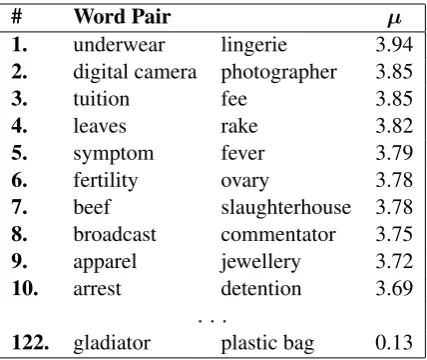
An excerpt of the Rel-122 norms is shown in Table 1. We note that the highest rated pairs in our dataset are not strictly similar entities; exactly half of the 10 most strongly related nouns in Table 1 are dissimilar (e.g.,digital camera–photographer).
Judgments from individual subjects in our study exhibited high average correlation to the elicited relatedness means (r = 0.769, σ = 0.09, N =
73). Resnik (1995), in his replication of the
3We used this sampling method to prevent extreme out-liers from masking their own aberration during outlier de-tection, which is potentially problematic when dealing with small populations. Without leave-one-out-sampling, we would have identified fewer outliers (14 instead of 19), but the resulting means would still have correlated strongly to our final relatedness norms (r= 0.991,p <0.01).
4http://www.cs.ucf.edu/
∼seansz/rel-122
# Word Pair µ
1. underwear lingerie 3.94
2. digital camera photographer 3.85
3. tuition fee 3.85
4. leaves rake 3.82
5. symptom fever 3.79
6. fertility ovary 3.78
7. beef slaughterhouse 3.78
8. broadcast commentator 3.75
9. apparel jewellery 3.72
10. arrest detention 3.69
. . .
[image:3.595.310.524.61.241.2]122. gladiator plastic bag 0.13
Table 1: Excerpt of Rel-122 norms.
M&C study, reported average individual correla-tion of r = 0.90 (σ = 0.07, N = 10) to similar-ity means elicited from a population of 10 gradu-ate students and postdoctoral researchers. Presum-ably Resnik’s subjects had advanced knowledge of what constitutes semantic similarity, as he estab-lished r = 0.90 as an upper bound for expected
human correlation on that task.
The fact that average human correlation in our study is weaker than in previous studies suggests that human perceptions of relatedness are less strictly constrained than perceptions of similarity, and that a reasonable computational measure of re-latedness might only approach a correlation ofr=
0.769 to relatedness norms.
In Table 2, we present the performance of a va-riety of relatedness and similarity measures on our new set of relatedness means.5Coefficients of cor-relation are given for Pearson’s product-moment correlation (r), as well as Spearman’s rank
corre-lation (ρ). For comparison, we include results for
the correlation of these measures to the M&C and R&G similarity means.
The generally weak performance of the WordNet-based measures on this task is not surprising, given WordNet’s strong disposition toward codifying semantic similarity, which makes it an impoverished resource for discovering general semantic relatedness. We note that the three WordNet-based measures from Table 2 that are regarded in the literature as relatedness measures (Banerjee and Pedersen, 2003; Hirst and St-Onge, 1998; Patwardhan and Pedersen, 2006)
Rel-122 M&C R&G
Measure r ρ r ρ r ρ
* Szumlanski and Gomez (2010) 0.654 0.534 0.852 0.859 0.824 0.841 * Patwardhan and Pedersen (2006) 0.341 0.364 0.865 0.906 0.793 0.795
Path Length 0.225 0.183 0.755 0.715 0.784 0.783
* Banerjee and Pedersen (2003) 0.210 0.258 0.356 0.804 0.340 0.718
Resnik (1995) 0.203 0.182 0.806 0.741 0.822 0.757
Jiang and Conrath (1997) 0.188 0.133 0.473 0.663 0.575 0.592 Leacock and Chodorow (1998) 0.173 0.167 0.779 0.715 0.839 0.783 Wu and Palmer (1994) 0.187 0.180 0.764 0.732 0.797 0.768
Lin (1998) 0.145 0.148 0.739 0.687 0.726 0.636
[image:4.595.109.497.68.231.2]* Hirst and St-Onge (1998) 0.141 0.160 0.667 0.782 0.726 0.797
Table 2: Correlation of similarity and relatedness measures to Rel-122, M&C, and R&G. Starred rows (*) are considered relatedness measures. All measures are WordNet-based, except for the scoring metric of Szumlanski and Gomez (2010), which is based on lexical co-occurrence frequency in Wikipedia.
# Noun Pair Sim. Rel. # Noun Pair Sim. Rel.
1. car automobile 3.92 4.00 16. lad brother 1.66 2.68
2. gem jewel 3.84 3.98 17. journey car 1.16 3.00
3. journey voyage 3.84 3.97 18. monk oracle 1.10 2.54
4. boy lad 3.76 3.97 19. cemetery woodland 0.95 1.69
5. coast shore 3.70 3.97 20. food rooster 0.89 2.59
6. asylum madhouse 3.61 3.91 21. coast hill 0.87 1.59
7. magician wizard 3.50 3.58 22. forest graveyard 0.84 2.01
8. midday noon 3.42 4.00 23. shore woodland 0.63 1.63
9. furnace stove 3.11 3.67 24. monk slave 0.55 1.31
10. food fruit 3.08 3.91 25. coast forest 0.42 1.89
11. bird cock 3.05 3.71 26. lad wizard 0.42 2.12
12. bird crane 2.97 3.96 27. chord smile 0.13 0.68
13. tool implement 2.95 2.86 28. glass magician 0.11 1.30
14. brother monk 2.82 2.89 29. rooster voyage 0.08 0.63
15. crane implement 1.68 0.90 30. noon string 0.08 0.14
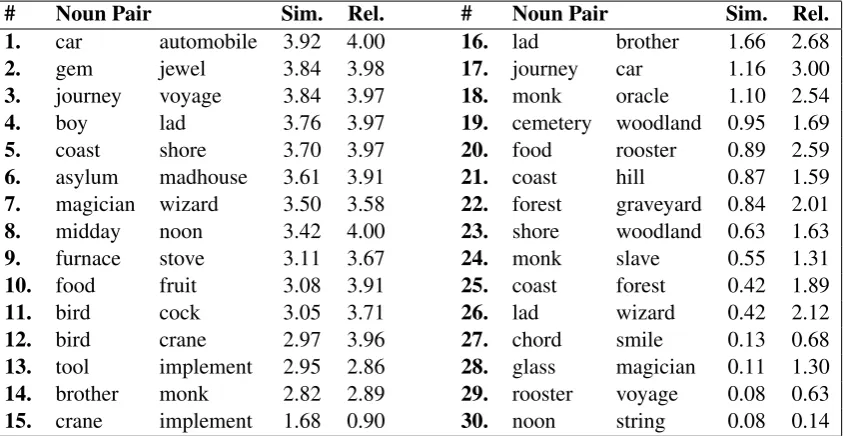
Table 3: Comparison of relatedness means to M&C similarity means. Correlation isr= 0.91.
have been hampered by their reliance upon Word-Net. The disparity between their performance on Rel-122 and the M&C and R&G norms suggests the shortcomings of using similarity norms for evaluating measures of relatedness.
5 (Re-)Evaluating Similarity Norms
After establishing our relatedness norms, we cre-ated two additional experimental conditions in which subjects evaluated the relatedness of noun pairs from the M&C study. Each condition again had 32 noun pairs: 15 from M&C and 17 from Rel-122. Pairs from M&C and Rel-122 were uni-formly distributed between these two new
condi-tions based on matched normative similarity or re-latedness scores from their respective datasets.
Results from this second phase of our study are shown in Table 3. The correlation of our relat-edness means on this set to the similarity means of M&C was strong (r = 0.91), but not as strong
as in replications of the study that asked subjects to evaluate similarity (e.g. r = 0.96 in Resnik’s
(1995) replication and r = 0.95 in Finkelstein et
al.’s (2002) M&C subset).
[image:4.595.90.512.300.518.2]our study, shown in Table 3, is that relatedness norms for pairs that are related but dissimilar (e.g.,
journey–carandforest–graveyard) deviate signif-icantly from established similarity norms. This in-dicates that asking subjects to evaluate “similar-ity” instead of “relatedness” can significantly im-pact the norms established in such studies.
6 Conclusions
We have established a new set of relatedness norms, Rel-122, that is offered as a supplementary evaluative standard for assessing semantic related-ness measures.
We have also demonstrated the shortcomings of using similarity norms to evaluate such mea-sures. Namely, since similarity is only one type of relatedness, comparison to similarity norms fails to provide a complete view of a measure’s abil-ity to capture more general types of relatedness. This is particularly problematic when evaluating WordNet-based measures, which naturally excel at capturing similarity, given the nature of the Word-Net ontology.
Furthermore, we have found that asking judges to evaluate “relatedness” of terms, rather than “similarity,” has a substantive impact on resulting norms, particularly with respect to the M&C sim-ilarity dataset. Correlation of individual judges’ ratings to resulting means was also significantly lower on average in our study than in previous studies that focused on similarity (e.g., Resnik, 1995). These results suggest that human percep-tions of relatedness are less strictly constrained than perceptions of similarity and validate the need for new relatedness norms to supplement ex-isting gold standard similarity norms in the evalu-ation of relatedness measures.
References
Eneko Agirre, Enrique Alfonseca, Keith Hall, Jana Kravalova, Marius Pas¸ca, and Aitor Soroa. 2009. A study on similarity and relatedness using
distribu-tional and WordNet-based approaches. In
Proceed-ings of the North American Chapter of the Associa-tion for ComputaAssocia-tional Linguistics (NAACL), pages 19–27.
Satanjeev Banerjee and Ted Pedersen. 2003. Ex-tended gloss overlaps as a measure of semantic re-latedness. InProceedings of the 18th International Joint Conference on Artificial Intelligence (IJCAI), pages 805–810.
Alexander Budanitsky and Graeme Hirst. 2006. Eval-uating WordNet-based measures of lexical semantic
relatedness. Computational Linguistics, 32(1):13–
47.
Ruth B. Ekstrom, John W. French, Harry H. Harman,
and Diran Dermen. 1976.Manual for Kit of
Factor-Referenced Cognitive Tests. Educational Testing Service, Princeton, NJ.
Lev Finkelstein, Evgeniy Gabrilovich, Yossi Matias, Ehud Rivlin, Zach Solan, Gadi Wolfman, and Ey-tan Ruppin. 2002. Placing search in context: The
concept revisited. ACM Transactions on
Informa-tion Systems (TOIS), 20(1):116–131.
Evgeniy Gabrilovich and Shaul Markovitch. 2007. Computing semantic relatedness using Wikipedia-based explicit semantic analysis. InProceedings of the 20th International Joint Conference on Artificial Intelligence, pages 1606–1611.
Graeme Hirst and David St-Onge. 1998. Lexical chains as representations of context for the detec-tion and correcdetec-tion of malapropisms. In Christiane
Fellbaum, editor, WordNet: An Electronic Lexical
Database, pages 305–332. MIT Press.
Thad Hughes and Daniel Ramage. 2007.
Lexi-cal semantic relatedness with random graph walks. In Proceedings of the 2007 Joint Conference on Empirical Methods in Natural Language Process-ing and Computational Natural Language LearnProcess-ing (EMNLP-CoNLL), pages 581–589, Prague, Czech Republic, June. Association for Computational Lin-guistics.
Mario Jarmasz and Stan Szpakowicz. 2003. Roget’s thesaurus and semantic similarity. InProceedings of the International Conference on Recent Advances in Natural Language Processing (RANLP), pages 212– 219.
Jay J. Jiang and David W. Conrath. 1997. Semantic similarity based on corpus statistics and lexical
tax-onomy. InProceedings of the International
Confer-ence on Research in Computational Linguistics (RO-CLING), pages 19–33.
Claudia Leacock and Martin Chodorow. 1998. Com-bining local context and WordNet similarity for word sense identification. In Christiane Fellbaum,
editor, WordNet: An Electronic Lexical Database,
pages 265–283. MIT Press.
Dekang Lin. 1998. An information-theoretic defini-tion of similarity. InProceedings of the 15th Inter-national Conference on Machine Learning (ICML), pages 296–304.
David Milne and Ian H. Witten. 2008. An effective, low-cost measure of semantic relatedness obtained
from Wikipedia links. InProceedings of the First
AAAI Workshop on Wikipedia and Artificial Intelli-gence (WIKIAI), pages 25–30.
Siddharth Patwardhan and Ted Pedersen. 2006. Us-ing WordNet-based context vectors to estimate the
semantic relatedness of concepts. In Proceedings
of the 11th Conference of the European Chapter of the Association for Computational Linguistics Work-shop on Making Sense of Sense, pages 1–8.
Ted Pedersen, Siddharth Patwardhan, and Jason
Miche-lizzi. 2004. WordNet::Similarity – Measuring
the relatedness of concepts. In Proceedings of the
5th Annual Meeting of the North American Chap-ter of the Association for Computational Linguistics (NAACL), pages 38–11.
Simone Paolo Ponzetto and Roberto Navigli. 2010. Knowledge-rich word sense disambiguation rivaling
supervised systems. InProceedings of the 48th
An-nual Meeting of the Association for Computational Linguistics (ACL), pages 1522–1531.
Philip Resnik. 1995. Using information content to evaluate semantic similarity in a taxonomy. In Pro-ceedings of the 14th International Joint Conference on Artificial Intelligence (IJCAI), pages 448–453. Herbert Rubenstein and John B. Goodenough. 1965.
Contextual correlates of synonymy.
Communica-tions of the ACM, 8(10):627–633.
Sean Szumlanski and Fernando Gomez. 2010. Au-tomatically acquiring a semantic network of related
concepts. In Proceedings of the 19th ACM
Inter-national Conference on Information and Knowledge Management (CIKM), pages 19–28.
Zhibiao Wu and Martha Palmer. 1994. Verb
seman-tics and lexical selection. In Proceedings of the