Munich Personal RePEc Archive
Modelling the Electricity and Natural
Gas Sectors for the Future Grid:
Developing Co-Optimisation Platforms
for Market Redesign
Foster, John and Wagner, Liam and Liebman, Ariel
University of Queensland, Griffith University, Monash University
1 December 2015
Online at
https://mpra.ub.uni-muenchen.de/70114/
1
Modelling the Electricity and Natural Gas Sectors for the Future Grid:
Developing Co-Optimisation Platforms for Market Redesign
By
Prof John Foster,
Dr Liam Wagner,
Dr Ariel Liebman
Deliverables 4 and 5
:
CSIRO Future Grid Flagship Cluster
Project 3:Economic and investment models for future grids
2
Table of Contents
1 Introduction ... 5
2 Co-optimisation and Expansion of transmission networks and electricity generation for the Future Grid .... 6
2.1 Collaboration with Projects 1 and 2 ... 9
3 Electricity Market Simulation Platform. ... 10
3.1 Optimal Power Flow Solution ... 11
3.2 LT Plan ... 12
3.3 PASA... 13
3.4 MT Schedule ... 13
3.5 ST Schedule and Spot Market Dispatch ... 14
3.6 Short Run Marginal Cost Recovery Algorithm ... 16
3.7 Long Run Marginal Cost Recovery ... 16
3.8 Data and assumptions ... 17
3.8.1 Generation capacity and investment ... 17
3.8.2 Fuel Prices ... 18
3.8.3 Network ... 18
4 Natural Gas Market Modelling ... 19
4.1 Data ... 22
4.1.1 Natural Gas Demand ... 30
4.2 Base Case Simulation Results ... 33
5 Future Grid Scenario Modelling ... 36
5.1 The four influences ... 37
5.2 Scenario Kernels ... 38
5.3 Scenario Planning: BAU/Counter Factual ... 40
5.4 Scenario Correspondence between CFGF and the Project 3 CFGC ... 43
5.5 Representing the Scenarios for the CSIRO Future Grid Cluster ... 44
5.6 Scenario 1: “Set and Forget” ... 47
5.6.1 Assumptions and Data for Scenario 1 ... 48
5.6.2 Fuel Price Projections ... 50
5.6.3 Demand Projections ... 51
5.7 Initial Modelling Results ... 59
5.7.1 Wholesale market spot prices ... 59
5.7.2 Generation Profile ... 60
5.7.3 Concluding remarks ... 64
3
List of Figures
Figure 1: PLEXOS Simulation Core... 11
Figure 2: PLEXOS Least Cost Expansion Modelling Framework ... 13
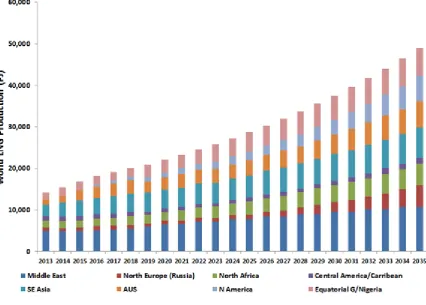
Figure 3: World Gas Production Optimistic Case ... 20
Figure 4: The effects of international market linkage ... 21
Figure 5: Australia’s natural gas basins. Source: Geoscience Australia ... 24
Figure 6: Marginal Cost Curve for the Eastern Australian Gas Market ... 27
Figure 7: Sensitivity of the Golombek marginal cost of supply curve ... 28
Figure 8: Cooper Eromanga/Golombek marginal cost of supply curve ... 28
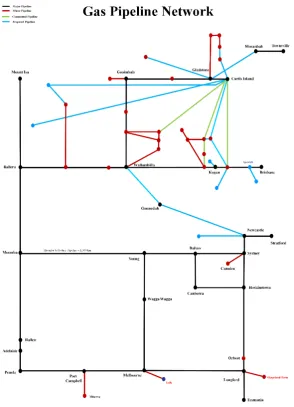
Figure 9: Stylized Network Diagram of the Eastern Australian Natural Gas Market ... 32
Figure 10: Marginal cost curve shift associated with a delay supply ... 34
Figure 11: Natural Gas Spot Prices Base Case Scenario ... 35
Figure 12: Supply node production schedule over time ... 35
Figure 13: Future Grid Forum core scenarios [78] ... 36
Figure 14: Projected Coal Prices (Medium Forecast) ... 50
Figure 15: NEM Demand Projections for Scenario 1 ... 51
Figure 16: Technology Costs for Conventional Electricity Generation ... 58
Figure 17: Technology Costs for Renewable Electricity Generation ... 58
Figure 18: Yearlywholesale electricity market spot prices (Load Weighted Average) ... 60
Figure 19: Installed Capacity by technology type for Scenario 1 ... 61
Figure 20: Generation profile by technology type for Scenario 1 ... 62
Figure 21: Installed Generation Capacity with respect to technological share ... 63
Figure 22: Generation Dispatch Quantities with respect to Conventional and Renewable Technologies ... 63
4
List of Tables
Table 1: Natural Gas Reserves within the Eastern States... 25
Table 2: Natural gas reserves by resource type ... 25
Table 3: Field reserve and production cost data example ... 26
Table 4: Golomobek Function Coefficients for Example Fields ... 29
Table 5: Main Transmission Pipelines ... 30
Table 6: Kernel elements ... 39
Table 7: BAU/Counter Factual Scenario Assumptions ... 41
Table 8: BAU/Counter Factual Scenario Kernels ... 42
Table 9: Project 3 and CSIRO Future Grid Forum Scenarios ... 45
Table 10: CFGF Scenarios and drivers ... 46
Table 11: CSIRO Future Grid Forum and the Cluster Project 3 Scenario drivers ... 47
Table 12: Mapping of the CSIRO Future Grid Forum “Set and Forget” Scenario to Project 3 Scenario Framework ... 52
Table 13: Representation of the CSIRO Future Grid Forum Scenario 1 Domestic Policy ... 53
Table 14: Representation of the CSIRO Future Grid Forum Scenario 1 International Forces ... 54
Table 15: Representation of the CSIRO Future Grid Forum Scenario 1 Demand Side Forces ... 55
Table 16: Representation of the CSIRO Future Grid Forum Scenario 1 Technological Development ... 56
5
1
Introduction
This report provides detail on the modelling and scenario frameworks for the economic
analysis of the Future Grid. These frameworks and modelling platforms have been
constructed to support the Future Grid Cluster in examining policy and market issues which
will affect the electricity and natural gas markets in Australia.
Initially we provide an overview of the co-optimisation and expansion of transmission
networks and electricity generation for the future grid. In this section we outline not only the
key mechanisms and analyses required, but also how we have and will continue to
collaborate with the other projects within the Future Grid Cluster.
In section 3 we provide an extensive analysis of the electricity market modelling platform
PLEXOS. This section will outline, not only the mechanistic components of modelling
electricity markets, but also some of the assumptions which are required to examine issues
such as generation investment under uncertainty.
The following section is a discussion of the natural gas modelling platform ATESHGAH.
This model has been in construction for several years prior to the commencement of the
Future Grid Cluster and represents a significant shift in gas market modelling methodology
for Australia, compared to previous approaches. This model is capable of examining multiple
issues associated with policy, market, economic, and physical aspects of gas production,
transmission, sale and liquefied natural gas (LNG) export simultaneously. We have used this
model to examine how Australia’s eastern gas market could be affected by the
commencement of LNG exports from Curtis Island in 2015/16.
In the remaining section, we present the scenario modelling framework as an overview and
present some initial results for Scenario 1: Set and Forget. These results represent the first set
of simulations and should thus be viewed as an initial attempt to undertake the large search
6
2
Co-optimisation and Expansion of transmission networks and
electricity generation for the Future Grid
The expansion of energy systems and its planning aims to address the problem of expanding
and augmenting electricity and natural gas infrastructure, while serving growing demand and
fulfilling a variety of technical, economic and policy constraints. Previously, the majority of
the energy system had been characterised by vertical integration, which allowed for the
optimal least-cost expansion subject to reliability and system constraints.
Since the implementation of market liberalisation [1-3], and the deregulation of the previous
vertically integrated supply chain into a number of horizontal components [4], there have
been a number of conflicting planning objectives which include:
1. The promotion of competition amongst electricity market participants by the
implementation of an aggregated spot market pool [5, 6]:
The maximization of social welfare now occurs in a market based environment (i.e. the pool based market mechanisms [7, 8] and bilateral
contracts)
Market participants can hedge risk via forward contract markets (contracts for
difference) which lower the probability of wholesale energy price spikes
affecting consumers [9]
These market features provide non-discriminatory access to the lowest cost generation sources for all consumers connected to the main grid [10].
2. Facilitation of the early adoption of more efficient and lower cost generation
technology types [11]:
Enhances the proliferation of generation assets which have a higher level of operational flexibility [12]
The development of advanced technology such as Ultra-Super Critical Coal fired power stations [13].
3. Promoting the deployment and integration of renewable energy sources such as wind
and solar [14], which will lead to:
7 Diversification of fuel sources [16, 17].
4. Encouraging demand side participation via:
Demand side management (DSM) [18, 19]
Distributed Generation (DG) [20]
Localisation of Storage [21, 22].
5. Constructing a robust and resilient physical electricity network which can adapt to and
enable processes which will:
Ensure that the occurrence of network congestion remains low [23, 24]
Reduce transmission losses
Provide fair and adequate supply-side and demand-side reserves for all economic agents in the system (for supply-side agents [25, 26] and demand-side agents [27,
28])
Promote resilience to uncertainties such as weather-related extreme events [29]
Fairly price consumer security of supply requirements based on actual risks [30], rather than via fault-tolerant risk criterion values [31].
The deregulation and vertical restructuring of the power sector may lead to a significant
increase in the uncertainties and risk that central planner’s face when trying to maintain
adequacy of the energy system. Furthermore, this increase in risk and uncertainty may
decrease the potential options available to policy makers [32]. We now briefly outline the
uncertainties for power system planning in the future grid, which can be categorised into two
main elements:
1. Random uncertainties [33]
Demand (load)
Generation costs
Bidding behaviour of generating units
Availability of transmission capacity
Generation asset availability
Production from renewable energy sources. 2. Non-random uncertainties [34-36]
8 Load expansion and removal
Transmission network augmentation
Market rules and regulatory processes
Fuel costs and availability
Inflation or interest rates
Environmental regulation
Public Perception
The dynamics of other energy and financial markets.
This project utilizing its gas and electricity market modelling platforms (outlined in Sections
3 and 4) has the capability to examine gas scheduling and its influence on outputs of both the
gas and power sectors. Furthermore, this combined modelling approach has the potential to
integrate gas market operations into system adequacy questions which relate to power system
reliability.
This project however, will not examine the effects of contracts, be they short- or long-term on
the natural gas market. It is likely that long-term contracts will be priced at the expected
value of long-term production costs with an added risk premium. However, we briefly
mention how our analysis could take into account gas market contracts and operations.
Medium- to long-term gas market scheduling is executed somewhat in accordance with gas
supply contracts.
In general terms, there are usually four types of gas supply contracts which warrant
discussion: long-term contracts; fixed delivery of volume and timing; flexible delivery of
volume and timing, and; the Take-or-Pay (ToP) contract arrangement. While supplementary
to bilateral over-the-counter arrangements, transactions on the gas spot market are mainly to
offset quantity deviations [37] and provide market liquidity and an indexed price for
long-term contracts.
To remain competitive, the majority of Open Cycle Gas Turbines (OCGT) require the use of
the more flexible and ToP type gas contracts. This reflects the price of these contract types
are typically below the other contract types previously mentioned. Thus, a consequence of
these types of contracting is that during periods of gas market infrastructure and supply
9
Furthermore, from a market operations perspective, non-electricity/LNG based consumers
(such as residential customers) should have a higher positioning on the schedule for dispatch.
This project has the capability to examine the prospect of insufficient gas supplies and how
this may compromise the power outputs of GPG units which may jeopardize the reliability of
the power system. Thus, gas transmission limits should also be taken into account when
examining the electricity generation capacity of GPG units as well as the possible shifts in
gas supply due to system curtailment and gas system operations.
In collaboration with the Universities of Newcastle and Sydney, our co-planning objective is
to maximize the overall social welfare function of consumers and to minimize total network
expansion and generation capacity costs.
In collaboration with Projects 1 and 2, our goal is to establish an integrated natural gas and
electricity market suite of constraints to understand system operational limits. The
fundamental constraints are transmission and supply constraints that involve the
combinations of generation/production, demand and line/pipeline flow. The transmission
constraints refer to technical limits for both gas pipelines and power lines. The supply
constraints refer to both gas production fields and power generators.
2.1 Collaboration with Projects 1 and 2
There are two ways in which Project 3’s database can be used: 1) some scenarios proposed by
P3 will be incorporated into P1 and P2 models, such as carbon prices, renewable energy
certificate prices forecast, fuel prices, etc. ;2) the gas price forecast, which can be considered
as gas production costs by basin/node. Next, a central gas dispatch scheme is performed
based on those costs of gas providers. Then we simulate gas prices in spot markets (bidding
to provide gas) to better inform the cluster of prevailing fuel price conditions. More
specifically, gas prices in Project 3's models will be gas production costs in models of P2.
This is due to the modelling platforms design purpose which is to provide gas prices from P2
models which are simulation results/outputs, reflecting gas demands as well as the market
10
3
Electricity Market Simulation Platform.
Modelling the National Electricity Market (NEM) has been conducted using a commercially
available electricity market simulation platform known as PLEXOS [38] provided by Energy
Exemplar. The core implementation of optimisation algorithms which drive this software
platform are primarily Linear Programming (LP), Non-Linear Programming (NLP), Mixed
Integer Programming (MIP), Quadratic Programming (QP), and Quadratic Constraint
Programming (QCP). Furthermore, the platform requires a number ofthird party industrial
solvers such as Gurobi, CPLEX and MOSEK to perform the transmission and generation
expansion planning.
PLEXOS utilizes these solvers in combination with an extensive input database of regional
demand forecasts, transmission thermal line limits and generation plant specifications to
produce price, generator behavioural characteristics (bidding behaviour) and demand
forecasts to replicate the NEM dispatch engine (NEMDE, formerly SPD (scheduling, pricing
and dispatch)) which is used by the Australian Energy Market Operator (AEMO) to operate
the market.
PLEXOS is a mature, and well respected modelling package and which is currently in use in
similar modelling-related research, including modelling the impact of electric vehicles on
Ireland’s electricity market [39, 40]. Furthermore, PLEXOS can provide a highly accurate prediction of prices and has been used to model market behaviour following the introduction
of carbon prices [41].
PLEXOS’ least cost expansion algorithm and planning tools, as used in this study and by AEMO [42], provides the optimal generation capacity mix given the current and forecasted
policy constraints [12, 43, 44].
Project 3 has specifically chosen PLEXOS as the key modelling platform for the Future Grid
Cluster given our previous research in modelling the future electricity grid and the
competitiveness of Australia’s electricity sector [45-47], and the platform is populated with
Australia’s NEM data [42, 48, 49] to enable robust modelling of the NEM.
In this project report, we now provide a short overview of the methodologies that PLEXOS
uses to simulate the electricity market and to evaluate its optimal expansion. The reader
should note however, the full description of the algorithmic development and methods that
11
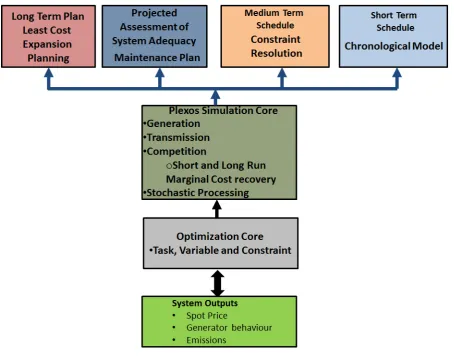
PLEXOS breaks down the simulation of the NEM into a number of phases which range in
scope and scale. These time-scales range from: year-long generation expansion planning and
constraint evaluation; security and systematic supply requirements; network expansion down
to hourly dispatch and market clearing. Although PLEXOS has the capability to perform
five-minute dispatch we will follow the method used by the Future Grid Forum [50] and
AEMO’s National Transmission and Network Development Plan [42], which both use hourly dispatch periods. This particular time scale is most useful in simulating long-term
electricity market structural behaviour patterns and in an effort to reduce the computational
requirements of this study. The operation and the interaction between these modelling phases
[image:12.595.72.527.308.667.2]is shown in Figure 1. We shall now explore briefly the operational aspects of PLEXOS and the methodologies it employs to simulate the electricity market.
Figure 1: PLEXOS Simulation Core
3.1 Optimal Power Flow Solution
The solution to the optimal power flow (OPF), is one of the core functions of the PLEXOS
simulation engine which utilizes a linearized version of the direct current (DC) approximation
12
losses. In PLEXOS the locational marginal prices (LMP) are reflective of transmission
marginal loss factors as well as congestion throughout the system. Further, the congestion
modelling results are also an indicator of long-term constrains within sub-branch loops (such
as the Tarong loop in Queensland), which may require capacity upgrades in the future.
However, PLEXOS does not perform any pre-computation or impose any restrictions on how
dynamic the network data may be, thus it can model transmission augmentations and
transmission outages dynamically. PLEXOS thus optimizes the power flows using a
linearized DC approximation to the AC power flow equations. This model is completely
integrated into the mathematical programming framework that results in the realistic
simulation of generator dispatch, transmission power flows and regional reference pricing
which are jointly optimized with the power flow solution.
3.2 LT Plan
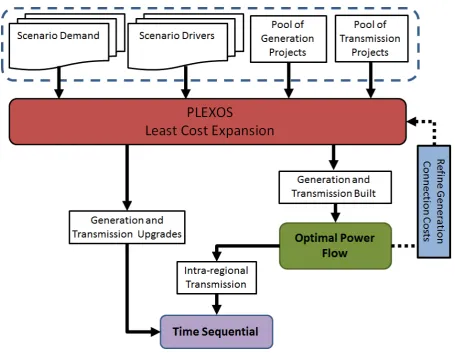
The long-term (LT) planning phase of the PLEXOS model establishes the optimal
combination of new entrant generation plant, economic retirements, and transmission
upgrades which will minimize the net present value (NPV) of the total costs of the system
over the planning horizon (as detailed in Figure 2). The following types of
expansions/retirements and other planning features are supported within the LT Plan:
Building new generation assets (including multi-stage projects)
Retiring existing generation plant
Upgrading the capacity of existing transmission lines
New build transmission line infrastructure (including multi-stage projects).
Furthermore, the PLEXOS least cost expansion planning phase also allows the tactful
inclusion of global and domestic policy drivers into its input data set. While the scenario
development capability of PLEXOS is an important issue into its operation, the
13
Figure 2: PLEXOS Least Cost Expansion Modelling Framework
3.3 PASA
The Projected Assessment of System Adequacy (PASA) schedules maintenance events such
that the optimal generation capacity is available and distributed suitably across
interconnected regions. The PASA phase of the model allocates/samples discrete and
distributed maintenance timings and random forced outage patterns for generators and
transmission lines. This ability to sample forced and planned outage patterns allows for
uncertainty in generation plant availability and informs the LT Plan expansion phase of the
model of further capacity requirements.
3.4 MT Schedule
The Medium Term (MT) Schedule is a model based on Load Duration Curves (LDC) (also
known as load blocks), that can run on daily, weekly or monthly resolutions which includes a
full representation of the power system and major constraint equations, but without the
complexity of individual unit commitment. The MT Schedule models constraint equations
14
Fuel off-take commitments (i.e. gas take-or-pay contracts)
Energy limits
Long term storage management taking into account inflow uncertainty
Emissions abatement pathways.
Each constraint is optimized over its original timeframe and the MT to ST Schedule’s bridge
algorithm converts the solution obtained (e.g. a storage trajectory) to targets or allocations for
use in the shorter step of the ST Schedule. The LDC blocks are designed with more detailed
information concerning peak and off-peak load times and less on average load conditions,
thus preserving some of the original volatility.
The solver/s used by PLEXOS will then schedule generation to meet the load and clear offers
and bids inside these discrete blocks. System constraints are then applied, except those that
define unit commitment and other inter-temporal constraints that imply a chronological
relationship between LDC block intervals. The LDC component of the MT Schedule
maintains consistency of inter-regional load profiles which ensures the coincident peaks
within the simulation timeframe are captured. This method is able to simulate over long time
horizons and large systems in a very short time frame. Its forecast can be used as a
stand-alone result or as the input to the full chronological simulation ST Schedule.
3.5 ST Schedule and Spot Market Dispatch
The Short Term (ST) Schedule is a fully featured, chronological unit commitment model,
which solves the actual market interval time steps and is based on mixed inter programming.
The ST Schedule generally executes in daily steps and receives information from the MT
Schedule which allows PLEXOS to correctly handle long run constraints over this shorter
time frame.
PLEXOS models the electricity market central dispatch and pricing for each state on the
NEM via Regional Reference Nodes (RRN). This is achieved by determining which power
stations are to be included for each dispatch interval in order to satisfy forecasted demand.
To adequately supply consumer demand, PLEXOS examines which generators are currently
bid into the market as being available to generate for the market at that interval. This
15
generators in the dispatch set in the given trading interval, taking into account the physical
transmission network losses and constraints can serve load.
Each day consists of 24 hour trading periods, and market scheduled generation assets have
the option to make a supply offer for a given volume (MW) of electricity at a specified price
($/MWh) across 10 bid bands. Each band, consists of bid price/quantity pairs which are then
included into the nodal bid stack.
Following the assembly of the generator bid pairs for each bid band, the LP algorithm begins
with the least cost generator and stacks the generators in increasing order of their offer pairs
at the node, while taking into account the transmission losses. The LP algorithm then
dispatches generators/power stations in merit order, from the least cost to the highest cost
until it dispatches sufficient generation to supply the forecasted demand with respect to the
inter-regional losses. This methodology replicates not only the NEM dispatch process but is
similar in construction to the least cost “Dutch Auction” [51, 52].
The price of the marginal generating unit at each time interval determines the marginal price
of electricity at the RRN for that given trading period. It should also be noted that this
dispatch process and the ST Schedule have the following properties:
The dispatch algorithm calculates separate dispatch and markets prices for each node
and then for the Regional Reference Price for each state of the NEM
Generator offer pairs determine the merit order for dispatch which and are adjusted with respect to relevant marginal loss factors
The market clearing price is the marginal price, not the average price of all dispatched
generation (as per the “Dutch Auction” market design [53, 54]).
Price differences across regions are calculated using inter-regional loss factor equations as outlined by AEMO [42, 49].
PLEXOS can produce market forecasts, by taking advantage of one of the following three
generator bidding behavioural models for cost recovery and market behaviour methodologies:
Short Run Marginal Cost Recovery (SRMC, also known as economic dispatch)
User defined market bids for every plant in the system
16
3.6 Short Run Marginal Cost Recovery Algorithm
The core capability of any electricity market model is to perform the economic dispatch or
Short Run Marginal Cost (SRMC) recovery based simulations of generating units across a
network to meet demand at least cost. PLEXOS’ platform performs economic dispatch under
perfect competition where generators are assumed to bid faithfully their SRMC into the
market. While simulations such as these will never result in a price trace which would match
historical market data from an observed competitive market, they provide a lower bound
representative of a pure competitive market.
3.7 Long Run Marginal Cost Recovery
PLEXOS has implemented a heuristic Long Run Marginal Cost (LRMC) recovery algorithm
that develops a bidding strategy for each generating portfolio such that it can recover the
LRMC for all its power stations. This price modification is dynamic and designed to be
consistent with the goal of recovering fixed costs across an annual time period. The cost
recovery algorithm runs across each MT Scheduled time step. The key steps of this algorithm
are as follows:
1. The MT Schedule is run with ‘default’ pricing (i.e. SRMC offers for each generating
units)
2. For each firm (company), calculate total annual net profit and record the pool revenue
in each simulation block of the LDC
3. Notionally allocate any net loss to simulation periods using the profile of pool
revenue (i.e. periods with highest pool revenue are notionally allocated a higher share
of the annual company net loss)
4. Within each simulation block, calculate the premium that each generator inside each
firm should charge to recover the amount of loss allocated to that period and that firm
equal to the net loss allocation divided by the total generation in that period – which is
referred to as the ‘base premium’
5. Calculate the final premium charged by each generator in each firm as a function of
the base premium and a measure how close the generator is to the margin for pricing
(i.e. marginal or extra marginal generators charge the full premium, while
infra-marginal generators charge a reduced premium)
6. Re-run the MT Schedule dispatch and pricing with these new premium values
7. If the ST Schedule is also run, then the MT Schedule solution is used to apply
17
method is run at each step. Thus, the ST Schedule accounts for medium-term
profitability objectives while solving in short steps.
In using PLEXOS, this project has set the LRMC recovery algorithm to run three times for
each time step to produce price trace forecasts with sufficient volatility and shape as
recommended by the software’s vendor, Energy Exemplar. This will ensure that under normal demand conditions, generating units will bid effectively to replicate market conditions
as seen in the NEM. It should be noted that the actual dispatch algorithm in this process is
still an LP based protocol which is in contrast to other commercial tools that use much slower
heuristic rule based algorithms to solve for LRMC recovery.
3.8 Data and assumptions
At the time of initiating this modelling the only publicly available PLEXOS data set that is
available is AEMO’s NTNDP 2014 [42]. However, this database requires significant
upgrading/repurposing so the database developed for this project was developed using the
NTNDP dataset and other publicly available data. Prior to this project a former database to
the NTNDP was used to model wholesale market behaviour in other related research such as:
the deployment of plug-in hybrid electric vehicles [55], distributed generation [20] and the
competitiveness of renewables [46]. The data and assumptions used to populate the database
have been developed such that the completed database includes the following details:
Capacity factors (%)
Ramp rates (MW/min)
Emissions intensity factors (kg-CO2/MWh)
Fuel costs ($/GJ) for coal, oil, distillate and natural gas
Gas transport costs ($/GJ), where Moomba used as the NEM reference price
Variable and fixed operating and maintenance costs ($/MWh and $/MW/year respectively)
Scheduled outage rates and probability of forced outage rates (% hours/year).
3.8.1 Generation capacity and investment
Historical generation plant behaviour was sourced from AEMO’s data server [56], with technical specifications for all current generation assets sourced from AEMO, ACIL, Worley
18
with long-term supply contracts which were likely to be in place from 2030 onwards.
Inclusion of the above data provided an accurate predictor of generation plant likely to be
economically and technically feasible [42, 48, 49, 56, 61-65] for operation in 2035.
3.8.2 Fuel Prices
The cost projections for coal for use in QLD, NSW and VIC power generation were sourced
from recent assessments on fuel prices by AEMO and others [42, 48, 49, 56-60, 63, 66, 67].
Furthermore, due to the lack of infrastructure to support international trade, coal prices for
power generation are projected to remain subdued and stable until 2050. Natural gas costs
and market conditions are the subject of another model which will be discussed in Section 4.
3.8.3 Network
The network topology used within the modelling framework was initially sourced from
AEMO’s NTNDP [42], with its corresponding constraints on inter-region transmission flow. Upgrades to the network for this paper were only assumed if they had been previously
announced or currently under consideration by the market operator AEMO or the Australian
Energy Regulator (AER). Furthermore, the optimal expansion of the transmission network
19
4
Natural Gas Market Modelling
Australia is in a key geographic and strategic position to supply a sizable proportion of the
Asia Pacific regions’ LNG demand, and potentially be one of the world’s largest suppliers
(see [68]). Current trends in the development of the natural gas industry, particularly in
Western Australia, have shown that the internationalization of prices can have a significant
impact on electricity prices [69], carbon emissions [45, 47, 70], and the availability of gas for
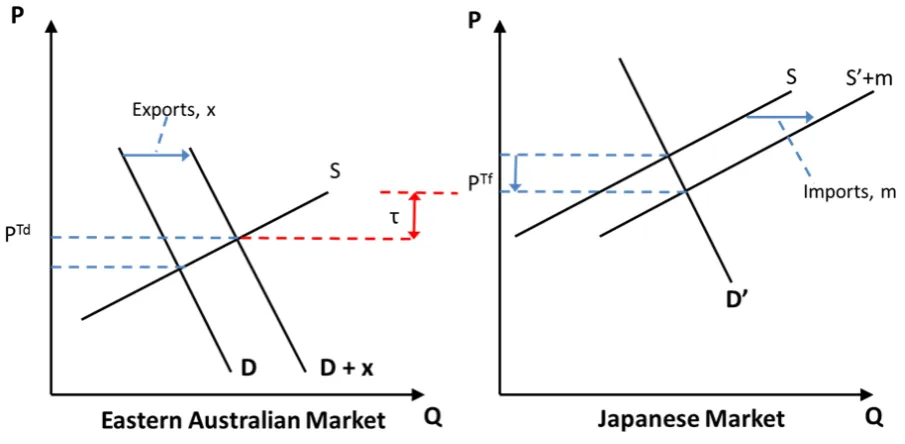
industrial users [71]. The effects of the expected uplift in prices with trade between two
markets, price in each adjusts depending on the elasticities of supply and demand (see Figure
4).
Further, the arbitrage opportunities which are presented to US produces to the detriment of
Australia’s interests are also of concern, such that the prevailing spot price in Japan has historically been much higher than the comparative European ports [72]. The newly
improved transport cost conditions (due to the upgrade of the Panama Canal) make East
Asian markets a very attractive prospect for US shale gas producers [73, 74].
While the demand for natural gas in Australia pales in comparison to its export potential [71],
there are numerous concerns surrounding the potential effects that exports may have on
industrial users and electricity generators. These competing interests are also apparent,
particularly between state governments, who are likely to receive a significant boost in
resource rents and somewhat higher availability of cheap supply for domestic consumption.
Aside from the significant coal reserves in Queensland, one of the key drivers for coal seam
gas exploration was the implementation of the Gas Electricity Scheme in 1994 [75, 76].
Accredited electricity generators could create tradable certificates which represented one
MWh of eligible generation. The schemes initial intention was to diversify the generation
mix, encouraging gas exploration and to offset the then high costs of using natural gas. This
inherent interest in using gas from electricity in Queensland was complemented by the
growing concern for reducing greenhouse gas emissions.
Similarly the New South Wales (NSW) government in 2003 implemented the NSW
Greenhouse Gas Abatement Scheme (NGGAS), which mandated a reduction in CO2
emissions per capita by 2007. The development of new gas powered generation assets which
20
capable of contributing to this abatement target. These two schemes were closed in 2013 and
2012 respectively due to the significant discovery of natural gas resources in QLD and the
[image:21.595.87.514.173.478.2]introduction of national emissions reduction legislation [77].
21
Figure 4: The effects of international market linkage
The modelling framework ATESHGAH [78, 79], is well placed within the international
energy literature which has an extensive history of implementing Complementarity models
for examining oil and natural gas markets [80-82]. Many of these models that were
developed, address fundamental policy issues affecting natural gas markets. For example: the
disruption of Russian gas supplies via the Ukraine [83]; intra-European trade and capacity
bottlenecks [84, 85]; the potential cartelization of global gas markets [86]; the influence of
Eurasian gas supplies, and; the strategic implications of the South Stream pipeline [77]. The
use of Complementarity methods has also been used in a variety of studies which examine
the market liberalization process in a number of international contexts [87].
This report summarizes the inputs and overarching assumptions for the Non-Linear Program
(NLP) which in turn applies the Mixed Complementarity Problem (MCP) based framework,
to examine multi-producer oligopolistic agent behaviour via Nash-Cournot equilibrium in the
Eastern Australia natural gas market (EGM). This modelling platform has been developed in
GAMS to take advantage of its ability to model both economic problems, but also its
implementation of the MCP solver known as PATH [88-90]. More specifically, this
deterministic and myopic model examines the production trends, system adequacy and
22
The model developed by Wagner [78], is focused on analyzing the international linkages that
the EGM will have with its main export partners in Asia and the likely effects on production
and wholesale gas costs. The economic behaviour of agents in this newly minted
internationalized market is modelled via an optimization problem and market clearing
conditions. The principle agents which we have considered here are producers,
traders/marketers, and consumers in three crucial sectors (GPG, MMLI and LNG). The roles
of end-users and marketers have been simplified so that a producer who would normally face
several intermediaries before delivering to the final consumer, faces an aggregated demand
curve for each node in the network. In contrast to other models whose implementation of
multiple staged games [86] link several demand curves and a border price which would
overly complicate this model. We have assumed that producers act as semi-vertically
integrated agents whose roles fit more in context with the EGM [71, 78].
The primary objective for creating this model was to examine the strategic interactions
between the producer agents and LNG exporters. We have implicitly assumed that there is no
material benefit for disaggregating traders/marketers from the supply side. As noted above,
the aggregation of these roles is a reasonable and necessary assumption given that producers
such as Arrow and Origin not only sell at the bulk supply level, they consume natural gas as a
production input into markets such as GPG and LNG. Furthermore, as we only consider
yearly time intervals for demand we are able to avoid any issues with long-term contracts for
supply and spot market behavioural issues which is in keeping with the international
experience with modelling these types of markets [91-93] and more specifically their
linkage/interconnection [94].
4.1 Data
The purpose of this model is to provide a comprehensive representation of all producers in
the EGM. The data set includes all producing fields (by owner/operator), pipelines
(transmission and major laterals) and demand by the three main gas consuming sectors within
23
We assume that there is an integrated producer/trader/marketer agent whose objective is to
maximize profits when faced with nodal inverse demand curves. The lack of data availability
on nodal Mass Market (MM) and Light Industrial (LI) demand (excluding utility gas powered
generation), is one of the limitations of this model. Aggregate historical and forecasts of
demand for the combined sector MM/LI is used to maintain the appropriate level of scope for
this analysis. Similar agent aggregations have also been seen in the international literature,
and the experience with modelling the European [83, 91, 93] and US markets [92], further
justifies our methodology.
Initially the base year 2013, is used to parametrize the model for simulation, which allows us
to establish the yearly and long-term structural consequences of international market linkage
for the EGM with its key Asian trading partners. The literature which examines similar
markets/regional trade blocks, has deemed it sufficient to evaluate these situations via yearly
time steps [86, 92, 95]. The omission of daily or seasonal effects associated with demand may
lead to different results, especially in the presence of binding transport constraints and high
levels of capacity utilization. However, the use of storage and inter-period arbitrage by
producers/processors can overcome some of these difficulties [92, 95].
The data and analysis presented in this report are represented in SI units. Therefore, reserves
are expressed in petajoules (PJ); production, transport capacity and demand in PJ/year, which
allows for us to neglect differential qualities and facilitate constraint qualifications to be
uniformly applied. We shall now explore the construction of the base case data set and detail
the possible scenarios and their implementation.
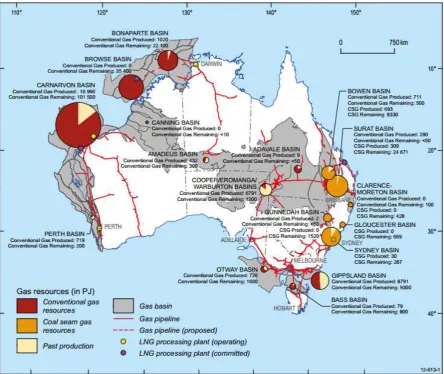
The availability of resources in the EGM has been sourced from the technical literature [83,
86], state and federal regulators [71, 96, 97], the market operator [98-100], industry analysts
[66, 101-103] and corporate reporting [104, 105] (also see Figure 5). The discovery, firming
up and transformation of reserve tranches are all sourced and calculated exogenously to this
modelling framework [97, 102, 103]. The 13 basins’ reserve and resource base case data is
shown below in Table 1 and Table 2 (by basin and by resource type). It should be noted that
each basin is associated with a single resource type. For example, the resources associated
with Surat/Bowen are considered conventional natural gas, whereas the Bowen and Surat
24
Figure 5: Australia’s natural gas basins. Source: Geoscience Australia
Production costs have been sourced from a range of commercial services, industry reports
and government reports [71, 100]. Each field is composed of tenures and grouped by
geological formation and owner/developer (as in [106, 107]). Each field (producing area) has
detailed estimates of reserves and resources with a range of costs associated with extraction
(cf. [99]). The costs associated with each tranche of possible production is then used to
calibrate the supply cost curve (via the Golombek supply cost function [108]).
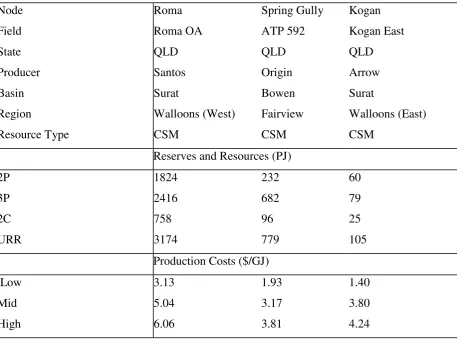
Table 3 shows example fields with corresponding reserves and costs. We also provide the
cumulative cost curve for natural gas by production tranche within each basin (see Figure 6).
It shows that 50% of all available reserves have an expected production cost of $5.16/GJ,
which far exceeds the expected average cost of US shale gas production at $2-3/GJ? [92,
25
Table 1: Natural Gas Reserves within the Eastern States
Basin Resource 2P 3P 2C 3C URR
Type (PJ) (PJ) (PJ) (PJ) (PJ)
Bass Conventional 338 250 360 268 726
Bowen CSG 8,535 25,130 4,345 2,834 31,488
Clarence/Moreton CSG 445 2,922 2,511 629 6,062
Cooper/Eromanga Mixed 2,198 1,901 6,416 244 8,488
Galilee CSG - - 259 1,634 1,634
Gippsland Conventional 3,890 3,859 1,094 10,000 14,192
Gloucester CSG 669 832 - - 832
Gunnedah CSG 1,426 1,426 3,460 - 4,886
Maryborough Shale - 3,000 - - 3,000
Otway Conventional 604 - 274 - 878
Surat CSG 28,835 38,831 11,979 - 50,810
Surat-Bowen Conventional 76 106 2,000 - 2,106
Sydney CSG 424 728 - - 728
Totals 47,440 78,985 32,698 15,609 125,830
Table 2: Natural gas reserves by resource type
Resource 2P 3P 2C 3C URR
Type (PJ) (PJ) (PJ) (PJ) (PJ)
Conventional 1,790 2,007 4,176 244 6,349
CSG 40,334 69,868 22,554 5,097 96,440
Offshore 4,832 4,109 1,728 10,268 15,796
Shale - 3,000 - - 3,000
Unconventional 5 - 4,240 - 4,245
26
Table 3: Field reserve and production cost data example
Node Roma Spring Gully Kogan
Field Roma OA ATP 592 Kogan East
State QLD QLD QLD
Producer Santos Origin Arrow
Basin Surat Bowen Surat
Region Walloons (West) Fairview Walloons (East)
Resource Type CSM CSM CSM
Reserves and Resources (PJ)
2P 1824 232 60
3P 2416 682 79
2C 758 96 25
URR 3174 779 105
Production Costs ($/GJ)
Low 3.13 1.93 1.40
Mid 5.04 3.17 3.80
High 6.06 3.81 4.24
27
Figure 6: Marginal Cost Curve for the Eastern Australian Gas Market
The functional form of the Golombek primary cost function
𝐶𝑖(𝑣𝑖) = 𝛼 ∗ 𝑣𝑖 +12 𝛽 ∗ 𝑣𝑖2− 𝛾 ∗ (𝑉𝑖 − 𝑣𝑖) ∗ ln (1 −𝑣𝑉𝑖
𝑖) − 𝛾 ∗ 𝑣𝑖,
(1)
The marginal cost function is as follows:
where vi, is the volume of production in time t, α is the minimum cost of production, β and γ
are parameters fitted to the change in production costs associated with accessing increasingly
deeper and more difficult to extract gas and Vi is the remaining reserves. The sensitivity of
each of the aforementioned coefficient is presented in Figure 7. We present three key supply fields with their associated Golombek coefficients in Table 4 and an example of the marginal cost curve for the unconventional Cooper/Eromanga fields in Figure 7.
𝑀𝐶𝑖(𝑣𝑖) = 𝛼 + 𝛽 ∗ 𝑣𝑖− 𝛾 ∗ ln (1 −𝑣𝑉𝑖 𝑖),
28
Figure 7: Sensitivity of the Golombek marginal cost of supply curve
[image:29.595.77.522.331.629.2]29
Table 4: Golomobek Function Coefficients for Example Fields
Node Roma Spring Gully Kogan
Field Roma OA ATP 592 Kogan East
Α 3.35 4.70 3.01
Β 0.061 0.0044 0.00108
Γ -0.015 -0.00099 -0.003157
Processing capacity is sourced from AEMO’s annual planning reports (GSOO [99, 100]), and it should also be noted that processing capacity is dealt with implicitly as an exogenous upper
bound on production capacity. Thus, expansion timing and entry timing of processing plant is
derived from AEMO [100].
Transport pipelines and the formation of the network topology has been derived from [99,
100], and more generally from [101]. The maximum flow capacity along each pipeline
pathway within the network of nodes, is by necessity an exogenous input into the model.
Contrary to the production and processing capacities, the dual of the utilization in network
capacity is required for the model formation. Pipeline network expansion can also be
implemented via scenarios for policy planning and analysis or with optimal expansion
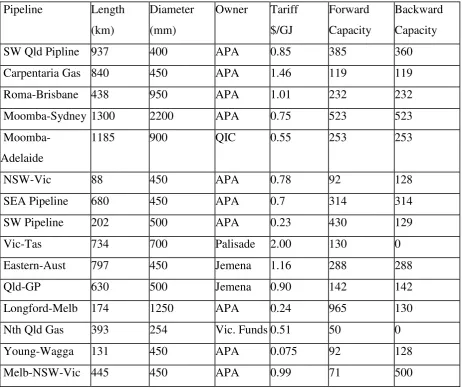
techniques discussed in André [110]. We present the main transmission pipelines which
30
Table 5: Main Transmission Pipelines
Pipeline Length Diameter Owner Tariff Forward Backward
(km) (mm) $/GJ Capacity Capacity
SW Qld Pipline 937 400 APA 0.85 385 360
Carpentaria Gas 840 450 APA 1.46 119 119
Roma-Brisbane 438 950 APA 1.01 232 232
Moomba-Sydney 1300 2200 APA 0.75 523 523
Moomba-Adelaide
1185 900 QIC 0.55 253 253
NSW-Vic 88 450 APA 0.78 92 128
SEA Pipeline 680 450 APA 0.7 314 314
SW Pipeline 202 500 APA 0.23 430 129
Vic-Tas 734 700 Palisade 2.00 130 0
Eastern-Aust 797 450 Jemena 1.16 288 288
Qld-GP 630 500 Jemena 0.90 142 142
Longford-Melb 174 1250 APA 0.24 965 130
Nth Qld Gas 393 254 Vic. Funds 0.51 50 0
Young-Wagga 131 450 APA 0.075 92 128
Melb-NSW-Vic 445 450 APA 0.99 71 500
4.1.1 Natural Gas Demand
The demand for natural gas by the LNG sector has been initially sourced from [71, 96, 100,
101, 103]. We assume that the required minimum capacity utilization rate for each of the
proposed liquification facilities is set at 93% [111]. Furthermore, the timing of demand is a
key variable, and is therefore considered in the scenario planning capability of this model. It
should be noted that the demand is assumed to incorporate the losses associated with pipeline
transport and liqification as is presented via the "as-produced" method in a similar fashion to
the electricity sector [112, 113]. The timing of additional liquification plant trains to
correspond to export demand, further developments in gas reserves and international demand,
31
The reference prices of demand for gas by the LNG sector is derived from the Free-on-board
(Fob) netback equivalent price with respect to the Japanese hub Cargo-insurance-freight price
(Cif). The derived Cif prices presented here for model calibration is sourced from the burner
tip equivalent of the Japanese Crude Cocktail (JCC) price for oil translated into a gas price
via the standard oil index linked S-curve [111, 113]. The demand curve, an iso-elastic
non-linear function is represented with respect to our assumptions of quantity and reference price
via the JCC/S-Curve pricing methodology [113].
The electricity generation sector is greatly affected by a shift in price and availability of
natural gas [47]. As such, the future development of Gas fired Power Generation (GPG) is
particularly sensitive to long-term prices and has had similar market integration issues when
gas supply networks have been interconnected via international exports (e.g. Western
Australia [111]). The demand for natural gas by GPG’s has been sourced from [100].
Furthermore, technical specifications for each of these power stations is sourced from [42, 48,
49, 57, 58, 62, 63, 112, 114]. We calibrate the likely bounds of demand given historical
operating capacities [42, 49], as a mid-point estimate. The upper and lower bounds for
natural gas demand is derived from each GPG’s installed capacity, heat rate (GJ/MWh), the
type of operation (baseload, intermediate or peaking) and the technology type of the gas
turbine (open or combined cycle), are all used to exogenously parameterize each power
station.
The combined Mass Market/Light Industry sector historical and forecasts of demand for
natural gas has been calculated from AEMO [100] and BREE [71, 96]. Historical prices at
each of the corresponding nodes to AEMO’s original network topology [99, 100] have been
used to parametrize the iso-elastic inverse demand curve for the sector. Elasticities of demand
have been sourced from the literature to further aid in the construction of this model [
115-118]. We have chosen to represent the demand for natural gas in any node/market m, by
applying a non-linear iso-elastic demand function which can be represented as follows:
𝐷𝑚 = 𝐷𝑚𝑂[𝑃𝑚𝑃(𝐷𝑚) 𝑚𝑂 ]
𝜎𝑚
32
where 𝐷𝑚 and 𝑃𝑚(𝐷𝑚) are the levels of demand and price at equilibrium, 𝐷𝑚𝑂 and 𝑃𝑚𝑂 are the
reference (historical) demand and prices respectively in market m in 2013 [98]. The price
elasticity of demand 𝜎𝑚, for the three sectors in this model (GPG, LNG and MM/LI) is
sourced from previous literature [117, 119, 120]. As mentioned earlier in this report, we shall
neglect the full technical description of the market clearing conditions and algorithmic
[image:33.595.151.446.205.613.2]methods for simulating this market model and again refer the reader to [78].
33 4.2 Base Case Simulation Results
The base case scenario presented here creates a comparative benchmark for future scenario
development for policy analysis. This base case is largely used as a mechanism for parameter
validation and as a proof of concept rather than a most likely case and should be viewed as
such. Initially, we assume that the Japanese Cif price remains high, which corresponds to the
medium scenario for global oil prices which reaches ~160/bbl in 2040 [121]. Demand for
natural gas has been derived from the AEMO Gas statement of Opportunities (see [99, 100]).
Electricity market generation behaviour has been derived from AEMO [42, 48, 49] and we
further assume that entry timing and retirements are within the bounds of previously reported
rates [47].
The LNG sector is assumed to have an investment and production profile that is largely
derived from [99, 100]. Furthermore, we also assume that the entry of ARROW gas reserves
will be delayed and the associated national supply and marginal cost curve is shifted to the
left (see Figure 10). While this shift in the supply curve is dramatic, the resulting gas prices for the Eastern Australian capital cities are still somewhat in line with the expectations of
AEMO and Core Energy’s analysis [102, 103]. While world gas markets are now in turmoil given the current Saudi Arabian led OPEC over production of oil and gas, the world being
awash with gas is still a somewhat interesting and important scenario to examine. The results
presented in Figure 11 and Figure 12, while not out of sample with AEMO [100], nor its counterpart Core Energy [103], estimate that prices will remain high. This base case
mentioned here represents a proof of concept for the modelling platform and its integration
34
Figure 10: Marginal cost curve shift associated with a delay supply
35
Figure 11: Natural Gas Spot Prices Base Case Scenario
36
5
Future Grid Scenario Modelling
In this section we will provide an overview of the scenario frameworks employed by Project
3 and the CSIRO Future Grid Cluster [50]. We will then provide a brief overview of the
relationships between the CSIRO’s Future Grid Forum (CFGF) Scenarios and how the cluster
will proceed with its modelling. Furthermore, this report will largely focus on Project 3’s
modelling results for the first of the CFGF scenarios with an expanded sensitivity and parameter suite.
Figure 13: Future Grid Forum core scenarios [50]
Project 3 will reexamine and re-establish the CFGF scenarios from first principles and this reformulation will allow for the Future Grid Cluster projects to take into account a broader
range of: policy/regulatory; economic/market and technological influences. These three key system influencer categories are inextricably linked and therefore need to be modelled.
Furthermore, these drivers are the cornerstone to scenario development and quite like a chain
37
Firstly, the key influencers were summarized into ten scenario kernel elements that are
somewhat independent of each other. We then generate a set of “Reduced Scenarios” that can be used for discussion, scenario selection and external communication purposes. Secondly,
scenarios are represented via all of their explicit sub-components which reflect the “micro”
inputs which generate the parameter suite that needs to be modelled explicitly.
5.1 The four influences
The four categories of key influences and their inter-relationships are set out in this Section
and we provide a further overview of Project 3’s scenario construction and integration with
the CFGF.
1) Policy (and regulatory) decisions
Actions in the policy and regulation space which are under the control of Australian policymakers and stakeholders
Policy actions are orthogonal to states of the world
Can depend on outcomes of states of the world
Policy and regulatory decisions can be classified into either supply- or demand-side focused.
2) States of the World
Forces or influences that are outside Australia’s control are described here by the
following three categories:
a. Supply-side forces: These include changes in the parameters of key supply
side technologies, such as technology costs and costs of fuel feed-stocks
b. Demand-side forces, that are further divided into two sub-categories, those
being:
Structural and behavioural, and
Technological development related
c. International Forces which includes actions of markets and policy decisions by
other countries.
38
Many policy and states of the world need to be modelled as having two or three outcomes.
Some are binary (yes/no) and some are sensitivities with several states. We chose to limit
sensitivities to three levels, that is, low, medium, and high (or slow, medium, and fast in the case of rate based parameters, such as technological learning). This limitation is imposed in
order to limit the extent of the combinatorial explosion that arises when combining all the
different possible outcomes.
4) Linkages
There are also interactions between the various forces and their sensitivities. In particular, it
is important to note that there can be linkages within and between forces in the following two
categories:
States of the world
Policy.
5.2 Scenario Kernels
In order to facilitate the communication of Project 3’s modelling results for scenarios that are
relevant to policy and investment decisions, we need to work at an appropriate level of detail.
Since the Future Grid Cluster is only concerned with the impacts of policies and external
forces on large-scale infrastructure investments and wholesale market behaviour, the kernel
scenarios will be handled at this level. The structure for developing the Project 3 scenarios is
39
Table 6: Kernel elements
Kernel Element States of the World
Supply Side Low/Slow Medium High/Fast
Technology
costs and
selection
Fossil Technology
costs
1
Renewable/Zero
emission
Technology costs
reduction
2
Fossil Fuel Costs 3
Climate policy
Carbon Pricing 4
Renewable Energy
Target
5
Electricity
Demand
Decline BAU High
Energy Growth
(GWh)
6
Demand
profile changes
Decrease Status
Quo
Increase
Load Factor
Change
7
-> Day Status
Quo
-> Night
Day to Night
Load peak shift 8
Policy Support
for renewable
generation
Yes No
Transmission Super projects 9
Scale Efficient Network Extensions 10
The above table sets out the ten kernel elements grouped into three major categories: supply
40
three sensitivities and a further two which have two sensitivities. This leads to a total of
26,244 possible combinations which are not easily manageable for without a methodology
such as ours.
5.3 Scenario Planning: BAU/Counter Factual
Establishing a set of scenarios which examines the possible future given a set of prior
assumptions is a difficult exercise [122-124]. The most common starting point for any
investigation using the “Scenario Analysis” methodology [125, 126], is to create a counter-factual that may or may not represent our future expected states, but is used as a reference
state for comparison [127].
This counterfactual in our case is used to create a well-defined rule based environment whose
main value is to elucidate the current state of affairs in the electricity sector and to understand
an idealised representation completely [46, 128]. While a very idealised picture of the
electricity market may turn out to be an approximate and somewhat incomplete picture of the
real world, its “valuefulness” lies in the construction of such a conceptual framework [128], as outlined in this report and the previous deliverables [129, 130]. Furthermore, due to recent
policy volatility and an increasingly visible trend in the decline of electricity demand this
scenario shouldn’t be regarded as a “Business As Usual” case study. Furthermore, this methodology remains useful as a reference or counterfactual scenario against which other
scenarios could be compared [125, 128, 130-132].
While this BAU/Counter Factual is mostly self-explanatory the broad aspects of this scenario
are as follows:
Demand for electricity is assumed to be increasing in terms of total annual energy (as generated) and with respect to peak demand.
The shape of the load duration curve and load factors for each of the NEM states
remains the same (as shown in the 2012 and 2014 AEMO NTNDPs’ [42, 133]).
Greenhouse gas (GHG) and Renewable Energy Target (RET) policies are both assumed to be with the moderate/medium carbon price trajectories and the previous
RET (41 TWh at 2020 which equates to roughly 20% of all electricity generated).
Technological costs, for conventional (combustion) and renewable energy generators have been sourced from a survey of the best available forecasts (i.e. from [42, 45, 50,
41
The assumptions used to develop this BAU/Counter Factual scenario are presented in Table 7 and were originally developed for a similar exercise by this project team [45, 137]. Following the broad overview presented in Table 7 we will now provide the homoeomorphic mapping into the scenario kernel elements via
Table 8.
Table 7: BAU/Counter Factual Scenario Assumptions
Forces underpinning
scenario
Long-term historic trend consumption growth
No consumer reaction to rising prices
Gas prices reflect global energy trends
Climate change not an issue
No recognition of technology shift to renewables and
distributed generation
Capital costs (2035)
CCGT $1100/kW
OCGT $1100/kW
Wind $2558/kW
Network topology Existing
Generation locations Located close to transmission infrastructure
Modelling
assumptions Wind intermittent to 30% capacity factor
Fuel price
(Moomba), (2035)
Medium Gas $8.32/GJ
Low gas price $4.89/GJ
42
Table 8: BAU/Counter Factual Scenario Kernels BAU/ Counter Factual
Kernels
Kernel
Eleme
nt
States of the World
Supply Side Low/Slo
w Medium
High/Fas
t
Technology costs
and selection
Fossil Technology
costs 1 X
Renewable/Zero
emission
Technology costs
reduction
2 X
Fossil Fuel Costs 3 X
Climate policy
Carbon Pricing 4 X
Renewable Energy
Target 5 X
Electricity Demand Decline BAU High
Energy Growth
(GWh) 6 X
Demand profile
changes
Load Factor
Change
Decrease Status Quo Increase
7 X
Day to Night
demand peak shift
-> Day Status Quo -> Night
8 X
43
generation
Transmission Super projects 9 X
Scale Efficient Network Extensions 10 X
5.4 Scenario Correspondence between CFGF and the Project 3 CFGC
The CFGF has taken a similar and somewhat related approach to developing its own scenario
suite but has traversed a slight different path via its need to use detailed modelling levers.
This has translated into a modelling and simulation input based approach. Furthermore, the
scope and scale of the CFGF had the additional requirement of examining distribution system
investment due to expansion, asset replacement and end-user pricing impacts and for the
potential for changing elasticities in demand.
The CFGF scenarios have been constructed via three differentiators:
Centralised generation versus distributed generation
Significance of peak demand growth and the flattening (skewness) of the load profile
Deployment of large scale renewable energy generation projects.
These differentiators are represented within this projects’ scenario modelling framework,
while also incorporating the relationships between the scenario Kernels (as illustrated in
Table 9). Furthermore, the CFGF scenario drivers are shown in Table 10 below.
Below in Table 9, the relationship between this projects methodology of using supply- and demand-side based drivers, and the CFGF scenarios is shown. Given that there are a variety
of ways that drivers can be classified, we have used a mapping matrix as a guide to
translating between the two slightly different approaches. As we have reported previously
[129, 130], for example, we break the growth of distributed generation (DG) impacts into
three components which then become drivers for the modelling scenarios: energy efficiency;
and load profile changes of two kinds, load factor changes; and shifts of the peak to different
times of the day. While this matrix is not exhaustive, experience is needed to transform the
input data into inputs using our framework. We have done this in Project 3 by setting up the