C u t a n d P a s t e B a s e d T e x t S u m m a r i z a t i o n
H o n g y a n J i n g a n d K a t h l e e n R . M c K e o w n D e p a r t m e n t o f C o m p u t e r S c i e n c e
C o l u m b i a U n i v e r s i t y N e w Y o r k , N Y 1 0 0 2 7 , U S A h j i n g , k a t h y Q c s . c o l u m b i a . e d u
A b s t r a c t
We present a cut and paste based text summa- rizer, which uses operations derived from an anal- ysis of human written abstracts. The summarizer edits extracted sentences, using reduction to remove inessential phrases and combination to merge re- suiting phrases together as coherent sentences. Our work includes a statistically based sentence decom- position program t h a t identifies where the phrases of a s u m m a r y originate in the original document, pro- ducing an aligned corpus of summaries and articles which we used to develop the summarizer.
1 I n t r o d u c t i o n
There is a big gap between the summaries produced by current a u t o m a t i c summarizers and the abstracts written by h u m a n professionals. Certainly one fac- tor contributing to this gap is that automatic sys- tems can not always correctly identify the i m p o r t a n t topics of an article. Another factor, however, which has received little attention, is that automatic sum- marizers have poor text generation techniques. Most automatic summarizers rely on extracting key sen- tences or paragraphs from an article to produce a summary. Since the extracted sentences are discon- nected in the original article, when they are strung together, the resulting s u m m a r y can be inconcise, incoherent, and sometimes even misleading.
We present a cut and paste based text sum- marization technique, aimed at reducing the gap between automatically generated summaries and human-written abstracts. Rather than focusing on how to identify key sentences, as do other re- searchers, we study how to generate the text of a s u m m a r y once key sentences have been extracted.
T h e main idea of cut and paste summarization is to reuse the text in an article to generate the summary. However, instead of simply extracting sentences as current summarizers do, the cut and paste system will "smooth" the extracted sentences by editing them. Such edits mainly involve cutting phrases and pasting them together in novel ways.
T h e key features of this work are:
(1) The identification of cutting and past-
ing operations. We identified six operations t h a t can be used alone or together to transform extracted sentences into sentences in human-written abstracts. T h e operations were identified based on manual and automatic comparison of human-written abstracts and the original articles. Examples include sentence reduction, sentence combination, syntactic transfor- mation, and lexical paraphrasing.
(2) D e v e l o p m e n t o f an automatic system to p e r f o r m cut and paste operations. Two opera- tions - sentence reduction and sentence combination - are most effective in transforming extracted sen- tences into s u m m a r y sentences that are as concise and coherent as in human-written abstracts. We implemented a sentence reduction module that re- moves extraneous phrases from extracted sentences, and a sentence combination module t h a t merges the extracted sentences or the reduced forms resulting from sentence reduction. Our sentence reduction model determines what to cut based on multiple sources of information, including syntactic knowl- edge, context, and statistics learned from corpus analysis. It improves the conciseness of extracted sentences, making them concise and on target. Our sentence combination module implements combina- tion rules that were identified by observing examples written by h u m a n professionals. It improves the co- herence of extracted sentences.
(3) Decomposing human-wrltten s u m m a r y sentences. The cut and paste technique we propose here is a new computational model which we based on analysis of human-written abstracts. To do this analysis, we developed an a u t o m a t i c system t h a t can match a phrase in a human-written abstract to the corresponding phrase in the article, identifying its most likely location. This decomposition program allows us to analyze the construction of sentences in a human-written abstract. Its results have been used to train and test the sentence reduction and sentence combination module.
system architecture. The m a j o r components of the system, including sentence reduction, sentence com- bination, decomposition, and sentence selection, are described in Section 4. T h e evaluation results are shown in Section 5. Related work is discussed in Section 6. Finally, we conclude and discuss future work.
Document sentence: When it arrives some- time next year in new T V sets, the V-chip will give parents a new and potentially revolution- ary device to block out programs they don't want their children to see.
S u m m a r y sentence: T h e V-chip will give par- ents a device to block out programs they d o n ' t want their children to see.
2 C u t a n d p a s t e i n s u m m a r i z a t i o n 2.1 R e l a t e d w o r k in professional
summarizing
Professionals take two opposite positions on whether a s u m m a r y should be produced by cutting and past- ing the original text. One school of scholars is opposed; "(use) your own words... Do not keep too close to the words before you", states an early book on abstracting for American high school stu- dents (Thurber, 1924). Another study, however, shows that professional abstractors actually rely on cutting and pasting to produce summaries: "Their professional role tells abstractors to avoid inventing anything. T h e y follow the a u t h o r as closely as pos- sible and reintegrate the most i m p o r t a n t points of a document in a shorter text" (Endres-Niggemeyer et al., 1998). Some studies are somewhere in be- tween: "summary language m a y or may not follow that of author's" (Fidel, 1986). Other guidelines or books on abstracting (ANSI, 1997; Cremmins, 1982) do not discuss the issue.
Our cut and paste based summarization is a com- putational model; we make no claim that humans use the same cut and paste operations.
2.2 Cut and paste operations
We manually analyzed 30 articles and their corre- sponding human-written summaries; the articles and their summaries come from different domains ( 15 general news reports, 5 from the medical domain, 10 from the legal domain) and the summaries were written by professionals from different organizations. We found that reusing article text for summarization is almost universal in the corpus we studied. We de- fined six operations that can be used alone, sequen- tially, or simultaneously to transform selected sen- tences from an article into the corresponding sum- mary sentences in its human-written abstract:
(1) sentence reduction
Remove extraneous phrases from a selected sen- tence, as in the following example 1:
1 All the examples in this section were produced by human professionals
T h e deleted material can be at any granularity: a word, a phrase, or a clause. Multiple components can be removed.
(2) sentence c o m b i n a t i o n
Merge material from several sentences. It can be used together with sentence reduction, as illustrated in the following example, which also uses paraphras- ing:
Text Sentence 1: But it also raises serious questions a b o u t the privacy of such highly personal information wafting about the digital world.
Text Sentence 2: The issue thus fits squarely into the broader debate a b o u t privacy and se- curity on the internet, whether it involves pro- tecting credit card number or keeping children from offensive information.
S u m m a r y sentence: But it also raises the is- sue of privacy of such personal information and this issue hits the head on the nail in the broader debate a b o u t privacy and security on the internet.
(3) syntactic transformation
In both sentence reduction and combination, syn- tactic transformations m a y be involved. For exam- ple, the position of the subject in a sentence m a y be moved from the end to the front.
(4)
lexical
paraphrasing
Replace phrases with their paraphrases. For in- stance, the summaries substituted point out with
note, and fits squarely into with a more picturesque description hits the head on the nail in the previous examples.
(5) g e n e r a l i z a t i o n o r specification
Replace phrases or clauses with more general or specific descriptions. Examples of generalization and specification include:
Generalization: "a proposed new law that would require Web publishers to obtain parental consent before collecting personal in- formation from children" --+ "legislation to protect children's privacy on-line"
Specification: "the White House's top drug official" ~ "Gen. Barry R. McCaffrey, the
p . . .
,_e_ yr _',
-
I
, Co-reference
~,
I . . . I,]WordNet'l
~ n e d i e ~ -~
Input~icle . I ~
I Sentenc i extracti°nl )
extracteikey s e n t e n c ~
Cut and paste based generation
[ Sentence reduction ]
I Sentence combinatio~
Output summary
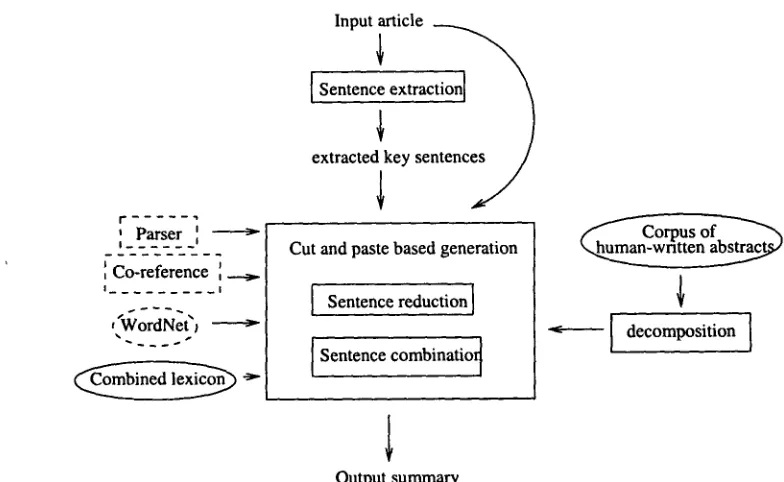
Figure 1: System architecture
(6) r e o r d e r i n g
Change the order of extracted sentences. For in- stance, place an ending sentence in an article at the beginning of an abstract.
In human-written abstracts, there are, of course, sentences that are not based on cut and paste, but completely written from scratch. We used our de- composition program to automatically analyze 300 human-written abstracts, and found that 19% of sen- tences in the abstracts were written from scratch. There are also other cut and paste operations not listed here due to their infrequent occurrence.
3 S y s t e m a r c h i t e c t u r e
The architecture of our cut and paste based text summarization system is shown in Figure 1. Input to the system is a single document from any domain. In the first stage, extraction, key sentences in the ar- ticle are identified, as in most current summarizers. In the second stage, cut and paste based generation, a sentence reduction module and a sentence combina- tion module implement the operations we observed in human-written abstracts.
The cut and paste based component receives as input not only the extracted key sentences, but also the original article. This component can be ported to other single-document summarizers to serve as the generation component, since most current sum- marizers extract key sentences - exactly what the extraction module in our system does.
Other resources and tools in the summarization system include a corpus of articles and their human-
written abstracts, the automatic decomposition pro- gram, a syntactic parser, a co-reference resolution system, the WordNet lexical database, and a large- scale lexicon we combined from multiple resources. The components in dotted lines are existing tools or resources; all the others were developed by ourselves.
4 M a j o r c o m p o n e n t s
The main focus of our work is on decomposition of summaries, sentence reduction, and sentence com- bination. We also describe the sentence extraction module, although it is not the main focus of our w o r k .
4.1 D e c o m p o s i t i o n o f h u m a n - w r i t t e n s u m m a r y s e n t e n c e s
The decomposition program, see (Jing and McKe- own, 1999) for details, is used to analyze the con- struction of sentences in human-written abstracts. The results from decomposition are used to build the training and testing corpora for sentence reduc- tion and sentence combination.
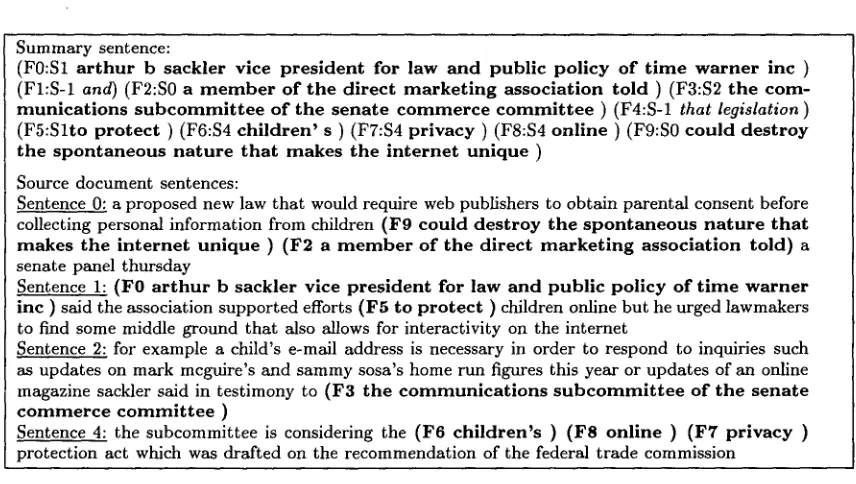
The decomposition program answers three ques- tions about a sentence in a human-written abstract: (1) Is the sentence constructed by cutting and past- ing phrases from the input article? (2) If so, what phrases in the sentence come from the original arti- cle? (3) Where in the article do these phrases come from?
[image:3.612.123.515.82.323.2]Summary sentence:
(F0:S1 a r t h u r b s a c k l e r v i c e p r e s i d e n t for law a n d p u b l i c p o l i c y o f t i m e w a r n e r inc ) (FI:S-1 and) (F2:S0 a m e m b e r o f t h e d i r e c t m a r k e t i n g a s s o c i a t i o n t o l d ) (F3:$2 t h e c o m - m u n i c a t i o n s s u b c o m m i t t e e o f t h e s e n a t e c o m m e r c e c o m m i t t e e ) (F4:S-1 that legislation )
(F5:Slto p r o t e c t ) (F6:$4 c h i l d r e n ' s ) (F7:$4 p r i v a c y ) (F8:$4 o n l i n e ) (F9:S0 c o u l d d e s t r o y t h e s p o n t a n e o u s n a t u r e t h a t m a k e s t h e i n t e r n e t u n i q u e )
Source document sentences:
Sentence 0: a proposed new law that would require web publishers to obtain parental consent before collecting personal information from children (F9 could d e s t r o y t h e s p o n t a n e o u s n a t u r e t h a t m a k e s t h e i n t e r n e t u n i q u e ) (F2 a m e m b e r o f t h e d i r e c t m a r k e t i n g a s s o c i a t i o n told) a senate panel thursday
Sentence 1 : ( F 0 a r t h u r b s a c k l e r v i c e p r e s i d e n t for law a n d p u b l i c p o l i c y o f t i m e w a r n e r inc ) said the association supported efforts (F5 t o p r o t e c t ) children online but he urged lawmakers to find some middle ground that also allows for interactivity on the internet
Sentence 2: for example a child's e-mail address is necessary in order to respond to inquiries such as updates on mark mcguire's and sammy sosa's home run figures this year or updates of an online magazine sackler said in testimony to (F3 t h e c o m m u n i c a t i o n s s u b c o m m i t t e e o f t h e s e n a t e c o m m e r c e c o m m i t t e e )
Sentence 4: the subcommittee is considering the (F6 c h i l d r e n ' s ) (F8 online ) (F7 p r i v a c y ) protection act which was drafted on the recommendation of the federal trade commission
Figure 2: Sample o u t p u t of the decomposition p r o g r a m
sentence, a d o c u m e n t position t h a t it m o s t likely comes from. T h e position of a word in a d o c u m e n t is uniquely identified by the position of the sentence where the word appears, and the position of the word within the sentence. Based on the observation of cut and paste practice by humans, we produced a set of general heuristic rules. Sample heuristic rules in- clude: two adjacent words in a s u m m a r y sentence are most likely to come from two adjacent words in the original document; adjacent words in a s u m m a r y sentence are not very likely to come from sentences that are far a p a r t in the original document. We use these heuristic rules to create a Hidden Markov Model. T h e Viterbi algorithm (Viterbi, 1967) is used to efficiently find the most likely d o c u m e n t position for each word in the s u m m a r y sentence.
Figure 2 shows sample o u t p u t of the program. For the given s u m m a r y sentence, the p r o g r a m cor- rectly identified t h a t the sentence was combined from four sentences in the input article. It also di- vided the s u m m a r y sentence into phrases and pin- pointed the exact d o c u m e n t origin of each phrase. A phrase in the s u m m a r y sentence is a n n o t a t e d as
(FNUM:SNUM actual-text), where F N U M is the se- quential n u m b e r of the phrase and S N U M is the number of the d o c u m e n t sentence where the phrase comes from. SNUM = -1 means t h a t the compo- nent does not come from the original document. T h e phrases in the d o c u m e n t sentences are a n n o t a t e d as
( F N U M actual-text).
4.2 S e n t e n c e r e d u c t i o n
T h e task of the sentence reduction module, de- scribed in detail in (Jing, 2000), is to remove extra- neous phrases from extracted sentences. The goal of
reduction is to "reduce without m a j o r loss"; t h a t is, we want to remove as m a n y extraneous phrases as possible from an extracted sentence so t h a t it can be concise, but without detracting from the main idea t h a t the sentence conveys. Ideally, we want to re- move a phrase f r o m an extracted sentence only if it is irrelavant to the main topic.
Our reduction module makes decisions based on multiple sources of knowledge:
(1) G r a m m a r c h e c k i n g . In this step, we m a r k which components of a sentence or a phrase are obligatory to keep it g r a m m a t i c a l l y correct. To do this, we traverse the sentence parse tree, produced by the English Slot G r a m m a r ( E S G ) parser devel- oped at IBM (McCord, 1990), in top-down order and m a r k for each node in the parse tree, which of its children are obligatory. T h e main source of knowledge the system relies on in this step is a large-scale, reusable lexicon we combined from mul- tiple resources (Jing and McKeown, 1998). T h e lexi- con contains subcategorizations for over 5,000 verbs. This information is used to m a r k the obligatory ar- guments of verb phrases.
[image:4.612.103.531.65.307.2]E x a m p l e 1:
Original sentence : When it arrives sometime next year in new T V sets, t h e V - c h i p will give
parents a n e w and p o t e n t i a l l y revolutionary device to block o u t p r o g r a m s t h e y d o n ' t
w a n t t h e i r c h i l d r e n to see.
Reduction program: The V-chip will give parents a new and potentially revolutionary device to block out programs they don't want their children to see.
Professionals : The V-chip will give parents a device to block out programs they don't want their children to see.
E x a m p l e 2:
Original sentence : Sore a n d H o f f m a n ' s creation w o u l d allow b r o a d c a s t e r s t o insert
m u l t i p l e ratings into a show, enabling the V-chip to filter out racy or violent material but leave unexceptional portions o.f a show alone.
Reduction Program: Som and Hoffman's creation would allow broadcasters to insert multiple rat- ings into a show.
Professionals : Som and Hoffman's creation would allow broadcasters to insert multiple rat- ings into a show.
Figure 3: Sample o u t p u t of the
by adding up the scores of its children nodes in the parse tree. This score indicates how i m p o r t a n t the phrase is to the m a i n topic in discussion.
(3) C o r p u s e v i d e n c e . T h e p r o g r a m uses a cor- pus of input articles and their corresponding reduced forms in h u m a n - w r i t t e n a b s t r a c t s to learn which components of a sentence or a phrase can be re- moved and how likely they are to be removed by professionals. This corpus was created using the de- composition p r o g r a m . We c o m p u t e three types of probabilities from this corpus: the probability t h a t a phrase is removed; the probability t h a t a phrase is reduced (i.e., the phrase is not removed as a whole, but some c o m p o n e n t s in the phrase are removed); and the probability t h a t a phrase is unchanged at all (i.e., neither removed nor reduced). These cor- pus probabilities help us capture h u m a n practice.
(4) F i n a l d e c i s i o n . T h e final reduction decision is based on the results f r o m all the earlier steps. A phrase is removed only if it is not g r a m m a t i c a l l y obligatory, not the focus of the local context (indi- cated by a low context i m p o r t a n c e score), and has a reasonable probability of being removed by humans. T h e phrases we remove f r o m an extracted sentence include clauses, prepositional phrases, gerunds, and to-infinitives.
T h e result of sentence reduction is a shortened version of an extracted sentence 2. This shortened text can be used directly as a s u m m a r y , or it can be fed to the sentence combination module to be merged with other sentences.
Figure 3 shows two examples produced by the re- duction p r o g r a m . T h e corresponding sentences in h u m a n - w r i t t e n a b s t r a c t s are also provided for com- parison.
2It is actually also possible that the reduction program decides no phrase in a sentence should be removed, thus the result of reduction is the same as the input.
sentence reduction p r o g r a m
4 . 3 S e n t e n c e c o m b i n a t i o n
To build the c o m b i n a t i o n module, we first m a n u - ally analyzed a corpus of c o m b i n a t i o n examples pro- duced by h u m a n professionals, a u t o m a t i c a l l y cre- ated by the decomposition p r o g r a m , and identified a list of c o m b i n a t i o n operations. Table 1 shows the combination operations.
To i m p l e m e n t a c o m b i n a t i o n operation, we need to do two things: decide when to use which com- bination operation, and i m p l e m e n t the combining actions. To decide when to use which operation, we analyzed examples by h u m a n s and m a n u a l l y wrote a set of rules. T w o simple rules are shown in Fig- ure 4. Sample o u t p u t s using these two simple rules are shown in Figure 5. We are currently exploring using machine learning techniques to learn the com- bination rules f r o m our corpus.
T h e i m p l e m e n t a t i o n of the combining actions in- volves joining two parse trees, substituting a subtree with another, or adding additional nodes. We im- plemented these actions using a f o r m a l i s m based on Tree Adjoining G r a m m a r (Joshi, 1987).
4 . 4 E x t r a c t i o n M o d u l e
T h e extraction module is the front end of the sum- marization system and its role is to extract key sen- tences. Our m e t h o d is primarily based on lexical re- lations. First, we link words in a sentence with other words in the article through repetitions, morpholog- ical relations, or one of the lexical relations encoded in WordNet, similar to step 2 in sentence reduction. An i m p o r t a n c e score is c o m p u t e d for each word in a sentence based on the n u m b e r of lexical links it has with other words, the type of links, and the direc- tions of the links.
C a t e g o r i e s C o m b i n a t i o n O p e r a t i o n s Add descriptions or names for people or organizations
Aggregations
Substitute incoherent phrases
Substitute phrases with more general or specific information
add description (see Figure 5) add name
extract common subjects or objects (see Figure 5) change one sentence to a clause
add connectives (e.g., and or while)
add punctuations (e.g., ";") substitute dangling anaphora substitute dangling noun phrases substitute adverbs (e.g., here)
remove connectives
substitute with more general information substitute with more specific information
Mixed operations combination of any of above operations (see Figure 2)
Table 1: C o m b i n a t i o n operations R u l e 1:
I F : ((a person or an organization is mentioned the first time) and (the full name or the full descrip- tion of the person or the organization exists somewhere in the original article but is missing in the summary))
T H E N " replace the phrase with the full name plus the full description R u l e 2:
I F : ((two sentences are close to each other in the original article) and (their subjects refer to the same entity) and (at least one of the sentences is the reduced form resulting from sentence reduc- tion))
T H E N : merge the two sentences by removing the subject in the second sentence, and then com- bining it with the first sentence using connective "and".
Figure 4: Sample sentence combination rules
ized over the n u m b e r of words a sentence contains. T h e sentences with high scores are considered im- p o r t a n t .
T h e extraction system selects sentences based on the i m p o r t a n c e c o m p u t e d as above, as well as other indicators, including sentence positions, cue phrases, and tf*idf scores.
5 E v a l u a t i o n
Our evaluation includes separate evaluations of each module and the final evaluations of the overall sys- tem.
We evaluated the decomposition p r o g r a m by two experiments, described in (Jing and McKeown, 1999). In the first experiment, we selected 50 human-written abstracts, consisting of 305 sentences in total. A h u m a n subject then read the decomposi- tion results of these sentences to judge whether they are correct. 93.8% of the sentences were correctly decomposed. In the second experiment, we tested the system in a s u m m a r y alignment task. We ran the decomposition p r o g r a m to identify the source document sentences t h a t were used to construct the sentences in h u m a n - w r i t t e n abstracts. H u m a n sub- jects were also asked to select the d o c u m e n t sen- tences that are semantlc-equivalent to the sentences
in the abstracts. We c o m p a r e d the set of sentences identified by the p r o g r a m with the set of sentences selected by the m a j o r i t y of h u m a n subjects, which is used as the gold s t a n d a r d in the c o m p u t a t i o n of pre- cision and recall. T h e p r o g r a m achieved an average 81.5% precision, 78.5% recall, and 79.1% f-measure for 10 documents. T h e average performance of 14 h u m a n judges is 88.8% precision, 84.4% recall, and 85.7% f-measure. Recently, we have also tested the system on legal d o c u m e n t s (the headnotes used by Westlaw c o m p a n y ) , and the p r o g r a m works well on those documents too.
T h e evaluation of sentence reduction (see (Jing, 2000) for details) used a corpus of 500 sentences and their reduced forms in h u m a n - w r i t t e n abstracts. 400 sentences were used to c o m p u t e corpus probabili- ties and 100 sentences were used for testing. T h e results show t h a t 81.3% of the reduction decisions made by the s y s t e m agreed with those of humans. The h u m a n s reduced the length of the 500 sentences by 44.2% on average, and the system reduced the length of the 100 test sentences by 32.7%.
[image:6.612.81.570.79.238.2] [image:6.612.82.563.84.408.2]E x a m p l e 1: a d d d e s c r i p t i o n s or n a m e s for people or o r g a n i z a t i o n Original document sentences:
"We're trying to prove that there are big benefits to the patients by involving them more deeply in their treatment", said P a u l C l a y t o n , C h a i r m a n o f t h e D e p a r t m e n t d e a l i n g w i t h c o m p u t - erized m e d i c a l i n f o r m a t i o n at C o l u m b i a .
" T h e e c o n o m i c p a y o f f f r o m b r e a k i n g into h e a l t h care r e c o r d s is a lot less t h a n for b a n k s " , said Clayton at Columbia.
Combined sentence:
"The economic payoff from breaking into health care records is a lot less than for banks", said Paul Clayton, Chairman of the Department dealing with computerized medical information at Columbia. Professional: (the same)
E x a m p l e 2: e x t r a c t c o m m o n s u b j e c t s Original document sentences:
T h e n e w m e a s u r e is a n e c h o o f t h e original b a d idea, blurred just enough to cloud prospects both for enforcement and for court review.
Unlike the 1996 act, this o n e a p p l i e s o n l y t o c o m m e r c i a l W e b s i t e s - thus sidestepping 1996 objections to the burden such regulations would pose for museums, libraries and freewheeling conversation deemed "indecent" by somebody somewhere.
T h e n e w v e r s i o n a l s o r e p l a c e s t h e v a g u e " i n d e c e n c y " s t a n d a r d , to which the court objected, with the better-defined one of material ruled "harmful to minors."
Combined sentences:
The new measure is an echo of the original bad idea.
The new version applies only to commercial web sites and replaces the vague "indecency" standard with the better-defined one of material ruled "harmful to minors."
Professional:
While the new law replaces the "indecency" standard with "harmful to minors" and now only applies to commercial Web sites, the "new measure is an echo of the original bad idea."
Figure 5: Sample output of the sentence combination p r o g r a m
modules. To evaluate just the combination compo- nent, we assume t h a t the system makes the same reduction decision as humans and the co-reference system has a perfect performance. This involves manual tagging of some examples to prepare for the evaluation; this preparation is in progress. The eval- uation of sentence combination will focus on the ac- cessment of combination rules.
The overM1 system evMuation includes both in- trinsic and extrinsic evaluation. In the intrinsic evM- uation, we asked h u m a n subjects to compare the quality of extraction-based summaries and their re- vised versions produced by our sentence reduction and combination modules. We selected 20 docu- ments; three different a u t o m a t i c summarizers were used to generate a s u m m a r y for each document, pro- ducing 60 summaries in total. These summaries are all extraction-based. We then ran our sentence reduction and sentence combination system to re- vise the summaries, producing a revised version for each summary. We presented h u m a n subjects with the full documents, the extraction-based summaries, and their revised versions, and asked them to com- pare the extraction-based summaries and their re- vised versions. The h u m a n subjects were asked to score the conciseness of the summaries (extraction- based or revised) based on a scale from 0 to 10 - the higher the score, the more concise a s u m m a r y is.
They were also asked to score the coherence of the summaries based on a scale from 0 to 10. On aver- age, the extraction-based summaries have a score of 4.2 for conciseness, while the revised summaries have a score of 7.9 (an improvement of 88%). The average improvement for the three systems are 78%, 105%, and 88% respectively. The revised summaries are on average 41% shorter than the original extraction- based summaries. For s u m m a r y coherence, the aver- age score for the extraction-based summaries is 3.9, while the average score for the revised summaries is 6.1 (an improvement of 56%). The average improve- ment for the three systems are 69%, 57%, and 53% respectively.
We are preparing a task-based evaluation, in which we will use the d a t a from the Summariza- tion EvMuation Conference (Mani et al., 1998) and compare how our revised summaries can influence h u m a n s ' performance in tasks like text categoriza- tion and ad-hoc retrieval.
6 R e l a t e d w o r k
[image:7.612.129.548.69.388.2]eration in our system. The difference is that while elimination always removes parentheticals, sentence- initial PPs and certain adverbial phrases for every extracted sentence, our sentence reduction module aims to make reduction decisions according to each case and removes a sentence component only if it considers it appropriate to do so. The goal of the aggregation operation and the smoothing operation is similar to that of the sentence combination op- eration in our system. However, the combination operations and combination rules that we derived from corpus analysis are significantly different from those used in the above system, which mostly came from operations in traditional natural language gen- eration.
7
Conclusions and future
w o r kThis paper presents a novel architecture for text summarization using cut and paste techniques ob- served in human-written abstracts. In order to auto- matically analyze a large quantity of human-written abstracts, we developed a decomposition program. The automatic decomposition allows us to build large corpora for studying sentence reduction and sentence combination, which are two effective op- erations in cut and paste. We developed a sentence reduction module that makes reduction decisions us- ing multiple sources of knowledge. We also investi- gated possible sentence combination operations and implemented the combination module. A sentence extraction module was developed and used as the front end of the summarization system.
We are preparing the task-based evaluation of the overall system. We also plan to evaluate the porta- bility of the system by testing it on another corpus. We will also extend the system to query-based sum- marization and investigate whether the system can be modified for multiple document summarization.
Acknowledgment
We thank IBM for licensing us the ESG parser and the MITRE corporation for licensing us the co- reference resolution system. This material is based upon work supported by the National Science Foun- dation under Grant No. IRI 96-19124 and IRI 96-18797. Any opinions, findings, and conclusions or recommendations expressed in this material are those of the authors and do not necessarily reflect the views of the National Science Foundation.
References
ANSI. 1997. Guidelines for abstracts. Technical Re- port Z39.14-1997, NISO Press, Bethesda, Mary- land.
L. Baum. 1972. An inequality and associated max- imization technique in statistical estimation of
probabilistic functions of a markov process. In- equalities, (3):1-8.
Edward T. Cremmins. 1982. The Art of Abstracting.
ISI Press, Philadelphia.
Brigitte Endres-Niggemeyer, Kai Haseloh, Jens Mfiller, Simone Peist, Irene Santini de Sigel, Alexander Sigel, Elisabeth Wansorra, Jan Wheeler, and Brfinja Wollny. 1998. Summarizing Information. Springer, Berlin.
Raya Fidel. 1986. Writing abstracts for free-text searching. Journal of Documentation, 42(1):11- 21, March.
Hongyan Jing and Kathleen R. McKeown. 1998. Combining multiple, large-scale resources in a reusable lexicon for natural language generation. In Proceedings of the 36th Annual Meeting of the Association for Computational Linguistics and the 17th International Conference on Computational Linguistics, volume 1, pages 607-613, Universit6 de Montreal, Quebec, Canada, August.
Hongyan Jing and Kathleen R. McKeown. 1999. The decomposition of human-written summary sentences. In Proceedings of the P2nd In- ternational ACM SIGIR Conference on Re- search and Development in Information Re- trieval(SIGIR'99), pages 129-136, University of Berkeley, CA, August.
Hongyan Jing. 2000. Sentence reduction for au- tomatic text summarization. In Proceedings of ANLP 2000.
Aravind.K. Joshi. 1987. Introduction to tree- adjoining grammars. In A. Manaster-Ramis, ed- itor, Mathematics of Language. John Benjamins, Amsterdam.
Inderjeet Mani, David House, Gary Klein, Lynette Hirschman, Leo Obrst, Therese Firmin, Michael Chrzanowski, and Beth Sundheim. 1998. The TIPSTER SUMMAC text summarization eval- uation final report. Technical Report MTR 98W0000138, The MITRE Corporation.
Inderjeet Mani, Barbara Gates, and Erie Bloedorn. 1999. Improving summaries by revising them. In
Proceedings of the 37th Annual Meeting of the As- sociation for Computational Linguistics(A CL '99),
pages 558-565, University of Maryland, Mary- land, June.
Michael MeCord, 1990. English Slot Grammar.
IBM.
Samuel Thurber, editor. 1924. Prgcis Writing for American Schools. The Atlantic Monthly Press, INC., Boston.