Munich Personal RePEc Archive
Probabilistic Economic Theory
Kondratenko, Anatoly V.
2015
Online at
https://mpra.ub.uni-muenchen.de/81130/
Anatoly V. Kondratenko
PROBABILISTIC
ECONOMIC
THEORY
NOVOSIBIRSK “NAUKA”
ISBN 978–5–02–019121–1.
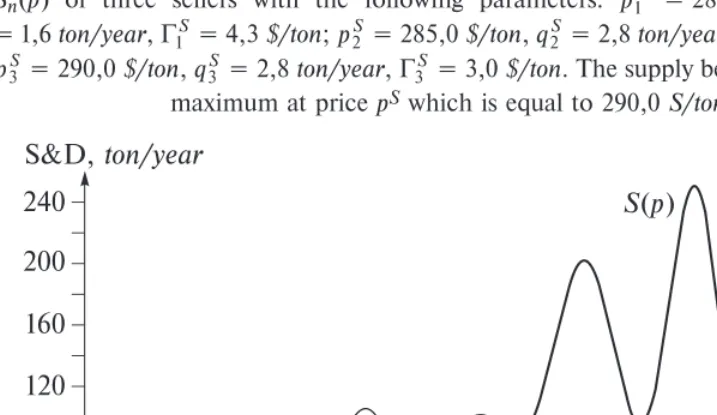
This book presents principles of physical economics, new economic discipline primarily concerned in the book with the agent-based physical modeling of the market economic systems and eventually with the elaborating of probabilistic economic theory. At the heart of physical economics and probabilistic economic theory are the well-known cornerstone concepts of classical economics, in particular the subjective theory of value, such as regularity in the sequence of market phenomena and an interdependence of those, as well as key roles of individuals’ actions and social cooperation in the many-agent market processes. The main point of the concept of the physical modeling is that formal approaches and procedures of theoretical physics are used to describe these economic concepts. The obvious structural and dynamic analogy of the many-agent economic systems with the many-particle physical systems is basic to the formulation of fundamentals of the method of the agent-based physical modeling of the many-agent market economic systems in the formal economic space. It is also vital to the elaboration of the main paradigm and eventually the five general principles of physical economics, as well as of probabilistic economic theory. The uncertainty and probability principle holds a central position among of them. All the principles provide the necessary background to physical economics that include such theories as classical economy, probability economics, and quantum economy. The book provides a unique source for learning and understanding all the concepts and principles of physical economics, together with the quantitative methods of calculating and analyzing the many-good, many-agent market economies. Conceptually, the book can be viewed as an introduction to economics for physicists, expressed by means of the terms and language of physics. This book is also addressed to all those who are interested in the background of economics, foremost in the axiomatic basis of modern economic theory.
All rights reserved. No part of this publication may be reproduced, stored in a retrieval system, or transmitted, in any form or by any means, electronic, mechanical, photocopying, recording, or otherwise, without the prior written permission of the author. Printed in Russia.
ISBN 978–5–02–019121–1
© Anatoly Kondratenko, 2015 © Publishing design. “Nauka”.
PREFACE. . . 9
References . . . 16
INTRODUCTION. Probabilistic Economic Theory . . . 17
References . . . 20
PART A. The Agent-Based Physical Modeling of Market Economic Systems 21 CHAPTER I. Fundamentals of the Method of Agent-Based Physical Modeling . . . 23
Preview. What is the Main Point of the Concept of Agent-Based Physical Modeling? . 23 1. The Concept of Agent-Based Physical Modeling . . . 24
2. The Main Paradigm of Physical Economics . . . 25
3. The Axioms and Principles of Physical Economics . . . 26
4. The Classical Economies . . . 29
4.1. The Two-Agent Market Economies . . . 29
4.2. The Main Market Rule “Sell all — Buy at all” . . . 36
4.3. The Many-Agent Market Economies . . . 42
4.4. The Classical Economies versus Neoclassical Economies . . . 44
References. . . 46
CHAPTER II. The Constructive Design of Agent-Based Physical Economic Models . . . 47
Preview. What is the Physical Economic Model? . . . 47
1. The Basic Concept of Physical Economic Design . . . 48
2. The Economic Multi-Dimensional Price-Quantity Space . . . 50
3. The Market-Based Trade Maximization Principle and the Economic Equations of Motion . . . 53
References . . . 55
PART B. Classical Economy . . . 57
CHAPTER III. Classical Economies in the Price Space . . . 59
Preview. What are the Economic Lagrange Equations? . . . 59
1. Foundations of Classical Economy . . . 59
2. The Economic Lagrange Equations . . . 61
3. Conclusions . . . 67
References . . . 67
PART C. Probability Economics. Stationary Probabilistic Economies in the Price Space . . . 69
CHAPTER IV. Functions of Supply and Demand . . . 71
Preview. What are Functions of Supply and Demand? . . . 71
1. The Neoclassical Model of Supply and Demand . . . 72
2. The Stationary Probability Model in the Price Space . . . 77
3. The Additivity Formula for Supply and Demand in Many-Agent Markets . . . 88
4. The Multiplicativity Formula for Supply and Demand in the Many-Good Markets . . . 92
5. The Factorization Formulas for Supply and Demand in the Good, Many-Agent Markets . . . 96
6. Comments and Discussions . . . 97
7. Conclusions . . . 101
References . . . 103
CHAPTER V. Market Price in the Price Space. . . 104
Preview. What is Market Price? . . . 104
1. Introduction . . . 105
2. Market Price in the Neoclassical Model . . . 107
3. Probabilistic Market Pricing in the One-Good Markets . . . 110
4. Market Price and Total Supply and Demand . . . 115
5. Monopoly of Supply . . . 118
6. Monopsony of Demand . . . 121
7. Relationship Between the Equilibrium Price and the Market Price in the One-Good Markets . . . 122
8. Market Price and Elasticities of Supply and Demand . . . 123
9. Probabilistic Market Pricing in the Many-Good Markets . . . 124
10. Comments and Conclusions . . . 128
References . . . 129
CHAPTER VI. Market Force in the Price Space . . . 130
Preview. What is Market Force? . . . 130
1. Introduction . . . 131
2. The One-Good Markets with One-Buyer and One-Seller . . . 134
3. The One-Good Markets with Several Buyers and Sellers . . . 140
4. Market Forces in the Many-Good Markets . . . 149
5. Conclusions . . . 154
PART D.
Probability Economics.
Stationary Probabilistic Economies in the Price-Quantity Space . 157
CHAPTER VII.
Supply and Demand, Price and Force . . . 159
Preview. What are Supply and Demand? . . . 159
1. Introduction . . . 160
2. The One-Good, One-Buyer and One-Seller Markets . . . 164
2.1. Supply and Demand . . . 164
2.2. The Factorization Formula for Supply and Demand . . . 166
2.3. Market Price and Market Force . . . 174
3. The One-Good, Many-Agent Markets . . . 179
3.1. The Additivity Formula for Supply and Demand . . . 179
3.2. The System of Equations for Market Prices and Market Quantities . . . 182
4. The Many-Good, Many-Agent Markets . . . 183
5. Conclusions . . . 190
References . . . 191
PART E. Probability Economics. Non-Stationary Probabilistic Economies in the Price-Quantity Space 193 CHAPTER VIII. The Market-Based Trade Maximization Principle: Market Processes, Supply and Demand Laws, and Equilibrium States . . . 195
Preview. What is Market Equilibrium State? . . . 196
1. Introduction . . . 196
2. The Non-Stationary Economies . . . 197
3. The Market-Based Trade Maximization Principle and the Market Process 204 3.1. Mutual Market Agents’ Cooperation . . . 204
3.2. Market Invisible Hand . . . 205
4. The Market-Based Trade Maximization Principle and the Supply and Demand Laws . . . 207
5. The Market-Based Trade Maximization Principle and the Market Equilibrium State . . . 211
5.1. The One-Good, One-Buyer and One-Seller Markets . . . 212
5.1.1. The Market Trade Function . . . 212
5.1.2. The Uncertainty Law . . . 218
5.1.3. Agent Structure of the Stationary Equilibrium State . . . 219
5.1.4. The Equilibrium Rule “Sell all — Buy at all” . . . 221
5.1.5. The Uncertainty Relation for Supply and Demand . . . 223
5.2. The Two-Good, One-Buyer, One-Seller Markets . . . 225
5.3. The Many-Good, Many-Agent Markets . . . 229
6. Conclusions . . . 230
PART F.
Quantum Economy . . . 233
CHAPTER IX. Quantum Economies in the Price Space . . . 235
Preview. What are the Economic Schrödinger Equations? . . . . 236
1. Introduction . . . 237
2. Foundations of Quantum Economy . . . 238
2.1. The Time-Dependent Economic Schrödinger Equation . . . . 238
2.2. The Stationary Economic Schrödinger Equation . . . . 239
3. The One-Good, One-Buyer, One-Seller Markets . . . 241
3.1. Agent Probability Distributions and the Deal Function . . . 243
3.2. Supply and Demand Functions . . . 245
3.3. Probabilistic Market Pricing Mechanism . . . 246
3.4. Market Price and Elasticities of Supply and Demand . . . 248
4. The Many-Agent Market Economies . . . 249
5. Conclusions . . . 251
References . . . 252
CHAPTER X. Quantum Economies in the Price-Quantity Space . . . 253
Preview. What is Quantum Economy? . . . 253
1. The Axioms of Physical Economics . . . 254
2. The Principles of Physical Economics . . . 257
3. The Time-Dependent Economic Schrödinger Equations in the Price-Quantity Space . . . 262
4. The Stationary Economic Schrödinger Equations in the Price-Quantity Space 264 5. The Hypotheses of Quantum Economy . . . 266
6. Numerical Calculations for the Model of Coupled Quantum Harmonic Oscillators . . . 284
7. Excited States of Quantum Economies . . . 286
8. Quantum Economic Cycles . . . 289
9. Interrelation of Quantum Economy with other Economic Theories . . . 290
10. Conclusions . . . 291
References. . . 292
AFTERWORD. . . 293
1. Is Physics-Based Economics Feasible? . . . 293
2. The Uncertainty and Probability Principle in Economic Theory . . . 295
3. Character of Economic Laws . . . 298
4. The Physical Method of Economics . . . 299
PREFACE
I have the pleasure of bringing to the reader’s notice a book that expounds on the principles of physical economics, and more specifically, probabilistic economic theory. In the broad sense, physical economics is a relatively new economic discipline concerned with the study of economic phenomena from the point of view of physics. More exactly, it is through such economic investigations that we explore methods of theoretical physics previously developed in that discipline for solving formally similar problems. Depending on the statement of the economic problem under study, those can be mechanical, statistical, thermodynamic or other methods. For this reason, there are several corresponding variants of presentation of physical economics in the literature depending on the methods applied. The two books [1, 2] can be cited as an example of the presentation of physical economics from the point of view of statistical physics. It is evident that these books primarily deal with open financial markets with huge numbers of market agents, where statistical effects obviously play one of the leading roles. The key review [3] presents a phenomenological version of physical economics in terms of classical mechanics.
reason, I treat the term physical economics in the book in the narrow sense of this concept, from the point of view of classical and quantum mechanics of the many-particle systems. More exactly, physical economics here is a study of the formal agent-based physical models of the market economic systems. Finally, I define physical economics here primarily as the science of the agent-based physical modeling of the market economic systems, with the aid of methods and approaches worked out earlier in classical and quantum mechanics. When applying ideas of quantum mechanics to the many-agent economic systems, we inevitably obtain probabilistic economic theory which is understood in this book as most of physical economics. Note that all the physical economic models here are also agent-based ones. I think that there is great advantage to applying the agent-based approach of physical modeling because it makes it possible at the micro level, i.e., at the level of separate agents, to find a basis for explaining economic phenomena at the macro level, i.e., at the level of the whole economy. Analogously, quantum mechanics first explained the behavior of the separate electron in the deep pit. At the time, it undertook the explanation of the macro effects and calculation of macro quantities on the basis of the knowledge obtained there.
In essence, a new physical economic picture of the market world is drawn in the book. There is a huge number of formulas in it, and practically none of them are borrowed from economic literature. However, they all have their analogues in the picture of the physical world, expressed in theoretical physics or, even more accurately, in classical and quantum mechanics.
economic laws should be derived from the study of practical human activities, but in no way by means of fitting of the known physical laws to the economic world. But the situation is reversed if we want to use theoretical methods of physics in search of the economic laws and to develop quantitative economic theories. The point is that physics has elaborated the enormous number of mathematical methods and apparatuses that describe the structure and dynamics of diverse physical systems, from the simple to the complex. And, there is nothing that would forbid us fruitfully applying these formal mathematical methods in economics.
I emphasize that the ideas, concepts and principles of classical economic theory constitute the foundation of physical economics in my understanding, and the approaches and methods of theoretical physics play here the role of the second plan. The task of these theoretical instruments is to give the adequate mathematical description of these ideas, concepts and principles. These help create the formal framework of the theory, as well as develop mathematical apparatus for describing the structure and behavior of market economies. Why is this possible? The point is that, in structure and properties, the many-agent market economic systems are quite similar to the many-particle physical systems. Take, for example, the polyatomic molecules. Indeed:
1. Markets consist of agents. Molecules consist of atoms.
2. Agents interact between themselves. Atoms interact between themselves.
3. Everything that markets do, the interacting agents do. Everything that molecules do, the interacting atoms do.
4. Dynamics of markets are determined by a principle of maxi-mization (e.g. the trade maximaxi-mization principle). Dynamics of mole-cules is determined by a principle of maximization (e.g. the least action principle).
5. Uncertainty and probability is an inherent important property of the market behavior. The same is valid for dynamics of molecules.
And this is still far from a complete enumeration of coincidences and analogies between the economic and physical systems.
physics is concerned, it is possible with reasonable caution to assert that this difference does not lie in the fact that in principle, mathematics cannot be widely used in economics by its very nature. Instead, physics has proven to be the more developed science mathematically in modern times for a variety of historical and technological reasons. This has been the situation for the past 300 years. Beautiful mathematical models have been created in physics during this time frame to describe dynamic phenomena in many-particle systems. Unfortunately, the same cannot be said for economic theory. It is obvious to me that, things being as they are, the correct conclusion for us now must not be to preserve the
status quo. Nor should economists urgently develop their own unique mathematical calculations to describe economic phenomena, inde-pendent of physics. After all, why re-invent the wheel? All that is needed is to make use of some of the most salient and staggering achievements of humanity at the present time by borrowing from theoretical physics. These can be put to use for the good of the development of economic science and the global economy. This book is one of the many steps in the right direction along the proper road. Hopefully I am not wrong, although there is always that chance. There is no doubt that it will be a long road to this accomplishment, and most certainly not a fast one.
I am well aware that the very idea of using methods of theoretical physics, especially quantum mechanics, for describing economic phenomena must cause a healthy dose of skepticism from the physicists. Therefore, I emphasize that the discussion deals with the fact that only the mathematic framework of theoretical models of the respective physical systems are transferred to the physical economic models.
apparatus to the analogous uncertainty and probability principle in economic theory for purposes of mathematical description?
It is obvious that this is only an initial approximation to reality. But we are talking about modeling economic systems, and models are only models, giving only an approximate shape to the object being modeled. My physical models of economic systems also do not pretend that they are complete and precise; they can give only the approximate patterns of our market economic world, only the specific stage in our understanding of the real economic world transposed into the language of mathematics. A physical economic model is nothing other than a certain ideal, imagined construction, aimed at explaining one or more aspects of the studied phenomenon. The question is not whether it is correct or not, but whether it is useful in helping to reach a true understanding of the real economic world. Nothing more. I think that by means of this approach, some insight into the important market economy phenomena has been gained in this study.
Ten years ago I published the small book “Physical Modeling of Economic Systems: The Classical and Quantum Economies” [4]. It was my first attempt to develop an economic theory ab initio, and constructed an axiomatic basis of the theory from a limited set of first principles. The basic hallmarks of the theory that made it probabilistic and quantitative are as follows.
First. A careful, step-by-step development of the market agent-based physical economic models, where market agents play a main role in market phenomena.
Second. The complete integration of uncertainty and probability perspectives throughout the theory.
Third.A unifying, analytic framework that uses equations of motion in the formal price economic space to describe economy evolution in time.
mathematical apparatus for describing the many-good, many-agent market economies. Despite the fact that achievements and expansions of theory mentioned above are very substantial, my new book carries the title “Probabilistic Economic Theory” and is, in essence, the second extended edition of my first book, in which I presented only very beginnings of the method of the agent-based physical modeling of economic systems and the basics of probabilistic economic theory.
The book, as noted above, is the collection of lectures, each of which is called to answer one or several questions given above. The genre of lecture (or essay) is selected for the purpose of concentrating on the compact, clear presentation of physical economics. In it I have used a whole series of new ideas, concepts and notions for the economic theory, which arise from theoretical physics. I believe I have succeeded in avoiding the necessity of making numerous surveys and references, the like of which can be found in most other textbooks on economics and economic history. Therefore, references in the book are made only to those sources which were actually used for the fulfillment of studies, the development of models, and writing of the book. To provide convenience to students in lectures, figures and fragments of the text are reproduced several times in some chapters.
It should be emphasized once more that I borrowed ideas, concepts and notions from physics, many of which are completely consistent with the discoveries of the classical economic theories of the 19th century, the first of which being the subjective theory of value. This concerns first and foremost such important milestones in the development of classical economic theory as [5]:
1. Regularity in the sequence of market economic phenomena. 2. Exclusive and dominant roles of market agents in the market phenomena.
3. Uncertainty of the future and the probabilistic nature of all market agents’ decisions.
4. Social cooperation of market agents etc.
All these aspects of human economic activities have an excep-tionally important effect on market processes and determine the course of economic development. But any formal methods of providing an adequate formal description of these economic phenomena and processes at a strict mathematical level in economic theory, until now, have been absent. Necessity and expediency of borrowing by economics from physics is substantiated by the fact that theoretical physics already developed sophisticated mathematical methods to incorporate analogous concepts into formal physical models. The method of equations of motion was first, and uses systems of differential equations of the 1st and 2nd orders, but economic theory still did not.
the main point of the concept of the agent-based physical modeling of the economic systems and physical economics as a whole. One can say that, in essence, physical economics is first and foremost the mathe-matical apparatus of classical economic theory at the contemporary level of its development. This mathematical apparatus is borrowed from theoretical physics and has therefore practically nothing to do with the mathematical apparatus of neoclassical economics.
In order not to overload the text of the book by the descriptions of the known concepts of classical economic theory upon which I rested in this investigation, I make use of complete quotations from the fundamental monograph of Ludwig von Mises [5] as epigraphs to each part and chapter of the book, with two exceptions. This method allowed me to avoid the mixing of completely different styles of the presentation in the book, which could hinder the perception of the text by readers. This is very important for me, since I have attempted to not to disappoint the readers, and to convince them of how it is fruitful to make use of achievements in theoretical physics for the development of economics. The point is not in the book’s detail, but rather in its broader concept of agent-based physical modeling of economic systems, which, in my view, has enormous potential. Here lies, I think, a new and enormous field for investigation, in which an abundant harvest will be gathered for many decades yet to come. I hope that the readers will obtain a certain benefit from the acquaintance with this new physical economic perspective for economic theory.
References
1. Rosario N. Mantegna, Eugene H. Stanley. An Introduction to Econophysics: Correlations and Complexity in Finance.Cambridge University Press, 1999.
2. Peter Richmond, Jürgen Mimkes, and Stefan Hutzler. Econophysics and Physical Economics.Oxford University Press, 2013.
3. D.S. Chernavsky, N.I. Starkov, A.V. Shcherbakov. On some problems of physical economics. UFN, Vol. 172, N 9, pp. 1046–1066, 2002.
4. A.V. Kondratenko.Physical Modeling of Economic Systems. Classical and Quantum Economies.Nauka: Novosibirsk, 2005. Electronic copy available at: http://ssrn.com/ abstract=1304630.
5. Ludwig von Mises.Human Action. A Treatise on Economics.Yale University, 1949.
INTRODUCTION.
Probabilistic Economic Theory
“The market economy is the social system of the division of labor under private ownership of the means of production. Everybody acts on his own behalf; but everybody’s actions aim at the satisfaction of other people’s needs as well as at the satisfaction of his own. Everybody in acting serves his fellow citizens. Everybody, on the other hand, is served by his fellow citizens. Everybody is both a means and an end in himself, an ultimate end for himself and a means to other people in their endeavors to attain their own ends.
This system is steered by the market. The market directs the individual's activities into those channels in which he best serves the wants of his fellow men. There is in the operation of the market no compulsion and coercion. The state, the social apparatus of coercion and compulsion, does not interfere with the market and with the citizens’ activities directed by the market. It employs its power to beat people into submission solely for the prevention of actions destructive to the preservation and the smooth operation of the market economy. It protects the individual's life, health, and property against violent or fraudulent aggression on the part of domestic gangsters and external foes. Thus the state creates and preserves the environment in which the market economy can safely operate… Each man is free; nobody is subject to a despot. Of his own accord the individual integrates himself into the cooperative system. The market directs him and reveals to him in what way he can best promote his own welfare as well as that of other people. The market is supreme. The market alone puts the whole social system in order and provides it with sense and meaning”.
Ludwig von Mises. Human Action. A Treatise on Economics.Page 243
In general terms, at the conceptual or descriptive level, the answers to these questions are known from classical economic theory. They are obtained with the aid of the logical method of economic theory and they are given in this book in epigraph form to the parts and the chapters. These answers represent by themselves extensive quotations from the fundamen-tal work of Ludwig von Mises [1]. But other questions agitate us more. Where can we search for the answers in this book, and how can all these answers of classical economic theory be expressed in terms of the natural exact sciences, i.e., in mathematical language? Therefore, in the book we attempt to develop quantitative methods of calculation for economic sys-tems, as well as their structure and dynamics, which would make it possible to speak about the further development of quantitative economic theory.
is not simply a complex dynamic, but that it is still probabilistic [2–5]. Therefore, in order to be able to give a sufficiently complete description of such complex probabilistic systems, adequate economic theory must also be probabilistic to a considerable extent. For this, it is necessary to inco-rporate into the classical economic theory the uncertainty, as well as pro-bability at the appropriate mathematical level, i.e., to develop probabilistic economic theory adequately in relation to the contemporary economic reality. Specifically, the present study is devoted mainly to this purpose.
In this book we have limited ourselves to the study of the probabilistic aspects of functioning markets in a sufficiently free market economy. More accurately, we study the details of supply and demand, as well as the mechanisms of the formation of prices and the establishment of equilibrium in the markets. Emphasis is given to the description of probabilistic nature of these fundamental market categories and notions. All these market concepts have been the subject of intensive investigations and critical rethinking in the book within the framework of the main paradigm of physical economics, which can be briefly formulated as follows.
principle tell us that all market phenomena are probabilistic in nature and thus help us to understand what a mathematical apparatus must do in order to adequately describe market behavior under uncertain conditions. We refer to the appropriate approach to as probabilistic economic theory, and since this theory is built by analogy with the “probabilistic physical theory” (quantum mechanics) of many-particle systems, we designated it more precisely as quantum economy [4]. Since the picture of the market economic world is built in physical economics at the micro level in approximately the same way as in physics, there is, in principle, a possibility of developing the quantitative methods of calculating the market economies by analogy with the calculation methods in physics. Consequently, it becomes possible to fruitfully use natural science concepts and speak natural science language to describe and analyze market structures and dynamics. In this book, we widely explore these great possibilities that help us to look at economic reality from the natural science points of view and discover new perspectives of economic theory for investigation and development.
In conclusion, it is natural that the direct mechanical transfer of methods and concepts of physics into the economic theory would be impossible. We only can accurately borrow and transfer general concepts and formal methods, since economic and physical phenomena are principally different in their essence and content. In this book and within the framework of this approach, the basic concepts and general principles of physical economics are developed and described. On this basis, we have developed the complex of the principally new quantitative methods of calculatio.n and analysis of many-good, many-agent market economies that we named probabilistic economic theory.
References
1. Ludwig von Mises. HumanAction. A Treatise on Economics.Yale University, 1949. 2. Emmanual Farjoun and MoshéMachover.Laws of Chaos: a Probabilistic Approach
to Political Economy.Verso, London, 1983).
3. Philip Ball. Physical Modelling of Human Social Systems. Complexus 2003; 1:190–206.
4. A.V. Kondratenko.Physical Modeling of Economic Systems. Classical and Quantum Economies.Nauka: Novosibirsk, 2005. Electronic copy available at: http://ssrn.com/ abstract
PART A.
The Agent-Based
Physical Modeling
of Market Economic Systems
“In the course of social events there prevails a regularity of phenomena to which man must adjust his actions if he wishes to succeed. It is futile to approach social facts with the attitude of a censor who approves or disapproves from the point of view of quite arbitrary standards and subjective judgments of value. One must study the laws of human action and social cooperation as the physicist studies the laws of nature. Human action and social cooperation seen as the object of a science of given relations, no longer as a normative discipline of things that ought to be”.
CHAPTER I.
Fundamentals of the Method
of Agent-Based Physical Modeling
“For a social collective has no existence and reality outside of the individual members’ actions. The life of a collective is lived in the actions of the individuals constituting its body. There is no social collective conceivable which is not operative in the actions of some individuals. The reality of a social integer consists in its directing and releasing definite actions on the part of individuals. Thus the way to a cognition of collective wholes is through an analysis of the individuals’ actions”.
Ludwig von Mises. Human Action. A Treatise on Economics.Page 43 “The whole market economy is a big exchange or market place, as it were. At any instant all those transactions take place which the parties are ready to enter into at the realizable price. New sales can be effected only when the valuations of at least one of the parties have changed”.
Ludwig von Mises.Human Action. A Treatise on Economics. Page 231
PREVIEW.
What is the Main Point of the Concept
of Agent-Based Physical Modeling?
funda-mental features of the market economy. The first one, the coopera-tion-oriented agent principle, is the cornerstone of all the physical economic models which holds that all market phenomena have their origins in agents’ actions. To put it differently, since the action of the market as a whole is a result of the actions of all the market agents and nothing other, the market agents and their actions must be at the basis of the physical economic models. In other words, according to the agent principle, all market phenomena have their origins in agents’ actions.
1. The Concept of Agent-Based
Physical Modeling
It is well-known that the method of conceptual modeling of economic systems has long and widely been used in economic theory. According to the new physical economic mode of thought, the main requirement for such economic models, which determines their basic predestination, is skill, with which several important basic concepts and principles must harmoniously, competently and simultaneously be incorporated into the theory. The latter is very important since, by the definition of the problem, all concepts and principles play roles that compare their significance in the economy under study.
Despite their simplicity, the first and most well-known conceptual theories of neoclassical economics, such as supply and demand (S&D below), contributed significantly to economic science. They helped economists to better understand the basic elements of the economic world, and they gave rise to graphic conceptualizations that aided the transfer of this knowledge to others, especially students. Early on, conceptual modeling had, and continues to have, great significance. This is also the case in Austrian economics, where it bears the name
towards conducting the quantitative numerical, and, as precisely as possible, calculations of structure and properties of these models. The deep structural and dynamic analogies between the many-particle physical systems and the many-agent economic systems are exploited in this book to transfer concepts and analytical methods from theoretical physics to economics.
2. The Main Paradigm
of Physical Economics
systems, but not the results of theoretical studies of the concrete real physical systems. Namely this is the essence of physical modeling of economic systems. In conclusion, the obvious structural and dynamic analogy of the many-agent economic systems with the many-particle physical systems is basic to the formulation of fundamentals of the method of the agent-based physical modeling of the many-agent market economic systems in the formal economic space, and eventually, of the five general principles of physical economics as well as probabilistic economic theory.
3. The Axioms and Principles
of Physical Economics
Generally speaking, our attitude towards the problem of adequate quantitative description of the agent behavior in the market as well as market S&D and price formation is based on the two rather simple axioms of a very general character.
1. The Agent Identity Axiom.
2. The Agent Distinction Axiom.
All market agents are distinguished. The second axiom works when the first axiom fails. Thus, it defines those areas and aspects of the agents’ behavior on the markets that are the subject of the studies of other sciences of more applied nature, such as marketing, behavioral science, managerial economics, psychology, policy, etc. In other words, these social sciences are concerned with the specific nuances and peculiarities in the behavior of concrete people, agents and communities in different markets and situations, etc.
Let us stress that in economics we do not study real people, but rather the real actions of these people on markets. The people can be different but market decisions and actions of these people can be the same, depending primarily on their supplies and demands on markets. It is this fact that lies in the background of the agent identity axiom.
Hence, we will sum up everything we have stated above in the form of the five general principles of physical economics and probabilistic economic theory as follows:
1. The Cooperation-Oriented Agent Principle.
The most important concept concerning markets is as follows: every market consists of market agents, buyers and sellers, all strongly interacting with each other. There are never any mysterious forces in markets. Everything that markets do, the cooperation-oriented market agents do, and therefore only the cooperation-oriented, agent-based models can provide the reasonable and justified foundation for any modern economic theory.
2. The Institutional and Environmental Principle.
external factors must be adequately taken into account in the models, as well as simultaneously with the inter-agent interactions.
3. The Dynamic and Evolutionary Principle.
Markets are complex dynamic systems; all the market agents are in perpetual motion in search of profitable deals with each other for the sale or purchase of goods. Buyers tend to buy as cheaply as possible, and sellers want to obtain the highest possible prices. Mathematically, we can describe this time-dependent dynamic and evolutionary market process as motion in the price — quantity economic space of market agents acting in accordance with objective economic laws. Therefore, this motion has a deterministic character to some extent. This motion can and must be approximately described with the help of equations of motion;
4. The Market-Based Trade Maximization Principle.
On relatively free markets, the buyers and sellers consciously and deliberately enter into transactions of buying and selling with each other, since they make deals only under conditions in which they obtain the portion of profit that suits each of them. It is in no way compulsory that they aspire to maximize their profit in each concluded transaction, since they understand that the transactions can only be mutually beneficial. But they do attempt to increase their profit via the conclusion of a maximally possible quantity of such mutually beneficial transactions. Thus, it is possible to assert that the market as a whole strives for the largest possible volume of trade during the specific period of time. Consequently, we can make the conclusion that market dynamics can approximately be described and even approximate equations of motion for the market agents can be derived in turn by means of applying the market-based trade maximization principle to the whole economic system (more exactly, this principle is system-based).
5. The Uncertainty and Probability Principle.
probabilistic approaches and models in the economic price — quantity space. The uncertainty law results from this principle.
We assume that, from one side, these five general principles are capable of sufficiently and adequately describing the basic structural and dynamic properties of market economic systems and the market processes within them. From other side, they can be regarded as the basic pillars of physical economics, which carry on constructing step-by-step the bodies or frameworks of our physical economic models. These principles and their substantiation will be repeatedly discussed in more detail and step-by-step in this book. Concluding, let us stress that new probabilistic economic theory has been built on the basis of these principles in this book.
4. The Classical Economies
4.1. The Two-Agent Market Economies
As mentioned previously, below we will sequentially introduce into the theory the new concepts of physical modeling. They will be the building blocks in the construction of the body or framework of our models, which will also be filled step-by-step with new, concrete contents. We will start with the construction of the simplest physical economic models. In this paragraph we will create this with the use of analogies and formal methods of classical mechanics. These physical economic models will be referred to asthe classical economies. Naturally in construction, we will use only first four principles, since only they have analogues in classical mechanics.
have not yet been expressed in a precise mathematic language, is not of key importance in this case. What is really important is that we believe all the market agents to act according to the economic laws of social cooperation that can be approximately described with the help of the market-based trade maximization principle.
Every market agent acts in the market in accordance with the rule of obtaining maximum profit, benefit, or some other criterion of optima-lity. In this respect, we believe the many-agent market economic systems to resemble the physical many-particle systems where all the particles interact and move in physical space. This is also in accordance with the same system-based maximization principle, such as the least action principle in classical mechanics which is applied to the whole physical system under study. The analogous situation exists in quantum mechanics (see below in the Part F).
The main drive of our research was to take the opportunity to create dynamic physical models for market economic systems. We construct these physical economic models by analogy with physics, or more precisely by analogy with theoretical models of the physical systems, consisting of formal interacting particles in formal external fields or external environments [1]. Let us stress that these particles are fictitious; they do not really exist in nature. Therefore, the physical systems mentioned above are also fictitious and they do not exist in nature either. They are indeed only imagined constructions and served simply as patterns for constructing the physical economic models. Thus, these physical economic models consist of the economic subsystem, or simply the economy or the market. It contains a certain number of buyers and sellers, as well as its institutional and external environment with certain interactions between market agents, and between the market agents and the market institutional and external environment. Moreover, according to the dynamic and evolutionary principle we assume that equations of motion, derived in physics for physical systems in the physical space, can be creatively used to construct approximate equations of motion for the corresponding physical models of economic systems in the particular formal economic spaces.
Analogously, by means of the quantity functionsq1D (t) andq1S (t) we will designate the desired good quantities set out by the buyer and the seller during the negotiations in the market. Below, for brevity, we will refer to these desired values as the price and quantity quotations, which can or cannot be publicly declared by the buyer and the seller, depending on the established rules of work on the market. Note that the setting out of these quotations by the market agents is the essence of the most important market phenomenon in classical economic theory, namely the market process leading eventually to the concrete acts of choices of the market agents, being implemented by the buyer and seller through making deals (see below). Graphically, we can display these quotations as the agents’ trajectories of motion in the formal economic space as will be shown below. In real market life, these quotations are discrete functions of time, but, for simplicity, we will visualize them graphically (as well as supply and demand functions, see below) as continuous linear functions or straight lines. This approximate procedure does not lead to a loss of generality, since these functions and lines are necessary to us. They are only for the illustration of the mechanism of the market work and for the most general graphic representation of the motion of the market agents in the two formal economic spaces, corresponding to the two independent variables, price P and quantity Q. We will refer to this agent motion as market behavior, for brevity, and sometimes the evolution of the economy in time. All these terms are, in essence, synonyms in this context of the discussion. And for simplicity we will call these spaces the price space and the quantity space, respectively, as well as the united space as the price-quantity space.
By setting out desired prices and quantities this way, buyers and sellers take part in the market process and act as homo negotians
q1S (t)) to the movement of the corresponding many-particle physical system in the physical space (described by the particles’ trajectories
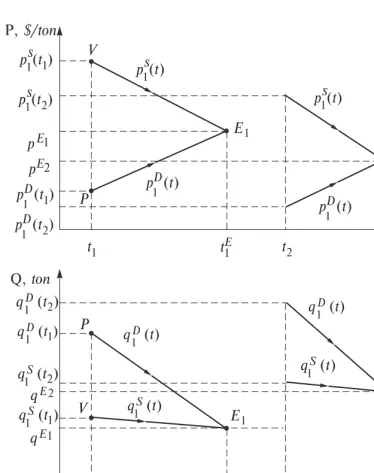
x tn( )) which is also subject to a certain physical principle of maximization. In Fig. 1, we give the graphic representation of these trajectories of agents’ motion depending on the time with the help of the suitable coordinate systems of the time-price (t, P), and the time-quantity (t, Q), in the same manner as we do the construction of analogous particles’ trajectories in classical mechanics. Below we will demonstrate a substantial similarity with physics that is depicted in the upper part of Fig. 1, with, the trajectory of the motion of agents in the price space (P-space below) and, in the lower part of Fig. 1 — in the quantity space (Q-space below). In the aggregate, both pictures represent the motion of market agents in the price quantity space (PQ-space below).
This agents’ motion reflects the market process, which consists in changing continuously by the market agents their quotations. Note, we depicted in Fig. 1 a certain standard situation on the market, in which the buyer and the seller encountered deliberately at the moment of the time t1 and began to discuss the potential transaction by a mutual exchange of information about their conditions, first of all the desired prices and the desired quantities of goods. During the negotiation, they continuously change these quotations until they agree on the final conditions of price pE1 and quantity qE1, at the moment in time tE
1 .
Such a simplest market model is applicable, for example, for the imaginable island economy in which once a year, a trade of grain occurs between a farmer and a hunter. They use the American dollar,$.To illustrate, the situation is described below in Fig. 1. Note that in this and subsequent pictures we use arrows to indicate the direction of the agent’s motion during the market process.
Up to the moment of t1, the market has been in the simple state of rest, there were no trading in it at all. At the moment of the time t1, there appear the buyer and the seller of grain in it, which set out their initial desired prices and quantities of grain, p1D (t1),p1S (t1), andq1D (t1),
Chapter I. Fundamentals of the Method of Agent-Based Physical Modeling
Fig. 1. Trajectory diagram displaying dynamics of the classical two-agent market economy in the one-dimensional economic price space (above) and in the economic quantity space (below). Dimension of time t is year, dimension of the price independent variable P is$/ton, and dimension of the quantity independent variable Q
transaction remain, otherwise the farmer and the hunter will have the difficult next year. The process of negotiations goes on, the market process of changing by the agents their quotations continues. As a result, the positions of the market agents converge and, after all, they coincide at the moment in time of t1E, which corresponds to the trajectories’ intersection point E1 on the graphs.
A voluntary transaction is accomplished to the mutual satisfaction. Further, the market again is immersed into the state of rest until the next harvest and its display to sale next year at the moment in time of t2. Harvest in this season grew, therefore q t1S( )2 > q t1S( )1 . In this
situation, the seller is, obviously, forced to immediately set out the lower starting price, p t1S( )2 < p t1S( )1 , while the buyer, seizing the opportunity, also reduced their price and increased their quantity of grain: p1D( )t2 < p1D( )t1 and q1D( )t2 > q1D( )t1 . It is natural to expect in this case that the trajectories of the buyer and the seller would be slightly changed, and agreement between the buyer and the seller will be achieved with other parameters than in the previous round of trading.
Conventionally, we will describe the state of the market at every moment in time by the set of real market prices and quantities of real deals which really take place in the market. As we can see from the Fig. 1 real deals occur in the market in our case only at the moments t1E andt2E
when the following market equilibrium conditions are valid (points Ei in Fig. 1):
( )
p1D tiE = p1S
( )
tiE = pEi, qD( )
t q t( )
qiE S iE Ei
1 = 1 = ,
( )
various theories contain different mathematical models of S&D that have been developed within the framework. In these theories, differing so-called S&D functions are used to formally define and quantitatively describe S&D.
In this book, we will also repeatedly encounter the various mathe-matical representations of this concept in different theories, which compose physical economics, namely, classical economy, probability economics, and quantum economy.
Even within the framework of one theory, it is possible to give several formal definitions of S&D functions supplementing each other. For example, within the framework of our two-agent classical economy, we can define total S&D functions as follows:
D t10( )@ p1D( )t ´q1D( )t, S10 ( )t @ p tS( )´q tS( ). (2) Thus, we have defined at each moment of time t the total demand function of the buyer, D t10( ), and the total supply function of the seller,
S t10( ), as the product of their price and quantity quotations. These functions can be easily depicted in the coordinate system of time and S&D [T, S&D], as it was done in Fig. 2 displaying the so-called S&D diagram. As one would expect, the S&D functions intersect at the equilibrium point E. It is accepted in such cases to indicate that S&D are equal at the equilibrium point. We consider that it is more strictly to say that equilibrium point is that point on the diagram of the trajectories, where these trajectories intersect, i.e., where the price and quantity quotations of the buyer and the seller are equal. But that in this case S&D curves intersect is the simple consequence of their definition equality of prices and quantities at the equilibrium point.
The last observation here concerns a formula for evaluating the volume of trade in the market, MTV t( ), between the buyer and theiE seller where they come to a mutual understanding and accomplishment of transaction at the equilibrium point Ei. It is clear that to obtain the trade volume (total value of all the transactions in this case), it is possible to simply multiply the equilibrium values of price and quantity that are derived from the above formula. The dimension of the trade volume is of course a product of the dimensions of price and quantity; in this example this is $. The same is valid for the dimensions of the total S&D, D t10( ) and S t10( ).
4.2. The Main Market Rule “Sell all — Buy at all”
[image:38.595.84.450.71.404.2]Having a method to more or less evaluate the price quantitatively is always advantageous, as it helps us to somewhat predict market prices. Using the main rule of work on the market is used to this end, and this strategic rule of decision making can be briefly formulated as follows: “Sell all — Buy at all”. This main market rule indicates the following different strategies of market actions (action on the market is setting out quotations) for both the seller and the buyer. For the seller this strategy consists in striving to sell all the goods planned to sale at the maximally possible highest prices. Whereas for the buyer this strategy consists in the fact that it will expend all the money planned for the purchase of Fig. 2.S&D diagram displaying dynamics of the classical two-agent market economy in the time-S&D functions coordinate system [T, S&D], within the first time interval
goods and try to purchase in this case as much as possible at the possible smallest price. Thus, the main market rule leads to the corresponding algorithms of the actions of agents on the markets, which are graphically represented in the form of agents’ trajectories in the pictures. The point of intersection and the respective trade volume in the market, MTV, are easily found with the help of the following mathematical formulas:
qEi @ q tS i
1 ( ), D t10( )i = p1D( )ti ´q1D( ),ti
pEi @D ti q tS i = pD ti ´qD ti q tS i
10( )/ 1 ( ) 1 ( ) 1 ( ) / 1 ( ),
MTV = pEi ´qEi = D ti
10( ), i = 1, 2. (3)
It is natural here to name D t10( ) the total demand of buyer at the1 initial moment of trading. The sense of this quantity is in the fact that this is quantity of resources, planned for the purchase of goods, expressed in the money, although the dimension of this demand is the dimension of money price ($/ton) multiplied by the dimension of quantity (ton). In our case, this is$. We emphasize that, over the course of development of quantitative theory, this is very important in order to draw attention to the dimension of the used quantities and parameters, and to the normalization of the applied functions (see below).
By analogy with classical mechanics, we can treat these prices and quantity functions as the trajectories of movement of the market agents in the two-dimensional economic PQ-space as it was displayed in Fig. 3.
In principle, this representation gives nothing new in comparison with Figs. 1 and 2. Nevertheless, there is one interesting nuance here, in which the similarity of this diagram can be compared to the traditional picture in the conceptual neoclassical model of S&D. We will examine this question below. But let us now focus attention on the following nuances in the picture in Fig. 3. First, it is clearly shown by the arrows, that the buyer and the seller seemingly move towards each other on the price, with the seller reducing it, and the buyer, on the contrary, increasing it. From this, we can reflect on the illustration of normal market negotiation processes. Secondly, usually the quotations of quantities are reduced during the process of negotiations both by the buyer and by the seller. Clearly, all agents want to purchase or to sell a smaller quantity of goods at the compromise market price than at the most desired, presented at the very beginning of trading.
And now we turn from the simplest economy to a more developed economy, in which the farmer and hunter gradually switch from the discrete trade system (one trade per year) to the continuous trade system on the market. Generally speaking, negotiations are conducted continuously and transactions are accomplished continuously, depen-ding on the needs of the buyer and the seller. This would continue for many years. Taking into account this new long-term outlook it is expedient to change somewhat the method of describing the work of the Fig. 3. Dynamics of the classical two-agent market economy in the two-dimensional
Chapter I. Fundamentals of the Method of Agent-Based Physical Modeling
market. Namely, by quotations of a quantity of goods, it is now more convenient to represent a quantity of goods during a specific and reasonable period of time, for example year, if the discussion deals with the long-standing work of the market. In this case the dimension of a quantity would be represented byton year/ . We show in Figs. 4, 5 how it is possible to graphically represent the work of the market over a long span of time. We see that before the establishment of equilibrium at point E, transactions were of course accomplished, but probably did not bring maximum satisfaction to the participants in the market. This would induce agents to continue to search for long-term compromises in prices and quantities. After reaching equilibrium, the volume of trade reaches a maximum, and participants in the market therefore attempt to further support this equilibrium.
[image:42.595.90.455.352.594.2]Here a fork appears in the following theory: — look at Figs. 5 and 6. If quotations cease to change, then the economy converts to a stationary state in which time appears to disappear. This is especially noticeable in Fig. 6, where this sort of stationary state is described by one point, E. We will label the economies in the stationary state simplythe stationary economies. But if
quotations vary with time, then the economy will be named the time-dependent or simply non-stationary economies. In Figs. 5 and 6 they are represented by two lines, which emanate from the equilibrium point E. If in this case the equilibrium quantity grows, then the economy is a growing one. But if it decreases, then the economy is falling one, which clearly is represented in Fig. 5. As a rule, in such cases, the total S&D behave similarly and this can be easily seen in Fig. 5. Let us note that their dimensions in this model have also changed, now equaling $ ton year× / .
[image:43.595.44.429.76.466.2]Chapter I. Fundamentals of the Method of Agent-Based Physical Modeling
4.3. The Many-Agent Market Economies
Now we will increase the level of complexity of the classical economies byexamining how it is possible to incorporateseveral buyers and sellers into the theory. It is understandable that each market agent will have its own trajectories in the PQ-space. In principle, they can vary greatly. There is good reason to believe that there is much similarity in the behavior of all buyers in general. The same is valid of course for all sellers. The reason is as follows. There is the intense information exchange on the market, by means of which the coordination of actions is achieved among the buyers, among the sellers, as well as among the buyers and sellers. This coordination is carried out to assist the market in reaching its maximum volume of trade, since it is precisely during the process of trading that the last point is placed in the long process of preliminary business operations: production, financing, logistics, etc. This is exactly what we would have referred to earlier as the social cooperation of the market’s agents. For example, it is natural to expect that all buyers, from one side, and sellers, from other side, behave on the market in approximately the same way, since they all are guided in their behavior on the market by one and the same main rule of work on the market: “Sell all — Buy at all”.
Hence it is possible to draw from the above discussion the following important conclusion: the trajectories of all buyers in the P-space will be close to each other; therefore, the totality of all buyers’ trajectories can be graphically represented in the form of a relatively narrow “pipe”, in which will be plotted the trajectories of all buyers. It is also possible to represent all price trajectories of the buyers by means of a single averaged trajectory, pD( ), which we will do below. We will do the samet
for the sellers, and their single averaged price trajectory we will designate as p tS( ).
them in order to obtain the quantity quotations of the whole market,
qD( ) èt q tS( ). However one should do this separately for the buyers and sellers as follows:
qD t qnD t q t q t
n N
S
mS m
M
( )= ( ), ( )= ( )
= =
å
å
1 1
, (4)
[image:45.595.41.421.269.574.2]where summing up of quantity quotations is executed formally for the market, which consists of N buyers and M sellers. In this case we understand that for the whole market we can draw all the same pictures as displayed in Figs. 1–6 for the two-agent market. Thus, for instance, we can represent the dynamics of our many-agent market by the help of the following pictures in Fig. 7. In it, the dynamics of Chapter I. Fundamentals of the Method of Agent-Based Physical Modeling
Fig. 7. Dynamics of the many-agent market economy in the price-quantity space.
qD(pD) and qS(pS) are quantity trajectories reflecting dynamics of market agents’ quotations in time up to the moment of establishment of tof establishment of the
many-agent market are depicted at the moment of equilibrium (curves
qD(pD) and q pS( S)), as well as dynamics of the stationary economy (point E) and dynamics of the non-stationary growing and falling economies.
4.4. The Classical Economiesversus Neoclassical Economies
Let us call attention to the fact that, in Figs. 3 and 6, the quotation curve of the buyer, q1D (pD), has negative slope, and the slope of the quotation curve of the seller, q1S (pS), is positive. This reflects the natural desire of the buyer to purchase more at the lower price, as far as possible, and the natural desire of the seller to sell more at the higher price, as far as possible. Specifically, it is here we reveal the visual similarity of the classical economies to the known neoclassical model of S&D. But the visual similarity of picture in Figs. 3, 6 with the corresponding famous neoclassical picture in the form of two intersected lines of S&D is only formal; economic content in them is entirely different. In classical economies, this is a graphic representation of the real market process (which really occurs on the market at a given instant), while in the neoclassical economies, this picture expresses the planned actions of market agents on the market in the future. Note that in neoclassical economics it is namely the curves q pS( S) and qD(pD) that are called S&D functions. The economic content of these S&D functions can be roughly expressed thus: “the market is by itself, I am by myself”. If one price is on the market, then I purchase (or I sell) one quantity, and if it is another, then will I purchase (or I will sell) another quantity, and so forth. Thus, the market process is completely ignored in the neoclassical economic model. But we know that, in real market life, all market agents participate continuously in the market process, permanently changing price and quantity quotations, since each has made transaction price changes on the market. We will discuss neoclassical models in more detail in other chapters of the book. However, we will now develop an artificial classical economy that will be as similar to the neoclassical model as possible.
hand of market”. In the quasi-market economy, there is a definite chief (very strict and all-seeing by definition) of the market (visible hand of the market), to whom all agents of the market for the planned period, let us say a year, must pass very detailed and reliable plans with respect to purchase and sale of goods. These plans are compiled by agents and are given to the chief in the form of tables, which are formed according to the rule stated above. If just such a price is found on the market, then I will sell a particular volume; if it is another price, then I will purchase (or sell) another, specific volume, and so forth. These agent tables are represented in Fig. 8 for simplicity in the form of continuous straight lines, a factor which does not decrease their generality in this case.
Let us note that each agent passes its plan to the chief in the form of table, and chief itself unites data of these plans and presents them in the easy-to-use shape of the two straight lines in one picture. Common sense tells us that it is most profitable for the buyer to purchase more at the minimum price. But in this scenario the seller would want to sell less. The opposite would be true for both buyer and seller at the maximum price. Graphically, this is reflected in the fact that when point Chapter I. Fundamentals of the Method of Agent-Based Physical Modeling
P1 is higher than point V1, and the point V2 higher than point P2, the consequence is that the slope of the curve of the buyer is be negative, and the slope of the curve of the seller, positive. It is obvious that these two straight lines will compulsorily be crossed at the point E (pE, qE), where the prices and quantities of the buyer and seller coincide. Next, the chief considers that these prices and quantities reflect certain equilibrium in the market, he or she calls the equilibrium price and quantity and declares that these values of price and quantity are set for the market year. Market process is, in this case, further completely eliminated from market life, in that the decisions of the market's chief completely substitutes it during the next year. We call this model economy a quasi-market one, since plans are compiled by market agents. However, they realize them in the prices and the quantities that are essentially dictated by the market’s chief.
We consider this quasi-market, stationary classical economy to be, in essence, the neoclassical model of S&D. The graphic representation of the neoclassical model economy is, by the way, the same Fig. 8, since plans in the neoclassical theory are drawn up in precisely the same way that we described above for the quasi-market economy. But in neoclassical economics, it is considered a priori that the market itself in some manner will carry out the role, which the chief of the market fills in the quasi-market economy. But if the market process is absent and there are no actions of agents adapting to the market, then who or what will fill this role? Moreover, if the economy is in a stationary state, then all prices and quantities are already known to all participants in the market, and their plans then are graphically reduced simply to one point: E. It is here that the neoclassical model generally lacks any sense or value.
References
CHAPTER II.
The Constructive Design
of the Agent-Based
Physical Economic Models
“The specific method of economics is the method of imaginary con-structions... Everyone who wants to express an opinion about the problems commonly called economic takes recourse to this method... An imaginary construction is a conceptual image of a sequence of events logically evolved from the elements of action employed in its formation. It is a product of deduction, ultimately derived from the fundamental category of action, the act of preferring and setting aside. In designing such an imaginary construction the economist is not concerned with the question of whether or not it depicts the conditions of reality which he wants to analyze. Nor does he bother about the question of whether or not such a system as his imaginary construction posits could be conceived as really existent and in operation. Even imaginary constructions which are inconceivable, self-contradictory, or unrealizable can render useful, even indispensable services in the comprehension of reality, provided the economist knows how to use them properly. The method of imaginary constructions is justified by its success. Praxeology cannot, like the natural sciences, base its teachings upon laboratory experiments and sensory perception of external objects... The main formula for designing of imaginary constructions is to abstract from the operation of some conditions present in actual action. Then we are in a position to grasp the hypothetical consequences of the absence of these conditions and to conceive the effects of their existence... The method of imaginary constructions is indispensable for praxeology; it is the only method of praxeological and economic inquiry”.
Ludwig von Mises.Human Action. A Treatise on Economics.Page 236
PREVIEW.
What is the Physical Economic Model?
many-particle systems in real space, but taking consistently into account basic, specific differences in the economic and physical systems. Each model is, in essence, only an imaginary construction, which by no means completely reflects genuine reality. It is, however, capable of describing one or several basic special features of structure or functioning of the market economy in sufficiently strict mathematical language. It was primarily created to provide fresh insight into these features, and, after the addition of another model feature or interaction, to understand, precisely how it influences entire end results.
1. The Basic Concept
of Physical Economic Design
By stretching a point, we can say that the basic concept of design of our physical economic models is skeuomorphism. Let us explain what this concept means in our case. As we have already mentioned repeatedly in this book, when constructing physical economic models we strive to reach a formal mathematical, linguistic and even graphical similarity to their physical prototypes. Specifically, this concerns both the structure and the dynamics, as well as the language and the methods of representation of the obtained results, including graphics. We consistently follow this basic concept of design throughout the book. Let us stress another point. Our main task in the book is the construction of economic models that, in as much as possible, highly resemble or copy the known form and custom physicists’ models of many-particle systems. This facilitates understanding of the models and makes it possible to use the existing, detailed language of physics within a new economic framework. For example, the language of wave functions and probability distributions will be widely used here below, although this, of course, unavoidably leads to the appearance in the theory of a large quantity of neologisms. This may strongly hamper the reading of texts by economists, but substantially facilitates this process for specialists in the fields of natural sciences. We think that this basic design concept is quite adequate for building physics-based models of economic systems.
economy consisting of active market subjects: buyers who have financial resources and a desire to buy goods or commodities, and sellers who have goods or commodities and a desire to sell them. They are the sellers and the buyers who form supply and demand (S&D below) in the market. Small dots inside the sphere denote buyers, and big ones denote sellers. The cross-hatched area outside the sphere represents the institutional and external environments, or more exactly, internal institutions such as the state, government, society, trade unions etc., and the external environment including other markets and economies, natural factors etc. It is evident that all elements and factors of the system influence each other; buyers compete with each other in the market for goods and sellers compete with each other for the mone
![Fig. 2. S&D diagram displaying dynamics of the classical two-agent market economyin the time-S&D functions coordinate system [T, S&D], within the first time interval[t1 , tE1 ].](https://thumb-us.123doks.com/thumbv2/123dok_us/293184.528879/38.595.84.450.71.404/diagram-displaying-dynamics-classical-economyin-functions-coordinate-interval.webp)
![Fig. 3. Dynamics of the classical two-agent market economy in the two-dimensionaleconomic�price-quantity�space�within�the�first�time�interval�[t1 , tE1 ].](https://thumb-us.123doks.com/thumbv2/123dok_us/293184.528879/40.595.80.443.78.475/dynamics-classical-agent-market-economy-dimensionaleconomic-quantity-interval.webp)
![Fig. 4. The classical stationary and non-stationary two-agent market economies in the[T,�P]�and�[T,�Q]�coordinate�systems�in�the�time�interval t � tE.](https://thumb-us.123doks.com/thumbv2/123dok_us/293184.528879/41.595.50.420.77.574/classical-stationary-stationary-market-economies-coordinate-systems-interval.webp)
![Fig. 5. The classical stationary and non-stationary two-agent market economies in the[T,�S&D]�—�coordinate�system.](https://thumb-us.123doks.com/thumbv2/123dok_us/293184.528879/42.595.90.455.352.594/fig-classical-stationary-stationary-agent-market-economies-coordinate.webp)