Which Are the Best Features for Automatic Verb Classification
Jianguo Li
Department of Linguistics The Ohio State University
Columbus Ohio, USA
Chris Brew
Department of Linguistics The Ohio State University
Columbus Ohio, USA
Abstract
In this work, we develop and evaluate a wide range of feature spaces for deriving Levin-style verb classifications (Levin, 1993). We perform the classification experiments using Bayesian Multinomial Regression (an effi-cient log-linear modeling framework which we found to outperform SVMs for this task) with the proposed feature spaces. Our exper-iments suggest that subcategorization frames are not the most effective features for auto-matic verb classification. A mixture of syntac-tic information and lexical information works best for this task.
1 Introduction
Much research in lexical acquisition of verbs has concentrated on the relation between verbs and their argument frames. Many scholars hypothesize that the behavior of a verb, particularly with respect to the expression of arguments and the assignment of semantic roles is to a large extent driven by deep semantic regularities (Dowty, 1991; Green, 1974; Goldberg, 1995; Levin, 1993). Thus measurements of verb frame patterns can perhaps be used to probe for linguistically relevant aspects of verb meanings. The correspondence between meaning regularities and syntax has been extensively studied in Levin (1993) (hereafter Levin). Levin’s verb classes are based on the ability of a verb to occur or not occur in pairs of syntactic frames that are in some sense meaning preserving (diathesis alternation). The fo-cus is on verbs for which distribution of syntactic frames is a useful indicator of class membership,
and, correspondingly, on classes which are relevant for such verbs. By using Levin’s classification, we obtain a window on some (but not all) of the poten-tially useful semantic properties of verbs.
Levin’s verb classification, like others, helps re-duce redundancy in verb descriptions and enables generalizations across semantically similar verbs with respect to their usage. When the information about a verb type is not available or sufficient for us to draw firm conclusions about its usage, the infor-mation about the class to which the verb type be-longs can compensate for it, addressing the perva-sive problem of data sparsity in a wide range of NLP tasks, such as automatic extraction of subcategoriza-tion frames (Korhonen, 2002), semantic role label-ing (Swier and Stevenson, 2004; Gildea and Juraf-sky, 2002), natural language generation for machine translation (Habash et al., 2003), and deriving pre-dominant verb senses from unlabeled data (Lapata and Brew, 2004).
Although there exist several manually-created verb lexicons or ontologies, including Levin’s verb taxonomy, VerbNet, and FrameNet, automatic verb classification (AVC) is still necessary for extend-ing existextend-ing lexicons (Korhonen and Briscoe, 2004), building and tuning lexical information specific to different domains (Korhonen et al., 2006), and boot-strapping verb lexicons for new languages (Tsang et al., 2002).
AVC helps avoid the expensive hand-coding of such information, but appropriate features must be identified and demonstrated to be effective. In this work, our primary goal is not necessarily to obtain the optimal classification, but rather to investigate
the linguistic conditions which are crucial for lex-ical semantic classification of verbs. We develop feature sets that combine syntactic and lexical infor-mation, which are in principle useful for any Levin-style verb classification. We test the general ap-plicability and scalability of each feature set to the distinctions among 48 verb classes involving 1,300 verbs, which is, to our knowledge, the largest in-vestigation on English verb classification by far. To preview our results, a feature set that combines both syntactic information and lexical information works much better than either of them used alone. In ad-dition, mixed feature sets also show potential for scaling well when dealing with larger number of verbs and verb classes. In contrast, subcategoriza-tion frames, at least on their own, are largely inef-fective for AVC, despite their evident efinef-fectiveness in supporting Levin’s initial intuitions.
2 Related Work
Earlier work on verb classification has generally adopted one of the two approaches for devising sta-tistical, corpus-based features.
Subcategorization frame(SCF): Subcategoriza-tion frames are obviously relevant to alternaSubcategoriza-tion behaviors. It is therefore unsurprising that much work on verb classification has adopted them as fea-tures (Schulte im Walde, 2000; Brew and Schulte im Walde, 2002; Korhonen et al., 2003). However, rely-ing solely on subcategorization frames also leads to the loss of semantic distinctions. Consider the frame NP-V-PPwith. The semantic interpretation of this frame depends to a large extent on the NP argument selected by the preposition with. In (1), the same surface form NP-V-PPwithcorresponds to three dif-ferent underlying meanings. However, such seman-tic distinctions are totally lost if lexical information is disregarded.
(1) a. I ate witha fork. [INSTRUMENT] b. I left witha friend. [ACCOMPANIMENT] c. I sang withconfidence. [MANNER]
This deficiency of unlexicalized subcategoriza-tion frames leads researchers to make attempts to incorporate lexical information into the feature rep-resentation. One possible improvement over subcat-egorization frames is to enrich them with lexical in-formation. Lexicalized frames are usually obtained
by augmenting each syntactic slot with its head noun (2).
(2) a. NP(I)-V-PP(with:fork) b. NP(I)-V-PP(with:friend) c. NP(I)-V-PP(with:confidence)
With the potentially improved discriminatory power also comes increased exposure to sparse data problems. Trying to overcome the problem of data sparsity, Schulte im Walde (2000) explores the ad-ditional use of selectional preference features by augmenting each syntactic slot with the concept to which its head noun belongs in an ontology (e.g. WordNet). Although the problem of data sparsity is alleviated to certain extent (3), these features do not generally improve classification performance (Schulte im Walde, 2000; Joanis, 2002).
(3) a. NP(PERSON)-V-PP(with:ARTIFACT) b. NP(PERSON)-V-PP(with:PERSON) c. NP(PERSON)-V-PP(with:FEELING)
JOANIS07: Incorporating lexical information di-rectly into subcategorization frames has proved in-adequate for AVC. Other methods for combining syntactic information with lexical information have also been attempted (Merlo and Stevenson, 2001; Joanis et al., 2007). These studies use a small col-lection of features that require some degree of expert linguistic analysis to devise. The deeper linguistic analysis allows their feature set to cover a variety of indicators of verb semantics, beyond that of frame information. Joanis et al. (2007) reports an experi-ment that involves 15 Levin verb classes. They de-fine a general feature space that is supposed to be applicable to all Levin classes. The features they use fall into four different groups: syntactic slots,
slot overlaps,tense, voice and aspect, andanimacy of NPs.
• Syntactic slots: They encode the frequency of the syntactic positions (e.g. SUBJECT, OB-JECT, PPat). They are considered approxima-tion to subcategorizaapproxima-tion frames.
The sun melted the ice, ice occurs in the sub-ject position in the first sentence but in the ob-ject position in the second sentence. An over-lap feature records that there is a subject-object alternation formelt.
• Tense, voice and aspect: Verb meaning and al-ternations also interact in interesting ways with
tense, voice, and aspect. For example, mid-dleconstruction is usually used in present tense (e.g.The bread cuts easily).
• Animacy of NPs: The animacy of the seman-tic role corresponding to the head noun in each syntactic slot can also distinguish classes of verbs.
Joanis et al. (2007) demonstrates that the gen-eral feature space they devise achieves a rate of error reduction ranging from 48% to 88% over a chance baseline accuracy, across classification tasks of varying difficulty. However, they also show that their general feature space does not generally im-prove the classification accuracy over subcategoriza-tion frames (see table 1).
Experimental Task All Features SCF Average 2-way 83.2 80.4 Average 3-way 69.6 69.4 Average (≥6)-way 61.1 62.8
Table 1: Results from Joanis et al. (2007) (%)
3 Integration of Syntactic and Lexical Information
In this study, we explore a wider range of features for AVC, focusing particularly on various ways to mix syntactic with lexical information.
Dependency relation (DR): Our way to over-come data sparsity is to break lexicalized frames into
lexicalized slots(a.k.a. dependency relations). De-pendency relations contain both syntactic and lexical information (4).
(4) a. SUBJ(I), PP(with:fork) b. SUBJ(I), PP(with:friend) c. SUBJ(I), PP(with:confidence)
However, augmenting PP with nouns selected by the preposition (e.g. PP(with:fork)) still gives rise
to data sparsity. We therefore decide to break it into two individual dependency relations: PP(with), PP-fork. Although dependency relations have been widely used in automatic acquisition of lexical infor-mation, such as detection of polysemy (Lin, 1998) and WSD (McCarthy et al., 2004), their utility in AVC still remains untested.
Co-occurrence(CO): CO features mostly convey lexical information only and are generally consid-ered not particularly sensitive to argument structures (Rohde et al., 2004). Nevertheless, it is worthwhile testing whether the meaning components that are brought out by syntactic alternations are also cor-related to the neighboring words. In other words, Levin verbs may be distinguished on the dimension of neighboring words, in addition to argument struc-tures. A test on this claim can help answer the ques-tion of whether verbs in the same Levin class also tend to share their neighboring words.
Adapted co-occurrence (ACO): Conventional CO features generally adopt a stop list to filter out function words. However, some of the functions words, prepositions in particular, are known to carry great amount of syntactic information that is related to lexical meanings of verbs (Schulte im Walde, 2003; Brew and Schulte im Walde, 2002; Joanis et al., 2007). In addition, whereas most verbs tend to put a strong selectional preference on their nominal arguments, they do not care much about the iden-tity of the verbs in their verbal arguments. Based on these observations, we propose to adapt the conven-tional CO features by (1) keeping all prepositions (2) replacing all verbs in the neighboring contexts of each target verb with their part-of-speech tags. ACO features integrate at least some degree of syntactic information into the feature space.
SCF+CO: Another way to mix syntactic informa-tion with lexical informainforma-tion is to use subcategoriza-tion frames and co-occurrences together in hope that they are complementary to each other, and therefore yield better results for AVC.
4 Experiment Setup
4.1 Corpus
in-ternational sources of English newswire.
4.2 Feature Extraction
We evaluate six different feature sets for their effec-tiveness in AVC:SCF, DR, CO,ACO,SCF+CO, andJOANIS07. SCFcontains mainly syntactic in-formation, whereas CO lexical information. The other four feature sets include both syntactic and lex-ical information.
SCFandDR: These more linguistically informed features are constructed based on the grammatical relations generated by the C&C CCG parser (Clark and Curran, 2007). TakeHe broke the door with a hammeras an example. The grammatical relations generated are given in table 2.
he broke the door with a hammer. (det door 3 the 2)
(dobj broke 1 door 3)
(det hammer 6 a 5)
(dobj with 4 hammer 6) (iobj broke 1 with 4) (ncsubj broke 1 He 0 )
Table 2: grammatical relations generated by the parser
We first build a lexicalized frame for the verb
break: NP1(he)-V-NP2(door)-PP(with:hammer). This is done by matching each grammatical label onto one of the traditional syntactic constituents. The set of syntactic constituents we use is summa-rized in table 3.
constituent remark
NP1 subject of the verb NP2 object of the verb NP3 indirect object of the verb PPp prepositional phrase
TO infinitival clause GER gerund
THAT sentential complement headed bythat WH sentential complement headed by awh-word ADJP adjective phrase
[image:4.612.128.246.281.352.2]ADVP adverb phrase
Table 3: Syntactic constituents used for building SCFs
Based on the lexicalized frame, we construct an SCF NP1-NP2-PPwith for break. The set of DRs generated for breakis [SUBJ(he), OBJ(door), PP(with), PP-hammer].
CO: These features are collected using a flat 4-word window, meaning that the 4 4-words to the
left/right of each target verb are considered poten-tial CO features. However, we eliminate any CO features that are in a stopword list, which con-sists of about 200 closed class words including mainly prepositions, determiners, complementizers and punctuation. We also lemmatize each word us-ing the English lemmatizer as described in Minnen et al. (2000), and use lemmas as features instead of words.
ACO: As mentioned before, we adapt the conven-tional CO features by (1) keeping all prepositions (2) replacing all verbs in the neighboring contexts of each target verb with their part-of-speech tags. (3) keeping words in the left window only if they are tagged as a nominal.
SCF+CO: We combine the SCF and CO features.
JOANIS07: We use the feature set proposed in Joanis et al. (2007), which consists of 224 features. We extract features on the basis of the output gener-ated by the C&C CCG parser.
4.3 Verb Classes
Our experiments involve two separate sets of verb classes:
Joanis15: Joanis et al. (2007) manually selects pairs, or triples of classes to represent a range of distinctions that exist among the 15 classes they in-vestigate. For example, some of the pairs/triples are syntactically dissimilar, while others show little syn-tactic distinction across the classes.
experi-ment. This process yields 48 classes involving about 1,300 verbs. In our automatic verb classification ex-periment, we test the applicability of each feature set to distinctions among up to 48 classes1. To our knowledge, this is, by far, the largest investigation on English verb classification.
5 Machine Learning Method
5.1 Preprocessing Data
We represent the semantic space for verbs as a ma-trix of frequencies, where each row corresponds to a Levin verb and each column represents a given feature. We construct a semantic space with each feature set. Except forJONAIS07which only con-tains 224 features, all the other feature sets lead to a very high-dimensional space. For instance, the se-mantic space with CO features contains over one million columns, which is too huge and cumber-some. One way to avoid these high-dimensional spaces is to assume that most of the features are irrel-evant, an assumption adopted by many of the previ-ous studies working with high-dimensional seman-tic spaces (Burgess and Lund, 1997; Pado and La-pata, 2007; Rohde et al., 2004). Burgess and Lund (1997) suggests that the semantic space can be re-duced by keeping only thekcolumns (features) with the highest variance. However, Rohde et al. (2004) have found it is simpler and more effective to dis-card columns on the basis of feature frequency, with little degradation in performance, and often some improvement. Columns representing low-frequency features tend to be noisier because they only involve few examples. We therefore apply a simple fre-quency cutoff for feature selection. We only use fea-tures that occur with a frequency over some thresh-old in our data.
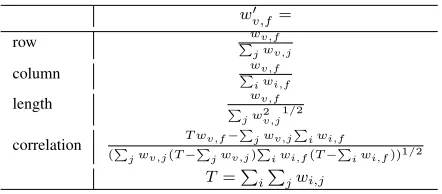
[image:5.612.317.538.138.235.2]In order to reduce undue influence of outlier fea-tures, we employ the four normalization strategies in table 4, which help reduce the range of extreme val-ues while having little effect on others (Rohde et al., 2004). The raw frequency (wv,f) of a verb v
oc-curring with a featurefis replaced with the
normal-1
In our experiment, we only use monosemous verbs from these 48 verb classes. Due to the space limit, we do not list the 48 verb classes. The size of the most classes falls in the range between 10 to 30, with a couple of classes having a size over 100.
ized value (w0v,f), according to each normalization method. Our experiments show that using correla-tion for normalizacorrela-tion generally renders the best re-sults. The results reported below are obtained from using correlation for normalization.
wv,f0 =
row wv,f
P
jwv,j
column Pwv,f
iwi,f
length wv,f
P
jwv,j2
1/2
correlation T wv,f−
P
jwv,jPiwi,f
(P
jwv,j(T−Pjwv,j)Piwi,f(T−
P
iwi,f))1/2 T=P
i P
jwi,j
Table 4: Normalization techniques
To preprocess data, we first apply a frequency cut-off to our data set, and then normalize it using the correlation method. To find the optimal threshold for frequency cut, we consider each value between 0 and 10,000 at an interval of 500. In our experiments, results on training data show that performance de-clines more noticeably when the threshold is lower than 500 or higher than 10,000. For each task and feature set, we select the frequency cut that offers the best accuracy on the preprocessed training set according tok-fold stratified cross validation2.
5.2 Classifier
For all of our experiments, we use the software that implements the Bayesian multinomial logistic re-gression (a.k.a BMR). The software performs the so-called 1-of-k classification (Madigan et al., 2005). BMR is similar to Maximum Entropy. It has been shown to be very efficient with handling large num-bers of features and extremely sparsely populated matrices, which characterize the data we have for AVC 3. To begin, let x = [x1, ..., xj, ..., xd]T be a
vector of feature values characterizing a verb to be classified. We encode the fact that a verb belongs to a classk ∈ 1, ..., K by aK-dimensional 0/1 val-ued vectory = (y1, ..., yK)T, whereyk = 1and all
other coordinates are 0. Multinomial logistic
regres-210-fold for Joanis15 and 9-fold for Levin48. We use a
bal-anced training set, which contains 20 verbs from each class in Joanis15, but only 9 verbs from each class in Levin48.
3
sion is a conditional probability model of the form, parameterized by the matrixβ = [β1, ..., βK]. Each
column ofβ is a parameter vector corresponding to one of the classes:βk= [βk1, ..., βkd]T.
P(yk= 1|βk, x) =exp(βTkx)/ X
ki exp(βT
kix)
6 Results and Discussion
6.1 Evaluation Metrics
Following Joanis et al. (2007), we adopt a single evaluation measure - macro-averaged recall - for all of our classification tasks. As discussed below, since we always use balanced training sets for each indi-vidual task, it makes sense for our accuracy metric to give equal weight to each class. Macro-averaged re-call treats each verb class equally, so that the size of a class does not affect macro-averaged recall. It usu-ally gives a better sense of the quality of classifica-tion across all classes. To calculate macro-averaged recall, the recall value for each individual verb class has to be computed first.
recall=no. of test verbs in classccorrectly labeled
no. of test verbs in classc
With a recall value computed for each verb class, the macro-averaged recall can be defined by:
macro-averaged recall= 1
|C|
X
c∈C
recall f or class c
C:a set of verb classes
c:an individual verb class
|C|:the number of verb classes
6.2 Joanis15
With those manually-selected 15 classes, Joanis et al. (2007) conducts 11 classification tasks includ-ing six 2-way classifications, two 3-way classifica-tions, one 6-way classification, one 8-way classifi-cation, and one 14-way classification. In our exper-iments, we replicate these 11 classification tasks us-ing the proposed six different feature sets. For each classification task in this task set, we randomly se-lect 20 verbs from each class as the training set. We
repeat this process 10 times for each task. The re-sults reported for each task is obtained by averaging the results of the 10 trials. Note that for each trial, each feature set is trained and tested on the same training/test split.
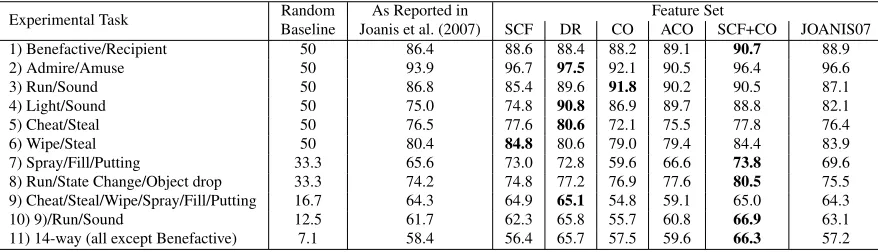
The results for the 11 classification tasks are sum-marized in table 5. We provide a chance baseline and the accuracy reported in Joanis et al. (2007)4for comparison of our results. A few points are worth noting:
• Although widely used for AVC,SCF, at least when used alone, is not the most effective fea-ture set. Our experiments show that the per-formance achieved by usingSCF is generally worse than using the feature sets that mix syn-tactic and lexical information. As a matter of fact, it even loses to the simplest feature setCO
on 4 tasks, including the 14-way task.
• The two feature sets (DR, SCF+CO) we pro-pose that combine syntactic and lexical infor-mation generally perform better than those fea-ture sets (SCF,CO) that only include syntactic or lexical information. Although there is not a clear winner,DRandSCF+COgenerally out-perform other feature sets, indicating that they are effective ways for combining syntactic and lexical information. In particular, these two feature sets perform comparatively well on the tasks that involve more classes (e.g. 14-way), exhibiting the tendency to scale well with larger number of verb classes and verbs. Another fea-ture set that combines syntactic and lexical in-formation,ACO, which keeps function words in the feature space to preserve syntactic infor-mation, outperforms the conventional CO on the majority of tasks. All these observations suggest that how to mix syntactic and lexical information is one of keys to an improved verb classification.
• AlthoughJOANIS07also combines syntactic and lexical information, its performance is not comparable to that of other feature sets that mix syntactic and lexical information. In fact,SCF
4
Experimental Task Random As Reported in Feature Set
Baseline Joanis et al. (2007) SCF DR CO ACO SCF+CO JOANIS07 1) Benefactive/Recipient 50 86.4 88.6 88.4 88.2 89.1 90.7 88.9 2) Admire/Amuse 50 93.9 96.7 97.5 92.1 90.5 96.4 96.6
3) Run/Sound 50 86.8 85.4 89.6 91.8 90.2 90.5 87.1
4) Light/Sound 50 75.0 74.8 90.8 86.9 89.7 88.8 82.1 5) Cheat/Steal 50 76.5 77.6 80.6 72.1 75.5 77.8 76.4
6) Wipe/Steal 50 80.4 84.8 80.6 79.0 79.4 84.4 83.9
[image:7.612.86.525.60.186.2]7) Spray/Fill/Putting 33.3 65.6 73.0 72.8 59.6 66.6 73.8 69.6 8) Run/State Change/Object drop 33.3 74.2 74.8 77.2 76.9 77.6 80.5 75.5 9) Cheat/Steal/Wipe/Spray/Fill/Putting 16.7 64.3 64.9 65.1 54.8 59.1 65.0 64.3 10) 9)/Run/Sound 12.5 61.7 62.3 65.8 55.7 60.8 66.9 63.1 11) 14-way (all except Benefactive) 7.1 58.4 56.4 65.7 57.5 59.6 66.3 57.2
Table 5: Experimental results for Joanis15 (%)
and JOANIS07 yield similar accuracy in our experiments, which agrees with the findings in Joanis et al. (2007) (compare table 1 and 5).
6.3 Levin48
Recall that one of our primary goals is to identify the feature set that is generally applicable and scales well while we attempt to classify more verbs into a larger number of classes. If we could exhaust all the possible n-way (2 ≤ n ≤ 48) classification tasks with the 48 Levin classes we will investigate, it will allow us to draw a firmer conclusion about the gen-eral applicability and scalability of a particular fea-ture set. However, the number of classification tasks grows really huge whenntakes on certain value (e.g. n = 20). For our experiments, we setnto be 2, 5, 10, 20, 30, 40, or 48. For the 2-way classification, we perform all the possible 1,028 tasks. For the 48-way classification, there is only one possible task. We randomly select 100 n-way tasks each for n = 5, 10, 20, 30, 40. We believe that this series of tasks will give us a reasonably good idea of whether a par-ticular feature set is generally applicable and scales well.
The smallest classes in Levin48 have only 10 verbs. We therefore reduce the number of training verbs to 9 for each class. For eachn= 2, 5, 10, 20, 30, 40, 48, we will perform certain number ofn-way classification tasks. For each n-way task, we ran-domly select 9 verbs from each class as training data, and repeat this process 10 times. The accuracy for eachn-way task is then computed by averaging the results from these 10 trials. The accuracy reported for the overalln-way classification for each selected
n, is obtained by averaging the results from each
in-dividualn-way task for that particularn. Again, for each trial, each feature set is trained and tested on the same training/test split.
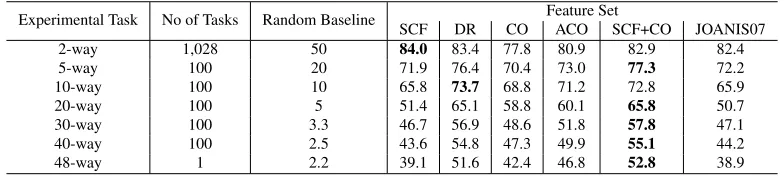
The results for Levin48 are presented in table 6, which clearly reveals the general applicability and scalability of each feature set.
• Results from Levin48 reconfirm our finding thatSCFis not the most effective feature set for AVC. Although it achieves the highest accuracy on the 2-way classification, its accuracy drops drastically asngets bigger, indicating that SCF does not scale as well as other feature sets when dealing with larger number of verb classes. On the other hand, the co-occurrence feature (CO), which is believed to convey only lexical infor-mation, outperformsSCFon everyn-way clas-sification whenn ≥ 10, suggesting that verbs in the same Levin classes tend to share their neighboring words.
• The three feature sets we propose that com-bine syntactic and lexical information generally scale well. Again, DR and SCF+CO gener-ally outperform all other feature sets on alln -way classifications, except the 2--way classifica-tion. In addition,ACOachieves a better perfor-mance on everyn-way classification thanCO. AlthoughSCF andCO are not very effective when used individually, they tend to yield the best performance when combined together.
Experimental Task No of Tasks Random Baseline Feature Set
SCF DR CO ACO SCF+CO JOANIS07 2-way 1,028 50 84.0 83.4 77.8 80.9 82.9 82.4
5-way 100 20 71.9 76.4 70.4 73.0 77.3 72.2
10-way 100 10 65.8 73.7 68.8 71.2 72.8 65.9
20-way 100 5 51.4 65.1 58.8 60.1 65.8 50.7
30-way 100 3.3 46.7 56.9 48.6 51.8 57.8 47.1 40-way 100 2.5 43.6 54.8 47.3 49.9 55.1 44.2
[image:8.612.110.502.60.150.2]48-way 1 2.2 39.1 51.6 42.4 46.8 52.8 38.9
Table 6: Experimental results for Levin48 (%)
6.4 Further Discussion
Previous studies on AVC have focused on using SCFs. Our experiments reveal that SCFs, at least when used alone, compare poorly to the feature sets that mix syntactic and lexical information. One ex-planation for the poor performance could be that we use all the frames generated by the CCG parser in our experiment. A better way of doing this would be to use some expert-selected SCF set. Levin clas-sifies English verbs on the basis of 78 SCFs, which should, at least in principle, be good at separating verb classes. To see if Levin-selected SCFs are more effective for AVC, we match each SCF gen-erated by the C&C CCG parser (CCG-SCF) to one of 78 Levin-defined SCFs, and refer to the resulting SCF set as unfiltered-Levin-SCF. Following stud-ies on automatic SCF extraction (Brent, 1993), we apply a statistical test (Binomial Hypothesis Test) to theunfiltered-Levin-SCF to filter out noisy SCFs, and denote the resulting SCF set as filtered-Levin-SCF. We then perform the 48-way task (one of Levin48) with these two different SCF sets. Recall that usingCCG-SCFgives us a macro-averaged re-call of 39.1% on the 48-way task. Our experiments show that usingunfiltered-Levin-SCFand filtered-Levin-SCFraises the accuracy to 39.7% and 40.3% respectively. Although a little performance gain has been obtained by using expert-defined SCFs, the ac-curacy level is still far below that achieved by using a feature set that combines syntactic and semantic information. In fact, even the simple co-occurrence feature (CO) yields a better performance (42.4%) than these Levin-selected SCF sets.
7 Conclusion and Future Work
We have performed a wide range of experiments to identify which features are most informative in
AVC. Our conclusion is that both syntactic and lex-ical information are useful for verb classification. Although neitherSCFnorCOperforms well on its own, a combination of them proves to be the most in-formative feature for this task. Other ways of mixing syntactic and lexical information, such asDR, and
ACO, work relatively well too. What makes these mixed feature sets even more appealing is that they tend to scale well in comparison toSCFandCO. In addition, these feature sets are devised on a general level without relying on any knowledge about spe-cific classes, thus potentially applicable to a wider range of class distinctions. Assuming that Levin’s analysis is generally applicable across languages in terms of the linking of semantic arguments to their syntactic expressions, these mixed feature sets are potentially useful for building verb classifications for other languages.
For our future work, we aim to test whether an automatically created verb classification can be ben-eficial to other NLP tasks. One potential applica-tion of our verb classificaapplica-tion is parsing. Lexicalized PCFGs (where head words annotate phrasal nodes) have proved a key tool for high performance PCFG parsing, however its performance is hampered by the sparse lexical dependency exhibited in the Penn Treebank. Our experiments on verb classification have offered a class-based approach to alleviate data sparsity problem in parsing. It is our goal to test whether this class-based approach will lead to an im-proved parsing performance.
8 Acknowledgments
References
Brent, M. (1993). From grammar to lexicon: Unsuper-vised learning of lexical syntax. Computational Lin-guistics, 19(3):243–262.
Brew, C. and Schulte im Walde, S. (2002). Spectral clus-tering for German verbs. InProccedings of the 2002 Conference on EMNLP, pages 117–124.
Burgess, C. and Lund, K. (1997). Modelling parsing constraints with high-dimentional context space. Lan-guage and Cognitive Processes, 12(3):177–210.
Chang, C. and Lin, C. (2001). LIBSVM:
A library for support vector machines. http://www.csie.ntu.edu.tw. cjlin/libsvm.
Clark, S. and Curran, J. (2007). Formalism-independent parser evaluation with CCG and Depbank. In Proceed-ings of the 45th Annual Meeting of ACL, pages 248– 255.
Dowty, D. (1991). Thematic proto-roles and argument selection. Language, 67:547–619.
Gildea, D. and Jurafsky, D. (2002). Automatic labeling of semantic role. Computational Linguistics, 28(3):245– 288.
Goldberg, A. (1995). Constructions. University of Chicago Press, Chicago, 1st edition.
Green, G. (1974). Semantics and Syntactic Regularity. Indiana University Press, Bloomington.
Habash, N., Dorr, B., and Traum, D. (2003). Hybrid natu-ral language generation from lexical conceptual struc-tures. Machine Translation, 18(2):81–128.
Joanis, E. (2002). Automatic verb classification using a general feature space. Master’s thesis, University of Toronto.
Joanis, E., Stevenson, S., and James, D. (2007). A general feature space for automatic verb classification.Natural Language Engineering, 1:1–31.
Korhonen, A. (2002). Subcategorization Acquisition. PhD thesis, Cambridge University.
Korhonen, A. and Briscoe, T. (2004). Extended lexical-semantic classification of english verbs. In Proceed-ings of the 2004 HLT/NAACL Workshop on Computa-tional Lexical Semantics, pages 38–45, Boston, MA.
Korhonen, A., Krymolowski, Y., and Collier, N. (2006). Automatic classification of verbs in biomedical texts. In Proceedings of the 21st International Conference on COLING and 44th Annual Meeting of ACL, pages 345–352, Sydney, Australia.
Korhonen, A., Krymolowski, Y., and Marx, Z. (2003). Clustering polysemic subcategorization frame distri-butions semantically. InProceedings of the 41st An-nual Meeting of ACL, pages 48–55, Sapparo, Japan.
Lapata, M. and Brew, C. (2004). Verb class disambigua-tion using informative priors. Computational Linguis-tics, 30(1):45–73.
Levin, B. (1993).English Verb Classes and Alternations: A Preliminary Investigation. University of Chicago Press, Chicago, 1st edition.
Lin, D. (1998). Automatic retrieval and clustering of sim-ilar words. InProceedings of the 17th Internation Con-ference on COLING and 36th Annual Meeting of ACL.
Madigan, D., Genkin, A., Lewis, D., and Fradkin, D. (2005). Bayesian Multinomial Logistic Regression for Author Identification.DIMACS Technical Report.
McCarthy, D., Koeling, R., Weeds, J., and Carroll, J. (2004). Finding predominant senses in untagged text. In Proceedings of the 42nd Annual Meeting of ACL, pages 280–287.
Merlo, P. and Stevenson, S. (2001). Automatic verb clas-sification based on statistical distribution of argument structure. Computational Linguistics, 27(3):373–408.
Minnen, G., Carroll, J., and Pearce, D. (2000). Applied morphological processing of English. Natural Lan-guage Engineering, 7(3):207–223.
Pado, S. and Lapata, M. (2007). Dependency-based con-struction of semantic space models.Computional Lin-guistics, 33(2):161–199.
Rohde, D., Gonnerman, L., and Plaut, D. (2004). An im-proved method for deriving word meaning from lexical co-occurrence. http://dlt4.mit.edu/ dr/COALS.
Schulte im Walde, S. (2000). Clustering verbs seman-tically according to alternation behavior. In Proceed-ings of the 18th International Conference on COLING, pages 747–753.
Schulte im Walde, S. (2003). Experiments on the choice of features for learning verb classes. InProceedings of the 10th Conference of EACL, pages 315–322.
Swier, R. and Stevenson, S. (2004). Unsupervised se-mantic role labelling. InProceedings of the 2004 Con-ference on EMNLP, pages 95–102.