Functional or structural separation to
deal with vertical foreclosure effects in
the electronic communications industry,
pending the Second British Telecoms
Review (2015)
Congedo, Pierluigi
Institut d’Etudes Europeennes, Universite’ Libre de Bruxelles,
LUISS Guido Carli, Rome, King’s College London, London
30 December 2015
Online at
https://mpra.ub.uni-muenchen.de/69619/
1
Functional or structural separation to deal with vertical foreclosure
effects in the electronic communications industry, pending the
Second British Telecoms Review (2015).
Abstract
The paper tackles the discussion about vertical separation in the electronic
communications sector, in its two main forms functional and structural. The author
will argue how mandatory structural separation under certain conditions could be a
possible option. The evidence is provided by the analysis of recent commitment
decisions adopted by the European Commission in the energy sector, and by
structural separation undertakings signed in Australia and New Zealand in the past
few years. The paper considers the theoretical background, such as the various
forms of separation identified by the OECD in 2001 and 2011, but also the current
discussion around the Second Telecoms Review (2005-2015) in the United
Kingdom.
Keywords: vertical structural separation, functional separation, regulation, abuse, dominance, essential facilities, commitments, electronic communications
Dr Pierluigi Congedo*
1. Introduction
This paper tackles the discussion about vertical separation (separation of
vertically-integrated parts of an undertaking, such as the network) in the electronic
communications sector, in its two main forms: functional and structural. The author
will argue how negotiated and even mandatory structural separation under certain
2
In the last decades the hypothesis of adopting structural remedies in the electronic
communications sector, at least at US level, lost the favour recorded in the 1980s.
The Harvard School advocates in favour of antitrust intervention to deal with market
structure hindering competition, and how separation may actually reduce the
structural competitive advantage that the incumbent may have in the market. The
Chicago School looks instead at economic efficiency reasons, and is generally
keener to adopt less invasive solutions and put behavioural remedies (i.e. functional
separation) on top of the competition enforcement agenda, only if and after
regulatory tools have shown their inadequacy.
Also the Organisation for Economic Cooperation and Development (‘OECD’) recently
took in a Recommendation on structural separation adopted on the 13 December
2011 (published in January 2012)1, showing how, at inter-governmental level, the
position changed in the last decade, in favour of ‘á la carte’ enforcement solutions,
departing from the position expressed in 2001, more favourable to structural
separation.
It is a very useful document that, alongside with a Report on structural separation
published at the same time, stresses how the choice of the most suitable form of
(horizontal or vertical) separation should follow a case-by-case approach, on the
basis of the evaluation of two main factors:
1. The advantages and disadvantages that the separation may determine in
competition terms;
2. The costs and benefits that the separation may determine.
* LL.M. (ULB), Ph.D. in Law (King’s College London), Solicitor of the Law Society, Cassation Court
Avvocato in Rome, module teacher of EU Competition Law, LUISS Guido Carli, Rome and La Sapienza, Rome, collaborateur scientifique, Institut d’Etudes Européennes, Université Libre de Bruxelles, Brussels.
The author takes personal responsibility of the opinion expressed.
1 OECD Report 2011 ‘Report on Experiences with Structural Separation’, OECD pub. 2012, p 10,
3
If this two-fold approach is correct, I am prone to add a third, decisive, factor to be
borne in mind in favour of structural separation: the importance of deterrence. The
threat of structural separation could be dropped at a later stage (for instance while
negotiating commitments), finally adopting behavioural-based solutions.
After having discussed the evolution of the OECD approach, I will analyse the
current position of the doctrine, both at legal and economic level.
Among various authors, Prof. Martin Cave played a decisive role in the United Kingdom in explaining how ‘replicability’ of infrastructures is of paramount importance to boost network-based competition, going beyond the pressure on the
local access incumbent to open its network (i.e. through ex ante regulatory tools), or
through mandatory divestiture of the network (through ex post enforcement tools). Martin Cave’s ‘ladder of investments’ scheme2
influenced the current debate at
European level on access to networks, in addition to the influence that OECD reports
on separation might have had on regulators and competition authorities. All these
positions were kept in consideration during the debate (what is considered the First
British Telecoms Review 2005) preceding BT’s functional separation and the
creation of the separate access division, Openreach in 20063.
I will also make reference to specific experiences such as the creation of Openreach as a separate division within BT’s group for the electronic communications sector,
2 CAVE,
Six Degrees of Separation, Operational Separation as a Remedy in European Telecommunications Regulation, in Communications & strategies, 2006, 89ff. See also CAVE - DOYLE, Network separation and investment incentives in telecommunications’ University of Warwick, MEC 1521, 2007, 1-32.
3
4
and to the commitments decisions in the cases EO.N4, RWE5 and ENI6 (2008-2010)
in the energy sector that led to structural separation.
After a short analysis of the OECD position on functional and structural separation,
the following sections highlight the reasoning behind the choice of functional
separation rather than structural separation when British Telecom negotiated the
undertakings that led to the creation of Openreach as a separated division within the
same group. The section on Openreach is aimed at clarifying the advantages and
the disadvantages that functional separation entails. I will then focus on the
advantages and disadvantages of structural separation, on the basis not only of the
AT&T case but also looking at the remedies adopted with respect to the energy
sector and to a recent case of structural separation adopted in Australia dealing with
the national incumbent: Telstra.
The last section contains conclusive remarks on structural separation and an analysis of the doctrine of Martin Cave on ‘degrees of separation’, opening the path to a new approach towards structural separation, as a remedy that can be
considered to be the most convincing form of deterrent that the enforcer, the
European Commission, can put forward in exercising its prerogatives on the basis of
Art. 7 of Regulation 1/2003/EC.
2. The OECD position in the last decade. From the 2001 Recommendation on structural separation to the 2011 Report and amended Recommendation.
4
Commission Decision E.ON (Case COMP/38.388-38.389) of 26 November 2008, [2009] OJ C36/8 of 13 February 2009, accessible at http://ec/europa.eu/competition/antitrust/cases/dec_docs/39388/39388_2796_3.pdf.
5 Commission Decision RWE (Gas Foreclosure) (Case COMP/39.402) of 18 March 2009, Summary of
the decision in [2009] OJ C133/10 of 12 June 2009 accessible at http://ec.europa.eu/competition/antitrust/cases/dec_docs/39402/39402_576_1.pdf
6 Commission Decision
5
In 2001 the OECD issued a ‘Recommendation [of the Council]7
on structural separation in regulated industries’ stating that policies aimed at boosting competition can be broadly divided in two types: (i) those primarily addressing the ‘incentives of the regulated firms’ (such as vertical ownership separation), called ‘structural policies’, and (ii) those primarily addressing the ability of the regulated firms to deny access (for instance, imposing access separation), which may be called ‘behavioural policies’.
In 2001 the OECD forum recognised that ‘structural’ policies, though the most difficult to adopt, could be the most suitable. Ten years later , in 2011, the same forum admitted that in certain circumstances ‘behavioural’ remedies (accounting separation, functional separation) «may play a useful and important role in
supporting certain policies such as access regulation», somehow modifying the
approach held one decade earlier8.
On the one hand, the decision-making process in favour of a structural remedy in
regulated industries often requires high-profile and sensitive trade-offs,
independence from the regulated industry, high expertise, and transparency in
assessing the competitive effects. On the other hand, behavioural remedies may not
entirely eliminate «the incentive of the regulated firm to restrict competition and
therefore may be less effective […] at facilitating competition than structural remedies»’9.
First of all, the OECD Report 2001 identifies the tools for protecting and promoting
competition, applicable to all the regulated industries (electronic communications,
energy, railways, postal sectors) distinguishing the so-called (i) ‘access regulation’
7 OECD,
Recommendation of the Council concerning structural separation in regulated industries, 26 April 2001, C (2001) 78/FINAL, Paris, 2001.
8 ibid, 3. 9
6
from (ii) ‘ownership separation’, (iii) ‘club ownership’ and (iv) ‘operational separation’10
.
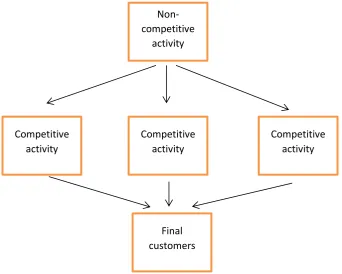
Access regulation (regulatory approach) follows the following scheme:
[image:7.595.109.448.188.444.2]Terms and conditions of access are determined by the regulators
Figure no. 1: Access Regulation (source: OECD Report 2001, p 12)
The regulator intervenes to fix the prices of access to the non-competitive activity,
i.e. the access to the infrastructure («the regulator sets these terms and conditions to facilitate competition downstream between rival firm and the competitive component
of the integrated firm»11).
10 ibid, 11-15
11
ibid, 11.
Non-competitive
activity
Competitive activity
Competitive activity
Competitive activity
7
But what if the regulatory approach (as in the case Deutsche Telekom12 or
Telefónica13 where the incumbent put in place margin squeeze practices even
applying the tariffs set by the German telecoms regulator), does not work?
The possibility introduced by Directive 2009/140/EC in the electronic
communications sector, on the basis of the British precedent, is functional
separation; whilst in the energy sector since 2009 the alternative is structural,
ownership separation.
The OECD Report 2001 had already foreseen these two possibilities. The following
figures depict how both ownership separation and club ownership work.
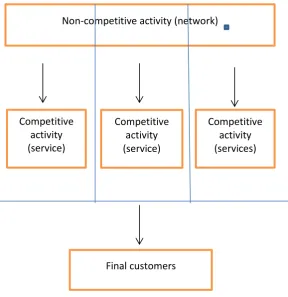
The first (ownership separation) is implemented through the vertical separation of the
non-competitive activity (the network) and the competitive activity (the services):
«under this approach the owner of the non-competitive part has no incentive to discriminate or distinguish artificially between competing firms in the competitive
activity»14:
12
Commission Decision Deutsche Telekom AG (Case COMP/C-1/37.451, 37.578, 37.579), [2003] OJ L263/9; on appeal, Deutsche Telekom AG v. Commission, Case T-271/03, [2008] ECR II 477; before the ECJ, Deutsche Telekom AG v European Commission, Case C-280/08, [2010] ECR I-09555, [2010] 5 CMLR 1495.
13 Commission Decision
Wanadoo España v Telefónica [2008] OJ C83/6 (‘Telefónica’), appealed at
the General Court: Case T-336/07 Telefónica and Telefónica de España v Commission [2007] OJ C269/55, ECR I-0000, judgment on the 29 March 2012. On appeal at the Court of Justice, Case C-295/12 (see opinion of the Adv Gen Wathelet, 26 September 2013 accessible at http://curia.europa.eu/jcms/upload/docs/application/pdf/2013-09/cp130117en.pdf).
14
8
Figure no. 2: Ownership Separation (energy sector, for instance, cases E.ON, RWE and ENI) (source: OECD Report 2001, p 13)
This form of separation removes the incentive to discriminate downstream
competition. The main disadvantage would be the potential loss of economies of
scope from integration. The separation of the company controlling the network from
the company/ies controlling the services is the most suitable at European level, considering that the AT&T form of separation (also called ‘club ownership separation’), horizontally dividing the group into local vertically-integrated companies can be considered equivalent, in size, to the co-existence of multiple
vertically-integrated telecoms groups in each European Member State.
With respect to club ownership separation, the network of one vertically-integrated
company is structurally separated on a local basis, preserving, in scale, vertical integration services/network (example: the creation of the ‘Baby Bells’ after the AT&T’s break-up).
The scheme is as follows:
Non-competitive
activity
Competitive activity
Final customers
Competitive activity Competitive
[image:9.595.101.444.76.350.2]9
Figure no. 3: Club ownership separation (case AT&T) (source: OECD Report 2001, p 13)
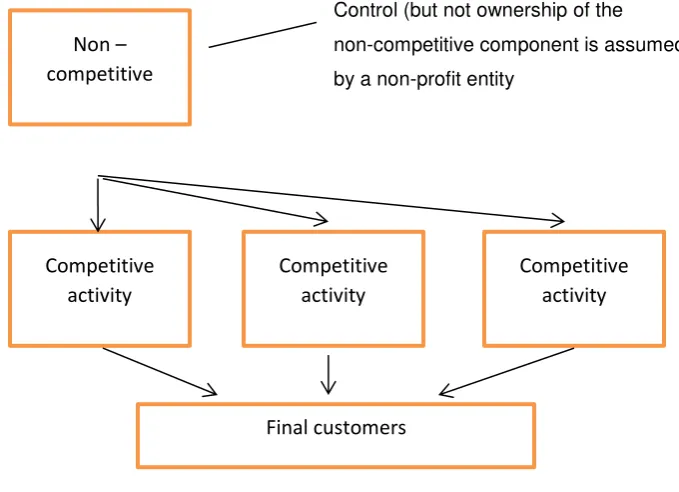
A fourth form of separation suggested by the OECD Report is the ‘operational separation’. It is also described as a hybrid of the previous three forms of separation, depending on the body which takes control of the non-competitive component
(network)15. Therefore, if the governance is in the hands of the regulator, it is
equivalent to regulatory separation (access regulation); if the governing body has
representatives of the downstream firms, can be compared to joint or club ownership
separation.
This approach takes this form:
15 ibid, 14.
Non-competitive activity (network)
Competitive activity (service)
Competitive activity (service)
Competitive activity (services)
[image:10.595.72.361.93.391.2]10
Control (but not ownership of the
[image:11.595.121.461.73.319.2]non-competitive component is assumed by a non-profit entity
Figure no. 4: operational separation (source: OECD Report 2001, p 15)
This form of ‘operational separation’ or ‘operational unbundling’ was adopted in the electricity industry in the US. The Federal Trade Commission defined this form of
operational separation as follows:
«[it] has taken the form of an entity independent of the [electricity] utility operating the transmission and distribution grids to ensure open access and transparent pricing, although the monopolist retains ownership of the physical assets. The operational unbundling plan may work to preserve economies of vertical integration, internalise loop flow externalities (caused by the fact that electricity does not follow a contract path, but rather the path of least resistance), and assure transparent investment signals for potential investors while eliminating the strategic opportunities of the monopolist to subtly favour its own generation capacity»16.
As per the OECD Report 2001 operational separation (or ‘unbundling’) is that adopted in the US electricity industry. The positions cited above are partially
16
Federal Trade Commission, Prepared Statement of the FTC before the Committee on the judiciary US of representatives, 28 July 1999.
Non – competitive
Competitive activity
Competitive activity Competitive
activity
11
accepted by the most recent OECD Report 2011 on structural separation17 published
in conjunction with the amendments to the OECD Recommendation 200118 on
structural separation in regulated industries, adopted on the 13 December 2011.
The OECD Report 2011 states that «structural separation is a remedy of continued relevance, which can both advance the process of market liberalisation and address
some of the difficulties inherent to behavioural remedies and more complex and intensive sector regulation […]. Nevertheless, structural separation may not be necessary or appropriate in all industries or markets [and] the impact of structural
separation or the lack thereof on corporate incentive to invest in the network
industries has become a prominent issue»19. To conclude; «the choice of structural
versus behavioural measures, in a given set of circumstances, therefore remains a
matter that requires careful evaluation»20.
The Report stresses how at European level during the 2001/2011 decade there have
been many successful examples of functional and structural separation. Some of
them were implemented on the basis of voluntary commitments (or undertakings, in
the UK experience)21: to make a few examples, BT’s functional separation occurred
in 2006 and structural separation of E.ON22, RWE23 and ENI24 as part of
17
OECD, Report on Experiences with Structural Separation, Paris, 2012, 10 (fn 6) (‘OECD 2011
Report’), accessible at http://www.oecd.org/daf/competition/50056685.pdf.
18
OECD, Recommendation 2011 on structural separation in regulated industries, C(2011) 135 and
CORR1, accessible at
http://www.oecd.org/regreform/liberalisationandcompetitioninterventioninregulatedsectors/recommend ationconcerningstructuralseparationinregulatedindustries.htm.
19 ibid, 8. 20
ibid.
21 ibid, 10.
22 Commission Decision
E.ON (Case COMP/38.388-38.389) of 26 November 2008, [2009] OJ C36/8 of 13 February 2009, accessible at http://ec/europa.eu/competition/antitrust/cases/dec_docs/39388/39388_2796_3.pdf.
23 Commission Decision
RWE (Gas Foreclosure) (Case COMP/39.402) of 18 March 2009, Summary of the decision in [2009] OJ C133/10 of 12 June 2009 accessible at
http://ec.europa.eu/competition/antitrust/cases/dec_docs/39402/39402_576_1.pdf
24 Commission Decision
ENI (Case COMP/39.315) of 29 September 2010, [2010] OJ C352/8 of 23 December 2010, accessible at
12
commitments signed with the European Commission in recent years (2008, 2009
and 2010 respectively).
It also underlines that functional separation and ownership vertical separation (or
divestiture) were implemented in various Member States with respect to the
electricity and gas sectors; whilst in the electronic communications markets
functional or structural vertical separation «is presented as an exceptional measure
for implementation only in cases of persistent market failure»25.
The most interesting aspect of the OECD Report 2011 is that it stresses how, before
choosing structural separation as a remedy, the regulatory or competition authorities
should bear in mind the «trade-off between efficiency and competition»26. In other
words, whilst there is a vast literature that shows that profit-maximising
vertically-integrated firms make efficient decisions, there are also arguments that underline
how a bottle-neck monopoly can create major problems for competition.
This dichotomy, competition versus efficiency, can be considered the main obstacle
to support the opportunity of structural separation in vertically-integrated
telecommunications companies. The OECD 2011 Report stresses that in any case in
which structural or functional separation had to be decided the authorities faced the
issue «whether separation measures will impact negatively on investment incentives»27.
The OECD Report 2011 also underlines how, on the one hand, behavioural
remedies are by their very nature more respectful of proportionality and of the rights
of the parties, and are obviously more flexible, since they can be tailored to the
specific conducts that need to be addressed. On the other hand, they tend to be too
weak vis à vis highly concentrated industries and require monitoring by a large
amount of people and resources.
25
ibid.10.
26 ibid.12. 27
13
Structural remedies are the most ‘effective’, in legal terms. Once adopted they can only with difficultly be brought to the status quo ante, therefore they do not require
high monitoring resources and can be put in place in the short term. However, they
might have high transactional costs; they can be inefficient, in economic terms; they
could potentially damage third party and could interfere with the technological
development of the company, whilst reducing the incentive to competition.
If wrongly applied, they can recreate the same anti-competitive situation, simply
changing the actor(s) in a specific market.
3. The role of the legal (‘effectiveness’) and economic (‘efficiency’) tests in choosing the best remedy, within the boundaries of competition law.
In recent years there has been wide debate on what remedy is the most suitable,
with respect to merger remedies as well as with respect to Art. 102 TFEU
enforcement.
Legal effectiveness means the capacity for a divested entity to remain a viable and
effective competitor28, whilst economic efficiency measures the grade of efficacy of a
proposed remedy pre-and post-merger; in other words, the effective impact that the
remedy has on examined markets (in terms of level of prices, level of supply, survival
of competitors, impact on the final consumers with respect to quality and level of
prices).
It is interesting to analyse and compare the remedies adopted in the presence of a
proposed (or implemented) merger with the remedies that could be adopted in order
to enhance the competitive environment in the presence of violations of Art. 102
TFEU. In fact, only taking into consideration both factors (effectiveness and
28 On the point see the excellent paper published by TAJAN-PAPANDROPOULOS,
14
efficiency of the remedies) it is finally possible to decide which remedy will have the
most suitable impact on a specific economic scenario.
For a long time the European Commission has been arguing that only ‘structural remedies’ can be really effective, considering the difficulties deriving from ex post
monitoring of a behavioural remedy. However, at least in the electronic
communications sector, the Directive 2009/140/EC favoured, as a regulatory tool,
functional separation. Functional remedy is directly linked with the idea of appointing
a trustworthy monitoring trustee, both in mergers and in art. 102 TFEU enforcement.
Monitoring trustees are widely used figure heads (both at EU level, and at national level) and ensure that the ‘undertakings’ signed by the merging parties (or the party that has accepted to divest or to carry out a certain number of obligations to address
the competition authority concerns) are effectively implemented.
The Commission (or the national competition authority), as correctly noted by
TAJANA and PAPANDROPOULOS in their seminal article, may have a lack of
expertise in a specific market29.Therefore, only a highly competent monitoring trustee
could be a sufficient guarantee for the adoption of a less invasive remedy such as
functional separation. Whilst preserving the integrity of the company, it may grant
that over a certain time-frame the competition concerns are duly addressed, through
the adoption of the measures that the Commission or the National Competition
Authority and Regulators may have suggested as urgent to make the market under
review more competitive.
Leaving aside the effectiveness of the remedy, probably the most important aspect,
still under-estimated, is the assessment of the economic impact of a long-term
remedy (either structural either behavioural with a functional nature). Taking an
economic perspective, at least in the short term, a structural remedy might not be the
most efficient. There is a possibility that if the undertaking is forced to divest, it will
29 TAJANA-PAPANDROUPOLOS, cited: «A third party, independent and with the necessary
expertise, is needed to oversee the activities of the parties and effectively monitor compliance with the
15
dismiss the less economically vital part of its business30. It has been argued that
there are good reasons in favour of the adoption of behavioural remedies, that may
be more effective in those economies where the competition authorities work in
combination with highly skilled Regulatory entities. Depending on the type of
behavioural remedies may turn to be less intrusive disruptive.
In 2000 US scholars such as SHELANSKI and SIDAK, pending the United States v
Microsoft31 proceedings for abuse of dominant position against Netscape, proposed
a three-fold test to assess the validity of a proposed divestiture, in order to assess
ex ante the impact that a (legally effective) remedy may have had in terms of
economic efficiency32. For them the remedy (i) should produce a net gain in static
economic efficiency; (ii) net gains in static economic efficiency should overcome
potential losses in dynamic efficiency; (iii) enforcement costs should be taken into
account.
In the first case, the remedy is seen in the perspective of creating new competitors,
or isolating an infrastructure that is finally opened up to multiple operators. The
pro-efficiency gains might be evident. Then the antitrust authority must take into account the risks that ‘dynamic efficiency’ is jeopardised by the presence of multiple players, on the one hand, and by the risk of disruptions pending on the head of the separated
30
MOTTA stressed the risk that «inappropriate divestments may actually facilitate collusion by restructuring an industry in a more symmetric way or multiply multi-markets contacts». MOTTA-POLO-VASCONCELOS, Merger Remedies in the EU: An Overview, in LEVEQUE-SHELANSKY (eds), Merger Remedies in American and European Union Competition Law, London, 2003, 106.
31 The Judge T. Jackson in his conclusion filed on the 3 April 2000 at the US District Court of the
District of Columbia acknowledged the attempt of monopolising by Microsoft and ordered as a remedy the separation of the company in two entities, one to produce the operating system, and one to produce other software components. It is famous the opinion expressed in his ‘findings of fact’ filed on 5 November 1999: «Most harmful of all is the message that Microsoft's actions have conveyed to every enterprise with the potential to innovate in the computer industry. Through its conduct toward Netscape, IBM, Compaq, Intel, and others, Microsoft has demonstrated that it will use its prodigious market power and immense profits to harm any firm that insists on pursuing initiatives that could intensify competition against one of Microsoft's core products. Microsoft's past success in hurting such companies and stifling innovation deters investment in technologies and businesses that exhibit the potential to threaten Microsoft. The ultimate result is that some innovations that would truly benefit consumers never occur for the sole reason that they do not coincide with Microsoft's self-interest». As known the judgment was partially overturned by the District Court of Appeals and remanded the case for consideration of a proper remedy under a more limited scope of liability. The case was ultimately settled and the separation was avoided.
32
16
industry (network), on the other. The enforcement costs of a structural remedy may
also be taken into account and depending on the market conditions (type of
industry), might be high or low.
As FARRELL and SHAPIRO discuss in their paper ‘Intellectual Property,
Competition, and Information Technology’33, network effects may play a crucial role
in deciding what remedy should be suggested. It must be said that authors like
TAJANA correctly stressed the risks that a draconian remedy may also have on third
parties (shareholders, employees), and takes also into consideration the impact of ‘general interest’34.
He pointed out how the Commission, or a national authority, rather than pursue the
effectiveness of a legal remedy, should take into consideration the ‘thermometer’
provided by economic, efficiency-oriented, tests, which may be able to foresee the
disruptions that a rather draconian remedy may cause.
Finally it must be stressed that there are a limited number of studies on the impact of
structural remedies in article 102 TFEU cases, because there are very few decisions
at European level which have adopted structural separation as a way of enhancing
competition35 (such as the above-mentioned commitments decisions adopted in the
energy sector).
4. Structural separation in the electronic communications: an option to be considered by the European enforcer.
33 FARELL-SHAPIRO,
Intellectual Property, Competition, and information Technology, Berkeley Competition Policy Centre Working Paper no. CPC-04-45, 2004.
34 TAJANA,
Structural Remedies and Abuse of Dominant Position, TILEC Discussion Paper, Tilburg University, 2005. These concerns raised by several parties. See LITAN-NOLL– NORDHAUS-SCHERER, Remedies Brief of Amici Curiae, United States v. Microsoft Corp., 27/4/2000, 64.
35
The main concern in Europe, since the creation of the early EEC, and until today, was the
17
Experience shows that functional separation as implemented in the United Kingdom
with the creation of Openreach, as a functionally separated entity, represented only
one of the possible forms of separation. It was tailored to the specific features of the
company, to the alleged anticompetitive behaviours and to the features of the British
market.
After having analysed the various possible forms of separation as identified by the
OECD report 200136, we can look at (and compare) three forms of separation: (i)
functional, (ii) structural (internal corporate separation) and (iii) ownership
separation, starting with the Openreach experience in the UK, looking at the
progressive passage from operational to full structural separation of the national
telecoms incumbent in Australia (Telstra) by 2018, and at the relatively recent
(December 2011) voluntary ownership separation of the New Zealand telecoms
incumbent (New Zealand Telecom). Functional separation represents a tighter form
of operational separation, with the creation of internal ‘walls’ mainly hindering
exchange of information within retail, wholesale and access divisions of the same
company. The various divisions still belong to the same company, but each division
acts as if it was a separate company. A very good synthesis: ‘they have to buy and
sell services between each other in an internal market»37.
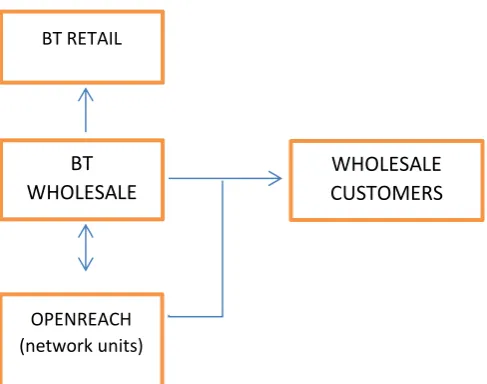
The model adopted in the UK with Openreach follows this scheme:
36OECD, ‘Restructuring public utilities for competition’, Report on Competition and Regulatory
Reform, 2001, accessible at
http://www.oecd.org/regreform/liberalisationandcompetitioninterventioninregulatedsectors/19635977.p df.
37
18
Figure no. 5: functional separation of BT, United Kingdom (2006)38
Openreach, the access division, deals with the local network infrastructure, the fibre
extension in local loop and the regional backhaul networks. It provides various
services: ULLs services, ISDN, PSTN resale. On the other hand, BT Wholesale
deals with (i) the electronics used on the network (including DSLAMS in local loop
and regional backhaul network), (ii) all the other regulated services not provided by
Openreach, and (iii) other most advanced communications services (e.g. wholesale
local switched calls, layer 3DSL). BT Wholesale division, as shown in the chart,
deals with its own wholesale customers and with BT retail customers, whilst
Openreach provides access services to BT Wholesale division and to Wholesale
customers on an equal footing.
On the 16 July 2015 OFCOM launched its second Telecoms Review39, publishing a
document open to responses until 6th October 2015. The targets of the review are to
modify the current legislation in order to increase (i) investment and innovation,
delivering widespread availability of services; (ii) sustainable competition, delivering
38
ibid, 4.
39 OFCOM, Strategic Review of Digital Communications (‘Strategic Review’), accessible at
http://stakeholders.ofcom.org.uk/binaries/consultations/dcr_discussion/summary/digital-comms-review.pdf
BT RETAIL
BT WHOLESALE
WHOLESALE CUSTOMERS
19
choice, quality and affordable prices; (iii) empowered consumers, able to take
advantage of competitive markets; and (iv) targeted regulation where necessary,
deregulation elsewhere. The OFCOM document considers the possibility of
introducing structural separation
«This has the potential to deliver benefits, since it would address BT’s underlying incentive to discriminate against competitors, and enable a simplified regulatory framework. It may also increase Openreach’s management focus on, and control over, network investment decisions and performance issues. However, to the extent those issues arise from a lack of competition to Openreach, it may not fully address them. It would be an intrusive and complex intervention both for BT and the rest of industry, with substantial implementation challenges. It would also require ongoing regulation to guard against excess returns by the structurally separate upstream ‘monopolist»40.
The British Telecom’s Openreach solution was subject to criticism by its competitor Vodafone, that actually argued that structural separation should be considered as a
new form of regulatory intervention41. Vodafone in particular claims that BT received
an anti-competitive advantage benefiting of a 5-billion pounds broadband network
financed with tax-payers money.
Matters developed differently in Australia. After a long debate42 about the opportunity
of adopting structural separation as recommended by the Australian government
40
OFCOM, Strategic Review, 14.
41 The Guardian, ‘Vodafone calls for BT form separate broadband company’, 25 March 2015, at
http://www.theguardian.com/business/2015/mar/25/vodafone-calls-for-bt-to-form-separate-broadband-company, accessed on the 22.12.15.
42 Plans for structurally separate Telstra, the Australian incumbent, were discussed by a Senate
20
since 200743, in 2012 undertakings were signed by Telstra leading to structural
separation of the company44. As per Telstra website,
«on 28 February 2012, the Australian Competition and Consumer Commission (ACCC) accepted Telstra’s Structural Separation Undertaking (SSU) and draft Migration Plan. The SSU commenced operation on 6 March 2012, while the Migration Plan took effect from 7 March 2012.
The SSU fulfils two roles:
It commits Telstra to structural separation by 1 July 2018, through the progressive disconnection of fixed voice and broadband services from Telstra’s copper and Hybrid Fibre-Coaxial (HFC) networks, while the New Broadband Network (NBN) is being rolled out [by the government45]; and,
It sets out the various measures which Telstra will put in place to provide for equivalence and transparency in the supply of regulated fixed network services to its wholesale customers and the supply of comparable services to its retail customers during the transition to the NBN»46.
43
For the debate preceding structural separation of Telstra, see ‘Telstra Faces Enforced Split’, by Katharine Murphy and Jesse Hogan, The Age, 3 October 2007 accessible at
http://www.theage.com.au/news/business/telstra-faces-enforced-split/2007/10/02/1191091114582.html.
44 On 29 July 2011 Telstra submitted a structural separation undertaking and draft migration plan to
the Australian Competition & Consumer Commission (ACCC) on the basis of Sections 577A and 577BDA of the Telecommunications Act 1997. After a supplement of negotiation, the ACCC accepted
on the 27 February 2012 Telstra’s structural separation undertaking and approved the draft migration plan. On the 6 March 2012, Telstra’s Structural Separation Undertaking and Migration Plan came into force. Detailed chronology and milestones are available at https://www.accc.gov.au/regulated-infrastructure/communications/industry-reform/assessment-of-telstras-ssu-draft-migration-plan.
45 Brackets added.
46
Australian Competition Authority (ACCC), Structural Separation Undertakings offered by Telstra on the 23 February 2012, accepted by ACCC on the 28 February 2012, accessible at http://www.accc.gov.au/system/files/Structural%20Separation%20Undertaking.pdf. An outlook of
Telstra’s structural separation undertaking is available both on the website of Telstra accessible at
http://www.telstrawholesale.com.au/structural-separation-undertaking/index.htm, and from the website
of the Australian Competition & Consumer Commission (ACCC). Particularly useful is the Telstra’s
Structural Separation Undertaking Annual Compliance Report 2011-12, accessible at
21
To understand how the Australian Competition & Consumers Commission (‘ACCC’) led the negotiations to the point of accepting undertakings leading to full structural
separation (by 2018) of Telstra, it is important to consider that as per 1st December
2006 the company was subject to operational separation, forcing it to keep separate
retail, wholesale and key network services business units47.
The Parliament of Australia however expressed serious concerns about the capacity
of Telstra to grant full competition by simply implementing an operational separation
scheme:
«Telstra’s integrated position across all the telecommunications platforms has led to longstanding and widespread concerns that the existing telecommunications structure in failing consumers, businesses and the economy in general»48.
Structural separation of Telstra (with the creation of a structurally-separated
state-funded New Broadband Network) was conceived as a step further than functional
(operational) separation.
An excerpt from ‘Telstra’s structural separation undertaking – Annual Compliance Report 2011-2012’ issued by the ACCC clarifies how the government found that
functional (operational) separation was not enough. This has to be borne in mind,
since the same reasoning might be applied to the European scenario, within single
Member States:
«In late 2010, the Australian Government introduced legislation which created a framework for reforming the telecommunications industry— effecting structural separation of Telstra by the progressive migration of Telstra’s fixed line access services to the wholesale-only National Broadband Network (NBN) as the NBN fibre is rolled out49. This reform
47
OECD Competition Committee, Report on Experiences with Structural Separation, PARIS, 2012, 109-110, available at http://www.oecd.org/daf/competition/50056685.pdf
48
Parliament of the Commonwealth of Australia, House of Representatives, Telecommunications Legislation Amendment (Competition and Consumer Safeguards) Bill 2009. Explanatory Memorandum, p 8.
22
recognised that Telstra, as the vertically integrated access provider to the ubiquitous copper network, operates at all levels of the supply chain and competes with the businesses that it supplies to. This has given rise to long standing competition concerns around Telstra’s ability and incentive to favour its retail business over other service providers accessing its network to the detriment of consumers.
Prior to the commencement of the SSU, Telstra was subject to an operational separation framework which was intended to promote equivalence between Telstra’s wholesale and retail customers. The ACCC has previously publicly stated that the operational separation regime, and the ACCC’s limited role in investigating and reporting matters to the Minister, was largely ineffective in addressing Telstra’s ability and incentive to discriminate against its competitors50. Upon the coming into force of the Structural Separation Undertaking (SSU) on 6 March 2012, the operational separation regime ceased to operate»51.
The operational separation (for the period 2006-2012), preliminary to the structural separation of the NBN [New broadband Network] from Telstra’s wholesale and retail services, had been conceived in the ‘separation of the business units formalised through subsidiaries, so that each separated business unit is a subsidiary of a
holding company rather than being an organisational unit within the one company.
[A] common set of shareholders still owns the structurally separated subsidiaries»52.
The chart that follows shows how operational (functional) separation (within the
same group) had been put in place from 2006 to 2012:
50 Emphasis added.
51 Australian Competition & Consumer Commission (ACCC), Telstra’s Structural Separation
Undertaking – Annual Compliance Report 2011-2012, a Report to the Minister for Broadband, Communications and the Digital Economy, with letter of 13 April 2013, accessible http://www.accc.gov.au/publications/telstras-structural-separation-undertaking. With respect to the instructions that the ACCC gives to Telstra in order to address competition concerns during the
current migration period, see ACCC press release of 7 February 2013, ‘ACCC directs Telstra to
amend measures developed under the Migration Plan’, accessible at http://www.accc.gov.au/media -release/accc-directs-telstra-to-amend-measures-developed-under-the-migration-plan.
52
23
Figure no. 6: operational separation of Telstra, Australia (2006-2012)53
In this case, the fixed network is operationally separated from the provision of
services. Telstra Wholesale does not operate the infrastructure, but supplies all wholesale services. An intermediate entity, ‘network support’, deals with the ‘operations support systems’ (‘OSS’), and supports both retail and wholesale units. This first phase of operational separation can be compared to functional separation as per the BT’s Openreach model, and constitutes a preliminary step towards the current structural separation migration plan. During the phase of
progressive structural separation 2012-2018 the functional separation model de
iure ceases to exist54.
53
ibid, 5.
54 See from Telstra Wholesale’s website, ‘High level summary of Telstra Structural Separation
Undertaking and Migration Plan’, page 1, accessible at
http://www.telstrawholesale.com.au/download/document/ssu-and-mp-briefing-summaries-1.pdf. It
expressly says that ‘consistent with the Government’s decision to frame structural separation as an alternative to functional separation for Telstra under the legislative scheme, the Interim Equivalence and Transparency measures in the Structural Separation Undertakings (SSU) do not constitute functional separation’. See in particular the detailed migration plan outlined from page 3ff.
TELSTRA RETAIL
NETWORK SUPPORT
WHOLESALE CUSTOMERS TELSTRA
WHOLESALE
24
The interesting aspect of the Australian ‘restructuring plan’ launched in 2011 is that the deployment of the New Generation Network (New Broadband Network or ‘NBN’) is conceived through the creation of a new infrastructure directly deployed by a separate, government owned, company55, so that all the players are put on
an equal footing in the future provisions of wholesale services, including Telstra.
This shows that since the New Generation Network substantially differs, from a
technological point of view, from the traditional fixed-line copper networks on
which broadband services are provided enhancing bandwidth through ADSL
technology, the model of functional separation as implemented in the British
telecommunications with Openreach is considered insufficient and not applicable
in the Australian context. The Australian competition authority has adopted
structural separation as a way of favouring the intervention of the government to create a ‘New Broadband Network’ (the entire operation should be completed by 2018), so that Telstra « must not supply services to those premises [customers]
using the copper or HFC networks (other than pay TV services in the case of the
HFC).Telstra will satisfy this commitments by progressively decommissioning its copper customer access network (‘CAN’) and HFC broadband service on an area by area basis as the NBN rolls out»56.
The new characteristics of the NBN are:
(a) It will be realised as the largest civil works projects for decades;
(b) There is still uncertainly on the future demand of services that will be
provided by the NGNs;
(c) There will be a constant and substantial investment to upgrade the
networks;
(d) NGNs are layered, open standard networks, compared to the
vertically-integrated technology of copper networks, barriers to entry at the
55 ibid, 12.
25
connectivity layers are lower and there is limited technological capability
to leverage between layers57.
Therefore the role of regulation, with respect to NGNs, will be much more linked to
the creation of incentives to develop new infrastructures, than to the application of
the traditional regulatory tools to deal with access-related bottlenecks58.
In the Australian scenario, matters are going in a different direction with the
progressive passage from functional to structural separation. The ACCC first tried to
implement functional separation within the Telstra group (separating wholesale and
retail services, while still operating the traditional network). When it was clear that
discrimination between its own retail customers and wholesale customers, was still
taking place, the ACCC pushed for the signature of undertakings preliminary to the
creation of a structurally separated entity, funded by the State, that will be the main
New Generation Network on which Telstra will provide its wholesale services in
competition with any other telecommunications operator.
In this respect, the creation of the New Generation Network as a separate entity
represents a measure that is set to avoid once for all any access-related anticompetitive conducts. Quoting from the mentioned ‘Telstra’s Structural Separation Undertaking (‘SSU’) - Compliance Report 2011-2012’
«[i]n introducing structural reform of the telecommunications industry, the government recognised that the ACCC would need stronger enforcement mechanisms that those under the operational separation regime to ensure transparency and equivalence. The SSU measures are a substantial improvement upon the previous operational59 separation framework and more effectively promote equivalence and transparency. The SSU provides for stronger enforcement mechanisms, which are particularly
57
ibid.
58 ibid.
59
26
important for protecting competition and delivering outcomes in the interests of consumers and businesses, during the rollout of the NBN»60.
Unfortunately, it is still premature to analyse quantitative data to see whether
structural separation currently under implementation in Australia will have a positive
impact on competition, prices and quality of the services provided. In that context the
SSU were signed as a preliminary step towards the creation of a NBN, with the idea
of putting Telstra and its competitors on an equal foot in the provisions of
telecommunications services. Seen from a European perspective, it looks like the
ACCC, suggesting complete structural separation by 2018, wants to create the pre-conditions for the realisation (mainly at government’s costs) of a New Generation Network. Considering that the new network is technically different from the traditional
copper wire network, it allows the presence of more players over the same
infrastructures, and should de facto represent an opportunity of growth and
development for that country.
It is important to note that during the implementation of the structural separation undertakings (also called the ‘migration plan’ phase) Telstra is under constant scrutiny by the ACCC. Regulatory tools such as price caps will be still put in place
during the transitional phase. However some features of the undertakings can be
directly enforced by the ACCC before the Australian Federal Courts, through
remedies that range from «fines to compensation orders and any other orders that
the Court considers appropriate»61.
If the ultimate scope of the undertakings signed by Telstra is that of structurally
separate its network by 1st July 2018 by progressively disconnecting fixed telephony
services on its copper network and broadband services on its hybrid fibre-coaxial
(HFC) network, migrating these services onto the (wholesale-only) NBN rolled out by
the government, Telstra management is aware that during the transitional phase the
objective of the undertakings is to ensure equivalence and transparency in how
Telstra treats retails and wholesale customers of regulated services on the copper
27
network62, a clear indication of the concerns raised by the ACCC during the phases
of negotiation of the structural separation undertakings63. The incumbent recently
showed that is confident to respect the roadmap set in 2012 with the ACCC, and will
be able to complete structural separation by 201864.
The New Zealand Telecom experience is a third model of separation to be
considered. They went a step further than in other jurisdictions, with the national
incumbent de-merging into two listed entities: Chorus and Telecom New Zealand,
with different share ownership65.
In 2005 the New Zealand government launched a review of the telecommunications
sector66, with a particular focus on broadband development. On the basis of the review, on December 2006 the government passed the ‘Telecommunications
62 See Telstra’s SSU Compliance in 2012
-2013, introduction, accessible at http://www.telstrawholesale.com.au/download/document/telstra-commitment-ssu-compliance-2012-2013.pdf .
63 To follow the developments of the undertakings signed by Telstra before the ACCC, a useful link is
http://www.accc.gov.au/regulated-infrastructure/communications/industry-reform/telstras-structural-separation-undertaking.
64
ADHIKARI, Telstra ready to push on with structural separation, Technology spectator, 18 March 2014, accessible at https://www.businessspectator.com.au/news/2014/3/18/technology/telstra-ready-push-structural-separation. In June and October 2014 Telstra put forward two proposals of rectification of the commitments signed with the ACCC. In particular, «[u]nder clause 9(a) of the SSU Telstra has an obligation to ensure that particular aspects of retail and wholesale services will be
equivalent (the ‘overarching equivalence commitment’). Under Schedule 11 to the SSU, Telstra may
report possible breaches of the overarching equivalence commitment and must, no later than 30 days after reporting the possible breach, submit a proposal to the ACCC which sets out the steps that
Telstra proposes to take to remedy the possible breach (a ‘rectification proposal’). The ACCC may
accept a rectification proposal or if satisfied that it does not provide an effective remedy for the possible breach, reject the rectification proposal and direct Telstra to take alternative steps to remedy the possible breach». See https://www.accc.gov.au/regulated-infrastructure/communications/industry-reform/telstras-structural-separation-undertaking, accessed on the 22.12.2015.
65
WATERS-DAMIAN, cited, 5.
66 Ministry of Economic Development, ‘Stocktake Process, stakeholder Input and Supporting
28
Amendment Act’ 67 requiring a ‘robust operational separation’ of the vertically
-integrated, privatised telecommunications incumbent, Telecom New Zealand, into at
least three business units, to provide wholesale, retail and local access services68.
The operational separation proposed in 2006 envisaged three pro-competition
targets:
(i) To promote competition in telecommunications markets for the long-term
benefit of end users of telecommunications services in New Zealand; (ii) to
require transparency, non-discrimination, and equivalence of supply in relation to
certain telecommunications services; and (iii) to facilitate efficient investment in
telecommunications infrastructure and services69.
Operational separation was implemented on 31 March 2008. Telecom New Zealand
therefore comprised «five customer-facing business units:
(i) a retail unit providing fixed line, mobile and internet services to
consumers and small and medium business customers;
(ii) an operationally separate wholesale business unit providing next
generation wholesale network products to service providers;
(iii) an operationally separate unit that manages Telecom’s local access
network;
(iv) a specialised unit that provides technology services for lager business
customers; and,
(v) an Australian subsidiary providing telecommunications services in
Australia»70.
67
New Zealand Parliament, Telecommunications Amendment Act (No2) 2006.
68 ibid, sect. 32, inserting a new Part 2A into the Telecommunications Act2001. See OECD Report
2012, cited, p 77-78.
69 New section 96A of the New Zealand Telecommunications Act 2001.
70OECD Report 2011 ‘Experiences with Structural Separation’, cited, 78
29
The model of operational separation of Telecom New Zealand was summarised
by the following chart
Figure no. 7: New Zealand MARK I operational separation model, preliminary to
ownership (structural) separation of CHORUS (local network) from 1st December
201171.
In the chart Chorus represented the business unit managing the local network (not
necessarily fibre-network), the regional backhaul networks (not the electronic equipment) and the information system to support Chorus’s services (but not to support shared services). The Telecom Wholesale, on the other hand, did not own
assets, since these belong to the Network Units72.
This process of operational (functional separation) finally resulted in ownership
separation of the network from the core wholesale and retail business, bringing the
monopoly of New Zealand Telecom to an end. On 30 November 2011 the ‘de -merger’ process was completed, with Telecom New Zealand and Chorus becoming
71 WATERS-DAMIAN, cited, 5. 72
ibid.
TELECOM RETAIL
NETWORK UNITS
TELECOM WHOLESALE
CHORUS
WHOLESALE
[image:30.595.89.421.133.326.2]30
separate listed companies73 (in literature also referred as Telecom New Zealand 2
and Chorus 2):
«On December 1, 2011 New Zealand telecommunications created a world first when the incumbent provider, Telecom, structurally separated and its network access division, Chorus, became a stand-alone, publicly listed company»74.
This is the sole case of (voluntary) full ownership structural separation already
implemented that I was able to identify. As I will discuss later, on an empirical point
of view, also in this case the time-window to assess whether in New Zealand
structural separation led to (i) increase in competition, (ii) reduction in costs and
(wholesale and retail) prices and (iii) enhanced quality of services is too short.
In September 2010 structural (and ownership) separation of Telecom New Zealand
was preceded by the launch of a sector inquiry by the New Zealand Ministry of Economic Development, on the basis of its ‘discussion document’ on ‘Regulatory implications of structural separation’75
.
The document states that the national incumbent announced (2010) its intention to
consider structural separation through the demerger into two companies of its
assets, within the framework of the Government’s ultra-fast broadband initiative76.
The Ministry made clear that any change in the existing regulatory regime should
have been consistent with the principle of «promotion of competition in
73
PUTT, After Structural Separation – New Zealand telecommunications a year after Telecom New Zealand and Chorus became separate companies, in Computer World New Zealand, 2012, 6-7. See also New Zealand Herald, 1st December 2011, accessible at http://www.nzherald.co.nz/business/news/article.cfm?c_id=3&objectid=10769994. See also PULLAR-STRECKER, ‘Telecom split first in world’, Fairfax NZ News, 27 October 2011, accessible at http://www.stuff.co.nz/business/industries/5858284/Telecom-split-first-in-world.
74
PUTT, cited, 6.
75 Ministry of Economic Development, ‘Discussion document – Regulatory Implications of Structural
Separation’, September 2010, accessible at http://www.med.govt.nz/sectors-industries/technology- communication/pdf-docs-library/communications/telecom-separation/regulatory-implications-of-structural-separation-september-2010.pdf.
76
31
telecommunications markets for the long-term benefit of end-users of
telecommunications services within New Zealand»77, in the hope that «the likely
model of structural separation would lower barriers to entry at the retail level, by
removing incentives to discriminate against competitors who operate at the retail
level. There is scope in these circumstances for removing regulatory provisions
which deal with the interface between wholesale and retail levels of the market.
However there would be some residual vertical integration between the network and
the wholesale layers of the business, so some incentives to discriminate against
competitors would likely to remain»78.
The voluntary structural separation of the network company Chorus from its mother
company Telecom New Zealand in reality was the only way to ensure that Telecom
New Zealand could take part of the roll out of the new ultra-fast broadband (UFB) network mainly rolled out at government’s expenses. One of the main advantages for the mother company was to be ‘relieved’ by the sector regulations, while Chorus would have continued to control the local copper and fibre network, dealing with
wholesale business complaining with the sector regulations79.
Therefore, in the Telecom New Zealand voluntary structural separation example we
face a combination of industrial strategy (make possible for Telecom New Zealand to
be part of the roll-out of the New Generation Network (UFB) without controlling the existing network too) and of government’s support for what was considered a pro -competitive initiative80, also considering that Chorus would have continued to be
subject to sectorial regulation. At the same time also Chorus, in the after break-up
scenario, would have been allowed to participate to up to 70% of the new UFB,
77 ibid. 78
ibid, 11.
79 PUTT, cited, 8-23. In May 2011 the managers of Telecom New Zealand announced that they would
have been partner of the government’s UFB network (22).
80 Ministry of Economic Development, ‘Discussion document – Regulatory Implications of Structural
32
receiving de facto a (interest-free) loan from the government of NZ$ 929 million, to
be repaid between 2025 and 203681.
In the first year from the break-up (November 2011/November 2012) 100,000
households (urban users) were connected with the new ultra-fast broadband
network82, demonstrating that structural separation did not cause disruption.
It is important to highlight here that in some highly dynamic OECD economies, such
as Australia and New Zealand, structural separation in the electronic
communications, in the form of separation of the network from communications
services, was not considered a taboo and was adopted as a valid option by the
respective competition authorities, sector regulators and governments.
Even though the Australian and New Zealand scenarios are different under a
competition law point of view (Telstra signed structural separation undertakings
before the Australian competition authority as a remedy to enhance competition,
while Telecom New Zealand voluntarily decided to break-up from its own network in
order to be put in condition to strategically invest in the new generation network),
they must be borne in mind as two examples that contradict the claims of inefficiency
and impracticability of the structural remedy.
5. Functional or structural separation: two possible options also for the Italian scenario.
In Italy the presence of network-related abuses, offers a good case to ask the
question of whether high pecuniary fines may represent a serious deterrent for
national incumbents.
81According to PUTT’s book, durin
g the transitional phase preceding the complete roll-out of the UFB network, 99% of Chorus revenues still come from fixed telephony services provided over the traditional copper network.
82
33
The question is whether the electronic communications regulator , in the presence of
recurrent abuses, could suggest the national competition authority to adopt a more
draconian remedy such as structural separation? If so, what type of structural
separation would be most suitable among those discussed?
The Italian Communications Authority (Autorità per le garanzie nelle Comunicazioni, ‘AGCOM’) on 2 May 2007, launched a public consultation process83 in order to
discuss the possibility of introducing into the Italian legal system structural or
functional separation of the communications infrastructure at present still controlled
by the incumbent. During the 2007 consultation process, the AGCOM pointed out
that, as per AGCOM decision no. 152/02/CONS of 2002, two set of provisions had
been already introduced in the Italian legal system establishing (i) general measures
to grant full application of the principle of non-discrimination; and (ii) specific duties
(or remedies) for all the relevant markets. AGCOM claimed that in line with the
fundamental targets of competition law at European level it had already established the ‘administrative separation’ of Telecom Italia, in order to facilitate non– discriminatory access to the network resources held by the dominant operator.
However, mere accounting separation did not impede Telecom Italia from carrying
out a series of (network) access-related abuses, sanctioned with pecuniary fines with
a very low deterrence impact, considering the recidivism.
AGCOM decision 208/07/CONS states that the Italian Competition Authority, before
the adoption of the above-mentioned AGCOM decision no. 152/02/CONS, had
issued a non-binding opinion theoretically favourable to structural (company or
ownership) separation. It actually stated that the best remedy would have been
structural separation, since it would have produced: (i) the greatest fairness in the
attribution of joint costs to the separate entities, facilitating the interpretation of the
access rate to the infrastructure or for the provision of wholesale or retail services;
(ii) the elimination of incentives to continue anticompetitive behaviours, since the two
legal entities (network and service provider) would have had two different and
83
AGCOM decision no. 208/07/CONS of 2 May 2007 (entitled ‘Avvio di una consultazione pubblica sugli aspetti regolamentari relativi all’assetto della rete di accesso fissa ed alle prospettive delle reti di
nuova generazione a larga banda’), available at