A n A u t o m a t i c Treebank Conversion A l g o r i t h m for
Corpus Sharing
Jong-Nae Wang
B e h a v i o r D e s i g n C o r p o r a t i o n N o . 28, 2 F , R & D R o a d II S c i e n c e - B a s e d I n d u s t r i a l P a r k H s i n c h u , T a i w a n 3 0 0 7 7 , R . O . C .
wj n @ b d c , c o m . t w
J i n g - S h i n C h a n g a n d K e h - Y i h S u D e p t . o f E l e c t r i c a l E n g i n e e r i n g N a t i o n a l T s i n g - H u a U n i v e r s i t y H s i n c h u , T a i w a n 3 0 0 4 3 , R . O . C .
s h ± n ~ h e r a , ee. nthu. edu. t w k y s u ~ b d c , com. t w
A b s t r a c t
An automatic treebank conversion m e t h o d is pro- posed in this paper to convert a treebank into an- other treebank. A new treebank associated with a different g r a m m a r can be generated automati- cally from the old one such that the information in the original treebank can be transformed to the new one and be shared among different research communities. T h e simple algorithm achieves con- version accuracy of 96.4% when tested on 8,867 sentences between two major grammar revisions of a large M T system.
M o t i v a t i o n
Corpus-based research is now a major branch for language processing. One major resource for corpus-based research is the treebanks available in many research organizations [Marcus et al.1993], which carry skeletal syntactic structures or 'brack- ets' that have been manually verified. Unfortu- nately, such resources may be based on different tag sets and g r a m m a r systems of the respective research organizations. As a result, reusability of such resources across research laboratories is poor, and cross-checking among different grammar sys- tems and algorithms based on the same corpora can not be conducted effectively. In fact, even for the same research organization, a major revision of the original grammar system may result in a re-construction of the system corpora due to the variations between the revisions. As a side effect, the evolution of a system is often blocked or dis- couraged by the unavailability of the correspond- ing corpora that were previously constructed. Un- der such circumstances, much energy and cost may have to be devoted to the re-tagging or re- construction of those previously available corpora. It is therefore highly desirable to automatically convert an existing treebank, either from a previ- ous revision of the current system or from another research organization, into another that is com- patible with the current grammar system.
SeverM problems may prevent a treebank con- version algorithm from effective conversion of the treebanks. Firstly, the tag sets, including ter- minal symbols (parts of speech) and nonterminal symbols (syntactic categories) may not be identi- cM in the two systems; the number of such sym- bols may be drastically different and the map- ping may not be one-to-one. Furthermore, the hierarchical structures, i.e., the underlying phrase structure grammars, of two grammar systems may not be easily and uniquely mapped. In fact, the number of mapping units and mapping rules be- tween two systems may become untolerably large if no systematic approach is available to extract the atomic mapping units and the mapping op- erations [Chang and Su 1993]. In addition, some constructs in one system may not be representable in terms of the grammar of another system; com- patibility of two grammar systems thus further complicates the conversion problems.
In many cases, a publicly available corpus may contain only the simplest annotations, like brack- ets (skeletal structure representations) for some major syntactic categories [Marcus et a1.1993]. In particular, a research organization may not want to contribute its corpora in full detail for free to the public since it may reveal the underlying knowledge, such as the grammar rules, used in the proprietary system. Therefore, the primitive an- notations, like brackets, are very likely to be the sole information available to the public in the near future. And corpus exchange is very likely to be limited to such primitive annotations. Such re- sources may not be directly usable by a system which needs much more information than anno- tated. In such cases, it is, however, desirable to be able to use the large amount of simply tagged corpus to help construct or bootstrap a large corpus which contains more detailed annotation.
required, the proposed algorithm is expected to be very useful and cost-effective for bootstrapping the corpus, in terms of corpus size and annotated in- formation, of a system by using publicly available treebanks or home-made treebanks, which are less costly than fully annotated corpora.
In the following sections, the treebank conver- sion task is modeled as a transfer problem, com- monly encountered in an M T system, between two representations of the same language. A matching metric for selecting the best conversion among all candidates is then proposed, followed by the tree- bank conversion algorithm. Finally, experiment results are reported, which show a very promising conversion accuracy with the proposed approach.
In the current task, we will assume that the new treebank will be compatible with an underly- ing target grammar of any appropriate form and a target tag set (including terminal and nontermi- hal symbols) associated with that grammar; since, otherwise, we could simply use the the original treebank directly without doing any conversion. This assumption is reasonable since most natural language research laboratories who deal with syn- tactic level processing and those who need a tree- bank is supposed to have an underlying phrase structure grammars or rules for identifying appro- priate constituents in the input text.
T a s k D e f i n i t i o n f o r T r e e b a n k C o n v e r s i o n
Formally, the task for a treebank conversion al- gorithm is to map a source tree (generated from a source grammar or bracketed by hand) into its corresponding target tree that would be gener- ated from a second grammar (hereinafter, the tar- get grammar) without changing, vaguely speaking, its structures or semantics. The conversion must therefore satisfies several criteria so that the target tree could be reused in the target system. First of all, the target tree must be compatible with the second grammar. This means that the target tree must also be generatable from the second gram- mar. Secondary, the source tree and target tree must be 'similar' in a sense that their~correspond - ing terminal symbols (parts of speech), nontermi- nal symbols (syntactic categories) and structures (production rules) preserve essentially similar cat- egorial or structural information.
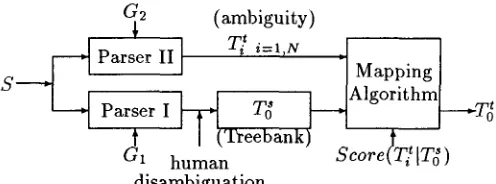
A simple model for such a conversion problem is shown in Figure 1, where S is a sentence in the treebank, G1 and G2 are the grammars for the original treebank and the target system, respec- tively, T~ is the manually proved tree for S in the treebank, T/t are all the possible ambiguous syn- tax trees for S as generated by the target grammar
S
G2 (ambiguity) ~ , [ II 7 t i = l , N =
Parser I I Mapping Parser I ~ - ~ T~ ~_~Algorithrn----~T~
1
I ('l~eebank) t t s c/1 humanScore(T i [Td)
disambiguation
Figure 1: A S i m p l e M o d e l f o r T r e e b a n k C o n - v e r s i o n
G2, and T~ is the best target tree selected from T/t based on a mapping score
Score(T/]T~)
defined on the treebank tree and the ambiguous construc- tions. T h e "conversion" from T~ to T~ is actually done by a matching algorithm.To ensure compatibility of the target trees with the target grammar, the sentences from which the source treebank was constructed are parsed by a parser (Parser II) using the target grammar. (It is also possible to enumerate all pos- sible constructs
via
other apparatus. The parser here is just a characterization of such an appara- tus.) All the possible target constructs for a sen- tence are then matched against the source tree, and the one that best matches the source tree is selected as the preferred conversion. In the above model, it is, of course, possible to incorporate any kind of preference mechanism in the parsing mech- anism of Parser II to prevent the converter from enumerating all possible syntactic structures al- lowed by the target grammar. In fact, the orig- inal design of the conversion model is to hook a matching module to the end of any existing pars- ing mechanism, so that the ambiguous structures are matched against manually verified structure information in the source treebank and pick up the correct parse without human inspection. [image:2.612.291.539.77.169.2]sentences t h a t are in two different languages while the treebank conversion p r o b l e m deals with only one language. T h e mechanism used to find the transfer units and transfer rules together with the transfer score used in the above frameworks can thus be used for treebank conversion with little modification.
M a t c h i n g M e t r i c f o r T r e e b a n k C o n v e r s i o n
T h e m a t c h i n g metric or m a t c h i n g score for tree- b a n k conversion is much simpler t h a n the trans- fer score for the transfer task between two syntax trees for two languages. T h e intuition is to assume that: it is very likely t h a t the tree representation for a sentence in a particular language will have essentially the s a m e bracket representation, which m a y possibly be associated with different (termi- nal or nonterminal) symbols, when expressed in a n o t h e r g r a m m a r . We thus use the n u m b e r of m a t c h i n g constituents in the source and target trees as the m a t c h i n g score for converting from one source tree to a target tree.
~
3,4,5) ~ ( 1 , 2 ) ~ , 4 , 5 )3 , 4 , 5 )
)
Figure 2: A n E x a m p l e f o r t h e T r e e M a t c h i n g M e t r i c
Take Figure 2 as an example. Node '9' in the source (left) tree contains Nodes '3', '4', '5' as its children; Node ' h ' in the target (right) tree also has Nodes '3', '4', '5' as its children. We therefore add a constant score of 1 to the matching score for this tree pair. T h e same is true for Node '10' and Node
'i'. Since Node '7' in the source tree and Node ' f ' in the target tree do not have any corresponding node as their counterparts, they contribute nothing to the m a t c h i n g preference. W h e n there are single productions, like the construct for Node '8' and its sole child Node '6', such constituents will be regarded as the same entity. Therefore, the match between Node '8' (or Node '6') and Node ' g ' will be assigned only one constant score of 1. This step corresponds to reducing such 'single p r o d u c t i o n ' rules into only one bracket. (For instance, X Y ~ a b c will have the bracket representation of [a b c], instead of [[a b c]].) As a result, the
matching score for the example tree pair is 3. To facilitate such matching operations and matching score evaluation, the word indices of the sentence for the s o u r c e / t a r g e t tree pair is perco- lated upward (and recursively) to the tree nodes by associating each nonterminal node with the list of word indices, called an index list, acquired by concatenating the word indices of its children. (The index lists are shown near the nodes in Fig- ure 2.) T w o nonterminal nodes which have the same index list form an aligned node pair; the subtrees rooted at such aligned nonterminal nodes and t e r m i n a t e d with aligned nodes then consti- tute the m a p p i n g units between the two trees. T h e n u m b e r of such matches thus represents a simple matching score for the tree pair. T h e in- dex lists can be easily established by a depth-first traversal of the tree. Furthermore, the existence of one constituent which consists of terminal nodes (l,l + 1 , . . . , m ) can be saved in a chart (a lower triangular matrix), where chart(l, m) records the n u m b e r of nodes whose terminal children are num- bered from l to m. By using a chart for a tree, all nodes in a chain of single productions will cor- respond to the same count for a particular chart entry. A m a t c h in a s o u r c e / t a r g e t node pair will correspond to a pair of nonzero cells in the charts; the matching score then reduces to the n u m b e r of such pairs. We therefore have the following treebank conversion algorithm based on the simple matching metric described here.
T h e B a s e l i n e T r e e b a n k C o n v e r s i o n A l g o r i t h m
W i t h the highly simplified m a p p i n g model, we can convert a tree in a treebank into a n o t h e r which is compatible with the target g r a m m a r with the following steps:
* 1. Parse the sentence of the source tree with a parser of the target s y s t e m based on the target g r a m m a r .
• 2. For each ambiguous target tree produced in step 1 and the source tree in the original treebank, associate each terminal word with its word index and associate each nonterminal node with the concatenation of the word indices of its children nodes. This can be done with a depth- first traversal of the tree nodes.
,, 4. For each chart of the candidate target trees, compare it with the chart of the source tree and associate a mapping score to the target tree by scanning the two charts. For each index range (l, m), increment the score for the target tree by one if both the Chart(l, m) entries for the source tree and the target tree are non-zero.
• 5. Select the target tree with the highest score as the converted target tree for the source tree. When there are ties, the first one encountered is selected.
In spite of its simplicity, the proposed algo- rithm achieves a very promising conversion accu- racy as will be shown in the next section. Note that the parser and the grammar system of the tar- get. system is not restricted in any way; therefore, the annotated information to the target treebank can be anything inherent from the target system; the bracket information of the original treebank thus provides useful information for bootstrapping the corpus size and information contents of the target treebank.
Note also that we do not use any informa- tion other than the index lists (or equivalently the hracket information) in evaluating the matching metric. The algorithm is therefore surprisingly simple. Further generalization of the proposed conversion model, which uses more information such as the mapping preference for a source/target tag pair or mapping unit pair, can be formulated by following the general corpus-based statistics- oriented transfer model for machine translation in [Chang and Su 1993]. In [Chang and Su 1993], the transfer preference between two trees is mea- sured in terms of a transfer score:
p(Tt[T~) =
~'=1 P(t~,j[t~j)
where T~ and T/t are the source tree and the i th possible target tree, which can be decomposed into pairs of transfer (i.e., mapping) units (t~ j, t~ j ) (local subtrees). The transfer pairs can be f()un~ by aligning the terminal and nonter- minal nodes with the assistance of the index lists as described previously [Chang and Su 1993].In fact, the current algorithm can be regarded as a highly simplified model of the above cited framework, in which the terminal words for the source tree and the target tree are identical and are implicitly aligned exactly 1-to-l; the mapping units are modeled by the pairs of aligned nodes; and the probabilistic mapping information is re- placed with binary constant scores. Such assign- ment of constant scores eliminate the requirement for estimating the probabilities and the require- ment of treebank corpora for training the mapping scores.
The following examples show a correctly matched instance and an erroneouly matched one.
INPUT: D e p e n d i n g o n t h e t y p e o f c o n t r o l
u s e d , it m a y o r m a y n o t r e s p o n d q u i c k l y e n o u g h t o p r o t e c t a g a i n s t spikes a n d f a u l t s • (Correct answer and selected output are #3.) 1. [[[Depending-on [[the type] [of [control used]]]] ,] it [may-or-may-not respond [quickly [enough to [protect [against [spikes and faults]]]]]]] .
2. [[[Depending-on [[the type] [of [control used]]]] ,] it [may-or-may-not respond [quickly [enough to [protect [against [spikes and faults]]]]]]] .
3. [[[Depending-on [[the type] [of [control used]]]] ,] it [may-or-may-not respond [[quickly enough] [to [protect [against [spikes and faults]]]]]]] .
4. [[[Depending-on [[the type] [of [control used]]]] ,] it [may-or-may-not respond [[quickly enough] [to [protect [against [spikes and faults]]]]]]] .
INPFr:
T h e P C ' s p o w e r s u p p l y is c a p a b l e o f a b s o r b i n g m o s t n o i s e , spikes , a n d f a u l t s (The correct answer is # 3 while the selected output is #2).1. [[[The PC's] power-supply] [is [capable [of [ab- sorbing [[[[most noise] ,] spikes ,] and faults]]]]]] . 2. [[The PC's] power-supply] [is [capable [of [ab- sorbing [[[most
noise],
spikes ,] and faults]]]]]] . 3. [[[The PC's] power-supply] [is [capable [of [ab- sorbing [most [[[noise ,] spikes ,] and faults]]]]]]] . 4. [[[The PC's] power-supply] [is [capable [of [[ab- sorbing most] [[[noise ,] spikes ,] and faults]]]]]] . 5. [[[The PC's] power-supply] [is [capable [of [[[[[absorbing most] noise] ,] spikes ,] and faults]]]]]6. [[[The PC's] power-supply] [is [capable [of [[[[ab- sorbing most] noise] , spikes ,] and faults]]]]] .
E x p e r i m e n t R e s u l t s
I G1 I a~ I
# : P )rbduction) 1,088 1,101 # E terminal) 37 30 # A f J (nonterminal) 107 141 # A (constraints) 144 138
Table 1: B a s i c P a r a m e t e r s o f t h e T w o G r a m - m a r s u n d e r
Testing
T h e target g r a m m a r shown here is an improved version of the source g r a m m a r . It has a wider coverage, a little more ambiguous structures, and shorter processing time t h a n the old one. T h e m a - jor changes are the representations of some con- structs in addition to the changes in the parts of speech and nonterminal syntactic categories. For instance, the hierarchy is revised in the new revi- sion to b e t t e r handle the 'gaps' in relative clauses, and the tag set is modified to b e t t e r characterize the classification of the various words. Such modi- fications are likely to occur between any two gram- m a r systems, which a d o p t different tag sets, syn- tactic structures and semantic constraints. There- fore, it, in some sense, characterizes the typical op- erations which m a y be applied across two different systems.
Each sentence produces a b o u t 16.9 ambiguous trees on the average under the new g r a m m a r G~. T h e source trees contain brackets corresponding to the fully parsed structures of the input sen- tences; however, multiple brackets which corre- spond to "single productions" are eliminated to only one bracket. For instance, a structure like
X ---* Y ~ Z --~ a b will reduces to the equiv- alent bracket s t r u c t u r e of [ a b]. This reduction process is implied in the proposed algorithm since we increment the matching score by one whenever the two charts have the same word index range which contains non-zero counts; we do not care how large the counts are. This also implies t h a t the target tree brackets are also reduced by the same process. T h e reduced brackets, on which the m a t c h i n g is based, in the source and target trees are thus less detailed t h a n their fully parsed trees structures.
After feeding the 8,867 sentences into the parser and selecting the closest m a t c h among the target trees against the source trees in the tree- bank, it is found t h a t a total of 115 sentences do not produce any legal syntactic structures under the new g r a m m a r , 158 sentences produce no cor- rect s t r u c t u r e in terms of the new g r a m m a r (in- cluding 12 sentences which produce unique yet er- roneous parses), and 1,546 sentences produce, un- ambiguously, one correct analysis. T h e former two cases, which is mostly a t t r i b u t e d to the coverage of
the target g r a m m a r , indicate the degree of incom- patibility between the two g r a m m a r s . T h e latter case will not indicate any difference between any tree conversion algorithms. Therefore, they are not considered in evaluating the performance of the conversion procedure.
For the remaining 7,048 sentences, 6,799 source trees axe correctly m a p p e d to their coun- t e r p a r t in the new g r a m m a r ; only 249 trees are incorrectly m a p p e d ; therefore, excluding u n a m - biguously parsed sentences, a conversion accuracy of 96.46% (6,799/7,048) is obtained. T h e results a p p e a r to be very promising with this simple algo- rithm. It also shows t h a t the bracket information and the m a p p i n g metric do provide very useful in- formation for treebank conversion.
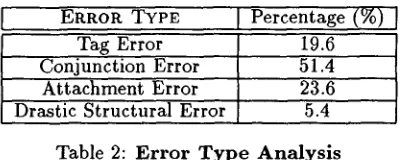
Eru~oa TYPE I Percentage (%) I Tag Error 19.6 Conjunction Error 51.4 A t t a c h m e n t Error 23.6 Drastic Structural Error 5.4
Table 2: E r r o r
Type Analysis
A sampling of 146 trees from the 249 incor- rectly m a p p e d trees reveals the error types of mis- match as tabulated in Table 2. T h e error in- troduced by i n a p p r o p r i a t e tags is a b o u t 19.6%. Structural error, on the other hand, is a b o u t 80.4%, which can be further divided into errors due to: incorrect m a p p i n g of conjunct elements a n d / o r appositions (51.4%), incorrect a t t a c h m e n t p a t t e r n s between heads and modifiers (23.6%) and drastic structure variation (5.4%). Note t h a t tag- ging error is far less than structural error; further- more, two trees with drastically different struc- tures are rarely matched. A closer look shows t h a t 2.72% (185/6799) of the correctly m a p p e d trees and 31.73% (79/249) of the incorrectly m a p p e d trees have the same scores ms the other competing trees; they are selected because they are the first candidate. T h e current solution to tie, therefore, tends to introduce incorrectly m a p p e d trees. A b e t t e r way m a y be required to avoid the chance of tie. For instance, we m a y increment different scores for different types of matches or different syntactic categories.
[image:5.612.99.285.75.139.2] [image:5.612.340.540.259.339.2]source structures rather than the target grammar. This phenomenon could prevent the improvement of the new grammar from being reflected in the converted corpus if the new grammar is a revi- sion of the old one. Attachment and conjunction scopes, which may vary from system to system, are more likely to suffer from such a bias as shown in the above experiment results. A wise way to incor- porate preference form the target grammar may be necessary if such bias introduces a significant frac- tion of errors. Such preference information may include mapping preference acquired from other e x t r a information or by using other more compli- cated models.
From the low error rate of the overall perfor- mance, however, it seems that we need not be too pessimistic with such a bias since most major con- stituents, like noun phrases and verb phrases, rec- ognized by different persons are in agreement to a large extent. It is probably also true even'for persons across different laboratories,
Since the conversion rate is probably high enough, it. is possible simply to regard errors in the converted treebank as noise in probabilistic frameworks, which use the converted treebank for parameter training. In these cases, further man- ual inspection is not essential and the conversion is basically automatic. This situation is particularly true if the original source treebank had been man- ually verified, since we can at least make sure that the target trees are legal, even though not pre- ferred. If serious work is necessary to avoid error accumulation in the treebank, say in the grammar revision process, it is suggested only to check a few high-score candidates to save checking time. If, in addition, the major differences of the two grammars are known, the checking time could be further reduced by only applying detailed checking to the trees that have relevant structure changes.
Of course, there are many factors which may affect the performance of the proposed approach among different grammar systems. In particu- lar, we did not use the information between the mapping of the parts of speech (terminal sym- bols) and the syntactic categories (nonterminal symbols), which may be useful in the cases where the mapping is applied to two trees with the same bracket representation. In our future research, we will try to convert large treebanks, such as the Penn Treebank, available in the community into our grammar system, and make use of more infor- mation on the parts of speech and syntactic cat- egories so that a robust conversion algorithm can be developed.
C o n c l u d i n g R e m a r k s
It is important to be able to share treebanks among different research organizations. T h e sig- nificance for developing a treebank conversion technique includes at least: (1) corpus sharing among different grammar systems and research or- ganizations; (2) automatic system corpus updat- ing between two major revisions; (3) corpus boot- strapping with a large and cheaply tagged tree- bank; (4) avoidance of duplicated investment in the construction and maintenance of proprietary corpora; (5) promoting continuous evolution of an old grammar system for a corpus-based system.
In this paper, we therefore proposed a simple approach for converting one treebank into another across two different grammar systems using a sim- ple conversion metric based one the bracket infor- mation of the original treebank. The simple met- ric, which evaluates the number of bracket match- ing, turns out to be effective in preserving the structures across two different grammars. T h e ex- periment results show that, excluding unambigu- ous sentences, the conversion accuracy, in terms of the number of correctly converted trees, achieves as high as 96.4%.
R e f e r e n c e s
[Chang and Su 1993] Jing-Shin Chang and Keh- Yih Su, 1993. "A Corpus-Based Statistics- Oriented Transfer and Generation Model for Machine Translation," In Proceedings of TMI- 93, pp. 3-14, 5th Int. Conf. on Theoretical and Methodological Issues in Machine Translation, Kyoto, Japan, July 14-16, 1993.
[Chen et al. 1991] Shu-Chuan Chen, Jing-Shin Chang, Jong-Nae Wang and Keh-Yih Su, 1991. "ArchTran: A Corpus-based Statistics-oriented English-Chinese Machine Translation System," In Proceedings of Machine Translation Summit III, pp. 33-40, Washington, D.C., USA, July 1- 4, 1991.
[Isabelle et al. 1993] Pierre Isabelle, Marc Dymet- man, George Forster, Jean-Marc Jutras, Elliott Machkovitch, Franqois, Perrault, Xiaobo Ren and Michel Simard, 1993. "Translation Anal- ysis and Translation Automation," Proceedings of TMI-93, pp. 201-217, 5th Int. Conf. on The- oretical and Methodological Issues in Machine Translation, Kyoto, Japan, July 14-16, 1993. [Marcus et al. 1993] Mitchell P. Marcus, Beatrice
Santorini, and Mary Ann Marcinkiewicz, 1993. "Building a Large Annotated Corpus of English: The Penn Treebank," Computational Linguis- tics, vol. 19, no. 2, pp. 313-330, June 1993. [Su and Chang 1990] Keh-Yih Su and Jing-Shin