Munich Personal RePEc Archive
Creation of Enterprises Knowledge
Economy in the Arab Countries
Driouchi, Ahmed
IEAPS, Al Akhawayn University, Ifrane, Morocco
20 October 2015
Online at
https://mpra.ub.uni-muenchen.de/67366/
By: Ahmed Driouchi,
Institute of Economic Analysis & Prospective Studies (IEAPS), Al Akhawayn University, Ifrane, Morocco
Abstract
The limited business and enterprise creation in relation to the high unemployment of
skilled labor are among the issues analyzed and discussed in this paper. The present paper shows
clearly that shifts to the creation of more enterprises are the most important ways to enhance
economic performance and market development through further access to the knowledge
economy.
Keywords: Enterprise creation, doing business
Introduction
Knowledge economy is assumed to be linked to both business development where
private initiatives are the main drivers of an overall macroeconomic and social growth
where governments play an important role. The impacts of knowledge economy on
businesses and economic policies are first reviewed as measured through series of
indices. Further analysis based on “doing business” data is then performed.
The way of doing business and mainly the starting of a business provide
important indications about how enterprises are created. It seems that the context of Arab
transactions in comparison with that of private businesses. As the growth of the number
of enterprises indicates how market economy is promoted, it also indicates how private
initiatives lead to enterprise creation.
This paper uses the data from the World Bank databases with the objective of
showing the major trends characterizing the initiation of businesses in Arab economies at
the level of countries and globally. The major characteristics as well as the comparisons
are important means to underline the existence of market incentives for the expansion of
private initiatives in individual countries and for the overall economy of the Arab World.
The present paper is composed of a literature review and a section based on data analysis.
This latter is used to discuss the trends taking place in Arab economies.
I. Literature Review
Most of the existing economic literature focuses on the general economic
conditions for business development and on the overall entrepreneurship in Arab
countries. Only few contributions are found to be based on the characterization of doing
business at the microeconomic level.
In practice, the creation of new enterprises goes through series of steps that relate
to the different stages needed for launching a business. This can be crucial in case of
largely fragmented set of authorizing agencies.
According to Doing Business (2012) when governments make registration easy, more
entrepreneurs start businesses in the formal sector creating thus, more jobs and generating
more revenue for the government. As Doing Business measures the ease of starting a
by an entrepreneur to start up and formally operate an industrial or commercial business
and the time and cost required to complete these procedures. It also records the paid-in
minimum capital that companies must deposit before registration (or within 3 months).
The ranking on the ease of starting a business is the simple average of the percentile
rankings on the 4 component indicators: procedures, time, cost and paid-in minimum
capital requirement.
Fig.1: How the Arab world ranks on Doing Business topics (source: DB, 2012, page 7)
The most important contribution in this area is provided by Qianwei and Guangnan
(2007). In this paper, the authors investigate how the fragmentation of licensing rights
affects the occurrence of the tragedy of anti-commons in the enterprise licensing
procedures. It is also shown that the impacts of the tragedy of the anti-commons are more
emphasized with the high extent of fragmentation. This situation alters the evolution of
the entrepreneurial initiatives in China because it creates considerable challenges for the
victims of the anti-commons (e.g., enterprises). Dethier, Hirn and Straub (2010) survey
the recent literature which examines the impact of the business climate on productivity
finance, security, competition, and regulation variables have been shown to have a
significant impact on enterprise performance.
Scharff (2006) in condemning the anti-commons found that economic development of
land may be suboptimal where multiple parties have the legal right to exclude use of the
property in question.
But some authors referred to the links between bureaucracy, corruption and economic
performance before the pioneering works on anti-commons. These include Quah (1982).
This author focused on some examples such as import-export licenses and the
underassessment of income tax.
The empirical evidence introduced here concern respectively the general trends taking
place in both technological and institutional innovations and related economic policies
pursued by series of developing countries. While economies should develop further
awareness about the negative effects of anti-commons and related tragedies, they are
invited to the strengthening of the knowledge base and the economic foundations that
sustain different policy shifts and reforms, especially when accounting for access to
promising technologies.
The pervasiveness of anti-commons appears at different levels in developing economies
and is not often perceived outside the existing legal frameworks. With the expansion of
urbanization and the increase of the number of buildings where individuals and
households own apartments in different floors, individualistic incentives show often the
blockages taking place in the access to new technologies and services (i.e: Internet) and
in the maintenance and repair of different facilities. This concerns the common areas, the
II. Empirical Analysis
There are several indices that are produced by different international organizations that
help identify the aggregate behavior of businesses, the macroeconomics and the sectors
environments in each economy. Selected indices are introduced before looking at all of
them as aggregated in groups.
The list of indices and the corresponding abbreviations used in the empirical analysis
undertaken below include Business Disclosure Index (BDI), Intellectual Property Protection
(IPP), Intensity of Local Competition (ILC), Rigidity of Employment Index (REI) , Soundness of
Banks (SB), Corporate Ethics Index (CEI), Corporate Governance Index (CGI). In addition, the
indices related to Corporate Illegal Corruption Index Component (CICI), Corporate Legal
Corruption Index (CLCI)n Public Sector Ethics Index, Economic Freedom Index (EFI), the
Bertelsmann Transformation Index (Management index), the Bertelsmann Transformation Index
(Status Index) are also considered in the descriptive analysis pursued here. The remaining indices
are Contract Intensive Money (CIM), Global Peace Index (GPI), and Government Effectiveness
(GE). The Silatech Index: Access Index Scores, The Silatech Index: Mindset Index Scores and
the index of Regulatory Quality (RQI).
[image:6.612.91.521.610.719.2]1. The positioning of Arab businesses relative to all indices
Table 1 Positioning of Arab countries with respect to variables as defined above
BDI IPP ILC REI SBI CEI EFI BMI BSI CIM GPI SIG SMSS RQI GEI Algeria 6 2.5 4.2 41 3.9 39.35 56.9 3.88 4.72 0.763 2.277 44 69 -0.94 -0.59
Bahrain 8 4.9 5.3 10 6.4 59.58 76.3 4.66 6.01 0.955 1.956 53 69 0.78 0.62
Egypt 8 3.6 4.6 27 4.7 44.81 59 4.15 4.88 0.856 1.784 22 55 -0.14 -0.3
Iraq 4 24 2.54 3.28 0.499 3.406 26 45 -1.04 -1.26
Jordan 5 4.6 5.6 24 5.8 63.18 66.1 4.81 5.12 0.86 1.948 35 65 0.36 0.28
Kuwait 7 3.6 5.1 0 6.2 67.7 3.94 5.2 0.968 1.693 66 77 0.2 0.21
Mauritania 5 39 52 5.94 4.46 2.389 32 65 -0.66 -0.9
Morocco 6 3.3 4.6 63 5.2 37.47 59.2 4.6 4.65 0.821 1.861 38 63 -0.01 -0.11
Oman 8 4.9 4.7 13 5.4 67.7 4.77 5.3 0.917 1.561 0.66 0.65
Palestine 6 31 28 52 -0.12 -0.87
Qatar 5 5.1 5.1 13 6.2 69 0.962 1.394 67 83 0.62 1.13
Saudi
Arabia 9 4.5 5.2 13 5.7 64.1 3.81 4.36 0.912 2.216 59 70 0.22 -0.09
Sudan 0 36 2.88 3 0.705 3.125 41 66 -1.25 -1.32
Syria 6 3.8 5.1 20 5 49.4 2.47 3.39 0.703 2.274 34 66 -1.07 -0.61
Tunisia 0 4.4 5.4 40 5.3 57.2 58.9 4.75 5.37 0.864 1.678 49 68 0.1 0.41
UAE 4 5.2 5.6 7 6.2 72.99 67.3 5.04 5.23 0.945 1.739 68 79 0.56 0.93
Yemen 6 24 54.4 3.97 3.91 2.573 19 53 -0.6 -1.12
Based on the above indices (table 1), three groups of Arab countries can be identified.
The first one includes Qatar, UAE, Oman, Bahrain and Kuwait. The second includes
Lebanon, Jordan, Palestine and Syria. The last one includes Algeria, Morocco, Tunisia,
Egypt, Mauritania, Sudan and Yemen. While all groups are setting policies of economic
openness, better market, and economy governance, the last group appears to have
deficiencies in most of the indices. The first group is in better position but is still
constrained by the existence of market imperfections. The second group is an
intermediate position where improvements are needed on both market and public
mechanisms. The following diagrams show the positioning of different Arab countries
with respect to all the variables in relation to subsets of the indices used in this
descriptive analysis (figures 3, 4, 5 and 6).
Fig.2: Positioning with All Variables
-50 0 50
100Alg eria Bahrain Eg yp t
Iraq
Jo rd an
Kuwait
Leb ano n Mauritania Mo ro cco Oman
Palestine Qatar Saud i Arab ia
Sud an Syria Tunisia
UAE Yemen
Business Environment Indices of Arab Countries 2004-2010
Fig.3: Positioning with Variables scoring from 1 to 100
Business Arab Countries Variables 1-100
0 20 40 60 80
100Algeria Bahrain Egypt Iraq Jordan Kuwait Lebanon Mauritania Morocco Oman Palestine Qatar Saudi Arabia Sudan Syria Tunisia UAE Yemen REI CEI EFI SIG SMSS
Fig.4: Positioning with Variables scoring from 1 to 10
Business Arab Countries Variables 1-10
0 2 4 6 8 10 Algeria Bahrain Egypt Iraq Jordan Kuwait Lebanon Mauritania Morocco Oman Palestine Qatar Saudi Arabia Sudan Syria Tunisia UAE Yemen BDI BMI BSI GPI
Fig.5: Positioning with Variables scoring from 1 to 7
Business Arab countries Variables 1-7
Fig.6: Positioning with Variables scoring from -2.5 to 2.5
Business Arab Countries Variables -2.5 to 2.5
-1.5 -1 -0.5 0 0.5 1 1.5
Algeria
Bahrain Egypt
Iraq
Jordan
Kuwait
Lebanon
Mauritania Morocco Oman
Palestine Qatar Saudi Arabia
Sudan Syria Tunisia
UAE Yemen
RQI
GEI
2. Using “Doing Business” data
“Doing Business Report” is an annual report issued by The World Bank Group (2010).
As of 2010, the report has input from 183 countries and 8000 lawyers, government
officials, agencies and professional. DBR is ranking countries using the Ease of Doing
Business Index. A country ranked in the top would have better laws and regulation for
creating a business and high investors’ protection. This index is based on 9 main sub
-indexes each measuring a topic or step in enterprise creation using indicators such as the
time, costs and procedures required to accomplish a step. Those can be listed as follow:
starting a business, dealing with construction permit, registering property, getting credit,
protecting investors, paying taxes, trading across borders, enforcing a contract, and
closing a business. The first three topics deal with the creation of enterprises and will be
used as data. The description of those topics and variables included will be in the next
section.
The data from the database of doing business (World Bank,) are now used to characterize
the business environment of both Arab and EEE countries.
Table 2: Comparing means of variables between Arab and EEE countries
Variables Arab Countries EEE Countries t- stat
Mean SD Observations Mean SD Observations
ST 30.10 24.821 136 28.89 19.172 109 0.4304
SP 9.38 2.888 136 8.74 3.309 109 1.5911
ECT 642.10 136.280 134 450.39 164.117 108 9.7327
ECP 44.48 5.713 134 34.76 6.339 108 12.3881
RPP 5.78 2.992 122 6.51 1.953 97 -2.1745
RPT 39.80 36.188 122 98.37 149.456 97 -3.7727
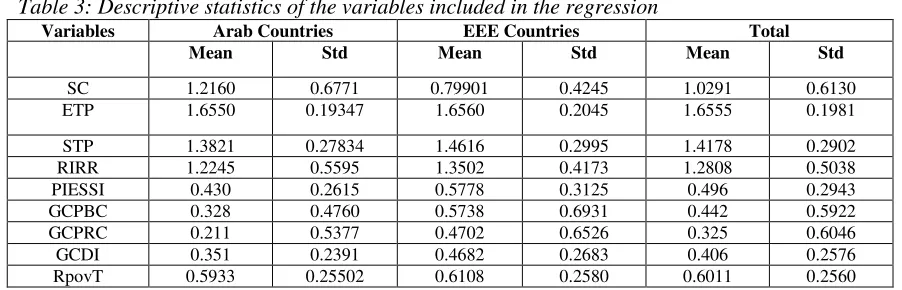
Variable Definitions: SC: the cost of starting a business. (% of income per capita).Etp: Enforcing contracts time per procedure. Stp: Time needed to start a business per procedure pertaining to the business. RpovT: Registering property procedures per unit of time. RIRR: Resolving Insolvency- the Recovery rate (cent recovered per dollar loaned). PIESSI: Index assessing the ease of shareholder suits. (0-10). GCPBC: % of adults getting credits- public bureau coverage. GCPRC: % of adults getting credits: public registry coverage. GCDI: Index informing on depth of credit. (0-6).
The means and standard deviations of the variables are introduced in table 2. While the
required time (ST) and the number of procedures (SP) exhibit no statistically significant
differences between Arab and EEE countries, the time of enforcing contracts as well as
the related procedures appear to be higher in Arab countries. The time and procedures for
registering property show lower levels in Arab countries. But the costs of starting a
[image:10.612.81.532.516.661.2]business are overall larger in the Arab countries as shown in tables 2 and 3.
Table 3: Descriptive statistics of the variables included in the regression
Variables Arab Countries EEE Countries Total
Mean Std Mean Std Mean Std
SC 1.2160 0.6771 0.79901 0.4245 1.0291 0.6130 ETP 1.6550 0.19347 1.6560 0.2045 1.6555 0.1981
STP 1.3821 0.27834 1.4616 0.2995 1.4178 0.2902 RIRR 1.2245 0.5595 1.3502 0.4173 1.2808 0.5038 PIESSI 0.430 0.2615 0.5778 0.3125 0.496 0.2943 GCPBC 0.328 0.4760 0.5738 0.6931 0.442 0.5922 GCPRC 0.211 0.5377 0.4702 0.6526 0.325 0.6046 GCDI 0.351 0.2391 0.4682 0.2683 0.406 0.2576 RpovT 0.5933 0.25502 0.6108 0.2580 0.6011 0.2560
a. Descriptive analysis
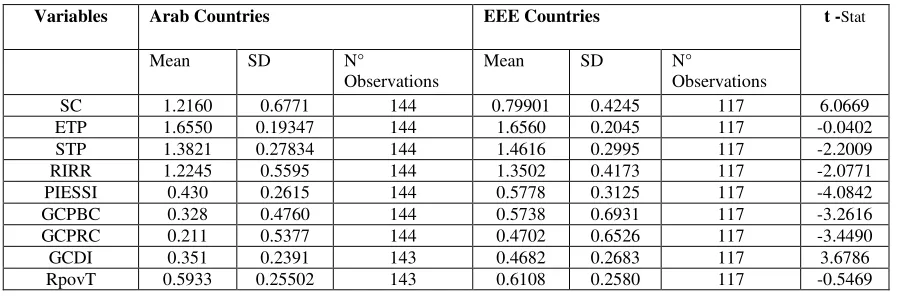
Table 4 shows that the Arab countries exhibit the highest costs for starting a business as
[image:11.612.83.534.174.322.2]shown by through the corresponding t-statistics given in the last column of this table.
Table 4: Comparisons of means of variables between Arab and EEE countries
Variables Arab Countries EEE Countries t -Stat
Mean SD N°
Observations
Mean SD N°
Observations
SC 1.2160 0.6771 144 0.79901 0.4245 117 6.0669 ETP 1.6550 0.19347 144 1.6560 0.2045 117 -0.0402 STP 1.3821 0.27834 144 1.4616 0.2995 117 -2.2009 RIRR 1.2245 0.5595 144 1.3502 0.4173 117 -2.0771 PIESSI 0.430 0.2615 144 0.5778 0.3125 117 -4.0842 GCPBC 0.328 0.4760 144 0.5738 0.6931 117 -3.2616 GCPRC 0.211 0.5377 144 0.4702 0.6526 117 -3.4490 GCDI 0.351 0.2391 143 0.4682 0.2683 117 3.6786 RpovT 0.5933 0.25502 143 0.6108 0.2580 117 -0.5469
b. Regression Analysis
The Table below introduces the outcomes of the regression of the cost of starting
business on the other variables.
The outcomes of the regressions for the sets of Arab, EEE and total countries
(Arab+EEE) show elasticities that are statistically significant for most of the explanatory
variables introduced. Another statistical result relates to the statistically significant
differences between the three models (Arab, EEE and all) using the Chow-F test that is
around 20.52. This means that each regression can be interpreted separately as it exhibits
coefficients that are different for the same variable. According to the results, the
regression of the Arab countries shows coefficients that are higher than those of the EEE.
The cost of starting a business or creating an enterprise in the Arab countries appears to
be more sensitive to ETP (2.592) (number of procedures to enforce business contracts).
(2.301) but the level of response of this same variable is not statistically significant for
[image:12.612.84.531.136.378.2]EEE economies (0.433).
Table 5: Outcomes of the regressions of starting business costs
Independent Variables Arab Countries EEE Countries Total
Constant -3.155
(-10.014)
-0.108 (-0.334)
-2.399 (-8.619)
ETP 2.592
(10.539)
0.433 (*) (1.818)
2.301 (11.545)
TP 0.589
(4.660)
0.280 (2.547)
0.389 (3.980)
RIRR -0.599
(-7.796)
0.394 (3.471)
-0.510 (-7.376)
PIESSI -0.468
(-3.235)
-0.349 (-2.954)
-0.338 (-3.039)
GCPBC -0.585
(-7.183)
0.052 (nss) (1.014)
-0.285 (-5.155)
GCPRC -0.293
(-4.571)
-.215 (-3.643)
-0.245 (-4.677)
GCDI 0.577
(2.749)
-0.477 (-2.677)
0.096 (nss) (0.577)
RpovT 0.429
(3.408)
-0.410 (-2.985)
0.100 (0.896)
R Square 0.791 0.561 .584
Fstat 62.981 17.124 43.908
VIF Less than 4 Less than 4 Less than 3
Chow Test 20.52238
IV. Discussion
In relation to labor markets and unemployment of skilled and unskilled labor, the limited
enterprise creation is not consistent with level of unemployment. But it is assumed that
constraints to enterprise creation, leads to limited creation of enterprises.
The indices and the “Doing Business Data” have had a promising role in
characterizing both the business environment and the creation of enterprises in Arab
countries with comparisons with EEE economies. The attained descriptive and regression
results confirm that Arab countries need to attain highest level of business performance at
both the environment and enterprise creation levels. EEE countries appear globally to
have highest performances but Arab countries such as those of the Gulf are ensuring
be sustained. The global economic and political conditions may inhibit the efforts that
have been undertaken so far.
CONCLUSION
The descriptions and analyzes pursued in this paper show that even with the existence of
highly performing enterprises in Arab economies, the creation of new enterprises suffers
from series of constraints as shown in “doing business” data. This means that the
youngest generations and the skilled labor from the education system do not benefit from
new business opportunities in most Arab countries. Does this trend explain the high
unemployment rates that prevail in North African, Jordan and Yemen?
Furthermore, the results attained in this article show the prevalence of economic and
social imperfections with regard to the adoption of knowledge economy and thus limit
access to new development opportunities? Different explanations are provided and
converge to indicate that the political economy of the Arab countries needs to shift
towards a more knowledge economy approach with further economic and trade openness.
The EEE economies have appeared to be creating more incentives for new enterprises
with a better business environment where knowledge is seen as engine for growth and
development.
Dethier, J., Hirn, M. and Straub, S. (2008). Explaining Enterprise Performance in
Developing Countries with Business Climate Survey Data. Policy Research
Working Paper 4792, World Bank, Washington DC http://econ.worldbank.org
Qianwei, Y. and Guangnan Z. (2007). Enterprise Licensing, Bribery and the Tragedy of
the AntiCommons: The Case of China. Asian Journal of Public Affairs Summer
2007 (1):1
Quah, J. (1982). Bureaucratic Corruption in the ASEAN Countries: A Comparative
Analysis of Their Anti-Corruption. Journal of Southeast Asian Studies 13 (1),
http://www.jstor.org/stable/20070476
Scharff, R. (2006). A Common Tragedy: Condemnation and the Anticommons. bepress
Legal Series. Working Paper 1312. http://law.bepress.com/expresso/eps/1312
World Bank Group. (2010). Doing Business Home. The World Bank Group.
http://www.doingbusiness.org/ (accessed November 25th, 2010)
UNESCO. (2003). Annual report 2003. UNESCO Publication
UNESCO. (2010). Annual report 2010. UNESCO Publication
World Bank Group. (2010). Doing Business Home. The World Bank Group.
http://www.doingbusiness.org/ (accessed November 25th, 2010)
Achy, L. (2012). L'économie de rente dans les pays arabes à l'origine du chômage et de la
précarité. Le Cercle. Retrieved from :
http://lecercle.lesechos.fr/economie-
societe/international/afrique/221144512/leconomie-rente-pays-arabes-a-lorigine-chomage-et-p
Acs Z.J, Braunerhjelm, P, Audretsch, D.B and Carlsson, B. (2009). The knowledge
spillover theory of entrepreneurship. Small Bus Econ 32(1):15–30
Acs, Z, J. and. Audretsch D, B.(1990). Innovation and Small Firms. Cambridge: MIT
Al-Yahya, K., and Vengroff, R. (2004). Human Capital Utilization, Empowerment, and
Organizational Effectiveness: Saudi Arabia in Comparative Perspective. Journal
of Global Development Studies, 3: 251-95.
Aoki, K. (1998). Neo-colonialism, Anticommons Property, and Biopiracy in the
(Not-So-Brave) New World Order of International Intellectual Property Protection.
Indiana Journal of Global Legal Studies, 11.
Bergstrom, T. (2010). The Uncommon Insight of Elinor Ostrom. Scandinavian Journal of
Economics. http://works.bepress.com/ted_bergstrom/107.
Birch, D. L. (1987). Job Generation in America. The Free Press: New York
Birch, D. L.(1979). The Job Generation Process. U.S. Department of Commerce,
National Technical Information Service.
Black, S. and Strahan, P, E. (2002). Entrepreneurship and the Availability of Bank Credit.
Journal of Finance, November, 67(6): 2807-2833.
Buchanan, J. and Yoon, Y. (2000). Symmetric Tragedies; Commons and Anticommons.
Journal of Law and Economics, 43 (1).
Canavese, A. (2004). Commons, anti-commons, corruption and behavior. Econometric
Society 2004 Latin American Meetings, 115.
Cantrell, R., Hettel, G., Barry, G. and Hamilton, R. (2004). Impact of Intellectual
Property on Nonprofit Research Institutions and the Developing Countries They
Serve. Minnesota Journal of Law, Science & Technology, 6 (1), 253-276
Choueiri, E. (2008). Igniting the Arab Scientific Revolution. Princeton, Princeton
University
Coelho, M., Filipe, J. and Ferreira,M. (2009). Tragedies on Natural Resources a
Commons and Anticommons Approach. Working Papers 2009/21, Department
of Economics at the School of Economics and Management (ISEG) , Technical
University of Lisbon.
Corden, W. M and Neary, P. J. (1982). Booming sector and de industrialization in a small
open economy. Economic Journal, 92 (1982): 335-59.
Corden, W.M. (1984). Booming Sector and Dutch Disease Economics: Survey and
Dabrowski, M. (2012). What can Arab countries learn from the post communist
transition. MEDPRO commentary, European commission, 7th framework
program, thinking ahead for the Mediterranean, 31 May, 2012. Retrieved from
http://www.eu-enprelatedjobs.eu/images/May%202012%20Arab%20Transition%20final.pdf
Depoorter, B. and Vanneste, S. (2004). Putting Humpty Dumpty Back Together:
Experimental Evidence of Anticommons Tragedies. Research Paper No. 04-53,
George Mason Law & Economics.
Dethier, J., Hirn, M. and Straub, S. (2008). Explaining Enterprise Performance in
Developing Countries with Business Climate Survey Data. Policy Research
Working Paper 4792, World Bank, Washington DC http://econ.worldbank.org
Dias, J. and McDermott, J. (2006). Institutions, education, and development: The role of
entrepreneurs. Journal of Development Economics 80, 299– 328.
Djankov, S; La Porta, R; de Silanes F, L; and Shleifer. A. (2002). The Regulation of
Entry. Quarterly Journal of Economics 117 (1): 1–37
Farzanegan, M. R. (2012). Resource Wealth and Entrepreneurship: A Blessing or a
Curse?. Marburg: Philipps-University of Marburg Center for Near and Middle
Eastern Studies (CNMS).
Frankel, J. (2010). The Natural Resource Curse: A Survey. NBER Working Paper, No.
15836. Cambridge: National Bureau of Economic Research.
Gylfason, T. (2001). Natural Resources, Education, and Economic Development.
European Economic Review, 45, 847–59.
Hardin, G. (1968). The Tragedy of the Commons. Science 162.
Hause, J. and Du Rietz, G. (1984). Entry, Industry Growth, and the Microdynamics of
Industry Supply. Journal of Political Economy, 92, 733—57.
Heller, M. (1998). The Tragedy of the Anticommons: Property in the Transition from
Marx to Markets. Harvard Law Review 11: 621-688.
Hofstede, G. (2010). The GLOBE debate: Back to relevance. Journal of International
Business Studies, 41, 1339–1346.
Hofstede, G. (1980). Culture’s Consequences: International Differences in Work-Related
Hofstede, G. (2001). Culture’s consequences: Comparing values, behaviors, institutions,
and organizations across nations. Thousand Oaks, CA: Sage, 2nd Edition.
ILO. (2011). Employment report 2011. ILO publications
Kelly, D., & Michelman, F. (1980). Are Property and Contract Efficient?. Hofstra Law
Review 8:711.
Klapper, L. Laeven, L. and Rajan, R. (2006). Entry regulation as a barrier to
entrepreneurship. Journal of Financial Economics 82 (3): 591– 629.
Nash, M. (2001). Grains of Hope. TIME.
www.time.com/time/asia/biz/magazine/0,9754,98034,00.html
Ostrom, E. (1990). Governing the Commons. Cambridge University Press: New York.
Ostrom, E., & Schlager, E. 1992. Property rights regimes and natural resources. Land
Economics 68:249-262.
Parisi, F., Depoorter, B. and Schulz, N. (2003). Simultaneous and Sequential
Anticommons. Working Papers 279, John M. Olin Center for Studies in Law,
Economics, and Public Policy.
Parisi, F., Depoorter, B. and Schulz, N. (2005). Duality in Property: Commons and
Anticommons. International Review of Law and Economics 25 (4):10.
Qianwei, Y. and Guangnan Z. (2007). Enterprise Licensing, Bribery and the Tragedy of
the AntiCommons: The Case of China. Asian Journal of Public Affairs Summer
2007 (1):1
Quah, J. (1982). Bureaucratic Corruption in the ASEAN Countries: A Comparative
Analysis of Their Anti-Corruption. Journal of Southeast Asian Studies 13 (1),
http://www.jstor.org/stable/20070476
Robinson, J.A., Torvik, R. and Verdier, T. (2006). Political foundations of the resource
curse. Journal of Development Economics, vol. 79, pp. 447–68.
Scharff, R. (2006). A Common Tragedy: Condemnation and the Anticommons. bepress
Legal Series. Working Paper 1312. http://law.bepress.com/expresso/eps/1312
Schwalje, W. (2011). Knowledge-based Economic Development as a Unifying Vision in
a Post-awakening Arab World. London: London School of Economics, MPRA,
Schwalje, W. (2012). Measuring Value for Money in Education System Reform for
Knowledge-based Development in Qatar. London: London School of Economics.
Torvik, R. (2001). Learning by doing and the Dutch disease. European Economic Review
45, 285–306.
Torvik, R. (2002). Natural resources, rent seeking and welfare. Journal of Development
Economics.
Twati, J. M. (2006). Societal and Organisational Culture and the Adoption of MIS in
Arab Countries. Ph.D thesis, University of Brisbane, Australia (unpublished
thesis).
UNESCO. (2003). Annual report 2003. UNESCO Publication
UNESCO. (2010). Annual report 2010. UNESCO Publication
Van der Ploeg, F. (2011). Natural resources: curse or blessing?. Journal of Economic
Literature 49, 366-420.
Van Wijenbergen, S. (1984). Inflation, employment, and the Dutch disease in oil
exporting countries: a short-run disequilibrium analysis. Quarterly Journal of
Economics 99, 233–250.
Velho, L. (2004). Agricultural Biotechnology Research Partnerships in Sub-Saharan
Africa: Achievements, Challenges and Policy Issues. Technology Policy Briefs
4(1).
World Bank Group. (2010). Doing Business Home. The World Bank Group.