An Efficient Kernel for Multilingual Generation in
S p e e c h - t o - S p e e c h Dialogue Translation
T i l m a n B e c k e r and W o l f g a n g F i n k l e r and A n n e K i l g e r and P e t e r P o l l e r G e r m a n Research Center for Artificial Intelligence ( D F K I G m b H )
S t u h l s a t z e n h a u s w e g 3 D-66123 Saarbriicken
G e r m a n y
b e c k e r ~ d f k i . d e , f i n k l e r ~ d f k i . d e , k i l g e r O d f k i . d e , p o l l e r ~ d f k i . d e
A b s t r a c t
We present core aspects of a fully implemented generation component in a multilingual speech- to-speech dialogue translation system. Its de- sign was particularly influenced by the neces- sity of real-time processing and usability for multiple languages and domains. We devel- oped a general kernel system comprising a mi- croplanning and a syntactic realizer module. Tile microplanner performs lexical and syntac- tic choice, based on constraint-satisfaction tech- niques. The syntactic realizer processes HPSG grammars reflecting the latest developments of the underlying linguistic theory, utilizing their pre-processing into the TAG formalism. The declarative nature of the knowledge bases, i.e., the microplanning constraints and the HPSG grammars allowed an easy adaption to new do- mains and languages. The successful integra- tion of our component into the translation sys- tem Verbmobil proved the fulfillment of the spe- cific real-time constraints.
1 I n t r o d u c t i o n
In this paper we present core aspects of the mul- tilingual natural language generation compo- nent VM-GECO 1 that has been integrated into the research prototype of Verbmobil (Wahlster, 1993; Bub et al., 1997), a system for sponta- neous speech-to-speech dialog translation.
In order to achieve multilinguality as ele- gantly as possible we found that a clear modu- lar separation between a language-independent general kernel generator and language-specific parts which consist of syntactic and lexical knowledge sources was a very promising ap- proach. Accordingly, our generation component
1VM-GECO is an acronym for "VerbMobil GEnera- tion COmponents."
consists of one kernel generator and language- specific knowledge sources for the languages used in Verbmobih German and English with current work on Japanese.
Additionally, the kernel generator itself can be modularized furthermore into two separate components. The task of the so-called mi- eroplanning component is to plan an utterance on a phrase- or sentence-level (Hovy, 1996) in- cluding word-choice (section 2). It generates an annotated dependency structure which is used by the syntactic generation component to re- alize an appropriate surface string for it (sec- tion 3). The main goal of this further modular- ization is a stepwise constraining of the search- space of alternative linguistic realizations, using abstracted views on different choice criteria.
Multilingual generation in dialog translation imposes strong requirements on the generation module. A very prominent problem is the non- wellformedness (incorrectness, irrelevance, and inconsistency) of spontaneous input. It forces the realization of robust generation to be able to cope with erroneous and incomplete input data so that the quality of the generated out- put may vary between syntactically correct sen- tences and semantically understandable utter- ances. On the level of knowledge sources this is achieved by using a highly declarative HPSG grammar which very closely reflects the latest developments of the underlying linguistic the- ory (Pollard and Sag, 1994) and covers phe- nomena of spoken language. This HPSG is compiled into a TAG grammar in an offtine pre-Processing step (Kasper et al., 1995) which keeps the declarative nature of the grammar in- tact (section 3).
above mentioned features of V M - G E C O con- tribute to the efficiency of the generation com- ponent. T h e TAG-formalism is well known for the existence of efficient syntactic generation al- gorithms (Kilger and Finkler, 1995).
In general, all knowledge sources of all mod- ules are declarative. The main advantage is that this allows for an easier adaptation of the generation component to other domains, lan- guages and semantic representation languages besides the easier extendability of the current system. The feasibility of the language adap- tation was proved in the Verbmobil project it- self where the (originally English) generator was recently extended to cover German and is cur- rently adapted for Japanese. T h e adaptation to another domain and also to another specifi- cation language for intermediate structures was shown in another translation project which uses in contrast to Verbmobil an interlingua based approach (section 4.1).
2 T h e M i c r o p l a n n e r
A generation system for target language utter- ances in an approach to speech-to-speech trans- lation has to work on input elements represent- ing intermediate results of recognition, analy- sis, and transfer components. In that setting, several of the tasks of a complete natural lan- guage generation system such as selection and organization of the contents to be expressed are outside of the control of our generator. They have been decided by the h u m a n user of the translation system or they have been negoti- ated and computed by a transfer component. Nevertheless, there remain a number of different but highly interrelated subtasks of the genera- tion process where decisions have to be made in order to determine and realize the trans- lation result to be sent to a speech synthesis component. The diverse subtasks - - often col- lectively denoted as microplanning (cf. (Levelt, 1989; Hovy, 1996)) - - comprise the planning of a rough structure of the target language ut- terance, the determination of sentence borders, sentence type, topicalization, t h e m e - r h e m e or- ganization of sentential units, focus control, uti- lization of nominalized, or infinitival style, as well as triggering the generation of anaphora and lexical choice. In addition, they have to address the problem of expressibility of the se- lected contents in a text realization component,
i.e., bridging the generation gap (see (Meteer, 1990)).
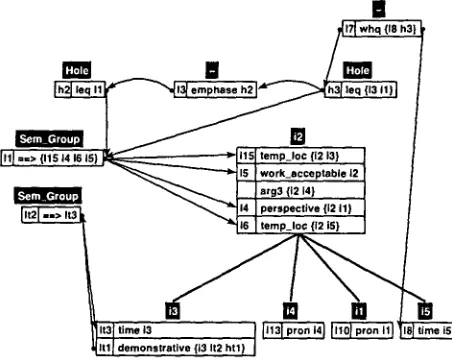
T h e input to our microplanning component consists of semantic representations encoded in a minimal recursive structure following a vari- ant of UDRT. Each individual indicated by some input utterance is formally represented by a discourse referent. Information about the in- dividual is encoded within the DRS-conditions. Relations between descriptions of different dis- course referents lead to a hierarchical semantic structure (see Figure 1 for a graphical represen- tation of fragments of an example input to the generator). Discourse referents are depicted as boxes headed by individual names in; conditions are illustrated within those boxes.
[]
mm _ [] / I m
==> {1151416 IS}
[ ]
temp_loc {i213}
workjcceptable 12
arg3 {i214}
perspective {i2 I1)
;em_Groul
1,3 I,,o. 13 I ~
~
'
~
Itll demonstrative {i3 It2 ht 1) J
Figure 1: Example I n p u t to the Generator
Besides these input terms from the transfer component, the generator may access knowl- edge about the dialogue act, the dialogue his- tory as well as some prosodic information of the user's utterance.
T h e o u t p u t of the microplanner is a sentence plan that serves as input for the syntactic real- ization component. It describes a dependency tree over lexical items a n n o t a t e d with syntac- tic, semantic, and pragmatic information which is relevant to produce an acceptable utterance and guide the speech synthesis component.
2.1 D e s i g n o f t h e M i c r o p l a n n i n g K e r n e l
[image:2.612.313.539.263.443.2]order of decisions over others. E.g., the choice of an interrogative sentence requires an (at least elliptical) verbal phrase as a major constituent of the sentence; nominalization or the choice of passive voice depends on the result of word choice, etc. Therefore, we conceived microplan- ning as a constraint-satisfaction problem (Ku- mar, 1992) representing undirected relations be- tween variables. Thereby, variables are created for elements in the input to the generator. They are connected by means of weighted constraints. The domains of the variables correspond to ab- stractions of possible alternatives for syntactic realizations of the semantic elements including sets of specifications of lexical items and syntac- tic features. A solution of the constraint system is a globally consistent instantiation of the vari- ables and is guaranteed to be a valid input for the syntactic generation module. Since there might be locally optimal mappings that lead to contradiction on a global level, the microplan- net generally uses these weighted constraints to direct a backtracking or propagation process.
One the one hand, the advantages of utiliz- ing a constraint system lie in the declarativ- ity of the knowledge sources allowing for an easier adaptation of the system to other do- mains and languages. We benefited from this design decision and realized microplanning for English and G e r m a n by means of merely estab- lishing new rule sets for lexical and syntactic choice. T h e core engine for constraint process- ing was reused without modification. On the other hand, having defined a suitable represen- tation of the problem to be solved, a constraint- based approach also establishes a testbed for examining the pros and cons of different eval- uation methods, including backtracking, con- straint propagation, heuristics for the order of the instantiation of variable values, to name a few means of dealing with competition among alternatives and to find a solution.
T h e microplanner makes use of the minimal recursive structure of its semantic input term (see Fig. 1) by triggering activities by bundles of conditions, discourse referents, and holes repre- senting underspecified scope relations in the in- put. These three input categories are reflected by different microplanning rule sets that are ap- plied conjointly during the process of microplan- ning. T h e rules are represented as p a t t e r n -
condition-action triples. A p a t t e r n is to be matched with part of the input, a condition describes additional context-dependent require- ments to be fulfilled by the input, and the ac- tion part describes a bundle of syntactic features realizing lexical entities and their relations to complements and modifiers.
A microplanning rule for the combination of the semantic predicates WORK_ACCEPTABLE, ARG3,
and PERSPECTIVE which get realized as a finite verb, i.e., representing a 3:1 m a p p i n g of se- mantic predicates to a syntactic specification is shown in Figure 2.
; ; s t a n d a r d f i n i t e v e r b w i t h 2 c o m p l e m e n t s ((WORK_ACCEPTABLE (L I) ARG3 (L 1 12) ;; pattern
PERSPECTIVE (L% I I3))
($not ($sem-match NOM (L I))) ;; condition
(WORK_ACCEPTABLE (CAT V) ;; action
(HEAD (OR SUIT_V1 SUIT_V2)) (FORM ordinary) (TENSE Sget-tense I) (VOICE Sget-voice I)) (I2 (GENDER (NOT MAS FEM)))
(REGENT-DEP-FUNC WORK_ACCEPTABLE 12 AGENT) (REGENT-DEP-FUNC WORK_ACCEPTABLE 13 PATIENT) (KEY KEY-V) )
; ; nominalized form . . .
Figure 2: Example Microplanning Content Rule
In the condition part of the verbal m a p p i n g the existence of a NOM-condition within the se- mantic input information is tested. It would forbid the verbal form by d e m a n d i n g a nomi- nalized form. T h e action part describes the re- sult of lexical selection (the l e m m a "suit") plus generic functions for c o m p u t i n g relevant syntac- tic features like tense and voice. I2 which stands
for the ARG3 of WORK_ACCEPTABLE, defined by a
database of linking-information as the semantic agent is characterized as neither allowing gen- der masc(uline) nor fem(inine) for preventing
"he suits" in the sense of "he is okay". En-
tries starting with KEY define identifiers used for computing the preference value of a microplan- ning rule with respect to the given situation. In an additional database, KEYs are associated with weights for predefined situation character- istics such as time pressure, or register. T h e microplanning content rules are not directly en- tered by a rule writer but are compiled off-line from several knowledge sources for lexical choice rules, rules for syntactic decisions and linking rules, thereby filtering out contradictory combi- nations without requiring on-line runtime.
from the application of the microplanning rules, the most direct way of realizing a constraint net seems to be the definition of one variable for each condition, discourse referent, and hole, leading to a variable net as shown in Figure 3.
Figure 3: Variable Net for Microplanning
For our task, it is not enough to define bi- nary matching constraints between each pair of variables that purely test the compatibility of the described syntactic features. Some syn- tactic specifications may contain identifications of further entities, e.g., discourse referents and syntactic identifiers which influence the result of the compatibility test between a pair of vari- ables referring to these identifiers. Thus, the constraint net is not easily subdivided into sub- nets that can be efficiently evaluated. The large number of combinations of alternative values is handled by known means for CSP such as unit- ing variables with 1-value domains and apply- ing matching mechanisms to their values, com- putation of 2-consistency by matching value pairs and filtering out inconsistent ones, storing and reusing knowledge about binary incompat- ibility and performing intelligent backtracking.
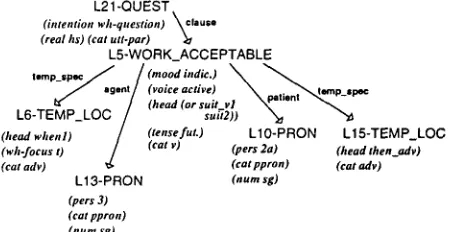
The result of the constraint solving process for the input shown in Fig. 1 is given in Fig. 4.
L21-QUEST
(intention w/i-question) ~clau=e (real hs) (cat utt.par)
L -WORK_ACCEP+AB'E \
/ ==gent/(voice active) \ .. ~ temp =pe¢
~'/ / ( h e a d ( . . . . it_vl ~patient " ~ - - '
L6-TEMP_LOC / suit2)) "~ "~
(head whenl) / (tensefut.) L 1 0 - P R O N L 1 5 - T E M P _ L O C
(wh-focus t) / (cat v) (pers 2a) (head then adv)
(cat adv) ~ (cat ppron) (cat adv)
L13-PRON (aura s$)
(pers 3) (cat ppron) (hum sg)
Figure 4: Microplanning Result for the Example
3 T h e R e a l i z e r
The syntactic realizer 2 proceeds from the mi- croplanning result as shown in Figure 5. It pro- duces a derived phrase structure from which the o u t p u t string is read off. The realizer is based on a fully lexicalized g r a m m a r in the sense that every lexical item selects for a finite set of possi- ble phrase structures (called elementary trees). In particular, we use a Feature-Based Lexical- ized Tree-Adjoining G r a m m a r (FB-LTAG, see (Vijay-Shanker and Joshi, 1988; Schabes et at., 1988)) that is derived from an HPSG g r a m m a r (see section 4 for some more details). The el- } ementary trees (see Figure 9) can be seen as maximal partial projections. A derivation of an utterance is constructed by combining appro- priate elementary trees with the two elementary TAG operations of adjunction and substitution. For each node (i.e., lexical item) in the de- pendency tree, the tree selection phase deter- mines the set of relevant TAG trees. A first tree retrieval step maps every object of the dependency tree into a set of applicable ele- mentary TAG trees. T h e main tree selection phase uses information from the microplanner o u t p u t to further refine the set of retrieved trees. The combination phase finds a success- ful combination of trees to build a (derived) phrase structure tree. T h e final inflection phase uses the information in the feature structures of the leaves (i.e., the words) to apply appro- priate morphological functions. An initial pre- processing phase is needed to accommodate the handling of auxiliaries which are not determined in microplanning. They are derived from the tense, aspect and sentence m o o d information as supplied by microplanning.
(expand ,vxiliazi=s) (adj~lining ~id ~ubstiIUilOll)
l ~
g
- 'AG
Figure 5: Steps of the syntactic generator.
The two core phases are the tree selection and
[image:4.612.67.294.126.241.2] [image:4.612.314.538.526.623.2] [image:4.612.68.293.530.646.2]the combination phase. T h e tree selection is driven by the H P S G instance or word class t h a t is supplied by the microplanner. It is m a p p e d to a lexical t y p e by a lexicon t h a t is automatically compiled from the HPSG g r a m m a r . T h e lexi- cal types are t h e n m a p p e d to a tree family, i.e., a set of elementary TAG trees representing all possible minimally complete phrase structures t h a t can be build from the instance. T h e ad- ditional information in the d e p e n d e n c y tree is then used to add f u r t h e r feature values to the trees. This additional information acts as a fil- ter for selecting appropriate trees in two stages: Some values are incompatible with values al- r e a d y present in the trees. These trees can therefore be filtered i m m e d i a t e l y from the set. E.g., a syntactic s t r u c t u r e for an imperative clause is m a r k e d as such by a feature and can be discarded if a declarative sentence is to be generated. Additional features can prevent the combination with other trees during the combi- nation phase. This is the case, e.g., with agree- ment features.
T h e combination phase completely belongs to the core machinery. It can be exchanged with more efficient algorithms w i t h o u t change of the g r a m m a r or lexicon. It explores the search space of all possible combinations of trees from the c a n d i d a t e sets for each lexical item (instance). Since there is sufficient information available from the microplanner result and from the trees, a well-guided best-first search strategy can be employed in the current system.
As p a r t of the tree selection phase, based on the rich a n n o t a t i o n of the input structure, the tree sets are sorted locally such t h a t preferred trees are tested first. T h e n a modified back- tracking algorithm traverses the d e p e n d e n c y tree in a b o t t o m - u p fashion a. At each node and for each subtree in the d e p e n d e n c y tree, a can- didate for the phrase s t r u c t u r e of the subtree is constructed. T h e n all possible a d j u n c t i o n or substitution sites are computed, possibly sorted (e.g., allowing for preferences in word order) and the best c a n d i d a t e for a combined phrase struc- ture is returned. Since the combination of two partial phrase structures by adjunction or sub- stitution might fail due to incompatible feature structures, a backtracking algorithm must be
3The algorithm stores intermediate results with a memoization technique.
used. A partial phrase s t r u c t u r e for a subtree of the d e p e n d e n c y is finally checked for complete- ness. These tests include the unifiability of all top and b o t t o m feature structures and the satis- faction of all other constraints (e.g., obligatory adjunctions or open substitution nodes) since no further adjunctions or substitutions will oc- cur in this subtree.
T h e necessity of a spoken dialog translation system to robustly p r o d u c e o u t p u t calls for some relaxations in these tests. E.g., 'obliga- tory' a r g u m e n t s m a y be missing in the utter- ance. This can be caused by ellipsis in sentences such as "Ok, we postpone." or by false segmen- tations in the analysis such as segmenting "Wit soIlten (we should) das Treffen verschieben (the meeting postpone)." into two segments "Wit sollten" and "das Treffen verschieben". In order to generate "postpone the meeting" for the sec- ond segment, the tests in the syntactic genera- tor must accept a phrase with a missing subject if no other complete phrase can be generated.
Figure 6 shows a combination of the tree retrieval and the tree selection phases. In the tree retrieval phase for L5-WORK.ACCEPTABLE,
first the HEAD information is used to d e t e r m i n e the lexical types of the possible realizations
SUIT_Vl and SUIT_V2, namely MV_NP_TRANS_LE
and MV_EXPL_PREP_TRANSIE respectively 4. These
types are then m a p p e d to their respective sets of elementary trees, a total of 25 trees. In the tree selection phase, this n u m b e r is reduced to six. For example, the tree M V _ N P _ T R A N S _ L E . 2 in Figure 9 has a feature C [ _ - M O D E with the value I M P E R A T I V E . Now, the microplanner output for the root entity LGVI contains the informa- tion (INTENTION WH-QUESTION). T h e INTENTION information is unified with all appropriate CL-
MODE features, which in this case fails. There-
fore the tree MV_NP_TRANS_LE.2 is discarded in the tree selection phase.
T h e combination phase uses the best-first b o t t o m - u p algorithm described above to deter- mine one suitable tree for every entity a n d also a target node in the tree t h a t is selected for the governing entity. For the above example, the selected trees and their combination nodes are
4MV_NP_TRANS_LE is an abbreviation for "Main Verb,
; ; traverse for: LS-WORK_ACCEPTABLE returned MV_NP_TRANS_LE
returned MV_EXPL_PREP_TRANS_LE total: 6 t r e e s
;; traverse for: LI3-PRON returned PERS_PRO_LE total: 1 tree
;; traverse for: LIO-PRON returned PERS_PR0_LE total: I tree
; traverse for: L6-TEMP L0C returned WH_ADVERB_W0RD_LE total: 2 t r e e s
traverse for: LI5-TEMP_LOC returned NP_ADV_WORD LE total: 5 t r e e s
; traverse for: LGVI returned WILL_AUX_P0S_LE total: 2 t r e e s
Figure 6: An excerpt from the tree retrieval and selection phase.
shown in Figure 75 .
s
o . - - - .
, " S/ADV " ' . " ' , A DV
-"
'
-:::
" . . - I , - VP . . . ', VP:
v/%,4,
ADV . " " NP ,
I
I
',--'"
I
I
vl
I
w~tesl ~vill il xldl you then
L6 -'rEMP_LOC I ~ l Y l L Z 3 - P R O N L 5 - ~ J Z T LZO-PlION L 1 5 - T I 4 ( P _ L O C
Figure 7: The trees finally selected for the enti- ties of the example sentence.
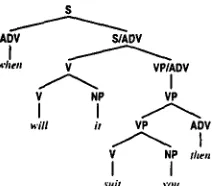
Figure 8 shows the final phrase structure for the example. The inflection function selects the base form of "suit" according to the BSE value of the VFORM feature and correctly uses
"will." Information about the sentence mode
WH-QUESTION can be used to annotate the re- sulting string for the speech-synthesis module. 4 R e s u l t s
Our approach to separate a generation mod- ule into a language-independent kernel and language-specific knowledge sources has been successfully implemented in a dialogue trans- lation system. Furthermore, the mentioned adaptability to other generation tasks has also been proved by an adaptation of the generation module to a new application domain and also to a completely different semantic representation
5Note that the node labels shown in Figures 7 and 8 are only a concession to readability. The TAG require- ment that in an auxiliary tree the foot node must have the same category label as the root node is fulfilled.
S
ADV S/ADV
I
v.'he. V VPIADV
I
V NP VP
I I
w i l l i t VP ADV
V NP then
I i
s u i t y o u
Figure 8: The final phrase structure for " W h e n will it suit you then?"
MV_NP TRANS L F - ! MV_NP_TRANS LF~2 MV NP TRANS_LE.3 MV NP TRANS LEA
VP S S S
MV NP_TRANS L| V NP J,
l
I
I
MV_NP TRAN$ LE MV NP_TRANS LE MV NP TRANS_LE
Figure 9: Some of the trees for transitive verbs. They are compiled from the corresponding lex- ical type MV_NP_TRANS_LE as defined in the HPSG grammar. Trees 3 and 4 differ only with respect to their feature structures which are not shown in this figure.
language by adapting the microplanning knowl- edge sources to the new formalism.
V M - G E C O is fully implemented (in Common Lisp) and integrated into the speech-to-speech translation system Verbmobil for two output languages, English and German. The adapta- tion to Japanese generation will be performed in the current project phase. Our experience from adding German makes us confident that this can be done straightforwardly by creating the appropriate knowledge sources without modi- fications of the kernel generator. To give the reader a more detailed impression of the im- plementation of the generation component we present some characteristic data of the English generator. The numbers for the German sys- tem, especially for lexicon and processing time, are similar.
[image:6.612.374.480.66.159.2] [image:6.612.71.215.69.257.2] [image:6.612.317.542.207.266.2] [image:6.612.70.299.311.420.2]tegrated handling of structural and lexical de- cisions based on constraint propagation. The microplanning rules are of course especially adapted to the underlying semantic represen- tation formalism. Furthermore, the underlying lexicon covers the word list that has been con- structed from a large corpus of the application domain of the Verbmobil system, i.e., negotia- tion dialogues in spontaneous speech.
The TAG grammar resulting from the com- pilation step allows for highly efficient lexically driven robust syntactic generation mainly con- sisting of tree adjoinings, substitutions, and fea- ture unifications. The average overall genera- tion time per sentence (up to length 24) is 0.7 seconds on a SUN ULTRA-1 machine, 68 % of the runtime are needed for the microplanning while the remaining 32 % of the runtime are needed for syntactic generation.
4.1 R e u s i n g t h e K e r n e l
Beside the usability for multiple languages in Verbmobil our kernel generation component has also proven its adaptability to a very differ- ent semantic representation language (system- atically and terminologically) in another still ongoing multilingual (currently 12 languages) translation project. The project utilizes an interlingua-based approach to semantic rep- resentations of utterances. The goal of this project is to overcome the international lan- guage barrier which is exemplarily realized by a large corpus improvement of the transparency of consisting of international law texts. Our part in this project is the realization and implemen- tation of the German generation component. Because of our language-independent core gen- erator the adaptation of the generation compo- nent to this semantic representation decreased to the adaptation of the structural and lexi- cal knowledge bases of the microplanning com- ponent and appropriate domain-specific exten- sions on the lexicon of the syntactic generator. With an average sentence length of 15 words the average runtime per sentence on a SUN ULTRA-2 is less than 0.5 seconds. Currently, even the longest sentence (40 words) needs un- der 2 seconds runtime.
Within Verbmobil, the generation component will also be used for text generation when pro- ducing protocols as described in (Alexandersson and Poller, 1998).
R e f e r e n c e s
J. Alexandersson and P. Poller. 1998. Towards multilingual protocol generation for spon- taneous speech dialogues. In 9th INLGW,
Niagara-on-the-lake, Canada.
T. Becker. 1998. Fully lexicalized head- driven syntactic generation. In 9th INLGW,
Niagara-on-the-lake, Canada.
Th. Bub, W. Wahlster, and A. Waibel. 1997. Verbmobil: The combination of deep and shallow processing for spontaneous speech translation. In Proceedings of ICASSP '97.
E. Hovy. 1996. An overview of automated natu- ral language generation. In X. Huang, editor,
Proc. of the Intl. Symposium on NL Genera- tion and the Processing of the Chinese Lan- guage, INP(C)-96, Shanghai, China.
R. Kasper, B. Kiefer, K. Netter, and K. Vijay- Shanker. 1995. Compilation of HPSG to TAG. In 33rd A CL, Cambridge, Mass. A. Kilger and W. Finkler. 1995. Incremen-
tal generation for real-time applications. Research Report RR-95-11, D F K I GmbH, Saarbrficken, Germany, July.
V. Kumar. 1992. Algorithms for constraint- satisfaction problems: A survey. A I Maga- zine, 13(1):32-44.
W.J.M. Levelt. 1989. Speaking: From Intention to Articulation. The MIT Press, Cambridge, MA.
M.W. Meteer. 1990. The "Generation G a p " - The Problem of Expressibility in Text Plan- ning. Ph.D. thesis, Amherst, MA. BBN Re- port No. 7347.
C. Pollard and I. A. Sag. 1994. Head-Driven Phrase Structure Grammar. Studies in Con- temporary Linguistics. University of Chicago Press, Chicago.
Y. Schabes, A. Abeill~, and A. K. Joshi. i988. Parsing strategies with 'lexicalized' gram- mars: Application to t r e e adjoining gram- mars. In COLING-88, pages 578-583, Bu- dapest, Hungary.
K. Vijay-Shanker and A. K. Joshi. 1988. Fea- ture structure based tree adjoining grammars. In COLING-88, pages 714-719, Budapest, Hungary.
W. Wahlster. 1993. Verbmobih Translation of face-to-face dialoges. In M T Summit IV,