Learning Arguments and Supertypes of Semantic Relations using
Recursive Patterns
Zornitsa Kozareva and Eduard Hovy
USC Information Sciences Institute 4676 Admiralty Way
Marina del Rey, CA 90292-6695
{kozareva,hovy}@isi.edu
Abstract
A challenging problem in open informa-tion extracinforma-tion and text mining is the learn-ing of the selectional restrictions of se-mantic relations. We propose a mini-mally supervised bootstrapping algorithm that uses a single seed and a recursive lexico-syntactic pattern to learn the ar-guments and the supertypes of a diverse set of semantic relations from the Web. We evaluate the performance of our algo-rithm on multiple semantic relations ex-pressed using “verb”, “noun”, and “verb prep” lexico-syntactic patterns. Human-based evaluation shows that the accuracy of the harvested information is about 90%. We also compare our results with existing knowledge base to outline the similarities and differences of the granularity and di-versity of the harvested knowledge.
1 Introduction
Building and maintaining knowledge-rich re-sources is of great importance to information ex-traction, question answering, and textual entail-ment. Given the endless amount of data we have at our disposal, many efforts have focused on mining knowledge from structured or unstructured text, including ground facts (Etzioni et al., 2005), se-mantic lexicons (Thelen and Riloff, 2002), ency-clopedic knowledge (Suchanek et al., 2007), and concept lists (Katz et al., 2003). Researchers have also successfully harvested relations between en-tities, such as is-a (Hearst, 1992; Pasca, 2004) and part-of (Girju et al., 2003). The kinds of knowl-edge learned are generally of two kinds: ground instance facts (New York is-a city,Rome is the cap-ital of Italy) and general relational types (city is-a location,engines are part-of cars).
A variety of NLP tasks involving inference or entailment (Zanzotto et al., 2006), including QA
(Katz and Lin, 2003) and MT (Mt et al., 1988), require a slightly different form of knowledge, de-rived from many more relations. This knowledge is usually used to support inference and is ex-pressed as selectional restrictions (Wilks, 1975) (namely, the types of arguments that may fill a given relation, such asperson live-in cityand air-line fly-to location). Selectional restrictions con-strain the possible fillers of a relation, and hence the possible contexts in which the patterns ex-pressing that relation can participate in, thereby enabling sense disambiguation of both the fillers and the expression itself.
To acquire this knowledge two common ap-proaches are employed: clustering and patterns. While clustering has the advantage of being fully unsupervised, it may or may not produce the types and granularity desired by a user. In contrast pattern-based approaches are more precise, but they typically require a handful to dozens of seeds and lexico-syntactic patterns to initiate the learn-ing process. In a closed domain these approaches are both very promising, but when tackling an un-bounded number of relations they are unrealistic. The quality of clustering decreases as the domain becomes more continuously varied and diverse, and it has proven difficult to create collections of effective patterns and high-yield seeds manually.
In addition, the output of most harvesting sys-tems is a flat list of lexical semantic expressions such as “New York is-a city” and “virus causes flu”. However, using this knowledge in inference requires it to be formulated appropriately and or-ganized in a semantic repository. (Pennacchiotti and Pantel, 2006) proposed an algorithm for au-tomatically ontologizing semantic relations into WordNet. However, despite its high precision en-tries, WordNet’s limited coverage makes it impos-sible for relations whose arguments are not present in WordNet to be incorporated. One would like a procedure that dynamically organizes and extends
its semantic repository in order to be able to ac-commodate all newly-harvested information, and thereby become a global semantic repository.
Given these considerations, we address in this paper the following question: How can the selec-tional restrictions of semantic relations be learned automatically from the Web with minimal effort us-ing lexico-syntactic recursive patterns?
The contributions of the paper are as follows:
• A novel representation of semantic relations using recursive lexico-syntactic patterns.
• An automatic procedure to learn the se-lectional restrictions (arguments and super-types) of semantic relations from Web data.
• An exhaustive human-based evaluation of the harvested knowledge.
• A comparison of the results with some large existing knowledge bases.
The rest of the paper is organized as follows. In the next section, we review related work. Section 3 addresses the representation of semantic rela-tions using recursive patterns. Section 4 describes the bootstrapping mechanism that learns the selec-tional restrictions of the relations. Section 5 de-scribes data collection. Section 6 discusses the ob-tained results. Finally, we conclude in Section 7.
2 Related Work
A substantial body of work has been done in at-tempts to harvest bits of semantic information, in-cluding: semantic lexicons (Riloff and Shepherd, 1997), concept lists (Lin and Pantel, 2002), is-a relis-ations (Heis-arst, 1992; Etzioni et is-al., 2005; Pasca, 2004; Kozareva et al., 2008), part-of re-lations (Girju et al., 2003), and others. Knowl-edge has been harvested with varying success both from structured text such as Wikipedia’s infoboxes (Suchanek et al., 2007) or unstructured text such as the Web (Pennacchiotti and Pantel, 2006; Yates et al., 2007). A variety of techniques have been employed, including clustering (Lin and Pantel, 2002), co-occurrence statistics (Roark and Char-niak, 1998), syntactic dependencies (Pantel and Ravichandran, 2004), and lexico-syntactic pat-terns (Riloff and Jones, 1999; Fleischman and Hovy, 2002; Thelen and Riloff, 2002).
When research focuses on a particular relation, careful attention is paid to the pattern(s) that ex-press it in various ways (as in most of the work above, notably (Riloff and Jones, 1999)). But it
has proven a difficult task to manually find ef-fectively different variations and alternative pat-terns for each relation. In contrast, when re-search focuses on any relation, as in TextRun-ner (Yates et al., 2007), there is no standardized manner for re-using the pattern learned. TextRun-ner scans sentences to obtain relation-independent lexico-syntactic patterns to extract triples of the form (John,fly to,Prague). The middle string de-notes some (unspecified) semantic relation while the first and third denote the learned arguments of this relation. But TextRunner does not seek spe-cific semantic relations, and does not re-use the patterns it harvests with different arguments in or-der to extend their yields.
Clearly, it is important to be able to specify both the actual semantic relation soughtanduse its tex-tual expression(s) in a controlled manner for max-imal benefit.
The objective of our research is to combine the strengths of the two approaches, and, in addition, to provide even richer information by automati-cally mapping each harvested argument to its su-pertype(s) (i.e., its semantic concepts). For in-stance, given the relationdestinationand the pat-tern X flies to Y, automatically determining that John, Prague) and (John, conference) are two valid filler instance pairs, that (RyanAir, Prague) is another, as well as thatperson andairlineare supertypes of the first argument andcityandevent of the second. This information provides the se-lectional restrictions of the given semantic rela-tion, indicating that living things like people can fly to cities and events, while non-living things like airlines fly mainly to cities. This is a significant improvement over systems that output a flat list of lexical semantic knowledge (Thelen and Riloff, 2002; Yates et al., 2007; Suchanek et al., 2007).
How-ever, if we have at our disposal a repository of se-mantic relations with their selectional restrictions, the problem addressed in (Igo and Riloff, 2009) can be alleviated.
In order to obtain selectional restriction classes, (Pennacchiotti and Pantel, 2006) made an attempt to ontologize the harvested arguments of is-a, part-of, and cause relations. They mapped each argument of the relation into WordNet and identi-fied the senses for which the relation holds. Un-fortunately, despite its very high precision en-tries, WordNet is known to have limited cover-age, which makes it impossible for algorithms to map the content of a relation whose arguments are not present in WordNet. To surmount this limitation, we do not use WordNet, but employ a different method of obtaining superclasses of a filler term: the inverse doubly-anchored patterns DAP−1 (Hovy et al., 2009), which, given two ar-guments, harvests its supertypes from the source corpus. (Hovy et al., 2009) show that DAP−1 is reliable and it enriches WordNet with additional hyponyms and hypernyms.
3 Recursive Patterns
A singly-anchored pattern contains one example of the seed term (the anchor) and one open posi-tion for the term to be learned. Most researchers use singly-anchored patterns to harvest semantic relations. Unfortunately, these patterns run out of steam very quickly. To surmount this obstacle, a handful of seeds is generally used, and helps to guarantee diversity in the extraction of new lexico-syntactic patterns (Riloff and Jones, 1999; Snow et al., 2005; Etzioni et al., 2005).
Some algorithms require ten seeds (Riloff and Jones, 1999; Igo and Riloff, 2009), while others use a variation of 5, 10, to even 25 seeds (Taluk-dar et al., 2008). Seeds may be chosen at ran-dom (Davidov et al., 2007; Kozareva et al., 2008), by picking the most frequent terms of the desired class (Igo and Riloff, 2009), or by asking humans (Pantel et al., 2009). As (Pantel et al., 2009) show, picking seeds that yield high numbers of differ-ent terms is difficult. Thus, when dealing with unbounded sets of relations (Banko and Etzioni, 2008), providing many seeds becomes unrealistic. Interestingly, recent work reports a class of pat-terns that use only one seed to learn as much infor-mation with only one seed. (Kozareva et al., 2008; Hovy et al., 2009) introduce the so-called
doubly-anchored pattern (DAP) that has two anchor seed positions “htypeisuch ashseediand *”, plus one open position for the terms to be learned. Learned terms can then be replaced into the seed position automatically, creating a recursive procedure that is reportedly much more accurate and has much higher final yield. (Kozareva et al., 2008; Hovy et al., 2009) have successfully applied DAP for the learning of hyponyms and hypernyms ofis-a rela-tions and report improvements over (Etzioni et al., 2005) and (Pasca, 2004).
Surprisingly, this work was limited to the se-mantic relationis-a. No other study has described the use or effect of recursive patterns for differ-ent semantic relations. Therefore, going beyond (Kozareva et al., 2008; Hovy et al., 2009), we here introduce recursive patterns other than DAP that use only one seed to harvest the arguments and su-pertypes of a wide variety of relations.
(Banko and Etzioni, 2008) show that seman-tic relations can be expressed using a handful of relation-independent lexico-syntactic patterns. Practically, we can turnanyof these patterns into recursive form by giving as input only one of the arguments and leaving the other one as an open slot, allowing the learned arguments to replace the initial seed argument directly. For example, for the relation “fly to”, the following recursive pat-terns can be built: “* andhseedifly to *”, “hseedi
and * fly to *”, “* fly tohseediand *”, “* fly to * andhseedi”, “hseedifly to *” or “* fly tohseedi”, wherehseediis an example likeJohnorRyanair, and (∗) indicates the position on which the ar-guments are learned. Conjunctions like and, or are useful because they express list constructions and extract arguments similar to theseed. Poten-tially, one can explore all recursive pattern varia-tions when learning a relation and compare their yield, however this study is beyond the scope of this paper.
4 Bootstrapping Recursive Patterns
4.1 Problem Formulation
The main goal of our research is:
[image:4.595.89.277.223.364.2]Task Definition: Given a seed and a semantic relation ex-pressed using a recursive lexico-syntactic pattern, learn in bootstrapping fashion the selectional restrictions (i.e., the arguments and supertypes) of the semantic relation from an unstructured corpus such as the Web.
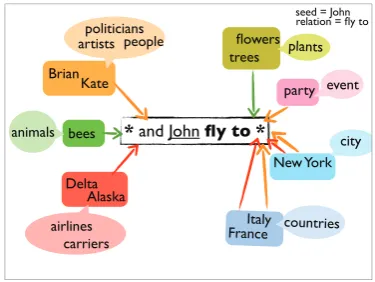
Figure 1 shows an example of the task and the types of information learned by our algorithm.
* and John fly to*
seed = John relation = fly to
Brian Kate
politicians people artists
Delta Alaska
airlines carriers
bees animals
party event
Italy
France countries New York
city flowers
trees plants
Figure 1:Bootstrapping Recursive Patterns.
Given a seedJohnand a semantic relationfly to expressed using the recursive pattern “* and John fly to *”, our algorithm learns the left side argu-ments{Brian, Kate, bees, Delta, Alaska}and the right side arguments {flowers, trees, party, New York, Italy, France}. For each argument, the algo-rithm harvests supertypes such as{people, artists, politicians, airlines, city, countries, plants, event}
among others. The colored links between the right and left side concepts denote the selectional re-strictions of the relation. For instance,peoplefly toeventsandcountries, but never totreesor flow-ers.
4.2 System Architecture
We propose a minimally supervised bootstrap-ping algorithm based on the framework adopted in (Kozareva et al., 2008; Hovy et al., 2009). The al-gorithm has two phases: argumentharvesting and supertypeharvesting. The final output is a ranked list of interlinked concepts which captures the se-lectional restrictions of the relation.
4.2.1 Argument Harvesting
In the argument extraction phase, the first boot-strapping iteration is initiated with a seedY and a recursive pattern“X∗and Y verb+prep|verb|noun
Z∗”, whereX∗andZ∗are the placeholders for the arguments to be learned. The pattern is submit-ted to Yahoo! as a web query and all unique snip-pets matching the query are retrieved. The newly learned and previously unexplored arguments on the X∗ position are used as seeds in the subse-quent iteration. The arguments on the Z∗ posi-tion are stored at each iteraposi-tion, but never used as seeds since the recursivity is created using the terms onX andY. The bootstrapping process is implemented as an exhaustive breadth-first algo-rithm which terminates when all arguments are ex-plored.
We noticed that despite the specific lexico-syntactic structure of the patterns, erroneous in-formation can be acquired due to part-of-speech tagging errors or flawed facts on the Web. The challenge is to identify and separate the erroneous from the true arguments. We incorporate the har-vested arguments onX andY positions in a di-rected graph G = (V, E), where each vertex
v ∈ V is a candidate argument and each edge
(u, v) ∈Eindicates that the argumentvis gener-ated by the argumentu. An edge has weightw cor-responding to the number of times the pair(u, v)
is extracted from different snippets. A node u
is ranked by u= P
∀(u,v)∈Ew(u,v)+
P
∀(v,u)∈Ew(v,u)
|V|−1
which represents the weighted sum of the outgo-ing and incomoutgo-ing edges normalized by the total number of nodes in the graph. Intuitively, our con-fidence in a correct argumentuincreases when the argument (1) discovers and (2) is discovered by many different arguments.
Similarly, to rank the arguments standing on the Z position, we build a bipartite graph G0 = (V0, E0) that has two types of vertices. One set of vertices represents the arguments found on the
Y position in the recursive pattern. We will call theseVy. The second set of vertices represents the arguments learned on theZ position. We will call theseVz. We create an edgee0(u0, v0) ∈ E0 be-tweenu0 ∈Vy andv0 ∈Vzwhen the argument on theZ position represented byv0 was harvested by the argument on theY position represented byu0. The weight w0 of the edge indicates the number of times an argument on theY position foundZ.
Vertexv0 is ranked asv0= P
∀(u0,v0)∈E0w(u
0,v0)
|V0|−1 . In
4.2.2 Supertype Harvesting
In the supertype extraction phase, we take all
<X,Y>argument pairs collected during the argu-ment harvesting stage and instantiate them in the inverse DAP−1pattern“* such as X and Y”. The query is sent to Yahoo! as a web query and all 1000 snippets matching the pattern are retrieved. For each<X,Y>pair, the terms on the (*) position are extracted and considered as candidate supertypes. To avoid the inclusion of erroneous supertypes, again we build a bipartite graphG00 = (V00, E00). The set of verticesVsuprepresents the supertypes, while the set of vertices Vp corresponds to the
hX,Yipair that produced the supertype. An edge
e00(u00, v00) ∈ E00, whereu00 ∈ Vp andv00 ∈ Vsup shows that the pairhX,Yidenoted asu00harvested the supertype represented byv00.
For example, imagine that the argument X∗= Ryanair was harvested in the previous phase by the recursive pattern“X∗ and EasyJet fly to Z∗”. Then the pairhRyanair,EasyJetiforms a new Web query “* such as Ryanair and EasyJet” which learns the supertypes “airlines” and “carriers”. The bipartite graph has two verticesv001 andv002 for the supertypes“airlines”and“carriers”, one ver-tex u003 for the argument pair hRyanair, EasyJeti, and two edgese001(u003, v100)ande002(u003, v100). A vertex
v00∈Vsupis ranked byv00= P
∀(u00,v00)∈E00w(u
00,v00)
|V00|−1 .
Intuitively, a supertype which is discovered mul-tiple times by various argument pairs is ranked highly.
However, it might happen that a highly ranked supertype actually does not satisfy the selectional restrictions of the semantic relation. To avoid such situations, we further instantiate each supertype concept in the original pattern1. For example, “aircompanies fly to *”and“carriers fly to *”. If the candidate supertype produces many web hits for the query, then this suggests that the term is a relevant supertype.
Unfortunately, to learn the supertypes of theZ
arguments, currently we have to form all possi-ble combinations among the top 150 highly ranked concepts, because these arguments have not been learned through pairing. For each pair ofZ argu-ments, we repeat the same procedure as described above.
1Except for the
“dress”and“person” relations, where the targeted arguments are adjectives, and the supertypes are nouns.
5 Semantic Relations
So far, we have described the mechanism that learns from one seed and a recursive pattern the selectional restrictions of any semantic relation. Now, we are interested in evaluating the per-formance of our algorithm. A natural question that arises is: “How many patterns are there?”. (Banko and Etzioni, 2008) found that 95% of the semantic relations can be expressed using eight lexico-syntactic patterns. Space prevents us from describing all of them, therefore we focus on the three most frequent patterns which capture a large diversity of semantic relations. The relative fre-quency of these patterns is 37.80% for “verbs”, 22.80% for “noun prep”, and 16.00% for “verb prep”.
[image:5.595.319.512.464.592.2]5.1 Data Collection
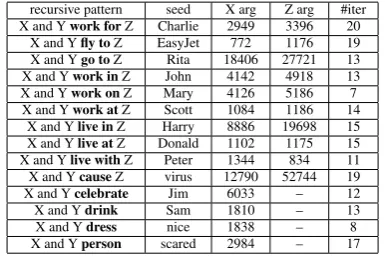
Table 1 shows the lexico-syntactic pattern and the initial seed we used to express each semantic rela-tion. To collect data, we ran our knowledge har-vesting algorithm until complete exhaustion. For each query submitted to Yahoo!, we retrieved the top 1000 web snippets and kept only the unique ones. In total, we collected 30GB raw data which was part-of-speech tagged and used for the argu-ment and supertype extraction. Table 1 shows the obtained results.
recursive pattern seed X arg Z arg #iter X and Ywork forZ Charlie 2949 3396 20
X and Yfly toZ EasyJet 772 1176 19 X and Ygo toZ Rita 18406 27721 13 X and Ywork inZ John 4142 4918 13 X and Ywork onZ Mary 4126 5186 7 X and Ywork atZ Scott 1084 1186 14 X and Ylive inZ Harry 8886 19698 15 X and Ylive atZ Donald 1102 1175 15 X and Ylive withZ Peter 1344 834 11 X and YcauseZ virus 12790 52744 19 X and Ycelebrate Jim 6033 – 12 X and Ydrink Sam 1810 – 13 X and Ydress nice 1838 – 8 X and Yperson scared 2984 – 17
Table 1:Total Number of Harvested Arguments.
rapid growth is observed until a saturation point is reached.
0 10000 20000 30000 40000 50000 60000
1 2 3 4 5 6 7 8 9 10 11 12 13 14 15 16 17 18 19
#Items Learned
Iterations X and Y Cause Z
X Z
0 500 1000 1500 2000
1 2 3 4 5 6 7 8
#Items Learned
Iterations X and Y Dress
[image:6.595.77.296.103.182.2]X
Figure 2: Items extracted in 10 iterations.
The speed of leaning is related to the connectiv-ity behavior of the arguments of the relation. In-tuitively, a densely connected graph takes shorter time (i.e., fewer iterations) to be learned, as in the “work on”relation, while a weakly connected net-work takes longer time to harvest the same amount of information, as in the“work for”relation.
6 Results
In this section, we evaluate the results of our knowledge harvesting algorithm. Initially, we de-cided to conduct an automatic evaluation compar-ing our results to knowledge bases that have been extracted in a similar way (i.e., through pattern ap-plication over unstructured text). However, it is not always possible to perform a complete com-parison, because either researchers have not fully explored the same relations we have studied, or for those relations that overlap, the gold standard data was not available.
The online demo of TextRunner2 (Yates et al., 2007) actually allowed us to collect the arguments for all our semantic relations. However, due to Web based query limitations, TextRunner returns only the first 1000 snippets. Since we do not have the complete and ranked output of TextRunner, comparing results in terms of recall and precision is impossible.
Turning instead to results obtained from struc-tured sources (which one expects to have high correctness), we found that two of our relations overlap with those of the freely available ontology Yago (Suchanek et al., 2007), which was harvested from the Infoboxes tables in Wikipedia. In addi-tion, we also had two human annotators judge as many results as we could afford, to obtain Preci-sion. We conducted two evaluations, one for the arguments and one for the supertypes.
2http://www.cs.washington.edu/research/textrunner/
6.1 Human-Based Argument Evaluation
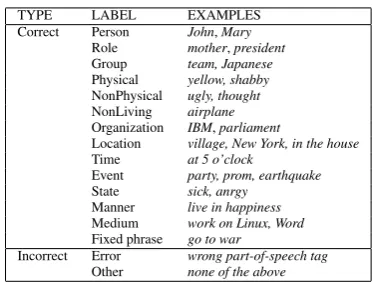
In this section, we discuss the results of the har-vested arguments. For each relation, we selected the top 200 highly ranked arguments. We hired two annotators to judge their correctness. We cre-ated detailed annotation guidelines that define the labels for the arguments of the relations, as shown in Table 2. (Previously, for the same task, re-searchers have not conducted such an exhaustive and detailed human-based evaluation.) The anno-tation was conducted using the CAT system3.
TYPE LABEL EXAMPLES Correct Person John,Mary
Role mother,president
Group team, Japanese
Physical yellow, shabby
NonPhysical ugly, thought
NonLiving airplane
Organization IBM,parliament
Location village, New York, in the house
Time at 5 o’clock
Event party, prom, earthquake
State sick, anrgy
Manner live in happiness
Medium work on Linux, Word
Fixed phrase go to war
Incorrect Error wrong part-of-speech tag
[image:6.595.322.509.234.375.2]Other none of the above
Table 2:Annotation Labels.
We allow multiple labels to be assigned to the same concept, because sometimes the concept can appear in different contexts that carry various con-ceptual representations. Although the labels can be easily collapsed to judge correct and incorrect terms, the fine-grained annotation shown here pro-vides a better overview of the information learned by our algorithm.
We measured the inter-annotator agreement for all labels and relations considering that a single entry can be tagged with multiple labels. The Kappa score is around 0.80. This judgement is good enough to warrant using these human judge-ments to estimate the accuracy of the algorithm. We computeAccuracyas the number of examples tagged asCorrectdivided by the total number of examples.
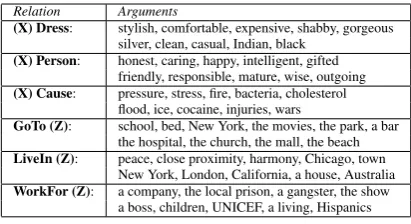
Table 4 shows the obtained results. The over-all accuracy of the argument harvesting phase is 91%. The majority of the occurred errors are due to part-of-speech tagging. Table 3 shows a sam-ple of 10 randomly selected examsam-ples from the top 200 ranked and manually annotated arguments.
Relation Arguments
(X) Dress: stylish, comfortable, expensive, shabby, gorgeous silver, clean, casual, Indian, black
(X) Person: honest, caring, happy, intelligent, gifted friendly, responsible, mature, wise, outgoing
(X) Cause: pressure, stress, fire, bacteria, cholesterol flood, ice, cocaine, injuries, wars
GoTo (Z): school, bed, New York, the movies, the park, a bar the hospital, the church, the mall, the beach
LiveIn (Z): peace, close proximity, harmony, Chicago, town New York, London, California, a house, Australia
[image:7.595.77.283.61.173.2]WorkFor (Z): a company, the local prison, a gangster, the show a boss, children, UNICEF, a living, Hispanics
Table 3:Examples of Harvested Arguments.
6.2 Comparison against Existing Resources
In this section, we compare the performance of our approach with the semantic knowledge base Yago4 that contains 2 million entities5, 95% of which were manually confirmed to be correct. In this study, we compare only the unique arguments of the“live in”and“work at”relations. We provide Precision scores using the following measures:
P rY ago=#terms harvested by system#terms f ound in Y ago
P rHuman=#terms judged correct by human#terms harvested by system
N otInY ago= #terms judged correct by human but not in Y ago
Table 5 shows the obtained results.
We carefully analyzed those arguments that were found by one of the systems but were miss-ing in the other. The recursive patterns learn infor-mation about non-famous entities like Peter and famous entities like Michael Jordan. In contrast, Yago contains entries mostly about famous enti-ties, because this is the predominant knowledge in Wikipedia. For the“live in”relation, both repos-itories contain the same city and country names. However, the recursive pattern learned arguments likepain,effortwhich express a manner of living, and locations likeslums,box. This information is missing from Yago. Similarly for the“work at” relation, both systems learned that people work at universities. In addition, the recursive pattern learned a diversity of company names absent from Yago.
While it is expected that our algorithm finds many terms not contained in Yago—specifically, the information not deemed worthy of inclusion in Wikipedia—we are interested in the relatively large number of terms contained in Yago but not found by our algorithm. To our knowledge, no
4
http://www.mpi-inf.mpg.de/yago-naga/yago/
5Names of cities, people, organizations among others.
XWorkFor A1 A2 WorkForZ A1 A2 Person 148 152 Organization 111 110 Role 5 7 Person 60 60 Group 12 14 Event 4 2 Organization 8 7 Time 4 5 NonPhysical 22 23 NonPhysical 18 19 Other 5 5 Other 3 4 Acc. .98 .98 Acc. .99 .98
XCause A1 A2 CauseZ A1 A2 PhysicalObj 82 75 PhysicalObj 15 20 NonPhysicalObj 69 66 NonPhysicalObj 89 91 Event 21 24 Event 72 72 State 29 31 State 50 50 Other 3 4 Other 5 4 Acc. .99 .98 Acc. .98 .98
XGoTo A1 A2 GoToZ A1 A2
Person 190 188 Location 163 155 Role 4 4 Event 21 30 Group 3 3 Person 11 13 NonPhysical 1 3 NonPhysical 2 1 Other 2 2 Other 3 1 Acc. .99 .99 Acc. .99 .99
XFlyTo A1 A2 FlyToZ A1 A2 Person 140 139 Location 199 198 Organization 54 57 Event 1 2 NonPhysical 2 2 Person 0 0 Other 4 2 Other 0 0 Acc. .98 .99 Acc. 1 1
XWorkOn A1 A2 WorkOnZ A1 A2 Person 173 172 Location 110 108 Role 2 3 Organization 27 25 Group 4 5 Manner 38 40 Organization 6 6 Time 4 4 NonPhysical 15 14 NonPhysical 18 21 Error 1 1 Medium 8 8 Other 1 1 Other 13 15 Acc. .99 .99 Acc. .94 .93
XWorkIn A1 A2 WorkInZ A1 A2 Person 117 118 Location 104 111 Group 10 9 Organization 10 25 Organization 3 3 Manner 39 40 Fixed 3 1 Time 4 4 NonPhysical 55 59 NonPhysical 22 21 Error 12 10 Medium 8 8 Other 0 0 Error 13 15 Acc. .94 .95 Acc. .94 .93
XWorkAt A1 A2 WorkAtZ A1 A2 Person 193 192 Organization 189 190 Role 1 1 Manner 5 4 Group 1 1 Time 3 3 Organization 0 0 Error 3 2 Other 5 6 Other 0 1 Acc. .98 .97 Acc. .99 .99
XLiveIn A1 A2 LiveInZ A1 A2 Person 185 185 Location 182 186 Role 3 4 Manner 6 8 Group 9 8 Time 1 2 NonPhysical 1 2 Fixed 5 2 Other 2 1 Other 6 2 Acc. .99 .99 Acc. .97 .99
XLiveAt A1 A2 LiveAtZ A1 A2 Person 196 195 Location 158 157 Role 1 1 Person 5 7 NonPhysical 0 1 Manner 1 2 Other 3 3 Error 36 34 Acc. .99 .99 Acc. .82 .83
XLiveWith A1 A2 LiveWithZ A1 A2 Person 188 187 Person 165 163 Role 6 6 Animal 2 4 Group 2 2 Manner 15 15 NonPhysical 2 3 NonPhysical 15 15 Other 2 2 Other 3 3 Acc. .99 .99 Acc. .99 .99
XDress A1 A2 XPerson A1 A2 Physical 72 59 Physical 8 2 NonPhysical 120 136 NonPhysical 188 194
Other 8 5 Other 4 4 Acc .96 .98 Acc. .98 .98
XDrink A1 A2 XCelebrate A1 A2 Living 165 174 Living 157 164 NonLiving 8 2 NonLiving 42 35
[image:7.595.309.521.61.694.2]P rY ago P rHuman NotInYago
XLiveIn .19 (2863/14705) .58 (5165)/8886 2302 LiveInZ .10 (495/4754) .72 (14248)/19698 13753
[image:8.595.76.288.61.110.2]XWorkAt .12(167/1399) .88 (959)/1084 792 WorkAtZ .3(15/525) .95 (1128)/1186 1113
Table 5:Comparison against Yago.
other automated harvesting algorithm has ever been compared to Yago, and our results here form a baseline that we aim to improve upon. And in the future, one can build an extensive knowledge harvesting system combining the wisdom of the crowd and Wikipedia.
6.3 Human-Based Supertype Evaluation
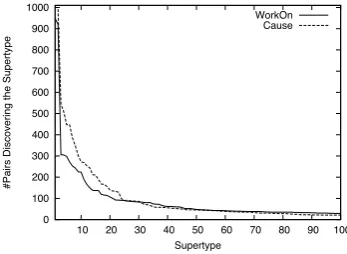
In this section, we discuss the results of harvest-ing the supertypes of the learned arguments. Fig-ure 3 shows the top 100 ranked supertypes for the “cause”and“work on”relations. The x-axis in-dicates a supertype, the y-axis denotes the number of different argument pairs that lead to the discov-ery of the supertype.
0 100 200 300 400 500 600 700 800 900 1000
10 20 30 40 50 60 70 80 90 100
#Pairs Discovering the Supertype
Supertype
WorkOn Cause
Figure 3: Ranked Supertypes.
The decline of the curve indicates that certain supertypes are preferred and shared among differ-ent argumdiffer-ent pairs. It is interesting to note that the text on the Web prefers a small set of supertypes, and to see what they are. These most-popular har-vested types tend to be the more descriptive terms. The results indicate that one does not need an elab-orate supertype hierarchy to handle the selectional restrictions of semantic relations.
Since our problem definition differs from avail-able related work, and WordNet does not contain all harvested arguments as shown in (Hovy et al., 2009), it is not possible to make a direct compar-ison. Instead, we conduct a manual evaluation of the most highly ranked supertypes which normally are the top 20. The overall accuracy of the super-types for all relations is 92%. Table 6 shows the
Relation Arguments
(Supx) Celebrate: men, people, nations, angels, workers, children countries, teams, parents, teachers
(Supx) Dress: colors, effects, color tones, activities, patterns
styles, materials, size, languages, aspects
(Supx) FlyTo: airlines, carriers, companies, giants, people competitors, political figures, stars, celebs
Cause (Supz): diseases, abnormalities, disasters, processes, isses
disorders, discomforts, emotions, defects, symptoms
WorkFor (Supz) organizations, industries, people, markets, men automakers, countries, departments, artists, media
GoTo (Supz): countries, locations, cities, people, events
men, activities, games, organizations,
[image:8.595.306.537.61.187.2]FlyTo (Supz) places, countries, regions, airports, destinations locations, cities, area, events
Table 6:Examples of Harvested Supertypes.
top 10 highly ranked supertypes for six of our re-lations.
7 Conclusion
We propose a minimally supervised algorithm that uses only one seed example and a recursive lexico-syntactic pattern to learn in bootstrapping fash-ion the selectfash-ional restrictfash-ions of a large class of semantic relations. The principal contribution of the paper is to demonstrate that this kind of pat-tern can be applied to almost any kind of se-mantic relation, as long as it is expressible in a concise surface pattern, and that the recursive mechanism that allows each newly acquired term to restart harvesting automatically is a signifi-cant advance over patterns that require a handful of seeds to initiate the learning process. It also shows how one can combine free-form but undi-rected pattern-learning approaches like TextRun-ner with more-controlled but effort-intensive ap-proaches like commonly used.
In our evaluation, we show that our algorithm is capable of extracting high quality non-trivial in-formation from unstructured text given very re-stricted input (one seed). To measure the perfor-mance of our approach, we use various semantic relations expressed with three lexico-syntactic pat-terns. For two of the relations, we compare results with the freely available ontology Yago, and con-duct a manual evaluation of the harvested terms.
We will release the annotated and the harvested data to the public to be used for comparison by other knowledge harvesting algorithms.
[image:8.595.92.266.370.497.2]that can support a variety of applications, includ-ing textual entailment, information extraction, and question answering.
Acknowledgments
This research was supported by DARPA contract number FA8750-09-C-3705.
References
Michele Banko and Oren Etzioni. 2008. The tradeoffs between open and traditional relation extraction. In
Proceedings of ACL-08: HLT, pages 28–36, June.
Dmitry Davidov, Ari Rappoport, and Moshel Koppel. 2007. Fully unsupervised discovery of concept-specific relationships by web mining. In Proc. of the 45th Annual Meeting of the Association of Com-putational Linguistics, pages 232–239, June.
Oren Etzioni, Michael Cafarella, Doug Downey, Ana-Maria Popescu, Tal Shaked, Stephen Soderland, Daniel S. Weld, and Alexander Yates. 2005. Un-supervised named-entity extraction from the web: an experimental study. Artificial Intelligence, 165(1):91–134, June.
Michael Fleischman and Eduard Hovy. 2002. Fine grained classification of named entities. In Proceed-ings of the 19th international conference on Compu-tational linguistics, pages 1–7.
Roxana Girju, Adriana Badulescu, and Dan Moldovan. 2003. Learning semantic constraints for the auto-matic discovery of part-whole relations. InProc. of the 2003 Conference of the North American Chapter of the Association for Computational Linguistics on Human Language Technology, pages 1–8.
Marti Hearst. 1992. Automatic acquisition of hy-ponyms from large text corpora. In Proc. of the 14th conference on Computational linguistics, pages 539–545.
Eduard Hovy, Zornitsa Kozareva, and Ellen Riloff. 2009. Toward completeness in concept extraction and classification. InProceedings of the 2009 Con-ference on Empirical Methods in Natural Language Processing, pages 948–957.
Sean Igo and Ellen Riloff. 2009. Corpus-based se-mantic lexicon induction with web-based corrobora-tion. InProceedings of the Workshop on Unsuper-vised and Minimally SuperUnsuper-vised Learning of Lexical Semantics.
Boris Katz and Jimmy Lin. 2003. Selectively using re-lations to improve precision in question answering. In In Proceedings of the EACL-2003 Workshop on Natural Language Processing for Question Answer-ing, pages 43–50.
Boris Katz, Jimmy Lin, Daniel Loreto, Wesley Hilde-brandt, Matthew Bilotti, Sue Felshin, Aaron Fernan-des, Gregory Marton, and Federico Mora. 2003. Integrating web-based and corpus-based techniques for question answering. In Proceedings of the twelfth text retrieval conference (TREC), pages 426– 435.
Zornitsa Kozareva, Ellen Riloff, and Eduard Hovy. 2008. Semantic class learning from the web with hyponym pattern linkage graphs. InProceedings of ACL-08: HLT, pages 1048–1056.
Dekang Lin and Patrick Pantel. 2002. Concept dis-covery from text. InProc. of the 19th international conference on Computational linguistics, pages 1–7.
Characteristics Of Mt, John Lehrberger, Laurent Bourbeau, Philadelphia John Benjamins, and Rita Mccardell. 1988. Machine Translation: Linguistic Characteristics of Mt Systems and General Method-ology of Evaluation. John Benjamins Publishing Co(1988-03).
Patrick Pantel and Deepak Ravichandran. 2004. Auto-matically labeling semantic classes. InProc. of Hu-man Language Technology Conference of the North American Chapter of the Association for Computa-tional Linguistics, pages 321–328.
Patrick Pantel, Eric Crestan, Arkady Borkovsky, Ana-Maria Popescu, and Vishnu Vyas. 2009. Web-scale distributional similarity and entity set expan-sion. In Proceedings of the 2009 Conference on Empirical Methods in Natural Language Process-ing, pages 938–947, August.
Marius Pasca. 2004. Acquisition of categorized named entities for web search. In Proc. of the thirteenth ACM international conference on Information and knowledge management, pages 137–145.
Marco Pennacchiotti and Patrick Pantel. 2006. On-tologizing semantic relations. InACL-44: Proceed-ings of the 21st International Conference on Com-putational Linguistics and the 44th annual meeting of the Association for Computational Linguistics, pages 793–800.
Ellen Riloff and Rosie Jones. 1999. Learning dic-tionaries for information extraction by multi-level bootstrapping. InAAAI ’99/IAAI ’99: Proceedings of the Sixteenth National Conference on Artificial in-telligence.
Ellen Riloff and Jessica Shepherd. 1997. A Corpus-Based Approach for Building Semantic Lexicons. In Proc. of the Second Conference on Empirical Methods in Natural Language Processing, pages 117–124.
Rion Snow, Daniel Jurafsky, and Andrew Y. Ng. 2005. Learning syntactic patterns for automatic hypernym discovery. InAdvances in Neural Information Pro-cessing Systems 17, pages 1297–1304. MIT Press.
Fabian M. Suchanek, Gjergji Kasneci, and Gerhard Weikum. 2007. Yago: a core of semantic knowl-edge. InWWW ’07: Proceedings of the 16th inter-national conference on World Wide Web, pages 697– 706.
Partha Pratim Talukdar, Joseph Reisinger, Marius Pasca, Deepak Ravichandran, Rahul Bhagat, and Fernando Pereira. 2008. Weakly-supervised acqui-sition of labeled class instances using graph random walks. In Proceedings of the Conference on Em-pirical Methods in Natural Language Processing, EMNLP 2008, pages 582–590.
Michael Thelen and Ellen Riloff. 2002. A Bootstrap-ping Method for Learning Semantic Lexicons Using Extraction Pattern Contexts. In Proc. of the 2002 Conference on Empirical Methods in Natural Lan-guage Processing, pages 214–221.
Yorick Wilks. 1975. A preferential pattern-seeking, semantics for natural language inference. Artificial Intelligence, 6(1):53–74.
Alexander Yates, Michael Cafarella, Michele Banko, Oren Etzioni, Matthew Broadhead, and Stephen Soderland. 2007. Textrunner: open information ex-traction on the web. InNAACL ’07: Proceedings of Human Language Technologies: The Annual Con-ference of the North American Chapter of the Asso-ciation for Computational Linguistics: Demonstra-tions on XX, pages 25–26.