Concise Integer Linear Programming Formulations
for Dependency Parsing
Andr´e F. T. Martins∗† Noah A. Smith∗ Eric P. Xing∗
∗School of Computer Science, Carnegie Mellon University, Pittsburgh, PA 15213, USA †Instituto de Telecomunicac¸˜oes, Instituto Superior T´ecnico, Lisboa, Portugal
{afm,nasmith,epxing}@cs.cmu.edu
Abstract
We formulate the problem of non-projective dependency parsing as a polynomial-sized integer linear pro-gram. Our formulation is able to handle non-local output features in an efficient manner; not only is it compatible with prior knowledge encoded as hard con-straints, it can also learn soft constraints from data. In particular, our model is able to learn correlations among neighboring arcs (siblings and grandparents), word valency, and tendencies toward nearly-projective parses. The model parameters are learned in a max-margin framework by employing a linear programming relaxation. We evaluate the performance of our parser on data in several natural languages, achieving improvements over existing state-of-the-art methods.
1 Introduction
Much attention has recently been devoted to in-teger linear programming (ILP) formulations of NLP problems, with interesting results in appli-cations like semantic role labeling (Roth and Yih, 2005; Punyakanok et al., 2004), dependency pars-ing (Riedel and Clarke, 2006), word alignment for machine translation (Lacoste-Julien et al., 2006), summarization (Clarke and Lapata, 2008), and coreference resolution (Denis and Baldridge, 2007), among others. In general, the rationale for the development of ILP formulations is to incorpo-rate non-local features or global constraints, which are often difficult to handle with traditional algo-rithms. ILP formulations focus more on the mod-eling of problems, rather than algorithm design. While solving an ILP is NP-hard in general, fast solvers are available today that make it a practical solution for many NLP problems.
This paper presents new, concise ILP formu-lations for projective and non-projective
depen-dency parsing. We believe that our formula-tions can pave the way for efficient exploitation of global features and constraints in parsing applica-tions, leading to more powerful models. Riedel and Clarke (2006) cast dependency parsing as an ILP, butefficientformulations remain an open problem. Our formulations offer the following comparative advantages:
• The numbers of variables and constraints are polynomial in the sentence length, as opposed to requiring exponentially many constraints, elim-inating the need for incremental procedures like the cutting-plane algorithm;
• LP relaxations permit fast online discriminative training of the constrained model;
• Soft constraints may be automatically learned from data. In particular, our formulations han-dle higher-order arc interactions (like siblings and grandparents), model word valency, and can learn to favor nearly-projective parses.
We evaluate the performance of the new parsers on standard parsing tasks in seven languages. The techniques that we present are also compatible with scenarios where expert knowledge is avail-able, for example in the form of hard or soft first-order logic constraints (Richardson and Domin-gos, 2006; Chang et al., 2008).
2 Dependency Parsing
2.1 Preliminaries
A dependency tree is a lightweight syntactic repre-sentation that attempts to capture functional rela-tionships between words. Lately, this formalism has been used as an alternative to phrase-based parsing for a variety of tasks, ranging from ma-chine translation (Ding and Palmer, 2005) to rela-tion extracrela-tion (Culotta and Sorensen, 2004) and question answering (Wang et al., 2007).
Let us first describe formally the set of legal de-pendency parse trees. Consider a sentence x =
hw0, . . . , wni, wherewidenotes the word at thei
-th position, andw0=$ is a wall symbol. We form
the (complete1) directed graphD = hV, Ai, with vertices inV = {0, . . . , n}(thei-th vertex corre-sponding to the i-th word) and arcs in A = V2. Using terminology from graph theory, we say that B ⊆ A is an r-arborescence2 of the directed
graphDifhV, Biis a (directed) tree rooted atr. We define the set of legal dependency parse trees ofx(denotedY(x)) as the set of0-arborescences ofD, i.e., we admit each arborescence as a poten-tial dependency tree.
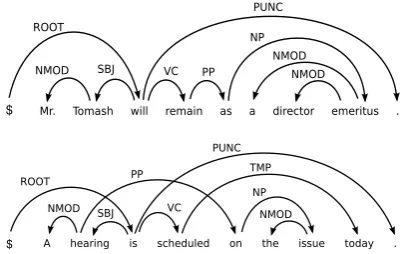
Let y ∈ Y(x) be a legal dependency tree for x; if the arc a = hi, ji ∈ y, we refer to ias the parent ofj (denotedi=π(j)) andjas a child of i. We also say thataisprojective(in the sense of Kahane et al., 1998) if any vertexkin the span of ais reachable fromi(in other words, if for anyk satisfyingmin(i, j) < k < max(i, j), there is a directed path inyfromitok). A dependency tree is called projective if it only contains projective arcs. Fig. 1 illustrates this concept.3
The formulation to be introduced in §3 makes use of the notion of the incidence vector associ-ated with a dependency tree y ∈ Y(x). This is the binary vectorz ,hzaia∈A with each
compo-nent defined asza =I(a∈ y) (here,I(.)denotes
the indicator function). Considering simultane-ously all incidence vectors of legal dependency trees and taking the convex hull, we obtain a poly-hedron that we call the arborescence polytope, denoted by Z(x). Each vertex of Z(x) can be identified with a dependency tree in Y(x). The Minkowski-Weyl theorem (Rockafellar, 1970) en-sures that Z(x) has a representation of the form Z(x) ={z∈R|A| |Az≤b}, for somep-by-|A|
matrixAand some vectorbinRp. However, it is
not easy to obtain acompactrepresentation (where p grows polynomially with the number of words n). In §3, we will provide a compact represen-tation of an outer polytope Z¯(x) ⊇ Z(x) whose
integer vertices correspond to dependency trees. Hence, the problem of finding the dependency tree that maximizes some linear function of the
inci-1
The general case whereA ⊆ V2 is also of interest; it arises whenever a constraint or a lexicon forbids some arcs from appearing in dependency tree. It may also arise as a consequence of a first-stage pruning step where some candi-date arcs are eliminated; this will be further discussed in§4.
2
Or “directed spanning tree with designated rootr.” 3In this paper, we consider
[image:2.595.319.522.63.190.2]unlabeleddependency parsing, where only the backbone structure (i.e., the arcs without the labels depicted in Fig. 1) is to be predicted.
Figure 1: A projective dependency graph.
Figure 2: Non-projective dependency graph.
those that assume each dependency decision is in-dependent modulo the global structural constraint that dependency graphs must be trees. Such mod-els are commonly referred to asedge-factoredsince their parameters factor relative to individual edges of the graph (Paskin, 2001; McDonald et al., 2005a). Edge-factored models have many computa-tional benefits, most notably that inference for non-projective dependency graphs can be achieved in polynomial time (McDonald et al., 2005b). The pri-mary problem in treating each dependency as in-dependent is that it is not a realistic assumption. Non-local information, such as arity (or valency) and neighbouring dependencies, can be crucial to obtaining high parsing accuracies (Klein and Man-ning, 2002; McDonald and Pereira, 2006). How-ever, in the data-driven parsing setting this can be partially adverted by incorporating rich feature rep-resentations over the input (McDonald et al., 2005a). The goal of this work is to further our current understanding of the computational nature of non-projective parsing algorithms for both learning and inference within the data-driven setting. We start by investigating and extending the edge-factored model of McDonald et al. (2005b). In particular, we ap-peal to the Matrix Tree Theorem for multi-digraphs to design polynomial-time algorithms for calculat-ing both the partition function and edge expecta-tions over all possible dependency graphs for a given sentence. To motivate these algorithms, we show that they can be used in many important learning and inference problems including min-risk decod-ing, training globally normalized log-linear mod-els, syntactic language modeling, and unsupervised
learning via the EM algorithm – none of which have previously been known to have exact non-projective implementations.
We then switch focus to models that account for non-local information, in particular arity and neigh-bouring parse decisions. For systems that model ar-ity constraints we give a reduction from the Hamilto-nian graph problem suggesting that the parsing prob-lem is intractable in this case. For neighbouring parse decisions, we extend the work of McDonald and Pereira (2006) and show that modeling vertical neighbourhoods makes parsing intractable in addi-tion to modeling horizontal neighbourhoods. A con-sequence of these results is that it is unlikely that exact non-projective dependency parsing is tractable for any model assumptions weaker than those made by the edge-factored models.
1.1 Related Work
There has been extensive work on data-driven de-pendency parsing for both projective parsing (Eis-ner, 1996; Paskin, 2001; Yamada and Matsumoto, 2003; Nivre and Scholz, 2004; McDonald et al., 2005a) and non-projective parsing systems (Nivre and Nilsson, 2005; Hall and N´ov´ak, 2005; McDon-ald et al., 2005b). These approaches can often be classified into two broad categories. In the first cat-egory are those methods that employ approximate inference, typically through the use of linear time shift-reduce parsing algorithms (Yamada and Mat-sumoto, 2003; Nivre and Scholz, 2004; Nivre and Nilsson, 2005). In the second category are those that employ exhaustive inference algorithms, usu-ally by making strong independence assumptions, as is the case for edge-factored models (Paskin, 2001; McDonald et al., 2005a; McDonald et al., 2005b). Recently there have also been proposals for exhaus-tive methods that weaken the edge-factored assump-tion, including both approximate methods (McDon-ald and Pereira, 2006) and exact methods through in-teger linear programming (Riedel and Clarke, 2006) or branch-and-bound algorithms (Hirakawa, 2006).
For grammar based models there has been limited work on empirical systems for non-projective pars-ing systems, notable exceptions include the work of Wang and Harper (2004). Theoretical studies of note include the work of Neuhaus and B¨oker (1997) showing that the recognition problem for a
mini-$ Figure 1: A projective dependency graph.
Figure 2: Non-projective dependency graph.
those that assume each dependency decision is in-dependent modulo the global structural constraint that dependency graphs must be trees. Such mod-els are commonly referred to asedge-factoredsince their parameters factor relative to individual edges of the graph (Paskin, 2001; McDonald et al., 2005a). Edge-factored models have many computa-tional benefits, most notably that inference for non-projective dependency graphs can be achieved in polynomial time (McDonald et al., 2005b). The pri-mary problem in treating each dependency as in-dependent is that it is not a realistic assumption. Non-local information, such as arity (or valency) and neighbouring dependencies, can be crucial to obtaining high parsing accuracies (Klein and Man-ning, 2002; McDonald and Pereira, 2006). How-ever, in the data-driven parsing setting this can be partially adverted by incorporating rich feature rep-resentations over the input (McDonald et al., 2005a). The goal of this work is to further our current understanding of the computational nature of non-projective parsing algorithms for both learning and inference within the data-driven setting. We start by investigating and extending the edge-factored model of McDonald et al. (2005b). In particular, we ap-peal to the Matrix Tree Theorem for multi-digraphs to design polynomial-time algorithms for calculat-ing both the partition function and edge expecta-tions over all possible dependency graphs for a given sentence. To motivate these algorithms, we show that they can be used in many important learning and inference problems including min-risk decod-ing, training globally normalized log-linear mod-els, syntactic language modeling, and unsupervised
learning via the EM algorithm – none of which have previously been known to have exact non-projective implementations.
We then switch focus to models that account for non-local information, in particular arity and neigh-bouring parse decisions. For systems that model ar-ity constraints we give a reduction from the Hamilto-nian graph problem suggesting that the parsing prob-lem is intractable in this case. For neighbouring parse decisions, we extend the work of McDonald and Pereira (2006) and show that modeling vertical neighbourhoods makes parsing intractable in addi-tion to modeling horizontal neighbourhoods. A con-sequence of these results is that it is unlikely that exact non-projective dependency parsing is tractable for any model assumptions weaker than those made by the edge-factored models.
1.1 Related Work
There has been extensive work on data-driven de-pendency parsing for both projective parsing (Eis-ner, 1996; Paskin, 2001; Yamada and Matsumoto, 2003; Nivre and Scholz, 2004; McDonald et al., 2005a) and non-projective parsing systems (Nivre and Nilsson, 2005; Hall and N´ov´ak, 2005; McDon-ald et al., 2005b). These approaches can often be classified into two broad categories. In the first cat-egory are those methods that employ approximate inference, typically through the use of linear time shift-reduce parsing algorithms (Yamada and Mat-sumoto, 2003; Nivre and Scholz, 2004; Nivre and Nilsson, 2005). In the second category are those that employ exhaustive inference algorithms, usu-ally by making strong independence assumptions, as is the case for edge-factored models (Paskin, 2001; McDonald et al., 2005a; McDonald et al., 2005b). Recently there have also been proposals for exhaus-tive methods that weaken the edge-factored assump-tion, including both approximate methods (McDon-ald and Pereira, 2006) and exact methods through in-teger linear programming (Riedel and Clarke, 2006) or branch-and-bound algorithms (Hirakawa, 2006).
For grammar based models there has been limited work on empirical systems for non-projective pars-ing systems, notable exceptions include the work of Wang and Harper (2004). Theoretical studies of note include the work of Neuhaus and B¨oker (1997) showing that the recognition problem for a
mini-$
Figure 1: A projective dependency parse (top), and a non-projective dependency parse (bottom) for two English sen-tences; examples from McDonald and Satta (2007).
dence vectors can be cast as an ILP. A similar idea was applied to word alignment by Lacoste-Julien et al. (2006), where permutations (rather than ar-borescences) were the combinatorial structure be-ing requirbe-ing representation.
LettingX denote the set of possible sentences, defineY , S
x∈XY(x). Given a labeled dataset L , hhx1, y1i, . . . ,hxm, ymii ∈ (X × Y)m, we
aim to learn a parser, i.e., a functionh :X → Y that givenx∈ X outputs a legal dependency parse y ∈ Y(x). The fact that there are exponentially many candidates inY(x)makes dependency pars-ing a structured classification problem.
2.2 Arc Factorization and Locality
There has been much recent work on dependency parsing using graph-based, transition-based, and hybrid methods; see Nivre and McDonald (2008) for an overview. Typical graph-based methods consider linear classifiers of the form
hw(x) = argmaxy∈Yw>f(x, y), (1) wheref(x, y)is a vector of features andwis the corresponding weight vector. One wants hw to
have small expected loss; the typical loss func-tion is the Hamming loss, `(y0;y) , |{hi, ji ∈ y0 : hi, ji ∈/ y}|. Tractability is usually ensured by strong factorization assumptions, like the one underlying thearc-factored model(Eisner, 1996; McDonald et al., 2005), which forbids any feature that depends on two or more arcs. This induces a decomposition of the feature vectorf(x, y)as:
f(x, y) =P
a∈yfa(x). (2)
shown by McDonald et al. (2005), is an instance of themaximal arborescence problem. Combi-natorial algorithms (Chu and Liu, 1965; Edmonds, 1967) can solve this problem in cubic time.4 If the dependency parse trees are restricted to be projective, cubic-time algorithms are available via dynamic programming (Eisner, 1996). While in the projective case, the arc-factored assumption can be weakened in certain ways while maintain-ing polynomial parser runtime (Eisner and Satta, 1999), the same does not happen in the nonprojec-tive case, where finding the highest-scoring tree becomes NP-hard (McDonald and Satta, 2007). Approximate algorithms have been employed to handle models that are not arc-factored (although features are still fairly local): McDonald and Pereira (2006) adopted an approximation based on O(n3) projective parsing followed by a hill-climbing algorithm to rearrange arcs, and Smith and Eisner (2008) proposed an algorithm based on loopy belief propagation.
3 Dependency Parsing as an ILP
Our approach will build a graph-based parser without the drawback of a restriction to local fea-tures. By formulating inference as an ILP, non-local features can be easily accommodated in our model; furthermore, by using a relaxation tech-nique we can still make learning tractable. The im-pact of LP-relaxed inference in the learning prob-lem was studied elsewhere (Martins et al., 2009).
Alinear program(LP) is an optimization prob-lem of the form
minx∈Rd c >x
s.t. Ax≤b. (3)
If the problem is feasible, the optimum is attained at a vertex of the polyhedron that defines the con-straint space. If we add the concon-straintx∈Zd, then
the above is called an integer linear program
(ILP). For some special parameter settings—e.g., when bis an integer vector andA is totally uni-modular5—all vertices of the constraining polyhe-dron are integer points; in these cases, the integer constraint may be suppressed and (3) is guaran-teed to have integer solutions (Schrijver, 2003). Of course, this need not happen: solving a gen-eral ILP is an NP-complete problem. Despite this
4
There is also a quadratic algorithm due to Tarjan (1977). 5A matrix is called totally unimodular if the determinants of each square submatrix belong to{0,1,−1}.
fact, fast solvers are available today that make this a practical solution for many problems. Their per-formance depends on the dimensions and degree of sparsity of the constraint matrixA.
Riedel and Clarke (2006) proposed an ILP for-mulation for dependency parsing which refines the arc-factored model by imposing linguistically motivated “hard” constraints that forbid some arc configurations. Their formulation includes an ex-ponential number of constraints—one for each possible cycle. Since it is intractable to throw in all constraints at once, they propose a cutting-plane algorithm, where the cycle constraints are only invoked when violated by the current solu-tion. The resulting algorithm is still slow, and an arc-factored model is used as a surrogate during training (i.e., the hard constraints are only used at test time), which implies a discrepancy between the model that is optimized and the one that is ac-tually going to be used.
Here, we propose ILP formulations that elim-inate the need for cycle constraints; in fact, they require only apolynomialnumber of constraints. Not only does our model allow expert knowledge to be injected in the form of constraints, it is also capable of learning soft versions of those con-straints from data; indeed, it can handle features that are not arc-factored (correlating, for exam-ple, siblings and grandparents, modeling valency, or preferring nearly projective parses). While, as pointed out by McDonald and Satta (2007), the inclusion of these features makes inference NP-hard, byrelaxingthe integer constraints we obtain approximate algorithms that are very efficient and competitive with state-of-the-art methods. In this paper, we focus on unlabeled dependency parsing, for clarity of exposition. If it is extended to labeled parsing (a straightforward extension), our formu-lation fully subsumes that of Riedel and Clarke (2006), since it allows using the same hard con-straints and features while keeping the ILP poly-nomial in size.
3.1 The Arborescence Polytope
We start by describing ourconstraint space. Our formulations rely on a concise polyhedral repre-sentation of the set of candidate dependency parse trees, as sketched in §2.1. This will be accom-plished by drawing an analogy with a network flow problem.
associated with a sentence x ∈ X, as stated in §2. A subgraphy =hV, Biis a legal dependency tree (i.e.,y ∈ Y(x)) if and only if the following conditions are met:
1. Each vertex inV \ {0}must have exactly one incoming arc inB,
2. 0has no incoming arcs inB, 3. Bdoes not contain cycles.
For each vertex v ∈ V, let δ−(v) , {hi, ji ∈ A |j = v} denote its set of incoming arcs, and δ+(v) , {hi, ji ∈ A |i = v} denote its set of outgoing arcs. The two first conditions can be eas-ily expressed by linear constraints on the incidence vectorz:
P
a∈δ−(j)za= 1, j∈V \ {0} (4)
P
a∈δ−(0)za = 0 (5)
Condition 3 is somewhat harder to express. Rather than adding exponentially many constraints, one for each potential cycle (like Riedel and Clarke, 2006), we equivalently replace condition 3 by
30. Bis connected.
Note that conditions 3 are equivalent to 1-2-30, in the sense that both define the same setY(x). However, as we will see, the latter set of condi-tions is more convenient. Connectedness of graphs can be imposed via flow constraints (by requir-ing that, for anyv ∈ V \ {0}, there is a directed path inBconnecting0tov). We adapt thesingle commodity flowformulation for the (undirected) minimum spanning tree problem, due to Magnanti and Wolsey (1994), that requiresO(n2)variables and constraints. Under this model, the root node must send one unit of flow to every other node. By making use of extra variables,φ , hφaia∈A,
to denote the flow of commodities through each arc, we are led to the following constraints in ad-dition to Eqs. 4–5 (we denote U , [0,1], and B,{0,1}=U∩Z):
• Root sends flown:
P
a∈δ+(0)φa=n (6) • Each node consumes one unit of flow:
X
a∈δ−(j) φa−
X
a∈δ+(j)
φa= 1, j∈V \ {0}(7)
• Flow is zero on disabled arcs:
φa≤nza, a∈A (8)
• Each arc indicator lies in the unit interval:
za∈U, a∈A. (9)
These constraints project an outer bound of the ar-borescence polytope, i.e.,
¯
Z(x) , {z∈R|A| |(z,φ)satisfy (4–9)}
⊇ Z(x). (10)
Furthermore, the integer points of Z¯(x) are pre-cisely the incidence vectors of dependency trees inY(x); these are obtained by replacing Eq. 9 by
za∈B, a∈A. (11)
3.2 Arc-Factored Model
Given our polyhedral representation of (an outer bound of) the arborescence polytope, we can now formulate dependency parsing with an factored model as an ILP. By storing the arc-local feature vectors into the columns of a matrix
F(x) , [fa(x)]a∈A, and defining the score
vec-tors , F(x)>w(each entry is an arc score) the inference problem can be written as
max
y∈Y(x)w
>
f(x, y) = max
z∈Z(x) w
>F(x)z = max
z,φ s
>z
s.t. A
"
z φ
#
≤b
z∈B
(12) whereAis a sparse constraint matrix (withO(|A|) non-zero elements), and b is the constraint vec-tor; A andb encode the constraints (4–9). This is an ILP with O(|A|) variables and constraints (hence, quadratic in n); if we drop the integer constraint the problem becomes the LP relaxation. As is, this formulation is no more attractive than solving the problem with the existing combinato-rial algorithms discussed in§2.2; however, we can now start adding non-local features to build a more powerful model.
3.3 Sibling and Grandparent Features
To cope with higher-order features of the form
a candidate dependency tree), we employ a lin-earization trick (Boros and Hammer, 2002), defin-ing extra variablesza1...aK ,za1∧. . .∧zaK. This logical relation can be expressed by the following O(K)agreement constraints:6
za1...aK ≤ zai, i= 1, . . . , K
za1...aK ≥ PK
i=1zai−K+ 1. (13) As shown by McDonald and Pereira (2006) and Carreras (2007), the inclusion of features that correlate sibling and grandparent arcs may be highly beneficial, even if doing so requires resort-ing to approximate algorithms.7 Define Rsibl ,
{hi, j, ki | hi, ji ∈ A,hi, ki ∈ A} and Rgrand ,
{hi, j, ki | hi, ji ∈ A,hj, ki ∈ A}. To include such features in our formulation, we need to add extra variables zsibl , hz
rir∈Rsibl and zgrand , hzrir∈Rgrand that indicate the presence of sibling and grandparent arcs. Observe that these indica-tor variables areconjunctionsof arc indicator vari-ables, i.e.,zijksibl=zij ∧zikandzgrandijk =zij ∧zjk.
Hence, these features can be handled in our formu-lation by adding the followingO(|A| · |V|) vari-ables and constraints:
zsiblijk ≤zij, zsiblijk ≤zik, zijksibl ≥zij+zik−1
(14) for all tripleshi, j, ki ∈ Rsibl, and
zgrandijk ≤zij, zijkgrand ≤zjk, zgrandijk ≥zij+zjk−1
(15) for all triples hi, j, ki ∈ Rgrand. Let R , A∪
Rsibl ∪ Rgrand; by redefining z , hz
rir∈R and
F(x),[fr(x)]r∈R, we may express our inference
problem as in Eq. 12, withO(|A| · |V|)variables and constraints.
Notice that the strategy just described to han-dle sibling features is not fully compatible with the features proposed by Eisner (1996) for pro-jective parsing, as the latter correlate only con-secutive siblings and are also able to place spe-cial features on the first child of a given word. The ability to handle such “ordered” features is intimately associated with Eisner’s dynamic pro-gramming parsing algorithm and with the Marko-vian assumptions made explicitly by his genera-tive model. We next show how similar features 6Actually, any logical condition can be encoded with lin-ear constraints involving binary variables; see e.g. Clarke and Lapata (2008) for an overview.
7By
sibling features we mean features that depend on pairs of sibling arcs (i.e., of the formhi, jiand hi, ki); by grandparent featureswe mean features that depend on pairs of grandparent arcs (of the formhi, jiandhj, ki).
can be incorporated in our model by adding “dy-namic” constraints to our ILP. Define:
znext siblijk ,
1 ifhi, jiandhi, kiare consecutive siblings, 0 otherwise,
zfirst childij ,
(
1 ifjis the first child ofi, 0 otherwise.
Suppose (without loss of generality) thati < j < k≤n. We could naively compose the constraints (14) with additional linear constraints that encode the logical relation
zijknext sibl=zsiblijk∧V
j<l<k¬zil,
but this would yield a constraint matrix with O(n4)non-zero elements. Instead, we define aux-iliary variablesβjkandγij:
βjk = (
1, if∃ls.t.π(l) =π(j)< j < l < k 0, otherwise,
γij = (
1, if∃ks.t.i < k < jandhi, ki ∈y 0, otherwise.
(16)
Then, we have thatzijknext sibl =zijksibl∧(¬βjk) and
zfirst child
ij =zij∧(¬γij), which can be encoded via
zijknext sibl ≤ zijksibl zijfirst child ≤ zij
znext sibl
ijk ≤ 1−βjk zijfirst child ≤ 1−γij
zijknext sibl ≥ zijksibl−βjk zijfirst child ≥ zij−γij
The following “dynamic” constraints encode the logical relations for the auxiliary variables (16):
βj(j+1) = 0 γi(i+1) = 0
βj(k+1) ≥ βjk γi(j+1) ≥ γij
βj(k+1) ≥ X
i<j
zijksibl γi(j+1) ≥ zij
βj(k+1) ≤ βjk+ X
i<j
zsiblijk γi(j+1) ≤ γij+zij
Auxiliary variables and constraints are defined analogously for the case n ≥ i > j > k. This results in a sparser constraint matrix, with only O(n3)non-zero elements.
3.4 Valency Features
that indicate, for a candidate arborescence, how many outgoing arcs depart from each vertex; de-note these quantities by vi , Pa∈δ+(i)za, for
eachi∈V. We callvithevalencyof theith
ver-tex. We add valency indicatorszvalik , I(vi = k)
fori∈V andk= 0, . . . , n−1. This way, we are able to penalize candidate dependency trees that assign unusual valencies to some of their vertices, by specifying a individual cost for each possible value of valency. The following O(|V|2)
con-straints encode the agreement between valency in-dicators and the other variables:
Pn−1
k=0kzikval = P
a∈δ+(i)za, i∈V (17) Pn−1
k=0zikval = 1, i∈V
zikval ≥ 0, i∈V, k∈ {0, . . . , n−1}
3.5 Projectivity Features
For most languages, dependency parse trees tend to be nearly projective (cf. Buchholz and Marsi, 2006). We wish to make our model capable of learning to prefer “nearly” projective parses when-ever that behavior is observed in the data.
The multicommodity directed flow model of
Magnanti and Wolsey (1994) is a refinement of the model described in §3.1 which offers a compact and elegant way to indicate nonprojective arcs, re-quiring O(n3) variables and constraints. In this model, every node k 6= 0 defines a commodity: one unit of commodity k originates at the root node and must be delivered to node k; the vari-able φkij denotes the flow of commodity k in arc hi, ji. We first replace (4–9) by (18–22):
• The root sends one unit of commodity to each node:
X
a∈δ−(0)
φka−X
a∈δ+(0)
φka=−1, k∈V \ {0} (18)
• Any node consumes its own commodity and no other:
X
a∈δ−(j)
φka−X
a∈δ+(j)
φka =δjk, j, k∈V \ {0}(19)
whereδjk,I(j=k)is the Kronecker delta.
• Disabled arcs do not carry any flow:
φka≤za, a∈A, k ∈V (20)
• There are exactlynenabled arcs:
P
a∈Aza=n (21)
• All variables lie in the unit interval:
za∈U, φka ∈U, a∈A, k∈V (22)
We next define auxiliary variablesψjkthat
indi-cate if there is a path fromjtok. Since each ver-tex except the root has only one incoming arc, the following linear equalities are enough to describe these new variables:
ψjk = Pa∈δ−(j)φka, j, k∈V \ {0} ψ0k = 1, k∈V \ {0}. (23)
Now, define indicatorsznp,hzanpia∈A, where
zanp,I(a∈yandais nonprojective).
From the definition of projective arcs in§2.1, we have that zanp = 1if and only if the arc is active
(za= 1) and there is some vertexkin the span of
a = hi, jisuch that ψik = 0. We are led to the
followingO(|A| · |V|)constraints forhi, ji ∈A:
zijnp ≤ zij
zijnp ≥ zij −ψik, min(i, j)≤k≤max(i, j)
zijnp ≤ −Pmax(k=min(i,j)i,j−)+11 ψik+|j−i| −1
There are other ways to introduce nonprojectiv-ity indicators and alternative definitions of “non-projective arc.” For example, by using dynamic constraints of the same kind as those in §3.3, we can indicate arcs that “cross” other arcs with O(n3)variables and constraints, and a cubic num-ber of non-zero elements in the constraint matrix (omitted for space).
3.6 Projective Parsing
It would be straightforward to adapt the con-straints in§3.5 to allow only projective parse trees: simply forcezanp= 0for anya∈A. But there are
more efficient ways of accomplish this. While it is difficult to impose projectivity constraintsorcycle constraints individually, there is a simpler way of imposingboth. Consider 3 (or 30) from§3.1.
Proposition 1 Replace condition 3 (or 30) with 300. Ifhi, ji ∈ B, then, for any k = 1, . . . , n
such thatk 6= j, the parent of kmust satisfy (definingi0,min(i, j)andj0,max(i, j)):
i0 ≤π(k)≤j0, ifi0< k < j0,
π(k)< i0∨π(k)> j0, ifk < i0ork > j0
Then,Y(x)will be redefined as the set of projec-tivedependency parse trees.
We omit the proof for space. Conditions 1, 2, and 300can be encoded withO(n2)constraints. 4 Experiments
We report experiments on seven languages, six (Danish, Dutch, Portuguese, Slovene, Swedish and Turkish) from the CoNLL-X shared task (Buchholz and Marsi, 2006), and one (English) from the CoNLL-2008 shared task (Surdeanu et al., 2008).8 All experiments are evaluated using the unlabeled attachment score(UAS), using the default settings.9 We used the same arc-factored features as McDonald et al. (2005) (included in the MSTParser toolkit10); for the higher-order models described in§3.3–3.5, we employed simple higher order features that look at the word, part-of-speech tag, and (if available) morphological information of the words being correlated through the indica-tor variables. For scalability (and noting that some of the models requireO(|V| · |A|)constraints and variables, which, whenA = V2, grows cubically
with the number of words), we first prune the base graph by running a simple algorithm that ranks the k-best candidate parents for each word in the sen-tence (we setk= 10); this reduces the number of candidate arcs to|A|=kn.11This strategy is sim-ilar to the one employed by Carreras et al. (2008) to prune the search space of the actual parser. The ranker is a local model trained using a max-margin criterion; it is arc-factored and not subject toany
structural constraints, so it is very fast.
The actual parser was trained via the online structured passive-aggressive algorithm of Cram-mer et al. (2006); it differs from the1-best MIRA algorithm of McDonald et al. (2005) by solv-ing a sequence ofloss-augmentedinference prob-lems.12 The number of iterations was set to10.
The results are summarized in Table 1; for the sake of comparison, we reproduced three strong 8We used the provided train/test splits except for English, for which we tested on the development partition. For train-ing, sentences longer than80words were discarded. For test-ing, all sentences were kept (the longest one has length118).
9
http://nextens.uvt.nl/∼conll/software.html 10
http://sourceforge.net/projects/mstparser 11Note that, unlike reranking approaches, there are still ex-ponentially many candidate parse trees after pruning. The oracle constrained to pick parents from these lists achieves >98%in every case.
12The loss-augmented inference problem can also be ex-pressed as an LP for Hamming loss functions that factor over arcs; we refer to Martins et al. (2009) for further details.
baselines, all of them state-of-the-art parsers based on non-arc-factored models: the second order model of McDonald and Pereira (2006), the hy-brid model of Nivre and McDonald (2008), which combines a (labeled) transition-based and a graph-based parser, and a refinement of the latter, due to Martins et al. (2008), which attempts to ap-proximate non-local features.13 We did not repro-duce the model of Riedel and Clarke (2006) since the latter is tailored forlabeled dependency pars-ing; however, experiments reported in that paper for Dutch (and extended to other languages in the CoNLL-X task) suggest that their model performs worse than our three baselines.
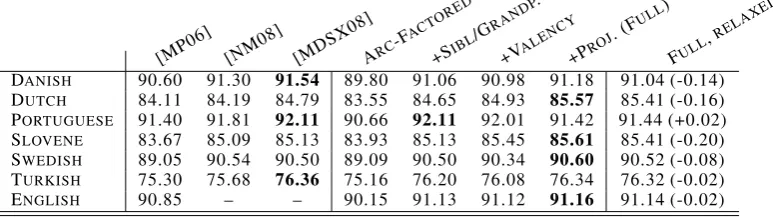
By looking at the middle four columns, we can see that adding non-arc-factored features makes the models more accurate, for all languages. With the exception of Portuguese, the best results are achieved with the full set of features. We can also observe that, for some languages, the valency features do not seem to help. Merely modeling the number of dependents of a word may not be as valuable as knowing whatkindsof dependents they are (for example, distinguishing among argu-ments and adjuncts).
Comparing with the baselines, we observe that our full model outperforms that of McDonald and Pereira (2006), and is in line with the most ac-curate dependency parsers (Nivre and McDonald, 2008; Martins et al., 2008), obtained by com-bining transition-based and graph-based parsers.14 Notice that our model, compared with these hy-brid parsers, has the advantage of not requiring an ensemble configuration (eliminating, for example, the need to tune two parsers). Unlike the ensem-bles, it directly handles non-local output features by optimizing a single global objective. Perhaps more importantly, it makes it possible to exploit expert knowledge through the form ofhard global constraints. Although not pursued here, the same kind of constraints employed by Riedel and Clarke (2006) can straightforwardly fit into our model, after extending it to perform labeled dependency parsing. We believe that a careful design of
fea-13Unlike our model, the hybrid models used here as base-lines make use of the dependency labels at training time; in-deed, the transition-based parser is trained to predict a la-beleddependency parse tree, and the graph-based parser use these predicted labels as input features. Our model ignores this information at training time; therefore, this comparison is slightly unfair to us.
[MP0 6]
[NM 08]
[MDS X08]
ARC -FAC
TORE D
+SIB
L/G RAND
P.
+VAL
ENCY
+PRO
J. (F ULL
)
FULL
,RELA XED
[image:8.595.113.500.59.168.2]DANISH 90.60 91.30 91.54 89.80 91.06 90.98 91.18 91.04 (-0.14) DUTCH 84.11 84.19 84.79 83.55 84.65 84.93 85.57 85.41 (-0.16) PORTUGUESE 91.40 91.81 92.11 90.66 92.11 92.01 91.42 91.44 (+0.02) SLOVENE 83.67 85.09 85.13 83.93 85.13 85.45 85.61 85.41 (-0.20) SWEDISH 89.05 90.54 90.50 89.09 90.50 90.34 90.60 90.52 (-0.08) TURKISH 75.30 75.68 76.36 75.16 76.20 76.08 76.34 76.32 (-0.02) ENGLISH 90.85 – – 90.15 91.13 91.12 91.16 91.14 (-0.02)
Table 1: Results for nonprojective dependency parsing (unlabeled attachment scores). The three baselines are the second order model of McDonald and Pereira (2006) and the hybrid models of Nivre and McDonald (2008) and Martins et al. (2008). The four middle columns show the performance of our model using exact (ILP) inference at test time, for increasing sets of features (see§3.2–§3.5). The rightmost column shows the results obtained with the full set of features using relaxed LP inference followed by projection onto the feasible set. Differences are with respect to exact inference for the same set of features. Bold indicates the best result for a language. As for overall performance, both the exact and relaxed full model outperform the arc-factored model and the second order model of McDonald and Pereira (2006) with statistical significance (p <0.01) according to Dan Bikel’s randomized method (http://www.cis.upenn.edu/∼dbikel/software.html).
tures and constraints can lead to further improve-ments on accuracy.
We now turn to a different issue: scalability. In previous work (Martins et al., 2009), we showed that training the model via LP-relaxed inference (as we do here) makes it learn to avoid frac-tional solutions; as a consequence, ILP solvers will converge faster to the optimum (on average). Yet, it is known from worst case complexity the-ory that solving a general ILP is NP-hard; hence, these solvers may not scale well with the sentence length. Merely considering the LP-relaxed version of the problem at test time is unsatisfactory, as it may lead to a fractional solution (i.e., a solution whose components indexed by arcs,˜z=hzaia∈A,
are not all integer), which does not correspond to a valid dependency tree. We propose the following approximate algorithm to obtain an actual parse: first, solve the LP relaxation (which can be done in polynomial time with interior-point methods); then, if the solution is fractional, project it onto the feasible setY(x). Fortunately, the Euclidean pro-jection can be computed in a straightforward way by finding a maximal arborescence in the directed graph whose weights are defined by ˜z (we omit the proof for space); as we saw in§2.2, the Chu-Liu-Edmonds algorithm can do this in polynomial time. The overall parsing runtime becomes poly-nomial with respect to the length of the sentence.
The last column of Table 1 compares the ac-curacy of this approximate method with the ex-act one. We observe that there is not a substantial drop in accuracy; on the other hand, we observed a considerable speed-up with respect to exact in-ference, particularly for long sentences. The
av-erage runtime (across all languages) is0.632 sec-onds per sentence, which is in line with existing higher-order parsers and is much faster than the runtimes reported by Riedel and Clarke (2006).
5 Conclusions
We presented new dependency parsers based on concise ILP formulations. We have shown how non-local output features can be incorporated, while keeping only a polynomial number of con-straints. These features can act as soft constraints whose penalty values are automatically learned from data; in addition, our model is also compati-ble with expert knowledge in the form of hard con-straints. Learning through a max-margin frame-work is made effective by the means of a LP-relaxation. Experimental results on seven lan-guages show that our rich-featured parsers outper-form arc-factored and approximate higher-order parsers, and are in line with stacked parsers, hav-ing with respect to the latter the advantage of not requiring an ensemble configuration.
Acknowledgments
References
E. Boros and P.L. Hammer. 2002. Pseudo-Boolean op-timization. Discrete Applied Mathematics, 123(1– 3):155–225.
S. Buchholz and E. Marsi. 2006. CoNLL-X shared task on multilingual dependency parsing. InProc. of CoNLL.
X. Carreras, M. Collins, and T. Koo. 2008. TAG, dynamic programming, and the perceptron for effi-cient, feature-rich parsing. InProc. of CoNLL. X. Carreras. 2007. Experiments with a higher-order
projective dependency parser. InProc. of CoNLL. M. Chang, L. Ratinov, and D. Roth. 2008. Constraints
as prior knowledge. In ICML Workshop on Prior Knowledge for Text and Language Processing. Y. J. Chu and T. H. Liu. 1965. On the shortest
arbores-cence of a directed graph. Science Sinica, 14:1396– 1400.
J. Clarke and M. Lapata. 2008. Global inference for sentence compression an integer linear program-ming approach. JAIR, 31:399–429.
K. Crammer, O. Dekel, J. Keshet, S. Shalev-Shwartz, and Y. Singer. 2006. Online passive-aggressive al-gorithms. JMLR, 7:551–585.
A. Culotta and J. Sorensen. 2004. Dependency tree kernels for relation extraction. InProc. of ACL. P. Denis and J. Baldridge. 2007. Joint determination
of anaphoricity and coreference resolution using in-teger programming. InProc. of HLT-NAACL. Y. Ding and M. Palmer. 2005. Machine translation
us-ing probabilistic synchronous dependency insertion grammar. InProc. of ACL.
J. Edmonds. 1967. Optimum branchings. Journal of Research of the National Bureau of Standards, 71B:233–240.
J. Eisner and G. Satta. 1999. Efficient parsing for bilexical context-free grammars and head automaton grammars. InProc. of ACL.
J. Eisner. 1996. Three new probabilistic models for de-pendency parsing: An exploration. InProc. of COL-ING.
S. Kahane, A. Nasr, and O. Rambow. 1998. Pseudo-projectivity: a polynomially parsable non-projective dependency grammar. InProc. of COLING-ACL. S. Lacoste-Julien, B. Taskar, D. Klein, and M. I.
Jor-dan. 2006. Word alignment via quadratic assign-ment. InProc. of HLT-NAACL.
T. L. Magnanti and L. A. Wolsey. 1994. Optimal Trees. Technical Report 290-94, Massachusetts In-stitute of Technology, Operations Research Center. A. F. T. Martins, D. Das, N. A. Smith, and E. P. Xing.
2008. Stacking dependency parsers. In Proc. of EMNLP.
A. F. T. Martins, N. A. Smith, and E. P. Xing. 2009. Polyhedral outer approximations with application to natural language parsing. InProc. of ICML. R. T. McDonald and F. C. N. Pereira. 2006. Online
learning of approximate dependency parsing algo-rithms. InProc. of EACL.
R. McDonald and G. Satta. 2007. On the complex-ity of non-projective data-driven dependency pars-ing. InProc. of IWPT.
R. T. McDonald, F. Pereira, K. Ribarov, and J. Hajiˇc. 2005. Non-projective dependency parsing using spanning tree algorithms. InProc. of HLT-EMNLP. J. Nivre and R. McDonald. 2008. Integrating graph-based and transition-graph-based dependency parsers. In Proc. of ACL-HLT.
V. Punyakanok, D. Roth, W. Yih, and D. Zimak. 2004. Semantic role labeling via integer linear program-ming inference. InProc. of COLING.
M. Richardson and P. Domingos. 2006. Markov logic networks. Machine Learning, 62(1):107–136. S. Riedel and J. Clarke. 2006. Incremental integer
linear programming for non-projective dependency parsing. InProc. of EMNLP.
R. T. Rockafellar. 1970. Convex Analysis. Princeton University Press.
D. Roth and W. T. Yih. 2005. Integer linear program-ming inference for conditional random fields. In ICML.
A. Schrijver. 2003. Combinatorial Optimization: Polyhedra and Efficiency, volume 24 ofAlgorithms and Combinatorics. Springer.
D. A. Smith and J. Eisner. 2008. Dependency parsing by belief propagation. InProc. of EMNLP.
M. Surdeanu, R. Johansson, A. Meyers, L. M`arquez, and J. Nivre. 2008. The conll-2008 shared task on joint parsing of syntactic and semantic dependen-cies. Proc. of CoNLL.
R. E. Tarjan. 1977. Finding optimum branchings. Net-works, 7(1):25–36.
M. Wang, N. A. Smith, and T. Mitamura. 2007. What is the Jeopardy model? A quasi-synchronous gram-mar for QA. InProceedings of EMNLP-CoNLL.
Y. Zhang and S. Clark. 2008. A tale of