Macro-Segregation Characteristics in Semi-Solid Forging
of a High Strength Al-4.8Si-0.7Mg Alloy
Byoung-Hee Choi, Young-Soo Jang, Byung-Keun Kang and Chun-Pyo Hong
+Department of Materials Science and Engineering, Yonsei University, 134 Shinchon-dong, Seodaemun-ku, Seoul 120-749, Korea
Semi-solid forging of a high strength Al alloy was carried out to investigate the macro-segregation characteristics in regard to the evolution of solidification microstructures. The evolution of segregation was closely affected by the feeding behavior of semi-solid slurries. Two types of macro-segregation were found in semi-solid forging: one is composed offine dendritic¡-Al particles caused by liquid segregation and the other is the residual eutectic segregation. The formation of these segregations was strongly affected by the quality of semi-solid slurries, such as the shape and the size of the primary¡-Al particles. In the case of coarse dendritic microstructures,¡-Al particles are easily interlocked with each other, resulting in the formation of macro-segregation. In the case offine and uniform globular microstructures, primary globular¡-Al particles can be readily filled into a die cavity during forging, leading to uniform microstructures without the formation of macro-segregation. Optimization of process parameters was carried out both for semi-solid slurry making and for semi-solid forging. The T6 heat treatment was carried out, and hardness distribution on the semi-solid forging specimens was also evaluated to investigate the effect of macro-segregation on mechanical properties. [doi:10.2320/matertrans.M2014201]
(Received May 29, 2014; Accepted August 21, 2014; Published October 25, 2014)
Keywords: semi-solid forging, macro-segregation, rheological behavior, microstructural characteristics, process parameter
1. Introduction
Semi-solid metal forming is known as a noble manufactur-ing process as it promises less castmanufactur-ing defects and low production cost compared to conventional liquid and solid-state metal forming process, such as casting and forging processes.13) The semi-solid metal forming process can be
divided into two typical methods: rheo-diecasting and semi-solid forging.4,5)In the case of rheo-diecasting, the size and
thickness of the products are very restricted because of shrinkage defects frequently appeared in thick-wall parts. On the other hand, semi-solid forging process is very flexible to be employed in manufacturing various thicknesses and sizes of the products. In addition, it needs very low forging pressures compared to conventional solid-state forging process. It is thus considered that semi-solid forging process might be useful to manufacture automobile parts of Al alloys having high mechanical performance, under low production costs, compared to other conventional metal forming processes.
In semi-solid metal forming, macro-segregation is known as one of the typical detrimental defect which should be removed in order to guarantee the quality of the final products. When the semi-solid slurry is injected into a forming die, solidification history inside the die cavity might be different depending on the thickness and positions, resulting in non-uniform microstructures and segrega-tion throughout the products. The formasegrega-tion of macro-segregation results in the deterioration of mechanical performance.6) According to our previous study on the squeeze casting of Al alloys, when the applied pressure for squeeze forming is larger than a certain critical value, macro-segregation formed in the products.7,8)It can be guessed that
a similar solidification history might occur in semi-solid forging to that of squeeze casting of liquid metal. Most of
previous studies on semi-solid forging process were very limited on microstructural evolution and its effects on mechanical properties.911)Thus, macro-segregation behavior in semi-solid forging process has not been understood clearly yet.
The present study aims to analyze the formation of macro-segregation in semi-solid forging of an Al-Si based alloy. In slurry making, the pouring temperature of the melt into a slurry making vessel was optimized to obtain fine and uniform microstructures, and its effect on the evolution of macro-segregation was also investigated. Optimization of the forging temperature and applied pressure was carried out to prevent the formation of macro-segregation. The solute distribution and hardness values in the segregated region of the specimens were evaluated and compared with those of the sound semi-solid forged product.
2. Experimental Procedure
An Al-Si based (Al-4.8 mass%-0.7 mass%Mg-0.5 mass% -Cu) alloy which was developed in the previous study12)was
used in the present study. The estimated liquidus temperature of the alloy is 625°C. The alloy was melted and degassed at 750°C using pure Ar gas with degassing chemical tablet (N2)
injected into the melt and held at 700«5°C for 30 min prior to making the slurries. Semi-solid slurries used for semi-solid forging are made by the electro-magnetic (EM) stirring method which was described in the literature in details.13) In this method, heterogeneous nuclei of ¡-Al particles are generated in the inner vessel by the wall nucleation effect at an early stage of solidification and high quality semisolid slurry which has fine and uniform globular microstructures can be obtained.13,14) The slurry making vessel made of
stainless steel coated with BN2was used (60 mm in diameter
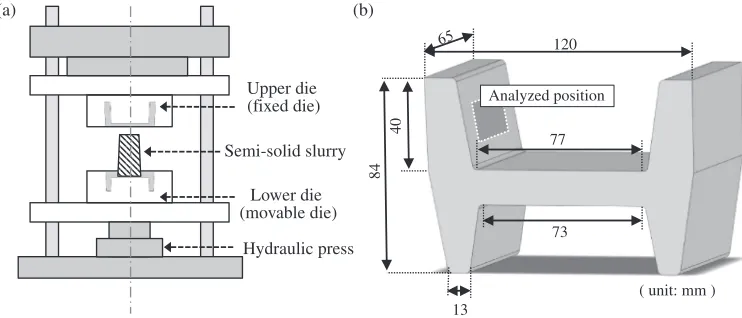
stirring was carried out during 8 s from the pouring stage. The intensity of the EM stirring power was adjusted to an ampere of 10 A at 220 V. The semi-solid slurry was taken out of the slurry making vessel in the temperature range of 614³599°C corresponded to the solid fractions of 0.3³0.5, and forged using a forging machine. A schematic drawing of the semi-solid forging system and H-shaped forging die are illustrated in Fig. 1(a) and (b). The forging die temperature was maintained at 200°C using a heating system to prevent the initial solidification prior to the forging process. The applied forging pressure was changed in the range of 150³250 MPa. The microstructures of the semi-solid forged specimens were analyzed at the position shown in Fig. 1(b). All the specimens were ground with SiC paper and polished on a cloth with a 0.04 µm diamond suspension for optical microscopy. The solute distributions of the semi-solid forged specimens were evaluated using an electron probe micro-analysis (EPMA). The T6 heat treatment conditions were set at a solid solution treatment of 520°C for 6 h and an aging treatment of 160°C for 5 h, and hardness values on the macro-segregated area was tested using a micro-Vickers hardness tester.
3. Results and Discussions
3.1 Segregation behavior in semi-solid forging
In the rheo-diecasting process, the quality offinal products was significantly influenced by the microstructural character-istics of the slurries, such as the size and shape of primary¡ -Al particles.1315)According to the literatures, the formation
of macro-segregation is closely related to the microstructural evolution in solidification of Al-alloys, especially solidified under high pressures as in squeeze casting.7,8)
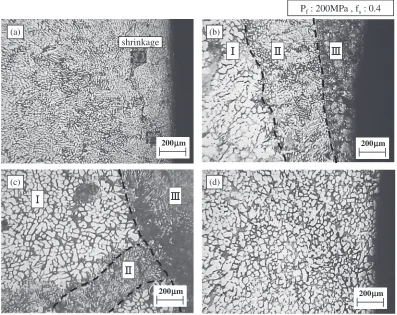
In semi-solid metal forming, the final solidification microstructures are greatly dependent upon the microstruc-tures of semi-solid slurries, which are closely related to the superheat of the melt in making slurries.15) Three types of semi-solid slurries which are shown in Fig. 2(a)(c) were used in semi-solid forging to investigate the influence of microstructures of semi-solid slurries on the formation of macro-segregation. The microstructure observation was carried out using the water-quenched specimens at the solid fraction of 0.4. When the superheating is above 30°C, semi-solid slurries with coarse dendritic and rosette-like ¡-Al particles are found, as shown in Fig. 2(a)(b). With the superheat of 15°C, fine and globular primary ¡-Al particles were obtained in the slurry making stage, as shown in Fig. 2(c). Typical microstructures of final semi-solid forged specimens using the slurries were shown in Fig. 3. The applied forging pressure was set at 200 MPa. In the case of the solidification microstructure of liquid metal, fine ¡-Al dendrites with shrinkage defects, were observed, as shown in Fig. 3(a). When the superheating is 45°C, non-uniform microstructures which have three different regions were obtained as shown in Fig. 3(b). The inner region, designated as‘region I’, shows coarse primary¡-Al particles, which are very similar to the initial microstructure of slurry, shown in Fig. 2(a). The middle region, named as ‘region II’, shows fine ¡-Al dendrites similar to those of liquid metal, shown in Fig. 3(a). In the exterior region, named as ‘region III’, (b)
120
84
40
73
13
77 (a)
Semi-solid slurry Upper die (fixed die)
Lower die (movable die)
Hydraulic press
Analyzed position
( unit: mm )
Fig. 1 Schematic drawings of the experimental system for semi-solid forging process: (a) the semi-solid forging system and (b) the H-shaped mold.
200µm (a)
200µm (b)
200µm (c)
[image:2.595.112.483.71.230.2] [image:2.595.73.523.275.388.2]segregation of the residual eutectic melt was found. In the case of the superheat of 15°C, on the other hand, fine and globular primary ¡-Al particles without macro-segregation were observed as shown in Fig. 3(d).
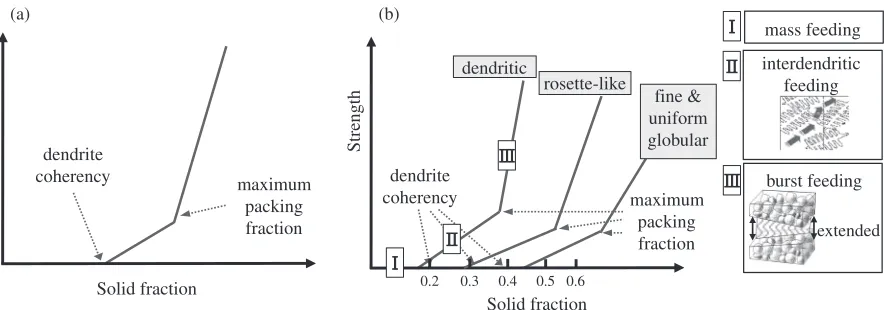
In order to explain segregation patterns found in semi-solid forging of an Al alloy, the feeding characteristic of semi-solid slurries should be understood, which might be closely related to the rheological behavior of slurries. The rheological behavior in the mushy zone during solidification was reported in the literatures, in which the relationship between the shear strength for deformation versus the solid fraction of slurries was employed for analyzing the rheological behavior of slurries.16,17)A typical plot of shear strength versus solid
fraction was shown in the Fig. 4(a).16)In this relationship, the
significant changes of rheological behavior were indicated at the two points: the dendrite coherency point and the maximum packing fraction point. The dendrite coherency point marks the region where¡-Al particles are started to be impinged each other. The maximum packing fraction point indicates the region where the network of ¡-Al particles is fully interlocked. When the solid fraction of slurry is below the dendrite coherency point, the strength for deformation is zero, and therefore shearing can easily occur without resistance. Between the dendrite coherency point and the maximum packing fraction point, strength increases steadily. When the solid fraction of slurry is above the maximum packing fraction point, extensive shear strength for deforma-tion is required, and thus the rheological characteristics
of slurries exhibited solid-like behavior. In most casting processes, the mushy-state liquid might be difficult toflow into the die cavity above the maximum packing fraction point. However, in semi-solid forging, the semi-solid slurries could be filled into the die cavity until the end of solidification due to high forging pressure.
Based on the consideration of the rheological behaviors of semi-solid slurries, microstructural evolution in regards to solid fraction can be schematically illustrated as Fig. 4(b). In semi-solid forging, when the solid fraction of slurry is under the dendrite coherency point, the slurry can easily be filled into the die cavity without filling resistance, exhibiting the mass feeding behavior. In this mass feeding stage, the distribution of ¡-Al particles was not changed a lot from those at the slurry making stage, and the microstructure similar to the ‘region I’in Fig. 3(b) can be obtained. When the solid fraction of slurry increases over the dendrite coherency point, the mass feeding of the slurry becomes more difficult and therefore the liquid portion in the slurry moves through the space in the primary ¡-Al particles, resulting in the formation of fine dendritic microstructures like the ‘region II’. When the solid fraction exceeds the maximum packing fraction point as the solidification progresses, primary ¡-Al particles were packed together and mechanically interlocked. At this stage, the solidified network of the primary ¡-Al particles can hardly flow. Therefore, the residual eutectic liquid in the slurry can transferred into the die cavity with the shear or failure of the
200µm
200µm
shrinkage
200µm
200µm
Pf: 200MPa , fs: 0.4
(a) (b)
(c) (d)
Fig. 3 Representative microstructures at the surface region of the semi-solid forging specimens with various slurry-making conditions: (a) molten liquid metal, (b) the superheat of 45°C, (c) the superheat of 30°C and (d) the superheat of 15°C, wherePfis the forging
[image:3.595.100.497.72.387.2]solidified network as named ‘burst feeding’, resulting in the formation of the‘region III’microstructure.
It is considered that the evolution of macro-segregation in semi-solid forging is closely related to the slurry micro-structures such as the size, shape and uniformity of primary
¡-Al particles, as shown in Fig. 4(b). In the case of non-uniform and coarse dendritic primary ¡-Al particles at the superheat of 45°C, primary ¡-Al particles are readily interlocked with each other and the resistance to deformation increases, resulting in the formation of macro-segregation. At the superheat of 30°C, which has rosette-like primary ¡-Al particles, the dendrite coherency and maximum packing fraction points move toward a little higher solid fraction region. There are still regions of macro-segregation, as shown in Fig. 3(c). On the other hand, when primary¡-Al particles are fine and globular, which can be obtained under a low superheat of 15°C, feeding of primary ¡-Al particles into a die cavity can easily occur, resulting in the evolution of uniform globular microstructure without macro-segregation. It is considered that high-quality slurries with fine and uniform globular¡-Al particles are need to be used in semi-solid forging to obtain uniform semi-solidification microstructures without the formation of macro-segregation.
3.2 Effects of process conditions on the formation of macro-segregation
In the case of squeeze casting of Al-alloys, the character-istic of macro-segregation which is dependent on the microstructural evolution is closely related to the process
parameters, such as the applied pressure and the pouring temperature.7) It is thus considered that optimization of the
process conditions, such as the process temperature for semi-solid forging and the applied forging pressure, might be very important in preventing the formation of macro-segregation in semi-solid forging. In order to investigate the influences of the process temperature in the semi-solid forging process, semi-solid forging was carried out with various processing temperatures of 614°C, 608°C and 599°C, corresponding to the solid fractions of 0.3, 0.4 and 0.5. The superheat at pouring was 15°C at the slurry-making stage. In case of the process temperature of 614°C, the liquid channel through the
¡-Al particles was formed because of the relatively low solid fraction of the slurry as 0.3. On the other hand, when the process temperature is 599°C, a large amount of macro-segregation was observed along the wall of the specimen because of the high solid fraction of the slurry of 0.5. However, when the process temperature for semi-solid forging was 608°C, which is corresponding to the solid fraction of 0.4, the solidification microstructure without macro-segregation was obtained. The forging pressure was also changed in the range of 150³250 MPa with the process temperature of 608°C, and the final solidification micro-structures under various forging pressures are shown in Fig. 5. When the forging pressure is 150 MPa, shrinkage defects are observed because of insufficient pressure, as shown in Fig. 5(a). With the forging pressure of 250 MPa,
¡-Al particles were deformed and agglomerated and macro-segregation of type III was observed as shown in Fig. 5(c), Solid fraction
Strength
maximum packing fraction dendrite
coherency
Solid fraction
Strength
dendrite coherency
dendritic
fine & uniform globular
extended burst feeding interdendritic
feeding (b)
mass feeding (a)
rosette-like
maximum packing fraction
0.4 0.5 0.3
0.2 0.6
Fig. 4 (a) A plot of the shear strength for deformation versus the solid fraction of slurries16)and (b) a schematic drawing for feeding
behavior of slurries related to microstructural evolution.
200µm
shrinkage
200µm 200µm
(a) (b) (c)
region segregation
[image:4.595.83.525.69.224.2] [image:4.595.68.531.269.385.2]which is considered to be caused by the squeeze of residual eutectic liquid. Thus, the forging pressure of 200 MPa was employed as an optimum pressure, and uniform micro-structures without macro-segregation was obtained, as shown in Fig. 5(b).
3.3 Segregation of alloying elements and related hard-ness distribution
The main alloying elements such as Cu and Mg are used for strengthening the mechanical properties by precipitation hardening of Mg2Si and Al2Cu through the T6 heat treatment.
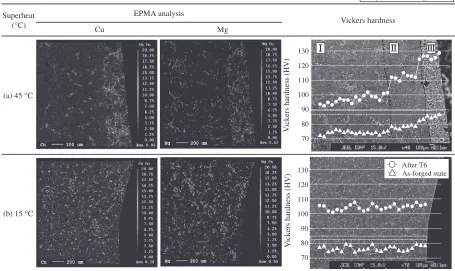
The mechanical properties of semi-solid forged products might be highly affected by the formation of macro-segregation. In order to evaluate the distribution of alloying elements, EPMA analysis was carried out with the specimens of two superheats of 15°C and 45°C, before and after T6 heat treatment, and the results are shown in Fig. 6. The micro-Vickers hardness was also measured on the same areas where the EPMA analysis was taken out for evaluating the effect of macro-segregation on the mechanical performance of semi-solid forging products. As shown in Fig. 6(a), in the case of superheat of 45°C, segregation of Cu and Mg was observed at the exterior region, denoted as ‘region III’, while no particular segregation pattern was found in ‘regions I’ and ‘II’. The hardness value measured along the regions I through III for the superheat of 45°C was not uniform. The region ‘III’shows the highest hardness value compared to the other regions. The precipitation of intermetallic compounds, such as Mg2Si and Al2Cu, was found to enhance the hardness
value compared to the as-forged state as shown in thefigure. There is a slight increase in hardness value in region ‘II’ compared to region‘I’, and it is considered to be caused by
the difference in microstructures between them. The region ‘I’shows a relatively coarse dendritic structure, and on the other hand the region‘II’has a veryfine dendritic structure. In the case of superheat of 15°C, macro-segregation was not found in the semi-solid forged specimen, as shown in Fig. 3(d), and it was confirmed by EPMA analysis as in Fig. 6(b). In this case, the hardness value was uniform in the range of 100 to 110 HV throughout the specimen which are much higher than those of the as-forged state. It is to be noted that semi-solid forging with optimum process conditions results in fine and uniform microstructures without macro-segregation, resulting in high mechanical performance.
4. Concluding Remarks
The characteristics of macro-segregation in semi-solid forging of a high strength Al alloy was investigated in order to understand the evolution of macro-segregation in regards to solidification microstructures. The mechanism of the evolution of macro-segregation was explained with the concepts of the dendrite coherency point and the maximum packing fraction point. Two types of segregation pattern were observed: one is related to dendritic microstructure in which primary ¡-Al particles can easily be interlocked with each other, and the other is caused by squeezed flow of residual eutectic liquid through inter-dendritic networks. When the primary ¡-Al particles are fine and uniform globular, no macro-segregation was found throughout the semi-solid forged products. It is considered to be caused by the fact that the semi-solid slurries with primary globular ¡-Al particles can flow easily into the die cavity, resulting in uniform solidification microstructures. The optimized process
Superheat (°C)
EPMA analysis
Vickers hardness
Cu Mg
(a) 45 °C
(b) 15 °C
V
ick
ers hardness (HV)
0 1 2 3 4 5
130
120
110
100
90
80
70
V
ick
ers hardness (HV)
130
120
110
100
90
80
70
As-forged state After T6
Pf: 200MPa , fs: 0.4
[image:5.595.70.525.83.354.2]parameters for semi-solid forging are as follows: the slurry temperature of 608°C corresponding to a solid fraction of 0.4 and the forging pressure of 200 MPa. The distributions of alloying elements and hardness values before and after T6 heat treatment were evaluated and known to be closely related to the macro-segregation patterns. When the semi-solid forging is carried out under the optimum process conditions, uniform solidification microstructures can be obtained, resulting in high mechanical performance without having macro-segregation.
REFERENCES
1) J. R. Davis (ed.):Aluminum and Aluminum Alloys, (ASM international, OH, USA, 1993).
2) M. C. Flemings: Metall. Sci. Technol.18(2000) 34. 3) Z. Fan:Int. Mater. Rev.47(2002) 4985.
4) M. C. Flemings:Metall. Mater. Trans. B22(1991) 269293.
5) G. Hirt, R. Cremer, A. Winkelmann, T. Witulsk and M. Zillgen:
J. Mater. Process. Technol.45(1994) 359364.
6) H. H. Kim and C. G. Kang:Mater. Sci. Eng. A.497(2008) 309321.
7) C. P. Hong, H. F. Shen and I. S. Cho:Metall. Mater. Trans. A29(1998) 339349.
8) C. P. Hong, H. F. Shen and S. M. Lee:Metall. Mater. Trans. B31
(2000) 297305.
9) Y. N. Chen, J. F. Wei, Y. Q. Zhao and J. Sun:J. Alloy. Compd.487
(2009) 314320.
10) A. Dodangeh, M. Kazeminezhad and H. Aashuri:Mater. Sci. Eng. A
558(2012) 371376.
11) G. Hirt, H. Shimahara, I. Seidl, F. Kuthe, D. Abel and A. Schonbohm:
CIRP Ann.54(2005) 257260.
12) K. S. Park, Y. S. Jang, B. H. Choi, B. K. Kang, H. S. Kim, S. H. Choi and C. P. Hong:J. Korea Foundary Soc.32(2012) 98103.
13) J. G. Sim, Y. S. Jang, J. Y. Moon, J. M. Kim, K. H. Min and C. P. Hong:
ISIJ Int.49(2009) 17001709.
14) B. H. Choi, Y. S. Jang, J. G. Sim, H. S. Kim and C. P. Hong:ISIJ Int.
53(2013) 502510.
15) B. H. Choi, Y. S. Jang and C. P. Hong:Mater. Trans.55(2014) 930 936.
16) S. M. Nabulsi: Ph. D. Thesis, The University of Queensland, Brisbane, Australia, (1997).