Efficient Tabular LR Parsing
M a r k - J a n N e d e r h o f F a c u l t y of A r t s U n i v e r s i t y of G r o n i n g e n
P . O . B o x 716 9700 A S G r o n i n g e n
T h e N e t h e r l a n d s
markj an@let, rug. nl
Giorgio Satta
D i p a r t i m e n t o di E l e t t r o n i c a e d I n f o r m a t i c a U n i v e r s i t £ di P a d o v a
v i a G r a d e n i g o , 6 / A 1-35131 P a d o v a
I t a l y
satt a@dei, unipd, it
A b s t r a c t
We give a new treatment of tabular LR parsing, which is an alternative to Tomita's generalized LR algorithm. The advantage is twofold. Firstly, our treatment is con- ceptually more attractive because it uses simpler concepts, such as grammar trans- formations and standard tabulation tech- niques also know as chart parsing. Second- ly, the static and dynamic complexity of parsing, both in space and time, is signifi- cantly reduced.
1 I n t r o d u c t i o n
The efficiency of LR(k) parsing techniques (Sippu and Soisalon-Soininen, 1990) is very attractive from the perspective of natural language processing ap- plications. This has stimulated the computational linguistics community to develop extensions of these techniques to general context-free grammar parsing. The best-known example is generalized LR pars- ing, also known as Tomita's algorithm, described by Tomita (1986) and further investigated by, for ex- ample, Tomita (1991) and Nederhof (1994a). Des- pite appearances, the graph-structured stacks used to describe Tomita's algorithm differ very little from parse fables, or in other words, generalized LR pars- ing is one of the so called tabular parsing algorithms, among which also the CYK algorithm (Harrison, 1978) and Earley's algorithm (Earley, 1970) can be found. (Tabular parsing is also known as chart pars- ing.)
In this paper we investigate the extension of LR parsing to general context-free grammars from a more general viewpoint: tabular algorithms can of- ten be described by the composition of two construc- tions. One example is given by Lang (1974) and Billot and Lang (1989): the construction of push- down automata from grammars and the simulation
of these automata by means of tabulation yield dif- ferent tabular algorithms for different such construc- tions. Another example, on which our presentation is based, was first suggested by Leermakers (1989): a grammar is first transformed and then a standard tabular algorithm along with some filtering condi- tion is applied using the transformed grammar. In our case, the transformation and the subsequent ap- plication of the tabular algorithm result in a new form of tabular LR parsing.
Our method is more efficient than Tomita's algo- rithm in two respects. F i r s t , reduce operations are implemented in an efficient way, by splitting them in- to several, more primitive, operations (a similar idea has been proposed by Kipps (1991) for Tomita's al- gorithm). Second, several paths in the computation that must be simulated separately by Tomita's algo- rithm are collapsed into a single computation path, using state minimization techniques. Experiments on practical grammars have indicated that there is a significant gain in efficiency, with regard to both space and time requirements.
Our grammar transformation produces a so called cover for the input grammar, which together with the filtering condition fully captures the specifica- tion of the method, abstracting away from algorith- mic details such as data structures and control flow. Since this cover can be easily precomputed, imple- menting our LR parser simply amounts to running the standard tabular algorithm. This is very attrac- tive from an application-oriented perspective, since many actual systems for natural language processing are based on these kinds of parsing algorithm.
en in Section 7, and further discussion of our m e t h o d is provided in Section 8.
2
D e f i n i t i o n s
T h r o u g h o u t this paper we use standard formal lan- guage notation. We assume that the reader is famil- iar with context-free g r a m m a r parsing theory (Har- rison, 1978).
A context-free g r a m m a r (CFG) is a 4-tuple G = ( S , N, P, S), where S and N are two finite disjoint sets of terminal and nonterminal symbols, respec- tively, S E N is the start symbol, and P is a finite set of rules. Each rule has the form A ---* a with A E N and a E V*, where V denotes N U E . T h e
size of G, written I G I, is defined a s
E(A--*a)EP [Aot
I;by I a I we mean the length of a string of symbols a. We generally use symbols A , B , C , . . . to range over N, symbols a, b, c , . . . to range over S, symbols X, Y, Z to range over V, symbols ~, 8, 7 , . . . to range over V*, and symbols v, w, z , . . . to range over S*. We write e to denote the e m p t y string.
A CFG is said to be in binary form if ~ E
{e} U V t.J N 2 for all of its rules A --* c~. (The binary form does not limit the (weak) generative capaci- ty of context-free grammars (Harrison, 1978).) For
technicM reasons, we sometimes use the augment-
ed g r a m m a r associated with G, defined as G t = ( S t , N t, p t , St), where St, t> and <1 are fresh sym- bols, S t = S U {t>,<l}, N t = N U {S t } and p t = p U {S t ~ t>S<~}.
A pushdown a u t o m a t o n (PDA) is a 5-tuple .4 = (Z, Q, T, qi,, q/in), where S , Q and T are finite sets of input symbols, stack symbols and transitions, re-
spectively; qin E Q is the initiM stack symbol and
q/i, E Q is the finM stack symbol. 1 Each transition
has the form 61 ~-~ 62, where 61,82 E Q*, 1 < 161 l,
1 < 1621 < 2, and z = e or z = a. We generally use symbols q, r, s , . . . to range over Q, and the symbol 6 to range over Q*.
Consider a fixed input string v E ~*. A config-
uration of the a u t o m a t o n is a pair (6, w) consisting of a stack 6 E Q* and the remaining input w, which is a suffix of the input string v. T h e rightmost sym-
bol of 6 represents the top of the stack. The initial
configuration has the form (qi~, v), where the stack
is formed by the initial stack symbol. The final con-
figuration has the form (qi, q/i,, e), where the stack is formed by the final stack symbol stacked upon the initial stack symbol.
ZWe dispense with the notion of state, traditionally
incorporated in the definition of PDA. This does not affect the power of these devices, since states can be encoded within stack symbols and transitions.
T h e application of a transition 81 ~-~ 82 is de- scribed as follows. If the top-most symbols of the stack are 61, then these symbols m a y be replaced by 62, provided that either z = e, or z = a and a is the first symbol of the remaining input. Furthermore, if z = a then a is removed from the remaining input. Formally, for a fixed PDA .4 we define the bina- ry relation t- on configurations as the least relation satisfying (881, w) ~- (662, w) if there is a transition
61 ~ 62, and (881, aw) t- (682, w) if there is a tran-
sition 61 a 82. T h e recognition of a certain input v is obtained if starting from the initial configuration for t h a t input we can reach the final configuration by repeated application of transitions, or, formally, if (qin, v) I"* (q~,, aria, e), where t-* denotes the re- flexive and transitive closure of b.
By a computation of a PDA we mean a sequence
( q i , , v ) t- (61,wl) h . . . t- (6n,wn), n > 0. A PDA is
called deterministic if for all possible configurations
at most one transition is applicable. A PDA is said
to be in binary form if, for all transitions 61 ~L~ 62,
we have 1611 < 2.
3 L l : t a u t o m a t a
Let G = ( S , N, P, S) be a CFG. We recall the no- tion of LR a u t o m a t o n , which is a particular kind of PDA. We make use of the augmented g r a m m a r G t = ( s t , N t, p t , S t) introduced in Section 2.
Let !LR : {A ~ a • ~ I (A --~ aft) E p t } .
We introduce the function closure from 2 I~'R to 2 ILR
and the function goto from 2 ILR × V to 2 l~rt. For
any q C ILK, closure(q) is the smallest set such that
(i) q c closure(q); and
(ii) (B --~ c~ • Aft) e closure(q) and (A ~ 7) e p t
together imply (A --* • 7) E closure(q).
We then define
goto(q, X ) =
{A ---* ~ X • fl I (A --* a • Xfl) E closure(q)}.
We construct a finite set T~Lp ~ a s the smallest collec-
tion of sets satisfying the conditions:
(i) { S t ~ t > . S<~} E ~'~Ll=t; and
(ii) for every q E
~T~LR
and X E V, we havegoto(q, X ) E 7~LR, provided goto(q, X ) ~ 0.
Two elements from
~Lt~
deserve special attention:qm = {S t --+ t> * S<~}, and q/in, which is defined to be the unique set in
"~Ll:t
containing (S t ~ t>S * <~);For A • N, an A-redex is a string qoqlq2"" "qm,
m _> 0, of elements from T~Lrt, satisfying the follow- ing conditions:
(i) (A ~ a . ) • closure(q,,), for some a =
X1X~. • • • Xm ; and
(ii) goto(q~_l, X k ) = qk, for 1 < k < m.
Note that in such an A-redex, (A --~ • X 1 X g . . . . X m )
• closure(qo), and (A ~ X 1 . . . X k * X k + z ' " X m ) E qk, for 0 < k < m.
The LR a u t o m a t o n associated with G is now in- troduced.
Definition
1 .ALR = (S, QLR, TLR, qin, q~n), whereQ L R " - ~'~LR, qin = {S t -'* t> • S<~}, qlin =
goto(qin, S), and TLR contains:
(i) q ~ q q', for every a • S and q, q~ • ~LR such that q' = goto(q, a);
(ii) q5 ~-L q q', for every A • N , A-redex q~, and
q' • TiLa such that q~ = goto(q, A).
Transitions in (i) above are called shift, transitions
in (ii) are called reduce.
4 2 L R A u t o m a t a
The a u t o m a t a .At, rt defined in the previous section are deterministic only for a subset of the CFGs, called the LR(0) grammars (Sippu and Soisalon- Soininen, 1990), and behave nondeterministical-
ly in the general case. When designing tabular
methods that simulate nondeterministic computa- tions of ~4LR, two main difficulties are encountered:
• A reduce transition in .ALrt is an elementary op- eration that removes from the stack a number of elements bounded by the size of the underly- ing grammar. Consequently, the time require- ment of tabular simulation of .AL~ computa- tions can be onerous, for reasons pointed out by Sheil (1976) and Kipps (1991).
• The set 7~Lrt can be exponential in the size of the g r a m m a r (Johnson, 1991). If in such a case the computations of.ALR touch upon each state, then time and space requirements of tabular simulation are obviously onerous.
The first issue above is solved here by re-
casting .ALR in binary form. This is done
by considering each reduce transition as a se- quence of "pop" operations which affect at most
two stack symbols at a time. (See also
Lang (1974), Villemonte de la Clergerie (1993) and
Nederhof (1994a), and for LR parsing specifically g i p p s (1991) and Leermakers (19925).) The follow- ing definition introduces this new kind of automaton.
I !
D e f i n i t i o n 2 A~R = ( ~ , QLR' TLR., qin, q1~n), where
q,
LR --- 7~LR U ILR, qin = {S t "* I> • S<2}, qJin =goto(qin, S) and TLR contains:
(i) q ~ q q,, for every a • S and q, q' • 7~Lrt such that q' = goto(q, a);
(ii) q A. q (A --* a . ) , for every q • TiLR and (A
• ) • closure(q);
(iii) q (A --* a X • ,8) ~ (A ~ a • X,8), for every
q • ~ L R and (A ~ a X . ,8) • q;
(iv)
q (A --* * c~) A, q q', for every q, q' • 7~LR and (A ~ ~) • p t such that q' = goto(q, A).Transitions in (i) above are again called shift, tran-
sitions in (ii) are called initiate, those in (iii) are
called gathering, and transitions in (iv) are called
goto. T h e role of a reduce step in .ALR is taken over in .A£K by an initiate step, a number of gathering steps, and a goto step. Observe that these steps in- volve the new stack symbols (A --~ a • ,8) • ILI~ that are distinguishable from possible stack symbols { A .-* a • ,8} • '/'~LR-
We now turn to the second above-mentioned prob- lem, regarding the size of set 7dgR. The problem is in part solved here as follows. The number of states in 7~Lrt is considerably reduced by identify- ing two states if they become identical after items A --~ cr • fl from ILrt have been simplified to only the suffix of the right-hand side ,8. This is rem- iniscent of techniques of state minimization for fi- nite a u t o m a t a (Booth, 1967), as they have been ap- plied before to LR parsing, e.g., by Pager (1970) and Nederhof and Sarbo (1993).
Let G t be the augmented g r a m m a r associated
with a CFG G, and let I2LI~ -- {fl I (A ---, a,8) e
p t } . We define variants of the closure and 9oto func-
tions from the previous section as follows. For any
set q C I2Lt~, closurel(q) is the smallest collection of
sets such that
(i) q C elosure'(q); and
(ii) (Aft) e closure' (q) and (A ---* 7) • p t together
imply (7) • closure'(q).
Also, we define
goto'(q, x )
= {,8 I (x,8)
~ closure'(q)}.(i) {S<l} 6 7~2LR; and
(ii) for every q 6
T~2LI:t
and X • V, we havegoto'(q, X) • T~2LR, provided goto'(q, X) # @.
As stack symbols, we take the elements from I2LR
and a subset of elements from (V × ~2Lrt):
Q2LR = {(X,q) I 3q'[goto'(q',X) = q]} U I2LR
In a stack symbol of the form (X, q), the X serves to record the g r a m m a r symbol that has been recog- nized last, cf. the symbols that formerly were found immediately before the dots.
The 2LK a u t o m a t o n associated with G can now be introduced.
Z T ' '
D e f i n i t i o n 3 .A2LR ---~ ( , Q2LR, 2LR, qin, qfin), where Q LR is as defined above, = (C>, q~. = (S, goto'({S.~}, S)), and T2LR contains:
(i) (X,q) ~ (X,q) (a,q'), for every a • Z and
(X, q), (a, q') • Q2Lrt such that q' = goto'(q, a);
(ii) (X,q) ~+ ( X , q ) ( e ) , for every (X,q) • Q2LR
such that e • closure'(q);
(iii) ( Z , q ) ( ~ ) ~ ( Z g ) , for every (X,q) • Q2LR
and 19 • q;
(iv) (X,q) (o~) ~ (X,q) (A,q'), for every (X,q),
(A,q') • Q2LR and (A ---~ c~) • p t such that q' = goto'(q, A).
Note that in the case of a reduce/reduce conflict with two grammar rules sharing some suffix in the right-hand side, the gathering steps of A2Lrt will treat both rules simultaneously, until the parts of the right-hand sides are reached where the two rules differ. (See Leermakers (1992a) for a similar sharing of computation for common suffixes.)
An interesting fact is that the automaton .A2LR is very similar to the a u t o m a t o n .ALR constructed for
a grammar transformed by the transformation rtwo
given by Nederhof and Satta (1994). 2
5 T h e a l g o r i t h m
This section presents a tabular LR parser, which is the main result of this paper. The parser is derived from the 2LR a u t o m a t a introduced in the previous section. Following the general approach presented by Leermakers (1989), we simulate computations of
2For the earliest mention of this transformation, we have encountered pointers to Schauerte (1973). Regret- tably, we have as yet not been able to get hold of a copy of this paper.
these devices using a tabular method, a grammar transformation and a filtering function.
We make use of a tabular parsing algorithm which is basically an asynchronous version of the CYK al- gorithm, as presented by Harrison (1978), extended to productions of the forms A ---* B and A ~ and with a left-to-right filtering condition. The al- gorithm uses a parse table consisting in a 0-indexed square array U. The indices represent positions in the input string. We define Ui to be Uk<i Uk,i.
Computation of the entries of U is moderated by
a filtering process. This process makes use of a
function pred from 2 N to 2 N, specific to a certain
context-free grammar. We have a certain nontermi- nal Ainit which is initially inserted in U0,0 in order to start the recognition process.
We are now ready to give a formal specification of the tabular algorithm.
A l g o r i t h m 1 Let G = ( ~ , N , P , S ) be a CFG in
binary form, let pred be a function from 2 N to 2 N,
let Ai,,t be the distinguished element from N, and let v = a l a 2 . "'an 6 ~* be an input string. We compute the least ( n + 1) x ( n + 1) table U such that
Ainit 6 U0,0 and
(i) A 6 Uj_ 1,j
if (A ~ aj) 6 P, A 6 pred(Uj_l);
(ii) A 6 Uj,j
if (A --+ e) 6 P, A E pred(Uj);
(iii) A 6 Ui,j
if B 6 Ui,~, C 6 Uk,j, (A ---. BC) 6 P, A 6
pred(Ui);
(iv) A 6 Uij
if B 6 Uij, (A ~ B) 6 P, A 6 pred(UO.
The string has been accepted when S 6 U0,,. We now specify a g r a m m a r transformation, based on the definition of .A2LR.
D e f i n i t i o n 4 Let A2LR = ( S , Q2LR, T2LR, ' qin,q~,)
be the 2L1% automaton associated with a CFG G.
The 2 L R c o v e r associated with G is the CFG
C2I r (G) = ( Q2Lr , P2I rt, where the rules in
P2LR are given by:
(i) ( a , q ' ) --* a,
for every (X, q) ~-~ (X, q) (a, q') E T2LR;
(ii) (e) ~ ¢,
for every (X, q) ~-* (X, q) (e) 6 T2LR;
(iii) (X~) ~ (X, q) (~),
(iv)
(A,q') --, (a),
for every (X, q) (or) ~-~ (X, q)
(A, q') E T2La.Observe that there is a direct, one-to-one correspon- dence between transitions of.A2La and productions
of
C2LR(G).
The accompanying function
pred
is defined as fol-lows (q, q', q" range over the stack elements):
pred(v) = {q I q'q" ~-~ q E
T2La} U{q ] q' E r, q' ~ * q ' q E T ~ L a } U
{q I q ' E r ,
q'q"~-~q'qET2La}.
The above definition implies that only the tabular equivalents of the shift, initiate and goto transitions are subject to actual filtering; the simulation of the gathering transitions does not depend on elements in r.
Finally, the distinguished nonterminal from the
cover used to initialize the table is
qin'l
Thus westart with (t>, {S<l)) E U0,0.
The 2LR cover introduces spurious ambiguity: where some grammar G would allow a certain num- ber of parses to be found for a certain input, the
grammar C2Lrt(G) in general allows
more
parses.This problem is in part solved by the filtering func-
tion
pred.
The remaining spurious ambiguity isavoided by a particular way of constructing the parse trees, described in what follows.
After Algorithm 1 has recognized a given in- put, the set of all parse trees can be computed as
tree(q~n, O, n)
where the functiontree,
which deter- mines sets of either parse trees or lists of parse trees for entries in U, is recursively defined by:(i)
tree((a, q'), i, j)
is the set {a}. This set contains a single parse tree Consisting of a single node labelled a.(ii)
tree(e, i, i)
is the set {c}. This set consists of anempty list of trees.
(iii)
tree(Xl?,i,j)
is the union of the sets T. k (x~),i,j,where i < k < j , (8) E
Uk,j,
and there is atleast one (X, q) E
Ui,k
and (X~) ---* (X, q) (8)in C2La(G), for some q. For each such k, select one such q. We define 7:, ~ ( X fl ),i,j = { t . t s
I t E
tree((X,q),i,k) A ts
Etree(fl, k,j)}.
Eacht. ts
is a list of trees, with head t and tail
ts.
(iv)
tree( ( A, q'), i, j)
is the union of the setsT. a ( A,ql ),i,j ' where (~) E
Uij
is such that(A, q') ---* (c~) in C2La(G). We define T ~ ( a , q ' ) , i , j - -
-{glue(A, ts) l ts E tree(c~,i,j)}.
The functionglue
constructs a tree from a fresh root nodelabelled A and the trees in list ts as immediate subtrees.
We emphasize that in the third clause above, one should not consider more than one q for given k in order to prevent spurious ambiguity. (In fact, for fixed X, i, k and for different q such that (X, q) E
Ui,k, tvee((X, q),i, k)
yields the exact same set of trees.) With this proviso, the degree of ambiguity, i.e. the number of parses found by the algorithm for any input, is reduced to exactly that of the source grammar.A practical implementation would construct the parse trees on-the-fly, attaching them to the table entries, allowing packing and sharing of subtrees (cf.
the literature on
parse forests
(Tomita, 1986; Ell-lot and Lang, 1989)). Our algorithm actually only needs one (packed) subtree for several ( X, q) E Ui,k
with fixed
X , i , k
but different q. The resultingparse forests would then be optimally compact, con- trary to some other LR-based tabular algorithms, as pointed out by Rekers (1992), Nederhof (1993) and Nederhof (1994b).
6 A n a l y s i s o f t h e a l g o r i t h m
In this section, we investigate how the steps per- formed by Algorithm 1 (applied to the 2LR cover) relate to those performed by .A2LR, for the same in- put.
We define a subrelation ~ + of
t -+ as: (6, uw) ~+
(66',w)
if and only if(6, uw) = (6, zlz2".'zmw) t-
(88l,z2..-zmw) ~- ... ~ (68re,w)
= (86',w), for some m > 1, where I~kl > 0 for all k, 1 < k < m.Informally, we have (6,
uw) ~+ (6~', w)
if configura-tion (~8', w) can be reached from (6,
uw)
without thebottom-most part 8 of the intermediate stacks being affected by any of the transitions; furthermore, at least one element is pushed on top of 6.
The following characterization relates the automa- ton .A2Lrt and Algorithm 1 applied to the 2LR cover.
Symbol q E Q~Lrt is eventually added to
Uij
if andonly if for some 6:
(q;n,al...an) ~-*
(di, a i + l . . . a n )~+ (~q, aj+l...an).
In words, q is found in entry
Ui,j
if and only if, atinput position j, the a u t o m a t o n would push some element q on top of some lower-part of the stack that remains unaffected while the input from i to j is being read.
by J42LR and the number of steps performed by the above algorithm are exactly the same. In the case of grammars which are not LR(0), the tabular LR algo- rithm is more efficient than for example a backtrack realisation of -A2LR.
For determining the order of the time complex- ity of our algorithm, we look at the most expen- sive step, which is the computation of an element
(Xfl) E Ui,j
from two elements(X, q) e Ui,k
and(t3) E Uk,j,
through (X,q) (fl) ,--% (Xfl) E
T2LR. In a straightforward realisation of the algorithm, thisstep can be applied O(IT2LRI" Iv
13)
times (once foreach
i, k , j
and each transition), each step taking aconstant amount of time. We conclude that the time complexity of our algorithm is O([ T2LR] • IV [Z).
As far as space requirements are concerned, each set
Ui,j
orUi
contains at mostI O2w.RI
elements.(One may assume an auxiliary table storing each
Ui.)
This results in a space complexity O(I Q2LRI" Iv 12). The entries in the table represent single stack ele- ments, as opposed to pairs of stack elements follow- ing Lang (1974) and Leermakers (1989). This has been investigated before by Nederhof (1994a, p. 25) and Villemonte de la Clergerie (1993, p. 155).
7 E m p i r i c a l r e s u l t s
We have performed some experiments with Algo-
rithm 1 applied to ,A2L R and .A ~ LR, for 4 practical
context-free grammars. For ,4 ~ LR a cover was used
analogous to the one in Definition 4; the filtering function remains the same.
The first grammar generates a subset of the pro- gramming language ALGOL 68 (van Wijngaarden and others, 1975). The second and third grammars generate a fragment of Dutch, and are referred to as the CORRie grammar (Vosse, 1994) and the Deltra grammar (Schoorl and Belder, 1990), respectively. These grammars were stripped of their arguments in order to convert them into context-free grammars. The fourth grammar, referred to as the Alvey gram- mar (Carroll, 1993), generates a fragment of English and was automatically generated from a unification- based grammar.
The test sentences have been obtained by au- tomatic generation from the grammars, using the Grammar Workbench (Nederhof and Koster, 1992), which uses a random generator to select rules; there- fore these sentences do not necessarily represent in- put typical of the applications for which the gram- mars were written. Table 1 summarizes the test ma- terial.
Our implementation is merely a prototype, which means that absolute duration of the parsing process
G = ( Z , N , P , S )
ALGOL 68 ~
CORRie Deltra Alvey
Table 1: The test material: the four grammars and some of their dimensions, and the average length of the test sentences (20 sentences of various length for each grammar).
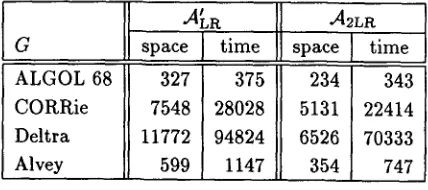
4 LR A2LR
G space ] time space ] time
ALGOL 68 327 375 234 343
CORRie 7548 28028 5 1 3 1 22414
Deltra 11772 94824 6 5 2 6 70333
Alvey 599 1147 354 747
Table 2: Dynamic requirements: average space and time per sentence.
is little indicative of the actual efficiency of more sophisticated implementations. Therefore, our mea- surements have been restricted to implementation- independent quantities, viz. the number of elements stored in the parse table and the number of elemen- tary steps performed by the algorithm. In a practical implementation, such quantities will strongly influ- ence the space and time complexity, although they do not represent the only determining factors. Fur- thermore, all optimizations of the time and space efficiency have been left out of consideration.
Table 2 presents the costs of parsing the test sen- tences. The first and third columns give the number of entries stored in table U, the second and fourth columns give the number of elementary steps that were performed.
An elementary step consists of the derivation of
!
one element in QLR or Q2LR from one or two other elements. The elements that are used in the filter- ing process are counted individually. We give an example for the case of .A~R. Suppose we derive an
element
q~ E Ui,j
from an element(A - . • c~) E Ui,j,
warranted by two elements
ql,q2 E Ui, ql ~ q2,
through
pred,
in the presence of ql (A --* • c~)ql q' e T~.~ and q2 (A ---* • c~) ~-~ q2 q' E T~R. We
then count
two
parsing steps, one for ql and one forq2.
[image:6.612.333.546.75.154.2] [image:6.612.332.546.230.325.2]G
ALGOL 68
CORRie Deltra
Alvey
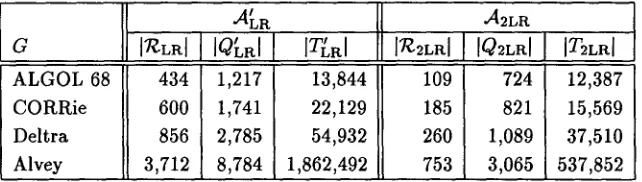
.A ! LR
[T~LR[ I [Q[a[ [ [T~R[
434 1 , 2 1 7 13,844
600 1 , 7 4 1 22,129
856 2,785 54,932
3,712 8,784 1,862,492
,A2LR
In2LRI [ [O2La[ [ IT2Lrd
109 724 12,387
185 821 15,569 260 1 , 0 8 9 37,510 753 3 , 0 6 5 537,852
Table 3: Static requirements.
,A2LR.
Apart from the dynamic costs of parsing, we have also measured some quantities relevant to the con- struction and storage of the two types of tabular LR parser. These data are given in Table 3.
We see that the number of states is strongly re- duced with regard to traditional LR parsing. In the
case of the Alvey grammar, moving from
[T~LR [ to
]T~2LR[ amounts to a reduction to 20.3 %. Whereas time- and space-efficient computation of T~LR for this grammar is a serious problem, computation of T~2La will not be difficult on any modern computer. Al- so significant is the reduction from [T~R [ to [T2LR[, especially for the larger grammars. These quanti- ties correlate with the amount of storage needed for naive representation of the respective automata.
8
Discussion
Our treatment of tabular LR parsing has two impor- tant advantages over the one by Tomita:
* It is conceptually simpler, because we make use of simple concepts such as a grammar trans- formation and the well-understood CYK al- gorithm, instead of a complicated mechanism working on graph-structured stacks.
• Our algorithm requires fewer LR states. This leads to faster parser generation, to smaller parsers, and to reduced time and space com- plexity of parsing itself.
The conceptual simplicity of our formulation of tabular LR parsing allows comparison with other tabular parsing techniques, such as Earley's algo- rithm (Earley, 1970) and tabular left-corner pars- ing (Nederhof, 1993), based on implementation- independent criteria. This is in contrast to experi- ments reported before (e.g. by Shann (1991)), which treated tabular LR parsing differently from the other techniques.
The reduced time and space complexities reported in the previous section pertain to the tabular real- isation of two parsing techniques, expressed by the
automata A~, R and A2La. The tabular realisation of the former automata is very close to a variant of Tomita's algorithm by Kipps (1991). The objective of our experiments was to show that the automata ~4~La provide a better basis than .A~a for tabular LR parsing with regard to space and time complexity.
Parsing algorithms that are not based on the LR technique have however been left out of con- sideration, and so were techniques for unification grammars and techniques incorporating finite-state processes. 3
Theoretical considerations (Leermakers, 1989; Schabes, 1991; Nederhof, 1994b) have suggested that for natural language parsing, LR-based techniques may not necessarily be superior to other parsing techniques, although convincing empirical data to this effect has never been shown. This issue is dif- ficult to resolve because so much of the relative ef- ficiency of the different parsing techniques depends on particular grammars and particular input, as well as on particular implementations of the techniques. We hope the conceptual framework presented in this paper may at least partly alleviate this problem.
A c k n o w l e d g e m e n t s
The first author is supported by the Dutch Organiza- tion for Scientific Research (NWO), under grant 305- 00-802. Part of the present research was done while the second author was visiting the Center for Lan- guage and Speech Processing, Johns Hopkins Uni- versity, Baltimore, MD.
We received kind help from John Carroll, Job Honig, Kees Koster, Theo Vosse and Hans de Vreught in finding the grammars mentioned in this paper. Generous help with locating relevant litera- ture was provided by Anton Nijholt, Rockford Ross, and Arnd Ruflmann.
3As remarked before by Nederhof (1993), the algo-
rithms by Schabes (1991) and Leermakers (1989) are n o t
[image:7.612.131.452.71.162.2]R e f e r e n c e s
Billot, S. and B. Lang. 1989. The structure of shared forests in ambiguous parsing. In 27th An- nual Meeting of the ACL, pages 143-151.
Booth, T.L. 1967. Sequential Machines and Au- tomata Theory. Wiley, New York.
Carroll, J.A. 1993. Practical unification-based pars- ing of natural language. Technical Report No. 314, University of Cambridge, Computer Labora- tory, England. PhD thesis.
Earley, J. 1970. An efficient context-free parsing al- gorithm. Communications of the ACM, 13(2):94- 102.
Harrison, M.A. 1978. Introduction to Formal Lan- guage Theory. Addison-Wesley.
Johnson, M. 1991. The computational complexi- ty of GLR parsing. In Tomita (1991), chapter 3, pages 35-42.
Kipps, J.R. 1991. GLR parsing in time O(n3). In Tomita (1991), chapter 4, pages 43-59.
Lang, B. 1974. Deterministic techniques for ef- ficient non-deterministic parsers. In Automata, Languages and Programming, 2nd Colloquium, LNCS 14, pages 255-269, Saarbrficken. Springer- Verlag.
Leermakers, R. 1989. How to cover a grammar. In 27th Annual Meeting of the ACL, pages 135-142. Leermakers, R. 1992a. A recursive ascent Earley parser. Information Processing Letters, 41(2):87- 91.
Leermakers, R. 1992b. Recursive ascent parsing: from Earley to Marcus. Theoretical Computer
Science, 104:299-312.
Nederhof, M.J. 1993. Generalized left-corner pars- ing. In Sixth Conference of the European Chapter
of the ACL, pages 305-314.
Nederhof, M.J. 1994a. Linguistic Parsing and Pro- gram Transformations. Ph.D. thesis, University of Nijmegen.
Nederhof, M.J. 1994b. An optimal tabular parsing algorithm. In 32nd Annual Meeting of the ACL, pages 117-124.
Nederhof, M.J. and K. Koster. 1992. A customized grammar workbench. In J. Aarts, P. de Haan, and N. Oostdijk, editors, English Language Cor- pora: Design, Analysis and Exploitation, Papers from the thirteenth International Conference on English Language Research on Computerized Cor- pora, pages 163-179, Nijmegen. Rodopi.
Nederhof, M.J. and J.J. Sarbo. 1993. Increasing the applicability of LR parsing. In Third Interna- tional Workshop on Parsing Technologies, pages 187-201.
Nederhof, M.J. and G. Satta. 1994. An extended theory of head-driven parsing. In 32nd Annual Meeting of the ACL, pages 210-217.
Pager, D. 1970. A solution to an open problem by Knuth. Information and Control, 17:462-473. Rekers, J. 1992. Parser Generation for Interactive
Environments. Ph.D. thesis, University of Am- sterdam.
Schabes, Y. 1991. Polynomial time and space shift- reduce parsing of arbitrary context-free gram- mars. In 29th Annual Meeting of the ACL, pages 106-113.
Schauerte, R. 1973. Transformationen von LR(k)-grammatiken. Diplomarbeit, Universit~it GSttingen, Abteilung Informatik.
Schoorl, J.J. and S. Belder. 1990. Computation- al linguistics at Delft: A status report. Report W T M / T T 90-09, Delft University of Technology, Applied Linguistics Unit.
Shann, P. 1991. Experiments with GLR and chart parsing. In Tomita (1991), chapter 2, pages 17- 34.
Sheil, B.A. 1976. Observations on context-free pars- ing. Statistical Methods in Linguistics, pages 71- 109.
Sippu, S. and E. Soisalon-Soininen. 1990. Pars- ing Theory, Vol. II: LR(k) and LL(k) Parsing. Springer-Verlag.
Tomita, M. 1986. Efficient Parsing for Natural Lan- guage. Kluwer Academic Publishers.
Tomita, M., editor. 1991. Generalized LR Parsing. Kluwer Academic Publishers.
van Wijngaarden, A. et at. 1975. Revised report on the algorithmic language ALGOL 68. Acta Infor- matica, 5:1-236.
Villemonte de la Clergerie, E. 1993. Automates Piles et Programmation Dynamique -- DyALog:
Une application h la Programmation en Logique. Ph.D. thesis, Universit@ Paris VII.