C o m b i n a t i o n o f a n A u t o m a t i c a n d a n I n t e r a c t i v e
D i s a m b i g u a t i o n M e t h o d
M a s a y a Y a m a g u c h i , T a k e y u k i K o j i m a ,
N o b u o
I n u i , Y o s h i y u k i K o t a n i a n d H i r o h i k o N i s i m u r aD e p a r t m e n t of C o m p u t e r Science, T o k y o U n i v e r s i t y of A g r i c u l t u r e a n d T e c h n o l o g y , N i s i m u r a , K o t a n i u n i t , 2-24-16 N a k a - c h o , K o g a n e i , T o k y o , J a p a n
A b s t r a c t
In natural language processing, many methods have been proposed to solve the ambiguity problems. In this paper, we propose a technique to combine a method of interactive disambiguation and automatic one for alnbiguous words. The characteristic of our method is that the accuracy of the interactive dis- ambiguation is considered. The method solves the two following problems when combining those dis- ambiguation lnethods: (1) when should the inter- active disambiguation be executed? (2) which am- biguous word should be disambiguated when more than one ambiguous words exist in a sentence? Our method defines the condition of executing the inter- action with users and the order of disambiguation based on the strategy where the accuracy of the re- sult. is maximized, considering the accuracy of the interactive disambiguation and automatic one. Us- ing this lnethod, user interaction can be controlled while holding the accuracy of results.
1
I n t r o d u c t i o n
In natural language processing, many methods have been proposed to solve the ambiguity prob- lems(Nagao and Maruyama, 1992). One of those technique uses interactions with users, because it is difficult to make all the knowledge for disambigua- tion beforehand. That technique is classified into two types according to the condition of executing user interaction. One type(TypeA) is that the dis- ambiguation system executes interactions(Blanchon
et al., 1995),
(Maruyama andWatanabe, 1990),
(Yalnaguchi et al., 1995). Another type(TypeB) is that users executes interactions(D.Brawn andNiren-
burg,
1990), (Muraki etal., 1994).
In thispaper, Ty- peA will be adopted because TypeB gives users more trouble than TypeA does. F o r example, in TypeB, a user may have to find where is wrongly analyzed in inputsentences.
In TypeA, the two following conditions must
be
determined: (1) when should interactive disam- biguation be executed? (2) which ambiguous words should be disambiguated when morethan one
aln- biguous word exist in a sentence? Consideringthe
accuracy of tile analyzed result, they should be de- cided by both the accuracy of the interactive dis- ambiguation and that of tile autolnatic disambigua- tion. The traditional lnethods did not considered the accuracy of the interactive disambiguatiom For instance, the accuracy of the analyzed result may decrease in spite of executing the user interaction if the accuracy of the interactive disaml)iguation is low.
In this paper, we propose the method to com- bine the interactive disambiguation and the auto- matic one, considering each accuracy. The method allows the disambiguation system to maximize the accuracy of the analyzed result. This paper focuses on the anabiguity caused by ambiguous words that have more than one mealfing. Section 2 represents preconditions for disamlfiguation. In Section 3, we descrihe the condition of executing the interactive disambiguation. Section 4 shows the procedure t h a t decides the order of disamhiguation. The perfor- mance of the lnethod is discussed by the result of the sinmlation under assumhlg the both accuracy of the interactive disambiguation and the autolnatic one.
2
Preconditions for Disambiguation
This section describes preconditions for disambigua- tion and methods of the disamlfiguation.In this paper, the disambiguation for ambiguous words means that all ambiguous ones in an input sentence a.re disambiguated. Describing it. formally,
the
disambiguation is to decide one element of the following M S .M S = M 1 x M 2 x . . . x slit,
where an input sentence contains ! ambiguous words. Mi
means the set
of lneanings in the am- biguous word wi.Each disambiguation method has preconditions as follows:
Interactive Disambiguation
• T h e s y s t e m can calculate the probability where a user selects the right explanation.
A u t o m a t i c D i s a m b i g u a t i o n
• T h e occurrence probabilities for each candidate can be calculated for preference.
• T h e result is the candidate with the m a x i m u m occurrence probability.
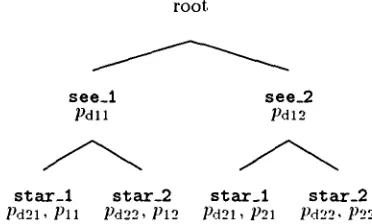
To show the iuformation mentioned above, candi- dates are expressed by the tree in Figure 1. This tree is an example in the case t h a t an input sentence is "I saw a star.", which contains two ambiguous words 'see' and ' s t a r ' and each word has two meanings.
root
771~1 1 77112 1711n
Pdl, Pl Pd-~, P.~ Pdn, P,
Figure 2: An example of the tree of candidates for one ambiguous word in an input sentence
T h e accuracy of the interactive disambiguatiou
/~ntr
and t h a t of the a u t o m a t i c disambiguation Pauto are defined as follows:root.
s e e _ l see_2
Pdll Pdl2
s t a ~ _ l s t a x _ 2 s t a r _ l s t a r _ 2 Pd2_l, Pll Pd22, P12 Pd21, P21 Pd22, P'_'2
Figure 1: All example of the tree of candidates
T h e depth of the tree expresses the order of dis- anfl)iguation. In Figure 1, the auabiguities are re- solved in the order from 'see' to 'star'. T h e occur- fence probability is calculated at each leaf node by the a u t o m a t i c disambiguation method. For exam- pie, PH expresses the probability for the candidate { s e e _ l , s t a r _ l } . Furthermore, the accuracy of in- teraction is also calculated at the leaf node by the interactive disalnbiguation m e t h o d . Pd~.l is the prob- ability where the meanillg of ' s t a r ' is ' s t a L l ' and tim system shows explanations of ' s t a r _ l ' , ' s t a r _ 2 '
for ' s t a r ' to a user a.nd (s)he selects the explanation of ' s t a r _ 2 ' . At. Nodes besides leaf ones, only the accuracy of interaction is calculated.
3 T h e C o n d i t i o n o f E x e c u t i n g t h e I n t e r a c t i v e D i s a m b i g u a t i o n
3.1 B a s i c I d e a
At each node besides leaf ones, the disambigua- tion s y s t e m decides which disambiguation m e t h o d is used. Basically, the interactive disambiguation is executed when its accuracy is higher than the ac- curacy of the a u t o m a t i c disambiguation. First of all, let us consider the case where an input sentence contains one ambiguous word t h a t has ~, meanings. Figure 2 shows the tree of candidates for this case.
Pintr ---- £ PdiPi
i
P~uto = maxp~
T h e interactive disambiguation is executed, when the following condition is satisfied.
Pintr > Pauto
Considering tile condition more carefully, the ac- curacy of tile interactive disambigualion is iuflu- enced by the explanations t h a t are showu t.o users. T h u s tim accuracy m a y be improved by limiting to show some explanations to users. For example, this m a y be caused when the accuracy of roll is very low and a user m a y select m l l wrongly by the higher similarity of the explanation for 11111 to other expla- nations. T h e autonmtic disambiguation corresponds to showing only one explanation to users in the in- teractive disanabiguation. Therefore the condition of executing the interactive disambiguatiou can be defined as the exceptional case of the limitation.
3.2 T h e A c c u r a c y a t a N o d e
[image:2.612.346.512.67.131.2] [image:2.612.91.277.247.359.2]Ptntr(i) = ~
pd(,nlM ) x P,(m)
(1) rnEM .Pluto(i) = max(Pr(m)) (2)
m E M
where M is the set of the node directly under node i, pd(m[M) is the accuracy of the interactive disam- biguation at node m, that is, the probability that a user selects m provided that the system shows ex- planations for all the elements of M to him(her).
Pr(m) is the accuracy at node m and the definition is as follows:
P~(,,)
=
(if the interactive disambiguation is executed a,t, node m)
Pluto(,7/.)
(if the automatic disambiguation is ex- ecuted at node m)
Poccur(m) (if m is a leaf node)
where/)occur(m) is tile occurrence probability of the candidate that includes nodes between the root node alld I l o d e 7/l.
When tile following condition is satisfied, the ill- teractive disanlbiguation is executed at node i.
Pintr(i) > Pauto(i) (3)
3.3 T h e L i m i t a t i o n o f E x p l a n a t i o n s
Ill user interaction, tile presentation of many expla- nations gives users trouble t.o select, one explanation. So it. is desirable that tile disambiguation system shows fewer exl)lanation to users, if possible. In this section, we describe the condition where the number of explanations is limited without losing the accu- racy of the analyzed result.
By formula (1), the accuracy of the interactive disanlbiguation Piaster in the case of limiting the set of explanations AI ~ is defined as follows:
max Z p d ( m [ M -- M ' ) P , ( m ) M ~
m E M - M ~
Pitntr(i) - if ]M - M'[ > 1
Pr(t) if I M - M ' I = 1
If fornmla (4) is satisfied, the set. of tile explana- tion M ' is not shown to users in the interaction at node i.
/~ntr(i) ~ Pi~ntr(i) (4)
Furtherlnore, if Ill,l- M ' I = 1, then tile automatic disambiguation is executed at. node i. Therefore, formula (4) implies fornmla (3).
4
D e t e r m i n a t i o n of t h e Order of
D i s a m b i g u a t i o n
4.1 P r o c e d u r e
up to here, we have discussed ~l:amt r and Pluto under a certain order of disambiguation. Ill this section, we describe a procedure to decide the order of dis- ambiguation where the accuracy is maximum.
The accuracy of the analyzed result may be differ- ent in each order of disambiguation, This is the rea- son that the disambiguation of one ambiguous word leads to constrain the meaning of other ambiguous ones. Therefore, the contents of the interaction may differ from each order of disambiguation. The or- der with the maximum accuracy is obtained in the following procedure:
1. Calculating each occurrence probal)ility of can- didate for tile analyzed result by the automatic disambiguation method.
2. Obtaining the accuracy in each order of (lisam- biguation based on the method described in the previous sections.
3. Disanlbiguating by the order with the maximum accuracy.
4.2 E x a m p l e
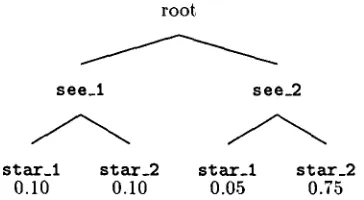
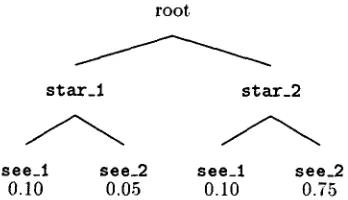
Ill this section, we illustrate the determination of ex- ecuting the interactive disambiguatioll and the order of disanlbiguation. The values at leaf nodes are the occurrence probabilities. Tile accuracy of the inter- active disalnbiguation is 0.9 at the any nodes. Since the number of ambiguous words is two, the num- ber of the order of disambiguation is 2! as shown in Figure 3, 4.
root
see_l see_2
star_l star_2 star_l star_2
0.10 0.10 0.05 0.75
Figure 3: An example of tile order of disambigua- tion(1)
To begin with, we intend to calculate what kind of disambiguation is executed at node 'star_l' and ' s t a r _ 2 ' , ill Figure 3. By fornmla (1), (2), ~nt,.(see-1) and P l u t o ( s e e - I ) are as follows (since both ambiguous words have two meanings, P[ntr(i)
[image:3.612.334.516.477.577.2]root,
star_l star_2
s e e _ l see_2 see_l see_2
0.10 0.05 0.10 0.75
Figure 4: An example of the order of disambigua- tion(2)
Pi,,t,.(see_l)
-'- 0.9 x (0.75 + 0.05) = 0.72Pauto(see-1)
-- max(0.75,0.05)= 0.75
Because of
Pi.~,.(see_l) < Pauto(See-1),
the au- tomatic disambiguation is executed at. node s e e _ l .Oil the other hand, at node see_2, P,,,t,.(see_2) and
Pa.to(see-2)
are as follows:P i , ~ , . ( s e e _ 2 ) = 0 . 1 8
t~,to(see_2)
= 0.10Pi,,tr(see_2) >
Pa,,to(see-2)
is satisfied. So the system interacts with users at this node.By the result of the above,
Pi,t,.(root)
andPa,to(root)
are as follows:Pi,,t,.(root) = 0 . 9 ( P r ( s e e _ l ) -t- P , . ( s e e _ 2 ) )
: 0.9(Pauto(see-1) + Pi,,t,.(see-2))
= 0 . 0 ( 0 . 7 5 + 0.18) = 0.837
Pauto(root) = m a x ( P r ( s e e _ l ) , P r ( s e e _ 2 ) )
= max(0.75,0.18) = 0.75
Therefore, the interactive disambiguation is ex- ecuted at. the root. node because of
Pint,.( root ) >
P~to( rOot ),
andP~(root)
= 0.837.Next, let us explain the case of Figure 4. Cal- culating the same way as Figure 3, t h e interactive disambiguation is executed in any node besides leaf ones, and P / , t ,
(root), P~,to (root)
are a.s follows:Pi,,~. (root)
P~,,to( ,'oot )
= 0 . 9 ( P r ( s t a r _ l ) + P r ( s t a r _ 2 ) ) = 0.9(Pi, t r ( s ' c a r _ l ) +
Pint~(star_2))
= 0.9(0.765+0.135) : 0.81
= m a x ( P r ( s t a r _ l ) , Pr(sl;ar_2)) = max(0.10,0.75) = 0.75
Therefore, P,,t~(root) >
P~u,o(rOot),
andP,.(root)
becomes 0.81. C o m p a r i n g withP~(root)
of each order,
P~(root)
of Figure 3 is greater than t h a t of Figure 4. Thus the system interacts with users against 'see' in the first, place.5 E x p e r i m e n t s
We applied the proposed m e t h o d ( a b b r e v i a t e d as MP) to the disambiguation of trees of ca lldidates that are made for experiments, and compared it with the method (abbreviated as MA) t h a t executes in- teraction in all nodes.
We set the following properties to the tree of can- didates.
• the number of ambiguous words included in an input sentence
• the mlmber of meanings in an ambiguous word
• the occurrence probability of candidates
To assign an occurrence probability to each can- didate, a r a u d o m value is given to each candidate above all, and each value is divided by the sum of values given to all candidates.
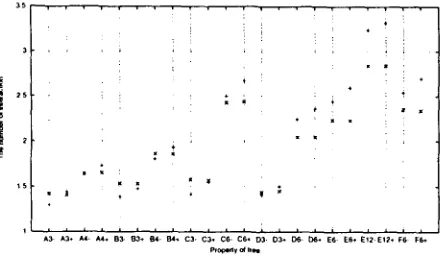
Figure 5, 6 show the accuracy at the root node and the number of interaction, respectively. In these figures, a mark '+' indicates results of MI ). Each of t h e m is the average of 300 trees. A mark "*" indicates results of MA. Because MA does not prescribe the order of disambiguation, the result of each tree is the average of all the orders.
o g
o a s
o e
~ o 75
o 7
o 65
A3. A~ A~. o3. a3~ ~ . e 4 . C3. C ~ CS- C,~* 03. Oa* D6. Oe. E6 ES* EIZ. E I 2 . r~. F6. I~optmy a t r ~
Figure 5: T h e accuracy of MP, MA
T h e horizontal axis means the p r o p e r t y of the tree. Each A l p h a b e t in the value of the horizontal axis stands for the number of ambiguous words in a tree and the nunlber of meanings of a word as follows:
[image:4.612.102.276.75.175.2] [image:4.612.323.546.440.576.2]• t
4
i I ~ ~ i
, i i i i i i , i , , i i i i i i , i L i i A a A a . Aa. A 4 . a 3 ~ , 8 4 - B 4 . c a - C a . C6. CS, O a . 0 3 . t ) ~ t ~ . E e E S * E 1 2 E l 2 * e 6 r ~
Figure 6: T h e nurnber of interaction of MP, MA
For instance, '2 x 4' shows that there are two am- biguous words ill a tree and one ambiguous word has two meanings and another word has four meanings. T h e lmmber in the value of the x-axis represents the number of the candidate whose occurrence prob- ability is not zero. Two marks, "+' and ' - ' mean that the accuracy of interactioll is 0.9, 0.85 respectively.
6
D i s c u s s i o n
6.1 T h e A c c u r a c y o f D i s a m b i g u a t i o n
The effect of the proposed method on tile accuracy is expressed by the difference of distributions of two lnarks, '+' and '*' in Figure 5. This shows that the accuracy of the proposed method is better t.hall that of MA in ally property of tree. Table 1 (the line of "Accuracy') shows the minimum, maxinmln, and av- erage values of the ratio of ilnproved accuracy (RIA). The definition of RIA is shown as follows:
R I A - acp - aCa
1 . 0 - aca
where acp, ac a is t.he accuracy the result by MP and MA respectively.
Table 1: Summary of the results
Minimum Maximuna Average
Accuracy 0.14 0.23 0.18
Interaction - 0 . 0 6 0.12 0.03
6.2 T h e N u m b e r o f I n t e r a c t i o n
Tile number of interaction may increase on the con- dition that the accuracy of the analyzed result is maxinfized. Ill this section, the degree of the in- crease will be estimated by comparing the number of interaction of MP with that of MA. For this purpose, 'RII' is defined as follows:
R I I - n p - n a
n w
where np, na is the number of interaction by MP and MA respectively, 71.,,, is the llumber of ambigu- ous words in an input sentence. RII represents the ratio of the increase ill the number of interaction per ambiguous word. Table l ( t h e lille of 'Interaction') shows the rnininaum, lnaximuna, and average of RII. To reduce the number of interaction, the auto- matte disambiguation is executed instead of execut- ing tile interactive disambiguation, estimating the loss of the accuracy L(i) ill node i. L(i) is defined as follows:
L ( i ) = P , . ( i ) - Pat, t o ( i )
T h e proposed lnethod will allow the system to re- duce the nunfi)er of interaction, by considering L(i) ill each node.
7 C o n c l u s i o n
We have proposed the lnethod of combining the interactive disalnbiguation and the autonlatic one. The characteristic of our method is that it. considers the accuracy of the interactive disambiguat ion. This method makes three following things possible:
• selecting the disambiguation method that ob- tains higher accuracy
• limiting exl)lanations shown to users
• obtaining the order of disaml)iguation where t he accuracy of the analyzed resuhs is maximized.
R e f e r e n c e s
Herve' Blanchon, K. Loken-Kina, and T. Morimoto. 1995. An interactive disambiguation module for English natural language utteracalwes. In Pro- ce¢dings of NLPRS"95, pages 550-555.
Ralf D.Brawn and Sergei Nirenburg. 1990. Humall- computer interaction for semantic disambigua- tion. Ill Proccedings of COLING-90, pages 42-47. II. Maruyama and H. Watanabe. 1990. All interac- tive Japanese parser for machine trallslation. Ill
Proceedings of COLING-90, pages 257-262. K. Muraki, S. Akamiue, K. Satoh, and S. Ando.
1994. T W P : How to assist English production on Japanese word processor. Ill Proceedings of COLING-94, pages 847-852.
K. Nagao and H. Maruyama. 1992. Ambiguities and their resolution in natural language processing.
Journal of 1PSJ, 33(7):741-745.
[image:5.612.71.293.64.194.2]