C o m p i l i n g H P S G t y p e constraints into definite clause p r o g r a m s
T h i l o G ~ t z a n d W a l t D e t m a r M e u r e r s * S F B 340, U n i v e r s i t £ t T f i b i n g c n
K l e i n e W i l h e l m s t r a t ~ e 113 72074 T f i b i n g e n
G e r m a n y
~tg, dm}©sf s. nphil, uni-tuebingen,
deA b s t r a c t
We present a new approach to HPSG pro- cessing: compiling HPSG grammars ex- pressed as type constraints into definite clause programs. This provides a clear and computationally useful correspondence between linguistic theories and their im- plementation. The compiler performs off- line constraint inheritance and code opti- mization. As a result, we are able to effi- ciently process with HPSG grammars with- out haviog to hand-translate them into def- inite clause or phrase structure based sys- tems.
1 I n t r o d u c t i o n
The HPSG architecture as defined in (Pollard and Sag, 1994) (henceforth HPSGII) is being used by an increasing number of linguists, since the formally well-defined framework allows for a rigid and ex- plicit formalization of a linguistic theory. At the same time, the feature logics which provide the for- mal foundation of HPSGII have been used as basis for several NLP systems, such as ALE (Carpenter, 1993), CUF (DSrre and Dorna, 1993), Troll (Gerde- mann and King, 1993) or TFS (Emele and Zajac, 1990). These systems are - at least partly - intended as computational environments for the implementa- tion of HPSG grammars.
HPSG linguists use the description language of the logic to express their theories in the form of im- plicative constraints. On the other hand, most of the computational setups only allow feature descriptions as extra constraints with a phrase structure or defi- nite clause based language. 1 From a computational point of view the latter setup has several advantages. It provides access to the pool of work done in the
*The authors are listed alphabetically.
1One exception is the TFS system. However, the pos- sibility to express recursive relations on the level of the description language leads to serious control problems in that system.
area of natural language processing, e.g., to efficient control strategies for the definite clause level based on tabelling methods like Earley deduction, or differ- ent parsing strategies in the phrase structure setup.
The result is a gap between the description lan- guage theories of HPSG linguists and the definite clause or phrase structure based NLP systems pro- vided to implement these theories. Most grammars currently implemented therefore have no clear corre- spondence to the linguistic theories they originated from. To be able to use implemented grammars to provide feedback for a rigid and complete formal- ization of linguistic theories, a clear and computa- tionMly useful correspondence has to be established. This link is also needed to stimulate further devel- opment of the computational systems. Finally, an HPSGII style setup is also interesting to model from a software engineering point of view, since it permits a modular development and testing of the grammar.
The purpose of this paper is to provide the de- sired link, i.e., to show how a HPSG theory formu- lated as implicative constraints can be modelled on the level of the relational extension of the constraint language. More specifically, we define a compilation procedure which translates the type constraints of the linguistic theory into definite clauses runnable in systems such as Troll, ALE, or CUF. Thus, we per- form constraint inheritance and code optimization off-line. This results in a considerable efficiency gain over a direct on-line treatment of type constraints as, e.g., in TFS.
2 B a c k g r o u n d
2.1 T h e H P S G I I a r c h i t e c t u r e
A HPSG grammar consists of two components: the declaration of the structure of the domain of linguis- tic objects in a signature (consisting of the type hi- erarchy and the appropriateness conditions) and the formulation of constraints on that domain. The sig- nature introduces the structures the linguist wants to talk about. The theory the linguist proposes dis- tinguishes between those objects in a domain which are part of the natural language described, and those which are not.
HPSGII gives a closed world interpretation to the type hierarchy: every object is of exactly one min- imal (most specific) type. This implies that every object in the denotation of a non-minimal type is also described by at least one of its subtypes. Our compilation procedure will adhere to this interpre- tation.
2.2 T h e t h e o r i e s o f H P S G I I : D i r e c t l y c o n s t r a i n i n g t h e d o m a i n
A HPSGII theory consists of a set of descriptions which are interpreted as being true or false of an object in the domain. An object is admissible with respect to a certain theory iff it satisfies each of the descriptions in the theory and so does each of its substructures. The descriptions which make up the theory are also called
constraints,
since these de- scriptions constrain the set of objects which are ad- missible with respect to the theory.Figure 1 shows an example of a constraint, the head-feature principle of HPSGII. Throughout the paper we will be using HPSG style AVM notation for descriptions.
phrase - . . *
DTRS headed-strut
SYNSEM]LOC[CAT[HEAD
DTRSIH AD DTRISYNSE I' OClC l" '
Figure 1: The Head-Feature Principle of HPSGII
The intended interpretation of this constraint is that every object which is being described by type
phrase
and by [DTI~S
h~aded-str~c]
also has to be described by the consequent, i.e. have its head value shared with that of its head-daughter.In the HPSG II architecture any description can be used as antecedent of an implicative constraint. As shown in (Meurers, 1994), a complex description can be expressed as a type by modifying the signature and/or adding theory statements. In the following, we therefore only deal with implicative constraints with type antecedents, the type definitions.
2.3 T h e o r i e s in c o n s t r a i n t logic p r o g r a m m i n g : e x p r e s s i n g d e f i n i t e clause r e l a t i o n s
As mentioned in the introduction, in most computa- tional systems for the implementation of HPSG the- ories a grammar is expressed using a relational ex- tension of the description language 2 such as definite clauses or phrase structure rules. Figure 2 schemat- ically shows the embedding of HPSG II descriptions in the definition of a relation.
relo (D1 . . . D~) : - tell(E1,..., Ej),
re/n(Fl . . . . , Fh).
Figure 2: Defining relation
relo
The HPSG description language is only used to specify the arguments of the relations, in the exam- ple noted as D, E, and F. The organization of the descriptions, i.e. their use as constraints to narrow down the set of described objects, is taken over by the relational level. This way of organizing descrip- tions in definite clauses allows efficient processing techniques of logic programming to be used.
The question we are concerned with in the follow- ing is how a HPSG II theory can be modelled in such a setup.
3 M o d e l l i n g H P S G I I t h e o r i e s o n a r e l a t i o n a l l e v e l : a s i m p l e p i c t u r e
There are three characteristics of HPSGII theories which we need to model on the relational level: one needs to be able to
1. express constraints on any kind of object,
2. use the hierarchical structure of the type hier- archy to organize the constraints, and
3. check any structure for consistency with the theory.
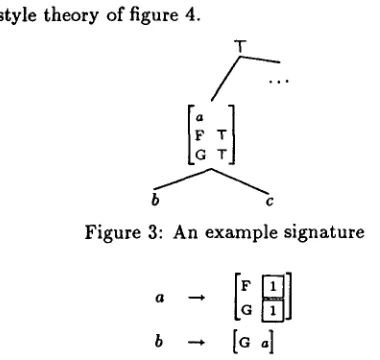
A straightforward encoding is achieved by express- ing each of these three aspects in a set of relations. Let us illustrate this idea with a simple example. As- sume the signature given in figure 3 and the HPSGII
2 For the logical foundations of relational extensions of arbitrary constraint languages see (HShfeld and Smolka,
style theory of figure 4.
T
/-=
b c
Figure 3: An example signature
o _
b --. [ Q ° I
Figure 4: An example theory in a HPSGII setup
First, we define a relation to express the con- straints immediately specified for a type on the ar- gument of the relation:
• a o,, ) :- T , v p , G ) .
• b b :-
• c ° o n , ( c ) .
For every type, the relation specifies its only argu- ment to bear the type information and the conse- quents of the type definition for that type. Note that the simple type assignment [G a] leads to a call to the relation atvp~ imposing all constraints for type a, which is defined below.
Second, a relation is needed to capture the hier- archical organization of constraints:
• ; ....
• ahi,~(~):- a,o,,,([~]), ( bh,,~(~); chi,r([~) ).
•
bhi,r(]~]):- bco,,,(~).
Each hierarchy relation of a type references the con- straint relation and makes sure that the constraints below one of the subtypes are obeyed.
Finally, a relation is defined to collect all con- straints on a type:
• atyp~(~) :- This,-( ri-1 a ).
• bt,p~(E~ ]) :- Thief( [-i~b ).
*
ctvpe([~]) :- Thier( r-~c ).
aA disjunction of the immediate subtypes of T.
Compared to the hierarchy relation of a type which collects all constraints on the type and its subtypes, the last kind of relation additionally references those constraints which are inherited from a supertype. Thus, this is the relation that needs to be queried to check for grammaticality.
Even though the simple picture with its tripartite definition for each type yields perspicuous code, it falls short in several respects. The last two kinds of relations (reltype and relhier) just perform inheri- tance of constraints. Doing this at run-time is slow, and additionally there are problems with multiple inheritance.
A further problem of the encoding is that the value of an appropriate feature which is not mentioned in any type definition may nonetheless be implicitly constrained, since the type of its value is constrained. Consider for example the standard HPSG encoding of list structures. This usually involves a type he_list with appropriate features HD and TL, where under HD we encode an element of the list, and under TL the tail of the list. Normally, there will be no extra constraints on ne_list. But in our setup we clearly need a definite clause
he_list
ne_listcon,( HD ) :- Ttvp~([~), listtyp¢(~]).
.TL
since the value of the feature HD may be of a type which is constrained by the grammar. Consequently, since he_list is a subtype of list, the value of TL needs to be constrained as well.
4 C o m p i l i n g H P S G t y p e c o n s t r a i n t s i n t o d e f i n i t e c l a u s e s
After this intuitive introduction to the problem, we will now show how to automatically generate definite clause programs from a set of type definitions, in a way that avoids the problems mentioned for the simple picture.
4.1 T h e a l g o r i t h m
Before we can look at the actual compilation proce- dure, we need some terminology.
D e f i n i t i o n (type interaction)
Two types interact if they have a common subtype.
Note that every type interacts with itself.
D e f i n i t i o n (defined type)
A defined type is a type that occurs as antecedent of an implicational constraint in the grammar.
D e f i n i t i o n (constrained type)
[image:3.612.63.253.60.240.2] [image:3.612.72.208.304.387.2]Whenever we encounter a structure of a constrained type, we need to check that the structure conforms to the constraint on that type. As mentioned in section 2.1, due to the closed world interpretation of type hierarchies, we know that every object in the denotation of a non-minimal type t also has to obey the constraints on one of the minimal subtypes of t. Thus, if a type t has a subtype t' in common with a defined type d, then t ~ is a constrained type (by virtue of being a subtype of d) and t is a constrained type (because it subsumes t').
D e f i n i t i o n (hiding type)
The set of hiding types is the smallest set s.t. if t is n o t a constrained type and subsumes a type to t h a t h a s a feature f appropriate s.t. approp(to,f) is a con- strained type or a hiding type, then t is a hiding type.
T h e type ne_list t h a t we saw above is a hiding type.
D e f i n i t i o n (hiding feature)
I f t is a constrained or hiding type, then f is a hiding feature on t iff approp(t,f) is a constrained or hiding
type.
D e f i n i t i o n (simple type)
A simple type is a type that is neither a constrained n o r a hiding type.
When we see a structure of a simple type, we don't need to apply any constraints, neither on the top node nor on any substructure.
Partitioning the types in this m a n n e r helps us to construct definite clause programs for type con- straint grammars. For each type, we compute a u n a r y relation t h a t we just give the same name as the type. Since we assume a closed world interpre- tation of the type hierarchy, we really only need to c o m p u t e proper definitions for minimal types. T h e body of a definition for a non-minimal type is just a disjunction of the relations defining the minimal subtypes of the non-minimal type.
When we want to compute the defining clause for a minimal type, we first of all check what sort of type it is. For each simple type, we just introduce a unit clause whose argument is just the type. For a constrained type t, first of all we have to perform constraint inheritance from all types that subsume t. T h e n we transform t h a t constraint to some internal representation, usually a feature structure (FS). We now have a schematic defining clause of the form
t(FS) :- ?.
Next, we compute the missing right-hand side (RHS) with the following algorithm.
1. C o m p u t e HF, the set of hiding features on the type of the current node, then insert these fea- tures with appropriate types in the structure
P':<.}
/ARG2 list I e_list /HD T /
/ARG3 iist~ I.TL ,i,tJ
LGOALS list.]
(FS) if they're not already there. For each node under a feature in HF, apply step 2.
2. Let t be the type on the current node and X its tag (a variable).
(a) If t is a constrained type, enter t(X) into RHS (if it's not already there).
(b) Elseif t is a hiding type, then check if its hiding features and the hiding features of all its hiding subtypes are identical. If they are identical, then proceed as in step 1. If not, enter t(X) into RHS.
(c) Else (t is a simple type) do nothing at all. For hiding types, we do exactly the same thing, ex- cept t h a t we d o n ' t have any structure to begin with. But this is no problem, since the hiding features get introduced anyway.
4.2 A n e x a m p l e
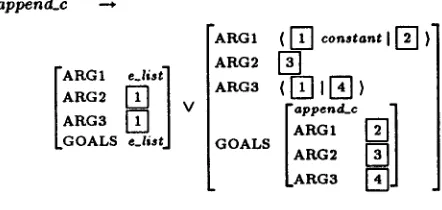
A formal p r o o f of correctness of this compiler is given in (GStz, 1995) - here, we will t r y to show by ex- ample how it works. Our example is an encodin~ of a definite relation in a type constraint s e t u p 2 append_c appends an a r b i t r a r y list onto a list of con- stants.
T
c o n s t a n t
Figure 5: T h e signature for the append_c example
We will stick to an AVM style n o t a t i o n for our ex- amples, the actual p r o g r a m uses a s t a n d a r d feature term syntax. List are abbreviated in the s t a n d a r d H P S G manner, using angled brackets.
a p p e n d _ c -*
[A O1
A R G 2 A R G 3
GOALS e_listJ
" A R G 1 A R G 2 A R G 3 V
G O A L S
15q oo.,,..,i 5q ¢
[]
IE]I[EI
ARG 1 [~] A R G 2 A R G 3
Figure 6: A constraint on append_c
Note t h a t the set of constrained types is {append_c,
[image:4.612.329.545.337.426.2] [image:4.612.327.548.527.632.2]T} and the set of hiding types is
{list, ne_list}.
Con- verting the first disjunct ofappend_c
into a feature structure to start our compilation, we get something like'append_c
ARG1
v--a[]e-list]
I
append_c( A R G 2 121 listARG3
.GOALS
e_list.I
: - ? .
Since the values of the features of
append_c
are of typelist,
a hiding type, those features are hiding features and need to be considered. Yet looking at node [-i7, the algorithm findse_list,
a simple type, and does nothing. Similarly with node [~]. On node ~ ] , we find the hiding typelist.
Its one hiding sub- type,ne_list,
has different hiding features(list
has no features appropriate at all). Therefore, we have to enter this node into the RHS. Since the same node appears under both ARG1 and ARG2, we're done and have[
ARG1
append_c
e_list
1
append_c( I ARG3ARG2
~__lisq):-]Jst(~).
LGOALS
e_list
jwhich is exactly what we want. It means that a structure of type
append_c
is well-formed if it unifies with the argument of the head of the above clause and whatever is under ARG2 (and AR.G3) is a well- formed list. Now for the recursive disjunct, we start out withappend_el
"append_c
rne_list
ARGI E] l
[ ] constant
[ ] .st
A R G 2
[~]
list
rne-list
t]
he.list -append_c ]
GOALS[] HD ~] ARG2
L.~J|
[] 4,: mJ
: - ? .
Node E ] bears a hiding type with no subtypes. Therefore we don't enter that node in the RHS, but proceed to look at its features. Node [ ] bears a sim- ple type and we do nothing, but node [ ] is again a
list
and needs to be entered into the RHS. Similarly with nodes [ ] and ['~.append_c
on node [ ] is a con- strained type and [ ] also has to go onto the RHS.T h e final result then is
append_c(
"append_c
me-list
constant]
ARG2 [~]
list
me-list
t]
rne_list
/ rapP:-d_c "1
/ IARG1 r31 |
._
l i s t ( ~ ) , list([~]), list([~]), append_c(~]).
This is almost what we want, but not quite. Con- sider node ~ ] . Clearly it needs to be checked, but what about nodes ~ ] , [ ] and E ] ? They are all em- bedded under node [ ] which is being checked any- way, so listing them here in the RHS is entirely re- dundant. In general, if a node is listed in the RHS, then no other node below it needs to be there as well. Thus, our result should really be
append_c(
"append_c
rne-list
constant]
ARG2 r~1
list
me-list
t]
rne-list
I
r append-e 1
IHD
GOALS I
I
| LAFtG3 16~J
LTL
e_list
:_
appendoc([~]).
Our implementation of the compiler does in fact perform this pruning as an integrated part of the compilation, not as an additional step.
4.3 I m p l e m e n t a t i o n a n d E x t e n s i o n s
The compiler as described in the last section has been fully implemented under Quintus Prolog. Our interpreter at the moment is a simple left to right backtracking interpreter. The only extension is to keep a list of all the nodes that have already been visited to keep the same computation from being repeated. This is necessary since although we avoid redundancies as shown in the last example, there are still cases where the same node gets checked more than once.
This simple extension also allows us to process cyclic queries. The following query is allowed by our system.
me_list ~]
Query> [~] [THD
Figure 7: A permitted cyclic query
An interpreter without the above-mentioned exten- sion would not terminate on this query.
The computationally oriented reader will now wonder how we expect to deal with non-termination anyway. At the moment, we allow the user to specify minimal control information.
• The user can specify an ordering on type expan- sion. E.g., if the type hierarchy contains a type
sign
with subtypesword
andphrase,
the user may specify thatword
should always be tried beforephrase.
• The user can specify an ordering on feature ex- pansion. E.g., HD should always be expanded before TL in a given structure.
Since this information is local to any given structure, the interpreter does not need to know about it, and the control information is interpreted as compiler directives.
5 C o n c l u s i o n a n d O u t l o o k
We have presented a compiler that can encode HPSG type definitions as a definite clause program. This for the first time offers the possibility to ex- press linguistic theories the way they are formulated by linguists in a number of already existing compu- tational systems.
The compiler finds out exactly which nodes of a structure have to be examined and which don't. In doing this off-line, we minimize the need for on-line inferences. The same is true for the control informa- tion, which is also dealt with off-line. This is not to say that the interpreter wouldn't profit by a more sophisticated selection function or tabulation tech- niques (see, e.g., (DSrre, 1993)). We plan to apply Earley deduction to our scheme in the near future and experiment with program transformation tech- niques and bottom-up interpretation.
Our work addresses a similar problem as Carpen- ter's work on resolved feature structures (Carpen- ter, 1992, ch. 15). However, there are two major differences, both deriving form the fact that Car- penter uses an open world interpretation. Firstly, our approach can be extended to handle arbitrar- ily complex antecedents of implications (i.e., arbi- trary negation), which is not possible using an open world approach. Secondly, solutions in our approach have the so-called subsumption monotonicity or
per-
sistence
property. That means that any structure subsumed by a solution is also a solution (as in Pro- log, for example). Quite the opposite is the case in Carpenter's approach, where solutions are not guar- anteed to have more specific extensions. This is un- satisfactory at least from an HPSG point of view, since HPSG feature structures are supposed to be maximally specific.A c k n o w l e d g m e n t s
The research reported here was carried out in the context of SFB 340, project B4, funded by the Deutsche Forschungsgemeinschaft. We would like to thank Dale Gerdemann, Paul John King and two anonymous referees for helpful discussion and com- ments.
R e f e r e n c e s
Hassan Ait-Kaci. 1984.
A lattice theoretic
approach to computation based on acalculus of partially
or- deredtype structures.
Ph.D. thesis, University of Pennsylvania.Bob Carpenter. 1992.
The logic of typed feature
s~ructures,
volume 32 ofCambridge Tracts in
The-oretical
Computer Science.
Cambridge UniversityPress.
Bob Carpenter. 1 9 9 3 . ALE - the attribute logic engine, user's guide, May. Laboratory for Computational Linguistics, Philosophy Depart- ment, Carnegie Mellon University, Pittsburgh, PA 15213.
Jochen DSrre and Michael Dorna. 1993. CUF - a formalism for linguistic knowledge representa- tion. In Jochen DSrre, editor,
Computational as-
pects of constraint based linguistic descriptions I,
pages 1-22. DYANA-2 Deliverable R1.2.A, Uni- versit~t Stuttgart, August.Jochen DSrre. 1993. Generalizing earley deduction for constraint-based grammars. In Jochen DSrre, editor,
Computational aspects of
constraint basedlinguistic descriptions I,
pages 25-41. DYANA- 2 Deliverable R1.2.A, Universit~t Stuttgart, Au- gust.International Conference on Computational Lin- guistics.
Dale Gerdemann and Paul John King. 1993. Typed feature structures for expressing and com- putationally implementing feature cooccurrence restrictions. In Proceedings of 4. Fachtagung
der Sektion Computerlinguistik der Deutschen
Gesellschafl fffr Sprachwissenschaft, pages 33-39.
Thilo GStz. 1 9 9 5 . Compiling HPSG constraint grammars into logic programs. In Proceedings of the joint E L S N E T / C O M P U L O G - N E T / E A G L E S workshop on computational logic for natural lan- guage processing.
M. HShfeld and Gert Smolka. 1988. Definite rela- tions over constraint languages. LILOG technical report, number 53, IBM Deutschland GmbH.
Paul John King. 1989. A logical formalism for head.
driven phrase structure grammar. Ph.D. thesis,
University of Manchester.
W. Detmar Meurers. 1994. On implementing an HPSG theory - Aspects of the logical archi- tecture, the formalization, and the implementa- tion of head-driven phrase structure grammars. In: Erhard W. Hinrichs, W. Detmar Meurers, and Tsuneko Nakazawa: Partial- VP and Split-NP Topicalization in German - An HPSG Analysis
and its Implementation. Arbeitspapiere des SFB
340 Nr. 58, Universit£t Tfibingen.
Carl Pollard and Ivan A. Sag. 1994. Head-Driven
Phrase Structure Grammar. Chicago: University
of Chicago Press and Stanford: CSLI Publica- tions.
A p p e n d i x A.
A s m a l l g r a m m a r
The following small example grammar, together with a definition of an append type, generates sen- tences like "John thinks cats run". It is a modified version of an example from (Carpenter, 1992).
phrase --,
A
"CAT s
D T R I IAGR LPHON
I
A G R, LPHO N
A R G I G O A L S ( I A R G 2
[ A R G 3
"CAT
vp
A G R [ ~
r°AT
V D T R I
IAGR
LPHON T .DTR2 [PHON
]
word ---}
V
V
V
V "CAT
PHON AGR
ICAT :PHON
AGR
rCAT ~PHON
AGR
'CAT PHON
~GR
'CAT
P H O N
AGR
p
]
( john
V raary}
singular
( cats V dogs )
plural
up
( runs V jumps )
singular
( run v j u m p ) plural
""
]
( knows v thinks )
singular
Here's an example query. Note that the feature GOALS has been suppressed in the result.
Q u e r y > [PHON { john, runs )]
Result>
"phrase CAT PHON
D T R 1
DTR2
[ ~ j o b . I ~ ] ( r u . s ) )
"word CAT np
t
A G R
{~ingular
P H O N )
"word
AGR PHON
For the next query we get exactly the s a m e result.