Bulk-Type All-Solid-State Lithium Batteries Using Complex Hydrides Containing
Cluster-Anions
Atsushi Unemoto
1,*, Koji Yoshida
2, Tamio Ikeshoji
1,2and Shin-ichi Orimo
1,2 1WPI–Advanced Institute for Materials Research (WPI–AIMR), Tohoku University, Sendai 980–8577, Japan 2Institute for Materials Research, Tohoku University, Sendai 980–8577, JapanIn this study, we incorporated fast lithium ion conducting complex hydrides containing cluster anions, namely icosahedral dodecahy-dro-closo-dodecaborate anions, [B12H12]2−, into a bulk-type all-solid-state battery. Li2B12H12, TiS2 and Li were used as an electrolyte, a positive electrode active material and a negative electrolyte, respectively, for a battery assembly to investigate its battery performance. Bulk-type bat-tery contains high quantity of electrode active materials in the electrode layer, and thereby the enhanced energy-storage density is expected. In addition, nonflammable solid-state electrolyte would ensure the safety, which is currently problematic for the conventional lithium rechargeable battery that uses organic liquid electrolyte. Li2B12H12 has a high lithium ionic conductivity of log(σ/S cm−1) = −2.6 at 393 K. It exhibits a rel-atively higher conductivity of log(σ/S cm−1) = −3.5 at reduced temperatures such as 333 K. These high lithium ionic conductivity allows for the repeated operation of the bulk-type all-solid-state TiS2/Li battery for at least 10 cycles at not only 393 K but also 333 K with the discharge ca-pacities higher than 190 mAh g−1. Li2B12H12 exhibits higher oxidative stability. Thus, our battery realized high coulombic efficiencies of over 92% during the battery operation. This information will be beneficial for the further development of novel complex hydride-based electrolyte to have high-performance bulk-type all-solid-state batteries. [doi:10.2320/matertrans.MAW201601]
(Received May 9, 2016; Accepted June 17, 2016; Published July 25, 2016)
Keywords: complex hydrides, cluster anion, bulk-type all-solid-state batteries, fast lithium ionic conductors, solid-state electrolytes
1. Introduction
Complex hydrides possess energy-storage- and conver-sion-related functions including hydrogen storage,1,2) lithium storage,3,4) and fast ionic conductions.5–7) Owing to their high hydrogen densities, we have devoted our significant research and development efforts to investigate complex hydrides as potential hydrogen storage materials. LiBH4, a typical com-plex hydride, experiences a phase transition from an orthor-hombic structure (low-temperature phase, LT phase) to a hex-agonal one (high-temperature phase, HT phase) at elevated temperatures and around 390 K.8) Following a further in-crease in temperature, this material releases hydrogen accord-ing to the followaccord-ing pyrolysis reaction:2,9–12)
LiBH4→(1/12)Li2B12H12+(5/6)LiH+(13/12)H2
→LiH+B+(3/2)H2 (1)
This pyrolysis enables the release of hydrogen from LiBH4 with a gravimetric hydrogen density of 13.8 mass%. In the HT phase of LiBH4, a nearly free rotation of the complex anion [BH4]− occurs. This assists the formation of a metasta-ble interstitial lithium site, leaving a lithium vacancy and en-abling the material to act as a lithium carrier.13–15) A percola-tion of lithium sites in its crystal lattice enables the formapercola-tion of lithium ion conduction paths. These result in high lithium ionic conductivity that exceeds log(σ/S cm−1) = −3 in the HT phase of LiBH4.5) Since our discovery of the fast lithium ion-ic conduction in the HT phase of LiBH4, we explored com-plex hydrides that exhibit high ionic conductivities with the hope of incorporating them into the solid-state batteries. As a result, we found a variety of the complex hydride-based fast lithium and sodium ionic conductors with various crystal structures and compositions.6,7)
Complex hydride electrolytes have numerous merits,
par-ticularly light weight, ability to accept metal negative elec-trodes, high-temperature durability, and simple handling, when they are incorporated into all-solid-state batteries.7) Re-cently, we demonstrated the repeated operation of a bulk-type all-solid-state lithium rechargeable battery that uses the LiBH4-based electrolytes.7,16–20) Hence, this class of the ma-terials is considered to represent the third family of solid-state electrolyte, after sulfides and oxides. The solid-state battery that uses LiBH4 could only operate at temperatures above 393 K, at which point, the LiBH4 electrolyte exhibited high lithium-ionic conductivity. Thus, a novel complex hydride electrolyte that decreases the battery operating temperature is urgently required.
The successful repeated operation of solid-state batteries relies on not only realizing high lithium ionic conductivity but also introducing a robust interface that hinders the mutual diffusion of constituent elements across the electrode and electrolyte since the mutual diffusion leads to capacity fad-ing,21,22) and the hetero-interface comprised of the electrode and electrolyte often invites an increased interface resistance owing to the formation of a space charge layer.23–25)
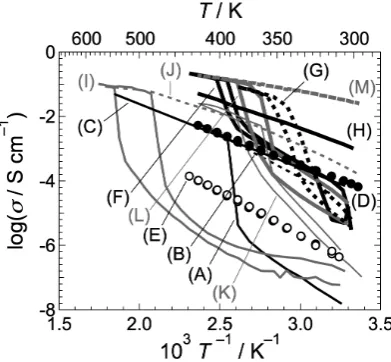
We have previously investigated the factors influencing the stable operation of the bulk-type all-solid-state TiS2/Li bat-teries using the LiBH4 electrolyte, paying careful attention to the interface stability between the positive electrode active material and the solid state electrolyte in the positive elec-trode layer. The precipitates accompanied by hydrogen de-sorption from the interface region, most likely Li2B12H12,2,9–12) act as a stable interface that has high electrochemical stability and charge transfer reactivity. As a result, over 300 discharge– charge cycles were successfully demonstrated.18) We ex-plored a series of complex hydrides having a cluster anion as a novel electrolyte design guide, and discovered various fast lithium26,27) and sodium ionic conductors;26–30) the ionic con-ductivities of a selection of these compounds are shown in Fig. 1.
*
In this study, we have incorporated the Li2B12H12 electro-lyte, which was recently shown by He and coworkers to ex-hibit high lithium ionic conductivity at temperatures lower than 393 K (for instance, log(σ/S cm−1) = −3.6 for Li2B12H1232) while log(σ/S cm−1) = −7.0 for LT–LiBH45) at 333 K), into a bulk-type all-solid-state TiS2/Li battery. It was hypothesized that this would lower the battery operating tem-perature below 393 K.33) In addition, this material was ex-pected to have higher oxidative stability than LiBH4.18) The battery performance is discussed based on the electrochemi-cal and thermal properties of the Li2B12H12 electrolyte.
2. Experimental Procedure
2.1 Preparation of Li2B12H12
In this study, we synthesized Li2B12H12 via the solid-state reaction of LiBH4 (≥ 95%, Sigma-Aldrich) and B10H14 (Re-agent grade, Wako Pure Chemical Industries, Ltd.) as report-ed previously.32,34) The reagents were weighed in a stoichio-metric ratio and mixed using an agate mortar in an agate pes-tle. The powder mixture was further mixed by planetary ball milling at 400 rpm for 5 h. The resultant powder was pressed into pellet, transferred into a molybdenum crucible, and an-nealed at 473 K for 15 h in an Ar environment. The product prepared by the solid-state reaction route is labeled as Li2B12H12(–A). We also examined a commercially available Li2B12H12 4H2O powder (Katchem) was investigated. The powder was dehydrated by annealing at 498 K for 20 h in vacuum. The resultant powder is labeled as Li2B12H12(–B). To identify the crystal structure of both Li2B12H12 samples, powder X-ray diffraction (XRD, X Pert Pro, PANalytical) measurements were carried out at room temperature.
2.2 Electrochemical measurements
The ionic conductivities of Li2B12H12 were investigated us-ing a lithium-symmetric cell configuration and a two-probe ac technique. The powders were placed into an 8 mm die, and pressed at 240 MPa at room temperature. Lithium discs were
cut from a lithium foil (Honjo Metal Co., Ltd.) and placed onto both surfaces of the electrolyte compact. The lithi-um-symmetric cells were placed in a stainless steel electro-chemical cell with an 8 mm diameter Teflon guide, as sche-matically illustrated elsewhere.17) The assembled cell was connected to a Chemical Impedance Meter (3532–80, Hioki Corp.). The ac impedance measurements were carried out in the temperature range from room temperature to 423 K with 10 K step intervals for two heating and cooling cycles. The input voltage perturbation and the frequency range were set to be 50–100 mV and 1 M–4 Hz, respectively. Cyclic voltam-mograms were obtained at a scan rate of 5 mV s−1 for asym-metric stainless steel (SS) | Li2B12H12(–A) | Li cells at 393 K and 333 K in the voltage range from −0.1 to 5 V. DC relax-ation curves were collected for lithium symmetric cells using the Li2B12H12(–A) electrolyte under a constant voltage of 20 mV at 393 K and 333 K for 1 h using an electroanalytical system (1470E, Solartron Analytical).
2.3 Battery assembly and testing
Commercially available TiS2 powder (99.9%, Sigma-Al-drich) was used as the positive electrode active material. The TiS2 powder and Li2B12H12 were mixed in a 2:3 mass ratio using an agate pestle in an agate mortal. The resultant mix-tures were then used as the composite positive electrode. At first, 25 mg of the Li2B12H12 powder was placed in an 8 mm die, and then pressed at 60 MPa at room temperature. Subse-quently, 6 mg of the composite positive electrode powder was transferred onto the pressed electrolyte still present in the die, and uniaxially pressed at 240 MPa to obtain a single pellet comprised of the composite positive electrode and the elec-trolyte layers.
The microstructures and element distributions of the bilay-er compact comprised of the composite positive electrode and electrolyte layers were recorded using a scanning electron microscope (SEM, JSM-6009, JEOL Ltd.) and an energy dis-persive X-ray spectrometer (EDS, EX-54175JMH, JEOL Ltd.), respectively. A lithium disc with an 8 mm diameter was cut from a lithium foil and used as the negative electrode. The lithium disc was placed opposite the positive electrode layer. The assembled bulk-type all-solid-state TiS2/Li battery was placed in a stainless steel electrochemical cell, as in the case of the conductivity measurements described above. Battery tests were carried out at 393 K and 0.2 C, and 333 K and 0.05 C in the voltage range of 1.6–2.7 V using an electro-chemical battery test system (580 Battery Test System, Scrib-ner Associates, Inc.). The values 0.2 C and 0.05 C correspond to the current densities of 228 µA cm−2 and 57 µA cm−2, re-spectively. The batteries were held at the measurement tem-peratures for 2 h to observe the open circuit potential (OCP) prior to the battery test. An extra battery was assembled for the OCP measurement at 373 K to systematically observe the OCP values as a function of temperature.
In order to compare the battery performances, we assem-bled a battery consisting of the TiS2/Li2B12H12(–B) positive electrode, the LiBH4 electrolyte, and the Li negative elec-trode, and 20 mg of the LiBH4 powder was used for the bat-tery assembly. The procedure was the same as the batbat-tery as-sembly described above.
The reactivity of TiS2 with electrolytes such as LiBH4, Fig. 1 Lithium ionic conductivities of (A) LiBH4,5) (B) Li4(BH4)3I,31) (C)
[image:2.595.71.267.70.251.2]Li2B12H12(–A), and Li2B12H12(–B) was investigated by means of the powder XRD measurements at room tempera-ture. TiS2 and the electrolytes were mixed in a 2:3 mass ratio (the same mixing ratio as for the composite positive electrode for the battery assembly), pressed into a pellet and annealed at 393 K for 2 h. The resultant compacts were well ground and again annealed 10 times or until the solid-state reaction was likely finished.
3. Results and Discussions
3.1 Crystal structure of Li2B12H12 and battery assembly
Peaks in the XRD patterns obtained for both Li2B12H12(–A) and Li2B12H12(–B) could be assigned to the cubic phase of Li2B12H12 with the space group of Pa−3.35) The lattice pa-rameter, a, was 0.9535(3) nm for Li2B12H12(–A), and 0.956009(9) nm for Li2B12H12(–B). These values were simi-lar to the literature data in which a = 0.95771(2) nm.35)
Regardless of the preparation method, Li2B12H12 allowed for the assembly of the bulk-type all-solid-state batteries merely by uniaxial pressing at room temperature, i.e., cold-pressing similar to that used for LiBH4, because of their high deformability,7,16–20) as a photograph shown in Fig. 2. Microstructures observed by SEM and element distributions evaluated by EDS, shown in Fig. 3, suggest that the electro-lyte layer is fully densified, and robust interfaces are intro-duced between TiS2 and Li2B12H12(–A), and between the positive electrode and the electrolyte layers. This microstruc-ture is ideal to reduce the contact resistance at the hetero-in-terfaces.36)
3.2 Battery test
Repeated operations of the bulk-type all-solid-state TiS2/
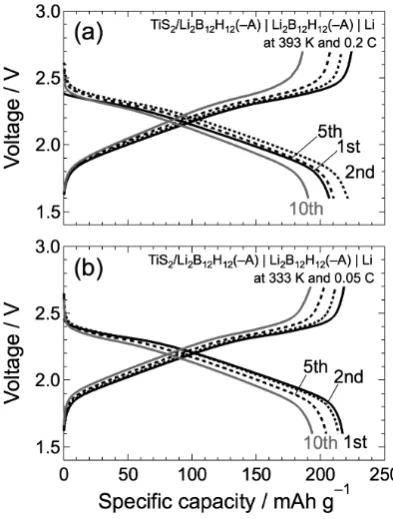
Li batteries were successfully demonstrated at 393 K and 333 K when the Li2B12H12(–A) electrolyte was used, as the discharge–charge profiles shown in Figs. 4. The electrochem-ical intercalation and deintercalation of lithium-ions into TiS2 and from LixTiS2, respectively, proceed as:37,38)
TiS2+xLi++xe− LixTiS2 (2) The theoretical capacity is 239 mAh g−1 when x in Li
xTiS2 varies from 0 to 1.
Our battery exhibited an initial discharge capacity of 207 mAh g−1 when operated at 393 K and 0.2 C. A high dis-charge capacity of 190 mAh g−1 was maintained at the tenth discharge. The high discharge capacity of the battery was re-tained even though the battery operating temperature were reduced to 333 K, and at 0.05 C. At this temperature, the ini-tial discharge capacity was 217 mAh g−1. The tenth discharge capacity remained as high as 193 mAh g−1. Regardless of the battery operating temperature, our battery realized a high coulombic efficiency, which is defined by the ratio of the dis-charge capacity to the dis-charge capacity, at the initial cycle as is expected for this electrolyte18) and summarized in Table 1. The stability of this electrolyte will be discussed later. The battery test results suggest that both the high lithium ionic conductivity and the high oxidative stability of Li2B12H12(–A) ensured the repeated operation of the bulk-type all-solid-state battery with high coulombic efficiency.
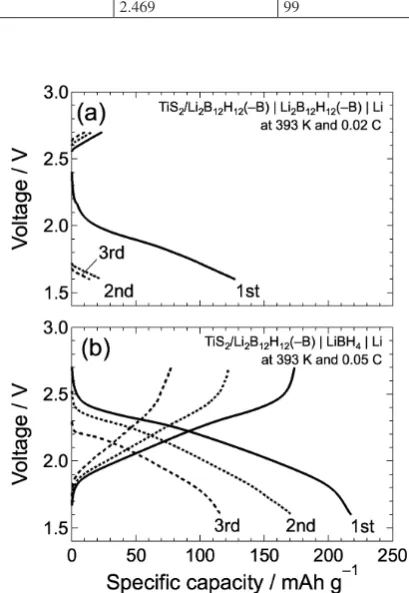
On the other hand, repeated operation of the bulk-type all-solid-state battery that used the Li2B12H12(–B) electrolyte was not possible, as may be seen from the discharge–charge profiles shown in Fig. 5 (a). This was in spite of a C-rate one order of magnitude smaller than the that used for the TiS2/Li battery incorporating the Li2B12H12(–A) electrolyte at 393 K. Although further investigation is needed to fully understand Fig. 2 A photograph of the bulk-type all-solid-state battery, TiS2/
Li2B12H12(–A) | Li2B12H12(–A) | Li. A part of the negative electrode was delaminated to clearly show the battery configuration.
Fig. 3 Fractured surface image and element distributions of the bilayer compact consisting of the composite positive electrode, TiS2/ Li2B12H12(–A), and the electrolyte, Li2B12H12(–A). (a) SEM image. Dis-tributions of (b) B, (c) Ti, and (d) S.
[image:3.595.326.523.69.329.2] [image:3.595.69.268.71.171.2] [image:3.595.47.292.238.327.2]this reason, large internal resistance is a possible factor that interferes the battery operation; thus, we evaluated the ionic conductivities of Li2B12H12(–A) and Li2B12H12(–B), as shown in Fig. 1. While Li2B12H12(–A) possessed a lithium ionic conductivity of log(σ/S cm−1) = −2.6, Li
2B12H12(–B) had only log(σ/ S cm−1) = −4.4 at 393 K. The high lithium ionic conductivity of log(σ/S cm−1) = −3.5 at 333 K for Li2B12H12(–A) is thought to allow for battery operation at this temperature.
To assess the impact of lithium ionic conductivity on bat-tery performance, the performance of the bulk-type all-solid-state TiS2/Li battery that uses LiBH4 as the electrolyte layer was evaluated, and the results are shown in Fig. 5 (b). The lithium ionic conductivity of LiBH4 has been reported as log(σ/S cm−1) = −2.7.5) The battery performance was im-proved compared with the battery comprised of only the Li2B12H12(–B) electrolyte. The TiS2/Li battery that uses LiBH4 exhibited a high initial discharge capacity of 217 mAh g−1, but the second and the third discharge
capaci-ties degraded and were 171 mAh g−1 and 116 mAh g−1, re-spectively. The lithium ionic conductivity of LiBH4 is higher than that of Li2B12H12(–B) at 393 K, and the lithium ionic conductivity of the latter compound in the composite positive electrode is considered insufficient. Hence, this limits the per-formance of the bulk-type all-solid-state TiS2/Li battery.
3.3 Stability of Li2B12H12
In the cyclic voltammograms obtained for the asymmetric SS | Li2B12H12(–A) | Li cells, reversible reductive and oxida-tive currents were observed at around 0 V owing to lithium dissolution and precipitation at 393 K and 333 K, as shown in Fig. 6 (a) and (b). In addition, when dc voltage was applied to the lithium symmetric cells, the current rapidly relaxed and steady-state currents were observed, as displayed in Fig. 6 (c). These results suggest that the Li2B12H12(–A) electrolyte forms a stable interface with the lithium electrode, as illus-trated by the stable battery operation demonsillus-trated for the bulk-type all-solid-state TiS2/Li battery in Fig. 4 (a) and (b).
In the high voltage range, no irreversible oxidative wave was observed at the interface comprised of the Li2B12H12(–A) and the SS electrode. The OCP of the bulk-type all-solid-state TiS2/Li battery using the Li2B12H12(–A) electrolyte was 2.386 V (vs. Li/Li+) although a value of 2.452 V is expected for LixTiS2 (x ∼ 0) at 393 K.18) In addition, the coulombic ef-ficiency at the initial cycle deviated from 100% at the higher battery operating temperatures. These results suggest that the intercalation of Li into TiS2 via the solid-state reaction be-tween TiS2 and Li2B12H12(–A) took place before the battery test in the composite positive electrode at the battery operat-ing temperature. Since the interface stability is determined by the combination of the electrolyte and electrode materials, we decided to investigate the oxidative stability of Li2B12H12 by investigating the reactivity with TiS2.
To understand the reactivity between TiS2 and Li2B12H12(–A), we carried out the XRD measurements on the mixture obtained after repeated solid-state reaction cycle at 393 K. For comparison, we carried out the identical sol-id-state reactions and subsequent XRD measurements for the mixtures comprised of TiS2, and LiBH4 or Li2B12H12(–B). The diffraction peaks resulting from TiS2 shifted towards lower angles for the TiS2/LiBH4, and TiS2/Li2B12H12(–A) mixtures following annealing at 393 K for 2 h, as may be seen from the XRD patterns shown in Fig. 7 (a) and (b). These results suggest that a lattice expansion of TiS2 took place in these mixtures. The lattice expansion of TiS2 in the Table 1 Summary of open circuit potential (OCP) (vs. Li/Li+) just before
the battery test, and the coulombic efficiency (defined by the ratio of charge capacity to discharge capacity) at the initial cycle of the bulk-type all-solid-state TiS2/Li battery using the Li2B12H12(–A) electrolyte. The OCPs of LixTiS2 are 2.452 V and 1.664 V (vs. Li/Li+) when x ∼ 0 and x ∼ 1, respectively, at 393 K.18)
Battery operating temperature/K
OCP (vs. Li/Li+)/V Coulombic efficiency at the initial cycle/%
393 2.386 92
373 2.409 94
333 2.469 99
Fig. 5 Discharge–charge profiles of the bulk-type all-solid-state batteries: (a) TiS2/Li2B12H12(–B) | Li2B12H12(–B) | Li operated at 393 K and 0.02 C (23 μA cm−2), and (b) TiS2/Li2B12H12(–B) | LiBH4 | Li operated at 393 K and 0.05 C (57 μA cm−2).
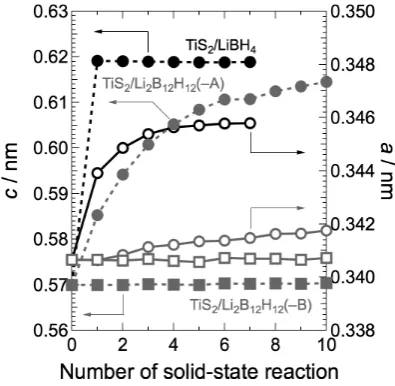
[image:4.595.306.550.69.162.2] [image:4.595.64.269.184.481.2]TiS2/LiBH4 mixture was more obvious than that in the TiS2/ Li2B12H12(–A) mixture. On the other hand, as shown in Fig. 7 (c), no peak shifts were observed for the mixtures of TiS2/ Li2B12H12(–B) despite the fact that the solid-state reaction cy-cle was repeated 10 times. From the XRD patterns of the mix-ture, we evaluated the lattice parameters of LixTiS2 by assum-ing that the lattice expansion of TiS2 was caused only by the intercalation of lithium into TiS2, and the results are depicted in Fig. 8.
Before the annealing, our TiS2 had a hexagonal structure with a space group of P−3m1, and the lattice parameters were
a = 0.34061(2) nm and c = 0.56986(7) nm.18) These agree with the literature data of a = 0.34079(3) nm and c = 0.56989(6) nm.39) For the TiS
2/LiBH4 mixture, the lattice pa-rameters were a = 0.34580(2) nm and c = 0.61885(4) nm after the seventh solid-state reaction. These parameters agree with the literature data for LiTiS2, i.e., a = 0.34590(3) nm and c = 0.61879(6) nm.38) This means that the solid-state reaction cy-cle between TiS2 and LiBH4 to form LiTiS2 was finished by the seventh solid-state reaction. Since LixTiS2 has a redox po-tential of 1.664 V (vs. Li/Li+) when x ∼ 1,18) the decomposi-tion potential of LiBH4 is lower than this voltage at 393 K.
For the TiS2/Li2B12H12(–A) mixture, the lattice parameters for LixTiS2 were a = 0.34176(5) nm and c = 6.145(1) nm. From the literature data describing the lattice parameters as a function of x in LixTiS2,40) we could estimate x in LixTiS2 to be x = 0.3–0.4. This result suggests that Li2B12H12(–A) is less reactive than LiBH4. Thus, our battery realized a high OCP before the battery test and a high coulombic efficiency over the battery operation, as shown in Fig. 4. It should be noted here that the reaction between TiS2 and Li2B12H12(–A) was unlikely to be finished after ten solid-state reaction cycles. Thus, further investigations are required to fully address the thermodynamics of Li2B12H12(–A).
1H MAS-NMR spectra of Li
2B12H12(–A) inferred the exis-tence of a non-negligible concentration of the [B10H10]2− cluster anion.32) As in this previous report, we also observed small concentrations of [BH4]− and [B10H10]2− in the 1H MAS-NMR spectra of the Li2B12H12(–A) electrolyte synthe-sized in this study. In addition, the differential scanning calo-rimetry (DSC) profile at elevated temperature exhibited a sharp endothermic peak appeared at 630 K for Li2B12H12(–B), accompanied by a phase transition.41) Such a clear endother-mic peak was not observed for the Li2B12H12(–A). Gas chro-matograph (G.C.) profiles at elevated temperatures show that Li2B12H12(–B) underwent a one-step pyrolysis reaction at temperatures around 750–850 K. On the other hand, the situ-ation seems to be more complicated for Li2B12H12(–A). This material had more than two pyrolysis steps, appearing at 570– 750 K and higher than 770 K (1H MAS-NMR spectra, DSC and GC profiles are not shown). These results suggest that the controls of ionic conduction and thermodynamic properties of the complex hydrides containing cluster anion would be possible by utilizing crystal modifications, which are differ-ent from the convdiffer-entional elemdiffer-ent replacemdiffer-ent method, typi-cally replacement of the complex anion by halides.31) In addi-tion, we recently discovered that when Na2B12H12 powder is aggressively ball-milled, the crystals become nanometer scaled, which results in the disappearance of the conductivity jump accompanied by the phase transition.29) As a result, ball-milled Na2H12H12 possessed high sodium ionic conduc-tivity of log(σ/S cm−1) = −3.8 at room temperature, as shown in Fig. 1. Our future studies will focus on how the chemical composition and microstructure of the complex hydrides with cluster anions impact on the ionic conductivity and phase sta-bilities.
4. Conclusion
In this study, we incorporated the Li2B12H12 electrolyte into a bulk-type all-solid-state TiS2/Li battery. Repeated op-erations were successfully demonstrated for at least ten dis-charge–charge cycles, retaining high discharge capacities, at 393 K and 333 K. At these temperatures, this material has a high lithium ionic conductivity of log(σ/S cm−1) = −2.6 at 393 K, and −3.5 at 333 K. Compared with the bulk-type all-solid-state TiS2/Li battery that uses the LiBH4 electrolyte, our battery maintained high initial discharge capacity and high coulombic efficiency during the repeated discharge– charge cycles. These are owing to the superior oxidative sta-bility of Li2B12H12 compared with LiBH4. In future studies, we will investigate the detailed chemical composition, micro-Fig. 7 Powder XRD patterns of the mixtures of (a) TiS2 and LiBH4, (b)
TiS2 and Li2B12H12(–A), and (c) TiS2/Li2B12H12(–B). The solid-state re-action was carried out at 393 K for 2 h in an Ar environment, and it was repeated ten times for until the solid-state reaction was likely finished.
[image:5.595.55.285.66.206.2] [image:5.595.69.267.272.465.2]structure and phase stability of this class of materials with a view toward the development of high-performance novel sol-id-state electrolytes for use in batteries.
Acknowledgments
The authors would like to thank Mr. K. Sato, Ms. H. Ohm-iya, and Ms. N. Warifune for technical assistance. Financial support from the Target Project 4 of WPI–AIMR, Tohoku University; Collaborative Research Center on Energy Materi-als, Tohoku University; JSPS KAKENHI Grant No. 25220911; and the Advanced Low Carbon Technology Re-search and Development Program (ALCA) from the Japan Science and Technology Agency (JST) are gratefully ac-knowledged.
REFERENCES
1) L. Schulapbach and A. Züttel: Nature 414 (2001) 353–358.
2) S. Orimo, Y. Nakamori, J.R. Eliseo, A. Züttel and C.M. Jensen: Chem. Rev. 107 (2007) 4111–4132.
3) W. Zaïdi, J.-P. Bonnet, J. Zhang, F. Cuevas, M. Katroche, S. Couillaud, J.-L. Bobet, M.T. Sougrati, J.-C. Jumas and L. Aymard: Int. J. Hydro-gen Energ. 38 (2013) 4798–4808.
4) J. Zhang, W. Zaïdi, V. Paul-Boncour, K. Provost, A. Michalowicz, F. Cuevas, M. Latroche, S. Belin, J.-P. Bonnet and L. Aymard: J. Mater. Chem. A 1 (2013) 4706–4717.
5) M. Matsuo, Y. Nakamori, S. Orimo, H. Maekawa and H. Takamura:
Appl. Phys. Lett. 91 (2007) 224103.
6) M. Matsuo and S. Orimo: Adv. Energy Mater. 1 (2011) 161–172.
7) A. Unemoto, M. Matsuo and S. Orimo: Adv. Funct. Mater. 24 (2014) 2267–2279.
8) J.-P. Soulie, G. Renaudin, R. Cerny and K. Yvon: J. Alloy. Compd. 346 (2002) 200–205.
9) A. Züttel, S. Rentsch, P. Fischer, P. Wenger, P. Sudan, P. Mauron and C. Emmenegger: J. Alloy. Compd. 356–357 (2003) 515–520.
10) M.P. Pitt, M. Paskevicius, D.H. Brown, D.A. Sheppard and C.E. Buck-ley: J. Am. Chem. Soc. 135 (2013) 6930–6941.
11) S. Orimo, Y. Nakamori, N. Ohba, K. Miwa, S. Towata, A. Züttel and M. Aoki: Appl. Phys. Lett. 89 (2006) 021920.
12) N. Ohba, K. Miwa, M. Aoki, T. Noritake, S. Towata, Y. Nakamori, S. Orimo and A. Züttel: Phys. Rev. B 74 (2006) 075110.
13) T. Ikeshoji, E. Tsuchida, K. Ikeda, M. Matsuo, H.-W. Li, Y. Kawazoe and S. Orimo: Appl. Phys. Lett. 95 (2009) 221901.
14) T. Ikeshoji, E. Tsuchida, T. Morishita, K. Ikeda, M. Matso, Y. Kawazoe and S. Orimo: Phys. Rev. B 83 (2011) 144301.
15) J.S.G. Myrdal, B. Blanchard, D. Sveinbjörnsson and T. Vegge: J. Phys. Chem. C 117 (2013) 9084–9091.
16) A. Unemoto, H. Wu, T.J. Udovic, M. Matsuo, T. Ikeshoji and S. Orimo:
Chem. Commun. (Camb.) 52 (2016) 564–566.
17) A. Unemoto, S. Yasaku, G. Nogami, M. Tazawa, M. Taniguchi, M. Matsuo, T. Ikeshoji and S. Orimo: Appl. Phys. Lett. 105 (2014) 083901.
18) A. Unemoto, T. Ikeshoji, S. Yasaku, M. Matsuo, V. Stavila, T.J. Udovic and S. Orimo: Chem. Mater. 27 (2015) 5407–5416.
19) A. Unemoto, C. Chen, Z. Wang, M. Matsuo, T. Ikeshoji and S. Orimo:
Nanotechnology 26 (2015) 254001.
20) K. Yoshida, S. Suzuki, J. Kawaji, A. Unemoto and S. Orimo: Solid State Ionics 285 (2016) 96–100.
21) A. Brazier, L. Dupont, L. Dantras-Laffont, N. Kuwata, J. Kawamura and J.-M. Tarascon: Chem. Mater. 20 (2008) 2352–2359.
22) A. Sakuda, A. Hayashi and M. Tatsumisago: Chem. Mater. 22 (2010) 949–956.
23) N. Ohta, K. Takada, L. Zhang, R. Ma, M. Osada and T. Sasaki: Adv. Mater. 18 (2006) 2226–2229.
24) J. Haruyama, K. Sodeyama, L. Han, K. Takada and Y. Tateyama: Chem. Mater. 26 (2014) 4248–4255.
25) K. Takada: Acta Mater. 61 (2013) 759–770.
26) W.S. Tang, A. Unemoto, W. Zhou, V. Stavila, M. Matsuo, H. Wu, S. Orimo and T.J. Udovic: Energy Environ. Sci. 8 (2015) 3637–3645.
27) W.S. Tang, M. Matsuo, H. Wu, V. Stavila, W. Zhou, A.A. Talin, A.V. Soloninin, R.V. Skoryunov, O.A. Babanova, A.V. Skripov, A. Unemoto, S. Orimo and T.J. Udovic: Adv. Energy Mater. 6 (2016) 1502237.
28) T.J. Udovic, M. Matsuo, A. Unemoto, N. Verdal, V. Stavila, A.V. Skri-pov, J.J. Rush, H. Takamura and S. Orimo: Chem. Commun. (Camb.)
50 (2014) 3750–3752.
29) W.S. Tang, M. Matsuo, H. Wu, V. Stavila, A. Unemoto, S. Orimo and T.J. Udovic: Energ. Storage Mater. 4 (2016) 79–83.
30) T.J. Udovic, M. Matsuo, W.S. Tang, H. Wu, V. Stavila, A.V. Soloninin, R.V. Skoryunov, O.A. Babanova, A.V. Skripov, J.J. Rush, A. Unemoto, H. Takamura and S. Orimo: Adv. Mater. 26 (2014) 7622–7626.
31) H. Maekawa, M. Matsuo, H. Takamura, M. Ando, Y. Noda, T. Kara-hashi and S. Orimo: J. Am. Chem. Soc. 131 (2009) 894–895.
32) L. He, H.-W. Li, H. Nakajima, N. Tumanov, Y. Filinchuk, S.-J. Hwang, M. Sharma, H. Hagemann and E. Akiba: Chem. Mater. 27 (2015) 5483–5486.
33) J.A. Teprovich, Jr., H. Colon–Mercado, A.L. Washington, II, P.A. Ward, S. Greenway, D.M. Missimer, H. Hartman, J. Velten, J.H. Chris-tian and R. Zidan: J. Mater. Chem. A 3 (2015) 22853–22859.
34) L. He, H.-W. Li, S.-J. Hwang and E. Akiba: J. Phys. Chem. C 118 (2014) 6084–6089.
35) J.-H. Her, M. Yousufuddin, W. Zhou, S.S. Jalisatgi, J.G. Kulleck, J.A. Zan, S.-J. Hwang, R.C. Bowman, Jr. and T.J. Udovic: Inorg. Chem. 47 (2008) 9757–9759.
36) A. Sakuda, A. Hayashi and M. Tatsumisago: Sci. Rep. 3 (2013) 2261.
37) M.S. Whittingham: Science 192 (1976) 1126–1127.
38) M.S. Whittingham: Prog. Solid State Chem. 12 (1978) 41–99.
39) J. Dahn, W. McKinnon, R.R. Haering, W. Buyers and B. Powerll: Can. J. Phys. 58 (1980) 207–213.
40) J. Dahn and R.R. Haering: Solid State Commun. 40 (1981) 245–248.