Munich Personal RePEc Archive
An interactive fuzzy judgment
aggregation model for consensus with
partially undecided judges
Beg, Ismat and Syed, Ayesha
Lahore School of Economics
15 November 2016
Online at
https://mpra.ub.uni-muenchen.de/96096/
1
An interactive fuzzy judgment aggregation model for
consensus with partially undecided judges
Ismat Beg and Ayesha Syed
Lahore School of Economics, Lahore 53200, Pakistan
Corresponding author e-mail; [email protected]
Abstract
New requirements and challenges arise in judgment aggregation, due to the complexity of judgment making process and the necessity of dealing with huge amounts of vague and uncertain information and alternatives. In this paper we propose an interactive fuzzy judgment aggregation method for consensus to deal with the situation where judges are partially undecided.
Keywords: Judgment aggregation; fuzzy; consensus decision.
JEL classification: C02; C60; D71.
1.
Introduction
Judgment aggregation deals with the issue of making collective decision concerning
truth-values of multiple issues. Each judge sets out its judgment in form of true or false. A
judgment aggregation rule signifies the form and combination through which the truth-value
assignments are combined together to reach at a collective solution. The theory basically
questions how the numerous judgments on logically connected propositions can be aggregated
into consistent group decision. In spite of the fact that judgment aggregation have been an object
of research during last several decades, new requirements and challenges often arise, due to the
complexity of judgment making process, and the necessity of dealing with huge amounts of
information and alternatives. More over these problems are ill-structure, whose framework often
2
at numerous times judgment aggregation face the problem of incomplete judgment set. This
situation arises when among the panel of judges; one or more judges refrain from giving an
opinion on a proposition. These sorts of situations could be the result of missing information the
judge had while making the decision. The reason a judge may refrain from giving judgment on a
certain proposition could be for many reasons, the judge does not have sufficient information to
decide, the judge may consider a proposition irrelevant and abstain to give opinion, or the judge
may be indifferent between two alternatives.
Collaboration between multiple judges is based on cooperation and coordination. Group
decisions reached by the judges should be superior over other factors like personal opinions and
needs of the judges. A kind of group assent (majority) is called a consensus. A consensus is
mutual and binding cooperation among judges. The whole process of reaching a consensus has
become a major research field in economics, considering cases when a decision has a socio
economic impact. Social choice theory in economics has worked in order to reach methods that
help individuals to reach a decision that is chosen from a given set of alternatives. In the horizon
of social choice theory there are different theories such as, preference theory, voting theory,
utility theory and judgment aggregation theory. They focused on shaping formulas and
procedures to reach coherent collective outcomes. After Arrow (1963) classic book “Social
Choice and Individual Values”, the theory of aggregation has become a booming area for
research. Arrow’s book emphasize on the aggregation of preferences. Since there are many
economic and political situations where preference ordering is required, thus Arrow’s work
inspired many researchers. The link between social scientists and this field goes back to the
3
The main aim of this work is to study the situation in which judges involved in complex
judgment making problems usually provide information about their preferences by eliciting their
knowledge with different fuzzy assessments including abstaining. Fuzzy model is used to
overcome the complexity due to uncertainty and vagueness.
2.
Literature review
Condorcet (1785) studied voting theory and analyzes cyclical preferences. Judgment
aggregation also faces similar problems like preference aggregation named as “discursive
dilemma”. Kornhauser and Sager (1896) discussed the problem of “doctrinal paradox” or
“discursive dilemma” with the help of a three member court example. Dokow and Holzman
(2010) in their paper studied the problem of missing judgments by working on a new framework,
they allowed abstentions on several issues. Dokow and Holzman (2010) further explains their
model by stating that those numbers that are part of set {0,1} have to be equal to the number of
issues. The problem arises when number of issues are not equal to the number of judgments.
Dokow and Holzman (2010) extended the known model due to Wilson (1951). Afterwards
Fishburn and Rubinstein (2006) further generalized it. However in addition to the existing
literature they allowed abstaining on judgments for any specific reason. Mathematical model in
their paper was constructed in a way that abstentions were captured by another object * to be
characterized by abstaining from judgment. One of the axiom in Arrow’s analogue is
Independence, which means that society’s stand on an issue should be dependent only on
individual’s decision on that issue. Second axiom was Pareto optimality, which means that
society accepts any 0 or 1 position. Hence the result of Dokow and Holzman (2010) implied the
theorem for linear preferences only. Their work was motivated by the work of Gardenfors
4
to have judgments that are only consistent and complete. However Benarma et al. (2010)
allowed judges to abstain or give neutral judgments, as well as they included an additional point
by allowing judges to give their agreement or disagreement on the decision rule where they can
also if not satisfy with the decision rule, include their own decision rule. Miller (2008) in his
remarkable paper worked on subjectivity of the decision making and illustrated how the
aggregation problem looks like when judges have different views on the way premises are
connected. Miller (2008) presented a model where there is no defined decision rule rather
certain premises where the judges have to give their opinion, however along with opinion the
judges also state the rule that they want to follow and then their decision is calculated based on
that decision rule. Miller (2008) allowed the judges to explain their decision rule where only
some specific premises which they deem relevant appear, but alongside the judges also have to
explain their opinion on the propositions they have stated to be irrelevant for the final decision.
This basically aims to invoke the subjectivity of the decision maker and their decision will be
based on their analysis and connection between the premises and how they think it will affect.
For future work, Miller (2008) suggested that other general logics along with probabilistic
approach can help to achieve the missing and hindering factor in this approach. Fuzzy set theory
has provided successful results in different fields to model and cope with the inherent uncertainty
and vagueness. Lagerspetz (2016) has studied the conditions of Arrow’s general possibility
theorem and has shown how the independence axiom is plausible in democratic decision making.
Bellman and Zadeh (1970) and Beg and Butt (2012) have shown the usefulness of using fuzzy
models.
3.
Basic concepts
5
Definition 3.1. [Zadeh (1965)] A fuzzy subset 𝐴 of a non-empty universe U is a
mapping 𝐴: 𝑈 ⟶ [0, 1]. Here for any x in U, A(x) can be assigned any value between the
number 0 and 1, and the number A(x) is the degree of membership of x in fuzzy subset A of U.
The theory of fuzzy sets is filled with numerous aggregation operators known as
triangular norms and their implications. These functions have played a substantial role in
forming some of the important insights in aggregations.
Definition 3.2. [Beg and Ashraf (2008)] A triangular norm (t-norm) ∆ is a function
∆: [0, 1] × [0, 1] → [0, 1] .
Satisfying,
i. ∆(𝑥, 1) = 𝑥. (identity element)
ii. ∆(𝑥, 𝑦) = ∆(𝑦, 𝑥) (commutative)
iii. ∆(𝑥, (∆(𝑦, 𝑧)) = ∆ (∆(𝑥, 𝑦), 𝑧) (associative)
iv. ∆(𝑥, 𝑦) ≤ ∆(𝑥, 𝑧) 𝑖𝑓 𝑦 ≤ 𝑧 (monotonicity).
For all x, y, z ϵ [0, 1].
In this work we will use Łukasiewicz t-norm denoted by ∆𝐿 and defined by
∆𝐿(𝑥, 𝑦) = 𝑚𝑎𝑥 {0, 𝑥 + 𝑦 − 1} .
Definition 3.3. [Beg and Ashraf (2008)] Hamming distance H between two sets of judgement on
given proposition is the number of propositions on which they disagree.
For example if there are two judgement sets 𝑗𝑖 ={TFF}={1,0,0} and 𝑗′𝑖
={FFF}={0,0,0}, then the Hamming distance between 𝑗𝑖 and 𝑗′𝑖 is
𝐻(𝑗𝑖 , 𝑗′
6
4.
Proposed method and illustrative example
Method: Our model uses Dietrich’s (2007, 2016) model of judgment aggregation and Beg and
Butt (2012) a fuzzy aggregation model. Explaining some basics of our model, let £ be a logical
language. A panel of members in a committee who have to decide on an agenda, where an
agenda is a non-empty set 𝛽 ⊆ £, interpreted as a set of propositions on which judgments are
made, with 𝛽 as a union of proposition-negation pairs. The model is based on certain essential
elements, let π be a logical language with connectives. Now given our agenda, each individual i’s
judgment set is an element 𝑗𝑖. Our model is based on the fact that this approach gives judges
freedom to state their opinion in the range between 0 and 1 using membership function. This
methodology gives a far more realistic approach that on an offset allows the agent to assign
proposition the exact amount of truthfulness that they apprehend is accurate.
We assume that judges can give their opinion in form of a degree of membership which will
lie in [0, 1], additional to this judges can either stay neutral [N] or they can abstain [A] from
giving an opinion. Distance from the collective outcome is then calculated with the help of
Hamming distance, value that gives the minimum distance are placed in the missing judgment
set. Further work is done to make the calculations into the area where the judgment set is
consistent, closed but not complete. Inference of this idea is based on Gardenfors (2006), who
stated that it is not possible in real situations to always get the judgment sets that are complete.
Following this stance, this work employs in fuzzy set theory and work out in situations where
judgment set is not complete. The basic concern is under what circumstances the judges may
7
To further illustrate reasons for a judge to desist in giving an opinion; consider the case of a
committee of five members, who have to make a decision for the selection of a Ph.D. instructor.
Following are the clauses on which members cast their vote:
a: Years of experience
b: Number of publications
c: Selection for the position
Now members/judges can vote between a range [0, 1], assign a degree of membership, stay
neutral [N] or abstain [A] from giving an opinion. Multiple reasons could result in neutral
opinion by the judge. Neutrality basically defines the idea that the judge is indifferent regarding
that proposition. Clause for the number of publications in an agenda to decide for a Ph.D.
instructor could draw mixed opinion by judges. The candidate might have enough publications
but the judge is not satisfied with the journals and quality of the publications. In this situation
when the judge wants to stay out of any controversy he may name his judgment as neutral (N) on
this proposition. Another such case could be if the judge thinks that the actual subject matter in
this case should be the number of years a candidate has experience in and not the publications,
hence he wants to stay neutral.
On the other hand a judge may abstain from giving a judgment for two reason; one is that
he might not consider the clause to be important enough and hence gives no judgment on it.
Other could be when the judge thinks that the information he has regarding the clause are not
enough and his decision may not be right, in this case judge may refrain from giving an opinion.
Thus for any reason, a judge abstains from giving an opinion and the problem of incomplete
8
membership equal 0.5 is assigned, as per the preference theory. The idea of preference theory
states that the individual assigns a value of 1 if he completely prefers B over A and a value of 0 if
he completely prefers A over B. In judgment aggregation which is the specific form of preference
theory, if the judge is indifferent on a proposition, the degree of membership assigned is equal to
0.5. For the decision rule, we will use Łukasiewicz t-norm and calculate the values for the
decision clause. To calculate the values for abstentious judgments and decision clause example
4.2 is worked with the help of Hamming distance.
Example 4.1. A research work is presented in front of a five member committee. Its funding is
based on a certain criteria presented through following propositions;
𝑎: 𝑜𝑟𝑖𝑔𝑖𝑛𝑎𝑙𝑖𝑡𝑦 𝑜𝑓 𝑡ℎ𝑒 𝑖𝑑𝑒𝑎
𝑏: 𝑎𝑝𝑝𝑙𝑖𝑐𝑎𝑏𝑖𝑙𝑖𝑡𝑦 𝑜𝑓 𝑡ℎ𝑒 𝑖𝑑𝑒𝑎
𝑐: 𝑖𝑓 𝑏𝑜𝑡ℎ (𝑎 𝑎𝑛𝑑 𝑏) 𝑡ℎ𝑒𝑛 𝑓𝑢𝑛𝑑𝑖𝑛𝑔 𝑓𝑜𝑟 𝑡ℎ𝑒 𝑝𝑟𝑜𝑗𝑒𝑐𝑡
Now if a member abstains from giving a judgment, a solution is derived with the help of
Hamming distance from collective judgment. To calculate missing values Hamming
distance 𝐻(𝜃, 𝑗𝑖) is minimized, where 𝜃 is the group average and 𝑗𝑖 is the judgment set with
missing value.
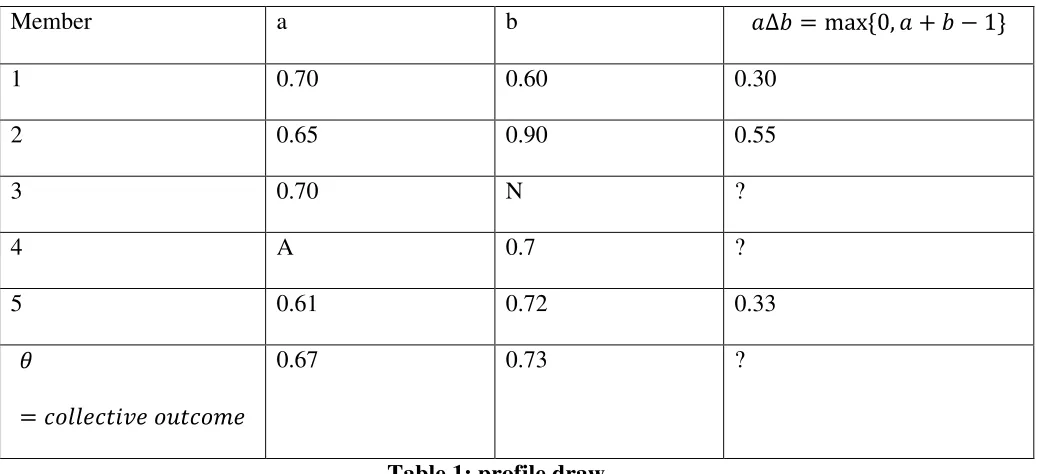
Looking at the Table 1, member 3 decides to stay neutral on proposition “b”. Based on
preference theory we assign 0.5 value to all neutral judgments. For judgment set which has
abstained judgments, Hamming distance 𝐻(𝜃, 𝑗𝑖) will be used to find min 𝐻(𝜃, 𝑗𝑖).
Now
𝐻(𝜃, 𝑗4) = |0.67 − 𝐴| + |0.73 − 0.72|
9
Member a b 𝑎∆𝑏 = max {0, 𝑎 + 𝑏 − 1}
1 0.70 0.60 0.30
2 0.65 0.90 0.55
3 0.70 N ?
4 A 0.7 ?
5 0.61 0.72 0.33
𝜃
= 𝑐𝑜𝑙𝑙𝑒𝑐𝑡𝑖𝑣𝑒 𝑜𝑢𝑡𝑐𝑜𝑚𝑒
[image:10.612.58.577.69.306.2]0.67 0.73 ?
Table 1; profile draw
To minimize 𝐻(𝜃, 𝑗4),“𝜎” should be equal to 0.67, hence A= 0.67 is assigned to
minimize the distance. Entire table is calculated again with values of neutral and abstentious
judgments. Now after using the values generated to fill the missing information in Table 1, we
have Table 2, a complete data set.
Member a b 𝑎∆𝑏 = max {0, 𝑎 + 𝑏 − 1
1 0.70 0.60 0.30
2 0.65 0.90 0.55
3 0.7 N=0.50 ?= 0.20
4 A=0.67 0.70 ?= 0.37
5 0.61 0.72 0.33
𝜃=collective outcome 0.67 0.68 ?= 0.35
[image:10.612.68.574.444.648.2]10
Based on the calculation, new values are assigned to the missing judgment set and the
recommendation is not to support the funding for this research project because collective
outcome = 𝜃 = a∆𝑏 = max {0, 𝑎 + 𝑏 − 1 = 0.35.
Remark 4.1. With this methodology of average values the group judgment sets have less
distance from individual judgment sets meaning the solution will be more realistic and better
representation of group member’s opinion.
Remark 4.2. Second important finding is that in existing literature the judgment of the judge
having missing values is ignored. That is not correct as each judge should be equally represented
in the decision process. More importantly for those propositions for which he has given a
judgment, his opinion should be taken into consideration. This way the solution reached can be
seen as the improved compromise among the judges on a set of propositions and thus make it
more practical.
Remark 4.3. The distance is minimized between judgment set and group outcome, and hence
the overall distance reduces as well.
5.
Conclusion
This study was able to establish the fact that judgment aggregation in fuzzy setting is a
better approach to arrive at group conclusions. It has more participation by each member of the
panel. Case of ignoring partially undecided judges (incomplete judgment set) or approach of
assigning 1 or 0 based on the choice of the researcher, is unrealistic. Our methodology in case of
incomplete judgment set allowed for catering the area of neutral and abstentions of judgment,
where the minimum distance from majority solved the problem. As a society, we have been
11
people. Social welfare departments should be meticulous in deciding how best to use their
budget and resources. Research has been one of the key contributors towards deriving decisions
and has been neglected by most departments. Research primarily includes information gathering,
assessing and analysing it before reaching a conclusion.
References
1. Arrow, K. J. (1963). Social Choice and Individual Values. Yale University Press
2. Beg, I., Ashraf, S. (2008). Fuzzy similarity and measure of similarity with Łukasiewicz implicator. New Mathematics and Natural Computation, 4(02):191-206.
3. Beg, I., Butt, N. (2012). Belief merging and judgment aggregation in fuzzy setting.
Advances in Fuzzy System, 5.
4. Bellman, R.E., Zadeh, L.A. (1970). Decision making in a fuzzy environment,
Management Sciences, 17, 141-164.
5. Benamara, F., Kaci, S., Pigozzi, G. (2010). Individual opinions-based judgment aggregation procedures. Modeling Decisions for Artificial Intelligence. Springer Berlin Heidelberg, 55-66.
6. Condorcet (M.J.A.N de Condorcet). (1785). Essa aur l’application de l’analyse a la probabilite des decisions rendues a la pluralite des viox (Imprimeric Royale, Paris); facsimile published in 1972 by Chalsea Publishing Company, New York.
7. Dietrich, F. (2007). Judgment aggregation in general logics. Social Choice and Welfare, 28(4): 529-565.
8. Dietrich, F. (2016). Judgment aggregation and agenda manipulation. Games and Economic Behavior, 95: 113-136.
9. Dokow, E., Holzman, R. (2010). Aggregation of binary evaluations, Journal of Economic Theory, 145: 495-511.
10.Fishburn, P. C., Rubinstein, A. (1986). Aggregation of equivalence relations. Journal of Classification, 3(1): 61-65.
11.Gärdenfors, P. (2006). A representation theorem for voting with logical consequences.
Economics and Philosophy, 22 (2):181-190.
12.Kornhauser, L., Sager, L. (1986). Unpacking the court. Yale Law Journal, 96: 82-117. 13.List, C., Polak, B. (2010). Introduction to judgment aggregation. Journal of Economic
Theory, 145:441–466.
14.Lagerspetz , E. (2016). Arrow’s Theorem. Social Choice and Democratic Values, 171-245.
15.Miller, M. (2008). Judgment aggregation and subjective decision-making. Economics and Philosophy, 24:205–231.