diffraction suggested that the improvement in the cold workability was the result of stress-induced transformations in both the¡¤¤martensite phase and the metastable¢phase. Furthermore, the short-time aging effect was investigated on the material solution-treated at 1148 K for 1 s and pre-deformed to a 16.7%strain. The results showed that the yield strength recovered and then exceeded the original strength level through short-time aging. [doi:10.2320/matertrans.M2011182]
(Received July 14, 2011; Accepted October 27, 2011; Published December 14, 2011)
Keywords: titanium alloy, titanium6aluminum4vanadium, short-time solution treatment, cold workability, ductility, yield ratio, stress-induced transformation, short-time aging, yield strength
1. Introduction
Ti6Al4V alloy is a typical ¡+¢ titanium alloy that possesses high specific tensile strength (tensile strength/ density) as well as excellent corrosion resistance and good heat resistance. This titanium alloy has been widely used in the aerospace industry in which the weight of products is the primary issue. According to Ref. 1), 56% of the titanium market in the USA, where the aerospace industry is very active, was actually occupied by Ti6Al4V alloy (1998). This indicates the impact of the improvement in the strength and workability of Ti6Al4V alloy.
In previous studies,25)the effect of short-time duplex heat treatment was investigated to improve the strength of Ti 6Al4V alloy. This heat treatment was composed of a first heat treatment at 1203 K for 60 s (water quenching) and a second heat treatment at 803 K for 40 s (air cooling). Hereafter, the first and second heat treatments are respec-tively called short-time solution treatment, and short-time aging. The results showed that the tensile strength and the fatigue strength of the titanium alloy markedly improved by 29 and 22%, respectively, without seeing a reduction in the ductility. Based on an investigation of the microstructure, it was concluded that the above improvement in the strength was a result of the formation of the acicular ¡¤ martensite phase and thefine¡phase in the prior¢phase. At the same time, it was believed that the ductility was maintained by stress-induced transformation of the metastable¢phase in the prior¢phase.
On the other hand, Ti6Al4V alloy has an inherent disadvantage concerning cold workability. In a related study,6) it was found that the ductility of the titanium alloy greatly increased, and in contrast, the yield strength decreas-ed as a result of short-time solution treatment, which was carried out at a relatively low temperature below 1173 K. Although this result was insignificant from the standpoint of
improving the strength, it suggested that short-time solution treatment will improve the cold workability.
From the above background, the effects of short-time solution treatment on the cold workability of Ti6Al4V alloy were carefully investigated. Tofind a suitable treatment condition, the Erichsen test and a bend test, etc., were conducted on the short-time solution-treated material. Furthermore, the effect of short-time aging was investigated on the recovery of yield strength to the original strength level.
2. Materials and Experimental Procedures
2.1 Short-time solution treatment and experimental procedures
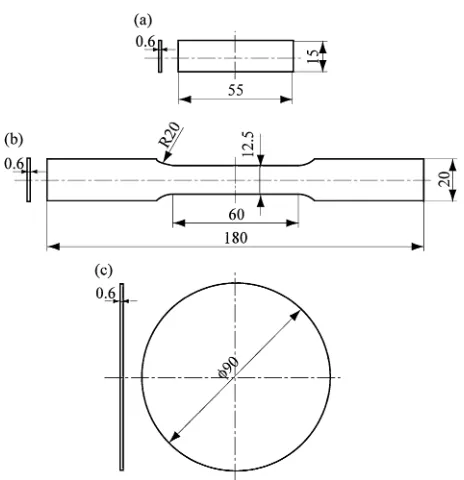
Table 1 shows the chemical composition of a Ti6Al4V alloy used in this study. This material was heat-treated at 1003 K for 4.5 ks, and then air-cooled before the material was accepted. The original shape was a thin plate with a thickness of 0.6 mm. The plates were machined to become one of the three types of specimens shown in Fig. 1. After a short-time solution treatment, the test sections of all the specimens, except the specimens used in the Erichsen test and the bend test, were polished to mirror finish with emery papers and alumina powders.
The specimens for the hardness measurement were solu-tion-treated at 10981223 K for 1, 10, and 60 s (pre-heating time: 60 s), and then water-quenched. The micro-Vickers hardness was measured on the polished surface five times under a test force of 0.98 N. The average of the measured values was used for the result of each material.
Short-time solution treatment was performed at 1098 1223 K for 1 s on the specimens that were used for the
Table 1 Chemical composition of Ti6Al4V alloy (mass%).
Al V O Fe C N H Ti
optical microscopy observations of the microstructure, X-ray diffraction, the tensile test, and the Erichsen test. For comparison, untreated material was also prepared.
The microstructure of each material was observed after etching with a Kroll’s etchant. X-ray diffraction was carried out under the following condition: diffraction angle 2ª= 3442 degrees, angle division 0.02 degree and a scan speed of 8.3©10¹3 degree·s¹1. This analysis was also performed
near the fractured parts of the specimens after the tensile test.
The tensile test was conducted under a displacement speed of 33.3 µm/s at ambient room temperature, based on JIS Z 2241. The Erichsen test was performed to investigate the relationship between the solution treatment temperature and the drawability, based on JIS Z 2247. For this test, a punch with a semispherical top (radius 10 mm) and a die with an inside diameter of 29 mm (radius offillet 3 mm) were used. The force tofix the specimens was 10 kN, and Teflon sheets were used for lubrication.
TEM observation and selected area electron diffraction were carried out for the material solution-treated at 1148 K for 1 s. These experiments were also performed for the solution-treated material fractured by the tensile test. A sample was obtained near the fractured part. The positions of the observation and electron diffraction were in the prior ¢ phase. In addition, thinning of the observation region of each material was conducted by ion-milling.
To confirm bendability improvement, bend tests were further conducted on untreated material and the material solution-treated at 1148 K for 1 s, based on JIS Z 2248. In this test, the bend radii were 3, 3.5, and 4 mm.
2.2 Short-time aging
Although ductility and cold workability were improved through short-time solution treatment, yield strength
simulta-neously decreased (Section 3.2). To recover yield strength after the cold working, the effect of short-time aging was investigated.
The specimens in Fig. 1(c) were first solution-treated at 1148 K for 1 s, and then were pre-deformed to 16.7% strain with a tensile test machine. This plastic deformation was given to simulate the cold working process. In addition, the above strain was the value arrived at tensile strength. Then, the pre-deformed material was aged at 753, 853, and 953 K for 40 s, and then air-cooled. Hereafter, these materials were called PD/AG materials. For comparison, the solution-treated material was also aged under the same conditions (AG materials). For AG and PD/AG materials, an optical microscopy observation of the microstructure, a hardness measurement, and a tensile test were performed using the methods mentioned in Section 2.1.
3. Results and Consideration
3.1 Microstructure and phases
Figure 2 shows the relationship between the solution treatment condition and hardness. As understood from this figure, hardness decreased from the initial level after a short-time solution treatment, except for the condition of 1223 K, 60 s. Since the reduction range of the hardness was larger in the case of 1 s, this holding time was selected to be suitable for the improvement of cold workability.
Figure 3 shows the microstructure of the materials, which were solution-treated at various temperatures. In the micro-structure of the untreated material, the bright region corresponds to equiaxial¡grains, and the dark points around the ¡ grains correspond to the ¢ phase. Although the ¢ phase was observed in the materials solution-treated at 1098 and 1123 K, this phase became unclear with increasing treatment temperature, and was not optically distinguished over 1123 K.
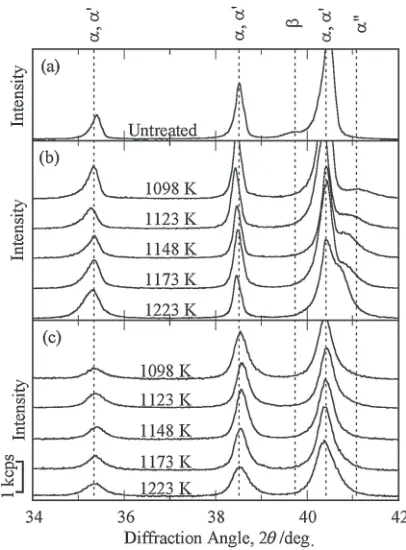
Figure 4 shows the results of X-ray diffraction. Figure 5 shows the microstructures observed by TEM and the electron diffraction patterns. Although bothfigures include the results obtained from the specimens after the tensile test, they will be referred to later.
In the case of the Ti6Al4V alloy, it has been reported that two types of maritensite phases are formed in the prior ¢ Fig. 1 Configurations of specimens (mm) for: (a) hardness measurement
and bend test, etc. (JIS Z2204, No. 3), (b) tensile test (JIS Z2201, No. 13B), (c) Erichsen test (JIS Z2247, No. 3).
Fig. 2 Relationship between the treatment condition of short-time solution treatment and hardness.
[image:2.595.54.286.65.305.2] [image:2.595.318.530.68.220.2]phase by a solution treatment.7)One is the ¡¤ phase with a
hexagonal close-packed structure and another is ¡¤¤ phase with a face centered cubic structure. Their formation
per-centage depends on the treatment temperature. Furthermore, the metastable ¢ phase can exist in the prior ¢ phase after the solution treatment and its stress-induced transformation contributes to the maintenance of ductility.8)
As understood by comparing Figs. 4(a) and 4(b), the peak of the ¢ phase completely disappeared after the short-time solution treatment, suggesting that most of the prior¢phase was transformed to other phases, such as¡¤and¡¤¤phases, or became a metastable¢phase. The peak of the¡¤¤phase was clearly seen in all data in Fig. 4(b), so the formation of this phase was obvious. Moreover, the peak of¡¤¤phase shifted to a lower diffraction angle with increasing treatment temper-ature. This result suggested that the amount of the¡¤¤ phase relatively decreased or the structure of¡¤¤ phase approached that of the¡¤phase by increasing the treatment temperature. On the other hand, the peak of the¡¤phase was the same as that of the¡phase and its existence cannot be determined Fig. 3 Microstructures of the materials untreated and solution-treated for
1 s.
Fig. 4 Results of X-ray diffraction: (a) untreated material, (b) materials solution-treated for 1 s, (c) materials solution-treated for 1 s and tensile-tested.
[image:3.595.339.512.66.519.2] [image:3.595.59.279.69.373.2] [image:3.595.67.270.421.696.2]by X-ray diffraction; however, the possibility of the formation of the ¡¤ phase was high because an acicular microstructure was observed in the prior ¢ phase by TEM [Fig. 5(a)]. In addition, a lot of studies have reported that the ¡¤ phase possesses an acicular shape, as observed in this study.710)Although the peak of the metastable¢phase is also
the same as that of the¡phase, it has been reported that the diffraction pattern is needed to determine the existence of this phase.8)Actually, the existence of a metastable¢phase was
confirmed from the diffraction pattern shown in Fig. 5(a).
3.2 Mechanical properties and cold workability Figure 6 shows the relationship between the solution treatment temperature and the mechanical properties. Figure 6(a) shows the results of the yield strength ( ) and the tensile strength ( ), and Fig. 6(b) shows the results of the yield ratio ( ) and the elongation ( ).
As seen in Fig. 6(a), the yield strength was greatly decreased by short-time solution treatment. Yield strength and tensile strength slightly increased with increasing treatment temperature. It was thought that this tendency in static strength can result from the increased amount of ¡¤ phase which contributes to improve the strength.
On the other hand, the elongation was significantly increased by the short-time solution treatment, whereas the yield ratio decreased [Fig. 6(b)]. In particular, when the treatment was conducted at 1148 K, the elongation was highest and the yield ratio was lowest in the examined conditions. This result suggested that the above temperature was suitable to improve cold workability.
It was considered that the marked change in elongation was caused by a stress-induced transformation of the ¡¤¤ phase and the metastable ¢phase. Actually, the peak of the ¡¤¤ phase disappeared after the tensile test, as shown in Fig. 4(c). At the same time, no diffraction pattern of the ¢
phase was obtained by electron diffraction, although it was carefully attempted [Fig. 5(b)].
Figure 7 shows the relationship between the solution treatment temperature and the Erichsen value. The Erichsen value is directly related to drawability, which is important in punch stretch forming. As expected, the highest value was obtained at 1148 K, where elongation was highest, and the yield ratio was lowest.
Furthermore, a bend test was carried out on the untreated material and the material solution-treated at 1148 K for 1 s. A difference between the materials was found when the bend radius was 3.5 mm, as shown in Fig. 8. Namely, while cracks were observed in the bent part of the untreated material, no crack was generated in the solution-treated material. The above results showed that bendability can be improved by short-time solution treatment.
3.3 Effect of short-time aging
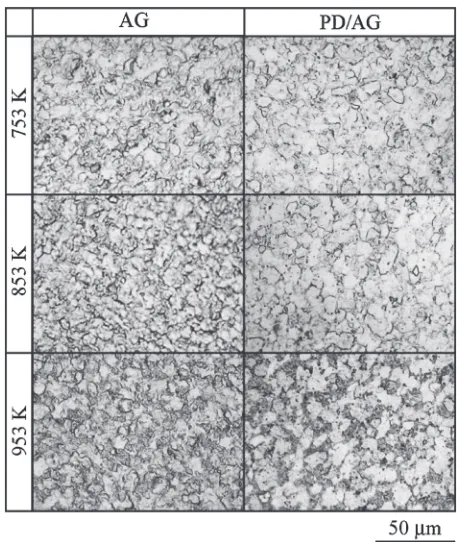
The effects of short-time aging were investigated to recover the yield strength after short-time solution treatment and cold working. Figure 9 shows the microstructure of each material. Figure 10 shows the changes in the hardness and Fig. 7 Relationship between the solution treatment temperature (holding
time: 1 s) and Erichsen value.
Fig. 6 Relationship between the solution treatment temperature (holding time: 1 s) and mechanical properties: (a) yield strength and the tensile strength, (b) yield ratio and elongation.
Fig. 8 Results of the bend test of the untreated material and the material solution-treated at 1148 K for 1 s (bending radius: 3.5 mm).
mechanical properties with short-time aging. In Figs. 10(a) 10(d), the solid plots ( ) show the results of the untreated, solution-treated and AG materials. The open plots ( ) show the results of the PD/AG material.
In Fig. 9, the¢phase (dark points) in the AG and PD/AG materials was seen more clearly with increasing aging temperature. If compared at the same aging temperature, no marked difference was found between the AG and PD/AG materials.
As shown in Fig. 10, the hardness and yield strength were decreased by short-time solution treatment. However, they increased beyond the initial values when short-time aging was conducted at 753 K. This improvement was caused by the precipitation of a fine ¡ phase in the prior ¢ phase.4,5)
While the hardness and yield strength of the AG material increased with increasing aging temperature, those of the PD/AG material decreased. It was thought that this decline tendency in the PD/AG material was caused by acceleration of the ¡ phase precipitation resulting from introduced dislocations.11)
On the other hand, the elongation unfortunately decreased through a short-time aging regardless of pre-deforming. Although some important results were obtained in this study, the above problem should be overcome by further studies.
4. Conclusions
(1) Hardness was reduced from an initial level by a short-time solution treatment. In particular, the reduction range of the hardness was largest with a holding time of 1 s.
(2) When the Ti6Al4V alloy was solution-treated at 10981223 K for 1 s, the results of X-ray diffraction,
TEM observation, and selected area electron diffraction suggested the formation of the¡¤and the¡¤¤martensite phases and the existence of a metastable¢phase in the prior¢phase.
(3) The yield ratio was markedly decreased by a short-time solution treatment because of the reduction in the yield strength. At the same time, elongation was greatly increased. It was believed that these changes were caused by a stress-induced transformation of the ¡¤¤ phase and a metastable¢phase to the¡¤phase. (4) Cold workability, such as deep drawability and
bendability, was improved by a short-time solution treatment due to the decrease of the yield ratio and increased elongation.
(5) Short-time aging improved the yield strength of the material solution-treated at 1148 K for 1 s and pre-deformed to a 16.7%strain; however, the elongation of the material decreased.
Acknowledgements
This work was supported by a Grant-in-Aid for Scientific Research (c), No. 90239658. The authors gratefully acknowl-edge the generous support received.
[image:5.595.54.287.68.339.2]Fig. 9 Microstructures of AG and PD/AG materials (strain: 16.7%, aging time: 40 s).
[image:5.595.325.522.71.432.2]REFERENCES
1) G. Lutjering and J. C. Williams: Titanium, (Springer-Verlag Berlin Heidelberg New York, 2003) p. 7.
2) T. Morita, W. Niwayama, K. Kawasaki and Y. Misaka:Trans. Japan Soc. Mech. Eng. (A)64(1998) 21152120.
3) T. Morita, Y. Misaka, K. Kawasaki and T. Iizuka:J. Japan Inst. Metals 68(2004) 862867.
4) T. Morita, K. Hatsuoka, T. Iizuka and K. Kawasaki:Mater. Trans.46 (2005) 16811686.
5) T. Morita, K. Shinoda, K. Kawasaki and Y. Misaka:J. Soc. Mater. Sci.
Japan56(2007) 345351.
6) T. Morita, T. Sakata, C. Kagaya and K. Kawasaki:J. Japan Inst. Metals 75(2011) 532538.
7) J. C. Williams and M. J. Blackburn: Trans. ASM60(1967) 373383. 8) M. A. Imam and C. M. Gilmore:Met. Trans. A 14A(1983) 233
240.
9) G. Lutjering and J. C. Williams: Titanium, (Springer-Verlag Berlin Heidelberg New York, 2003) p. 28.
10) J. M. Manero, F. J. Gil and J. P. Planell:Acta Mater.48(2000) 3353 3359.
11) T. Morita, W. Takahashi, K. Kawasaki and T. Maeda:J. Japan Inst. Metals70(2006) 797803.