Wettability of Sn
Zn, Sn
Ag
Cu and Sn
Bi
Cu Alloys on Copper Substrates
Xiaorui Zhang
1,+, Hiroyuki Matsuura
1, Fumitaka Tsukihashi
1and Zhangfu Yuan
21Department of Advanced Materials Science, Graduate School of Frontier Sciences,
The University of Tokyo, Kashiwa 277-8561, Japan
2Department of Energy and Resources Engineering, College of Engineering, Peking University,
Haidian District, Beijing 100871, P. R. China
The wettability of Sn9mass%Zn and Sn3mass%Ag0.5mass%Cu eutectic alloys and the new lead-free alloys Sn17mass%Bi 0.5mass%Cu and Sn30mass%Bi0.5mass%Cu on a Cu substrate has been investigated by the sessile drop method in Ar atmosphere as a function of time and temperature. The wetting time for SnBiCu alloys is much longer than that for Sn3mass%Ag0.5mass%Cu eutectic alloy at their liquidus or eutectic temperature. However, the Sn9mass%Zn alloy has poor wettability on a Cu substrate since Zn may be oxidized to ZnO, resulting in ZnO covering the surface of the droplet. The contact angles of the ternary alloys on a Cu substrate do not decrease monotonically with increasing temperature but do change with time. The wettability on a Cu substrate increases in the order Sn9mass%Zn, Sn 3mass%Ag0.5mass%Cu, Sn17mass%Bi0.5mass%Cu, Sn30mass%Bi0.5mass%Cu, as indicated by their contact angles of 115.8, 49.6, 37.6 and 27.1°, respectively, at 523 K. The addition of Bi clearly greatly improves the wettability of the alloys.
[doi:10.2320/matertrans.M2011349]
(Received November 9, 2011; Accepted February 16, 2012; Published March 28, 2012) Keywords: wettability, tin-based alloys, sessile drop method
1. Introduction
Wettability is one of the important physicochemical parameters in a wide range of technological applications such as welding, brazing and soldering.1)The wetting force,
spreading area and contact angle are frequently used to evaluate the ability of a liquid to spread on a solid surface, which is referred to as wettability.2,3) To investigate the
wettability of molten metals, the wetting balance method, the area of spread method and the sessile drop method are often used.4,5) For example, the wetting time and wetting force
are usually examined by the wetting balance method, the spreading diameter of the molten metal is examined by the area of spread method and the contact angle is examined by the sessile drop method. Owing to its simple operation, the possibility of direct observation, the small weight of sample, the controllable atmosphere and other advantages, the sessile drop method is often utilized to evaluate the wettability of a molten solder alloy on a substrate.
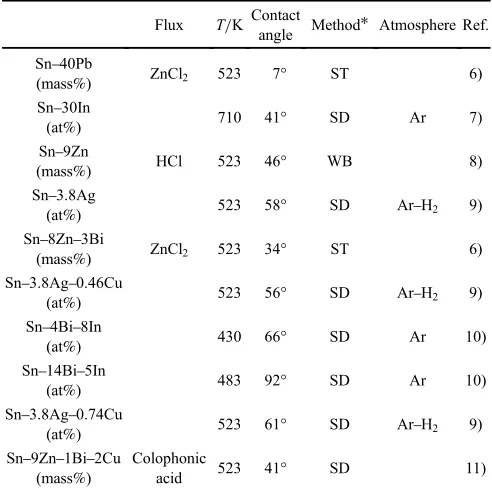
Furthermore, in the electronics industry, the eutectic SnPb solder alloys are gradually being replaced by lead-free solder alloys because of the toxicity of Pb. Thus, lead-free solder alloys with a stable microstructure and mechanical properties comparable to those of eutectic SnPb solder are stimulating immense interest owing to their potential use in micro-electronic applications. Table 1 lists the contact angles of several Sn-based alloys on a Cu substrate reported in the Refs. 611). The table shows that lead-free Sn-based alloys always have larger contact angles than the eutectic Sn 40mass%Pb alloy, which means that they have lower wettability with a Cu substrate. With the aim of developing excellent wettable lead-free solder alloys as substitutes for SnPb solder alloys, lead-free Sn-based alloy systems and their compositions have often been varied in previous studies. However, wettability, which is an issue in the reliability of
[image:1.595.304.550.372.617.2]electronic packaging, must also be investigated. The aim of this work is to demonstrate the wettability of Sn9mass%Zn and Sn3mass%Ag0.5mass%Cu eutectic alloys and the novel lead-free alloys Sn17mass%Bi0.5mass%Cu and Sn 30mass%Bi0.5mass%Cu on a Cu substrate. The wetting behavior at their eutectic or liquidus temperature and the relationship between the contact angle and the temperature and time were investigated by the sessile drop method in Ar atmosphere.
Table 1 Contact angles of several Sn-based alloys on a Cu substrate reported in literature.
Flux T/K Contact
angle Method* Atmosphere Ref. Sn40Pb
(mass%) ZnCl2 523 7° ST 6)
Sn30In
(at%) 710 41° SD Ar 7)
Sn9Zn
(mass%) HCl 523 46° WB 8)
Sn3.8Ag
(at%) 523 58° SD ArH2 9)
Sn8Zn3Bi
(mass%) ZnCl2 523 34° ST 6)
Sn3.8Ag0.46Cu
(at%) 523 56° SD ArH2 9)
Sn4Bi8In
(at%) 430 66° SD Ar 10)
Sn14Bi5In
(at%) 483 92° SD Ar 10)
Sn3.8Ag0.74Cu
(at%) 523 61° SD ArH2 9)
Sn9Zn1Bi2Cu (mass%)
Colophonic
acid 523 41° SD 11)
*ST is Spreading test, SD is Sessile drop method and WB is Wetting balance method.
+Graduate Student, The University of Tokyo
2. Experimental
The eutectic alloys of SnZn and SnAgCu and hyper-eutectic alloy of SnBiCu were prepared by melting a mixture of reagent-grade metal powders in a high-frequency induction furnace (50 kHz, 35 kW) in Ar atmosphere. The molten alloys were constantly stirred in a quartz tube long enough to obtain a homogeneous composition before casting into a copper mold. The quenched alloys were cut into cubes, polished sequentially with SiC papers up to abrasive number 2000 and then cleaned ultrasonically in acetone. The chemical compositions of the Sn-based alloys are given in Table 2. The Cu substrates were cut into platelike pieces of 20 mm©20 mm©2 mm, whose chemical composition is shown in Table 3. The Cu substrate was cleaned by dilute alkali and acid solution in turn, polished by a chemical polishing agent (a solution containing H2O2, H2SO4,
CH3COOH, CH3CH2OH, etc.), washed ultrasonically in
acetone and finally dried without touching the surface to avoid any possible contamination.
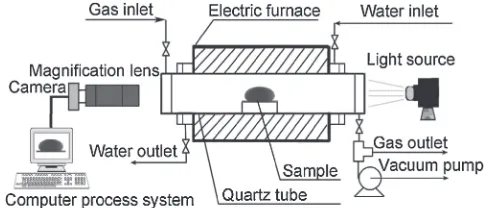
The sessile drop measurement equipment mainly consisted of a heating system, a gas system, an imaging system and a calculation system as shown in Fig. 1. In the heating system, the specimen was heated by SiC heating rods and the temperature was measured by a Pt10%Rh thermocouple with an error range of smaller than 2 K. The gas system was used to control the atmosphere in the furnace. The imaging system included a back light and a high-resolution CCD camera to capture distinct photographs of samples in the furnace. The contact angle was calculated from the image contours of the drop and substrate using the calculation system, and the accuracy of the calculation was estimated to be «0.5%. A more detailed description of the experimental apparatus can be found in the previous works of Yuanet al.1215)
About 0.9 g of an alloy sample was set on the center of a Cu substrate, and then the substrate was inserted into the hot zone of the heating system and its position was adjusted horizontally. After sealing, the electric resistance furnace was degassed andflushed with Ar gas, which was performed three
times. Ar gas then flowed at a rate of 0.2 L/min during the measurement, and the oxygen partial pressure in the atmosphere was considered to be lower than 10¹6Pa. The back light was adjusted to ensure that distinct images were captured.
The rate of temperature increase up to the targeted temperature was 10 K/min. For the eutectic alloys of Sn 9mass%Zn and Sn3mass%Ag0.5mass%Cu, the measuring temperature was first fixed at the eutectic temperature for 30 min, and then increased from 523 to 723 K in intervals of 50 K every 30 min, which was sufficient for the molten alloys to form a stable shape. For the hypereutectic alloys of Sn17mass%Bi0.5mass%Cu and Sn30mass%Bi0.5 mass%Cu, the measuring temperature was first fixed at the liquidus temperature for 30 min and then increased from 523 to 623 K in intervals of 50 K, with each temperaturefixed for 30 min.
[image:2.595.305.548.70.174.2]During the heating process, the alloy melted in situ and formed a liquid droplet. The shape profiles of the molten droplet and the Cu substrate were recorded using the high-resolution CCD camera during heating and holding at the above temperatures. The contact angleªbetween the molten droplet and substrate, the droplet diameter D and droplet height H were thus calculated from images as shown in Fig. 2.
3. Results and Discussion
3.1 Wetting behavior at melting temperature
Figure 3 shows some representative profiles of the eutectic alloy of Sn3mass%Ag0.5mass%Cu at its eutectic tem-perature and the hypereutectic alloy of Sn30mass%Bi 0.5mass%Cu at its liquidus temperature.
[image:2.595.47.291.94.199.2]For the eutectic alloys of Sn9mass%Zn and Sn 3mass%Ag0.5mass%Cu, the sample began to melt when the measuring temperature reached the eutectic temperature, and a droplet of the alloy was formed on the Cu substrate. However, for the hypereutectic alloys of Sn17mass%Bi 0.5mass%Cu and Sn30mass%Bi0.5mass%Cu with a range
Table 3 Chemical composition of the Cu substrate. Component Bi Se Te Sb As Fe Ag O
Content
(mass%) 0.02 0.02 0.02 0.04 0.05 0.1 0.2 <0.00150
Fig. 1 Schematic diagram of the measurement apparatus used to inves-tigate the wettability of molten alloys by the sessile drop method.
H D
θ θ
D
H
θ θ
Fig. 2 Schematic diagram ofª,DandH. Table 2 Chemical compositions and melting temperatures of the Sn-based
alloys.
System Component (mass%) T(K) Sn9mass%Zn Sn: balanceZn: 9.0, (eutectic)472 Sn3mass%Ag0.5mass%Cu Ag: 3.0, Cu:0.5,
Sn: balance
490 (eutectic) Sn17mass%Bi0.5mass%Cu Bi: 17.0, Cu: 0.5,
Sn: balance
463482 (solidus-liquidus) Sn30mass%Bi0.5mass%Cu Bi: 30.0, Cu: 0.5,
Sn: balance
[image:2.595.307.548.230.281.2] [image:2.595.46.291.247.285.2]of melting temperatures, the melting process of the alloy was considerably different from the above description. When the temperature was lower than the eutectic or solidus temper-ature, the shape of the sample did not change, and when temperature reached the eutectic or solidus temperature, part of the alloy sample began to melt, starting with the part in contact with the Cu substrate. When the temperature reached the liquidus temperature of the alloys, the whole alloy sample melted completely and formed a droplet on the Cu substrate.
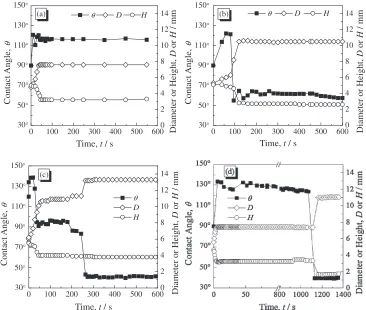
Figure 4 shows evolution of the contact angle at the eutectic or liquidus temperature of each alloy, except for the Sn9mass%Zn alloy (eutectic temperature: 472 K), which was measured at 523 K. For the eutectic alloys, the contact angle increased sharply when the alloys began to melt, and after that, short-term fluctuations of the contact angle were
observed. During the spreading process, times of 100 and 200 s were required for the contact angles of Sn9mass%Sn and Sn3mass%Ag0.5mass%Cu alloys to become stable, respectively. Meanwhile, the droplet diameter D of the molten alloys also increased dramatically and the droplet height H decreased correspondingly. For the SnBiCu alloys, the contact angle increased dramatically in a short time as soon as the sample began to melt, and then it decreased to a constant value. During this period, the wetting behavior reached an equilibrium stage, which lasted for 210 and 1100 s, respectively, for Sn17mass%Bi0.5mass%Cu and Sn30mass%Bi0.5mass%Cu alloys. Then the contact angle suddenly decreased to 41.0 and 39.8°, respectively, and the wetting behavior reached a second equilibrium stage. This spreading behavior could also be observed from the change in the droplet diameterDwith time.
The wetting time is defined as the interval between the formation of liquid droplet and the initiation of spreading. The wetting times of 260 and 1130 s, respectively, for Sn 17mass%Bi0.5mass%Cu and Sn30mass%Bi0.5mass%Cu alloys are much longer than that (95 s) of the eutectic alloy of Sn3mass%Ag0.5mass%Cu. Thefirst equilibrium stage of the contact angle observed for the hypereutectic alloys of Sn BiCu was not observed for the eutectic alloys of Sn 9mass%Zn and Sn3mass%Ag0.5mass%Cu. This could be due to the range of the melting temperature of the former. Figure 5 shows the binary phase diagram for the SnBi system without considering Cu.16,17) Sn17mass%Bi alloy
and Sn30mass%Bi alloy, respectively, marked as dotted and
0 0
2 4 6 8 10 12 14
30°
50°
70°
90°
θ D H
Time, t / s
Contact Angle,
θ 110°
130°
Diameter or Height,
D
or
H
/ mm
(a)
150°
0 0
2 4 6 8 10 12 14
θ D H
Time, t / s
Contact Angle,
θ
150°
130°
110°
90°
70°
50°
30°
Diameter or Height,
D
or
H
/ mm
(b)
0 0
2 4 6 8 10 12 14
θ
D H
Time, t / s
Contact Angle,
θ
150°
130°
110°
90°
70°
50°
30° Diameter or Height,
D
or
H
/ mm
(c)
600 500 400 300 200 100
600 500 400 300 200 100 600
500 400 300 200 100
Fig. 4 Wetting behavior of the Sn-based alloys on a Cu substrate at the eutectic or liquidus temperature except for (a). (a) Sn9mass%Zn at 523 K, (b) Sn3mass%Ag0.5mass%Cu at 490 K, (c) Sn17mass%Bi0.5mass%Cu at 482 K and (d) Sn30mass%Bi0.5mass%Cu at 459 K.
10 s 1070 s 1350 s
80 s 95 s 120 s 600 s
(a)
(b)
[image:3.595.48.289.68.163.2] [image:3.595.116.482.439.749.2]dot-dash lines in thisfigure, have distinct melting temperature range, that lie between the eutectic or solidus temperature and the liquidus temperature. Table 2 also gives the melting temperature ranges of Sn17mass%Bi0.5mass%Cu and Sn 30mass%Bi0.5mass%Cu alloys. The melting temperature range of Sn30mass%Bi0.5mass%Cu is 18 K larger than that of Sn17mass%Bi0.5mass%Cu, resulting in the Sn 30mass%Bi0.5mass%Cu alloy having a much longer wetting time than the Sn17mass%Bi0.5mass%Cu alloy.
[image:4.595.47.288.69.255.2]3.2 Effect of temperature on contact angle
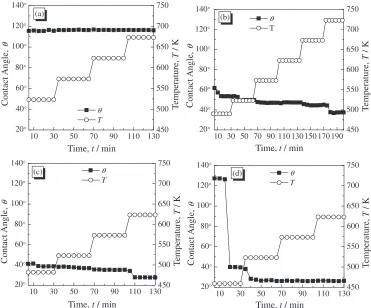
Figure 6 shows the relationship between the contact angle
and the temperature and time. For the ternary alloys, the contact angle did not decrease linearly and solely with temperature but also changed with time. A sudden decrease in the contact angle was observed for the ternary alloys, for example, 6.6° at 723 K for the Sn3mass%Ag0.5mass%Cu alloy, 6.3° at 623 K for the Sn17mass%Bi0.5mass%Cu alloy and 9.7° at 523 K for the Sn30mass%Bi0.5mass%Cu alloy. However, the contact angle between the Sn9mass%Zn alloy and the Cu substrate did not change with the temperature and time and always remained at approximately 116.4°, showing the poor wettability of the Sn9mass%Zn alloy on a Cu substrate. This poor wettability is ascribed to the easy oxidation of Zn element.
The changes in the Gibbs free energy for the oxidation reactions are expressed by eqs. (1) and (2).psatSnOis assumed to be equal to psatO2 in eq. (1). Comparing the changes in the Gibbs free energy, Zn is much more easily oxidized than Sn. At the measuring temperature range between 523 and 673 K, the saturated partial pressures of oxygen for SnO(g) and ZnO(s) are from 104.06 to 104.34Pa and from 10¹57.8 to 10¹42.8Pa, respectively. Under the current experimental conditions, the partial pressure of oxygen is on the order of 10¹6Pa, which is much higher than the saturated partial pressure of oxygen for ZnO(s). In addition, color of the surface of the Sn9mass%Zn alloy changed from luster to dark gray after experiment. Therefore, a thick oxide film of solid ZnO is produced on the surface of the molten Sn9mass%Zn alloy, which prevents the Sn9mass%Zn alloy from significantly spreading on a Cu substrate.18,19)
10 450
500 550 600 650 700 750
20°
40°
60°
80°
100°
120°
θ
T
Time, t / min
Contact Angle,
θ
140°
T
emperature,
T
/ K
(a)
10 450
500 550 600 650 700 750
20°
θ T
Time, t / min
Contact Angle,
θ
140°
120°
100°
80°
60°
40° Temperature,
T
/ K
(b)
10 450
500 550 600 650 700 750 θ
T
Time, t / min
Contact Angle,
θ
(c)
140°
120°
100°
80°
60°
40°
20°
T
emperature,
T
/ K
10 450
500 550 600 650 700 750 θ
T
Time, t / min
Contact Angle,
θ
(d)
140°
120°
100°
80°
60°
40°
20°
T
emperature,
T
/ K
130 110 90 70 50 30 130
110 90 70 50 30
130 110 90 70 50
30 30 50 70 90110130150170190
Fig. 6 Variation of contact angle of the molten alloys with temperature and time. (a) Sn9mass%Zn, (b) Sn3mass%Ag0.5mass%Cu, (c) Sn17mass%Bi0.5mass%Cu and (d) Sn30mass%Bi0.5mass%Cu.
[image:4.595.113.484.451.759.2]2SnðlÞ þO2ðgÞ ¼2SnOðgÞ ð1Þ
G¼ RTlnpO
2
sat¼12;550101:8T J=mol20Þ
2ZnðsÞ þO2ðgÞ ¼2ZnOðsÞ ð2Þ
G¼RTlnp
O2
sat¼ 670;000þ175T J=mol21Þ
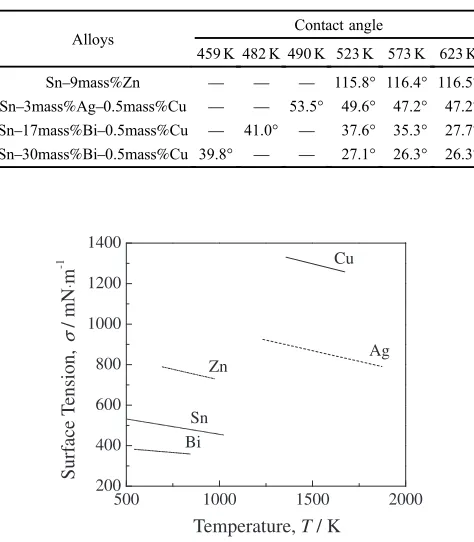
Table 4 lists the equilibrium contact angles of the alloys on a Cu substrate at each temperature. Comparing these contact angles, it is clear that the wettability of the ternary alloys is much greater than that of the binary alloy and that the wettability of the SnBiCu alloys is greater than that of the SnAgCu alloy. It is well known that the relationship between the contact angle and surface tension can be expressed by Young’s equation, cosª¼ ð·SV·SLÞ=·LV,
where ·SVis the surface free energy of the solid,·SL is the
tension of the solidliquid interface and ·LVis the surface
tension of the liquid. For a given substrate, the contact angle
ª is mainly determined by ·LV and ·SL. Figure 72226) and
eqs. (3) to (7) show the changes in the surface tension of Cu, Ag, Zn, Sn and Bi with temperature.
Cu:· ¼13300:23ðT1085Þ ð3Þ Ag:· ¼9250:21ðT 960Þ ð4Þ Zn:· ¼7890:21ðT420Þ ð5Þ Sn:·¼5310:151ðT505Þ ð6Þ Bi: ·¼3820:076ðT544Þ ð7Þ
The surface tension of the five elements decreases in the order Cu, Ag, Zn, Sn, Bi. Therefore, the surface tension of the ternary alloys decreases in the order Sn3mass%Ag0.5 mass%Cu, Sn17mass%Bi0.5mass%Cu, Sn30mass%Bi 0.5mass%Cu. In addition, because of its lowest surface
tension, Bi, which acts as a surfactant, is apt to concentrate at the surface and at the interface between the molten droplet and the substrate. Thus, Bi decreases the surface tension
·LVand interfacial tension·SLsimultaneously, which greatly
decreases the contact angle. Thus, the wettability of the Sn30mass%Bi0.5mass%Cu alloy is superior to that of the Sn17mass%Bi0.5mass%Cu alloy and Sn3mass%Ag 0.5mass%Cu alloy. According to the experimental results and the analysis based on Young’s equation, we can reasonably conclude that the addition of Bi element can increase the wettability of alloys on a Cu substrate.
4. Conclusions
The wettability of Sn9mass%Zn, Sn3mass%Ag 0.5mass%Cu, Sn17mass%Bi0.5mass%Cu and Sn 30mass%Bi0.5mass%Cu alloys on a Cu substrate was measured by the sessile drop method in Ar atmosphere. At their eutectic or liquidus temperature, the wetting behavior of the SnBiCu alloys exhibited two equilibrium stages, while that of the eutectic alloys did not exhibit thefirst equilibrium stage. Additionally, the larger melting temperature range of the SnBiCu alloys was found to greatly prolong the wetting time. The contact angle of the ternary alloys decreases with temperature and time, and a rapid decrease was also observed at different temperatures. The SnBiCu alloys were found to have greater wettability than the Sn AgCu alloy, and it was confirmed that the addition of Bi increases the wettability. The binary eutectic alloy of Sn 9mass%Zn has poor wettability on a Cu substrate because Zn is oxidized by the atmosphere, resulting in ZnO covering the surface of the droplet.
REFERENCES
1) M. J. Rizvi, C. Bailey, Y. C. Chan and H. Lu:J. Alloy. Compd.438 (2007) 116121.
2) M. Abtew and G. Selvaduray:Mater. Sci. Eng. R27(2000) 95141.
3) R. A. Islam, Y. C. Chan, W. Jillek and S. Islam:Microelectron. J.37 (2006) 705713.
4) J. D. Coninck:Colloids Surf. A Physicochem. Eng. Asp.89(1994) 109115.
5) K. L. Lin and J. M. Jang:Mater. Chem. Phys.38(1994) 3341.
6) R. Mayappan and Z. A. Ahmad: Sains Malaysiana38(2009) 395400. 7) S. Amore, E. Ricci, G. Borzone and R. Novakovic:Mater. Sci. Eng. A
495(2008) 108112.
8) R. Mayappan, A. B. Ismail, Z. A. Ahmad, T. Ariga and L. B. Hussain:
Mater. Lett.60(2006) 23832389.
9) Z. Moser, W. Gąsior, K. Bukat, J. Pstruś, R. Kisiel, J. Sitek, K. Ishida and I. Ohnuma: J. Phase Equilib. Diffus.27(2006) 133139. 10) F. Gnecco, E. Ricci, S. Amore, D. Giuranno, G. Borzone, G. Zanicchi
and R. Novakovic:Int. J. Adhes. Adhes.27(2007) 409416.
11) M. Kamal, M. S. Meikhail, A. B. EL-Bediwi and EL-S. Gouda:Radiat. Eff. Defects Solids160(2005) 301312.
12) X. Zhang, C. Wang, H. Zhao, J. Li and Z. Yuan: Chin. J. Process Eng.9
(2009) 829832 (in Chinese).
13) X. R. Zhang, Z. F. Yuan, H. X. Zhao, L. K. Zang and J. Q. Li:Chin. Sci. Bull.55(2010) 797801.
14) Z. Yuan, W. Huang and K. Mukai:Appl. Phys. A: Mater. Sci. Process. 78(2004) 617622.
15) Z. Yuan, K. Mukai, K. Takagi, M. Ohtaka, W. Huang and Q. Liu:
J. Colloid Interf. Sci.254(2002) 338345.
16) T. B. Massalski, H. Okamoto, P. R. Subramanian and L. Kacprzak (ed.): Binary Alloy Phase Diagrams, 2nd ed., (ASM International, 500
200 400 600 800 1000 1200 1400
Sn Bi
Zn Ag
Surf
ace T
ension,
σ
/ mN
⋅
m
-1
Temperature, T / K Cu
2000 1500
1000
[image:5.595.50.287.90.361.2]Fig. 7 Relationship between the surface tension of Cu, Ag, Zn, Sn and Bi and temperature.
Table 4 Equilibrium contact angles of the Sn-based alloys on a Cu substrate at each temperature.
Alloys Contact angle
Materials Park, OH, 1990) p. 794.
17) T. B. Massalski, H. Okamoto, P. R. Subramanian and L. Kacprzak (ed.): Binary Alloy Phase Diagrams, 2nd ed., (ASM International, Materials Park, OH, 1990) p. 796.
18) L. R. Garcia, W. R. Osório, L. C. Peixoto and A. Garcia:J. Electron. Mater.38(2009) 24052414.
19) K. Suganuma, K. Niihara, T. Shoutoku and Y. Nakamura:J. Mater. Res. 13(1998) 28592865.
20) E. T. Turkdogan:Physical Chemistry of High Temperature Technology, (Academic Press, INC., London, 1980) p. 21.
21) E. T. Turkdogan:Physical Chemistry of High Temperature Technology,
(Academic Press, INC., London, 1980) p. 24.
22) Z. F. Yuan, J. J. Ke and J. Li:The surface tension of metal and alloy 1st ed., (C. L. Bai ed., Science Press, Beijing, 2006) p. 30 (in Chinese). 23) Z. F. Yuan, J. J. Ke and J. Li:The surface tension of metal and alloy 1st
ed., (C. L. Bai ed., Science Press, Beijing, 2006) p. 32 (in Chinese). 24) Z. F. Yuan, J. J. Ke and J. Li:The surface tension of metal and alloy 1st
ed., (C. L. Bai ed., Science Press, Beijing, 2006) p. 41 (in Chinese). 25) Z. F. Yuan, J. J. Ke and J. Li:The surface tension of metal and alloy 1st