Oscillation of magnetically stable-axis with respect to a static field below 20 kOe occurred for various solids without spontaneous magnetic moment. The oscillation was caused by anisotropy of magnetic susceptibility. According to theoretical consideration on the origin of diamagnetic and paramagnetic anisotropy,values of ordinary solid is expected to range over 6 orders of magnitude. Thesevalues can be obtained from period of the above-mentioned oscillation; smallvalues were detectable because effect of restoration torque of a fiber that suspended the sample was excluded in the measurement.above1109emu/g were detected at terrestrial gravity in a field belowB¼
20kOe. The fiber itself was excluded by floating a sample in microgravity, for the purpose of detectingbelow1109emu/g. Alignment of
micron-sized crystals dispersed in fluid at room temperature is achieved below 2 Tesla for most of the solids since theirvalue is above
1109emu/g. Efficiency of magnetic alignment is enhanced considerably for ordinary oxide when resultantis increased by paramagnetic
impurity ions up to level of105emu/g. [doi:10.2320/matertrans.MI200711]
(Received May 11, 2007; Accepted September 3, 2007; Published October 25, 2007)
Keywords: magnetic alignment, magnetic oscillation, diamagnetic anisotropy, paramagnetic anisotropy, microgravity, mica, talc
1. Introduction
Magnetic alignment of solid particles without spontaneous magnetic moment has been considered to be a promising technique to innovate functional material, however possibil-ity of material processing has been reported for a limited number of materials.1,2) This is partly because magnetic
anisotropy, which is the cause of alignment, has not been obtained as yet for most of the solid materials. Hence it was difficult to perform quantitative analysis on alignment process for most of the materials. Alignment of micron-sized particles dispersed in fluid were quantitatively studied on inorganic material such as clay and mica minerals based on reliablevalues;3,4)it was explicitly shown that alignment
was controlled by magnetic anisotropy per unit mass , temperatureTand mass of particleM. The above-mentioned fact is directly deduced from a conventional mechanism proposed by Langevin and Curie.
Small of ordinary solid is difficult to obtain by conventional methods. A standard method to measureis based on a balance between a torque due to magnetic anisotropy energy induced in a sample and a restoration torque of a fiber suspending a sample in a horizontal field. Hence sensitivity was limited by physical properties of the fiber. The torque of fiber was controlled to be negligible by introducing a thin fiber;3,4) accumulation of small
proceeded for various oxides with a detection limit of 1 109emu/g.5,6)
of a material is described by a sum of diamagnetic anisotropyðÞDIAand paramagnetic anisotropyðÞPARA.
Recently, origin of ðÞDIA was studied for oxide crystals
based on the above-mentioned experimental data.3,4,6–8) It was concluded that ðÞDIA originated from preferential
orientation of bond direction with respect to a magnetic principle axis of crystal. Accordingly a material with high crystal symmetry was expected to posses small ðÞDIA
below 1109emu/g. It was reported that ðÞ
PARA is a
dominant factor ofwith respect toðÞDIAin an actual
material; this is because natural and synthetic materials usually contain finite amount of paramagnetic impurity ions. For example, ðÞPARA was as large as 105emu/g when
concentration of ferric ion was 1 mass% for most of the natural silicates.9–11)
Numerical values ofremain unmeasured for most of the ordinary solids. In the present paper, possibility is discussed on accumulating the immense number of unmeas-ured values effectively in terms of a single principle based on rotational oscillation. As mentioned before,is expected to range over 6 orders of magnitude according to the considerations on the origin ofðÞPARAandðÞDIA.
2. Experimental
Magnetic anisotropy is commonly measured by a principle proposed long ago by Krishnan and Banergee.12)A sample is suspended in a horizontal fieldBwith a rigid fiber as shown in Fig. 1; as mentioned before, measurement is based on a balance between torque due to magnetic anisotropy and restoration torque of fiber. Here two magnetically principal-axes of the sample rotate in the horizontal plane, andis measured between the two axes. Rotational motion of the sample is described as
Iðd2=dt2Þ ¼ ð1=2ÞB2Msin 2 ðD=lÞ; ð1Þ
whereIandMdenote moment of inertia and mass of sample, respectively.is the angle between stable axis andB. Second term of the equation corresponds to restoration torque of the fiber;Dandlare the tensional rigidity and the length of the fiber, respectively.
restoration torque as shown in Fig. 1(b).3,4,6) was obtained from a period of oscillation with negligible contribution ofDandlas,
¼42IM1ðBÞ2 ð2Þ
When was above 1109emu/g, the above exper-imental condition was achieved by suspending sample with a thin PET fiber of’50mmin diameter; here field intensity was below 20 kOe. Rotational oscillation was observed for popular crystals such as corundum, gypsum, KDP, quartz or talc.were obtained by inserting the measured values of
,IandM in eq. (2); the values agreed fairly well with the published values for these materials which confirmed the efficiency of the measuring system at this sensitivity.
The fiber that suspended the sample was deleted from the system in order to achieve higher sensitivity. A preliminary test of this principle was performed in microgravity condition at MGLAB, Gifu, Japan5) Rotational oscillation of a
magnetically stable axis with respect toBwas observed for single crystals of graphite, which was floated in an area of homogeneous field of 130 Oe in by microgravity. A large Helmholz-coil system was introduced to generate field in a spherical area of 20 cm in diameter. The large region was prepared since transferring was expected for the floated samples in microgravity condition.
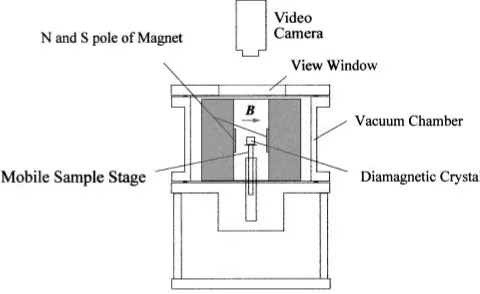
[image:2.595.131.465.73.201.2]According to eq. (2), sensitivity ofcan be improved by increasing field intensity; this is realized by replacing the Helmholz-coil with a permanent magnetic circuit as shown in Fig. 2.13) The magnet can produce a homogeneous field of 13 kOe in a small spatial region of 2.0 cm in diameter. Replacement of magnet was possible because a mobile sample stage stabilized the position of the sample in a small spatial region at microgravity condition. Oscillations were observed for several popular materials, namely calcite, gypsum, Rochelle salt and urea. The observedvalues were consistent with the values calculated by eq. (2). In order to improve sensitivity, it is effective to enhance the length of measurable, since it is difficult to increaseBor to decreaseI
from the present condition in a system using microgravity. The length ofcan be increased to duration of microgravity produced by a drop tube which is 4.5 s at MGLAB; accordingly is reduced to a level of 1010emu/g. The sensitivity may be reduced below 11010emu/g in a parabolic flight where measurable is enhanced to 20 seconds. In conclusion, magnetic anisotropy can be measured
over a wide range between105emu/g and1010emu/g (or even smaller) in terms of a single principle based on a rotational oscillation of sample.
3. Results and Discussion
3.1 Origin of ðÞDIA and their quantitative values expected for solid material
A model was proposed to explain the origin of diamagnetic anisotropy, in which a constant uniaxial ðÞDIA was
assigned to the individual bond orbital that composed a crystal.3,4) Small amount of preferential orientation of individual bond direction with respect to a magnetic principle axis of the crystal cause the resultant diamagnetic anisotropy of a crystal. CalculatedðÞDIAvalue of a crystal using this
model was consistent with the measured value for popular oxides, namely for corundum, KDP, gypsum, orthoclase,
-quartz, Mg(OH)2, AlOOH or Al(OH)3. Anisotropy of a single bondBOwas determined as3:71030emu for
a hydrogen bond, 1:11030emu for a T-O bond of tetrahedral [TO4] unit and0:321030emu for M-O bond of octahedral [MO6] unit.6–8)Here magnetically unstable axis
was parallel to bond direction; the assignment was compat-ible with the fact that spatial electron distribution is spread preferentially in directions perpendicular to a bond direction. It is noted that a approximate ðÞDIAvalue of an oxide
crystal can be calculated from its atomic position data and the above-mentionedBOvalues. This means that efficiency of Fig. 1 Principle to measure magnetic anisotropy by a (a) conventional method, (b) method based on rotational oscillation of magnetically
stable axis with respect toB.3,4)
[image:2.595.306.546.253.400.2]anisotropy of the local crystalline field of the site at which the paramagnetic ion occupies. As mentioned before, ðÞPARAis a dominant factor of compared toðÞDIA
for many of the oxide crystals. The fact was concluded from measured -T relationships compiled for various oxides with different crystalline symmetry, namely orthoclase,14,15)
muscovite, talc, scaporite and AlOOH.was as large as
105emu/g for biotite provided that the material contained paramagnetic ions at a level below 1 mass%.9–11) Here ðÞPARA is proportional to concentration of paramagnetic
ion. Similar relationship between concentration and ðÞPARA has been observed for other oxides with the
exception of crystals having cubic symmetry.
As a result of the above-mentioned considerations con-cerning the origin of diamagnetic and paramagnetic aniso-tropy, a value of ordinary solid may range between
105emu/g and1010emu/g. The values can be detected by the method of rotational oscillation described in section 2.
3.2 Minimum field to achieve alignment of micron-sized crystals and effect of paramagnetic ions
According to a process proposed by Langevin and Curie, a magnetically stable axes of micron-sized particles dispersed in a fluid at temperatureTalign almost parallel toBwhen a anisotropy energyð1=2ÞMB2induced in the particle is one order of magnitude larger compared to the energy of Brownian motion ð1=2ÞkBT; here M denote the weight of the particle. It is deduced from the mechanism that process of alignment is controlled by three parameters namely,T,Mand
.3,4)This means that the minimum field intensity required to achieve partial alignment is predicted before experiment whenandMvalue of the material is known.
Figure 3 shows a typical relationship between field intensity and degree of alignment observed for various oxide materials. Solid curves are the fit to measured data shown in solid symbols. Degree of alignment is described by an order parameter hmi ¼ hð3 cos21Þ=2i. Here angle between magnetically stable-axis of a particle andBis denoted as, and the average is taken over the particles contained in the suspension.
Field intensity where hmi was equivalent to 0.78 was defined as the field of orientationBs, which is calculated from the above-mentioned Langevin process as
Bs¼ ð15kBT=MÞ1=2: ð3Þ
Bsreduces with the decrease ofTor with the increase ofMor
. It is necessary to define an indicator such asBsin order to carry out quantitative discussions on a minimum field intensity to achieve partial alignment for a given material.
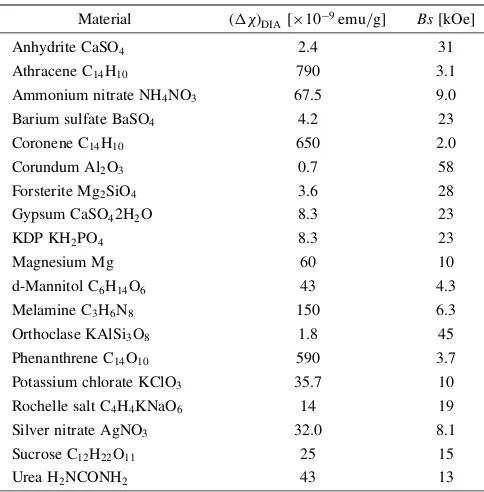
mentioned range as well; the data were accumulated for popular materials in biochemistry, mineralogy, petrology as well as in organic and inorganic synthesis. Accordingly, order of magnitude of Bs calculated for spherical single-crystals with diameter of 1.0mmat room temperature range between 102 and100. The calculated values are listed in Table 1. This relationship between and Bs were confirmed by a number of hmi-B measurements which are shown in Fig. 3.
Effect of paramagnetic ions onhmi-Bprocess are shown in Fig. 3, which were reported recently on various mica grains. It is seen that increase of concentrations of paramagnetic ions are effective in reducingBs. As mentioned before,ðÞPARA
is proportional to the concentration which was evaluated by a paramagnetic susceptibilityPARA. For example, it is seen in
Fig. 3(b) that Bs was as low as 220 Oe for biotite with
PARA¼4:4105emu/g. TheBsvalue of biotite was less
than 1% compared to Bsobserved for synthetic phlogopite free of paramagnetic ions; Bs was 36 kOe.10) Whereas, Bs
was 6.2 kOe for phlogopite withPARA¼1:2106emu/g.
The three kinds of mica minerals have almost equivalent crystal structures; the materials should have similarBsvalues deriving from similar amount ofderiving from diamag-netic anisotropy if theirðÞPARAwere not effective. Similar
relationship betweenPARAand Bs was observed for the two
muscovite samples shown in Fig. 3(c); Bs was 610 Oe for muscovite withPARA¼4:8106emu/g. Magnetic
align-ment at such low fields were not reported previously for particles without spontaneous moments; the alignment can be achieved by a field of a simple hand magnet. Similar effect due to paramagnetic ions was observed for various ceramic materials such as orthoclase, talc and kaolinite. It may be concluded that efficiency of magnetic alignment can be enhanced considerably for oxide materials in general by doping finite amount of paramagnetic ions in the course of material processing.
It is noted that precise value of as well as its temperature dependence are essential in the above analyses. The principle ofmeasurement described in section 2 is capable of detecting-T relationships even ifchanged considerably over several orders of magnitude due to the effect of Curie-Weiss law.
4. Conclusions
expected thatof this level is obtained by observing field-induced rotational oscillation of a sample floated in microgravity.
(2) Paramagnetic anisotropy ðÞPARA of a oxide may
exceed109emu/g when paramagnetic ion is included above a level of several ppm, which is the case for many of natural and synthetic materials. A simple system operated in terrestrial gravity [see Fig. 1(b)], can detect the above-mentioned. Compared to a conventional apparatus, the system is much easier to introduce in a research facility.
(3) Magnetic alignment of particles dispersed in fluid is controlled by temperature T, mass of particle M and
. Field intensity to achieve alignment is predicted from obtained by the method of (1) or (2) for a given material. When increases from 109 to
105emu/g, field of alignment Bs (see section 3) at room temperature, calculated for a spherical micron-sized crystal (0:5mm), decreases from 20 to 200 Oe Tesla. Hence alignment is expected to occur for most of the solid by a permanent magnet.
(4) Value of is not obtained as yet for many of the ordinary solids. Possibility of innovating new types of magnetic application may increase, whenvalues are recognized for ordinary solid in general.
REFERENCES
1) G. Malet and K. Dransfeld: Topics in App. Phys.57(1985) 144–187. 2) various papers appearing in Proc. Int. Symp. New Magneto-Sci.
Tsukuba, (Jpn. Sci. & Tec. Corp., NIMS, 1999).
3) C. Uyeda, T. Takeuchi, A. Yamagishi and M. Date: J. Phys. Soc. Jpn. Fig. 3 Relationship between the degree of orientationhmiand magnetic field intensityBobserved for micro-crystals of (a) diamagnetic
[image:4.595.83.509.75.329.2]graphite, orthoclase and corundum, (b) paramagnetic biotite, phlogopite and diamagnetic phlogopite and (c) paramagnetic muscovite. Samples are dispersed in liquid ethanol at room temperature. Definition ofhmiis given in the text.hmi ¼0and 1 correspond to a completely random and an ordered state of the particles, respectively. Measured data are shown by symbols, which is determined from field dependence of a light intensity transmitted through the sample suspension. Measurement is possible because direction of an optical principle axis of a crystal grain coincides with its magnetic principle axis. Theoretical fit to measured data are shown by solid curve, which is calculated using aMvalue that gives a best fit to measuredhmi-B. Herehmiis calculated by a Boltzmann average atTusing free energy induced in the particle.
Table 1 Field of alignment Bs calculated for micron-sized crystals of various materials dispersed in fluid atT¼300K. Spherical single crystal with diameter of 1.0mmwas assumed in the calculation.
Material ðÞDIA[109emu/g] Bs[kOe]
Anhydrite CaSO4 2.4 31
Athracene C14H10 790 3.1
Ammonium nitrate NH4NO3 67.5 9.0
Barium sulfate BaSO4 4.2 23
Coronene C14H10 650 2.0
Corundum Al2O3 0.7 58
Forsterite Mg2SiO4 3.6 28
Gypsum CaSO42H2O 8.3 23
KDP KH2PO4 8.3 23
Magnesium Mg 60 10
d-Mannitol C6H14O6 43 4.3
Melamine C3H6N8 150 6.3
Orthoclase KAlSi3O8 1.8 45
Phenanthrene C14O10 590 3.7
Potassium chlorate KClO3 35.7 10
Rochelle salt C4H4KNaO6 14 19
Silver nitrate AgNO3 32.0 8.1
Sucrose C12H22O11 25 15
[image:4.595.47.289.473.719.2]