Ti3Au increased with increasing aging time. The 0.2% flow stress of the materials was decreased as the volume fraction of Ti3Au increased. This
indicates that the Ti3Au precipitations are not effective on strengthening of the Ti-Au alloy. [doi:10.2320/matertrans.48.385]
(Received October 16, 2006; Accepted November 17, 2006; Published February 25, 2007)
Keywords: titanium-gold, near-eutectoid alloy, aging, phase constitution, lattice parameter, mechanical properties
1. Introduction
Recently, implants made of metallic materials such as artificial joints, dental restoratives and artificial bones are widely used. Titanium has high corrosion resistance and biocompatibility, because chemically stable oxide layer is formed on the surface. Thus, titanium alloys are attractive biomaterial, and now gradually replacing stainless steels and cobalt-chrome alloys used for artificial bone and dental implant. On the other hand, Au based alloys have been used as dental crowns and have technical achievement as reliable biomaterials. Thus, a combination of Ti and Au are fascinating, and the Ti-Au alloy must be a candidate for a new biomedical alloy.
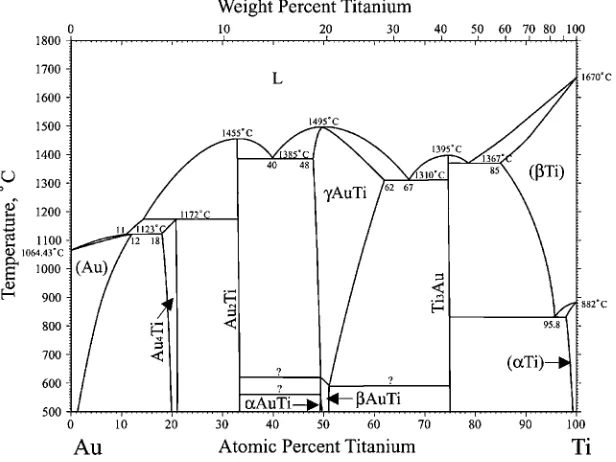
The Ti-Au binary phase diagram is shown in Fig. 1.1)It is
found in the phase diagram that a eutectoid reaction fromto both and Ti3Au exists at 1105 K at the Ti-4 mol%Au composition. Here, Ti3Au is an intermetallic compound with the A15 structure.1)The eutectic reaction may be applicable
to enhance mechanical properties of the alloy due to controlling precipitations and microstructure.2)Few system-atic works have been, however, done for the effect of heat treatments on the phase constitution and the mechanical properties of Ti-Au alloys with near-eutectoid compositions. Therefore, the purpose of this study is to clarify the effects of aging on the phase constitution and the mechanical properties of a Ti-4 mol%Au near-eutectoid alloy.
2. Experimental Procedure
Ti-4 mol%Au alloy was prepared using high purity elemental materials of Ti (99.99%) and Au (99.99%). An ingot was prepared by Ar arc-melting in an Ar-1%H2 atmosphere. The ingot was approximately 30 g in weight. Since the weight change after the arc-melting was negligible, no chemical analysis was carried out for the ingot. The ingot
was homogenized at 1273 K for 7.2 ks in vacuum followed by quenching into ice water. The surface layer of the homogen-ized ingot was removed by mechanical polishing. After homogenization, the ingot was cold-rolled with 95% of reduction in thickness to obtain sheets with 0.5 mm in thickness. A part of the rolled-sheets was solution-treated at 1173 K for 0.9 ks in vacuum followed by quenching into ice water. This material is termed ST, hereafter.
Two kinds of aging conditions were made. One was constant-time aging for 3.6 ks at various aging temperatures of 373, 473, 573, 673, 773, 873, 973 and 1073 K. Each material after aging is termed using both the aging time and the aging temperature like 3.6 ks-1073 K-AT and the term 3.6 ks-AT is used for all the specimens aged for 3.6 ks, hereafter. The other kind of aging was isothermal aging made at 973 K for several aging times from 3.6 to 604.8 ks. Each specimen in this case is termed like 973 K-604.8 ks-AT and the term 973 K-AT is used for all the specimens aged at 973 K, hereafter.
Phase transformation temperature was determined using a differential scanning calorimeter (DSC) with a heating/ cooling rate of 10 K/min (0.167 K/s) within a temperature range from 300 K to 1473 K in Ar atmosphere. A conven-tional-2X-ray diffraction (XRD) analysis was carried out at room temperature (RT, 300 K) in order to determine the phase constitution and the lattice parameters. Philips X’pert Pro Galaxy system equipped with an X’celerator module was used with CuKradiation. All the specimens for XRD were polished mechanically by emery papers and finished by diamond paste with diameter of 1mm. Mechanical properties were examined by a tensile test at RT with a strain rate of
5104s1. The loading direction was set to be parallel to the rolling direction (RD). The gage size was 10 mm in length, 2 mm in width and 0.5 mm in thickness.
3. Results and Discussion
3.1 Phase constitution of ST and 3.6 ks-AT
Figure 2 shows XRD profiles obtained for ST. According *Graduate Student, Tokyo Institute of Technology
to the Ti-Au binary phase diagram, the apparent phases expected are two phases ofTi and Ti3Au. However, single phase of is only recognized for ST in Fig. 2. Since the solubility limit of Au inphase is less than 1 mol%Au at the heat treatment temperature, the observed is judged to be supersaturated. It has been reported that eutectoid Ti-Au alloy transform fromto a supersaturated solid solution of
by a massive transformation.3,4) Although the details of the observed-transformation is not clear, the transformation from to observed in this work is suggested to occur similarly without long-range diffusion as massive or marten-sitic transformation. This supersaturated solid solution of
is, therefore, termedmin this study.
Figure 3 shows DSC cooling and heating curves of ST. It is found in the curves that ST has a reversible reaction: endothermic heat at 1098 K during heating and exothermic heat at 1127 K during cooling. By averaging both reaction temperatures, the reaction temperature is evaluated to be 1113 K. The exothermic peak observed during cooling becomes broadened compared to the endothermic reaction during heating. No other reaction was detected in DSC. The reaction temperature is close to the eutectoid reaction at 1105 K in the Ti-Au binary phase diagram in Fig. 1.
However, no Ti3Au phase was detected by XRD in Fig. 2. Then, the reaction observed is considered to be the massive (or might be martensitic) transformation betweenandm.
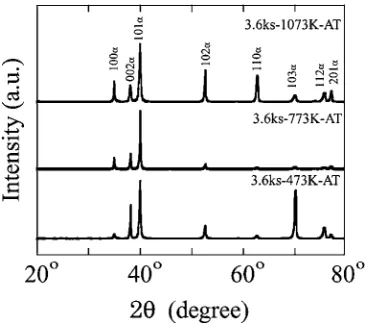
Figure 4 shows three examples of XRD profiles obtained for 3.6 ks-473 AT, 3.6 ks-773 AT and 3.6 ks-1073 K-AT. Onlym was detected as indexed in the profiles. At the
equilibrated state, the alloy is in the two-phase region of
and Ti3Au at the aging temperatures according to the Ti-Au binary phase diagram. Instead of the equilibrium two phases, 3.6 ks-AT was single phase of m regardless of the aging
temperature as demonstrated in Fig. 4. The incubation time for the phase decomposition or precipitation was deduced to be longer than 3.6 ks at these aging temperatures.
Figure 5 shows the lattice parametersaandc, and the axis ratioc=aofm for ST and 3.6 ks-AT as a function of aging
temperature. The lattice parameters of ST were plotted at RT in the figure. Three broken lines indicate the lattice
Fig. 2 XRD profiles of ST.
[image:2.595.145.453.74.305.2] [image:2.595.323.530.340.535.2]parameters of pure Ti5) for a comparison. The lattice parameters of m in ST were a¼0:2947nm, c¼0:4703
nm andc=a¼1:596. By comparing the value ofc-axis in the pure Ti, the increase in c-axis by the addition of Au is evaluated to be6104nm/mol%Au. All the values ofa,c andc=aofmare larger than those of pure Ti. Since thec=a
value ofmis higher than that of pure-Ti, Au addition was
found to anisotropically expand the c-axis largely in comparison with a-axis. This anisotropic lattice-expansion is similar to those caused by additions of C, N and O.6)The
lattice parameters measured were almost independent of the aging temperature. This is because neither precipitation nor phase decomposition occurred under the aging conditions. Then, the chemical composition of them was estimated to
be kept almost constant regardless of aging temperature in this case.
3.2 Mechanical properties of ST and 3.6 ks-AT
Figure 6 shows stress-strain curves of ST and 3.6 ks-AT. All the specimens exhibited good elongation of 15% or higher, independent of aging temperature. 0.2% proof stress was determined from the stress-strain curves. Figure 7 shows 0.2% proof stress of ST and 3.6 ks-AT as a function of aging temperature. ST was regarded as being aged at RT. The 0.2% proof stress is about 350 MPa for ST and decreases with increasing aging temperature. This phenomenon is suggested as follows. A number density of lattice defects is introduced during the -m transformation. Such defects must raise
0.2% flow stress. Then, during aging the defects are annihilated gradually. As the result, 0.2% flow stress is decreased by aging temperature.
3.3 Phase constitution and mechanical properties of 973 K-AT
Figure 8 shows the XRD profiles obtained for isothermal-aged 973 K-AT. 973 K-3.6 ks-AT was single phase of m.
With further increasing isothermal aging time, Ti3Au was
Fig. 5 The lattice parameters,aandc, andc=aofmphase obtained for ST
and 3.6 ks-AT-All as a function of aging temperature. The values of pure Ti in the literature are also drawn.5)
Fig. 6 Stress-strain curves of ST and 3.6 ks-AT-All.
Fig. 7 0.2% proof stress of ST and 3.6 ks-AT-All as a function of aging temperature.
[image:3.595.77.264.71.233.2] [image:3.595.323.528.72.272.2] [image:3.595.65.276.293.525.2] [image:3.595.320.528.318.495.2]formed by the aging for 86.4 ks. The relative intensity diffraction peaks of Ti3Au increased with increasing the aging time as seen in Fig. 8. This indicates that the volume fraction of Ti3Au increased with increasing aging time.
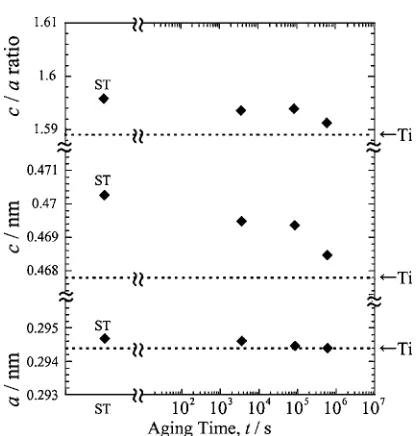
Figure 9 shows the lattice parameters of m for ST and
973 K-AT as a function of aging time. The lattice parameters,
a and c, are seen to approach to those of pure Ti with increasing aging time. This is because Ti3Au is precipitated from m matrix and the concentration of Au in m is
decreased.
Figure 10 shows stress-strain curves of ST and 973 K-AT-All. The flow-stress is seen to be decreased by the increase in the aging time. No significant degradation in elongation was detected in the tensile tests even though a hard intermetallic compound Ti3Au is precipitated. Figure 11 shows 0.2% proof stress of ST and 973 K-AT as a function of aging time. 0.2% proof stress of the 973 K-AT decreased with increasing aging time even though the hard Ti3Au was precipitated. It was found that the precipitation of Ti3Au is not effective on the strengthening of the near-eutectoid Ti-Au alloy. The
softening by the aging is partially explained by weakening of the solid solution hardening by the Au addition inmdue to
growth of Ti3Au precipitation. The decrease in the number density of lattice defects introduced during the-m
trans-formation and quenching is suggested to be another possible reason for this softening during the isothermal aging.
4. Conclusions
(1) Ti-4 mol%Au alloy transforms fromto supersaturated
(m) by quenching from-phase region. The reaction
temperature for the-mtransformation determined by
DSC was 1113 K.
(2) The lattice parameters of m in Ti-4 mol%Au alloy
werea¼0:2947nm,c¼0:4703nm andc=a¼1:596, respectively. The lattice parameters are almost constant regardless of aging temperature.
(3) By addition of 4 mol%Au to Ti, the lattice parameter of
c-axis was anisotropically expanded along c-axis largely in comparison with a-axis. The increase inc -axis is evaluated to be6104nm/mol%Au.
(4) Precipitation of Ti3Au does not occur during aging for
Fig. 8 XRD profiles of 973 K-AT-All.
Fig. 9 The lattice parameters of them-phase for ST and 973 K-AT-All as
[image:4.595.324.529.72.248.2]a function of aging time.
[image:4.595.65.274.273.491.2]Fig. 10 Stress-strain curves of ST and 973 K-AT-All.
[image:4.595.321.526.292.466.2]