Proceedings of the 49th Annual Meeting of the Association for Computational Linguistics:shortpapers, pages 603–608, Portland, Oregon, June 19-24, 2011. c2011 Association for Computational Linguistics
Semantic Information and Derivation Rules for Robust Dialogue Act
Detection in a Spoken Dialogue System
Wei-Bin Liang1 Chung-Hsien Wu2 Department of Computer Science and
Information Engineering National Cheng Kung University
Tainan, Taiwan 1[email protected] 2[email protected]
Chia-Ping Chen
Department of Computer Science and Engineering
National Sun Yat-sen University Kaohsiung, Taiwan
Abstract
In this study, a novel approach to robust di-alogue act detection for error-prone speech recognition in a spoken dialogue system is proposed. First, partial sentence trees are pro-posed to represent a speech recognition out-put sentence. Semantic information and the derivation rules of the partial sentence trees are extracted and used to model the relation-ship between the dialogue acts and the deriva-tion rules. The constructed model is then used to generate a semantic score for dialogue act detection given an input speech utterance. The proposed approach is implemented and evalu-ated in a Mandarin spoken dialogue system for tour-guiding service. Combined with scores derived from the ASR recognition probabil-ity and the dialogue history, the proposed ap-proach achieves 84.3% detection accuracy, an absolute improvement of 34.7% over the base-line of the semantic slot-based method with 49.6% detection accuracy.
1 Introduction
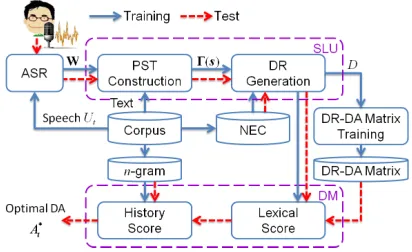
An intuitive framework for spoken dialogue system (SDS) can be regarded as a chain process. Specifi-cally, the automatic speech recognition (ASR) mod-ule accepts the user’s utterance Ut and returns a
string of words Wt The spoken language
under-standing (SLU) module convertsWtto an abstract
representation of the user’s dialogue act (DA). The dialogue management (DM) module determines the user’s dialogue act A∗t and accordingly decides the current act of the system. The system DA is con-verted to a surface representation by natural
lan-Figure 1: Details of the SLU and DM modules.
guage generation in the textual form, which is passed to a text-to-speech synthesizer for speech waveform generation. The cycle repeats when the user responds with a new utterance. Clearly, one can see that the inference of the user’s overall intention via DA detection is an important task in SDS.
[image:1.612.325.531.258.384.2]optimal dialogue act, and a proper action by the sys-tem is taken. In our syssys-tem, not only the clean text data but also the noisy ASR output data are used in order to take the error-proneness of ASR output into account. Furthermore, a predefined keyword list is used and the keyword tokens are replaced by the cor-responding named entity classes (NEC) in order to obtain a compact feature set.
2 Models for Dialogue Act Detection Referring to the SDS depicted in Figure 1, the DA detection can be formulated as follows. At turn t, the most likely DA is determined by
A∗t = arg max
A∈ΩP r(A|Ut, Ht), (1)
whereUtis the user’s utterance,Htis the dialogue
historical information, andΩ ={A1, . . . , Aq}is the
set of DAs. Using the maximum approximation for summation, (1) can be written as
A∗t = arg max
A∈Ω X
W
P r(A,W|Ut, Ht)
≈arg max
A∈ΩmaxW P r(A,
W|Ut, Ht)
= arg max
A∈Ω,W
P r(W|Ut, Ht)P r(A|W, Ut, Ht),
(2) whereW is the ASR output. Since the ASR output
is independent ofHtgivenUt, the ASR-related first
term in (2) can be re-written as
P r(W|Ut, Ht) =P r(W|Ut)∝f(W, Ut), (3)
where the function f(W, Ut) is introduced as the
ASR score function. In addition, assuming that the information provided byUtis completely conveyed
inW, we can approximate the second term in (3) by
the product of two functions
P r(A|W, Ut, Ht) =P r(A|W, Ht)
∝g(A,W)h(A, Ht), (4)
where g(A,W) is introduced as the lexical score
function, andh(A, Ht) is introduced as the history
score function. Thus, (3) can be re-written as
A∗t ≈arg max
A∈Ω,W
f(W, Ut)g(A,W)h(A, Ht). (5)
[image:2.612.325.529.71.135.2]In Sections 3 and 4, we specify and explain how the scores in (5) are computed.
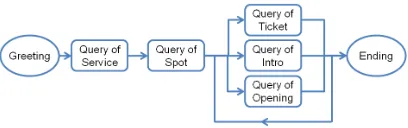
Figure 2: An example of a dialogue management mod-ule usingn-gram model for dialogue act sequence in the domain of historic spot.
3 ASR Score and History Score
For the ASR score, we use the conventional recog-nition probability of the ASR recogrecog-nition model. For the history score, similar to the schemes used in (Hori et al., 2009c; Hori et al., 2009b; Hori et al., 2009a), a back-off bi-gram model for DA sequence is estimated from the data collected by the SDS. The estimated bi-gram model is used to calculate the his-tory score. That is,
h(A, Ht) =P r(At=A|At−1). (6)
Essentially, (6) is based on a Markov model assump-tion for the chain of the dialogue acts. Figure 2 shows an example of dialogue controlling model of an SDS. In this example, each state represents a DA. A dialogue begins with the greeting state and ends with the ending state. During a session, a user can inquire the system about the provided services and then choose one service to continue (e.g., the loop-back connection in Figure 2).
4 The Lexical Score Function
The main challenge of this system is the computa-tion of the lexical scoreg(A,W). In this paper, we
propose a novel data-driven scheme incorporating many techniques.
4.1 Construction of Partial Sentence Tree
In an SDS, it is often beneficial to define a set of keywords K, and a set of non-keywords N. Each word w ∈ K should be indicative of the DA of the sentence. The set of sentences S containing at least one keyword in K, can be represented as S=N∗
(K N∗
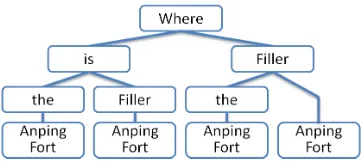
Figure 3: Construction of the partial sentence tree for the sentence Where is the Anping-Fort.
partial sentences can be compiled in a tree, called the partial sentence tree (PST) and denoted asT(s). The motivation for using PST is to achieve robust DA detection as the ASR module could be error-prone in adverse environments. In addition, words that are not confidently recognized are replaced by a special non-keyword token called Filler. Specif-ically, we compute the z-score (Larsen and Marx, 2000) of each wordwin the ASR output. Figure 3 illustrates the PST for the sentences: Where is the
Anping-Fort. There are two keywords Where and Anping-Fort and two non-keywords is and the. Note
that with2non-keywords in the original sentences, we have22= 4partial sentences in the PSTT(s).
4.2 Extraction of the Derivation Rules
After text processing, a sentencesis parsed by the statistical Stanford parser (S-parser) (Levy and Man-ning, 2003). Let the grammar of the S-parser be denoted as a 5-tuple G = (V,Σ,P, S, D) where V is the variable (non-terminal) set,Σis the termi-nal symbol set,P is the production rule set,S is the sentence symbol, andDis a function defined onP for rule probability (Jurafsky and Martin, 2009). A derivation rule is defined to be a derivation of the formA → B → wwhereA, B ∈ V andw∈Σ. The parsing result of the exemplar sentences repre-sented in the parenthesized expression is shown in Figure 4. From the parsing result, four DRs are ex-tracted. Essentially, we have one DR for each lexical word in the sentence. Totally, given a corpus,lrules are extracted and defined asD={R1, R2, . . . , Rl}.
Based on PST T(s)and DR set D, a vector rep-resentation v(s) for sentence scan be constructed according to the DRs used inT(s). That is
vi(s) =
(
1, ifRi ∈ T(s)
0, otherwise (7)
Parse Result Derivation Rule
(Root DR1: WHADVP (WRB Where)
(SINV DR2: VP (VBZ is)
(FRAG DR3: NP (DT the)
(WHADVP (WRB Where))) DR4: NP (NNP Anping-Fort) (VP (VBZ is))
[image:3.612.95.277.71.153.2](NP (DT the) (NNP Anping-Fort))))
Figure 4: The parse result (left) and the extracted deriva-tion rules (right) for the exemplar sentences.
For example,v(s) = [1 0 1 0]T means that there are
four derivation rules, of whichR1 andR3 are used inT(s). The motivation for using DRs instead of the lexical words is to incorporate the part-of-speech (POS) tags information. POS tags are helpful in the disambiguation of noun-and-verb homonyms in Chinese. Moreover, the probabilistic nature of the S-parser renders the DRs extracted from the pars-ing results quite robust and consistent, even for the error-prone ASR output sentences.
4.3 Generation of Dialogue Acts
The basic idea of data-driven DA is to cluster sen-tences in the set and identify the clusters as formed by the sentences of the same DA. In this work, the
spectral clustering algorithm (von Luxburg, 2007) is
employed for sentence clustering. Specifically, sup-pose we have n vectors represented asC = {vk ,
v(sk), k = 1, . . . , n}converted from sentences
ac-cording to (7). FromC, we construct ann×n sim-ilarity matrix M, in which each element Mkk′ is a symmetric nonnegative distance measure between
vkandvk′. In this work, we use the cosine measure. The matrixMcan be regarded as the adjacency ma-trix of a graphGwith node set N and edge set E, whereN is1-to-1correspondent to the setC, andE corresponds to the non-zero entries inM. The nor-malized Laplacian matrix ofM is
L,I−D−21M D−12, (8)
whereDis a diagonal matrix with entries
Dkk′ =δkk′
n
X
j=1
Mkj. (9)
eigenvalues. We put these eigenvectors in ann×q
orthogonal matrixQ, and cluster the row vectors to
q clusters. Each cluster correspond to a data-driven DAAj, and thensentences are classified according
to the cluster they belong to.
In order to use the DRs in a PST as a knowl-edge source for DA detection, we essentially need to model the relationship between the random DA and the random DR. Denote the random DA byX and the random DR byY. Given a text corpus, letnij be
the accumulated count thatRi occurs in a sentence
labeled asAj. Fromnij, the conditional probability
ofY =Aj givenX =Ri can be defined as
γij = ˆp(Y =Aj|X=Ri),
nij
Pq
j′=1nij′
, (10)
wherej= 1, . . . , q. The normalized entropy for the conditional probability function (10) is
ǫi =−
1 logq
q
X
j=1
γijlogγij. (11)
From (10) and (11), a matrixΦcan be constructed by Φij = (1 −ǫi)γij. We call Φ the
derivation-rule dialogue-act (DR-DA) matrix, in which each row corresponds to a derivation rule and each col-umn corresponds to a dialogue act.
4.4 Distance Measure
In our system, the lexical score g(A,W) in (5) is
further broken into two terms
g(A,W)≈gR(A, s)gN(A,W) (12)
where gR(A, s) is called the DR score and
gN(A,W) is called the named entity score. Note
thatsdenotes the sentence after text processing. The cosine distance measure is employed for the deriva-tion rule score,
gR(A=Aj, s) = max σ∈T(s)
bT
σaj
|bσ||aj| (13)
wherebTσ is the vector representation (using the
co-ordinates of the DRs) of a partial sentenceσinT(s), andajis thejthcolumn vector in the DR-DA matrix
Φ. For the named entity score, we use the approxi-mation
gN(A,W) =
Y
k
ν(A, αk) (14)
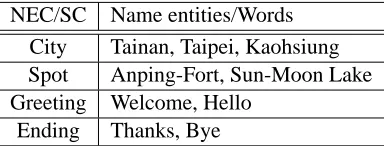
NEC/SC Name entities/Words City Tainan, Taipei, Kaohsiung Spot Anping-Fort, Sun-Moon Lake Greeting Welcome, Hello
[image:4.612.331.523.71.144.2]Ending Thanks, Bye
Table 1: Examples of named entity classes (NEC) and semantic classes (SC)
whereαk is the kth named entity inW. Note that
ν(A, α)is estimated from a training corpus by rela-tive frequencies.
5 Experiments and Discussion
To evaluate the proposed method of dialogue act de-tection for robust spoken dialogue system, we adopt the commonly-used Wizard-of-Oz approach (Fraser and Gilbert, 1991) to harvest the Tainan-city tour-guiding dialogue corpus in a lab environment and experiment with simulated noisy ASR results. The details are given in this section. Two types of data from different sources are collected for this work. The first type of data, called A-data, is a travel infor-mation data set harvested from the databases avail-able on the web, e.g., Wikipedia and Google Map. A-data consists of1,603sentences with317 word types. The second type of data, called Q-data, is the edited transcription of a speech data set simulating human-computer dialogues in a lab environment. Q-data is intended for the system to learn to handle the various situations, e.g., misunderstanding the user’s intention. It consists of144dialogues with1,586 ut-terances. From the Q-data,28named entity classes and796derivation rules were obtained from the S-parser. Table 1 gives some examples of the selected NECs and semantic classes.
5.1 Experimental Conditions
number of DA types 37 38 39 detection accuracy 82.7 84.3 77.2
Table 2: Detection accuracies with varying numbers of DA types.
on Hidden Markov Model (HMM) with 32 Gaus-sian mixture components per state. For the lan-guage model, SRILM toolkit (Stolcke, 2002) was employed to estimate a bi-gram model with the Q-data. The average word accuracy of the ASR module is 86.1% with a lexicon of297words. Note that the vocabulary size is small due to a limited domain. 5 -fold cross validation method was utilized for system evaluation.
As shown in Table 2, one can see that38DA types achieve the best performance for the proposed detec-tion model. Therefore, we use38DA types (q= 38) in our system. Note that some exemplar DAs are shown in Figure 2.
5.2 Incremental Evaluation
We incrementally add techniques in our SDS un-til the complete proposed overall system is imple-mented, to observe the effect of these techniques. The detection accuracies are shown in Table 3. In this table, the third column (ASR) represents the re-sults of the experiment using the ASR transcripts directly. The fourth column (REF) uses the refer-ence transcripts, so it represents the case with per-fect ASR. The first (40%-sim) and second (60%-sim) column represents the simulation where 40% and 60% of the words in the reference transcripts are retained, respectively. There are five sets of ex-periments summarized in this table. For the base-line, each keyword corresponds to a coordinate in the vector representation for a sentence. The results are shown in the first row (baseline). In the second set of experiments (NEC), the keywords are replaced by their NEC. In the third set of experiments (PST), the PST representation for a sentence is used. In the fourth set of experiments (DR), the derivation rule representation of a sentence is used. Finally, the entropy-normalized DR-DA matrix is used to repre-sent repre-sentences, and the results are shown in the last row (DR-DA). There are strong improvements when NEC (from 49.6% to 56.8%) and PST (from 56.8% to 76.2%) representations are introduced. Moreover,
40%-sim 60%-sim ASR REF
baseline 17.2 32.6 49.6 60.9
NEC 22.4 36.8 56.8 76.9
PST 29.8 49.2 76.2 91.1
DR 26.3 48.0 81.6 92.1
DR-DA 26.3 47.4 82.9 93.3
Table 3: Detection accuracies of cascading components for the lexical score.
value ofλL 0.5 0.6 0.7 0.8
Accuracy (%) 84.3 84.6 85.1 84.9
Table 4: Evaluation on different weighted product fusion
the DR and DR-DA representations also lead to sig-nificant improvements, achieving 81.6% to 82.9%, respectively. For the other conditions of 40%-sim, 60%-sim, and REF, similar improvements of using NEC and PST are observed. Using DR-DA, how-ever, suffers from performance degradation when the keywords are randomly discarded.
5.3 Evaluation on the Weighting Scheme
We examine the effect of different weighted product fusion and rewrite the formulation in (5) as
A∗t ≈arg max
A∈Ω,W
[f(W, Ut)g(A,W)]λA[h(A, Ht)]λL
(15) whereλA is the weight for the ASR score and the
lexical score,λLis the weight of the history score,
andλA+λL = 1. Table 4 shows the results that
history information will effect on the DA detection, because it was estimated by the dialogue turns that captured the user behaviors.
6 Conclusions
References
J. Bellegarda. 2000. Exploiting latent semantic informa-tion in statistical language modeling. Proceedings of
the IEEE, 88:1279–1296.
N. Fraser and G. N. Gilbert. 1991. Simulating speech systems. Computer Speech and Language, 5(1):81– 99.
C. Hori, K. Ohtake, T. Misu, H. Kashioka, and S. Naka-mura. 2009a. Recent advances in wfst-based dialog system. In Proc. INTERSPEECH, pages 268–271. C. Hori, K. Ohtake, T. Misu, H. Kashioka, and S.
Naka-mura. 2009b. Statistical dialog management applied to wfst-based dialog systems. In Proc. IEEE
Inter-national Conference on Acoustics Speech and Signal Processing (ICASSP), pages 4793–4796.
C. Hori, K. Ohtake, T. Misu, H. Kashioka, and S. Naka-mura. 2009c. Weighted finite state transducer based statistical dialog management. In Proc. ASRU. D. Jurafsky and J. H. Martin. 2009. Speech and
Lan-guage Processing, 2nd Edition. Pearson Education.
R. J. Larsen and M. L. Marx. 2000. An Introduction to
Mathematical Statistics and Its Applications, 3rd Edi-tion. ISBN: 0139223037.
R. Levy and C. Manning. 2003. Is it harder to parse chinese, or the chinese treebank? In Proc. Annual
Meeting of ACL, pages 439–446.
A. Stolcke. 2002. Srilm - an extensible language model-ing toolkit. In Proc. International Conference on
Spo-ken Language Processing, pages 901–904.
U. von Luxburg. 2007. A tutorial on spectral clustering.
Statistics and Computing, 17(4).
C.-H. Wu and Y.-J. Chen. 2004. Recovery from
false rejection using statistical partial pattern trees for sentence verification. Speech Communication, 43(1-2):71–88.
Steve J. Young, D. Kershaw, J. Odell, D. Ollason, V. Valtchev, and P. Woodland. 2006. The HTK Book