Developing practice recommendations for
endovascular revascularization for acute
ischemic stroke
Marc A. Lazzaro, MD Roberta L. Novakovic, MD Andrei V. Alexandrov, MD Ziad Darkhabani, MD Randall C. Edgell, MD Joey English, MD Donald Frei, MD Dara G. Jamieson, MD Vallabh Janardhan, MD Nazli Janjua, MD Rashid M. Janjua, MD Irene Katzan, MD Pooja Khatri, MD Jawad F. Kirmani, MD David S. Liebeskind, MD Italo Linfante, MD Thanh N. Nguyen, MD Jeffrey L. Saver, MD Lori Shutter, MD Andrew Xavier, MD Dileep Yavagal, MD Osama O. Zaidat, MD ABSTRACTGuidelines have been established for the management of acute ischemic stroke; however, spe-cific recommendations for endovascular revascularization therapy are lacking. Burgeoning inves-tigation of endovascular revascularization therapies for acute ischemic stroke, rapid device development, and a diverse training background of the providers performing the procedures un-derscore the need for practice recommendations. This review provides a concise summary of the Society of Vascular and Interventional Neurology endovascular acute ischemic stroke roundtable meeting. This document was developed to review current clinical efficacy of pharmacologic and mechanical revascularization therapy, selection criteria, periprocedure management, and endo-vascular time metrics and to highlight current practice patterns. It therefore provides an outline for the future development of multisociety guidelines and recommendations to improve patient selection, procedural management, and organizational strategies for revascularization therapies in acute ischemic stroke.Neurology®2012;79 (Suppl 1):S243–S255
GLOSSARY
ACT⫽ activated clotting time; AHA ⫽ American Heart Association; AIS ⫽ acute ischemic stroke; ASA ⫽ American Stroke
Association; ASPECTS⫽ Alberta Stroke Program Early CT score; CI ⫽ confidence interval; ECASS ⫽ European Cooperative
Acute Stroke Study III; ED⫽ emergency department; EMS ⫽ emergency medical services; ERT ⫽ endovascular
revascular-ization therapy; FDA⫽ US Food and Drug Administration; IA ⫽ intra-arterial; ICH ⫽ intracranial hemorrhage; IMS ⫽
Interven-tional Management of Stroke; J-MUSIC⫽ Japan Multicenter Stroke Investigators’ Collaboration; MCA ⫽ middle cerebral
artery; MELT⫽ MCA-Embolism Local fibrinolytic intervention Trial; MERCI ⫽ Mechanical Embolus Removal in Cerebral
Ischemia; MR CLEAN⫽ Multicenter Randomized Clinical Trial of Endovascular Treatment for Acute Ischemic Stroke in the
Netherlands; MR RESCUE⫽ MR and Recanalization of Stroke Clots Using Embolectomy; mRS ⫽ modified Rankin Scale;
NIHSS⫽ NIH Stroke Scale; NINDS ⫽ National Institute of Neurological Disorders and Stroke; OR ⫽ odds ratio; PROACT ⫽
Prolyse in Acute Cerebral Thromboembolism; rtPA⫽ recombinant tissue plasminogen activator; sICH ⫽ symptomatic ICH;
SYNTHESIS EXP⫽ Intra-Arterial Versus Systemic Thrombolysis for Acute Ischemic Stroke; THERAPY ⫽ Assess the
Penum-bra System in the Treatment of Acute Stroke; VBO⫽ vertebrobasilar occlusion.
In an effort to improve outcome in patients with acute ischemic stroke (AIS), recent initiatives
have outlined the best medical management and developed protocols to facilitate timely
iden-tification and administration of the US Food and Drug Administration (FDA)–approved IV
recombinant tissue plasminogen activator (rtPA) to eligible patients.
1,2Restoration of blood flow after AIS is associated with improved outcome and reduced
mortality.
3,4A meta-analysis including over 2,000 patients in 53 studies confirmed a strong
correlation between recanalization and good functional outcome at 3 months, in comparison
with nonrecanalization (odds ratio [OR] 4.43; 95% confidence interval [CI] 3.32–5.91).
4Intra-arterial (IA) thrombolysis has not received FDA approval, but randomized trials and
several case series have led to endorsements by multiple associations for select patients.
5–9Endovascular revascularization therapy (ERT) currently has a Class Ib recommendation for IA
thrombolysis for select patients and a Level IIb recommendation for mechanical thrombus
From the Medical College of Wisconsin/Froedtert Hospital (M.A.L., Z.D., O.O.Z.), Milwaukee, WI; University of Texas Southwestern Medical Center at Dallas (R.L.N.), Dallas; University of Alabama (A.V.A.), Birmingham; St. Louis University (R.C.E.), St. Louis, MO; University of California San Francisco (J.E.), San Francisco; Radiology Imaging Associates (D.F.), Denver, CO; Weill Cornell Medical College (D.G.J.), New York, NY; Texas Stroke Institute (V.J.), Dallas; Asia Pacific Comprehensive Stroke Institute (N.J.), Pahoa, HI; Wake Forest Baptist Health (R.M.J.), Winston-Salem, NC; Cleveland Clinic Foundation (I.K.), Cleveland, OH; University of Cincinnati (P.K., L.S.), Cincinnati, OH; New Jersey Neuroscience Institute (J.F.K.), JFK Medical Center, Edison; University of California Los Angeles (D.S.L., J.L.S.), Los Angeles; Baptist Medical Center (I.L.), Miami, FL; Boston University Medical Center (T.N.J.), Boston, MA; Wayne State University (A.X.), Detroit, MI; and University of Miami (D.Y.), Miami, FL.
Go to Neurology.org for full disclosures. Disclosures deemed relevant by the authors, if any, are provided at the end of this article. Correspondence & reprint
requests to Dr. Novakovic: [email protected]
extraction in the American Heart Association
(AHA) guidelines.
1–9Two device families
have FDA approval for ERT: the Merci
Re-triever (Concentric Medical, Inc., Mountain
View, CA) and the Penumbra Aspiration
Sys-tem (Penumbra Inc., Alameda, CA); and
multiple new devices are rapidly approaching
FDA approval and market availability.
10,11Es-tablished guidelines and recommendations
are available for the early treatment of adults
with AIS
1and for the development of
com-prehensive stroke centers
7and training
stan-dards for endovascular ischemic stroke
treatment.
9However, guidelines for ERT for
AIS are lacking. Ongoing clinical trials and
the brisk pace of emerging technologies have
fostered enthusiasm for endovascular therapy
for AIS, resulting in the need for development
of practice recommendations.
This outline was developed by a panel of
physicians with a range of expertise in
neuro-interventional procedures, vascular
neurol-ogy, neurocritical care, neurosurgery, and
neuroradiology. In many instances, definitive
clinical trial– based data are lacking, and
prac-tices are discussed on the basis of
pathophysi-ologic rationale and expert opinion, not on
the basis of randomized clinical trials.
SAFETY AND EFFICACY OF ENDOVASCULAR REVASCULARIZATION THERAPY FOR ACUTE
ISCHEMIC STROKE Endovascular treatment
op-tions for intracerebral revascularization have evolved considerably over the past decade. Several trials eval-uating the various therapies are summarized in table 1. The Prolyse in Acute Cerebral Thromboembolism (PROACT) and PROACT II studies evaluated the use of IA thrombolysis with prourokinase in middle cerebral artery (MCA) occlusions.5,6The initial phase 2 trial demonstrated higher recanalization rates with prourokinase.5The phase 3 trial, PROACT II, dem-onstrated the effectiveness of IA thrombolysis with prourokinase in patients with an MCA occlusion treated within 6 hours from symptom onset.6A min-imum requirement NIH Stroke Scale (NIHSS) score of 4, except for isolated aphasia or hemianopia, was required for enrollment. Patients treated with prou-rokinase had a higher rate of recanalization (66% vs 18%; p ⬍ 0.001) and were more likely to have a good outcome (modified Rankin Scale [mRS] score of 0 –2 at 90 days, 40% vs 25%; p⫽ 0.04), despite a higher rate of symptomatic intracranial hemor-rhage (sICH) (10% vs 2%; p⫽ 0.06). The
MCA-Embolism Local fibrinolytic intervention Trial (MELT) was a similarly designed trial comparing urokinase to placebo in patients with MCA occlu-sions, which was terminated early because of the ap-proval of the IV administration of rtPA in Japan.12 Although the MELT findings are underpowered, the results are consistent with those of the PROACT tri-als, suggesting higher recanalization rates (74%) with IA thrombolysis.12A meta-analysis of these 3 trials and 2 additional smaller trials combined 395 ran-domized patients and showed that IA thrombolysis increased the odds of both nondisabled outcome (mRS score 0 –1; OR 2.5; 95% CI 1.33–3.14; p⬍ 0.001) and nondependent outcome (mRS score 0 –2; OR 14; 95% CI 1.31–3.51; p ⬍ 0.003).13 A case-control analysis from Japan’s Multicenter Stroke In-vestigators’ Collaboration (J-MUSIC) compared 91 patients with an acute cardioembolic stroke treated with IA urokinase within 4.5 hours of symptom on-set to a matched control group that did not receive IA therapy. The analysis showed that a favorable out-come (mRS score of 0 –2) was more frequently observed in the urokinase group (50.5% vs 34.1%;
p⫽ 0.0124), and there was no difference in
mortal-ity rate.14Although confirmatory trials required for FDA approval of IA therapy have not been per-formed, these randomized trials and numerous case series support the use of IA thrombolysis in select patients who are ineligible for IV thrombolysis.
Mechanical devices for ERT have evolved as a means of achieving faster rates of recanalization in medium- to large-vessel occlusions. The Mechanical Embolus Removal in Cerebral Ischemia (MERCI) and Multi-MERCI were prospective, single-arm, multicenter trials designed to test the efficacy and safety of a corkscrew thrombectomy device in the treatment of medium- to large-vessel occlusions (an-terior and pos(an-terior circulation) within 8 hours of symptom onset.10A combined analysis of the 2 stud-ies demonstrated a successful recanalization rate (de-fined as Thrombolysis in Myocardial Infarction 2 or 3 score) of 64.6%, with good clinical outcome (mRS score of 0 –2) in 32.4%, despite an sICH rate of 7.8% in the first study and 9.8% in the second.15 The Penumbra Pivotal Stroke Trial provided registry data on a novel aspiration-thrombectomy device, the Penumbra system, used within 8 hours for large-artery cerebrovascular occlusion.11 A quarter of the patients achieved an mRS score of less than or equal to 2 at 90 days. Different techniques for measuring recanalization preclude a direct comparison between the rates achieved with MERCI and Penumbra, but both exceed the natural history rate.16
Randomized trials are ongoing, such as the Local Versus Systemic Thrombolysis for Acute Ischemic
Stroke (SYNTHESIS EXP) and the Multicenter Randomized Clinical trial of Endovascular treatment for Acute ischemic stroke in the Netherlands (MR CLEAN), comparing endovascular recanalization vs standard medical treatment alone (including IV rtPA or supportive care alone).17,18The NIH-funded Me-chanical Retrieval and Recanalization of Stroke Clots Using Embolectomy (MR RESCUE) trial is compar-ing the effectiveness of endovascular therapy within 8 hours of symptom onset and standard medical care to standard medical treatment alone.19Several trials are testing bridging therapies combining early ad-ministration of IV rtPA with the endovascular ap-proach, including the Interventional Management of Stroke III (IMS III) and Assess the Penumbra System in the Treatment of Acute Stroke (THERAPY) tri-als.20In the United States, the ongoing IMS, a ran-domized, multicenter trial, will enroll 900 subjects with AIS within 3 hours of symptom onset to com-pare combined IV and IA rtPA to IV rtPA alone.21
Alternative revascularization methods continue to evolve and have included acute intracranial stent im-plantation22and temporary endovascular bypass and thrombectomy with a retrievable stent.23,24 Initial open series reports with stent retrievers suggest po-tentially higher recanalization rates and shorter pro-cedure times.
PATIENT SELECTION FOR ENDOVASCULAR REVASCULARIZATION THERAPY IN ACUTE
ISCHEMIC STROKE Designing a decision
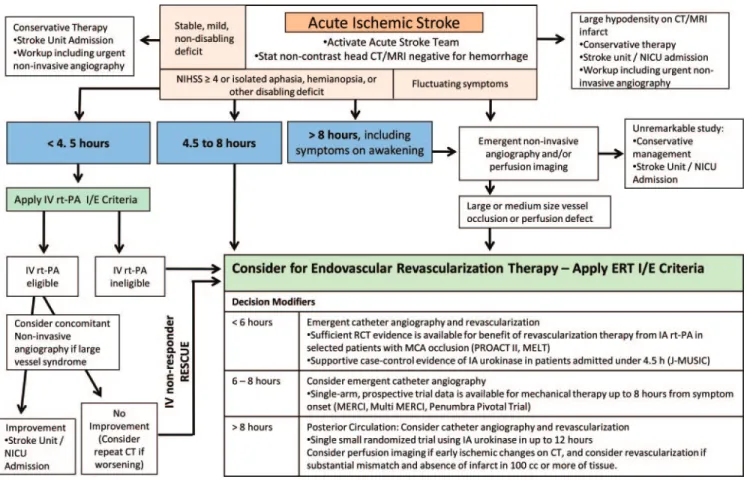
algo-rithm for patient selection for ERT in AIS is hin-dered by variable enrollment criteria in the trials cited previously. The presented outline for the devel-opment of a decision algorithm is based on findings from available randomized controlled trials and ex-trapolated from criteria from recent and ongoing clinical trials (figure). This is an example of one pos-sible algorithm, and further investigation is necessary prior to clinical use.
Outside of clinical trials, IV therapy remains first-line treatment for eligible patients presenting with clinical symptoms of AIS. Through a systematic re-view of the literature, the American Stroke Associa-tion (ASA) guidelines outline the best medical management as well as protocols to facilitate timely administration of IV rtPA to patients eligible for thrombolysis.1For patients with moderate to severe deficits and minimal or no early ischemic changes on brain imaging, therapy triage is largely governed by time from symptom onset. There is strong evidence from multiple clinical trials to support the use of IV rtPA within 3 hours.2,25,26 Current FDA approval exists for patients presenting up to 3 hours from symptom onset, and a science advisory from the ASA/AHA has recommended expanding the time
Table 1 Data from selected trials of endovascular revascularization therapy for acute ischemic stroke PROACT 5 PROACT II 6 EMS 56 IMS I 55 IMS II 40 MERCI 10 MELT 12 Multi-MERCI 29 Penumbra PST 11 Solitaire AB pilot study 24 Year 1998 1999 1999 2004 2007 2005 2007 2008 2009 2010 Intervention ProUK ⫹ IV heparin vs IV heparin ⫹ placebo (IA saline infusion) ProUK ⫹ IV heparin vs IV heparin IV tPA or IV placebo followed by IA tPA IV ⫹ IA tPA ⫹ IV heparin IV ⫹ IA tPA ⫹ IV heparin with or without Ekos Merci X6 Retriever ⫹ IV heparin UK vs control L5 Retriever ⫹ IV heparin Penumbra aspiration system ⫹ IV heparin Solitaire AB mechanical thrombectomy Enrollment time, h ⬍ 6 ⬍ 6 ⬍ 3 ⬍ 3 ⬍ 3 ⬍ 8 ⬍ 6 ⬍ 8 ⬍ 8 ⬍ 8 Design RCT, Phase II RCT, Phase III RCT, Phase I Single arm, safety and feasibility Single arm, safety and feasibility Single arm, Prospective RCT Single arm, prospective Single arm, prospective Single arm, safety and feasibility No. of patients 40 180 35 80 81 151 114 164 125 20 Recanalization rate, % of treatment/control 58/14 66/18 55/10 56 60 (TICI/TIMI 2–3) 46 74 57/69 with adj tx 82 90 Occlusion site MCA MCA CCA, ICA, MCA, BA ICA, MCA, VA, BA, SCA, PCA, ACA, AICA, PICA ICA, MCA, VA, BA, SCA, PCA, ACA, AICA, PICA ICA, MCA, VA, BA, MCA ICA, MCA, VA, BA, ICA, MCA, VA, BA, ICA, MCA Mean NIHSS, treatment/control 17/19 17/17 16/11 18 19 20 14/14 19 18 19 SICH, % of treatment/control 15/7 10.9/2 11.8/5.6 6 9.9 7.8 9/2 9.8 11.2 10 mRS 0–2 at 90 days, % of treatment/control 30/21 (mRS 0–1 at 90 days) 40/25 47/67 43 46 28 49.1 36 25 45 Abbreviations: ACA ⫽ anterior cerebral artery; adj tx ⫽ adjunctive therapy; AICA ⫽ anterior inferior cerebellar artery; BA ⫽ basilar artery; CCA ⫽ common carotid artery; EMS ⫽ Emergency Management of Stroke Bridging Trial; IA ⫽ intra-arterial; ICA ⫽ intracranial internal carotid artery; IMS ⫽ Interventional Management of Stroke trial; MCA ⫽ middle cerebral artery; MELT ⫽ Middle cerebral artery Embolism Local Fibrinolytic intervention Trial; MERCI ⫽ Mechanical Embolus Removal in Cerebral Ischemia; mRS ⫽ modified Rankin Scale; NIHSS ⫽ NIH Stroke Scale; PCA ⫽ posterior cerebral artery; PICA ⫽ posterior inferior cerebellar artery; PROACT ⫽ Prolyse in Acute Cerebral Thromboembolism trial; PST ⫽ Pivotal Stroke Trial; RCT ⫽ randomized controlled trial; SCA ⫽ superior cerebellar artery; SICH ⫽ symptomatic intracranial hemorrhage; TICI ⫽ thrombolysis in cerebral infarction; TIMI ⫽ thrombolysis in myocardial infarction; tPA ⫽ tissue plasminogen activator; UK ⫽ urokinase; VA ⫽ intracranial vertebral artery.
window to 4.5 hours in a subgroup of patients, on the basis of results of the European Cooperative Acute Stroke Study III (ECASS III).25,27
Patients presenting after 4.5 hours are not eligible for systemic thrombolysis; however, data exist, as cited previously, for the consideration of IA fibrino-lytic administration up to 6 hours from symptom onset in patients with a large- to medium-vessel oc-clusion.6,12,28 For patients in whom endovascular therapy can be initiated within 8 hours from symp-tom onset, 2 mechanical revascularization device families have demonstrated safe and feasible rates of recanalization in single-arm, prospective trials.10,11,29 The optimal device for mechanical revascularization has not been identified, and the rapid growth of de-vice technology will likely continue to challenge rig-orous clinical evaluation.
Vertebrobasilar artery occlusion (VBO) has an in-variably poor outcome if recanalization is not achieved early. The recent literature shows that mor-tality with acute VBO treated with nonthrombolytic drugs is 80% to 90%, although lower rates of 42% to 60% can be achieved with IA therapy.28,30,31Success of recanalization and neurologic status before treat-ment are independent predictors of a favorable out-come after IA therapy.30,31Multiple studies failed to establish a time window that would definitively
ex-clude patients from IA therapy.30One study found a significantly better clinical outcome in patients with acute VBO treated within 6 hours after symptom onset than in patients treated after 6 hours (favorable outcome of 36% vs 7%; mortality of 52% vs 70%;
p⫽ 0.005).28Other studies demonstrated trends to-ward better outcome, with shorter duration of symp-toms, and no significant association between time to treatment and clinical outcome.30,31When patients are in a coma or have had prolonged symptoms, additional imaging such as MRI with diffusion and perfusion or CT perfusion might help in identifying those who are likely to benefit from intervention. However, the cur-rent application of CT perfusion results to the posterior circulation may be limited.
The trials that shape the current decision patterns have been largely based on time from symptom on-set. Data are lacking on the efficacy of ERT beyond 12 hours from symptom onset in patients with poste-rior circulation occlusion and beyond 8 hours in an-terior circulation occlusion.10,11,29,31,32Given the poor natural history of VBO, revascularization has been considered beyond 12 hours from symptom onset. Enthusiasm continues for a perfusion imaging– based decision algorithm, although rigorous data to sup-port this approach are lacking.33 Further study of perfusion imaging may assist with selection of
tients who would benefit from revascularization be-yond 8 hours.34
At the very least, noncontrast head CT or diffusion- and susceptibility-weighted MRI are re-quired to exclude hemorrhage and identify early
isch-emic changes that could pose increased hemorrhagic risk following revascularization. Larger regions of well-defined hypoattenuation (CT) or hyperintensity (MRI) indicating infarcted tissue may carry a consid-erably higher risk of hemorrhage following revascu-larization. Careful consideration may be needed for patients with CT hypodensity or MRI hyperintensity in greater than 1/3 of the MCA territory or with prominent sulcal effacement.35Alternative standard-ized scoring systems may include the Alberta Stroke Program Early CT Score (ASPECTS).36
Future studies may show that for patients who receive IV rtPA and have a clinical presentation sug-gestive of a large-vessel occlusion, early consideration of ERT may be important. The limited efficacy of IV rtPA in large vessel occlusions is demonstrated by recanalization rates as low as 30% in the proximal MCA and 6% in the terminal internal carotid artery (ICA).37 Urgent noninvasive vascular imaging can identify patients with a large-vessel occlusion. The interval from a decision to pursue IA intervention to reaching the clot can be long, with time required to obtain consent, transport and prepare the patient, and negotiate tortuous anatomy. Accordingly, an efficient strategy may be to activate the neurointerventional team when a large-vessel occlusion is suspected, without delay in IV rtPA initiation. If dramatic clinical improvement occurs, patients can be rerouted to repeat noninvasive vessel assessment. One retrospective study has shown that in those patients with a contraindication to IV rtPA or whose IV therapy fails, the use of ERT within the first 3 hours after stroke symptom onset has a low sICH rate, of 5.3%.38
Patients with fluctuating deficits or continued mild deficits (NIHSS scoreⱕ4) following rapid im-provement from presentation carry a risk of harbor-ing a large-vessel occlusion with tenuous collateral supply. Failure of collateral supply could lead to acute deterioration; therefore, emergent noninvasive angiography to identify vessel occlusions amenable to ERT may be considered. To date, no randomized clinical trial has compared the natural history of medical treatment alone to early recanalization with ERT in this subset of patients.
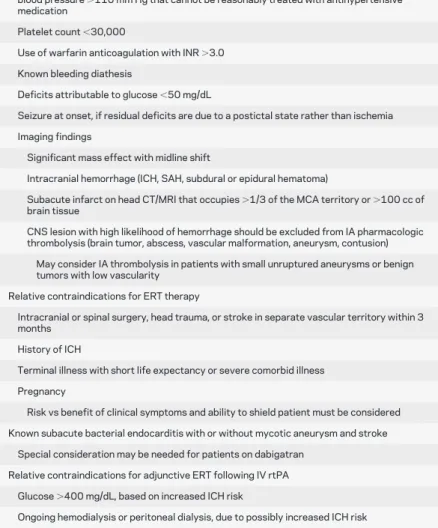
For patients in whom ERT is considered, inclu-sion and excluinclu-sion criteria will be needed. Based on the existing clinical trials and guidelines, a frame-work for the future development of criteria can be outlined (table 2).
SELECTION OF ENDOVASCULAR
REVASCU-LARIZATION THERAPY TECHNIQUEThe
heter-ogeneity of AIS characteristics, including thrombus composition, occlusion location, thrombus volume burden, and collateral perfusion, may demand
tai-Table 2 Possible selection criteria for acute ischemic stroke endovascular revascularization therapy
Inclusion criteria for ERT
Neurologic deficit attributable to a medium- to large-vessel occlusion IA chemical thrombolysis can be initiated within 6 h of symptom onset
Mechanical thrombectomy treatment can be initiated within window of 8 h from time of onset for anterior circulation strokes
ERT can be initiated within window of 12 h from time of onset for posterior circulation strokes
Treatment beyond 6–8 h may be guided by advanced imaging results (DWI MRI, PWI, CTP) when available
Potentially disabling neurologic deficit
Persistent or worsening neurological deficits following IV rtPA administration Exclusion criteria for ERT
Arterial stenosis precluding safe access Suspicion of aortic dissection
Uncontrolled hypertension, defined as systolic blood pressure⬎185 mm Hg or diastolic blood pressure⬎110 mm Hg that cannot be reasonably treated with antihypertensive medication
Platelet count⬍30,000
Use of warfarin anticoagulation with INR⬎3.0 Known bleeding diathesis
Deficits attributable to glucose⬍50 mg/dL
Seizure at onset, if residual deficits are due to a postictal state rather than ischemia Imaging findings
Significant mass effect with midline shift
Intracranial hemorrhage (ICH, SAH, subdural or epidural hematoma)
Subacute infarct on head CT/MRI that occupies⬎1/3 of the MCA territory or ⬎100 cc of brain tissue
CNS lesion with high likelihood of hemorrhage should be excluded from IA pharmacologic thrombolysis (brain tumor, abscess, vascular malformation, aneurysm, contusion)
May consider IA thrombolysis in patients with small unruptured aneurysms or benign tumors with low vascularity
Relative contraindications for ERT therapy
Intracranial or spinal surgery, head trauma, or stroke in separate vascular territory within 3 months
History of ICH
Terminal illness with short life expectancy or severe comorbid illness Pregnancy
Risk vs benefit of clinical symptoms and ability to shield patient must be considered Known subacute bacterial endocarditis with or without mycotic aneurysm and stroke
Special consideration may be needed for patients on dabigatran Relative contraindications for adjunctive ERT following IV rtPA
Glucose⬎400 mg/dL, based on increased ICH risk
Ongoing hemodialysis or peritoneal dialysis, due to possibly increased ICH risk
Abbreviations: CTP⫽ CT perfusion; DWI MRI ⫽ diffusion-weighted MRI; ERT ⫽
endovascu-lar revascuendovascu-larization therapy; IA⫽ intra-arterial; ICH ⫽ intracerebral hemorrhage; INR ⫽
international normalized ratio; MCA⫽ middle cerebral artery; NIHSS ⫽ NIH Stroke Scale;
lored interventions. For example, greater efficacy and safety may be demonstrated in distal vessel revascu-larization by use of IA fibrinolytic therapy, vs a me-chanical device that may be more difficult to deliver. Alternatively, in large proximal vessel occlusions, greater benefit may be achieved with mechanical thrombectomy. Furthermore, carotid occlusion at the origin of the ICA may be better treated with bal-loon angioplasty and stent implantation.
Pharmacologic thrombolysis. Local IA thrombolysis efficacy was demonstrated in PROACT II.6This led to an AHA Class I, level of evidence B recommenda-tion that IA thrombolysis is an oprecommenda-tion for the treat-ment of selected patients who have AIS under 6 hours duration due to occlusions of the MCA and who are not otherwise candidates for IV rtPA.1 Al-though variability in study designs prohibits direct com-parison of the data, theoretically there may be a higher risk of intracerebral hemorrhage (ICH) with chemical IA thrombolysis than with mechanical revasculariza-tion. However, increased ICH was not substantiated in a multicenter study.39
Microcatheter position during thrombolytic infu-sion may also theoretically affect recanalization rates. The microcatheter position varies among the studies; in some instances it is placed distal to the thrombus, within the thrombus, or proximal to the thrombus. Some operators will use multiple locations to infuse rtPA throughout the thrombus. The maximum safe dose for IA rtPA is not known; however, if we extrap-olate from large clinical trial experience, then a
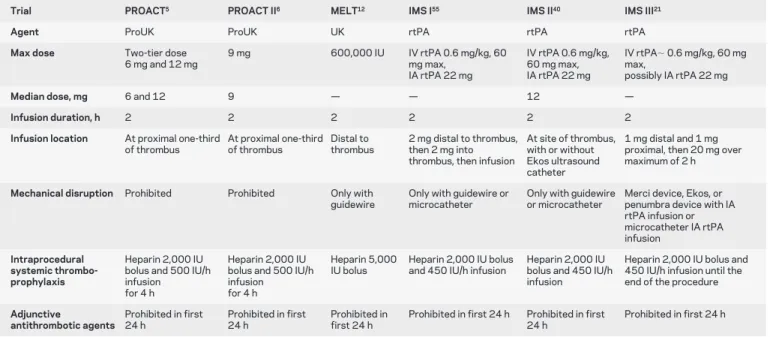
max-imum dose of 22 mg, as in the IMS trials, may be a reasonable initial limit.21,40
Bridging therapies.Bridging therapy trials evaluating the combined approach have shown better recanali-zation rates for medium- to large-vessel occlusions. However, they have shown only trends toward better outcomes in comparison with the IV rtPA–treated subjects in the National Institute of Neurological Disorders and Stroke (NINDS) rtPA Stroke Study or a database registry.40,41 Potential benefit of bridging therapy increases when the target population is lim-ited to IV rtPA nonresponders (40% IV-IA patients reached functional independence at 3 months, vs 14.9% of recipients of only IV rtPA, among the non-responders [ p⫽ 0.012]). This benefit came at the cost of a higher morbidity associated with the bridg-ing therapy (OR 2.14; 95% CI 0.58 –7.83 for sICH).42 The early Emergency Management of Stroke Bridging Trial/IMS trials used a protocol of 0.6 mg/kg IV rtPA with up to an additional maxi-mum of 22 mg IA rtPA, which in most patients al-lowed for the total dose to remain below the NINDS maximum amount of 90 mg (table 3). However, newer bridging studies and the amended IMS III are using full-dose IV rtPA in the combined IV-IA treat-ment arm.20,21
Mechanical revascularization.Mechanical techniques for ERT, including thrombectomy, clot retrieval, and thromboaspiration, have shown comparable or slightly higher recanalization rates than IA
thrombol-Table 3 Intra-arterial thrombolytic dosing and methods from selected trials
Trial PROACT5 PROACT II6 MELT12 IMS I55 IMS II40 IMS III21
Agent ProUK ProUK UK rtPA rtPA rtPA
Max dose Two-tier dose 6 mg and 12 mg 9 mg 600,000 IU IV rtPA 0.6 mg/kg, 60 mg max, IA rtPA 22 mg IV rtPA 0.6 mg/kg, 60 mg max, IA rtPA 22 mg IV rtPA⬃ 0.6 mg/kg, 60 mg max, possibly IA rtPA 22 mg
Median dose, mg 6 and 12 9 — — 12 —
Infusion duration, h 2 2 2 2 2 2
Infusion location At proximal one-third of thrombus At proximal one-third of thrombus Distal to thrombus 2 mg distal to thrombus, then 2 mg into thrombus, then infusion
At site of thrombus, with or without Ekos ultrasound catheter
1 mg distal and 1 mg proximal, then 20 mg over maximum of 2 h
Mechanical disruption Prohibited Prohibited Only with guidewire
Only with guidewire or microcatheter
Only with guidewire or microcatheter
Merci device, Ekos, or penumbra device with IA rtPA infusion or microcatheter IA rtPA infusion Intraprocedural systemic thrombo-prophylaxis Heparin 2,000 IU bolus and 500 IU/h infusion for 4 h
Heparin 2,000 IU bolus and 500 IU/h infusion for 4 h
Heparin 5,000 IU bolus
Heparin 2,000 IU bolus and 450 IU/h infusion
Heparin 2,000 IU bolus and 450 IU/h infusion
Heparin 2,000 IU bolus and 450 IU/h infusion until the end of the procedure
Adjunctive antithrombotic agents Prohibited in first 24 h Prohibited in first 24 h Prohibited in first 24 h
Prohibited in first 24 h Prohibited in first 24 h
Prohibited in first 24 h
Abbreviations: IA⫽ intra-arterial; IMS ⫽ Interventional Management of Stroke trial; IU ⫽ international units; MELT ⫽ Middle cerebral artery Embolism Local
Fibrinolytic intervention Trial; PROACT⫽ Prolyse in Acute Cerebral Thromboembolism trial; rtPA ⫽ IV recombinant tissue plasminogen activator; UK ⫽
ysis alone (table 1). Newer devices, such as the Soli-taire FR retrievable stent (eV3, Irvine, CA), have shown even higher recanalization rates (84%– 90%).23,24 In appropriately selected patients, me-chanical revascularization may theoretically have a lower risk of hemorrhagic complications, given the absence or reduced need for a thrombolytic agent. In patients who are considered for ERT after full-dose IV rtPA, a mechanical approach might be favorable. Limitations of mechanical revascularization include device failure, deliverability to distal locations, and embolization.
Multimodal revascularization.Given the heterogene-ity of vessel occlusion etiology in AIS, a combination of multiple techniques may afford the highest success for revascularization. Small series suggest that multi-modal therapies including IA thrombolysis and stent implantation lead to higher recanalization rates.39 Future studies may find mechanical thrombectomy to be more successful in proximal large-vessel occlu-sions, whereas local IA thrombolysis would be pre-ferred in distal small-vessel occlusions. Also, stent implantation may be most effective for in situ intra-cranial atherosclerosis with supervening thrombosis, but retrieval and aspiration techniques may be more effective for thromboemboli occlusive in relatively normal recipient arteries.4
Posterior circulation modality selection. The best treatment modality for patients with VBO remains poorly defined. A large prospective, observational registry and a separate systematic analysis of pub-lished case series analyzed a total of 1,012 patients; both studies did not support unequivocal superiority of IA therapy vs IV thrombolysis.32,43However, the heterogeneity of the data between the patients within the groups analyzed limits interpretation of the clini-cal conclusions. Early recanalization is an important prognostic factor for good clinical outcome; as such, higher and safer rates of recanalization are being achieved with newer therapeutic strategies utilizing mechanical embolectomy devices, retrievable stents, angioplasty with or without stenting, use of glyco-protein IIb/IIIa inhibitors, and combinations thereof.23,28,30,44,45
TARGET TIME INTERVALS, AND TRIAGE AND
TRANSFER STRATEGIES Time to
revasculariza-tion is an independent predictor of good outcome in patients with AIS.46,47Randomized trials of IV rtPA have demonstrated the greatest benefit in subjects treated within 90 minutes of symptom onset.2,25 Re-canalization rates with ERT are higher than with IV rtPA alone, although the delay to treatment may at-tenuate the benefit. This illustrates the importance of establishing benchmark door-to-revascularization
Table 4 Treatment times in selected studies, in minutes Trial PROACT 5 PROACT II 6 IMS I 55 IMS III 21 EMS 56 MELT 12 RECANALISE 41 Penumbra PST 11 Multi MERCI 29 ⴙ MERCI 10 Wolfe et al. 50 Docrocq et al. 54 Costalat et al. 43 Miley et al. 53 Suarez et al. 51 Mattle et al. 49 Flaherty et al. 52 No. of subjects 40 121 62 500 35 56 50 125 305 96 13 50 91 54 57 44 Treatment IA proUK or placebo IA proUK IV-IA rtPA IV aor IV ⫹ IA b IV-IA aor IA rtPA b IA UK IV-IA or IV-IAT rtPA IAT ⫾ IV rtPA IAT IV-IA aor IA rtPA b IA UK IV-RS or RS alone IV-IAT or IAT IA UK IAT U K IV/IA rtPA Time-to-door 114 Time-to-CT/MRI scan: mean (median) Onset 105 Onset 162 (145) Door 59 (34) Imaging-to-GP 161 (153) 81 (65) CT scan-to-microcatheter 174 Time-to-ERT initiation o r angiogram or GP SO (330) SO (318) SO 217 (212) SO 123.7 255.2 IV-bolus to GP:87.4 SO a(198) Ø b (180) Ø SO 227 SO 132 SO 258 £ SO (258) SO a151 b261 SO 324 (330) SO 321 Door (130) SO 244 SO (226) GP-to-max TIMI/TICI 54 (48) SO-to-max TIMI/TICI a(378) b(342) (220) 377 (327) Abbreviations: EMS ⫽ Emergency Management of Stroke; ERT ⫽ endovascular revascularization treatment; GP ⫽ groin puncture; IA ⫽ intra-arterial; IAT ⫽ intra-arterial therapy (includes thrombolysis and mechanical techniques); IMS ⫽ Interventional Management of Stroke trial; MELT ⫽ Middle cerebral artery Embolism Local Fibrinolytic intervention Trial; MERCI ⫽ Mechanical Embolus Removal in Cerebral Ischemia; PROACT ⫽ Prolyse in Acute Cerebral Thromboembolism trial; PST ⫽ Pivotal Stroke Trial; RECANALISE ⫽ REcanalisation using Combined intravenous Alteplase and Neurointerventional Algorithm for acute Ischemic StrokE; RS ⫽ retrievable stent; rtPA ⫽ recombinant tissue plasminogen activator; SO ⫽ symptom onset; TICI ⫽ thrombolysis in cerebral infarction; TIMI ⫽ thrombolysis in myocardial infarction; UK ⫽ urokinase.
times. The Brain Attack Coalition has recommended that IV rtPA be administered within 60 minutes from arrival to the emergency department (ED) for eligible patients.48The established time intervals tar-get a multidisciplinary goal. Each component of the process—ED physicians, ancillary staff, laboratory and radiology services, neurology team, and radiol-ogy staff—is essential for the time goal. As such, ERT time intervals should integrate into the existing model, beginning with patient arrival to the ED. Separate time intervals can be established for patients transferred from another institution and patients who receive adjunctive ERT following IV rtPA ther-apy. Because vascular anatomy can add unpredictable delays in procedural times, the endpoint should re-flect the last modifiable variable. Therefore, ERT time intervals should reflect door-to-puncture (more predictable), puncture-to-clot, and clot-to-close goals. A clot-to-close time of 120 minutes, as de-scribed in IMS III, may be warranted to establish procedural termination times. More variables, in-cluding anatomy, evidence of persistent penumbra, and ERT method, may be used in the future to mod-ify time benchmarks.
In the limited case series discussing time intervals to ERT, there is variability in which interval is uti-lized (table 4).5,6,11,12,15,41,43,49 –56 Randomized trials show feasibility in achieving time intervals of approx-imately 4 to 5 hours from stroke onset to IA rtPA administration.6,55 In PROACT II, median time from stroke onset to randomization and IA rtPA ad-ministration was 282 minutes, whereas the IMS study demonstrated an interval of 231 minutes from stroke onset to IA rtPA administration.6,55 Time from CT scan to microcatheter placement in the cerebrovasculature had a mean time of 174 ⫾ 60 minutes in 91 patients undergoing ERT for AIS, demonstrating wide variability and a need for time standards.53 Transferred patients whose laboratory tests and CT scan have already been completed may still have a door-to-puncture time of up to 60 min-utes.57Further study is needed to identify barriers to rapid access to endovascular therapy.
Currently, the American College of Cardiology and the AHA recommend that door-to-balloon time in ST segment elevation myocardial infarction should be within 90 minutes. A similar future pro-posal could be made for ERT in AIS, with a goal door-to-puncture time of 90 minutes (table 5). This would include activation of the stroke team, technol-ogists, and nurses. Adjunctive time benchmarks can be developed, including puncture-to-clot and clot-to-close goals. This target is more difficult to achieve for cerebral than cardiac revascularization, as stroke patients require more time-consuming neurologic
Table 5 Benchmark times for revascularization therapies and possible intervals for ERT American College of Cardiology 67 ASA/AHA AIS Guidelines for IV rt-PA 68 Proposed goals for AIS patients eligible for ERT presenting to ED: “Primary ERT Time” Proposed goals for AIS patients eligible for Rescue ERT following IV failure: “IV-Failure to Rescue ERT” Proposed goals for AIS patients transferred from outside hospital for ERT: “Drip-and-Ship to ERT” Door-to-balloon time 90 min Door-to-needle time 60 min Door-to-groin puncture time 90 min Needle-to-groin puncture time 60 min Door a-to-Groin Puncture time 60 min STEMI confirmed, cardiologist notified 10 min Door to ED 10 min Door to ED In parallel with IV rtPA pathway (10 min) ERT team is notified as s oon as large to medium vessel occlusion is suspected (i.e., NIHSS, hyperdense MCA on CT) in eligible patients 10 min after the eligibility CT scan and before IV bolus Transfer from outside hospital initiated, angio suite activated, team activated Prior to a rrival ED stabilizes patient, activates cath lab 30 min Stroke team activation 15 min Stroke and ERT teams activation In parallel w ith IV rtPA pathway (15 min) Receiving hospital arrival: Rapid h istory and exam, review of referring hospital films 15 min Cath lab and interventionalist ready 60 min CT scan initiated 25 min CT scan initiated In parallel with IV rtPA pathway (25 min) Angio suite activated, team on standby, consider noninvasive vascular imaging 25 min after the eligibility CT scan and after IV bolus initiation Ancillary brain imaging (i.e., CT perfusion) 35 min Final check and written consent 70 min CT scan interpreted, eligibility assessed 4 5 m in CT scan interpreted, eligibility assessed In parallel w ith IV rtPA pathway (45 min) Repeat NIHSS, obtain written c onsent, repeat CT if clinical worsening 45 min after the CT scan and 30 min a fter the IV rtPA bolus Final check, written consent, patient prepped 45 min Catheterization and PCI–balloon inflation 90 min IV rtPA infusion 60 min Groin puncture 90 min Groin puncture 60 min b Groin puncture 6 0 m in Abbreviations: AHA ⫽ American Heart Association; AIS ⫽ acute ischemic stroke; angio ⫽ angiogram; ASA ⫽ American Stroke Association; ED ⫽ emergency department; ERT ⫽ endovascular revascularization therapy; IA ⫽ intra-arterial; MCA ⫽ middle cerebral artery; NIHSS ⫽ NIH Stroke Scale; PCI ⫽ percutaneous coronary intervention; rtPA ⫽ recombinant tissue plasminogen activator; STEMI ⫽ ST segment elevation myocardial infarction. aFrom time of arrival to accepting hospital door. bTime will need to be adjusted to allow for additional imaging if clinical examination worsens or symptoms suggest hemorrhagic transformation.
evaluation and brain imaging before proceeding to the angiography laboratory.
Achieving a 90-minute door-to-puncture time would likely require the neurointerventionalist to play an integral part in the stroke team, because the decisions on treatment strategy may evolve as the pa-tient proceeds through the AIS protocol and IV rtPA evaluation pathway. The ERT protocol should inte-grate into the IV rtPA pathway. For interhospital transfers, the completed imaging and laboratory studies as well as additional lead time may reduce the target time interval to 60 minutes for door-to-puncture. However, significant delay in hospital transfer may warrant repeat neuroimaging when the patient arrives at the recipient institution. Bench-mark times will need to be established for IV nonre-sponders, with special consideration for additional delay when clinical deterioration following IV rtPA requires a repeat brain imaging prior to ERT.
Triage and transfer strategies. The considerable de-cline in efficacy of revascularization therapies at around 6 to 8 hours from symptom onset demands well-organized triage and transfer strategies.46 Emer-gency department reorganization has been an area of focus to improve early identification of stroke pa-tients. Tracking door-to-thrombolysis times, posi-tioning a CT/MRI scanner within the department, and having emergency medical services (EMS) send a prehospital notification are steps that have improved thrombolysis access.58 However, given the limited availability of Comprehensive Stroke Center infra-structure, few centers in a given geographic region will have capabilities for providing comprehensive stroke care and 24/7 ERT. This will lead to a high proportion of patients eligible for ERT arriving by interhospital transfer. Transfer delay has been shown to be a major factor limiting the use of ERT in stroke patients, accounting for an estimated odds of treat-ment decrease by 2.5% for every minute of transfer time.59To avoid transfer delay, regional protocols for triage of AIS patients by EMS personnel to desig-nated stroke centers has become a focus of prehospi-tal stroke triage policy.60
Alternative strategies include initiation of IV thrombolytic in a referring hospital prior to transfer “drip-and-ship,” followed by further management at the accepting hospital, which may include ERT. A described model of “drip, ship, and retrieve” used full-dose IV rtPA (0.9 mg/kg) followed by ERT with mechanical thrombectomy and thrombo-aspiration, suggesting feasibility in basilar artery occlusion.61 Different models may evolve where the patient re-ceives ERT in an outside hospital and is transferred for further care at a comprehensive stroke center where neurosurgery, neurocritical care, and vascular
neurology expertise are available, known as “retrieve-and-ship.” Pay-for-performance measures similar to those for acute myocardial infarction could help fa-cilitate transfer of appropriate patients from primary to comprehensive stroke centers (the hub-and-spoke model).
GENERAL PREPROCEDURAL AND INTRAPROCE-DURAL MANAGEMENT Anesthesia and monitoring.
The type of anesthesia for ERT has been a topic of controversy, with recent reports suggesting worse outcome with use of general endotracheal anesthesia, possibly due to treatment delays and complications from intubation.62,63 Alternatively, conscious seda-tion may pose a different set of risks related to patient cooperation, especially in those with severe aphasia or neglect, which may negatively influence time to revascularization and procedural success. Further-more, ancillary monitoring requiring invasive arterial access for blood pressure monitoring and central IV access may also be of limited value and add delay to initiation of therapy. Further study is needed to eval-uate sedation methods for ERT. Sedation methods may currently vary among centers.
Thromboprophylaxis with systemic anticoagulation.
Arterial catheterization carries a risk of thromboem-bolism, often requiring systemic anticoagulation. Randomized clinical trials of ERT report variable protocols for thromboprophylaxis, including bolus IV heparin infusion of 2,000 to 5,000 units at procedure onset, followed by continuous infusions of approximately 500 units of IV heparin per hour for the procedure duration.6,21 Alternatively, acti-vated clotting time (ACT) values can be obtained with heparin boluses to maintain an ACT at a therapeutic goal. Limited data exist on the safety of heparin anticoagulation during ERT proce-dures. A subgroup analysis of the MERCI trial showed no association with hemorrhage or 90-day mortality and heparin use.64 A reasonable ACT range may be 250 to 300 seconds during ERT.
Renal prophylaxis.Patients with AIS may also have chronic renal impairment, which may worsen with contrast administered during angiography. Inter-ventions designed to prevent contrast-induced ne-phropathy have not been rigorously studied. Reasonable prophylaxis strategies include hydra-tion with isotonic saline. Recent data have not provided strong support for the administration of
N-acetylcysteine.65The use of sodium bicarbonate infusion may be reasonable for patients with renal insufficiency, but it can be limited by the large volume and time to acquire the solution from the pharmacy. Periprocedural renal prophylaxis for
ERT in select AIS patients is an important area in need of further investigation.
POSTPROCEDURAL MANAGEMENT Imaging.
Patients may benefit from postprocedural imaging, including noncontrast head CT or susceptibility-weighted MRI within 16 to 32 hours from ERT. Given the associated risk of hemorrhagic complica-tions with revascularization therapy, urgent head CT or MRI may be needed for clinical deterioration in the postprocedure period. Intraprocedure imaging is also possible in many angiography suites and can of-fer rapid diagnostic information.
Neuromonitoring. Intensive care unit monitoring with staff trained in neurologic patient care may be important for postprocedure neuromonitoring, in-cluding frequent neurologic examination assessments by nursing staff experienced and trained in neurovas-cular diseases. Intensive monitoring would also in-clude surveillance for groin-access complications and the appropriate management. Stroke severity and outcome scales may be important in performance monitoring.
Blood pressure management.Patients in whom revas-cularization was successful may be at risk of reperfu-sion hemorrhage, thereby warranting aggressive blood pressure control. Common practice has fol-lowed a protocol similar to that for post IV rtPA administration with vigilant blood pressure monitor-ing for at least the first 24 hours. Blood pressure is measured every 15 minutes for 2 hours, then every 30 minutes for 6 hours, and every hour for 18 hours. Goal blood pressure is targeted to remain below 180/105 mm Hg. Bolus dosing of labetolol or continuous infusion of nicardipine has been used to achieve target blood pressure. Adjustments in blood pressure parameters may be necessary to achieve clinical stability.
Antithrombotic regimen. Postprocedure antithrom-botic regimen will likely follow a similar pathway to that in general AIS management. Antithrombotics are usually avoided in the first 24 hours following IV and IA administration of a thrombolytic agent. Cer-tain procedures may present exceptions, such as pa-tients receiving stent implantation, in which the respective preferred regimen will need to be imple-mented. This may include loading doses of 325 to 650 mg of aspirin (orally or rectally) and 300 to 600 mg of clopidogrel with subsequent dual antiplatelet therapy with daily aspirin (325 mg) and clopidogrel (75 mg) for 4 to 12 weeks, followed by indefinite single-antiplatelet therapy with aspirin 325 mg daily or tailored to the underlying etiology. A potential hazard of dual antiplatelet therapy for acute stent
im-plantation in a patient with a recent large stroke in-cludes hemorrhage.
Glycemia management. Hyperglycemia may be asso-ciated with an increased risk of hemorrhagic transfor-mation of the cerebral infarction.66 An appropriate glycemic-control regimen will likely be modeled after existing management strategies developed for AIS.
Statin therapy. Comprehensive management strate-gies for patients with AIS who undergo ERT will likely also adopt statin therapy regimens modeled af-ter those developed for AIS patients in general.
CLINICAL OUTCOME MEASUREMENTS
Moni-toring clinical outcomes following ERT is important for quality metrics. Thresholds and benchmarks for acceptable stroke severity–weighted sICH and mor-tality rates need to be established. The proportion of patients completing 90-day clinical follow-up (from those who are eligible) needs to be established. Simi-larly, consensus on rates of 90-day good functional mRS outcome (score of 0 –2) following ERT needs to be established.
DISCUSSION This outline can be used as a frame-work for the development of future practice recom-mendations and as an interim tool that the practicing neurovascular specialist can use to assess the rapidly evolving management strategies. This evolving field is marked by ongoing intense investigation of various therapies for acute revascularization, which will de-mand frequent reevaluation and modification of these strategies.
AUTHOR CONTRIBUTIONS
All authors participated in the design and revision of the manuscript. Dr. Lazzaro: drafting/revising the manuscript, study concept or design, analy-sis or interpretation of data. Dr. Novakovic: drafting/revising the manu-script, acquisition of data, statistical analysis, study supervision. Dr. Alexandrov: drafting/revising the manuscript, discussion of review con-tent. Dr. Darkhabani: drafting/revising the manuscript, acquisition of data. Dr. Edgell: drafting/revising the manuscript. Dr. English: drafting/ revising the manuscript, analysis or interpretation of data. Dr. Frei: draft-ing/revising the manuscript. Dr. Jamieson: draftdraft-ing/revising the manuscript. Dr. Janardhan: drafting/revising the manuscript, study con-cept or design, analysis or interpretation of data, development of stroke algorithms and figures for acute ischemic stroke endovascular therapy. Dr. N. Janjua: drafting/revising the manuscript. Dr. R.M. Janjua: drafting/ revising the manuscript. Dr. Katzan: drafting/revising the manuscript. Dr. Khatri: study concept or design. Dr. Kirmani: study concept or design, study supervision. Dr. Liebeskind: drafting/revising the manuscript, anal-ysis or interpretation of data, acquisition of data. Dr. Linfante: drafting/ revising the manuscript, study concept or design, analysis or interpretation of data, study supervision. Dr. Nguyen: drafting/revising the manuscript. Dr. Saver: drafting/revising the manuscript, study con-cept or design, analysis or interpretation of data. Dr. Shutter: drafting/ revising the manuscript. Dr. Xavier: drafting/revising the manuscript. Dr. Yavagal: drafting/revising the manuscript. Dr. Zaidat: drafting/revising the manuscript, study concept or design, contribution of vital reagents/ tools/patients, acquisition of data, statistical analysis, study supervision.
DISCLOSURE
Dr. Lazzaro reports no disclosures. Dr. Novakovic performs endovascular treatments for acute ischemic strokes (has not used a retrievable stent). Dr. Alexandrov serves as an Associate Editor for Frontiers in Interventional
Neurology; has a patent for Therapeutic Methods and Apparatus for Use of Sonication to Enhance Perfusion of Tissue; has received publishing royalties
for Cerebrovascular Ultrasound in Stroke Prevention and Treatment (first and second editions); has served as a consultant for Cerevast Therapeutics; spends 60% effort on clinical stroke service at Comprehensive Stroke Center, UAB Hospital, monitoring endovascular procedures and evaluat-ing success of recanalization with imagevaluat-ing; has received research support from Cerevast Therapeutics, Inc.; has received research support from NINDS; has received compensation from Cerevast Therapeutics, Inc.; and has received license fee payments from Therapeutic Methods and
Ap-paratus for Use of Sonication to Enhance Perfusion of Tissue. Dr.
Darkha-bani reports no disclosures. Dr. Edgell serves as an Associate Editor,
Frontiers in Interventional Neurology. Dr. English has served on the
scien-tific advisory board of Concentric Medical Inc., Clinical Events Commit-tee; serves on the editorial boards of Neurohospitalist and The Stroke
Interventionalist; and serves as Medical Scientific Advisor for Silk Road
Medical. Dr. Frei has served as a consultant to Penumbra, Inc. Dr. Ja-mieson has served as a consultant to Bayer and Boerhinger-Ingelheim; served on the speakers bureau for Boehringer-Ingelheim and Merck; served on the scientific advisory board for Bayer and on the Adjudication Committee for ARRIVE trial; and serves as an Assistant Editor for
Neurol-ogy Alert. Dr. Janardhan reports no disclosures. Dr. N. Janjua serves on
the scientific advisory board for Lundbeck/DSMB and Neurointerven-tions; receives research support from NIH/NINDS; and holds stock or stock options or board of directors compensation for Neurointerventions. Dr. R.M. Janjua reports no disclosures. Dr. Katzan has served as consul-tant to Pzifer and Genentech; served as a speaker for and received com-pensation from Cardionet; serves on the Real World Advisory Board for Pfizer; has received research funding from Novartis, Inc., Hoffman-La Roche Ltd, and Takeda Pharmaceuticals; and has received research fund-ing from Ohio Department of Health. Dr. Khatri is on the Executive Committee of the IMS III Trial, is Neurology PI of the Penumbra THERAPY Trial, and has received research support from Genentech, Inc., for survey implementation; served on the editorial boards of Frontiers
in Endovascular and Interventional Neurology; has received research
sup-port from the NIH/NINDS; and has served as an expert witness for stroke cases over the last 2 years. Dr. Kirmani served on the advisory board for Otsuka Pharmaceuticals; served as an Associate Editor for Frontiers in
Clinical Trials in Neurology; received publishing royalties from the Taylor
and Francis Group for The Stroke Center Handbook; receives research sup-port from Penumbra, Inc., and Genentech, Inc.; received research supsup-port from NIH/NINDS; and has served as expert witness for stroke cases. Dr. Liebeskind served as a consultant for Concentric Medical and CoAxia and receives research support from NIH. Dr. Linfante served as a consultant for Codman Neurovascular and Stryker; holds stock options in Surpass Limited; serves on the Scientific Advisory Board for Codman Neurovas-cular; serves on the editorial boards for Stroke and Journal of
Neurointer-ventional Surgery; and serves on the speakers bureau for Codman. Dr.
Nguyen serves as Associate Editor of Frontiers in Vascular and
Interven-tional Neurology and Editor of SVIN newsletter The Core; performs
intra-arterial stroke procedures; and serves as a consultant for Penumbra. Dr. Saver serves on the editorial boards of Stroke, Reviews in Neurologic
Dis-ease, Journal of Neuroimaging, and Journal of Stroke and Cerebrovascular Diseases; is an employee of the University of California (UC), which holds
a patent on retriever devices for stroke; serves on scientific advisory boards, for which the UC Regents receive payments, for CoAxia, Inc., Concentric Medical, Talecris Biotherapeutics, Ferrer, AGA Medical Cor-poration, BrainsGate, PhotoThera, Ev3, and Sygnis Bioscience GmbH & Co. KG; is an unpaid site investigator in multicenter clinical trials spon-sored by AGA Medical Corporation, Lundbeck, Inc., and Ev3, for which the UC Regents received payments based on clinical trial contracts for the number of subjects enrolled; is an unpaid site investigator in the NIH IRIS, CLEAR, IMS 3, SAMMPRIS, and VERITAS multicenter clinical trials, for which the UC Regents receive payments based on clinical trial contracts for the number of subjects enrolled; receives research support from the NIH and NINDS; receives research support from the AHA; and
performs acute stroke care (35%). Dr. Shutter serves on the scientific advisory board for Neuren Pharmaceuticals; receives funding for travel or speaker honoraria from Codman, J&J, and NIH; serves as a consultant for Cincinnati Bengals; receives research support from Department of De-fense and NIH (NINDS); receives research support from the Mayfield Education and Research Fund; and holds stock options in UCB Pharma. Dr. Xavier receives research support from Concentric Medical and from Medical University of South Carolina/NIH study. Dr. Yavagal received an honorarium from Penumbra Inc. for consultation and speaking; serves as an Associate Editor for Frontiers in Endovascular Neurology; and serves as a consultant to Penumbra Inc., Codman Neurovascular, Micrus, Inc., Genentech, and Boston Scientific. Dr. Zaidat serves on the scientific advi-sory board for Talecris; served on the adjudication committee for Stryker; received speaker honoraria from Stryker; served on the editorial board of
Frontiers in Neurology (Endovascular & Interventional Neurology
Sec-tion); serves as Editor of The Journal of Neurointerventional Surgery, and serves as Associate Editor and is a member of the Editorial Board of
Jour-nal of Stroke & Cerebrovascular Diseases; served as a consultant for Stryker
Neurovascular, Codman Neurovascular, and Microvention, Inc; and has received research support from Society of Vascular & Interventional Neu-rology (SVIN) for this educational activity. Go to NeuNeu-rology.org for full disclosures.
Received December 10, 2011. Accepted in final form February 23, 2012. REFERENCES
1. Adams HP Jr, del Zoppo G, Alberts MJ, et al. Guidelines for the early management of adults with ischemic stroke: a guideline from the American Heart Association/American Stroke Association Stroke Council, Clinical Cardiology Council, Cardiovascular Radiology and Intervention Council, and the Atherosclerotic Peripheral Vascular Dis-ease and Quality of Care Outcomes in Research Interdisci-plinary Working Groups. Stroke 2007;38:1655–1711. 2. The National Institute of Neurological Disorders and
Stroke rt-PA Stroke Study Group. Tissue plasminogen ac-tivator for acute ischemic stroke. N Engl J Med 1995;333: 1581–1587.
3. Zaidat OO, Suarez JI, Sunshine JL, et al. Thrombolytic therapy of acute ischemic stroke: correlation of angio-graphic recanalization with clinical outcome. AJNR Am J Neuroradiol 2005;26:880 – 884.
4. Rha JH, Saver JL. The impact of recanalization on ischemic stroke outcome: a meta-analysis. Stroke 2007;38:967–973. 5. del Zoppo GJ, Higashida RT, Furlan AJ, Pessin MS,
Row-ley HA, Gent M. PROACT: a phase II randomized trial of recombinant pro-urokinase by direct arterial delivery in acute middle cerebral artery stroke: PROACT Investiga-tors: Prolyse in Acute Cerebral Thromboembolism. Stroke 1998;29:4 –11.
6. Furlan A, Higashida R, Wechsler L, et al. Intra-arterial prourokinase for acute ischemic stroke: the PROACT II study: a randomized controlled trial: Prolyse in Acute Ce-rebral Thromboembolism. JAMA 1999;282:2003–2011. 7. Alberts MJ, Latchaw RE, Selman WR, et al.
Recommenda-tions for comprehensive stroke centers: a consensus statement from the Brain Attack Coalition. Stroke 2005;36:1597– 1616.
8. Leifer D, Bravata DM, Connors JJ 3rd, et al. Metrics for measuring quality of care in comprehensive stroke centers: detailed follow-up to Brain Attack Coalition comprehensive stroke center recommendations: a statement for healthcare professionals from the American Heart Association/American Stroke Association. Stroke 2011;42:849 – 877.
9. Meyers PM, Schumacher HC, Higashida RT, et al. Indica-tions for the performance of intracranial endovascular
neu-rointerventional procedures: a scientific statement from the American Heart Association Council on Cardiovascu-lar Radiology and Intervention, Stroke Council, Council on Cardiovascular Surgery and Anesthesia, Interdisciplin-ary Council on Peripheral Vascular Disease, and Interdisci-plinary Council on Quality of Care and Outcomes Research. Circulation 2009;119:2235–2249.
10. Smith WS, Sung G, Starkman S, et al. Safety and efficacy of mechanical embolectomy in acute ischemic stroke: re-sults of the MERCI trial. Stroke 2005;36:1432–1438. 11. The penumbra pivotal stroke trial: safety and effectiveness
of a new generation of mechanical devices for clot removal in intracranial large vessel occlusive disease. Stroke 2009; 40:2761–2768.
12. Ogawa A, Mori E, Minematsu K, et al. Randomized trial of intraarterial infusion of urokinase within 6 hours of middle cerebral artery stroke: the Middle Cerebral Artery Embolism Local Fibrinolytic Intervention Trial (MELT) Japan. Stroke 2007;38:2633–2639.
13. Lee M, Hong KS, Saver JL. Efficacy of intra-arterial fibri-nolysis for acute ischemic stroke: meta-analysis of random-ized controlled trials. Stroke 2010;41:932–937. 14. Inoue T, Kimura K, Minematsu K, Yamaguchi T. A
case-control analysis of intra-arterial urokinase thrombolysis in acute cardioembolic stroke. Cerebrovasc Dis 2005;19:225– 228.
15. Nogueira RG, Liebeskind DS, Sung G, Duckwiler G, Smith WS. Predictors of good clinical outcomes, mortality, and suc-cessful revascularization in patients with acute ischemic stroke undergoing thrombectomy: pooled analysis of the Mechani-cal Embolus Removal in Cerebral Ischemia (MERCI) and Multi MERCI Trials. Stroke 2009;40:3777–3783. 16. Saver JL, Liebeskind DS, Nogueira RG, Jahan R. Need to
clarify Thrombolysis In Myocardial Ischemia (TIMI) scale scoring method in the Penumbra Pivotal Stroke Trial. Stroke 2010;41:e115– e116.
17. Intra-arterial Versus Systemic Thrombolysis for Acute Ischemic Stroke: SYNTHESIS EXP. Available at: stroke-center.org. Accessed November 26, 2011.
18. MR CLEAN: a multicenter randomized clinical trial of endo-vascular treatment for acute ischemic stroke in the Nether-lands. 2011. Available at: www.trialregister.nl/trialreg/admin/ rctview.asp?TC⫽1804. Accessed November 26, 2011. 19. Mechanical Retrieval and Recanalization of Stroke Clots
Using Embolectomy: MR RESCUE. Available at: clinical-trials.gov/ct2/show/NCT00389467. Accessed November 26, 2011.
20. Assess the Penumbra System in the Treatment of Acute Stroke (THERAPY). Available at: clinicaltrials.gov/ct2/ show/NCT01429350. Accessed November 26, 2011. 21. The Interventional Management of Stroke (IMS) trials.
Available at: http://www.strokecenter.org/trials/trialDe-tail.aspx?tid⫽747. Accessed August 26, 2011.
22. Zaidat OO, Wolfe T, Hussain SI, et al. Interventional acute ischemic stroke therapy with intracranial self-expanding stent. Stroke 2008;39:2392–2395.
23. Roth C, Papanagiotou P, Behnke S, et al. Stent-assisted mechanical recanalization for treatment of acute intracere-bral artery occlusions. Stroke 2010;41:2559 –2567. 24. Castano C, Dorado L, Guerrero C, et al. Mechanical
thrombectomy with the Solitaire AB device in large artery occlusions of the anterior circulation: a pilot study. Stroke 2010;41:1836 –1840.
25. Hacke W, Kaste M, Bluhmki E, et al. Thrombolysis with alteplase 3 to 4.5 hours after acute ischemic stroke. N Engl J Med 2008;359:1317–1329.
26. Clark WM, Wissman S, Albers GW, Jhamandas JH, Mad-den KP, Hamilton S. Recombinant tissue-type plasmino-gen activator (alteplase) for ischemic stroke 3 to 5 hours after symptom onset: the ATLANTIS study: a randomized controlled trial: Alteplase Thrombolysis for Acute Nonin-terventional Therapy in Ischemic Stroke. JAMA 1999; 282:2019 –2026.
27. Del Zoppo GJ, Saver JL, Jauch EC, Adams HP Jr. Expan-sion of the time window for treatment of acute ischemic stroke with intravenous tissue plasminogen activator: a sci-ence advisory from the American Heart Association/Amer-ican Stroke Association. Stroke 2009;40:2945–2948. 28. Eckert B, Kucinski T, Pfeiffer G, Groden C, Zeumer H.
Endovascular therapy of acute vertebrobasilar occlusion: early treatment onset as the most important factor. Cere-brovasc Dis 2002;14:42–50.
29. Smith WS, Sung G, Saver J, et al. Mechanical thrombec-tomy for acute ischemic stroke: final results of the Multi MERCI trial. Stroke 2008;39:1205–1212.
30. Schulte-Altedorneburg G, Hamann GF, Mull M, et al. Outcome of acute vertebrobasilar occlusions treated with intra-arterial fibrinolysis in 180 patients. AJNR Am J Neu-roradiol 2006;27:2042–2047.
31. Arnold M, Nedeltchev K, Schroth G, et al. Clinical and radiological predictors of recanalisation and outcome of 40 patients with acute basilar artery occlusion treated with intra-arterial thrombolysis. J Neurol Neurosurg Psychiatry 2004;75:857– 862.
32. Schonewille WJ, Wijman CA, Michel P, et al. Treatment and outcomes of acute basilar artery occlusion in the Basi-lar Artery International Cooperation Study (BASICS): a prospective registry study. Lancet Neurol 2009;8:724 – 730.
33. Mishra NK, Albers GW, Davis SM, et al. Mismatch-based delayed thrombolysis: a meta-analysis. Stroke 2010;41: e25– e33.
34. Jovin TG, Liebeskind DS, Gupta R, et al. Imaging-based endovascular therapy for acute ischemic stroke due to proximal intracranial anterior circulation occlusion treated beyond 8 hours from time last seen well: retrospective mul-ticenter analysis of 237 consecutive patients. Stroke 2011; 42:2206 –2211.
35. Hacke W, Kaste M, Fieschi C, et al. Intravenous throm-bolysis with recombinant tissue plasminogen activator for acute hemispheric stroke: the European Cooperative Acute Stroke Study (ECASS) JAMA 1995;274:1017–1125. 36. Pexman JH, Barber PA, Hill MD, et al. Use of the Alberta
Stroke Program Early CT Score (ASPECTS) for assessing CT scans in patients with acute stroke. AJNR Am J Neu-roradiol 2001;22:1534 –1542.
37. Saqqur M, Uchino K, Demchuk AM, et al. Site of arterial occlusion identified by transcranial Doppler predicts the response to intravenous thrombolysis for stroke. Stroke 2007;38:948 –954.
38. Mathews MS, Sharma J, Snyder KV, et al. Safety, effective-ness, and practicality of endovascular therapy within the first 3 hours of acute ischemic stroke onset. Neurosurgery 2009;65:860 – 865, 2009.
39. Gupta R, Tayal AH, Levy EI, et al. Intra-arterial throm-bolysis or stent placement during endovascular treatment for acute ischemic stroke leads to the highest recanalization
rate: results of a multicenter retrospective study. Neurosur-gery 2011;68:1618 –1623.
40. The Interventional Management of Stroke (IMS) II study. Stroke 2007;38:2127–2135.
41. Mazighi M, Serfaty JM, Labreuche J, et al. Comparison of intravenous alteplase with a combined intravenous-endovascular approach in patients with stroke and con-firmed arterial occlusion (RECANALISE study): a prospective cohort study. Lancet Neurol 2009;8:802– 809. 42. Rubiera M, Ribo M, Pagola J, et al. Bridging intravenous-intra-arterial rescue strategy increases recanalization and the likelihood of a good outcome in nonresponder intrave-nous tissue plasminogen activator-treated patients: a case-control study. Stroke 2011;42:993–997.
43. Costalat V, Machi P, Lobotesis K, et al. Rescue, combined, and stand-alone thrombectomy in the management of large vessel occlusion stroke using the solitaire device: a prospective 50-patient single-center study: timing, safety, and efficacy. Stroke 2011;42:1929 –1935.
44. Eckert B, Koch C, Thomalla G, et al. Aggressive therapy with intravenous abciximab and intra-arterial rtPA and ad-ditional PTA/stenting improves clinical outcome in acute vertebrobasilar occlusion: combined local fibrinolysis and intravenous abciximab in acute vertebrobasilar stroke treatment (FAST): results of a multicenter study. Stroke 2005;36:1160 –1165.
45. Pfefferkorn T, Mayer TE, Opherk C, et al. Staged escala-tion therapy in acute basilar artery occlusion: intravenous thrombolysis and on-demand consecutive endovascular mechanical thrombectomy: preliminary experience in 16 patients. Stroke 2008;39:1496 –1500.
46. Khatri P, Abruzzo T, Yeatts SD, Nichols C, Broderick JP, Tomsick TA. Good clinical outcome after ischemic stroke with successful revascularization is time-dependent. Neu-rology 2009;73:1066 –1072.
47. Nogueira RG, Smith WS, Sung G, et al. Effect of time to reperfusion on clinical outcome of anterior circulation strokes treated with thrombectomy: pooled analysis of the MERCI and Multi MERCI trials. Stroke Epub 2011 Sept 15. 48. NINDS: Proceedings of a National Symposium on Rapid
Identification and Treatment of Acute Stroke. National Institute of Neurological Disorders and Stroke, 2011. Available at: http://www.ninds.nih.gov/news_and_events/ proceedings/stroke_proceedings/execsum.htm. Accessed September 15, 2011.
49. Mattle HP, Arnold M, Georgiadis D, et al. Comparison of intraarterial and intravenous thrombolysis for ischemic stroke with hyperdense middle cerebral artery sign. Stroke 2008;39:379 –383.
50. Wolfe T, Suarez JI, Tarr RW, et al. Comparison of com-bined venous and arterial thrombolysis with primary arte-rial therapy using recombinant tissue plasminogen activator in acute ischemic stroke. J Stroke Cerebrovasc Dis 2008;17:121–128.
51. Suarez JI, Sunshine JL, Tarr R, et al. Predictors of clinical improvement, angiographic recanalization, and intracra-nial hemorrhage after intra-arterial thrombolysis for acute ischemic stroke. Stroke 1999;30:2094 –2100.
52. Flaherty ML, Woo D, Kissela B, et al. Combined IV and intra-arterial thrombolysis for acute ischemic stroke. Neu-rology 2005;64:386 –388.
53. Miley JT, Memon MZ, Hussein HM, et al. A multicenter analysis of “time to microcatheter” for endovascular therapy in acute ischemic stroke. J Neuroimaging 2011;21:159 – 64.
54. Ducrocq X, Bracard S, Taillandier L, et al. Comparison of intravenous and intra-arterial urokinase thrombolysis for acute ischaemic stroke. J Neuroradiol 2005;32:26 –32. 55. Combined intravenous and intra-arterial recanalization for
acute ischemic stroke: the Interventional Management of Stroke Study. Stroke 2004;35:904 –911.
56. Lewandowski CA, Frankel M, Tomsick TA, et al. Com-bined intravenous and arterial r-TPA versus intra-arterial therapy of acute ischemic stroke: Emergency Management of Stroke (EMS) Bridging Trial. Stroke 1999;30:2598 –2605.
57. Lazzaro MA LV, Mohammad Y, Chen M, Lopes DK,
Prabhakaran S. Weekend effect is not observed in time to angiography for transferred acute ischemic stroke patients. Cerebrovasc Diseases 2010;29(suppl 2):329.
58. Lindsberg PJ, Happola O, Kallela M, Valanne L, Kuisma M, Kaste M. Door to thrombolysis: ER reorganization and reduced delays to acute stroke treatment. Neurology 2006; 67:334 –336.
59. Prabhakaran S, Ward E, John S, et al. Transfer delay is a major factor limiting the use of intra-arterial treatment in acute ischemic stroke. Stroke 2011;42:1626 –1630. 60. Crocco TJ, Grotta JC, Jauch EC, et al. EMS management
of acute stroke–prehospital triage (resource document to NAEMSP position statement). Prehosp Emerg Care 2007; 11:313–317.
61. Pfefferkorn T, Holtmannspotter M, Schmidt C, et al. Drip, ship, and retrieve: cooperative recanalization therapy in acute basilar artery occlusion. Stroke 2010;41:722–726. 62. Abou-Chebl A, Lin R, Hussain MS, et al. Conscious seda-tion versus general anesthesia during endovascular therapy for acute anterior circulation stroke: preliminary results from a retrospective, multicenter study. Stroke 2010;41: 1175–1179.
63. Gupta R. Local is better than general anesthesia during endovascular acute stroke interventions. Stroke 2010;41: 2718 –2719.
64. Nahab F, Walker GA, Dion JE, Smith WS. Safety of
periprocedural heparin in acute ischemic stroke endovas-cular therapy: the Multi MERCI trial. J Stroke Cerebro-vasc Dis Epub 2011 June 1.
65. Acetylcysteine for prevention of renal outcomes in patients undergoing coronary and peripheral vascular angiography: main results from the randomized Acetylcysteine for Contrast-Induced Nephropathy Trial (ACT). Circulation 2011;124:1250 –1259.
66. Kase CS, Furlan AJ, Wechsler LR, et al. Cerebral hemor-rhage after intra-arterial thrombolysis for ischemic stroke: the PROACT II trial. Neurology 2001;57:1603–1610.
67. Antman EM, Anbe DT, Armstrong PW, et al. ACC/AHA
guidelines for the management of patients with ST-elevation myocardial infarction: a report of the American College of Cardiology/American Heart Association Task Force on Practice Guidelines (Committee to Revise the 1999 Guidelines for the Management of Patients with Acute Myocardial Infarction). J Am Coll Cardiol 2004;44: E1–E211.
68. Fonarow GC, Smith EE, Saver JL, et al. Improving door-to-needle times in acute ischemic stroke: the design and rationale for the American Heart Association/American Stroke Association’s target: stroke initiative. Stroke 2011; 42:2983–2989.