P h a s e S e g r e g a t i o n
LOUIS J. JACOBS, JR.
Director, Corporate Engineering Division
A. E. Staley Manufacturing Company
Decatur, Illinois
W. ROY PENNEY
Director, Corporate Process Engineering
A. E. Stalev Manufacturing Company
Decatur, Illinois
3.1 BASIC MECHANISMS AND ANALOGIES
This chapter covers separations that are strictly a segregation of well-defined phase materials, that is, gas, solid, or liquid. Excluded are separations involving equilibrium considerations or phase changes of any of the components.
Separations of this type are always performed following some other contacting operation, often an equilibrium separation, such as, entrainment separation following distillation, filtration after crystallization, decantation after liquid-liquid extraction, and collection of solids from air exiting a dryer. Sometimes, the phase segregation is performed by the equilibrium separator hardware, but most frequently a separate piece of equipment is used.
These operations will be grouped by the phases that are to be separated: gas-liquid, liquid-liquid, solid-gas, and solid-liquid. The fundamental mechanisms in each group are similar. There are four basic mechanisms that contribute to each group of separations:
1. Gravity. 2. Centrifugal force. 3. Impaction (or interception). 4. Electromotive force.
Within each separation group there are variations and differences of effects, but most of the methods and equipment fall into one of these four categories.
Gravity separations depend essentially on the density differences of the gas, solid, or liquids present in the mix. The particle size of the dispersed phase and the properties of the continuous phase are also factors with the separation motivated by the acceleration of gravity. The simplest representation of this involves the assumption of a rigid spherical particle dispersed in a fluid with the terminal or free-settling velocity represented by
Reynolds number RE * dp
pU/fi
FIGURE 3.1-1 Drag coefficient versus Reynolds number for various particle shapes. Reprinted with permission from Lapple and Shepherd, Ind. Eng. Chem., 32, 605 (1940), © American Chemical Society.
where g is the local acceleration of gravity, dp is the particle diameter, pp is the particle density, p is the density of the continuous phase, and C is the drag coefficient. Any consistent set of units can be used in Eq. (3.1-1). The drag coefficient is a function of the particle shape and the Reynolds number, Re = dp pUIii, where U is the relative velocity between the fluid and the particle, and \i is the continuous fluid viscosity. Correlations have been developed by Lappel and Shepherd1 and by many others for the relation-ship of the drag coefficient to the Reynolds number for various types of dispersed- and continuous-phase systems. A common correlation of the drag coefficient to Re is that of Lappel and Shepherd (Fig. 3.1-1). Such relationships serve as the basis for design of many types of gravity separator. They represent only the simplest approach since factors such as particle geometrical variations, nonrigid particles, and hindrance effects of other particles complicate an actual design. At Re < 0.3, Stokes' Law applies with C = 24/Re and the terminal velocity equation becomes
(3.1-2)
Separations or segregations using centrifugal force are very similiar in principle to those for gravity separation. In this situation, the acceleration of gravity in Eq. (3.1-2) is replaced by the centrifugal accel-eration u>2r, where <*> is the rate of rotation and r is the radial distance from the center of rotation. For h^h-speed mechanical separators, the force driving the separation could be several orders of magnitude greater than that of gravity. Geometrical effects, dispersed-phase concentrations, and other factors will complicate any actual calculations, but the above functionality will hold and is useful to understand the phenomenon.
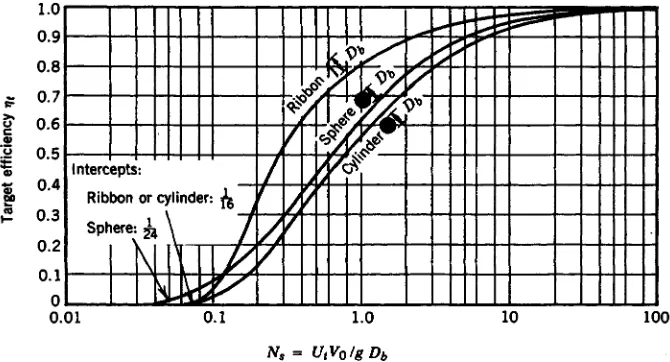
Impaction or impingement is another mechanism common to the various groups of separations. Fluid carrying a discrete dispersed phase, that is, solid or liquid, impacts or impinges on a body. This body could be another solid or liquid particle, a plate, a fiber, and so on. The fluid will deflect around the body while the particle having greater inertia will impact the body allowing the opportunity for separation. Figure 3.1-2 shows an example of this phenomenon. Impingement is estimated by calculating a target efficiency rj, = X/Db, where Db is the body face dimension and X is the dimension approaching the body in which all dispersed particles of a specified size will impact the body. The target efficiency has been correlated for various body shapes as in Fig. 3.1-3 using a separation number Nx = UtV0/gDb, where U1 is the terminal settling velocity of the particle assuming Stokes' Law applies, K0 is the bulk fluid velocity, g is the acceleration of gravity, and Db is the characteristic body dimension. Since % and N3 are both dimensionless, any consistent set of units may be used. This calculation assumes the body is in an infinite fluid. The presence of other target bodies, as in a rain of spray droplets or a fiber bed, would allow a higher collection efficiency.
A subset of the impaction mechanism is that of filtration for solid dispersed-phase particles. A screen or cloth may be used in which the space between components of the filter media is smaller than the particle
Dra
g coefficien
t C
Spheres
Disks
FIGURE 3.1-2 Mechanism of inertial interception. Adapted from Perry's Chemical Engineers' Handbook, 6th ed., 1984, Courtesy of McGraw-Hill Book Co.
size and the particle is sieved out of the fluid. Frequently, however, initial filter operation involves the basic impaction mechanism to remove particles even smaller than the filter media opening. Once solids build up on the media, the depth of solids ("the cake") serves as the impaction or sieving media, not the filter cloth or screen.
Another subset of the impaction mechanism involves collection of very small particles, less than 0.3 /urn, via contact with target bodies by Brownian movement. Brownian movement is a random diffusion of these small particles; since they are so small they have little momentum. In dense fields of target bodies, these particles diffuse randomly into contact with a body and are separated from the bulk fluid.
Electromotive or electrically induced charge separations are the fourth basic segregation mechanism common to the various phase combinations. The most common example of this mechanism is the gas-solid electrostatic precipitator. An electrical field is also used commercially for gas-liquid separations and for removing liquid water from organic liquids and solids from organic liquids. In most cases, the mixture is passed through an electrical field which charges the particles. Fixed bodies such as plates or grids with an opposite electrical charge are used to attract and collect the particles. The basic separation equations involve an efficiency calculation:
(3.1-3)
where n = collection efficiency ( < 1) inertial
interception
Targe
t efficienc
y
FIGURE 3.1-3 Target efficiency of various shapes for particles in a Stokes' Law condition. From Lang-muir and Blodgett, U.S. Army Air Forces Tech. Rep. 5418, 1946, U.S. Dept. of Commerce, Office of Technical Service PB27565.
Intercepts:
[image:3.396.31.366.410.591.2]Vn, = particle velocity toward collection electrode A = collector electrode area
Q = bulk fluid flow rate e = natural logarithm base
The V1n term is directly related to particle diameter and the electrical field strength of each electrode, and inversely proportional to the fluid viscosity. This term is difficult to calculate for performance predictions, but it is typically between 0.1 and 0.7 ft/s (0.03 and 0.21 m/s) for solid-in-gas systems.
Many of the commercial phase segregations involve a combination of the mechanisms discussed, either in the same piece of equipment or in multiple equipment items in series.
In addition to common separation mechanisms for the various combinations of phase segregation, the approach to solving problems also is similar. In each case, the quantity of each phase must be known, as well as the density of each phase, the viscosity of the continuous phase, the dispersed-phase particle size, and the desired specification for the quality of the finished separation. In most cases, this involves sampling and experimental work.
Selection of a specific separation technique or scheme requires the above information plus comparison of capital cost, operating cost, space available for equipment installation, and material of construction requirements. If the desired separation quality is obtainable by several approaches, the last four factors become trade-off parameters.
3.2 GAS-LIQUID SEGREGATION 3.2-1 General
Gas-liquid phase segregation is typically required following some other separation process, such as distil-lation, absorption, evaporation, gas-liquid reactions, and condensation. Before separation techniques or equipment can be selected, the parameters of the separation must be defined. Information on volume of gas or liquid, volume ratio of the phases, and dispersedphase particle size—that is, drop or bubble s i z e -should be known or estimated. For existing operations, measurements are a possibility, while for new facilities analogies from data on other processes could be used. Laboratory or pilot plant tests may be considered, but it is difficult to maintain all fluid dynamic properties constant while changing scale and wall effects may be significant on the small scale.
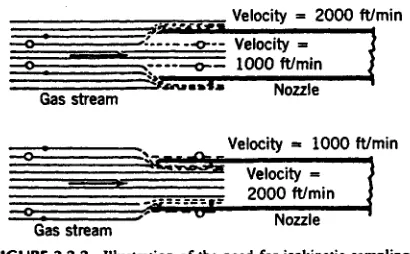
The most common of the gas-liquid separations are those involving liquid dispersed in gas such as entrainment from distillation trays, evaporators, or condensers. The usual objective is to prevent environ-mental emissions, downstream process contamination, or to conserve valuable material. The ratio of liquid to gas volumes is usually small although the weight ratio may be very high. Drop size is a key to selecting the most effective separation technique, but size is difficult to measure. It must also be measured at the point where the separation is to be made owing to coalescence of collected particles. Sample trains consisting of a series of cyclone or various impaction collectors (Fig. 3.2-1) are available and can give an indication of liquid quantities in various particle size cuts, although they are best used for solid particle cut evaluation. Sampling must be done in an isokinetic manner to assure a representive sample. Isokinetic means that the sample must be collected in-line with the bulk gas flow so that the velocity in the sample tube equals the bulk flow velocity (Fig. 3.2-2). This sampling approach works in a dispersed two-phase flow regime, but it is difficult in either two-phase gas-liquid systems such as annular or stratified flow regimes. Sampling is also more difficult in horizontal flow than in vertical flow because drops larger than 5 ftm tend to a nonuniform distribution in the stream, owing to gravity. Small particles (less than 3-5 fim) tend to remain uniformly dispersed owing to Brownian movement. Samples should be taken at more than one position across a duct.
For new gas-liquid systems or where measurements of particle size are too difficult to obtain, predictions from existing data can be used as analogies. Four sources of such information are spray nozzle correlations and data on gas bubbling through a liquid, vapor condensation, and two-phase flow in pipes. A good review of methods for predicting particle size can be found in Perry and Green.1 Table 3.2-1 indicates approximate size ranges for each of these operations if detailed correlations are not available.
Methods for estimating quantities of entrainment from gas-liquid contacting devices are also scarce. Distillation tray correlations by Fair2 are useful for tray-contacting operations (Figs. 3.2-3 and 3.2-4). Q B . Flood is obtained from Fig. 3.2-3; the flooding velocity is calculated by
(3.2-1)
FIGURE 3.2-1 Typical vapor stream sampling train configuration. Excerpted by special permission from Chemical Engineering, August 5, 1985, © McGraw-Hill, Inc., New York, NY 10020.
a = liquid surface tension (dynes/cm) pL - liquid density (lbm/ft3)
Pc = gas or vapor density (lb/ft3)
wu Wc - mass flow rates for liquid and vapor (gas) in Figs. 3.2-3 and 3.2-4
The percent of flood is calculated by {Vf I V^xJ) x 100. The entrainment ratio of liquid/gas is obtained from the v axis in Fig. 3.2-4. These correlations can also be used to approximate entrainment from bubbling liquids, as in evaporators, by setting WJWc equal to 1 and using the sieve tray correlations in Fig. 3.2-4. Below 30% flood the amount of entrainment is almost inversely proportioned to the (vapor rate)3 down to a liquid/gas ratio of 0.0001. Below this value, liquid/gas entrainment varies directly with the gas rate indicating a change in drop formation mechanism.
Gas stream
FIGURE 3.2-2 Illustration of the need for isokinetic sampling.
Nozzle
Velocity =
2000 ft/min
Velocity = 1000 ft/min
Nozzle
Gas stream
Velocity
-1000 ft/min
Velocity = 2000 ft/min
Air-tight pump
Coarse-control
valve
Vacuum gage
Dry-gas meter
Orifice gage
Pitot
manometer
Cyclone trap
Ice bath
Vacuum
line
Fine-control valve
lmpingers
Pitot
9age
"S" type
pitot tube
Cold
box
Probe
Stack wall
Thermometer
Check valve
Filter holder
[image:5.396.96.301.483.610.2]3.2-2 Gravity Segregation
Gravity separation occurs by merely reducing the velocity of a stream so that terminal particle settling or rise velocities due to gravity exceed the velocity of the bulk flow. The terminal particle or bubble velocities can be estimated by the methods described in Section 3.1.
This approach is usually not practical for drops less than 100 ^m, since for most situations large cross-sectional areas are needed to reduce the bulk velocity below the terminal settling velocities of such drops. An air stream with a 10 ft/s vertical velocity will entrain water drops less than about 700 /am, while a bulk velocity of 1.0 ft/s will entrain drops of about 100 pm or less. Gravity techniques can be used to remove large quantities of the larger-size dispersed-phase material prior to some other segregation technique.
Horizontal bulk flow configurations can be more effective than vertical flow by providing the dispersed material a shorter path to travel to be separated. Figure 3.2-5 shows a configuration where the minimum size particle that is removed at 100% efficiency is calculated by
(3.2-2)
This equation neglects the effect of stream turbulence. If the bulk stream flow has Re > 2100, then the drop settling velocity should exceed the velocity of turbulent eddies, which can be estimated by Ve = *o (y72)I/2, where/is the friction factor determined from a Reynolds number correlation.
[image:6.396.90.309.37.106.2]The above discussion holds for both liquid drops in gas or gas bubbles in liquid. It is especially difficult to remove small gas bubbles from liquids because of the high bulk fluid viscosity. A useful technique for gas removal involves use of thin liquid films or use of parallel plates in the bulk stream to minimize the vertical distance for a bubble to travel before coalescing with other gas volumes.
TABLE 3.2-1 Particle Size for Various Processes Conventional liquid spray nozzles
Two-fluid atomizing spray nozzles Gas bubbling through liquid Condensation processes with fogging Annular two-phase pipe flow
100-5000 pm 1-100 A*m 20-1000 fim 0.1-30 pm
10-2000 jim
Plate spacing
C
sb
, Floo
d
[image:6.396.30.368.372.592.2]FIGURE 3.2-4 Entrainment correlation for vapor-liquid contacting. From Fair, Pet./Chem. Eng., 33(10), 45 (September 1961).
3.2-3 Centrifugal Separators
The most common type of centrifugal separator for segregation is the cyclone. Many designs are used for gas-liquid and gas-solid separations. A design is shown in Fig. 3.5-2 which is common for gas-solid separations. It has also been used for gas-liquid separation but problems are often encountered. These problems are apparently due to re-entrainment of liquid from the cyclone wall or to liquid running down the outside of the outlet stack which is then carried out with the exit gas. A much improved design for gas-liquid cyclone or tangential entry separator is shown in Fig. 3.2-6. This design is based on information by Ludwig3 and Penney and Jacobs.4 The key differences over conventional cyclone design are the follow-ing:
FIGURE 3.2-5 Horizontal gravity-settler model.
Fractiona
l entrainmen
t (moles/mol
e gros
s downflow
)
of flood
[image:7.396.104.287.493.604.2]plotes-D
1 minimum or volumeneeded for liquid storage
FIGURE 3.2-6 Recommended vapor-liquid tangential separator geometiy.
1. The cone bottom is replaced with a dished or flat head.
2. Liquid in the bottom head is isolated from the rest of the separator volume by a horizontal plate with an open annular space at the vertical vessel walls to allow the separated liquid to pass into the bottom of the vessel.
3. The gas-liquid inlet is located well below the top of the vessel.
4. A lip is attached to the entrance of the outlet stack to cause liquid running down the outside of the outlet pipe to drop through the separator away from the high-velocity outlet gas vortex.
Figure 3.2-7 illustrates the potential problem with liquid re-entrainment if some of these measures are not applied. The horizontal liquid protector plate, which separates accumulated liquid from swirling gases is probably best supported by vessel wall baffles. This prevents rotation of the collected liquid and re-entrainment.
As the inlet velocity is increased from very low values, the separation efficiency rapidly increases to a maximum in the 80-120 ft/s range. At higher velocities, the liquid on the wall can be re-entrained by gas shear into the rotating gas vortex, and the separation efficiency drops significantly. The design limitation should be on the basis of gas shear which is proportional to pGVh where pc is the gas density (in lbm/ft3) and V1 is the inlet velocity (in ft/s); pcVy should be less than 1000.
For gas-liquid separators designed as in Fig. 3.2-6, the separation can be estimated using a common cyclone equation:
-Lip around outlet line
Liquid baffles Liquid protector
(3.2-3)
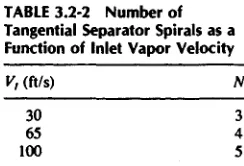
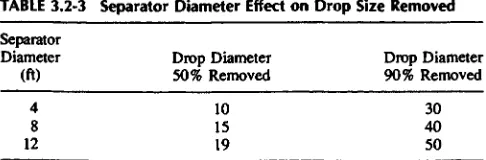
where dp,, is the drop cut diameter for 50% removal, N is the number of vapor spirals in the separator body, D, is the inlet nozzle diameter (in ft), and V1 is the inlet velocity (in ft/s). Table 3.2-2 provides an indication of variation of N with inlet velocity. Figure 3.2-8 indicates prediction of removal efficiency for other particle sizes. From Eq. (3.2-3), it can be observed that larger flow rates require larger diameters which increase the size of the drops effectively removed. Table 3.2-3 indicates the effect of separator size on drop collection. For very large flows, multiple units allow more efficient separation, although careful piping design is required to assure equal distribution to each unit.
Pressure drops through tangential entry separators are not well documented, but they are generally in the range of 8 velocity heads; that is, Ap = 8 (pcVJ/2gc)
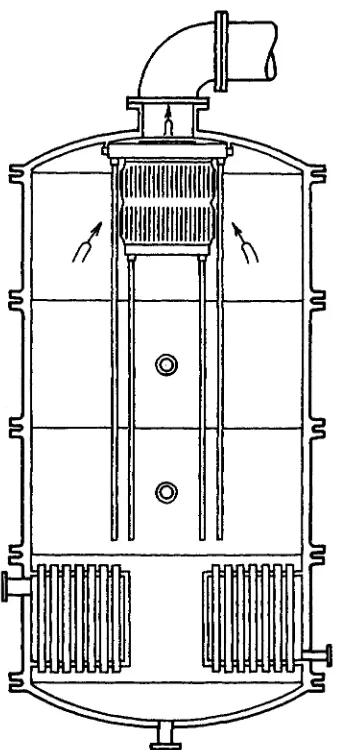
Several commercial separators are available using centrifugal principles. AU are similar, in that sta-tionary internal vanes direct the flow into a centrifugal motion which causes denser liquid drops to contact a surface where they coalesce and are separated by draining. These commercial devices are either in-line or inside vessels near the vapor outlet (Figs. 3.2-9 and 3.2-10). These devices are limited to smaller fractions of liquid than the tangential separators described above. They are, however, about 99% efficient in removing 10 jim drops. Sizing and pressure drop estimation are based on vendor's literature. Common application is in steam lines or evaporator heads to improve the "quality" of steam generated.
3.2-4 lmpaction and Impingement
This category involves a wide range of styles and devices, all based on some obstruction to the bulk vapor flow causing a directional change in the flow. The entrained liquid particles having greater momentum impinge or impact on a surface, coalesce with other liquid material, and separate via gravity.
Several manufacturers supply units with "wavy plates'* which force several direction changes in series (Fig. 3.2-11). Channel spacing may vary from a fraction of an inch to 6-8 in. Devices with four bends are common with channel spacing of 2-3 in. The best separation efficiency is obtained in the range of 7-20 ft/s bulk velocity with a pressure drop in the range of 0.05-0.15 in. H2O. Vendors should be consulted for actual performance data. These devices are limited to about 5% liquid by weight, and they can handle some entrained solids with the liquid flushing away collected solids. Separation efficiencies of 90% are possible for particles down to about 10 pm.
Some of the units have gutters (Fig. 3.2-11) on the vanes to trap separated liquid and force it to drain. Other designs such as the Petersen Candle Separator (Fig. 3.2-12) have close channel spacing down to 0.025-0.03 in., with a high turning angle which allow 80-90% separation of drops down to 2-3 fim. This is accomplished with a much higher pressure drop, 12-20 in. H2O.
Knitted wire mesh pads are a common impingement device for removing liquid entrainment from vapor or gas streams. The Otto H. York Company pioneered this concept with the Demister®. Several vendors are now active in the field.
[image:9.396.136.258.529.612.2]The wire or fiber pad is generally 4-12 in. in depth with 6 in. being the most common size. Wire diameter ranges from 0.006 to 0.15 in. and the density of the mesh varies from 5 to 13.5 lbm/ft3 for the
TABLE 3.2-2 Number of Tangential Separator Spirals as a Function of Inlet Vapor Velocity
FIGURE 3.2-7 Potential problems of vapor-liquid tangential separators. From Stern et al., Cyclone Dust Collectors, American Petroleum Institute, New York, 1955.
V1 (ft/s) 30 65 100
Particle size ratio (dp/d^)
FIGURE 3.2-8 Adjustment of separation efficiency for various particle sizes for tangential separators.
common 316 stainless steel material. The wire provides a target surface on which the liquid drops impinge as the mixture passes through. The larger, heavier drops have enough momentum that they are unable to follow the gas through the many layers of wire. As drops impact the wires, they coalesce with liquid already held on the wire until the mass of retained liquid grows large enough to drain and drop off the mesh pad. The pads are generally placed horizontally with vertical vapor flow up through the pad. Figure 3.2-13 shows several configurations.
As with other separators, there is an optimum vapor velocity through the pad. The allowable velocity is calculated by
(3.2-4)
K is a design constant based on experience which varies with disengaging height above the source of entrainment, system pressure, liquid loading, and liquid viscosity. The most common recommendation of the vendors is K = 0.35. A disengaging height below about 10 in. should have lower K values: £ = 0.12 for 3 in. or K = 0.22 for 6 in. For low-pressure applications the value of K should be reduced; at 2 in. Hg abs, K = 0.2 or at 16 in. Hg abs, K = 0.27 is recommended. Most vendors agree that for pressure surges a design velocity of a new separator should be VD = 0.75 Va. The separator diameter is calculated by Z) = (4Q/TTVD)U2. The calculated diameter is that available for the vapor flow and does not include the portion of the pad diameter that is ineffective because of support rings or bars.
Good separation efficiency is obtained from 0.3Kfl to V0. Efficient removal of smaller particles increases with velocity until re-entrainment occurs at velocities above Va. Mesh pads are effective in drop removal down to 5-10 /xm. Some solids may be handled, but the lower-density mesh and liquid sprays above the pad are recommended to prevent pluggage.
Pressure drop across a mesh pad is usually less than 1 in. H2O and is of little concern except in vacuum operations or systems involving large flows with fans or blowers at near atmospheric pressure. Pressure drop is estimated by Ap = CV% pc, , where Ap is the pressure drop (in in. H2O), Vc is the gas velocity (in ft/s), and pc is the vapor density (in lbm/ft3; C = 0.2 for a standard-density 4 in. thick pad, and C = 0.12 for a low-density 6 in. thick pad. For situations where pressure drop is critical, methods presented
TABLE 3.2-3 Separator Diameter Effect on Drop Size Removed
Remova
l efficienc
y o
f
particle
s d
p
(%)
Separator Diameter
(ft)
4 8 12
Drop Diameter 50% Removed
10 15 19
Drop Diameter 90% Removed
[image:10.396.79.322.532.612.2]FIGURE 3.2-9 Commercial in-line centrifugal vapor-liquid separator. Courtesy of the Centrifix Corp.
by York and Poppele5 should be used which include physical property, liquid loading, and mesh density effects.
Pads are usually made in sections to fit through vessel access paths with hold down bars above and below the mesh. These sections may be wired together and then wired to an annular vessel support ring.
Mesh material is usually 316 stainless steel wire although monel, nickel, copper, titanium, alloy 20, teflon, polyethylene, or other plastics are also available.
A wide variety of other packing materials such as rings, saddles, and Tellerettes are used to eliminate entrapment. Correlations for flow and pressure drop through these materials can be found in Chapter 6. Particles strike the packing and, if the surface is wet, adhere and coalesce. Drops as small as 3 /ttm can be separated with 90% efficiency with vapor velocities of up to 30 ft/s. With high liquid loading, the packing may be adequately wetted by the entrainment. If not, irrigation of the packed bed will be needed. Vapor flow can be either vertical or horizontal with countercurrent or cocurrent liquid irrigation in the vertical case or crossflow liquid design in the horizontal case. Horizontal crossflow has advantages of smaller total liquid rates to obtain the same wetting and more effective flushing of solids. Detailed packing design information is available from vendors. Unirrigated efficiency is less than mesh pads and frequently a packed section is followed by a mesh pad to catch final entrainment.
Tightly packed fiber bed mist eliminators are another option for impingement separations. These devices were developed by the Monsanto Company for sulfuric acid plant mist applications, but they are now also available from various companies. Their main advantage is to allow efficient removal of particles down to the 0.1-1 fim range. These very small particles are not separated by having greater momentum than the vapor or gas, but by the random Brownian movement or random diffusion. The particles diffuse to the fiber surface in the very densely packed beds. Brownian movement actually increases as particle size decreases, improving the separation of very small particles.
Various configurations are used, but a cylindrical bed as in Fig. 3.2-14 is the most common. The typical size ranges from 8.5 in. in diameter and 24 in. long to 24 in. in diameter and 120 in. long with multiple parallel units used for high gas flows.
Since the bed is very dense, the pressure drop will be very high unless low velocity and large cross-sectional flow areas are used. The units can be sized for a specific pressure drop since this quantity is not a significant factor in the efficiency obtained. Pressure drops of 2-20 in. H2O are typical with bed velocities in the 0.25-0.7 ft/s range.
While these devices are unsurpassed for particles less than 3 jtm, they are very expensive when compared Outlet
Drain Secondary vortex stabilizer
ring
FIGURE 3.2-10 Centrifugal vapor-liquid separator inside an evaporator. Courtesy of the Centrifix Corp.
to mesh pads and packing. Information on particle size should be obtained to be sure removal below 3 /im is required. Devices such as packing or mesh pads upstream of the fiber bed may be desirable to limit the liquid loading on the fiber bed, thereby minimizing pressure drop and possible re-entrainment.
Other techniques using an impingement or impaction principle involve collision of drops with larger drops of the same or different liquids. One way of facilitating this is to use spray nozzles to create a large population of liquid drops that intercept or contact the drops to be removed. Spray nozzles can be selected by style and pressure drop to obtain the desired droplet size that maximizes removal of entrained material and is large enough to be collected easily by gravity. Figure 3.1-3 is a plot of collection efficiency of a single drop. The V0 term is the relative velocity between the spray particle and the bulk gas flow. With target efficiency i\T, the overall efficiency of the spray can be estimated by Eq. (3.2-5):
(3.2-5)
where L is the effective spray length (in ft) and dc is the effective spray drop diameter (in ft). For multiple stages of sprays, as in Fig. 3.2-15, the separation efficiency is estimated by Eq. (3.2-6):
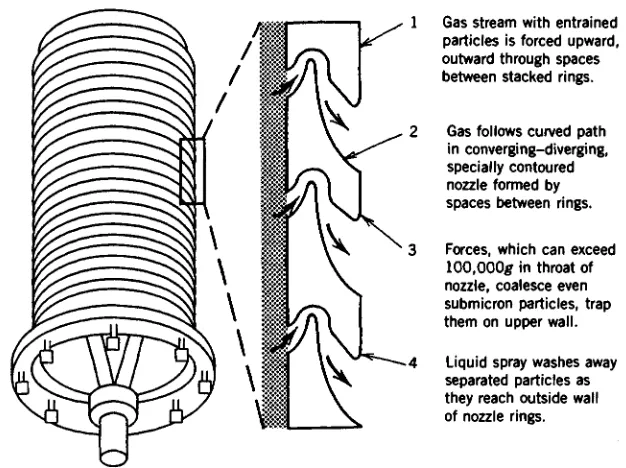
Gas stream with entrained
particles is forced upward,
outward through spaces
between stacked rings.
Gas follows curved path
in converging-diverging,
specially contoured
nozzle formed by
spaces between rings.
Forces, which can exceed
100,00Og in throat of
nozzle, coalesce even
submicron particles, trap
them on upper wall.
Liquid spray washes away
separated particles as
they reach outside wall
of nozzle rings.
[image:13.396.75.326.35.253.2] [image:13.396.42.355.363.597.2]Drain
FIGURE 3.2-11 Wavy plate impingement separator. Courtesy of the Peerless Manufacturing Co.
Stripping vanes
Gutters
Liquid reservoir
Condensate outlet
FIGURE 3.2-12 The Peterson candle separator mechanism.
Open separators In-line gas scrubbers Oil-gas separators Oversize vessel
FIGURE 3.2-13 Typical mesh pad installations in process equipment. Courtesy of Metal Textile Corp. Bulletin ME-7.
FIGURE 3.2-14 Fiber bed mist eliminator configuration. Courtesy Monsanto Envirochem Co.
where m is the number of stages of sprays. Desirable drop sizes of sprays are in the 200-800 /xm range. Numerous commercial designs are available using sprays. Open towers with sprays can remove particles down to about 10 /*m with about 0.5-1.0 in. H2O pressure drop. Spray systems have the advantage of handling solid entrapment as well as liquid, and they operate with a low irrigation rate, about 0.134 ft3 liquid/ft3 vapor.
Venturi scrubbers are an enhancement of the spray approach. A contacting liquid is added to the entrainment-contaminated gas stream just upstream of, or at the throat of, a venturi (Fig. 3.2-16). The turbulence of high-velocity gas in the venturi causes break-up of the introduced liquid into small drops that intercept and coalesce with the small, entrained particles. Collection efficiency greater than 90% of particles
Cleon gas out Retainer plate Cop screws Retomer lugs
Two lifting «ugs eq sp • Gosket
Cos flow
Support piote
•Concentric screens ,Liquid
droin-oge Fiber pocking
HoIf coupling
Vapor out
Second stage spray bank
First stage spray bank
Liquid in
Vapor in
Liquid out
FIGURE 3.2-16 Venturi separator system. Courtesy of Plant Engineering, Sept. 30, 1982.
down to 0.5 fim is possible with a venturi, but with a high pressure drop of about 20-40 in. H2O. A venturi can handle liquid and solid entrainment and can also allow for gas absorption by using appropriate contacting liquids. The scrubbing liquid is generally recirculated with purge and make-up added as needed.
Venturi scrubbers are available in various configurations from several vendors. All the designs have another device following the venturi, such as a cyclone or mesh pad to separate the liquid-gas mixture leaving the venturi.
Venturi scrubbers are costly to operate because of the high pressure drop associated with their use, particularly for large gas flows. Figure 3.2-17 indicates some of the trade-offs of pressure drop, liquid/gas ratio, and entrainment size removal.6 Various correlations are given in the literature, particularly by Calvert6 and a good review is found in Perry and Green,1 but vendors should be consulted for actual design data.
3.2-5 Electromotive Devices
Electrostatic precipitators are most often used for the removal of solids from large gas volumes, but they work equally well for submicron- to low-micron-range liquid entrainment. At dc voltages of 25-100 kV, a corona discharge occurs close to the negative electrode, which is usually a wire or grid. Gas is ionized and migrates to a grounded collector electrode, which is usually a vertical plate. Particles in the gas are charged and drawn to the collector plate where their charge is neutralized and they are collected. Liquid removal is less of a problem than solid removal since collected liquid coalesces and drains readily. Gas usually flows horizontally past the electrodes at velocities in the 2-8 ft/s range to allow particles time to migrate to the collector without significant turbulence. In some designs, vertical cylinders are used as the collector with the charging electrode being a concentric wire with gas flow up through the cylinder.
Pressure drop in these devices is only about 1 in. H2O which is a big advantage for very small particle removal in comparison to fiber bed or venturi separators. The low gas velocity and low pressure drop, however, require a unit with a large volume that has high capital cost.
Theoretical calculations are not recommended for design, but Eq. (3.1-3) gives an indication of the effect of several variables. Increasing collection efficiency from 90 to 99% requires doubling the collector area.
Liquid drain Liquid feeds
Inlet
Throat
Adjustable insert
Wetted elbow
Electric or hydraulic actuator
FIGURE 3.2-17 Venturi scrubber parameter trade-offs. Reproduced with permission from S. Calvert, J. Air Pollut. Control Assoc, 24, 929 (Oct. 1974).
3.2-6 Selection Approach
Selection of the optimal gas-liquid separation technique or equipment configuration depends on the follow-ing factors:
1. Primary objective of the separation (clean gas or clear liquid). 2. Concentration of liquid and vapor (or gas).
3. Size of drops (or bubbles if the liquid phase is continuous). 4. Separation efficiency required.
5. Presence of any solids with liquid en train ment. 6. Material of construction requirements. 7. Capital and operating costs.
These factors are listed in the order in which they are normally considered in making a selection. Figure 3.2-18 presents a logic diagram to aid in selection.
The first decision in the equipment-selection process is determining whether the objective of the sep-aration is a good quality liquid or gas. A clean gas, free of entrainment, is the more common sepsep-aration goal, especially in situations where gas or vapor is to be vented to the environment. The option seeking a good quality liquid effluent is a much less common problem. Typical situations involving the separation of gas from liquid include the removal of bubbles or foam to measure liquid properties for process control or final liquid product packaging.
The concentration of one phase in the other dictates the equipment configuration. If a clean gas stream is the primary objective, a stream with a high liquid loading, greater than 10% by volume of liquid, will need some technique to remove the gross liquid prior to a final clean-up device. A gravity-separator vessel or tangential-entry vessel can provide removal of most of the liquid with a mesh pad, wavy vane, or fiber bed following to provide the desired clean-up.
The particle size of liquid drops or gas bubbles to be removed significantly influences the selection. Figure 3.2-19 indicates the working range of the common gas-liquid separators as well as liquid particle sizes formed in several common processes.
FIGURE 3.2-18 Vapor-liquid separator selection logic.
Is clean gas or
liquid the prime
objective?
YES
LiquidNO Is gross gas disengagement
adequate?
NO Is foam break-up main concern?
YES
Use mechanical devices,
hot surfaces, or chemical addition
NO
NO
Is gas volume less than 5%?
Are bubbles below 300 Mm?
Tangential separator or gravity separator
Use commercial tangential separator
if size permits
YES YES
Promote coalescence with packed media or parallel plates
Use pipe separation
or knockout pot
Use mesh pad, wavy plates, or commercial centrifugal
device
NO Are solids a problem? NO YES Irrigated packed column NO Use tangential separator plus additional device
Must particles less than 10 ^m be
removed?
NO
Use mesh pad with sprays or spray
tower NO
NO Is pressure drop
limited to 20 in. H2O?
YES Electrostatic precipitator YES Are solids a problem? YES YES Use Brink* mist eliminator NO Must particles < 3ftm be removed? Use tangential
separator YES Is removal of particles > 40 /*m
adequate?
NO
Use knockout pot or pipe separator Is removal of particles > 500 ^m
adequate? YES YES Is liquid volume more than 50%? NO
YES Is liquid volume more than 10%? Gas
Use venturi scrubber followed
Particle size (jum)
FIGURE 3.2-19 Vapor-liquid separator application range.
Hydraulic nozzle drops
Pneumatic
nozzle drops
Condensing fog
H
7SO
4Contactor mist
Contact H^SO
4mist
Annular two-phase pipe flow
Gravity
Cyclone/tangential separator
Wavy plate
Commercial centrifugal devices
Mesh pads
Mesh pads with sprays
Packed or tray columns
Venturi scrubbers
Fiber bed Brink' mist eliminators
The presence of solids, even in small quantities, can be an extreme nuisance factor in a system design. Solids can readily foul packed columns, mesh pads, or fiber beds unless prescrubbing or significant irrigation is used to flush contact surfaces.
Material of construction is not a big factor in equipment selection because most equipment is available in a wide variety of metals, glasses, or plastics. In some situations where plastics are available, significant cost savings may be possible compared to use of some of the exotic metals.
Capital and operating costs are always the key factor in an equipment selection. They become a factor, however, only after multiple approaches have been identified as viable solutions to the defined problems. It is very difficult to generalize cost information for the amount of material to be handled, the separation requirements, and the materials of construction needed. Table 3.2-4 indicates relative comparisons of the general equipment types with regard to capital and operating costs. Operating costs should consider pressure drop through the equipment if the loss must be compensated with fan or blower energy, liquid handling such as pumping costs, chemical usage for cleaning, and maintenance. For situations where a process is vented from some significant pressure to atmosphere, the pressure drop through a separation may not be a factor if the loss is available.
The gravity settling chamber shows up as a high capital cost technique, if it is used separately to approach a high degree of separation efficiency. A much smaller gravity chamber to remove gross entrain-ment plus a follow-up device such as a mesh pad or centrifugal vane device could make a very economical separator.
3.3 IMMISCIBLE L I Q U I D SEGREGATION
3.3-1 General
As discussed in Section 3.1, the principles of all phase segregations are very similar regardless of whether the individual phases are gas, liquid, or solid. However, separation of immiscible liquid phases is distinctive compared to the others in that the important density difference between the phases is usually very small, sometimes less than 0.1 g/cm3. Liquid-gas, liquid-solid, or gas-solid separations typically have phase density differences of 1.0 g/cm3 or more. Segregation of phases with a small density difference requires large equipment, application of large forces, or unique equipment geometries. As with gas-liquid separa-tions, the common mechanisms are gravity, centrifugal force, impaction and interception, and electromotive effects.
Immiscible liquid phases are formed because of chemical effects, namely, the mutual solubilities of the two phases. The design for liquid-liquid separations is affected therefore by changes in temperature, pressure, presence of contaminants such as surfactants, and stream mixing effects. In this section, however, we will not consider any solubility factors, only the effect of physical forces.
The presence of two liquid phases may be the result of an extraction, washing, or reaction operation. The two phases may have been contacted in pipes, static mixers, agitated vessels, or at the impeller of a pump. The type of contacting, the level of shear forces applied, the concentration of the phases, and the time of contacting all influence the difficulty of the separation process.
[image:20.396.23.378.49.184.2]To define the immiscible-liquid-segregation problem, the drop size range of the dispersed phase must be known or approximated. Weinstein1 and Middleman2 present drop correlations for pipeline contacting and static mixers while Coulaloglou and Tavlarides3 present correlations of liquid in liquid drop sizes for agitated vessels. All use the Sauter mean drop size definitions and involve use of the Weber number, a
TABLE 3.2-4 Relative Costs of Gas-Liquid Separation
LOW HIGH Capital Open pipes Mesh pads Centrifugal vanes Mesh pad with vessel Wavy plates
Tangential entry separators Packed sections
Spray towers Venturi with separator Gravity settling chamber Fiber bed Electrostatic precipitator Operating Open pipes Gravity chambers Mesh pads Wavy plates Spray columns Packed sections Centrifugal turning vanes Electrostatic precipitators Fiber beds
dimensionless group relating inertial forces and surface-tension forces as in Eqs. (3.3-1) and (3.3-2):
(for pipes) (3.3-1)
(for agitated vessels or pump contacting) (3.3-2)
where D is the pipe diameter, V is the average velocity in the pipe, pc is the continuous-phase density, or is the interfacial tension, N is the impeller rotational speed, and D1 is the impeller diameter. Figure 3.3-1 gives correlations for open pipes or Kenics static mixers, where /*D is the dispersed-phase viscosity, /*c is the continuous-phase viscosity and d32 is the Sauter mean drop size. A design drop size of about 0.8 d32 is reasonable. For agitated vessels or pumps, Eq. (3.3-3) gives an estimate of drop size:
(3.3-3)
where d32 is the Sauter mean drop size in the same units as D1 and 4> is the weight fraction of the dispersed phase. The drop size range may be from 0.5 d32 to 2.0 d32.3
Part of the drop size prediction requires knowing which phase is dispersed and which is continuous. Selker and SIeicher4 provide a useful correlation to predict which is the dispersed phase based on phase volume ratios and density and viscosity of each phase. This information may be approximated by Eq. (3.3-4),
(3.3-4)
where QL is the volume of the light phase and QH the volume of the heavy phase is consistent units. The following guidelines are suggested:
X Result <0.3 Light phase always dispersed 0.3-0.5 Light phase probably dispersed
0.5-2.0 Phase inversion possible; design for the worst case 2.0-3.3 Heavy phase probably dispersed
> 3 . 3 Heavy phase always dispersed
In situations where either phase could be dispersed, the phase being added is normally the dispersed phase; that is, in an agitated vessel one phase is being mixed and a second phase is added. As concentrations, temperature, and physical properties change, phase inversion may occur.
3.3-2 Gravity Separation
A wide variety of designs are used for gravity segregation in immiscible-liquid separators: horizontal or vertical vessels, troughs (API separators), and vessels with various internal configurations or parallel plates.
FIGURE 3.3-1 Drop size correlation for pipes and static mixes. Reprinted with permission from S. Middleman, IEC Chem Process Des Dev., 13, 78 (1974), © American Chemical Society.
Sauter mean drop size Pipe ID.
Weber number Empty pipe
X <0.3 0.3-0.5 0.5-2.0 2.0-3.3 > 3 . 3
Result
Light phase always dispersed Light phase probably dispersed
Phase inversion possible; design for the worst case Heavy phase probably dispersed
The vessels are often referred to as decanters and may operate as a batch or a continuous operation. The emphasis here will be on continuous designs. The basic design approach is as follows:
Calculate settling velocity for drops.
Pick a preliminary size based on overflow rate. Estimate the time for drop coalescence. Specify feed and outlet geometries.
Drop settling velocity is estimated from Stokes' Law using Newton's basic drag equation:
(3.3-5)
where d is the drop size, g is the acceleration of gravity pD and pc are the dispersed- and continuous-phase
densities, and ptc is the continuous-phase viscosity. A number of assumptions for derivation of Eq.
(3.3-5) are often violated in the design of continuous equipment:
1. The continuous phase is a quiescent fluid. 2. The drop is a rigid sphere.
3. The drop moves in laminar flow (i.e., Re = Ud pcZ^c ^ №)•
4. The drop is large enough so that Brownian movement can be ignored. 5. The drop is not hindered by other drops or by vessel surfaces.
Assumption 1 is probably the most significant; however, the difficulty in obtaining or specifying a drop diameter overshadows these other factors. Most drop sizes calculated by typical correlations as in Fig. 3.3-1 are above 300 fim. However, because of the limitations of the assumptions of the design equation, a 150 /*m {d = 0.0005 ft) design drop diameter is recommended.
The overflow rate in a continuous gravity separator is defined as QcifAh where Qc is the
continuous-phase flow rate and A1 is the interfacial area between the coalesced phases. The continuous phase must
flow vertically from the entry elevation to the outlet. Drops must move countercurrently to this velocity to reach the interface and coalesce with other dispersed-phase material. Ideally, the continuous phase moves in a uniform plug flow with a velocity equal to the overflow rate. The minimum or design drop size should
have a settling velocity greater than the overflow rate, QcZA1 < U1. This provides an approach to set the
separator size based on interface area. The approach is made less accurate because of deviations from plug flow, but with a conservative design drop size, reasonable estimates can be obtained.
The performance of gravity separators is dependent on two parts: (1) the movement of dispersed-phase drops to the interface and (2) the coalescing of the dispersed-phase drops at the interface. Either part could be the controlling factor. The coalescence is dependent on the purity of the phases and the interfacial tension. There is no simple equation to predict the time required for coalescence; which may range from a fraction of a second to 2-3 min. The time gets shorter as the density difference between the phases increases, the continuous-phase viscosity decreases, the viscosity inside the drop decreases, and the inter-facial tension increases.
Drops waiting to cross the interface often form a deep band of dispersed drops. The depth of this dispersion band, HD, is correlated by HD = (QcZAr)n. Values of n range from 2.5 to 7 for different chemical
systems. If H0 becomes a significant fraction of the separator depth, a slight increase in feed rate could
cause the separator to become filled with the dispersion band, thereby eliminating the desired separation. Roughly half the volume of the dispersion band is occupied by dispersed-phase drops. Residence time in
the dispersion band is then 9 -1(H0AiZQ0). A good design practice is to keep HD < 10% of the separator
height and 9 greater than 2-5 min.
The above conditions assume two relatively pure liquids. The presence of a surface-active agent or fine dispersed solids can interfere with the coalescing process and result in a stable emulsion. Many liquid-liquid separators form a stable emulsion at the interface called a "rag layer" because of these agents and may require draw-off nozzles near the interface to prevent accumulation. The "rag layer" is like foam in liquid-gas systems and is typically stabilized by very fine solids. If the rag is drawn off it may be de-emulsified or broken by filtration, heating, chemical addition, or reversing the phase that is dispersed.
Both the overflow rate and the residence time in dispersion band are decreased by increasing the interfacial area. Accordingly, long horizontal vessels provide the most desirable geometry (Fig. 3.3-2). This configuration is good for vessels up to about a 12 ft (3.7 m) diameter and for pressure vessel requirements. For much larger volume applications, either a large horizontal tank with center feed and peripheral discharge, such as a water clarifier, or a large horizontal trough such as an API separator is a better selection.
Diffuser detail section C-C
FIGURE 3.3-2 Recommended horizontal decanter configuration.
problem; however, it is usually impractical to operate with laminar flow. The degree of turbulence is expressed by the Reynolds number Re = VDh Pclv-c* where V is the continuous-phase crossflow velocity and Dh is the hydraulic diameter of the continuous-phase layer (Dh equals four times the flow area divided by the perimeter of the flow channel including the interface). Experience indicates that the following guidelines hold for decanters:
Reynolds Number Effect
< 5,000 Little problem 5,000-20,000 Some hindrance 20,000-50,000 Major problem may exist
> 50,000 Expect poor separation
It is good practice to proportion the decanter so that the velocities of both phases are similar, normally with a ratio less than 2:1. Some velocity difference, however, seems to be desirable to aid coalescence.
The proper introduction to feed to a gravity separation is the key to its performance. For optimum design, the feed should be (1) introduced uniformly across the active cross-section of the decanter and (2) done in a way to leave no residual jetting or turbulence. An uncontrolled mixture inlet without proper diffusion will enter as a strong jet, shooting across the separator and causing significant turbulence and mixing. A practical approach is to limit the inlet velocity head at the nozzle to pV2 - 250 lbm/ft-s2. For water, this corresponds to about 2 ft/s. In addition, forcing a direction change on the inlet flow can reduce the jet effect. A very simple approach is to use a plate just inside the inlet at least two times the nozzle diameter and located one-half nozzle diameter in from the inlet. This deflects the jet and significantly reduces the velocity.
For critical designs or retrofitting a marginal existing separator, more elaborate designs are required. To force good distribution and to calm inlet velocity effects, diffusers having a peak velocity of no more than 2-5 times the separator mean velocity are recommended. Successful designs have two closely spaced, perforated or slotted, parallel plates. The first plate takes a high pressure drop with open flow area 3-10% of the separator cross-sectional area. The second plate has its open area off-set from the first plate to dissipate velocity. The second plate should have an area of 20-50% of the separator cross section. The spacing of the plates is about the dimension of the plate perforations or slot width.
High outlet velocity of the heavy and light phases can also adversely affect separation if a vortex is formed and nonseparated dispersion band material is drawn out in the vortex. The exit flow of each separated phase should be drawn from the separator at velocities not more than 10 times the average velocity in the separator. The ideal outlet consists of overflow and underflow weirs extending across the separator. If standard nozzles are used at the top or bottom of a horizontal vessel, vortex breaker plates four times the nozzle diameter inside the vessel can prevent vortexing.
Reynolds Number
< 5,000 5,000-20,000 20,000-50,000
> 50,000
Effect
Little problem Some hindrance Major problem may exist Expect poor separation
Light liquid out
I Valves to find and drain rag Feed nozzle
Heavy liquid out
1 in. holes
Section A-A
FIGURE 3.3-3 Simple decanter interface control.
For some critical designs, small-scale dynamic models are useful in evaluating performance. Care must be taken to assure that the same flow regime exists on both scales, that is, laminar or turbulent.
All gravity separators require good control of the liquid-liquid interface for consistent performance. For liquid-filled systems, level control instruments or interface detectors are used. A simpler, less costly method is to use a weir or underflow leg to fix the interface. The weirs or legs are made adjustable and are set on start-up. Positioning is estimated by doing a force balance [Eq. (3.3-6)] based on the ay b, and c dimensions indicated in Fig. 3.3-3:
(3.3-6)
Flow friction losses are assumed negligible and pL and pH are the light and heavy densities, respectively. Batch-operated gravity separations avoid the complications of turbulence in continuous separators. They can be designed based on Stokes' Law for dilute dispersions, where the separation time is that for a dispersed-phase drop to go from the farthest point to the interface: 6 = HIU, where O is separation time, H is the height from the farthest point to the interface, and V1 is the Stokes' Law settling velocity. For systems where coalescence is the limiting mechanism, the ratio of the volume to cross-sectional area should be proportional to separation time and is the key parameter. Small-scale batch tests can be used to confirm sizing or separation time.
Batch settlers are best used for separation following batch contacting of two phases where both oper-ations can be done in the same vessel. The difficult part is making a clean cut between phases when draining or pumping out. This is normally done visually with a sight glass or with a conductivity probe. Prevention of vortexing in the exit line is important to prevent premature entrainment of the light phase into the heavy phase. Use of a vortex breaker over a bottom outlet nozzle, a slow exit velocity, or taking an intermediate cut and recycling are alternate approaches.
Since all gravity settling depends on the distance a drop must travel to reach an interface, or the interface area available for coalescence, various designs having parallel plates have been promoted in recent years. The parallel plates create individual flow channels and, in effect, are many separators in parallel. Plate spacing may range from about 0.75 in. (1.9 cm) to several inches. The maximum distance a dispersed-phase drop must travel to reach an interface is the distance between the plates, rather than several feet in a large open gravity-settling vessel. The parallel plates also maximize the interfacial area to aid coalescence. Separations keyed to overflow rate QfA can be performed with much greater interface area in a much smaller vessel. The parallel plates also address the problem of turbulence affecting gravity settling. Since the separator Reynolds number is a function of hydraulic diameter, the presence of the plates greatly reduces the hydraulic diameter and allows laminar flow (Re < 2100) to be obtained in a reasonably sized vessel with 0.75-1.5 in. (1.9-3.8 cm) plate spacing.
Many variations of parallel-plate separators are now available; some have flat plates, some use wavy plates, some use parallel chevrons or tubes. Most of the plates are placed on an angle to allow the light and heavy phases to disengage as they pass through the plate section. New commercial designs use a crossflow approach, while some of the earlier designs required the collected dispersed phase to flow back countercurrent to the bulk flow. Some disengagement volume is needed after the bulk flow exits the plate sections, but at this point, the dispersed phase has coalesced into large drops which readily separate by gravity as they exit the plate surfaces. Units requiring countercurrent flow are not recommended for large volumes of dispersed phase. Parallel plates added to ineffective existing gravity separator vessels can greatly improve separation quality or increase capacity.
Feed Interface
Adjustable leg
3.3-3 Centrifugal Separators
Cyclones for liquid-liquid segregations have been tried experimentally but are not in use commercially owing to the relatively small density differences and the high shear flow in the device which would break down liquid drops.
Mechanical centrifuges, however, are used commercially for immiscible-liquid separations. Centrifuges work on the basic Stokes' Law functionality by increasing the settling velocity many times over that of gravity by the application of centrifugal force. This is referred to as the number of &s developed by the machine, G = r{2icN)2lgy where r is the centrifuge bowl radius, N is the number of revolutions of the bowl per second, and g is the acceleration due to gravity.
The simplest liquid-liquid centrifuge is a tubular device of small diameter ( < 8 in.) and very high speed. It is fed at one end with the separated liquid phases removed at the opposite end through tubes of different radii. Maximum capacity is about 0.045 ft3/s (1.3 L/s).
The most common liquid-liquid centrifuge is a disk type design (Fig. 3.3-4). Forces up to 9000 times gravity are typical. The inclined disks in the centrifuge enhance settling similar to the application of parallel plates in gravity settlers. The lower-density liquid phase moves to the top of the channel between disks and toward the center of the machine. The higher-density liquid phase moves toward the outside of the bowl but also exits at the top in a separate channel. Some solids can be handled with either periodic shutdown and clean-out or an automatic solids ejection by either parting the bowl momentarily or opening nozzles to eject the solids.
A minimum disk spacing must be maintained to prevent choking of the channels. Capacities of disk centrifuges range from 0.011 to 1.11 ft3/s (0.3 to 30 L/s). The specific gravity difference of the pure components should be at least 0.01 and the drop size of the dispersed phase should be at least 1 fim. Some reported results indicate removals down to 0-5 ppm on feed streams of 15% dispersed phase.
3.3-4 Interception
Mixtures of immiscible liquids can be separated by an interception method analogous to mesh pads or fiber beds in gas-liquid segregation. The mixture is passed through a dense bed of fibers or wire mesh and the dispersed drops contact with media surface. Most systems are designed with media materials that are preferentially wetted by the dispersed drops. The dispersed material is held by the media until enough material coalesces and large globules disengage from the media. The large globules, now of significant size, are readily separated by gravity. These devices are often referred to as coalescers.
Metal wires are generally wetted by aqueous phases, while organic polymeric materials are usually wetted by organic chemicals. Glass or treated glass fibers can be tailored for either aqueous or organic phase wetting. Fiber size and media pore size are decreased with the need to separate smaller drops. Particles down to 1-5 /xm have been removed successfully. Pressure drop typically ranges from < 1 to 20 lbf/in.2.
For very efficient operations, two-stage combinations of coalescing elements are used. The second stage may be a continuous-phase wetted media, very densely packed to prevent entry of dispersed drops (Fig. 3.3-5).
Coalescers are good for clean liquid-liquid systems, but systems containing solids will rapidly plug the
Feed
Light-phase effluent
Heavy-phase effluent
[image:25.396.117.284.434.591.2]Solids holding space
FIGURE 3.3-5 Liquid-liquid coalescer configuration. Courtesy of Osmonics, Inc., Minnetonka, MN.
media unless a prefiltration step is used. When significant solids are present, a packed bed similar to a deep bed filter may be used with periodic backflush.
The performance of coalescers cannot be predicted theoretically and such systems require experimental work to determine sizing, using the same media, flow rate per area of media, and dispersion preparation method. Tests need to be run over sufficient time to assure that the media is fully loaded with the dispersed phase and that steady-state operation has been obtained. Periods up to 2 h may be needed to assure complete loading. A material balance of dispersed phase in and out of the system is a good check.
Another impaction technique is that of flotation. Gas bubbles are used to intercept dispersed liquid drops and float them out of the bulk phase. Three methods are used to form the bubbles: (1) mechanical dispersion, (2) electrolytic gas formation, and (3) dissolved air. Mechanically dispersed systems involve either agitators or gas spargers to form the bubbles. Bubble size is usually large and not efficient in contacting small liquid drops. Electrolytic gas uses a direct current between electrodes to create small oxygen and hydrogen bubbles from water solutions. Dissolved air flotation is the most common method; in this pro-cedure, liquid is saturated with gas by various techniques followed by a sudden pressure reduction. Bubbles 30-100 fim are evolved with optimum separation occurring with 50-60 fim bubbles.5 Gas requirements of 0.01-0.03 Ib1n air/lbm dispersed phase are typical. Oil refinery applications of flotation to remove oil from wastewater are used, after gross oil separation by gravity settlers. Separation efficiencies of greater than 90% are obtained with 50-250 ppm oil concentration feed.
Membrane separators are used for immiscible liquid segregation. These devices are extensively covered elsewhere in this book. For actual segregation, ultrafiltration or microfiltration membranes are another variation of an impaction or interception mechanism. Ultrafiltration membranes have discrete pores about 0.001-0.02 fim in diameter which allow the continuous phase to pass while trapping the much larger individual drops, which are usually greater than 0.1 fim. Flow velocity across the membrane surface resuspends trapped dispersed-phase material to prevent blinding of the pores. Pressure drop requirements
Organic phase outlet
Hydrophobic separatory membranes Emulsion inlet
Coolescing membranes Pressure gage
connection Hydrophilic separatory membranes Water-phase
for ultrafiltration are under 100 ltyin.2. Ideally, the membrane material is not wetted by the dispersed phase. These devices are good for obtaining a clarified continuous phase, for example, removing dilute oil from water. The dispersed phase, however, can only be concentrated, not truly separated, since a strong continuous-phase velocity is needed across the surface to prevent fouling. An example is feeding a 2-3% oil in water mimxture with a clear water stream passing through the membrane containing about 0.0005% oil, and an exit bulk flow of about 20-30% oil. The exit bulk flow could then be separated by more conventional settling devices.
3.3-5 Electroseparators
Electrical charging methods may be used to remove aqueous materials and solids from organic fluids as in crude oil desalting. Dispersed materials passed between electrodes are charged with either dipoles or net charges such that they are attracted either to each other or to an electrode surface where they coalesce with other dispersed-phase materials. The coalesced materials are readily separated by gravity settling. Some commercial units handle up to 125,000 bbl/day of crude oil.
3.3-6 Selection of Liquid-Liquid Segregation Devices
The following factors need to be considered in selection of the optimal device or combination of separation equipment items:
Concentration of feed Particle size of dispersed phase Effluent quality required Capital cost
Operating costs Space for equipment Material of construction
These factors are considered in the logic diagram shown as Fig. 3.3-6.
Systems with greater than 30% concentration of dispersed phase are difficult to handle in anything but large-volume gravity settlers. Coalescence will be a dominant factor due to the high frequency of dispersed-phase drop interaction. Coalescence will be greatly affected by the physical properties of the fluids, espe-cially the interfacial tension. Fluid pairs with interfacial tensions grater than 10 dynes/cm should readily coalesce, while those < 1 dynes/cm will readily emulsify. Concentrations below 30% disperse material can be handled by disk centrifuges also. Below 15%, concentration plate settlers can be added because settling, not coalescence, is likely to be the dominant mechanism. Below 5% concentration, all equipment is applicable and selection must be based on other criteria.
Dispersions may be considered in two categories—primary dispersions having drops 25 fim and larger and secondary dispersions of particles below 25 pm. Some secondary dispersions or haze are formed as a result of the coalescing of primary drops. Secondary dispersions require techniques other than gravity settling such as fiber coalescers, flotation, or centrifugation to obtain good separation efficiency.
Emulsions are another category of dispersion with particles generally less than 1 /*m and with low interfacial tension. Dense media coalescers are sometimes effective as are membranes. Chemical or heat treatment may be needed to break the emulsion by changing the interfacial tension followed by conventional techniques. For water dispersed in an organic emulsion, the electroseparators are a possible choice. Figure 3.3-7 gives an indication of the range of application of the various devices as a function of particle size.
The required effluent quality is a prime factor in the final separator system configuration. Combinations of two or three separator devices or techniques may be needed. Gravity settlers can do a gross separation of drops down to about 150 /im. Centrifuges, fiber bed coalescers, or membranes would be required for very high efficiencies of particles down to 1 /im. To clear a mixture of 30% dispersed-phase concentration to only a few parts per million residual would require gravity settling followed by some polishing device. Capital costs are difficult to generalize owing to the wide range of feed properties, output specifications, and material of construction requirements. Table 3.3-1 is a relative positioning of the various separation techniques.
Operating costs of the various devices vary from essentially no cost for gravity chambers with weir outlet controls, to significant electrical and maintenance costs for high-speed centrifuges. Some periodic costs for clean-out of solids accumulations may be required with most of the devices. Relative positioning of the devices by