Does Outsourcing Increase Profitability?*
HOLGER GÖRG
University of Nottingham and DIW Berlin
AOIFE HANLEY
University of Nottingham
Abstract:We investigate the relationship between outsourcing and profitability paying particular attention to the endogeneity of outsourcing. The empirical analysis uses unique plant level data for the electronics sector in Ireland. A particular feature of the data is that it records detailed information for 12 electronics sub-sectors covering both manufacturing and services activities. We distinguish outsourcing of materials from outsourcing of services inputs. We find that plants that are substantially larger than the mean employment size benefit from outsourcing materials while this does not appear to be the case for small plants. Results for outsourcing of services are not as clear-cut, however.
I INTRODUCTION
B
oth the popular press and academic literature have recently covered the growth of outsourcing or contracting out, of business activities and its economic implications. While Heshmati (2003) in his recent survey points out that there is no general definition or measurement of outsourcing, he broadly describes it as …different kinds of corporate action related to all subcontracting relationships between firms and the hiring of workers in non-traditional jobs(p. 99). Outsourcing may provide a viable strategy if firms aim to save on labour costs (Abraham and Taylor, 1996), exploit production differentials both within the services sector and between services and manufacturing (Fixler and Siegel, 1999), or take advantage of globalisation267
Paper presented at the Eighteenth Annual Conference of the Irish Economic Association, Belfast, 2004.
(Feenstra and Hanson, 1999). According to an article in the Financial Times, Subcontracting as many non-core activities as possible is a central element of the new economy.1
A fundamental question to ask is whether outsourcing is value enhancing and, in particular, whether the firm that undertakes outsourcing shows higher profitability as a result. Essentially this question renders down to the transactions cost question regularly posed to university undergraduates: should a firm manufacture its own inputs by some form of vertical merger or should it seek to obtain possibly more competitively priced inputs on the open market? While the viability of vertical mergers as a determinant of profitability is comparatively well researched, less work has been undertaken on the viability of pursuing a less integrated strategy, namely of outsourcing inputs.2
Recent evidence from practitioners casts some doubt on the benefits to outsourcing. A UK survey by Manpower focusing on the benefits accruing to firms from offshoring services, found that 68 per cent of firms outsource at least some services, the main motivation being cost reduction.3However, in a recent survey, 56 per cent of IT specialists claimed that outsourced IT work was at least inferior to that produced in-house. More worryingly, 11 per cent reported that the outsourced work actually induced a setback to the firm’s production.4Accordingly, in the popular press one appears to have arrived at a point where experts begin to question the validity of outsourcing as a long-term strategy or even short long-term as a cost reduction exercise.
To the best of our knowledge, there is only a very limited number of more rigorous statistical or econometric studies looking at this issue. The evidence that has been produced in such papers, however, suggests that the value-enhancing link between outsourcing and profitability is not clearly established. Specifically, Kimura (2002) does not find any evidence that subcontracting leads to higher profits in Japanese manufacturing firms. Differentiating between outsourcing of services and non-services inputs, Görzig and Stephan (2002) find that outsourcing of materials is positively correlated with profits, while there is a negative relationship between profitability and outsourced services for a sample of German manufacturing firms.
1Financial Times, 31 July 2001, p. 10. Feenstra (1998) provides an excellent overview of the increase in outsourcing activities worldwide.
2See Bhuyan (2002) for a recent analysis of whether vertical mergers induce higher profits or
Knarvik and Steen (2002) for an investigation of whether vertical mergers induce other positive externalities through agglomeration effects.
Motivated by the benefits to outsourcing claimed by some practitioners and the corresponding lack of any direct evidence as to the truth behind these assertions, we aim to establish whether outsourcing does indeed raise profitability.5We use unique plant level panel data for the electronics sector in the Republic of Ireland. Ireland represents an interesting case study for outsourcing as noted by Ruane and Görg (2001), who document the increasing growth in outsourcing in the electronics sector for the Irish economy.6 The novelty of our data stems from the fact that we can distinguish 12 electronics sub-sectors which cover both manufacturing and services activities. Also, we have detailed information on outsourcing activities at the plant level. Furthermore, in comparison to the study by Görzig and Stephan (2002) which is the one most closely related to ours, we pay particular attention to the possible endogeneity of outsourcing and profitability. We attempt to circumvent this problem by using an instrumental variable approach, implemented using a General Method of Moments (GMM) estimator.
The remainder of the paper is structured as follows. The following section briefly discusses recent literature on firms’ decisions to outsource, in order to provide the context for our subsequent empirical analysis. The data are described in Section III. Section IV outlines the econometric methodology and discusses the results. Finally, Section V presents some conclusions.
II OUTSOURCING AND PROFITABILITY
Essentially outsourcing addresses the issue as to whether a firm should make or buy intermediate inputs; an issue that has a long tradition in economics, dating back to the seminal work by Coase (1937) on the boundaries of a firm. Since then, a large body of literature has been concerned with analysing the determinants of this “make-or-buy decision”, focusing on the role of incomplete contracts, specific assets and transactions costs (e.g., Williamson, 1975; Grossman and Hart, 1986; Bolton and Whinston, 1993). In a nutshell, firms would prefer to “buy” as opposed to “make” as long as the cost of outsourcing is lower than in-house production. Hence, outsourcing can be used to economise on production cost, in particular labour cost (Abraham and
5Note that, in this paper, we do not distinguish domestic from international outsourcing, but
concern ourselves with outsourcing in general. In a related paper, Görg et al.(2004) investigate whether international outsourcing (imported intermediates) is associated with higher productivity in the outsourcing plant, using data for manufacturing plants in Ireland.
6This growth was revealed using plant level data on input purchasing behaviour of computer
Taylor, 1996) by substituting in-house production with the buying-in of components. The cost of outsourcing is not only determined by the price of the bought-in components, but also by transaction costs due to transport and incomplete contracting costs, and the possible implications of asset specificity for supplier and/or customer.
In a recent paper, Grossman and Helpman (2002) provide a comprehensive theoretical analysis of firms’ outsourcing decisions. In their model, firms decide whether to be vertically integrated or to outsource production of components to specialised producers. This involves a search process, whereby final good producers search for subcontractors and vice versa. There is incomplete information – subcontractors cannot easily signal their quality – and therefore a potential for a hold-up problem arises. Inter alia, Grossman and Helpman (2002) show that the viability of outsourcing is determined by the distribution of bargaining power between the two parties involved, the degree of competition in the market, and the number of potential partners in the market.
Taking this as a theoretical background, one may expect that the benefits from outsourcing are not always the same, but in particular depend on the characteristics of the firm and industry in question. Large firms may be in a better position to achieve high bargaining power vis-à-vissuppliers and may hence be better able to benefit from outsourcing. Also, large firms may face lower search costs as they may be better established in the market and have better knowledge of competitors and suppliers than small establishments.
In terms of industry characteristics, if there are more potential subcontractors in the industry, if the bargaining power is tilted towards the final good producers, or if the level of competition is high among subcontractors, final good producers are more likely to find outsourcing a viable strategy. While this is difficult to address in formal empirical work (as opposed to case studies) due to data constraints, our data set possesses one advantageous characteristic that allows us to have at least a first cut at this question.
while services outsourcing induces a negative effect on measured returns. This, they infer, is due to the non-transparent way in which outsourced services are priced vis-à-vis more tangible inputs. They conclude that while the markets for intermediate products appear to function, outsourced services may be subject to certain inefficiencies.7
In related work, Kimura (2002) discovers that poorly performing firms (low surplus to sales and low value added to sales) are more likely to use subcontractors, in an analysis of the Japanese machinery manufacturing industry. He concludes that profits are highest for those firms that do not get involved in any type of subcontracting, whether as a supplier or as an outsourcer. These results, accordingly, are in line with the findings for Germany by Görzig and Stephan (2002).
III DATA
In order to investigate the relationship between outsourcing and profits we use plant level data for the electronics industry in Ireland. This industry has undergone rapid growth in the Irish economy, in particular in the 1990s. As Ruane and Görg (2001) document, employment in the sector has increased threefold between 1984 and 1997, from roughly 7,300 to 22,700. Most of this growth arose during the mid-1990s; in 1994, total industry employment was only approximately 11,700. One striking feature is that the majority of firms operating in this industry are subsidiaries of foreign owned multinationals; they accounted for over 85 per cent of employment in 1997. The importance of multinationals in this sector is not least due to policies directed towards foreign firms. Ruane and Görg (2001) note that the Irish Development Authority (IDA Ireland) identified the electronics industry as a potential source of growth for the Irish economy as far back as the mid-1970s. This judgement was in part based on the perceived potential for outsourcing activities in that sector. Such outsourcing potential was expected to raise the scope for domestic Irish, as well as foreign companies to supply to final goods producers, thereby allowing the location of various stages of the production
7Interestingly, they draw attention to the need to focus on profitability rather than efficiency
process in the country.8Currently, electronics firms located in Ireland include such high-profile names as IBM, Microsoft, Intel etc.
The data used in this analysis are taken from the Irish Economy Expenditure Survey, undertaken annually by Forfás, the government agency with responsibility for enterprise development, science and technology. The survey provides anonymised plant level information on output, employment, profitability, nationality of ownership and industry, as well as details on plants’ expenditure on labour, materials, and service inputs.9,10
The survey is sent out to all plants with thirty or more employees based in Ireland in either the manufacturing or internationally traded services sectors. Response rates are generally good; plants responding to the survey account for around 60-80 per cent of employment of the target population each year (O’Malley, 1995). The exclusion of small plants with less than 30 employees from the sample, precludes us from investigating how outsourcing affects small firms in particular, and this factor has to be kept in mind for the subsequent interpretation of our results.
While the survey has been undertaken by Forfás since 1982, an examination of the data showed that for our purposes, information on outsourcing and profitability has only been available since 1990. Accordingly, we use electronics sector data for the period 1990 to 1995. These data are classified into 12 sub-sectors of electronics, which cover both manufacturing and service activities, making the dataset quite unique. These sub-sectors are: Computers; Consumer Electronics; Electronic Components; Instrumentation; Networking & Data Communication; Printed Circuit Board Assembly (PCBA); Peripherals & Media; Semiconductors; Software Development; Software Production; Telecommunications and IT Services.11 The inclusion of both manufacturing and services sub-sectors makes the dataset particularly interesting for our analysis.12All in all, there are 215 plants included in the sample, although the structure of the panel is highly unbalanced.
8 See also White (2000) for an excellent insiders-view on Irish industrial policy towards
multinationals.
9Unfortunately, the nature of our data does not allow us to distinguish between inputs sourced
from other plants within the same firm, and inputs sourced from other sources.
10All nominal variables are deflated using an output price deflator available from the Irish
Central Statistics Office.
11IT Services include IT related services not included in the other sub-sectors, such as Systems
Integration, IT Consulting and training and education.
12The availability of data for this six year period is of course limiting, as fragmentation activities
The main variables of interest are outsourcing and profitability at the level of the plant. The former is measured as the ratio of externally sourced inputs to value added in the plant, thus giving us a measure of the importance of bought-in intermediates in the production process. Specifically, we calculate three measures of outsourcing. Total outsourcing is defined as the ratio of total bought-in inputs over value added. As alluded to earlier, another advantage of our data is that we can distinguish intermediate inputs into raw materials and components (referred to as materials) and services inputs. We can therefore calculate two more disaggregated measures of outsourcing, namely, the ratio of bought-in tangible materials and components over value added, and the ratio of bought-in services inputs over value added. With regard to the latter measure, services inputs are comprised of other direct and indirect costs, excluding materials, wages, rent, interest payments and depreciation. This includes contracted out services, such as consultancy, maintenance, security, cleaning, catering etc. An increase in these outsourcing ratios indicates an increasing importance of outsourcing for production in the plant, as more inputs are purchased for further processing.
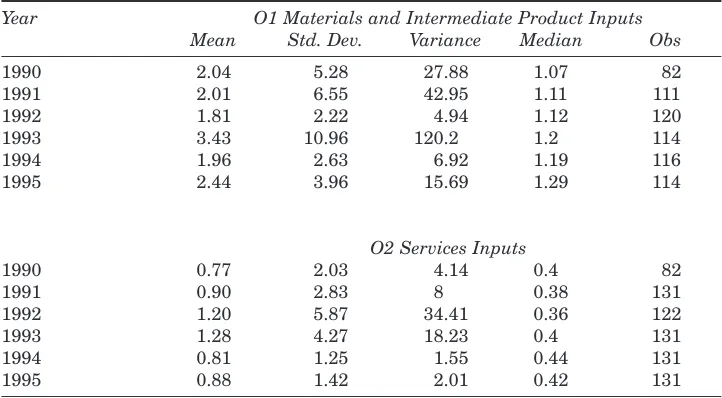
The measure of profitability is calculated as the ratio of net profits (i.e., total sales – total costs) over total output. Total costs includes all direct and indirect costs accruing to the plant. Table 1 shows some summary statistics on outsourcing of intermediary and materials inputs (O1) and services inputs (O2) respectively. O1 is noted for its higher ratio of inputs to value added compared to O2. It is possible that the higher ratios registered for O1inputs, are due to a higher degree of vertical integration in materials inputs vis-à-vis services inputs. Overall, the median value of the O1 ratio just exceeds unity (1.18) and the overall average ratio is 2.28, indicating that values in the upper tail of the distribution are driving the average value up. The corresponding values for O2inputs are 0.40 and 0.97 respectively. We would expect services inputs to exhibit lower values given their invariably ancillary function in industry.13 However, firms with strong affiliations to suppliers in a value chain, to the extent that they are fully integrated, should be expected to register high values for the O1ratio where components are purchased from an intermediary.14
We are unable to disclose detailed summary statistics for the profitability measure due to confidentiality reasons. The raw correlations between profits
13Abraham and Taylor (1996) outline types of business services received and include supportive
services such as accounting, auditing and bookkeeping and services to buildings in addition to more direct inputs such as personnel supply services.
14In Table A1 in the Appendix we present further summary statistics for the two outsourcing
and O1 and profits and O2 are –0.13 and –0.16 respectively, and the correlation between O1and O2is 0.21 (all statistically significant at the 1 per cent level).
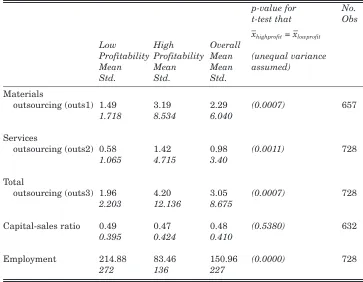
In Table 2 we present further summary statistics for the outsourcing variables, as well as for average employment and the capital-sales ratio (which are covariates included in the empirical model below). We distinguish the overall means, as well as means for ‘high profitability’ and ‘low profitability’ plants in order to highlight differences between these two groups of plants. For illustrative purposes, the former category is simply defined as plants demonstrating at least median profitability levels, while low profitability establishments are those with less than median profitability. As we can see, highly profitable firms tend to use more outsourcing in general. A simple t-test for the equality of means for the two groups of plants can be rejected. Note, however, that low profitability plants are on average larger (in terms of employment levels) than the other group of plants.
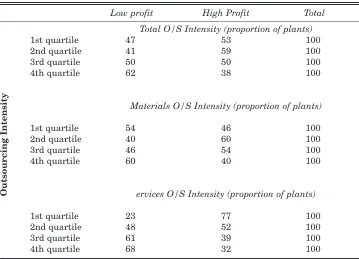
The differences in outsourcing usage between these two groups of plants are further highlighted in Figures 1 to 3. These graphs chart the distribution of outsourcing intensities of plants in high and low profitability categories for total, materials and services outsourcing respectively. The accompanying table containing the actual proportions used to generate these cross-sections is contained in Table A2 in the Appendix.
[image:8.498.73.434.99.298.2]If low and high profitability plants demonstrated no difference in Table 1: Breakdown of Outsourcing to Value Added Ratios for O1 and O2
Year O1 Materials and Intermediate Product Inputs Mean Std. Dev. Variance Median Obs
1990 2.04 5.28 27.88 1.07 82
1991 2.01 6.55 42.95 1.11 111
1992 1.81 2.22 4.94 1.12 120
1993 3.43 10.96 120.2 1.2 114
1994 1.96 2.63 6.92 1.19 116
1995 2.44 3.96 15.69 1.29 114
O2 Services Inputs
1990 0.77 2.03 4.14 0.4 82
1991 0.90 2.83 8 0.38 131
1992 1.20 5.87 34.41 0.36 122
1993 1.28 4.27 18.23 0.4 131
1994 0.81 1.25 1.55 0.44 131
1995 0.88 1.42 2.01 0.42 131
outsourcing intensity, they would both register equal proportions (i.e. 50 per cent) across all intensity quartiles. However, we see that certain biases emerge depending on (a) the nature of the outsourcing and (b) the level of the outsourcing intensity. Accordingly, we see in Figure 1 that of those establishments engaged in high level outsourcing (4th quartile), a dis-proportionate number (62 per cent) belong to the low profit group. Overall therefore, outsourcing appears to be an activity in which low profit plants are particularly active.
[image:9.498.63.426.110.392.2]Moving to Figures 2 and 3, we now examine the composition of establishments according to the nature of outsourcing i.e. whether we are dealing with materials or services outsourcing respectively. Consistent with what we have seen in Figure 1, a disproportionate percentage of plants in the highest intensity category (4thquartile) belong to the low profit category. This proportion is 60 and 68 per cent for materials and services outsourcing respectively. Accordingly, the nature of the outsourcing activity does matter. It Table 2: Comparison of Outsourcing Intensity and Other Control Variables
Across High and Low Profit Plants
p-value for No. t-test that Obs – –
xhighprofit= xlowprofit
Low High Overall
Profitability Profitability Mean (unequal variance
Mean Mean Mean assumed)
Std. Std. Std.
Materials
outsourcing (outs1) 1.49 3.19 2.29 (0.0007) 657
1.718 8.534 6.040
Services
outsourcing (outs2) 0.58 1.42 0.98 (0.0011) 728
1.065 4.715 3.40
Total
outsourcing (outs3) 1.96 4.20 3.05 (0.0007) 728
2.203 12.136 8.675
Capital-sales ratio 0.49 0.47 0.48 (0.5380) 632
0.395 0.424 0.410
Employment 214.88 83.46 150.96 (0.0000) 728
272 136 227
appears that of plants actively engaged in high level outsourcing, disproportionately more exhibit low profitability.
This profits discrepancy is more striking when non-tangible as opposed to tangible inputs are outsourced, a fact we infer from the disproportionate percentage of low profits plants engaged in services outsourcing. Staying with the issue of services outsourcing, accompanying the disproportionate activity of low profit plants in the fourth quartile, is a relatively weak showing in the lowest outsourcing intensity category (1stquartile). Here we see that a mere 23 per cent of establishments belong to the low profit group while a disproportionate proportion (77 per cent) belong to the high profit category.
70
60
50
40
30
20
10
0
1st qtile.
2nd qtile.
3rd qtile.
4th qtile.
Profit >= median
[image:10.498.115.394.255.417.2]Profit < median
Figure 1:Net Profits by Total Outsourcing Intensity
60
50
40
30
20
10
0
1st qtile.
2nd qtile.
3rd qtile.
4th qtile.
Profit >= median
Profit < median
[image:10.498.115.395.456.610.2]IV ECONOMETRIC ANALYSIS
The analysis of simple summary statistics does, of course, not allow us to isolate the possible effects on profitability of other covariates. In order to disentangle the effect of outsourcing and other factors on plant profitability, we turn to an econometric analysis. We start off with a profit function which we formulate in levels in order to explain profitability in plant iat time t, Πit
ln Πit= β1+ β1Oit + β2ln ksrit + β3ln employit + β3ln netgrjt
+ αj + νt + µi + εit (1)
where Oitis one of the measures of outsourcing as defined above, ksrit is the capital-to-sales ratio (where capital is measured as capital employed, i.e., working capital), employit is establishment size measured in terms of employment, and netgrjtis the net annual growth rate (measured in terms of
employment) of the electronics sub-sector j. Furthermore, αjand vtare full sets of sector and time dummies, µiis a plant specific time invariant effect, and εit
is the remaining error term which allows for heteroskedasticity as well as an unspecified correlation within but not across establishments.15
It is important to point out that the specification in (1) is not based on any particular theoretical framework. It is thus of a purely descriptive nature and
80
60
40
20
0
1st qtile.
2nd qtile.
3rd qtile.
4th qtile.
Profit >= median
[image:11.498.103.392.99.275.2]Profit < median
Figure 3:Net Profits by Services Outsourcing Intensity
meant to give some indication as to what attributes impact on plant profitability. Profits, of course, depend on barriers to entry (e.g, Shepherd, 1972, Domowitz et al., 1987). The capital-to-sales ratio is, therefore, included in the model in order to control for differences in profits across plants that are due to differences in capital intensity. Also, it is frequently found in the literature that large firms are more productive and more profitable than small establishments (e.g., Audretsch, 1995), hence, we control for establishment size in the empirical model. The sectoral net growth rate is included in order to account for the fact that fast growing industries may allow plants to reap higher profits, as additional entry in a growing industry may not affect incumbents’ profits negatively.
In order to purge the time invariant sector and plant specific effects from the estimation we first difference the equation and obtain
∆ln Πit= λ1∆Oit+ λ2∆ ln ksrit + λ3∆ ln employit + λ4∆ netgrit + νt+ uit (2)
From the discussion in Section II we would not expect the coefficient λ1to be equal across different establishment types. In particular, we may expect differences in the returns to outsourcing for small and large plants. In particular, large establishments may be in a better bargaining position than small establishments vis-à-vis their suppliers and, hence, may be better able to reap benefits from outsourcing. In order to allow for this difference we interact ∆Owith log employment size in the empirical implementation of the model. One further point to note is that by estimating Equation (2) on our six year panel we can only capture short-run effects of outsourcing on profitability. This should be kept in mind for the interpretation of results.
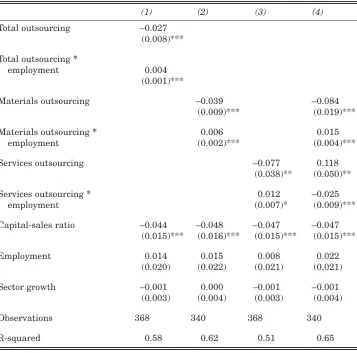
The results of simple OLS regressions of Equation (2) including the interaction term are presented in columns (1) to (4) in Table 3. Column (1) shows the results for estimating Equation (2) including total outsourcing, whereas columns (2) and (3) distinguish outsourcing of materials and intermediate components from outsourcing of services activities, as defined in Section III. Column (4) presents results including both materials and services outsourcing jointly.
which would lead to reductions in profit margins could be reflected in our findings.16
Turning to the results on the effect of outsourcing on profits, we observe a negative effect from total outsourcing. However, the positive and statistically significant coefficient on the outsourcing and (log) employment size interaction term shows that for larger plants increased outsourcing is associated with higher profits. This also holds when distinguishing materials and services outsourcing, see the results in columns (2) and (3). However, when including both materials and services outsourcing jointly in the estimation, then the signs on services outsourcing switch, while materials outsourcing still returns the same result (column 4).17 This indicates that there are important interactions between services and materials outsourcing. When controlling for materials outsourcing, there are no benefits from services outsourcing for large firms.
Before interpreting these results further we need to address an econometric concern. Specifically, one potential problem with the estimations in Table 3 is that there may be a potential endogeneity problem in the profitability-outsourcing relationship that is not accounted for. For example, it may be the case that badly performing plants decide to outsource part of the production process in order to boost profits further, or that further unobserved variables drive the outsourcing-profitability relationship. In order to deal with this issue we instrument for the outsourcing intensity variable Ousing its first and second lags. The equation is estimated using a Generalised Method of Moments (GMM) estimator.
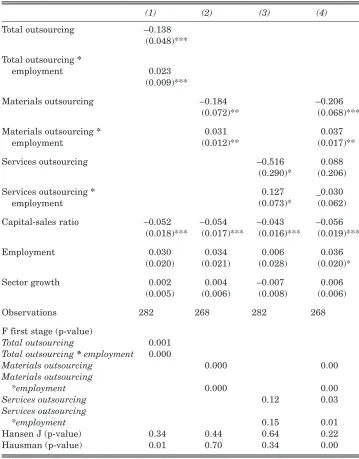
The results for estimating (2) using the GMM estimator are reported in Table 4 for total, materials and services outsourcing respectively. We report the Hansen J statistic to examine the null hypothesis that the correlation between the instrumental variable candidates and the error terms in Equation (2) is zero; a necessary condition for the validity of the instrumental variables approach. We are also careful to assess the strength of the relationship between the instruments and the potentially endogenous regressors. It has been noted in the econometric literature that when the partial correlation between the instruments and the endogenous variable is low, instrumental variables regression is biased in the direction of the OLS estimator. Staiger and Stock (1997) recommend that the F-statistics from the first stage
16Unfortunately, with the data at hand we are not able to investigate this issue further. However,
the negative coefficient on ksris persistent and striking in our results.
17One possible explanation may be that this is driven by the fact that there are 28 observations
regression be routinely reported in applied work. The F-statistic tests the hypothesis that the instruments should be excluded from the first-stage regressions (i.e., the relevance of the instruments). The idea here is that when the F-statistic is small, the instrumental variable estimates and the associated confidence intervals are unreliable.
[image:14.498.76.433.96.449.2]The Hansen test does not allow us to reject the null hypothesis of instrument validity, while the F tests also indicate that the instruments are
Table 3:Results from First Differenced OLS Regressions
(1) (2) (3) (4)
Total outsourcing –0.027 (0.008)***
Total outsourcing *
employment 0.004 (0.001)***
Materials outsourcing –0.039 –0.084 (0.009)*** (0.019)***
Materials outsourcing * 0.006 0.015 employment (0.002)*** (0.004)***
Services outsourcing –0.077 0.118 (0.038)** (0.050)**
Services outsourcing * 0.012 –0.025 employment (0.007)* (0.009)***
Capital-sales ratio –0.044 –0.048 –0.047 –0.047 (0.015)*** (0.016)*** (0.015)*** (0.015)***
Employment 0.014 0.015 0.008 0.022 (0.020) (0.022) (0.021) (0.021)
Sector growth –0.001 0.000 –0.001 –0.001 (0.003) (0.004) (0.003) (0.004)
Observations 368 340 368 340
R-squared 0.58 0.62 0.51 0.65
Notes: Response variable is profitability (first differenced). Regression includes time dummies and constant term. Clustered standard errors in parentheses
relevant. We note, however, that the F-tests are only marginal in the case of services outsourcing in column (3), hence we are cautious in interpreting those results. Overall, however, we can be reasonably confident that our results are valid. Furthermore, the Hausman test, which examines the null hypothesis that there is no statistically significant difference between the OLS and IV estimates, suggests that the GMM estimates are only preferred in the case of total outsourcing in column (1) and when jointly including materials and services outsourcing in column (4).
Turning to the coefficients we find similar results in columns (1) to (3) to the first differenced OLS regressions discussed earlier. However, the coefficients are in all cases somewhat larger. However, as pointed out above, for the analysis of materials and services outsourcing we prefer the OLS estimates in columns (2) and (3) to the GMM estimates. From column (4) we now find that once we control for materials outsourcing, there are no statistically significant profitability enhancing effects from services outsourcing. Materials outsourcing still benefits large plants, however. Note that this finding is in line with Görzig and Stephan’s (2002) study which finds from German micro data that materials outsourcing benefits firm performance, while there is no such evidence from services outsourcing. Taking the coefficients at face value, column (4) suggests that establishments start to benefit from materials outsourcing once they reach a size of 262 employees. Recalling that the mean employment level is around 150 (Table 2), this suggests that only plants considerably larger than the mean size are able to benefit from outsourcing.
Table 4: Results from GMM Regressions
(1) (2) (3) (4)
Total outsourcing –0.138 (0.048)***
Total outsourcing *
employment 0.023 (0.009)***
Materials outsourcing –0.184 –0.206 (0.072)** (0.068)***
Materials outsourcing * 0.031 0.037 employment (0.012)** (0.017)**
Services outsourcing –0.516 0.088 (0.290)* (0.206)
Services outsourcing * 0.127 _0.030
employment (0.073)* (0.062)
Capital-sales ratio –0.052 –0.054 –0.043 –0.056 (0.018)*** (0.017)*** (0.016)*** (0.019)***
Employment 0.030 0.034 0.006 0.036 (0.020) (0.021) (0.028) (0.020)*
Sector growth 0.002 0.004 –0.007 0.006 (0.005) (0.006) (0.008) (0.006)
Observations 282 268 282 268
F first stage (p-value)
Total outsourcing 0.001
Total outsourcing *employment 0.000
Materials outsourcing 0.000 0.00
Materials outsourcing
*employment 0.000 0.00
Services outsourcing 0.12 0.03
Services outsourcing
*employment 0.15 0.01
Hansen J (p-value) 0.34 0.44 0.64 0.22 Hausman (p-value) 0.01 0.70 0.34 0.00
Notes: Response variable is profitability (first differenced). Regression includes time dummies and constant term.
Instruments used are first and second lags of the outsourcing variable in levels. Clustered standard errors in parentheses.
may only be able to benefit in the medium to long run, while large plants may be better able to reap the benefits in the short run.
V CONCLUSIONS
We analyse empirically the relationship between outsourcing and profitability at the level of the plant, using data for the electronics sector in the Republic of Ireland. Our results suggest that the profit/outsourcing relationship depends on characteristics of the plant, in particular its size. We find that plants that are substantially larger than the mean employment size benefit from outsourcing materials inputs, while this does not appear to be the case for small plants. Within our empirical analysis we are not able to explain this size disadvantage, although we can speculate on the basis of the theoretical work by Grossman and Helpman (2002) that this reflects higher transaction costs for small plants. In particular, they may face lower bargaining power vis-à-vis suppliers and/or higher costs in searching for adequate suppliers. The benefits from services outsourcing are less clear-cut, however. When interpreting these results one needs to keep in mind that our empirical methodology implies that we are essentially analysing short-run effects. Due to the relatively short period of data covered we are unable to examine the long-run effects of outsourcing on profitability.
REFERENCES
ABRAHAM, KATHARINE G. and SUSAN K. TAYLOR, 1996. “Firms’ Use of Outside Contractors: Theory and Evidence”, Journal of Labor Economics, Vol. 14, pp. 394-424.
AUDRETSCH, DAVID B., 1995. Innovation and Industry Evolution, Cambridge: MIT Press.
BARRY, FRANK, and JOHN BRADLEY, 1997. “FDI and Trade: The Irish Host-Country Experience”, Economic Journal, Vol. 107, pp. 1798-1811.
BHUYAN, SANJIB, 2002. “Impact of vertical mergers on industry profitability: an empirical evaluation”, Review of Industrial Organization, Vol.20, pp. 61-79. BOLTON, PATRICK and MICHAEL D. WHINSTON, 1993. “Incomplete contracts,
vertical integration, and supply assurance”, Review of Economic Studies, Vol. 60, pp. 121-148.
COASE, RONALD, 1937. “The nature of the firm”, Economica, Vol. 4, pp. 386-405. DOMOWITZ, IAN, R. GLENN HUBBARD and BRUCE C. PETERSEN, 1987.
“Oligopoly supergames: Some empirical evidence on prices and margins”, Journal of Industrial Economics, Vol. 35, pp. 379-398.
Establishments in the United States”, in R.E. Baldwin, R.E. Lipsey and J.D. Richardson (eds.), Geography and ownership as bases for economic accounting, Chicago: University of Chicago Press, pp. 235-255.
FEENSTRA, ROBERT C., 1998. “Integration of Trade and Disintegration of Production in the Global Economy”, Journal of Economic Perspectives, Vol. 12, pp. 31-50. FEENSTRA, ROBERT C. and GORDON H. HANSON, 1999. “The impact of
outsourcing and high-technology capital on wages: Estimates for the United States”, Quarterly Journal of Economics, Vol. 114, pp. 907-940.
FIXLER, DENNIS and DONALD SIEGEL, 1999. “Outsourcing and productivity growth in services”, Structural Change and Economic Dynamics, Vol. 10, pp. 177-194.
GIRMA, SOURAFEL and HOLGER GÖRG, 2004. “Outsourcing, foreign ownership and productivity: Evidence from UK establishment level data”, Review of International Economics, Vol. 12, pp. 817-832.
GÖRG, HOLGER, AOIFE HANLEY and ERIC STROBL, 2004. “Outsourcing, foreign ownership, exporting and productivity: An empirical investigation with plant level data”, GEP Research Paper 04/08, University of Nottingham.
GÖRZIG BERND and ANDREAS STEPHAN, 2002. “Outsourcing and firm-level performance”, Discussion Paper No. 309, DIW Berlin.
GROSSMAN, GENE M. and ELHANAN HELPMAN, 2002. “Integration versus Outsourcing in Industry Equilibrium”, Quarterly Journal of Economics, Vol. 117, pp.85-120.
GROSSMAN, SANFORD J. and OLIVER HART, 1986. “The costs and benefits of ownership: A theory of vertical and lateral integration”, Journal of Political Economy, Vol. 94, pp. 691-719.
HESHMATI, ALMAS, 2003. “Productivity growth, efficiency and outsourcing in manufacturing and service industries”, Journal of Economic Surveys, Vol. 17, pp. 79-112.
KIMURA, FUKUNARI, 2002. “Subcontracting and the performance of small and medium firms in Japan”, Small Business Economics, Vol. 18, pp. 163-175.
KNARVIK MIDELFART, KAREN and FRODE STEEN, 2002. “Vertical industry linkages: sources of productivity gains and cumulative causation?” Review of Industrial Organization, Vol. 21, pp. 3-20.
KUMAR, NAGESH, 1990. “Mobility barriers and profitability of multinational and local enterprises in Indian manufacturing”, Journal of Industrial Economics, Vol. 38, pp. 449-463.
O’MALLEY, EOIN, 1995. An Analysis of Secondary Employment Associated with Manufacturing Industry, General Research Series No. 167, Dublin: The Economic and Social Research Institute.
RUANE, FRANCES and HOLGER GÖRG, 2001. “Globalisation and Fragmentation: Evidence for the Electronics Industry in Ireland”, in S. Arndt and H. Kierzkowski (eds.), Fragmentation: New Production Patterns in the World Economy. Oxford: Oxford University Press, pp. 144-164.
SHEPHERD, WILLIAM G., 1972. “The elements of market structure”, Review of Economics and Statistics, Vol. 54, pp. 25-37.
WHITE, PADRAIC A., 2000. “The Muscles of the Celtic Tiger: The IDA’s Winning Sectors” in R. MacSharry and P.A. White (eds.), The Making of the Celtic Tiger: The Inside Story of Ireland’s Boom Economy, Cork: Mercier Press, pp. 272-308. WILLIAMSON, OLIVER E., 1975. Markets and hierarchies: Analysis and antitrust
APPENDICES
Table A1: Summary Statistics for O1 and O2 by Sub-sector
1990 1995
O1
Components 1.53 (0.46) 2.59 (2.11) Computers 1.67 (1.67) 2.51 (2.77) Consumer Electronics 1.74 (0.78) 2.34 (1.78) Instrumentation 3.18 (5.72) 2.08 (1.42) Networking/Data Com 2.57 (0.09) 1.97 (1.22) PCBA 10.36 (23.86) 2.83 (2.35) Peripherals & Media 2.42 (0.87) 5.00 (5.53) Semiconductors 2.85 (2.16) 6.87 (7.39) IT Services 1.62 (1.08) 0.72 (0.58) Software Development – 1.67 (2.61) Software Production – 6.15 (11.54) Telecommunications 2.26 (1.91) 4.48 (5.49)
O2
Components 0.70 (0.41) 1.28 (0.21) Computers 0.86 (0.52) 1.96 (2.17) Consumer Electronics 0.96 (0.32) 0.99 (0.44) Instrumentation 0.89 (0.45) 1.23 (0.86) Networking/Data Com 1.76 (0.68) 0.91 (0.16)
PCBA 0.89 (0.78) 1.46 (0.96)
Peripherals & Media 1.26 (0.56) 1.61 (2.15) Semiconductors 1.23 (0.01) 3.82 (4.33) IT Services 0.43 (0.52) 0.48 (0.41) Software Development – 0.29 (0.41) Software Production – 1.31 (1.78) Telecommunications 1.03 (0.62) 1.61 (1.05)
Note:Means (Standard deviation in parentheses).
Table A2: Breakdown by Quartile for Low and High Profit Plants
Low profit High Profit Total
Total O/S Intensity (proportion of plants)
1st quartile 47 53 100
2nd quartile 41 59 100
3rd quartile 50 50 100
4th quartile 62 38 100
Materials O/S Intensity (proportion of plants)
1st quartile 54 46 100
2nd quartile 40 60 100
3rd quartile 46 54 100
4th quartile 60 40 100
ervices O/S Intensity (proportion of plants)
1st quartile 23 77 100
2nd quartile 48 52 100
3rd quartile 61 39 100
4th quartile 68 32 100