Stepwise Pyrolysis
A pyrolysis in which the sample temperature is raised stepwise. The pyrolysis products are recorded between each step.
Tar
A liquid pyrolysis residue.
Temperature-Programmed Pyrolysis
A pyrolysis during which the sample is heated at a controlled rate within a temperature range in which pyrolysis occurs.
Temperature Rise Time (TRT)
The time required for a pyrolyser temperature to be increased from its initial to itsRnal temperature.
Temperature Time Pro\le (TTP)
A graphical representation of temperatureversustime for a particular pyrolysis experiment or pyrolyser.
Total heating time (THT)
The time between the onset and conclusion of the sample heating in a pyrolysis experiment.
Volatile Pyrolyzate
That portion of the pyrolystate which has adequate vapour pressure to reach the detector.
List of Symbols
T(f,Py) Final pyrolysis temperature
T(max,Py) Maximum pyrolysis temperature
Index of Acronyms
Py-GC Pyrolysis-gas chromatography
Py-GC-IR Pyrolysis-gas chromatography-infrared spectroscopy
Py-GC-MS Pyrolysis-gas chromatography-mass spectrometry
Py-IR Pyrolysis-infrared spectroscopy
Py-MS Pyrolysis-mass spectrometry
THT Total heating time
TRT Temperature rise time
TTP Temperature time proRle
12A. NOMENCLATURE
Chromatography
(IUPAC Recommendations 1993)
Prepared for publication by
L. S. Ettre, Yale University,New Haven,CT,USA
Abstract
This report presents deRnitions of terms and symbols used in all chromatographic separations. The reports covers gas, liquid, size-exclusion, ion-exchange and supercritical-Suid chromatography and both column and planar modes of separation. DeRnitions are included for the description of the separation process, the chromatographic system and equipment and the properties of detectors.
Introduction
The Commission on Analytical Nomenclature of IUPAC has been active for a long time in establishing nomenclatures for chromatography. After proposing suitable nomenclatures for gas chromatography [1}2] and ion exchange [3}4] the Commission developed a uniRed nomenclature for chromatography [5}6]. Parallel to these activities other standardization bodies and scientists have also dealt with nomenclatures on gas chromatography [7}15], supercritical-Suid chromatography [16], liquid chromatography [17}20], exclusion chromatography [21}23] and planar chromatography [24].
The original activities of the IUPAC Commission on Analytical Nomenclature aimed to create a uniRed nomenclature applicable to all forms of chromatography, took place over 20 years ago. Since that time chromatographic techniques have advanced signiRcantly. Based on these developments it was decided to prepare a new, up-to-date universal chromatography nomenclature, which also considers the recommenda-tions incorporated in the various other nomenclatures developed since the original work of IUPAC.
The present nomenclature was prepared by Dr. L. S. Ettre originally for the Commission on Analytical Nomenclature. Following the reorganization of the Commissions of the Analytical Division at the General Assembly in Lund in 1989, this project became the responsibility of the Commission on Chromatography and Other Analytical Separations (LLTC). The Nomenclature considers all the previous nomenclatures referenced above as well as the four publications dealing with these nomenclatures [25}27].
The present nomenclature deals with all chromatographic terms and deRnitions used in the major chromato-graphic techniques such as gas, liquid and supercritical-Suid chromatography, column and planar chromato-graphy, partition, adsorption, ion-exchange and exclusion chromatography. However, it does not include terms related to the results calculated from chromatography data such as e.g. the various molecular weight terms computed from the primary data obtained by exclusion chromatography. Also it does not deal with detailed information related to detection and detectors or the relationships between chemical structure and chromato-graphic retention.
General Rules
In developing the uniRed nomenclature the rules and recommendations set up by IUPAC’s Division of Physical Chemistry [28] were followed. According to these, the following symbols should be used for major physical and physico-chemical quantities and units:
area . . . A density . . . diameter . . . d diffusion coefRcient . . . D equilibrium constant . . . K mass (weight) . . . W pressure . . . porP radius . . . r rate constant . . . k temperature (kelvin) . . . T time . . . t velocity . . . u viscosity . . . volume . . . V
letterl with the numeral ‘one’. Additional basic symbols accepted wereF for the volumetricSow rates and w for the peak widths. Also, differentiation has been made between p (for pressures) and P (for relative pressure).
In addition to these basic rules the following additional rules are followed in the present proposal:
(a) Except for a few superscripts further differentiation is always made by using subscripts and never composite symbols.
(b) Superscripts are used for various retention times and volumes and to speciRcally indicate data obtained in programmed-temperature conditions.
(c) Subscripts referring to the physical conditions or the phase are capitalized, e.g. M and S for the mobile and stationary phases respectively, or, in gas chromatography, G for the gas and L for the liquid phase. Thus, e.g. the diffusion coefRcient in the mobile phase isDMand notDm.
(d) In addition to those mentioned above, a few capitalized subscripts are used such as R for ‘retention’ (as in tRandVR), N for ‘net’ (as intNandVN) andFinRF, the retardation factor used in planar
chromatogra-phy.
(e) Compound subscripts are avoided. If a given compound is indicated and there is already a subscript, and if the compound is characterized by more than a simple number or letter, then the new subscript should be in parentheses. Thus, while it istRi, it should betR(st)ortR(z#1).
(f) In addition to reference to the outlet of a column, subscript ‘o’ is also used in a number of terms to describe some fundamental values. Similarly subscript ‘i’ has various meanings, depending on the term in which it is used.
(g) Physical parts of the system are generally characterized by lower-case subscripts such as, c for column, p for particles or pores, and f forRlm.
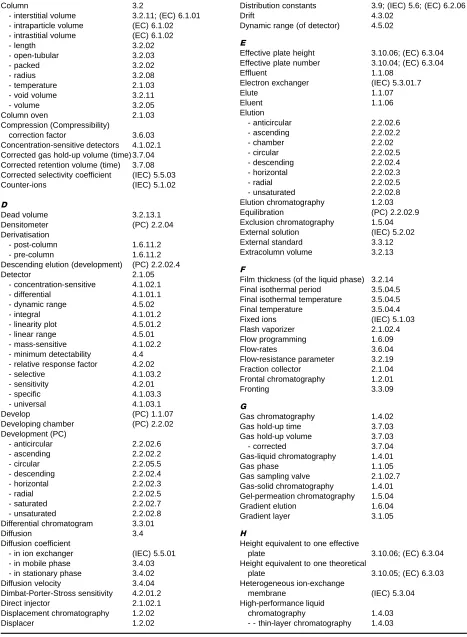
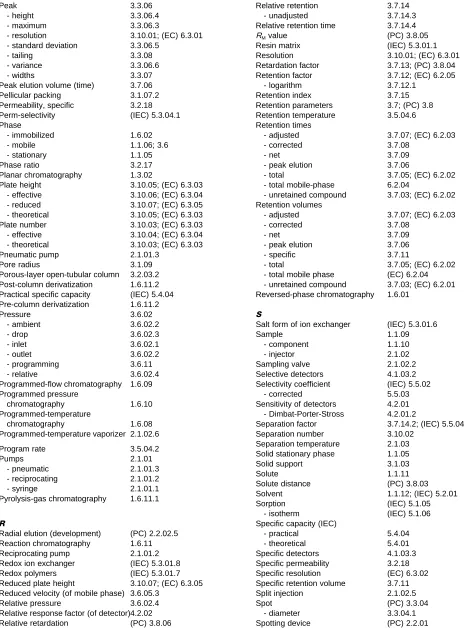
Three tables follow the nomenclature, listing alphabetically the terms, symbols and acronyms included in the text.
Contents
1. General Terminology
1.1. Basic DeRnitions 1.2. Principal Methods
1.3. ClassiRcation According to the Shape of the Chromatographic Bed 1.4. ClassiRcation According to the Physical State of the Mobile Phase 1.5. ClassiRcation According to the Mechanism of Separation
1.6. Special Techniques
2. Terms Related to the Chromatographic System
2.1. Apparatus in Column Chromatography 2.2. Apparatus in Planar Chromatography
3. Terms Related to the Chromatographic Process and the Theory of Chromatography
3.1. The Chromatographic Medium 3.2. The Column
3.3. The Chromatogram 3.4. Diffusion
3.5. Temperatures 3.6. The Mobile Phase
3.7. Retention Parameters in Column Chromatography 3.8. Retention Parameters in Planar Chromatography 3.9. Distribution Constants
3.10. Terms Expressing the EfRciency of Separation
4. Terms Related to Detection
4.3. Noise and Drift 4.4. Minimum Detectability 4.5. Linear and Dynamic Ranges
5. Special Terminology Used in Ion-exchange Chromatography
5.1. Basic DeRnitions 5.2. The Mobile Phase
5.3. The Chromatographic Medium 5.4. Capacity Values
5.5. Diffusion, Selectivity and Separation 5.6. Distribution Constants
6. Special Terminology Used in Exclusion Chromatography
6.1. The Column
6.2. Retention Parameters 6.3. EfRciency Terms
Tables
1. Index of Terms 2. List of Symbols
3. List of Acronyms Used in Chromatography
Figures
1. Typical Chromatograms 2. Typical Plane Chromatogram
3. Widths of the Gaussian Peak at Various Heights as a Function of the Standard Deviation of the Peak 4. Measurement of the Noise and Drift of a Chromatographic Detector
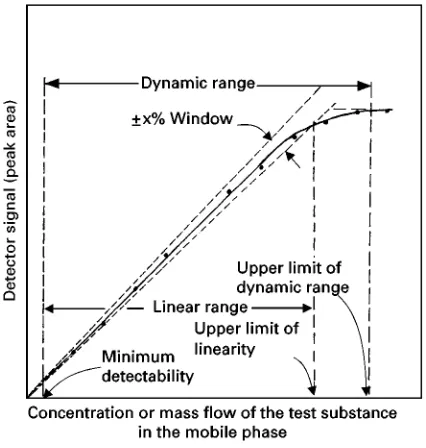
5. Linearity Plot of a Chromatographic Detector
6. Determination of the Linear and Dynamic Ranges of a Chromatographic Detector 7. Retention Characteristics in Exclusion Chromatography
1.
General Terminology
1.1. Basic De\nitions
1.1.01. Chromatography Chromatography is a physical method of separation in which the components to
be separated are distributed between two phases, one of which is stationary (stationary phase) while the other (the mobile phase) moves in a deRnite direction.
1.1.02. Chromatogram A graphical or other presentation of detector response, concentration of analyte in
the efSuent or other quantity used as a measure of efSuent concentration versus efSuent volume or time. In planar chromatography`chromatogramamay refer to the paper or layer with the separated zones.
1.1.03. Chromatograph (verb) To separate by chromatography.
1.1.04. Chromatograph (noun) The assembly of apparatus for carrying out chromatographic separation.
1.1.05. Stationary phase The stationary phase is one of the two phases forming a chromatographic system.
It may be a solid, a gel or a liquid. If a liquid, it may be distributed on a solid. This solid may or may not contribute to the separation process. The liquid may also be chemically bonded to the solid (Bonded Phase) or immobilized onto it (Immobilized Phase).
The expressionChromatographic Bed or Sorbent may be used as a general term to denote any of the different forms in which the stationary phase is used.
early development of liquid chromatography, the term ‘liquid phase’ had also been used to characterize the mobile phase as compared to the ‘solid phase’ i.e. the stationary phase. Due to this ambiguity, the use of the term ‘liquid phase’ is discouraged. If the physical state of the stationary phase is to be expressed, the use of the adjective forms such asLiquid Stationary PhaseandSolid Stationary Phase, Bonded PhaseorImmobilized Phaseis proposed.
1.1.05.1. Bonded phase A stationary phase which is covalently bonded to the support particles or to the inside wall of the column tubing.
1.1.05.2. Immobilized phase A stationary phase which is immobilized on the support particles, or on the inner wall of the column tubing, e.g. byin situpolymerization (cross-linking) after coating.
1.1.06. Mobile phase ASuid which percolates through or along the stationary bed, in a deRnite direction.
It may be a liquid (Liquid Chromatography) or a gas (Gas Chromatography) or a supercritical Suid (Supercritical-Fluid Chromatography). In gas chromatography the expressionCarrier Gasmay be used for the mobile phase. In elution chromatography the expressionEluentis also used for the mobile phase.
1.1.07. Elute (verb) To chromatograph by elution chromatograph. The process of elution may be stopped
while all the sample components are still on the chromatographic bed or continued until the components have left the chromatographic bed.
Note: The term ‘elute’ is preferred to the termDevelopused in former nomenclatures of planar chromato-graphy.
1.1.08. EfWuent The mobile phase leaving the column.
1.1.09. Sample The mixture consisting of a number of components the separation of which is attempted on
the chromatographic bed as they are carried or eluted by the mobile phase.
1.1.10. Sample components The chemically pure constituents of the sample. They may be unretained (i.e.
not delayed) by the stationary phase, partially retained (i.e. eluted at different times) or retained permanently. The termsEluteorAnalyteare also acceptable for a sample component.
1.1.11. Solute A term referring to the sample components in partition chromatography.
1.1.12. Solvent A term sometimes referring to the liquid stationary phase in partition chromatography.
Note: In liquid chromatography the term ‘solvent’ has been often used for the mobile phase. This usage is not recommended.
1.1.13. Zone A region in the chromatographic bed where one or more components of the sample are
located. The termBandmay also be used for it.
1.2. Principal Methods
1.2.01. Frontal chromatography A procedure in which the sample (liquid or gas) is fed continuously into
the chromatographic bed. In frontal chromatography no additional mobile phase is used.
1.2.02. Displacement chromatography A procedure in which the mobile phase contains a compound (the
Displacer) more strongly retained than the components of the sample under examination. The sample is fed into the system as aRnite slug.
1.2.03. Elution chromatography A procedure in which the mobile phase is continuously passed through or
1.3. Classi\cation According to the Shape of the Chromatographic Bed
1.3.01. Column chromatography A separation technique in which the stationary bed is within a tube. The
particles of the solid stationary phase or the support coated with a liquid stationary phase mayRll the whole inside volume of the tube (Packed Column) or be concentrated on or along the inside tube wall leaving an open, unrestricted path for the mobile phase in the middle part of the tube (Open-Tubular Column).
1.3.02. Planar chromatography A separation technique in which the stationary phase is present as or on
a plane. The plane can be a paper, serving as such or impregnated by a substance as the stationary bed (Paper Chromatography, PC) or a layer of solid particles spread on a support, e.g. a glass plate (Thin-Layer Chromatography, TLC). Sometimes planar chromatography is also termedOpen-Bed Chromatography.
1.4. Classi\cation According to the Physical State of the Mobile Phase
1.4.01. Chromatographic techniques are often classiRed by specifying the physical state ofbothphases used.
Accordingly, the following terms are in use:
Gas-liquid chromatography (GLC) Gas-solid chromatography (GSC) Liquid-Liquid chromatography (LLC) Liquid-solid chromatography (LSC)
The termGas-Liquid Partition Chromatography(GLPC) can also be found in the literature. However, often distinction between these modes is not easy. For example, in GC, a liquid may be used to modify an adsorbent-type solid stationary phase.
1.4.02. Gas chromatography (GC) A separation technique in which the mobile phase is a gas. Gas
chromatography is always carried out in a column.
1.4.03. Liquid chromatography (LC) A separation technique in which the mobile phase is a liquid. Liquid
chromatography can be carried out either in a column or on a plane.
Note: Present-day liquid chromatography generally utilizing very small particles and a relatively high inlet pressure is often characterized by the termHigh-Performance(orHigh-Pressure)Liquid Chromatogra-phy, and the acronym HPLC.
1.4.04. Supercritical-Wuid chromatography (SFC) A separation technique in which the mobile phase is
aSuid above and relatively close to its critical temperature and pressure.
Note: In general the terms and deRnitions used in gas or liquid chromatography are equally applicable to supercritical-Suid chromatography.
1.5. Classi\cation According to the Mechanism of Separation
1.5.01. Adsorption chromatography Separation is based mainly on differences between the adsorption
afRnities of the sample components for the surface of an active solid.
1.5.02. Partition chromatography Separation is based mainly on differences between the solubilities of the
sample components in the stationary phase (gas chromatography), or on differences between the solubilities of the components in the mobile and stationary phases (liquid chromatography).
1.5.03. Ion-exchange chromatography Separation is based mainly on differences in the ion exchange
afRnities of the sample components.
1.5.04. Exclusion chromatography Separation is based mainly on exclusion effects, such as differences in molecular size and/or shape or in charge. The termSize-Exclusion Chromatographymay also be used when separation is based on molecular size. The termsGel FiltrationandGel-Permeation Chromatography(GPC) were used earlier to describe this process when the stationary phase is a swollen gel. The termIon-Exclusion Chromatographyis speciRcally used for the separation of ions in an aqueous phase.
1.5.05. AfVnity chromatography This expression characterizes the particular variant of chromatography
in which the unique biological speciRcity of the analyte and ligand interaction is utilized for the separation.
1.6. Special Techniques
1.6.01. Reversed-phase chromatography An elution procedure used in liquid chromatography in which the
mobile phase is signiRcantly more polar then the stationary phase, e.g. a microporous silica-based material with chemically bonded alkyl chains.
Note: The term`reverse phaseais an incorrect expression to be avoided.
1.6.02. Normal-phase chromatography An elution procedure in which the stationary phase is more polar
than the mobile phase. This term is used in liquid chromatography to emphasize the contrast to reversed-phase chromatography.
1.6.03. Isocratic analysis The procedure in which the composition of the mobile phase remains constant
during the elution process.
1.6.04. Gradient elution The procedure in which the composition of the mobile phase is changed
continu-ously or stepwise during the elution process.
1.6.05. Stepwise elution The elution process in which the composition of the mobile phase is changed in
steps during a single chromatographic run.
1.6.06. Two-dimensional chromatography A procedure in which parts or all of the separated sample
components are subjected to additional separation steps. This can be done, e.g. by conducting a particular fraction eluting from the column into another column (system) having different separation characteristics. When combined with additional separation steps, this may be described as Multi-Dimensional Chromato-graphy.
In planar chromatography two-dimensional chromatography refers to the chromatographic process in which the components are caused to migrateRrst in one direction and subsequently in a direction at right angles to theRrst one; the two elutions are carried out with different eluents.
1.6.07. Isothermal chromatography A procedure in which the temperature of the column is kept constant
during the separation.
1.6.08. Programmed-temperature chromatography (temperature programming) A procedure in which the
temperature of the column is changed systematically during a part or the whole of the separation.
1.6.09. Programmed-Wow chromatography (Wow programming) A procedure in which the rate ofSow of
the mobile phase is changed systematically during a part or the whole of the separation.
1.6.10. Programmed-pressure chromatography (pressure programming) A procedure in which the inlet
pressure of the mobile phase is changed systematically during a part or whole of the separation.
1.6.11. Reaction chromatography A technique in which the identities of the sample components are
1.6.11.1. Pyrolysis-gas chromatography A version of reaction chromatography in which a sample is thermally decomposed to simpler fragments before entering the column.
1.6.11.2. Post-column derivatization A version of reaction chromatography in which the separated sample components eluting from the column are derivatized prior to entering the detector. The derivatization process is generally carried out`on-the-Sya, i.e. during transfer of the sample components from the column to the detector. Derivatization may also be carried out before the sample enters the column or the planar medium; this ispre-column(preliminary)derivatization.
2
.
Terms Related to the Chromatographic System
2.1. Apparatus in Column Chromatography
2.1.01. Pump A device designed to deliver the mobile phase at a controlledSow-rate to the separation
system. Pumps are generally used in liquid chromatography.
2.1.01.1. Syringe pumps Pumps with a piston, which advances at a controlled rate within a smooth cylinder to displace the mobile phase.
2.1.01.2. Reciprocating pumps Pumps with a single or multiple chamber, from which the mobile phase is displaced by reciprocating piston(s) or diaphragm(s).
2.1.01.3. Pneumatic pumps Pumps which employ a gas to displace the liquid mobile phase either directly or via a piston.
2.1.02. Sample injector A device by which a liquid, solid or gaseous sample is introduced into the mobile
phase of the chromatographic bed.
2.1.02.1. Direct injector A device which directly introduces the sample into the mobile-phase stream.
2.1.02.2. Bypass injector A device in which the sample isRrst introduced into a chamber (loop), temporar-ily isolated from the mobile phase system by valves, which can be switched to make an instantaneous diversion of the mobile phase stream through the chamber to carry the sample to the column. A bypass injector may also be known as aValve InjectororSampling Valve (see 2.1.02.7).
2.1.02.3. On-column injector A device in which the sample is directly introduced into the column. In gas chromatography the on-column injector permits the introduction of the liquid sample into the column without prior evaporation.
2.1.02.4. Flash vaporizer A heated device used in gas chromatography. Here the liquid sample is introduc-ed into the carrier gas stream with simultaneous evaporation and mixing with the carrier gas prior to entering the column.
2.1.02.5. Split injection A sample introduction technique used in gas chromatography. The sample isSash vaporized and after thorough mixing of the sample with carrier gas, the stream is split into two portions, one being conducted to the column and the other being discarded.
2.1.02.7. Gas sampling valve A bypass injector permitting the introduction of a gaseous sample of a given volume into a gas chromatograph.
2.1.03. Column oven A thermostatically controlled oven containing the column, the temperature of which
(Separation TemperatureorColumn Temperature) can be varied within a wide range.
2.1.04. Fraction collector A device for recovering fractional volumes of the column efSuent.
2.1.05. Detector A device that measures the change in the composition of the eluent by measuring physical
or chemical properties.
2.2. Apparatus in Planar Chromatography
2.2.01. Spotting device The syringe or micropipet used to deliver aRxed volume of sample as a spot or
streak to the paper or thin-layer media at the origin.
2.2.02. Elution chamber (developing chamber) A closed container, the purpose of which is to enclose the
media used as well as the mobile phase to maintain a constant environment in the vapor phase.
2.2.02.1. Sandwich chamber A chamber in which the walls are close enough to the paper or plate to provide a relatively fast equilibration.
2.2.02.2. Ascending elution (ascending development) A mode of operation in which the paper or plate is in a vertical or slanted position and the mobile phase is supplied to its lower edge; the upward movement depends on capillary action.
2.2.02.3. Horizontal elution (horizontal development) A mode of operation in which the paper or plate is in a horizontal position and the mobile-phase movement along the plane depends on capillary action.
2.2.02.4. Descending elution (descending development) A mode of operation in which the mobile phase is supplied to the upper edge of the paper or plate and the downward movement is governed mainly by gravity.
2.2.02.5. Radial elution (radial development) or circular elution (circular development) A mode of opera-tion in which the sample is spotted at a point source at or near the middle of the plane and is carried outward in a circle by the mobile phase, also applied at that place.
2.2.02.6. Anticircular elution (anticircular development) The opposite of 2.2.02.5. Here the sample as well as the mobile phase is applied at the periphery of a circle and both move towards the center.
2.2.02.7. Chamber saturation (saturated development) This expression refers to the uniform distribution of the mobile phase vapor through the elution chamber prior to chromatography.
2.2.02.8. Unsaturated elution (unsaturated development) This expression refers to chromatography in an elution chamber without attaining chamber saturation.
2.2.02.9. Equilibration The expression refers to the level of saturation of the chromatographic bed by the mobile-phase vapor prior to chromatography.
2.2.03. Visualization chamber A device in which the planar media may be viewed under controlled-wavelength light, perhaps after spraying with chemical reagents to render the separated components as visible spots under speciRed conditions.
2.2.04. Densitometer A device which allows portions of the developed paper or thin-layer media to be
scanned with a beam of light of a speciRed wavelength for measurements of UV or visible light absorption or
3
.
Terms Related to the Chromatographic Process and
the Theory of Chromatography
3.1. The Chromatographic Medium
3.1.01. Active solid A solid with sorptive properties.
3.1.02. ModiVed active solid An active solid the sorptive properties of which have been changed by some
treatment.
3.1.03. Solid support A solid that holds the stationary phase but, ideally, does not contribute to the
separation process.
3.1.04. Binders Additives used to hold the solid stationary phase to the inactive plate or sheet in thin-layer
chromatography.
3.1.05. Gradient layer The chromatographic bed used in thin-layer chromatography in which there is
a gradual transition in some property.
3.1.06. Impregnation The modiRcation of the separation properties of the chromatographic bed used in
planar chromatography by appropriate additives.
3.1.07. Packing The active solid, stationary liquid plus solid support, or swollen gel contained in a tube.
3.1.07.1. Totally porous packing Here the stationary phase permeates each porous particle.
3.1.07.2. Pellicular packing In this case the stationary phase forms a porous outer shell on an impermeable particle.
3.1.08. Particle diameter (dp) The average diameter of the solid particles.
3.1.09. Pore radius (rp) The average radius of the pores within the solid particles.
3.1.10. Liquid-phase loading A term used in partition chromatography to express the relative amount of
the liquid stationary phase in the column packing. It is equal to the mass fraction (%) of liquid stationary phase in the total packing (liquid stationary phase plus support).
3.2. The Column
3.2.01. Column The tube and the stationary phase contained within, through which the mobile phase
passes.
3.2.02. Packed column A tube containing a solid packing.
3.2.03. Open-tubular column A column, usually having a small diameter in which either the inner tube
wall, or a liquid or active solid held stationary on the tube wall acts as the stationary phase and there is an open, unrestricted path for the mobile phase.
3.2.03.1. Wall-coated open-tubular (WCOT) column In these columns the liquid stationary phase is coated on the essentially unmodiRed smooth inner wall of the tube.
3.2.03.3. Support-coated open-tubular (SCOT) column A version of a PLOT column in which the porous layer consists of support particles and was deposited from a suspension.
3.2.04. Capillary column A general term for columns having a small diameter. A capillary column may
contain a packing or have the stationary phase supported on its inside wall. The former case corresponds to a Packed Capillary Column while the latter case corresponds to an Open-Tubular Column. Due to the ambiguity of this term its use without an adjective is discouraged.
3.2.05. Column volume (Vc) The geometric volume of the part of the tube that contains the packing:
Vc"AcL
whereAcis the internal cross-sectional area of the tube andLis the length of the packed part of the column.
In the case of wall-coated open-tubular columns the column volume corresponds to the geometric volume of the whole tube having a liquid or a solid stationary phase on its wall.
3.2.06. Bed volume Synonymous withColumn Volumefor a packed column.
3.2.07. Column diameter (dc) The inner diameter of the tubing.
3.2.08. Column radius (rc) The inside radius of the tubing.
3.2.09. Column length (L) The length of that part of the tube which contains the stationary phase.
3.2.10. Cross-sectional area of the column (Ac) The cross-sectional area of the empty tube:
Ac"r2c"(d c/2)2
3.2.11. Interparticle volume of the column (Vo) The volume occupied by the mobile phase between the
particles in the packed section of a column. It is also called theInterstitial Volumeor theVoid Volumeof the column.
3.2.11.1. In liquid chromatography, the interparticle volume is equal to the mobile-phase hold-up volume (VM) in the ideal case, neglecting any extra-column volume.
3.2.11.2. In gas chromatography, the symbolVGmay be used for the interparticle volume of the column. In
the ideal case, neglecting any extra-column volume,VGis equal to the corrected gas hold-up volume (VoM) (see
3.6.03 and 3.7.04):
VG"VoM"V M)j
3.2.12. Interparticle porosity () The interparticle volume of a packed column per unit column volume:
"Vo/Vc
It is also called theInterstitial Fractionof the column.
3.2.13. Extra-column volume The volume between the effective injection point and the effective detection
point, excluding the part of the column containing the stationary phase. It is composed of the volumes of the injector, connecting lines and detector.
3.2.13.1. Dead-volume This term is also used to express the extra-column volume. Strictly speaking, the term`dead-volumearefers to volumes within the chromatographic system which are not swept by the mobile phase. On the other hand, mobile phase isSowing through most of the extra-column volumes. Due to this ambiguity the use of the term`dead-volumeais discouraged.
3.2.14. Liquid-phaseVlm thickness (df) A term used in connection with open-tubular columns to express
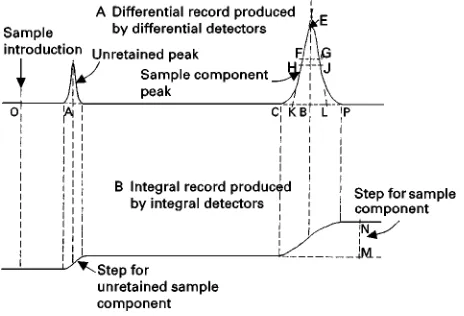
Figure 1 Typical chromatogram: A, differential record produced by differential detector; B, integral record produced by integral detector.
3.2.15. Stationary-phase volume (VS) The volume of the liquid stationary phase or the active solid in the
column. The volume of any solid support is not included. In the case of partition chromatography with a liquid stationary phase, it is identical to theLiquid-Phase Volume(VL).
3.2.16. Mass (weight) of the stationary phase (WS) The mass (weight) of the liquid stationary phase or the
active solid in the column. The mass (weight) of any solid support is not included. In the case of partition chromatography with a liquid stationary phase it is identical to theLiquid Phase Mass(Weight) (WL).
3.2.17. Phase ratio () The ratio of the volume of the mobile phase to that of the stationary phase in
a column:
"Vo/VS
In the case of open-tubular columns the geometric internal volume of the tube (Vc) is to be substituted forVo.
3.2.18. SpeciVc permeability (Bo) A term expressing the resistance of an empty tube or packed column to
theSow of aSuid (the mobile phase). In the case of a packed column
Bo" d 2 p3
180(1!)2+ d2
p
1000
In the case of an open-tubular column
Bo"r 2 c
8
3.2.19. Flow resistance parameter () This term is used to compare packing density and permeability of
columns packed with different particles; it is dimensionless.
"d2 p/Bo
wheredp is the average particle diameter. In open-tubular columns"32.
3.3. The Chromatogram
3.3.01. Differential chromatogram A chromatogram obtained with a differential detector (seeFigure 1A).
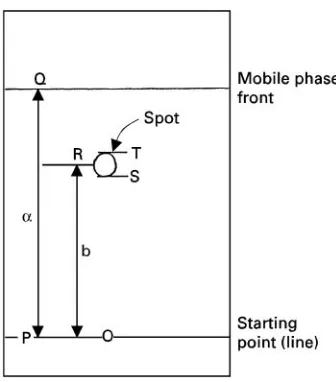
Figure 2 Typical planar chromatogram.
3.3.03. Starting point or line The point or line on a chromatographic paper or layer where the substance to
be chromatographed is applied (P inFigure 2).
3.3.04. Spot A zone in paper and thin-layer chromatography of approximately circular appearance.
3.3.04.1. Spot diameter (ST in Figure 2) The width of the sample component spot before or after chromatography.
3.3.05. Baseline The portion of the chromatogram recording the detector response when only the mobile
phase emerges from the column.
3.3.06. Peak The portion of a differential chromatogram recording the detector response when a single
component is eluted from the column (seeFigure 1A). If separation is incomplete, two or more components may be eluted as oneUnresolved Peak.
3.3.06.1. Peak base (CP in Figure 1A) The interpolation of the baseline between the extremities of the peak.
3.3.06.2. Peak area (CHFEGJP in Figure 1A) The area enclosed between the peak and the peak base.
3.3.06.3. Peak maximum (E in Figure 1A) The point on the peak at which the distance to the peak base, measured in a direction parallel to the axis representing detector response, is a maximum.
3.3.06.4. Peak height (EB in Figure 1A) The distance between the peak maximum and the peak base, measured in a direction parallel to the axis representing detector response.
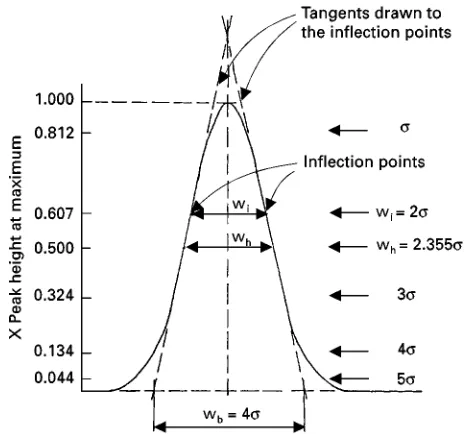
3.3.06.5. Standard deviation () The term in the exponent of the equation relating the width and height of a Gaussian peak:
y"yo. exp.!
x222
whereyis the peak height at any point on the peak,yois the peak height at maximum,xis the distance from
Figure 3 Widths of a Gaussian peak at various heights, as a function of the standard deviation of the peak.
3.3.06.6. Variance of the peak The square of the standard deviation (2).
3.3.07. Peak-widths Peak-widths represent retention dimensions (time or volume) parallel to the baseline.
If the baseline is not parallel to the axis representing time or volume, then the peak-widths are to be drawn parallel to this axis. Three peak-width values are commonly used in chromatography (see Figure 1A and
Figure 3).
3.3.07.1. Peak-width at base (wb) (KL in Figure 1A and Figure 3) The segment of the peak base intercepted by the tangents drawn to the inSection points on either side of the peak.
3.3.07.2. Peak-width at half height (wh) (HJ in Figure 1A and Figure 3) The length of the line parallel to the peak base at 50% of the peak height that terminates at the intersection with the two limbs of the peak
Note: The peak-width at base (wb) may be called the ‘base width’. However, the peak width at half height (wh)
must never be called the ‘half width’ because that has a completely different meaning. Also, the symbol w1/2should never be used instead ofwh.
3.3.07.3. Peak-width at inUection points (wi) (FG in Figure 1A and Figure 3) The length of the line drawn between the inSection points parallel to the peak base.
3.3.07.4. In the case of Gaussian (symmetrical) peaks, the peak-widths are related to the standard deviation () of the peak according to the following equations:
wb"4
wh"2((2 ln 2)"2.355
wi"2
3.3.08. Tailing Asymmetry of a peak such that, relative to the baseline, the front is steeper than the rear. In
3.3.09. Fronting Asymmetry of a peak such that, relative to the baseline, the front is less steep than the rear. In paper chromatography and thin-layer chromatography, it refers to the distortion of a spot, showing a diffuse region in front of the spot in the direction ofSow.
3.3.10. Step The portion of an integral chromatogram recording the amount of a component, or the
corresponding change in the signal from the detector as the component emerges from the column (see Figure 1B).
3.3.10.1. Step height (NM in Figure 1B) The distance, measured in the direction of detector response, between straight-line extensions of the baselines on both sides of a step.
3.3.11. Internal standard A compound added to a sample in known concentration to facilitate the
qualitative identiRcation and/or quantitative determination of the sample components.
3.3.12. External standard A compound present in a standard sample of known concentration and volume
which is analysed separately from the unknown sample under identical conditions. It is used to facilitate the qualitative identiRcation and/or quantitative determination of the sample components. The volume of the external standard (standard sample) need not to be known if it is identical to that of the unknown sample.
3.3.13. Marker A reference substance chromatographed with the sample to assist in identifying the
components.
3.4. Diffusion
3.4.01. The diffusion coefRcient (D) is the amount of a particular substance that diffuses across a unit area in
1 s under the inSuence of a gradient of one unit. It is usually expressed in the units cm2s\1.
3.4.02. Diffusion coefVcient in the stationary phase (DSorDL) The diffusion coefRcient characterizing the
diffusion in the stationary phase. In partition chromatography with a liquid stationary phase, the symbol DLmay be used to express this term.
3.4.03. Diffusion coefVcient in the mobile phase (DM orDG) The diffusion coefRcient characterizing the
diffusion in the mobile phase. In gas chromatography where the mobile phase is a gas, the symbolDGmay be
used to express this term.
3.4.04. Diffusion velocity (uD) This term is used in liquid chromatography in the expression of the reduced
mobile-phase velocity (see 3.6.05.3). The diffusion velocity expresses the speed of diffusion into the pores of the particles:
uD"DM/dp
3.5. Temperatures
3.5.01. Ambient temperature (Ta) The temperature outside the chromatographic system.
3.5.02. Injection temperature The temperature within the injection device.
3.5.03. Separation temperature (Tc) The temperature of the chromatographic bed under isothermal
opera-tion. In column chromatography it is called theColumn Temperature.
3.5.04. Temperatures during programmed-temperature analysis
3.5.04.2. Program rate The rate of increase of column temperature. The rate of temperature increase is usually linear (3C.min\1) but it may also be non-linear. During one analysis the temperature rate may be
changed and/or the temperature programming may be interrupted by an isothermal period. In this case one is speaking aboutMultiple Programming. In multiple programming each program must be speciRed by its initial andRnal temperatures and program rate.
3.5.04.3. Mid-analysis isothermal temperature The temperature of the column in an isothermal period during elution. The corresponding time (Mid-Analysis Isothermal Period) must also be speciRed.
3.5.04.4. Final temperature The highest temperature to which the column is programmed.
3.5.04.5. Final isothermal temperature The Rnal temperature of the program if it is followed by an isothermal period. The time corresponding to theFinal Isothermal Periodmust also be speciRed.
3.5.04.6. Retention temperature The column temperature corresponding to the peak maximum.
3.5.05. Detector temperature The temperature of the detector cell. In the case of a detector incorporating
aSame, it refers to the temperature of the detector base.
3.6. The Mobile Phase
3.6.01. Mobile phase viscosity () The viscosity of the mobile phase at the temperature of the
chromato-graphic bed.
3.6.02. Pressures
3.6.02.1. Inlet pressure (pi) Theabsolutepressure at the inlet of a chromatographic column.
3.6.02.2. Outlet pressure (po) The absolute pressure at the exit of a chromatographic column. It is usually but not necessarily equal to theAmbient Pressure(pa), the atmospheric pressure outside the chromatographic
system.
3.6.02.3. Pressure drop (p) The difference between the inlet and outlet pressures:
p"pi!po
3.6.02.4. Relative pressure (P) The ratio of the inlet and outlet pressures:
P"pi/po
3.6.03. Mobile phase compressibility correction factor (j) A factor, applying to a homogeneouslyRlled
column of uniform diameter, that corrects for the compressibility of the mobile phase in the column. It is also called the Compressibility Correction Factor. In gas chromatography, the correction factor can be calculated as:
j"3 2
p2!1 p3!1"
3 2
(pi/po)2!1
(pi/po)3!1
In liquid chromatography the compressibility of the mobile phase is negligible.
3.6.04. Flow rate The volume of mobile phase passing through the column in unit time.
3.6.04.1. TheSow rate is usually measured at the column outlet, at ambient pressure (pa) and temperature
(Ta, in K); this value is indicated with the symbol F. If a water-containing Sowmeter was used for the
measurement (e.g. the so-called soap bubbleSowmeter) thenFmust be corrected to dry gas conditions in order to obtain the Mobile Phase Flow Rate at Ambient Temperature(Fa):
Fa"F(1!pw/pa)
wherepw is the partial pressure of water vapor at ambient temperature.
3.6.04.2. In order to specify chromatographic conditions in column chromatography, theSow-rate (Mobile Phase Flow Rate at Column Temperature,Fc) must be expressed atTc (kelvin), the column temperature:
Fc"Fa(Tc/Ta)
3.6.05. Velocities
3.6.05.1. Mobile-phase velocity (u) The linear velocity of the mobile phase across the average cross-section of the chromatographic bed or column. It can be calculated from the columnSow-rate at column temperature (Fc), the cross-sectional area of the column (Ac) and the interparticle porosity ():
u"Fc/(Ac)
In practice the mobile phase velocity is usually calculated by dividing the column length (L) by the retention time of an unretained compound (tM; see 3.7.03):
u"L/tM
3.6.05.2. In gas chromatography, due to the compressibility of the carrier gas, the linear velocity will be different at different longitudinal positions in the column. Therefore two terms must be distinguished:
TheCarrier Gas Velocity at the Column Outlet(uo) can be obtained as above, from the carrier gasSow rate
measured at column outlet:
uo"Fc/(Ac)
TheAverage Linear Carrier Gas Velocity(uN) is obtained fromuo, by correcting it for gas compressibility:
uN"uoj
The average linear carrier gas velocity can also be obtained by dividing the column length (L) by the retention time of an unretained compound (tM):
uN"L/tM
In liquid chromatography where mobile phase compression is negligible,uN"u.
3.6.05.3. Reduced mobile phase velocity () A term used mainly in liquid chromatography. It compares the mobile phase velocity with the velocity of diffusion into the pores of the particles (the so-called diffusion velocity,uD: see 3.4.04):
"uN/uD"uNdp/DM
In open-tubular chromatography:
3.7. Retention Parameters in Column Chromatography
3.7.01. Retention parameters may be measured in terms of chart distances or times, as well as mobile phase
volumes; e.g., tYR(time) is analogous to VR(volume). If recorder speed is constant, the chart distances are
directly proportional to the times; similarly if theSow rate is constant, the volumes are directly proportional to the times.
Note: In gas chromatography, or in any chromatography where the mobile phase expands in the column,VM, VRandVYRrepresent volumes under column outlet pressure. IfFc, the carrier gasSow rate at the column
outlet and corrected to column temperature (see 3.6.04.2), is used in calculating the retention volumes from the retention time values, these correspond to volumes at column temperatures.
3.7.02. The various conditions under which retention volumes (times) are expressed are indicated by
superscripts: thus, a prime (; as inV R) refers to correction for the hold-up volume (and time) while a circle (3;
as inVR3) refers to correction for mobile-phase compression. In the case of the net retention volume (time) both corrections should be applied: however, in order not to confuse the symbol by the use of a double superscript, a new symbol (VN, tN) is used for the net retention volume (time).
3.7.03. Hold-up volume (time) (VM, tM) The volume of the mobile phase (or the corresponding time)
required to elute a component the concentration of which in the stationary phase is negligible compared to that in the mobile phase. In other words, this component is not retained at all by the stationary phase. Thus, the hold-up volume (time) is equal to theRetention Volume(Time)of an Unretained Compound. The hold-up volume (time) corresponds to the distance OA in Figure 1A and it includes any volumes contributed by the sample injector, the detector, and connectors.
tM"VM/Fc
In gas chromatography this term is also called theGas Hold-up Volume(Time).
3.7.04. Corrected gas hold-up (volume (VM3) The gas hold-up volume multiplied by the compression
(compressibility) correction factor (j):
VM3"VM.j
Assuming that the inSuence of extracolumn volume onVMis negligible, VM3"VG
(see 3.2.11.2)
3.7.05. Total retention volume (time) (VR,tR) The volume of mobile phase entering the column between
sample injection and the emergence of the peak maximum of the sample component of interest (OB in Figure 1a), or the corresponding time. It includes the hold-up volume (time):
tR"VR/Fc
3.7.06. Peak elution volume (time) (VR,tR) The volume of mobile phase entering the column between the
3.7.07. Adjusted retention volume (time) (VR, tR) The total elution volume (time) minus the hold-up
volume (time). It corresponds to the distance AB in Figure 1a:
V R"VR!VM
tR"tR!tM"(VR!VM)/Fc"VR/Fc
3.7.08. Corrected retention volume (time) (VR3,tR3) The total retention volume (time) multiplied by the
compression correction factor (j):
VR3"VR.j
tR3"VR.j/Fc"VR3/Fc
3.7.09. Net retention volume (time) (VN, tN) The adjustment retention volume (time) multiplied by the
compression correction factor (j):
VN"VR.j
tN"VR.j/Fc"VN/Fc
3.7.10. In liquid chromatography, the compression of the mobile phase is negligible and thus, the
compres-sion correction factor does not apply. For this reason, the total and corrected retention volumes (times) are identical (VR"V3R;tR"tN) and so are the adjusted and net retention volumes (times) (VR"VN;tR"tN).
3.7.11. SpeciVc retention volumes
3.7.11.1. The speciTc retention volume at column temperature (VFg) The net retention volume per gram of
stationary phase (stationary liquid, active solid or solvent-free gel (WS):
VFg"VN/WS
3.7.11.2. SpeciTc retention volume at 03C(Vg) The value ofVgcorrected to 03C:
Vg"VFg
273.15 K Tc "
VN WS
273.15 K Tc
whereTcis the column temperature (in kelvin).
3.7.12. Retention factor (k) The retention factor is a measure of the time the sample component resides in
the stationary phase relative to the time it resides in the mobile phase: it expresses how much longer a sample component is retarded by the stationary phase than it would take to travel through the column with the velocity of the mobile phase. Mathematically, it is the ratio of the adjusted retention volume (time) and the hold-up volume (time):
k"VR/VM"tR/tM
If the distribution constant (see 3.9) is independent of sample component concentration, then the retention factor is also equal to the ratio of the amounts of a sample component in the stationary and mobile phases respectively, at equilibrium:
If the fraction of the sample component in the mobile phase isR(see 3.7.13), then the fraction in the stationary phase is (1!R); thus
k"(1!R)/R
Note: In former nomenclatures and in the literature one mayRnd the expressionsPartition Ratio,Capacity Ratio,Capacity FactororMass Distribution Ratioto describe this term.
In the literature the symbolk is often used for the retention factor, particularly in liquid chromatogra-phy. The original reason for this was to clearly distinguish it from the partition coefRcient (distribution constant) for which the symbolKhad been utilized. Since, however, the distribution constants are all identiRed with a subscript, there is no reason to add the prime sign to this symbol. It should be emphasized that all the recognized nomenclatures (IUPAC, BS, ASTM) have always clearly identiRed the capacity factor with the symbolkand notk.
3.7.12.1. Logarithm of the retention factor This term is equivalent to the RM value used in planar
chromatography (see 3.8.05). The symbolis suggested to express logk:
"logk"log[(1!R)/R].
3.7.13. Retardation factor (R) The fraction of the sample component in the mobile phase at equilibrium; it
is related to the retention factor and other fundamental chromatography terms:
R"1/(k#1)
3.7.14. Relative retention values
3.7.14.1. Relative retention (r) The ratio of the adjusted or net retention volume (time) or retention factor of a component relative to that of a standard, obtained under identical conditions:
r"VRi/VR(st)"VNi/VN(st)"tRi/tR(st)"ki/kst
Depending on the relative position of the peak corresponding to the standard compound in the chromatogram, the value ofrmay be smaller, larger or identical to unity.
3.7.14.2. Separation factor () The relative retention value calculated for two adjacent peaks (V R2'V R1):
"VR2/VR1"VN2/VN1"tR2/tR1"k2/k1
By deRnition, the value of the separation factor is always greater than unity.
The separation factor is also identical to the ratio of the corresponding distribution constants.
Note: The separation factor is sometimes also called the ‘selectivity’. The use of this expression is dis-couraged.
3.7.14.3. Unadjusted relative retention (rGorG) Relative retention calculated by using the total retention
volumes (times) instead of the adjusted or net retention volumes (times):
rG"VRi/VR(st)"tRi/tR(st)" ki#1 kst#1
Subscript G commemorates E. Glueckauf, whoRrst used this expression.
programmed-temperature or gradient-elution conditions. Under such conditions, the symbol RRT (for Relative Retention Time) has also been used to describe the unadjusted relative retention values.
Using the same stationary and mobile phases and temperature, the relative retention and separation factor values are reproducible between chromatographic systems. On the other hand, the unadjusted relative retention (and ‘relative retention time’) values are only reproducible within a single chromatographic system.
3.7.15. Retention index; KovaHts (retention) index (I ) The retention index of a sample component is
a number, obtained by interpolation (usually logarithmic), relating the adjusted retention volume (time) or the retention factor of the sample component to the adjusted retention volumes (times) of two standards eluted before and after the peak of the sample component.
In the Kova&ts Index or Kova&ts Retention Index used in gas chromatography, n-alkanes serve as the standards and logarithmic interpolation is utilized:
I"100
logXi!logXz logX(z#1)!logXz#z
whereXrefers to the adjusted retention volumes or times,zis the number of carbon atoms of then-alkane eluting before, and (z#1) is the number of carbon atoms of then-alkane eluting after the peak of interest:
VRz(VRi(VR(z#1)
TheKova&ts(Retention)Indexexpresses the number of carbon atoms (multiplied by 100) of a hypothetical normal alkane which would have an adjusted retention volume (time) identical to that of the peak of interest when analyzed under identical conditions.
TheKova&ts Retention Indexis always measured under isothermal conditions. In the case of temperature-programmed gas chromatographya similar value can be calculated utilizing direct numbers instead of their logarithm. Since both the numerator and denominator contain the difference of two values, here we can use the total retention volumes (times). Sometimes this value is called theLinear Retention Index:
IT"100
tTRi!tTRz tT
R(z#1)!tTRz# z
wheretT
Rrefers to the total retention times (chart distances) measured under the conditions of temperature
programming. The value ofITwill usually differ from the value ofImeasured for the same compound under
isothermal conditions, using the same two phases.
3.8. Retention Parameters in Planar Chromatography
3.8.01. Mobile-phase front The leading edge of the mobile phase as it traverses the planar media. In all
forms of development except radial, the mobile phase front is essentially a straight line parallel to the mobile phase surface. It is also called theLiquid FrontorSolvent Front.
3.8.02. Mobile-phase distance The distance travelled by the mobile phase travelling along the medium
from the starting (application) front or line to the mobile phase front. It is the distanceain Figure 2.
3.8.03. Solute distance The distance travelled by the solute along the medium from the starting
(applica-tion) point or line to the center of the solute spot. If the solute spot is not circular, an imaginary circle is used whose diameter is the smallest axis of the spot. It is the distancebin Figure 2.
3.8.04. Retardation Factor (RF) Ratio of the distance travelled by the center of the spot to the distance
simultaneously travelled by the mobile phase. Using the symbols of Figure 2:
By deRnition theRFvalues are always less than unity. They are usually given to two decimal places. In order to
simplify this presentation thehRFValuesmay be used: they correspond to theRFvalues multiplied by 100.
Ideally, theRFvalues are identical to theRvalues (see 3.7.13).
3.8.05. RM value A logarithmic function of theRFvalue:
RM"log1!RF RF
"log
1 RF!1
3.8.06. Relative retardation (Rrel) This term is equivalent to relative retention used in column
chromatogra-phy: it is the ratio of theRFvalue of a component to theRFvalue of a standard (reference) substance. Since the
mobile phase front is common for the two components, theRrelvalue can be expressed directly as the ratio of
the distances travelled by the spot of the compound of interest (bi) and the reference substance (bst)
respectively:
Rrel"RF(i)/RF(st)"bi/bst
Note: In former nomenclatures the symbolRswas used to express relative retardation in planar
chromatogra-phy. Because of its identity with the symbol for peak resolution (see 3.10.01) the symbol Rrel is
suggested for relative retardation in planar chromatography.
3.9. Distribution Constants
The distribution constant is the concentration of a component in or on the stationary phase divided by the concentration of the component in the mobile phase. Since in chromatography a component may be present in more than one form (e.g. associated and dissociated forms), the analytical condition used here refers to the total amount present without regard to the existence of various forms.
There terms are also called theDistribution CoefTcients. However, the present term conforms more closely to the general usage in science.
The concentration in the mobile phase is always calculated per unit volume of the phase. Depending on the way the concentration in the stationary phase is expressed various forms of the distribution constants may exist.
3.9.01. Distribution Constant (Kc) In the general case, the concentration in the stationary phase is
expressedper unit volume of the phase. This term is mainly applicable to partition chromatography with a liquid stationary phase but can also be used with a solid stationary phase:
Kc"Wi(S)/VS Wi(M)/VM
whereWi(S)andWi(M)are the amounts of componentiin the stationary and mobile phases, whileVSandVMare
the volumes of the stationary and mobile phases, respectively.
The termDistribution Constantand the symbolKcare recommended in preference to the termPartition CoefTcientwhich has been in use in partition chromatography with a liquid stationary phase.
The value of Kc is related to the retention volume (VR) of a sample component and the volumes of the
stationary (VS) and mobile phases (VM) in the column:
VR"VM#KcVS
In gas chromatography bothVRandVMhave to be corrected for gas compressibility: thereforeV3R(see 3.7.08)
is to be used forVR, and VG"V3M(see 3.2.11.2) is to be used forVM.
3.9.02. Distribution constant (Kg) In the case of a solid stationary phase, the distribution constant may be
expressedper mass(weight)of the dry solid phase:
Kg"Wi(S)/WS Wi(M)/VM
where Wi(st) and Wi(M) are the amounts (masses) of the componenti in the stationary and mobile phases,
respectively,Wstis the mass (weight) of the dry stationary phase, andVMis the volume of the mobile phase in
the column.
3.9.03. Distribution constant (Ks) In the case of adsorption chromatography with a well characterized
adsorbent of known surface area, the concentration in the stationary phase may be expressedper unit surface area:
Ks"Wi(S)/AS Wi(M)/VM
where Wi(S) and Wi(M) are the amounts (masses) of the component i in the stationary and mobile phases,
respectively,ASis the surface area of the stationary phase, andVM is the volume of the mobile phase in the
column.
Note: The symbols used in 3.9.01 through 3.9.03 are generalized.
3.10. Terms Expressing the Ef\ciency of Separation
3.10.01. Peak resolution (Rs) The separation of two peaks in terms of their average peak width at base
(tR2'tR1):
Rs" (tR2!tR1) (wb1#wb2)/2"
2(tR2!tR1) wb1#wb2
In the case of two adjacent peaks it may be assumed thatwb1+wb2, and thus, the width of the second peak
may be substituted for the average value:
Rs+(tR2!tR1)/wb2
3.10.02. Separation number (SN) This expresses the number of peaks which can be resolved in a given part
of the chromatogram between the peaks of two consecutiven-alkanes withzand (z#1) carbon atoms in their molecules:
SN"tR(z#1)!tRz whz#wh(z#1)!
1
In the German literature the symbol TZ (Trennzahl) is commonly used to express the separation number. As the separation number depends on then-alkanes used for the calculation, they always must be speciRed with any given SN value.
3.10.03. Plate number (N) A number indicative of column performance, calculated from the following
equations which depend on the selection of the peak width expression (see 3.3.07):
N"(VR/)2"(tR/)2
N"16(VR/wb)2"16(tR/wb)2
N"5.545(VR/wh)2"5.545(tR/wh)2
In these expressions the units for the quantities inside the brackets must be consistent so that their ratio is dimensionless: i.e., if the numerator is a volume, then peak width must also be expressed in terms of volume.
Note: In former nomenclatures the expressions ‘Number of Theoretical Plates’ or ‘Theoretical Plate Number’ were used for the same term. For simpliRcation, the present name is suggested.
3.10.04. Effective plate number (Neff) A number indicative of column performance calculated by using the
adjusted retention volume (time) instead of the total retention volume (time). It is also called theNumber of Effective Plates:
Neff"(VR/)2"(tR/)2
Neff"16(VR/wb)2"16(tR/wb)2
Neff"5.545(VR/wh)2"5.545(tR/wh)2
The plate number and effective plate number are related to each other:
N"Neff
k#1k
2
Wherek is the retention factor (see 3.7.12).
Notes: In the former literature the expression ‘number of effective theoretical plates’ had been used to express this term. This is incorrect since the plate number is either theoretical or effective, but cannot be both. In former nomenclatures the respective symbolsnandNhave been used for the plate number and the effective plate number. However, there was often a confusion in the proper selection of lower case and capital letters; therefore, the present usage, characterizing the effective plate number by a subscript, is suggested.
3.10.05. Plate height (H) The column length (L) divided by the plate number:
H"L/N
It is also called theHeight Equivalent to One Theoretical Plate(HETP).
3.10.06. Effective plate height (Heff) The column length divided by the effective plate number:
Heff"L/Neff
It is also called theHeight Equivalent to One Effective Plate.
Notes: In the former literature the expression ‘height equivalent to one effective theoretical plate’ had been used to express this term. This is incorrect, since the plate height is either theoretical or effective (see 3.10.04), but cannot be both.
In former nomenclatures the respective symbolshandHhave been used for the plate height and the effective plate height, respectively. However, there was often a confusion in the proper selection of lower case and capital letters and also due to the fact thath(lower case letter) is also used to express the reduced plate height (see 3.10.07). The present usage is suggested in order to avoid any confusion.
3.10.07. Reduced plate height (h) A term used in liquid chromatography. It is the ratio of the plate height
to the average particle diameter:
h"H/dp
For open-tubular columns:
4.
Terms Related to Detection
4.1. Classi\cation of Detectors
4.1.01. ClassiVcation according to the form of response
4.1.01.1. Differential detectors These measure the instantaneous difference in the composition of the column efSuent.
4.1.01.2. Integral detectors These measure the accumulated quantity of sample component(s) reaching the detector.
4.1.02. ClassiVcation according to the basis of response
4.1.02.1. Concentration-sensitive detector A device the response of which is proportional to the concentra-tion of a sample component in the eluent.
4.1.02.2. Mass-Uow sensitive detector A device the response of which is proportional to the amount of sample component reaching the detector in unit time.
4.1.03. ClassiVcation according to Detector selectivity
4.1.03.1. Universal detector A detector which responds to every component in the column efSuent except the mobile phase.
4.1.03.2. Selective detector A detector which responds to a related group of sample components in the column efSuent.
4.1.03.3. SpeciTc detector A detector which responds to a single sample component or to a limited number of components having similar chemical characteristics.
4.2. Detector Response
4.2.01. Detector sensitivity (S) The signal output per unit concentration or unit mass of a substance in the
mobile phase entering the detector.
4.2.01.1. In the calculation of detector sensitivity the signal output of the detector is given as peak area in mV.min, A.s or AU.min (AU"absorbance unit). These values are obtained from theintegratedpeak area converted to the units speciRed.
Alternately, the peak area can also be obtained by multiplying the peak height at maximum (in mV, A or AU) by the peak-width at half height (in time units). The peak area calculated in this way will be 6% less than the true integrated peak area, assuming that peak is Gaussian.
4.2.01.2. In the case ofconcentration-sensitive detectors, sensitivity is calculated per unit concentration in the mobile phase:
S"AiFc/Wi"E/Ci
whereAiis the integrated peak area (in mV.min or AU.min),E is the peak height (in mV or AU),Ciis the concentration of the particular substance in the mobile phase at the detector (in g.cm\3),F
cis the mobile phase Sow rate corrected to column temperature (in cm3.min\1) and Wi is the mass (amount) of the substance
present (in mg). The dimensions of detector sensitivity are mV.cm3.mg\1or AU.cm3.mg\1.
4.2.01.3. In the case of thermal-conductivity detectors, this sensitivity value is also called the Dimbat-Porter-Stross Sensitivityof the detector.
In the case ofmass-Uow sensitive detectors, sensitivity is calculated per unit mass of the test substance in the mobile phase entering the detector: