CORBA Middleware for a Palm Operating
System
Mary Connolly
B.E.
A dissertation submitted to the University of Dublin,
in partial fulfillment of the requirements for the degree of
Master of Science in Computer Science
Declaration
I declare that the work described in this dissertation is, except where otherwise stated, entirely my own work and has not previously been submitted as an exercise for a degree at this or any other university.
Signed: ___________________ Mary Connolly
September 2001
Permission to lend and/or copy
I agree that Trinity College Library may lend or copy this dissertation upon request.
Signed: ___________________ Mary Connolly
Acknowledgements
Many thanks to my supervisor, Mr. Alexis Donnelly, for his guidance and advice throughout the course of this project.
Thanks to Raymond for his willingness to help me with any questions and problems that I had.
Thanks to the other members of the MSc class for their friendship and for making the year so enjoyable.
Abstract
Typically, Computer Networks are heterogeneous and therefore require special middleware applications in order to enable communication across their diverse platforms. Middleware applications make the task of writing software applications for heterogeneous systems easier, by applying platform-independent models and abstractions, and by hiding as much low-level complexity as possible without unduly sacrificing performance.
The Common Object Request Broker Architecture (CORBA) standard provides a set of rules for writing such platform independent middleware. CORBA applications require lots of functionality in order to unite diverse platforms within a heterogeneous system, and are therefore bulky and computation intensive. Generally, they are used on machines with considerable memory and processing resources, that can cope with them.
Table of Figures
Fig 2.1 CORBA Architecture diagram ...15
Fig 2.2 Structure of a value of type Any...18
Fig 2.3 Structure of a TypeCode pseudo-object ...19
Fig 2.4 Minimum CORBA architecture...27
Fig 2.5 Components of the TAO ORB ...29
Fig 2.6 GIOP Message types ...32
Fig 3.1 Client ORB Architecture...38
Fig 3.2 Client / Server ORB Architecture ...38
Fig 3.3 ORB Initialisation classes ...39
Fig 3.4 GIOP Messaging classes ...42
Fig 3.5 Stub Implementation classes ...44
Fig 3.6 Downcall classes...45
Fig 4.1 Request Invocation...58
Fig 4.2 Object Reference contents...61
Fig 4.3 Basic structure of a GIOP Message ...64
Fig 4.4 GIOP 1.2 message header ...65
Fig 4.5 GIOP Request message ...67
Fig 4.6 GIOP Reply message ...70
Table of Contents
1. INTRODUCTION ...1
1.1 FUTURE OF HANDHELD DEVICES IN DISTRIBUTED ENVIRONMENTS...1
1.2 PROJECT GOAL...2
1.3 ROADMAP...3
2. CORBA AND HANDHELD DEVICES ...5
2.1 LIMITATIONS OF HANDHELD DEVICES...7
2.2 CORBA MIDDLEWARE BACKGROUND...9
2.1.1 OMG...10
2.2.2 CORBA Architecture...10
2.2.3 Corba Features...12
2.2.3.1 IDL...12
2.2.3.2 Language Mappings...13
2.2.3.3 ORB Interface...13
2.2.3.4 Operation Invocation and Dispatch Facilities...14
2.2.3.5 Object Adapters...14
2.2.3.6 Inter-ORB Protocol...15
2.2.4 Interface Repository...16
2.2.5 Implementation Repository...17
2.2.6 The Any Type and TypeCodes...17
2.2.7 ORB Transparencies...19
2.2.8 Common Data Representation Format...21
2.2.9 Interoperable Object Reference...22
2.2.10 Server Side of an ORB...22
2.3 CORBA VS. MINIMUM CORBA ...23
2.3.1 MinimumCORBA Omissions...25
2.4 EXAMPLE IMPLEMENTATIONS OF CORBA MIDDLEWARE...27
2.4.1 TAO...27
2.4.2 PalmORB...29
2.5 IIOP AND GIOP ...31
3. ORB DESIGN...34
3.1 DESIGN GOALS...34
3.2 STRIPPED DOWN CORBA STANDARD TO FIT PALM III DEVICE...35
3.3 ORB CLASS DIAGRAMS...39
3.3.1 ORB Initialisation...39
3.3.2 GIOPMessaging...42
3.3.3 Stub Implementation...44
3.3.4 ORB Downcalling...45
3.4 EXTENSIBILITY OF ORB DESIGN...46
4. CODE IMPLEMENTATION ...48
4.1 DEVELOPMENT ENVIRONMENT...48
4.2 NETWORK CONNECTIVITY...49
4.4 MEMORY MANAGEMENT FOR THE PALM DEVICE...50
4.4.1 Memory Allocation of Strings...51
4.4.2 Memory Allocation of Classes...53
4.4.3 Reference Counting...53
4.4.4 Directional Attributes...54
4.5 USE OF TEMPLATES...55
4.6 BIG ENDIAN VS. LITTLE ENDIAN...56
4.7 REQUEST INVOCATION...57
4.7.1 Stubs and Skeletons...58
4.7.2 Creating an Object Reference from an IOR...59
4.7.3 Implementation of IIOP and GIOP...63
4.7.3.1 GIOP Message Header...64
4.7.3.2 Request Message Format...66
4.7.3.3 Reply Message Format...69
5. EVALUATION...72
5.1 CRITIQUE OF DESIGN...72
5.2 CRITIQUE OF IMPLEMENTATION...73
5.3 OVERALL CORBA ORB INTEROPERABILITY...75
6. CONCLUSIONS...76
6.1 SUMMARY OF WORK...76
6.2 KNOWLEDGE GAINED...77
6.3 FUTURE WORK...77
CHAPTER 1
1. INTRODUCTION
The original idea behind handheld devices was to produce a small (pocket sized), portable, easy to use device that could be used as an extension to a less portable desktop computer. Handhelds provide a window to desktop data. Once desktop data has been downloaded onto a handheld, it can be viewed away from the desk, conveniently and speedily. Applications that make most use of this tend to be of the personal organiser type. Examples include address books, to do lists and memo pads. Email applications can also exploit handhelds in the same fashion, so that users do not necessarily have to be sitting at a desktop in order to read their electronic mail.
Over the years, handhelds have evolved at quite a high rate. For example, the earlier Palm devices that date back to 1996 were very primitive, affording only 128KB of RAM, and little or no support for communication with other devices. More recent models like the Handspring Visor have up to 8MB of RAM and can communicate with other devices using Infrared and TCP/IP.
Although handheld devices are still quite limited, it is obvious that they are certainly becoming powerful enough for broader and more sophisticated applications than those of a mere electronic organiser.
1.1 Future of Handheld Devices in Distributed Environments
that endeavours to achieve anywhere, anytime, anyhow computing, the concept of a portable distributed systems becomes crucial.
Such extended capabilities transform a handheld device into something very powerful indeed. For example, remote invocation could be used to control operations located on other devices within a distributed computing system. Scope for exciting development is certainly provided for. Ponder the notion of a pocket size computer that can cross multiple programming languages, and multiple operating systems!
1.2 Project Goal
It is apparent that while the handheld device makes a reasonable effort in its role as remote desktop window, modern PDAs offer sizeable margins for capitalising on their enhanced capacity, so that they can be used for something much more powerful. The aim of this project is to make a contribution to the task of closing the gap between using a handheld as an extension to a desktop computer, and using it as a portable access point to a distributed computing environment, or indeed fully incorporating it into a distributed system by including server side functionality so that the device itself can actually implement some of the system functionality.
1.3 Roadmap
The remaining chapters in this thesis catalogue the project phases that were performed in order to realise the aforementioned goals.
Chapter 2 CORBA and Handheld Devices
This Chapter introduces handheld devices, their characteristics, and of course their limitations. These are things that must be considered when designing applications for PDAs. It also introduces the architecture and key features of the OMG’s CORBA standard, followed by a discussion on how the full CORBA standard can be stripped down to produce a minimal but compatible, standard set of implementation rules. The latter refers to the MinimumCORBA standard, which is also a recognised OMG standard that has been specially constructed for CORBA implementations on devices with limited resources.
Chapter 3 Design
The proposed extensible design of the CORBA ORB middleware, which adheres to the MinimumCORBA standard where possible, is described here. All omissions from the latter standard are documented and explained within this chapter.
Chapter 4 Implementation
This presents the important ORB implementation features and issues. It includes a section on the techniques employed to achieve consistent memory management of the Palm III device, which is key to the successful implementation of applications on such a limited piece of electronics.
Chapter 5 Evaluation
Chapter 6 Conclusions
CHAPTER 2
2. CORBA AND HANDHELD DEVICES
As already discussed, handheld devices such as those running Palm OS provide a useful extension to desktop computers. Even though it is indeed possible to perform more complex tasks with handhelds, their main purpose is for viewing data and entering small amounts of data, rapidly and easily. Typically a desktop user will remain at their desk for a prolonged period of time, working on a dedicated task that is enabled by their desktop. Handheld devices on the other hand, tend to be used as an aside, which can be conveniently and speedily referred to, while almost all attention is focused on another core task. For this reason, handhelds require the following key features:
• Small Size
They must be small enough to be conveniently carried anywhere, for example, in a shirt pocket.
• Ergonomic Interface
A handheld device should have a fast and easy to use user interface. A handheld user should be able to comfortably and rapidly navigate the device during meetings, at business lunches and in situations where there is no convenient place to mount the device.
• Desktop Integration
device. This process avoids lengthy manual data entry on the latter’s limited input interface.
[Foster ' 00]
Clearly, a handheld device can be utilised valuably in conjunction with a desktop computer, to enable the easy use of address book, memo-pad, and other helpful organisational applications, away from the actual desk itself. It is now time to progress towards a discussion on the incorporation of handhelds into a distributed environment that encompasses multiple platforms, for example Unix or Windows, running applications implemented in diverse programming languages like Java, COBOL or C/C++. It is also of immense importance to highlight the restrictions of handheld devices. These restrictions must be considered when endeavouring to implement on a handheld, the manner of bulky and intricate, low level middleware code, that enables such interoperation.
PalmORB [Roman ' 99], is a CORBA compliant middleware application that has been developed at the University of Illinois, with a design that allows it to fit onto limited resource devices. PalmORB provides a seamless mobile data access mechanism using handheld devices and wireless links. It essentially extends a handheld device from something that simply acts as a smart organiser with stripped down versions of widely used desktop programs, to a device that is seamlessly integrated into a sophisticated distributed computing environment. This provides users with a unified image of a distributed system from a device that can conveniently fit inside a shirt pocket.
Such technology has enabled sophisticated mechanisms such as video streaming to run on handheld devices. PalmORB is discussed in further detail in section 2.4.2.
The ORB implemented for this thesis is different in that it was designed to run entirely on any handheld device, to which it has been commissioned, with no outsourcing of complex and demanding tasks. Such an ORB facilitates the possibility of a flexible handheld device that can interoperate within diverse distributed systems. The design is discussed in depth in chapter 3.
2.1 Limitations of Handheld Devices
Since the capabilities of desktop computers and handheld devices differ significantly, the approach to designing a handheld application is much different to that for a desktop application. The following limitations should be kept in mind when designing for a handheld.
• Performance Requirements
Useful information should be available instantly, since unlike a user at a desktop, who is likely to remain at that machine for some time performing dedicated tasks, a handheld user is typically performing another more important task, and merely requires the handheld for a few small but crucial functions, like retrieving a telephone number, or jotting down key points at a meeting. Since there is a limit to the processing power of a handheld device, it is very important to ensure that their applications are small and efficient. Typically, handheld applications are implemented in C or C++ for its efficiency.
• Battery and Processor Power
One possible way to overcome this short coming would be to arrange for any intensive number crunching operations to be executed on a more powerful machine that is remote from the handheld. This approach is taken by PalmORB.
• Limited Memory
Limited memory space on a handheld means that things like deeply recursive routines. Large numbers of global variables, and huge dynamically allocated data structures are not handheld device friendly.
• RAM as Permanent Data Storage
Unlike desktops, where vast amounts of data can be stored on hard drives, with a handheld device all data must be stored in RAM, which means that storage space is much more limited. The reason for this is that data entry and access must be very fast. Space limitations mean that handheld applications must be as small as possible, and that infrequently used features should be left out. Also, any data to be stored persistently on a handheld should be packed tightly before being written to memory. The Palm III device used for this project has only 2MB of RAM.
Writing CORBA middleware is a difficult process. Obviously, writing such middleware for a restricted handheld device adds further complications. Such software tends to be bulky, and to involve the use of complicated structures and functions, and all other things that spell trouble when programming a limited resource, pocket sized device. The following subsections take a look at the CORBA standard, and then at the MinimumCORBA standard. The latter details ways of cutting down the former, in order to come up with a compliant set of rules for writing a minimal CORBA ORB, that fits onto a small handheld device, while remaining compatible with all other fully implemented, compliant CORBA ORBs.
2.2 CORBA Middleware Background
Typically, Computer Networks are heterogeneous. A network may, for example, have UNIX workstations for the support of software development, or a mainframe to handle database transactions, and of course, personal computers that run Windows and provide general office tools.
One of the main reasons for this heterogeneity is the change in technology over time. The best technologies from different time periods tend to end up co-existing on networks. Another reason for network heterogeneity is that different combinations of computers, operating systems, and networking platforms will work best for different subsets of the computing activities performed within diverse networks.
development, and by hiding as much low-level complexity as possible without unduly sacrificing performance.
The Common Object Request Broker Architecture (CORBA) standard provides a set of rules for writing such platform independent middleware, in order to hide some of the difficulties associated with writing applications for distributed and heterogeneous systems.
[Baker ' 97]
2.1.1 OMG
The Object Management Group (OMG) was formed in the late 1990s to address the problems of developing portable distributed applications for heterogeneous systems. The CORBA specification, written and maintained by the OMG, supplies a balanced set of flexible abstractions and concrete services needed to realise practical solutions for the problems associated with distributed heterogeneous computing. The CORBA standard has been reviewed on several occasions. The most up to date version is CORBA 2.3. [Henning ' 99]
2.2.2 CORBA Architecture
Object Request Broker middleware provides a means for writing distributed systems that can use different programming languages and operating systems, and integrate applications to provide new systems. ‘On-the-wire’ format is a standard language and platform independent message format, that is used when transmitting messages for remote object invocation in a distributed system.
The purpose of the CORBAservices, is to provide a set of utilities that are useful for objects or low level distributed applications. A subset of these services have been grouped into categories and described below.
• Distributed systems-related services:
Naming Service: to allow a client to find remote objects that have been registered with the naming service. This extra level of indirection means that target objects can easily be moved from one host to another without breaking any of the references to that object that are held by clients. The only place where the host destination details will need updating, is at the naming service itself.
Event Service: to allow a client or server to send a message or event to any number of receivers.
Security Service: to ensure that only suitable privileged users can call specified operations on particular objects
• Database-related services:
Concurrency Service: to provide a locking mechanism to control the access to an object by concurrent callers.
Transaction Service: to control the commitment and abortion of transactions that span multiple databases, of the same or of different types.
Persistent Object Service: to define an abstract framework for how a database and an object should communicate to store and restore the object to and from the database.
Licensing Service: to allow an object’s data to be converted to and from a stream of bytes, so that it can be copied to another location
Time Service: to find the time of day or to obtain an event call after a specified time.
CORBAfacilities, on the other hand provide a higher level of support for applications. The latter refers to a new area of CORBA which has been designed to address information management, system management, task management and user interfaces. [Baker ' 97]
2.2.3 Corba Features
2.2.3.1 IDL
In order to be able to invoke operations on a distributed object, a client must first of all know the interface related to the target object. Such an interface is composed of the operations it supports and the types of data that can be passed to and from those operations.
2.2.3.2 Language Mappings
CORBA Language mappings specify exactly how the IDL object interface definitions are translated into each of the different programming languages supported by the CORBA standard. For each IDL construct, a language mapping defines which features of the programming language are used to make the construct available to applications. For example, for languages that support the ‘class’ construct, IDL interfaces are mapped to classes, and operations are mapped to the member functions of those classes. Implementation languages currently supported by the CORBA standard are C, C++, Smalltalk, COBOL, Ada and Java. This cross language support enables the implementation of different portions of a distributed system in different languages. For example, a server application requiring speed and efficiency in order to cope with large amounts of data, could be implemented in a fast language like C or C++, while its clients could be written using languages, such as Java or Visual Basic, which have strong support for the development of aesthetically pleasing graphical user interfaces.
Most state of the art ORB implementations that use the CORBA standard have an IDL compiler associated with them, which generates stub and skeleton classes from the IDL definitions. These stubs and skeletons, which are discussed in further detail in section 4.7.1, provide the link between the client and server applications, and the ORB itself.
2.2.3.3 ORB Interface
2.2.3.4 Operation Invocation and Dispatch Facilities
CORBA applications invoke operations on remote objects by sending requests to the target CORBA objects. At the server side, the request is processed and dispatched to the correct object adapter and servant combination. A reply is then sent back to the requesting client. A servant is an entity that implements one or more CORBA objects. Object adapters are discussed in further detail in section 2.2.3.5.
The two general approaches to request invocation and dispatch are static and dynamic. With static invocation OMG IDL is translated into
language-specific stubs (client-side request invocation functions) and skeletons (server-side request dispatch functions). Dynamic invocation is more complicated. It requires the construction and dispatch of CORBA requests at run time rather than at compile time. The creation and interpretation of requests requires the use of a mechanism such as an Interface Repository, discussed in section 2.2.4, to provide run time access to IDL definitions, and their interfaces and types.
The latter approach can be useful for applications such as gateways or bridges, that receive and forward requests without having compile time knowledge of the types and interfaces involved. However, the static invocation approach provides a better programming model for application development in statically defined languages such as C++.
2.2.3.5 Object Adapters
Adapters facilitate the development of scalable, high performance server applications.
Until version 2.1, CORBA contained specifications only for the Basic Object Adapter (BOA). The BOA was the original CORBA object adapter. CORBA 2.2 introduced the Portable Object Adapter (POA) as a means of improving the portability and capabilities of object adapters [OMG ' 01] chapter 11. The POA replaced the BOA.
Fig 2.1 CORBA Architecture diagram
2.2.3.6 Inter-ORB Protocol
access privileges. However, to be CORBA compliant, an ORB must be able to use IIOP when communicating with objects on other ORBs.
IIOP request packets contain the identity of the target object, the name of the operation to be invoked, and the parameters. This information is used automatically at the server side to find the target object, and call the correct function on it. [Henning ' 99]
2.2.4 Interface Repository
An Interface Repository (IFR), can be implemented as a component of a CORBA ORB to provide persistent storage for all IDL types such as modules and interfaces. The purpose of such a storage facility is to provide clients with runtime access to an object’s type information (and other information about that type), so that a client can invoke an operation on a remote object, without always needing to have compile time knowledge of the objects characteristics.
A client application, wishing to invoke on a remote object, without having compile time knowledge of the objects type information, can use a Dynamic Invocation Interface (DII) to do so. The DII accesses information stored within the Interface Repository in order to construct a request message at runtime.
The IFR provides a set of functions that enable a DII to browse and list its contents, and to determine an object’s type information.
incoming operation invocation. The DSI then determines the identity of the object being invoked, the name of the operation, and the types and values of each of the parameters being passed. At that stage, it is possible for the operation being requested by the client to be executed, and the result returned. [Baker ' 97]
2.2.5 Implementation Repository
An Implementation Repository allows an ORB to locate and activate implementations of objects. The Implementation Repository maintains a mapping from a registered server name to the file name of the executable code which implements that server. The advantage of registering servers with an Implementation Repository, is that if an operation invocation is made on a object whose server is not running, or if a client attempts to bind to such an object, an ORB can automatically launch the server by consulting the Implementation Repository to obtain the se rvers executable code file name. [Baker ' 97]
2.2.6 The Any Type and TypeCodes
The IDL Any type provides a universal type the can hold a value of arbitrary IDL type. The Any type allows for values whose types are not fixed at compile time, to be sent and received at runtime. Values of type Any maintain type safety, for example, the receiver of an Any type must treat its contents exactly as the sender intended. If the sender placed a float value in the Any type, the receiver must extract that value as a float type, other wise a runtime error will be generated.
Value of type Any
CORBA::TypeCode
Describing the Value
Actual Value
Fig 2.2 Structure of a value of type Any
TypeCodes are used to carry runtime descriptions of IDL types. They are important for the dynamic aspects of CORBA such as type Any, the DII and the DSI.
TypeCodes provide several useful functions. They help to preserve the type safety of CORBA, by ensuring that type mismatches are detected at run time. In addition, TypeCodes provide introspection. Given an Any containing a value whose type is unknown, this unknown type can be determined by extracting the TypeCode from the Any and interrogating it. Introspection is vital for programs requiring dynamic typing. Also, TypeCodes provide an ORB runtime at the receiving end with the information required to correctly unmarshal the values off the wire.
Value of type TypeCode
TCKind
Description
Fig 2.3 Structure of a TypeCode pseudo-object
An example of an area where Typecodes and the Any type are very useful, is in the CORBA Event Service, where it must be possible to transport values whose IDL types are unknown to the service. Using Any types, the events can simply be values of type Any, and the Event Service can then act as a transport for these values without requiring compile time knowledge of the actual types contained in them. At the receiving end, Typecode introspection can be used in order to determine the type contained in the Any value.
2.2.7 ORB Transparencies
Request invocation for an ORB requires the following characteristics:
• Location transparency
The client should not need to know whether the target object is a local object in the same or a different address space, or if is implemented in a process on a different machine. Server processes do not necessarily remain on the same machine forever, it should be possible for them to be moved around from machine to machine without clients becoming aware of it. If a server process is moved, new IORs containing the new location details should be generated for each of the objects it supports. Once the client has obtained the updated IORs, the ORB should simply obtain the new server destination details, and use this information to send the client request to the correct location.
The client should not need to know which objects are implemented on which servers
• Language independence
The client should not be concerned with what language is used by the server. As an example, a C client should be able to call a Java implementation without being aware of the fact that it is invoking on a Java object.
• Implementation independence
The client should not need to be aware of how the object implementation works on the server.
• Architecture independence
The client should be unaware of the CPU architecture that is used by the server and should be shielded from such details as byte ordering and structure padding. This facilitates Palm / desktop communication, since Palm uses big-endian while intel based Pentium machines use little-endian.
• Operating system independence
The client should not be required to know what operating system is used by the server. The use of the standard on-the-wire message format means that a received message can be understood by any operating system.
• Protocol independence
2.2.8 Common Data Representation Format
The Common Data Representation, defined by GIOP, is required for the binary layout of IDL types for transmission across a network. CDR-encoded data should be tagged to indicate the byte ordering of the data, which can be either big-endian or little-endian. This is necessary so that both big-endian and little-endian machines can send data in their native format, with the onus being on the receiver to undertake byte-swapping if it uses a different byte order to the sender.
All data types require well-defined encodings in order to ensure interoperability between ORBs.
CDR requires the alignment of primitive data types along their natural byte boundaries. For example, short values should be aligned on a 2-byte boundary, long values on a 4-2-byte boundary and double values on an 8-byte boundary. Strings and wide strings should be aligned as unsigned long types (aligned on a 4-byte offset), that indicates the length of the string, including its terminating NULL byte, followed by the bytes of the string, terminated by a NULL byte. Structures should be aligned as a sequence of structure members in the order in which they are defined in the IDL. This kind of alignment means that data can be marshalled and un-marshalled simply by pointing at a value stored in memory in its natural binary representation. This approach avoids expensive data copying during marshalling.
Because CDR supports both little-endian and big-endian representations and aligns data on natural boundaries, it makes marshalling both simple and efficient. [Henning ' 99]
2.2.9 Interoperable Object Reference
Object references are the only way for a client to reach target objects. A client cannot communicate unless it holds an object reference. References are published by servers in several ways. The most common way for a client to acquire object references is to receive them in response to an object invocation. In that case, object references are parameter values and are no different from any other type of value, such as a string. Clients simply contact an object, and the object returns one or more object references. In this way, clients can navigate an “object web” in much the same way as following hyperlinks. Another common way for clients to obtain object references is for servers to advertise references in some well-known service, such as the Naming Service.
Regardless of the origin of object references, they should always be created by the ORB server run time on behalf of the client, to which they should subsequently be made available. [Henning ' 99]
2.2.10 Server Side of an ORB
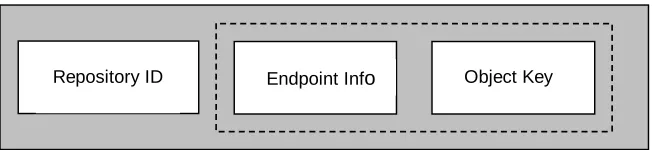
name) and TCP port number, to allow a client to correctly locate the host in which the remote object is implemented. The contents of an IOR are discussed in more detail in section 2.2.9. A server can insert its own address and port number into a reference to facilitate direct binding. A server can also employ indirect binding, which involves the use of an external location broker known as an Implementation Repository.
At the server side of a request invocation, the ORB locates the IOR information that is encoded within the request message. If the server application for the object being invoked is not already running, the ORB activates it. The server side object adapter uses the IOR information retrieved from the request message, to dispatch the request to the servant that incarnates the target object. Any arguments that have been provided by the client invocation are also passed to the object, and the operation is invoked. If any of the arguments are out or inout values, they are returned to the client in a reply message, along with the return value. Out and inout parameters are further discussed in section 4.4.4. If the call fails, an exception, including any data contained in the exception, is returned to the client.
2.3 CORBA Vs. Minimum CORBA
The minimumCORBA specification supports all of OMG IDL. This allows maximum compatibility between minimumCORBA and full CORBA applications.
Many of CORBAs features have much value in typical large scale CORBA applications, however there are also some cases where these features use up so many resources that their inclusion cannot be substantiated. Minimum CORBA omits many of the resource intensive features that are not typically essential to a basic CORBA implementation. However it is of course possible to implement such features within a minimal CORBA ORB, if they are required.
Omitting features from CORBA represents a trade-off between usability and conserving resources. Obviously, an implementation of the full CORBA standard has a greater degree of user-friendliness, but minimumCORBA facilitates the conservation of limited resources.
The MinimumCORBA specification defines a single profile that preserves the key benefits of CORBA (portability of applications and interoperability between ORBs). The following goals were recognized when choosing this profile:
• MinimumCORBA provides a profile that reserves broad applicability within the world of limited resource systems.
• MinimumCORBA should interoperate easily with CORBA so that applications running on either kind of ORB can interoperate as part of a larger system.
• MinimumCORBA should support full IDL so that any CORBA
• Features that support the dynamic aspects of CORBA are
omitted, as the systems for which minimumCORBA is targeted tend to make commitments at design -time rather than at runtime.
There are several features included within the minimumCORBA profile that incur considerable cost, in terms of static ORB size and stub code size, even when they are not being used by the applications. These include TypeCodes, user and system exception features, and inheritance features. [OMG ' 01] chapter 23.
2.3.1 MinimumCORBA Omissions
• ORB Interface omissions
A number of omissions are made from the ORB interface, particularly in areas to do with the dynamic features of CORBA.
Operations related to accessing the Interface Repository are omitted since the majority of the Interface Repository itself is omitted.
Operations that facilitate runtime type checking are omitted, as MinimumCORBA is only required to support design time resolution of type checking.
• DII, DSI and dynamic Anys
The entire Dynamic Invocation Interface, Dynamic Skeleton Interface, and dynamic Anys are omitted from minimumCORBA, as they support dynamic aspects of CORBA.
• Interface Repository & TypeCodes
However, part of the TypeCode interface is retained for sending and receiving IDL types that are known at build time. The latter is used with the Interface Repository.
• Portable Object Adapter
MinimumCORBA supports a subset of the interfaces and policies defined by CORBA for the Portable Object Adapter.
Features required for reasons of portability and interoperability are included. However, features that support a dynamic mode of POA operation are omitted. What remains is sufficient to achieve portability and interoperability between different minimumCORBA implementations and between minimumCORBA and full CORBA implementations.
• Policies
Only a subset of the server side policies are used in MinimumCORBA. Among these policies are all of the default policy values from the CORBA specification. In all other cases, only the policies required for basic ORB operation, portability and interoperability are included.
• Interoperability
The minimumCORBA specification has the same conformance criteria regarding interoperability as CORBA. See section 2.5.
• Language mappings
MinimumCORBA implementations must support at least one language mapping as defined by the OMG.
Fig 2.4 Minimum CORBA architecture. DII and DSI have been removed
2.4 Example Implementations of CORBA Middleware
For illustration purposes, two very different existing CORBA ORB implementations are presented here. TAO is a high-performance, real-time ORB, which offers a fully CORBA compliant implementation, along with some of its own additional features which are added to enhance its middleware capabilities. On the other hand, PalmORB is an ORB that implements only a subset of the CORBA standard features, in order to produce a middleware application that will fit comfortable on a restricted handheld device.
2.4.1 TAO
priority requests. CORBA also lacks real time programming features that could, for example, notify a client when transport level flow control occurs. If implemented, this could help prevent network congestion problems. TAO is an example of a CORBA ORB implementation that attempts to extend its ORB capabilities in order to cater for some of CORBA’s weaknesses.
As well as implementing all of the standard CORBA features discussed in chapter 2.2, TAO adds its own enhancements to the CORBA ORB specification, to enable clients to specify their QoS requirements to it, and to enforce QoS guarantees. TAO also endeavours to provide end-to-end latency, bandwidth and reliability guarantees to distributed applications, by integrating schemes for I/O subsystem architecture optimisations, into its middleware. These I/O subsystems are responsible for mediating ORB and application access to low-level network and OS resources such as device drivers, protocol stacks, and CPUs. In addition to all of the latter extras and enhancements, TAO also possesses a run-time scheduling service. This service is responsible for allocating CPU resources to meet the QoS requirements of the applications that share the ORB endsystem. It provides service guarantees for real time applications with deterministic QoS requirements, and tries to meet service guarantees within the desired tolerance, for real time applications with statistical QoS requirements.
Fig 2.5 Components of the TAO ORB
It is evident that a huge amount of time and resources must have been spent on the construction of the TAO ORB. The entire TAO implementation took 50 person years to build, and spans over 680,000 lines of code. Also, TAO’s large footprint requires powerful systems to run it. However its high level of sophistication means that is can be used in extreme mission critical applications. TAO has been employed by Boeing for use within its air traffic control system. Other significant users of TAO include Ericsson, Bellcore, Lucent, Motorola and Siemens. [Schmidt ' 98].
2.4.2 PalmORB
memory in its compiled form. This is ideal for a limited memory device.
The 2K distributed environment has also been implemented at Illinois. 2K provides a user centric organisation of a distributed system, by persistently storing user specific information in objects called an ‘environments’. Its operating system has been built on top of another fully implemented CORBA ORB (which is in fact, a modified version of TAO). The 2K system has been designed to dynamically adapt itself to the requirements of specific users that access it, providing each user with a customised view of the system that depends on their environment details. It also provides adaptable proxies, which can alleviate constrained devices from the execution of computation intensive software. 2K can decide what the original device and what the proxy should do, according to the hardware capabilities and available resources of the device.
PalmORB on its own permits a Palm device to communicate across diverse platforms with relatively simple applications. A more sophisticated type of application that has been enabled on a Palm device as a result of its integration into the 2K environment is that of video streaming. 2K proxies take care of the intensive decompression of video frames, and also reduce the size, rate and colour of these frames to something that can be handled with relative ease by a handheld device.
2.5 IIOP and GIOP
GIOP is defined as the basic interoperability framework for CORBA, that enables all CORBA compliant ORB communication. GIOP is not a concrete protocol that can be used directly to communicate between ORBs. Rather, it describes how specific protocols can be created to fit within the GIOP framework. The Internet Inter-ORB protocol (IIOP), which is specific to TCP/IP, is one solid realisation of GIOP. All CORBA 2.0 compliant interoperable ORBs must implement GIOP and IIOP, and almost all contemporary ORBs do so.
For IIOP, an IOR contains a host name, a TCP/IP port number, and an object key (the opaque part). The object key is used by the portable object adapter at the host referred to in the IOR (which is also the host that created that IOR), in order to identify the target object at that host name and port combination.
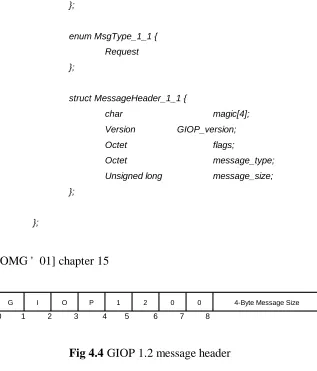
There are three versions of GIOP: versions 1.0, 1.1 and 1.2. GIOP and IIOP were initially defined by CORBA 2.0. They were revised with CORBA 2.1 in order to provide support for message fragmentation. A subsequent revision with CORBA 2.3 added support for bi-directional communication. The latter enables role reversal of the client and server, without the need to open a separate connection that may be blocked by a firewall.
GIOP has eight message types.
Message Type Originator
Request Client
Reply Server
Cancel Request Client
Locate Request Client
Locate Reply Server
CloseConnection Server
MessageError Client or Server
Fragment Client or Server
Fig 2.6 GIOP Message types
The Request message is sent from the client to the server, and is used to invoke an operation or to read or write an attribute.
CHAPTER 3
3. ORB DESIGN
A good place to start with the discussion of the ORB design would be to compare it with the two ORBs that have been illustrated in section 2.4, namely TAO and PalmORB. TAO provides a very advanced and complicated QoS oriented CORBA implementation. It implements the entire CORBA standard, along with some of its own added features and enhancements. While TAO is crucial for real-time mission-critical applications, it is obvious that much of its functionality would be absolutely superfluous for use on a handheld device, even if it was small enough to fit. A much more realistic comparison can be drawn between the designs for this ORB and those for PalmORB. By omitting server side functionality, PalmORB uses a subset of the features provided by the MinimumCORBA standard. It does however implement a minimal client side ORB that can invoke operations on remote CORBA objects. The ORB design for this thesis includes a similar set of ORB features to PalmORB. The main difference being that a PalmShell type application design, to integrate the ORB into a distributed environment was not included.
3.1 Design Goals
Another key design goal was to implement an extensible ORB, to which additional middleware functionality could be added with relative ease, for future use on a more resourceful Palm device than the Palm III, for instance, a Handspring Visor with 8MB.
3.2 Stripped down CORBA standard to fit Palm III Device
• Server-side omission
In a similar fashion to the PalmORB design, the MinimumCORBA client side functionality was included in this ORB, while server side functionality was eliminated. The Palm III presents itself as one of the more primitive of the Palm OS family of handheld devices, and while server side functionality would indeed provide a strong edge on PalmORB, it was deemed unsuitable for the device, which would serve much better as a client in most situations. A decision was therefore made, to concentrate on implementing a solid client side ORB. However an extensible ORB design provided a degree of compensation, with its aim to enabling the easy addition of extended ORB functionality for future use on one of the more modern Palm devices.
Of course, applications exceeding 64KB are also possible for Palm handhelds, but their code must be divided into multiple segments so that no segment exceeds 64KB in its compiled form. This multi segmentation technique also requires the use of special runtime libraries that take up even more space. It was very important therefore to try to avoid using multi segmentation on the Palm III, in order to preserve as much of its 2MB of memory as possible, for permanent data storage, and for the dynamic allocation required by running applications. Omitting server side functionality helped to keep the ORB footprint small. [Henning ' 99]
• Omission of DII
Features that support the dynamic aspects of CORBA are omitted by MinimumCORBA, since the systems for which the standard is targeted make commitments at design-time rather than runtime. Thus, a decision was made to abide by MinimumCORBA and omit the DII. [OMG ' 01] chapter 23.
• Omission of dynamic Anys
The dynamic Any types outlined in section 2.2.6, are omitted from the MinimumCORBA standard, and hence they are also excluded from this ORB design.
• TypeCode, exception and inheritance omissions
Some limited support for TypeCodes is included as part of the MinimumCORBA standard, however the support provided was not considered to be of particular use to this ORB. Thus, a decision was made to omit TypeCodes entirely from the design, in favor of saving on RAM.
System exception features were minimized for this ORB. In any case, the ORB code generated had to be quite small in order to fit onto a handheld, and small code requires reduced exception processing functionality.
The use of inheritance was minimized within the ORB design, however there were certain cases where it had to be included, one of the main areas being in the design of the stub classes. Inheritance provided a clean and easy way of seamlessly linking application specific stub code with ORB stub code, so that any application which implemented its own stubs could inherit from the ORB’s stubs, and hence use the ORB to invoke operations on remote objects. The stub design is discussed in further detail in section 3.3.
• Other omissions
Limited memory space on a handheld means that things like deeply recursive routines, large numbers of global variables, and huge dynamically allocated data structures are not handheld device friendly. The ORB was designed to avoid the over use of global variables, and recursive routines. Data structures were designed to be as small as possible, only including features that are required for basic ORB operation.
Fig 3.1 Client ORB Architecture
While server side ORB functionality has not been included in this design, figure 3.2 depicts a MinimumCORBA compliant client/server architecture. The Portable Object Adapter offers a subset of the functionality provided by a full CORBA implementation. Items that support the dynamic mode of the POA are omitted, in keeping with the minimum standards aim to omit dynamic aspects of CORBA. The dynamic skeleton interface is also omitted.
3.3 ORB Class Diagrams
The key components of the ORB design have been spread over the following four different class diagrams. The design has been broken down into these four major areas in order to enhance the clarity of presentation.
3.3.1 ORB Initialisation
Before the client can invoke on a remote operation, it calls on the methods that initialise an ORB instance. Once the ORB has been initialised, the client can call operations that kick-start the ORB into processing remote object references, and then marshalling a message to send to the target object.
• ORB_init is called by the Client application. It initialises the
ORB run-time and returns a reference to the ORB object. ORB_init expects three arguments, argc, argv and orb_identifier. Argc holds the number of entries in argv, which in turn holds ORB-specific options. Orb_identifier identifies the particular ORB to be initialised. These arguments are useful if an application needs to initialise more than one ORB run-time environment. For example, it is possible for different ORB instances to have different policies and services associated with them, each instance being of particular advantage to a possible subset of client invocation requests. Argc, argv and orb_identifier, were not fully utilised by the ORB developed for this thesis however, since its client application only required a single ORB. However, they were included in the code in order to facilitate the easy extension of the ORB, to produce multiple different ORB instances for a single client application, as mentioned above, for a Palm device with more RAM and processing power than the Palm III.
• The ORB_impl class provides the ORB run-time with access to an object factory class that can be used by the ORB to create an IOR object from an IOR string. This class has been structured to allow for the addition of things like more factory classes, the Initial Service Manager, and the POA Manager [OMG ' 01] chapter 11, for server side functionality, on a more advanced Palm device.
used to marshal request messages and to send then to the correct destination.
• The ObjectFactory generates IOR objects from their string representations. The ORB uses these IOR objects to direct request messages to the correct destination. To do this, the ObjectFactory implements the StringtoObject operation, that calls the CORBAObjectLocator class, which converts the string to an object. This conversion process is discussed in further detail in the implementation section.
• The RefCount class provides a painless mechanism for keeping a count of the number of references that have been made to objects that are referenced frequently throughout the ORB code. These reference counts can then be monitored, so that objects can be deleted when their count drops to zero, thus freeing up valuable memory.
3.3.2 GIOPMessaging
Fig 3.4 GIOP Messaging classes
• The GIOPOutgoingMessage class is responsible for writing
GIOP request messages to the output stream. These messages are then sent from the output stream to the server side ORB.
Details of the GIOP request and reply message formats are discussed in detail in section 4.7.3.
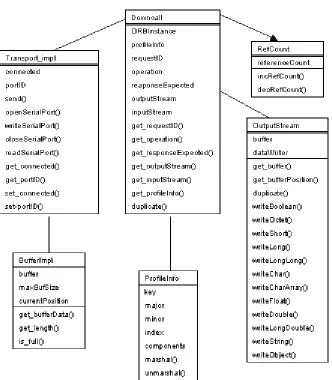
• The OutputStream class contains methods to align all data types on their natural boundaries when writing them to the output stream. This kind of alignment is necessary so that the message can be correctly de-marshalled when sent to the server side. The InputStream class contains methods that can read naturally aligned data types, from reply messages received into the input stream.
Data alignment is discussed in further detail in section 2.2.8.
• The input and output streams use instances of the BufferImpl
class to store data. This class also contains useful methods and holders for determining buffer data positions, in order to facilitate reading of messages from, and the writing of messages to, the input and output streams.
3.3.3 Stub Implementation
Fig 3.5 Stub Implementation classes
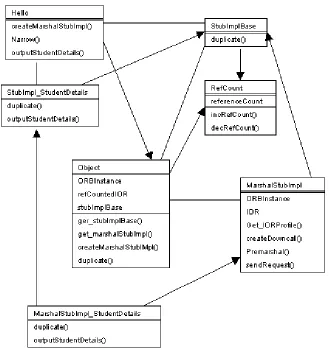
• StudentDetails is the name of the target object that can be invoked remotely. The StudentDetails interface class (not shown in figure 3.5) on the client side, provides the interface between the client application and the stub code that passes a request for a remote object to the ORB core. It contains the outputStudentDetails operation that has a signature identical to that of the remote operation being targeted.
[image:51.612.170.499.70.420.2]• The MarshalStubImpl_StudentDetails class implements the client
application specific proxy code that initiates the passing of a remote object invocation request to the ORB. MarshalStubImpl_StudentDetails inherits from the StubImpl_StudentDetails class, which provides a facility for keeping a reference count on the former’s instances. It also inherits from the MarshalStubImpl class, which is a generic ORB stub class which implements operations that pass a remote object request down to the ORB core, for marshalling and dispatching.
[image:52.612.172.504.268.648.2]3.3.4 ORB Downcalling
• The Downcall class gives a request message an identification
number. It also prompts the writing of a request message to the output stream, and subsequently calls the transport layer to send the message to the server side ORB.
• Transport_impl implements methods to open, write to, read from, and close the Palm device’s serial port. This serial port provides a link from the Palm to a remote application that implements a socket connection, for IIOP, to a server side ORB, as detailed in section 4.2. Transport_impl also interprets replies to request messages that are received from the server side ORB, in order to determine whether or not the request was successfully honoured. Transport_impl effectively acts as the ORBs transport layer, sending messages to, and receiving messages from a server side ORB.
3.4 Extensibility of ORB Design
• Section 3.3.1, on the ORB initialisation design, explains how the initialisation code was designed in order to facilitate the easy extension of the ORB, to enable single clients to use different ORB instances to deal with various remote object invocations, that could require slightly varying ORB characteristics, during the same execution session.
The ORB initialisation classes were also structured to simplify the addition of things like more factory classes, the Initial Service Manager, and the POA Manager [OMG ' 01] chapter 11, to provide server side functionality for a Palm device with more resources available to it than the Palm III.
support the older version if required. This would merely require the insertion of a new case into the GIOP messaging method, to enable the construction of a message under the new version of GIOP. The IOR and reply message interpretation code could also be extended in a similar fashion.
• At the time of writing, this PalmOS ORB was only capable of interpreting IIOP messages related to the TCP/IP communication protocol. However it did have the capacity to read IORs containing multi protocol data. This was achieved by creating a sequencing data structure into which the IOR profile data could be read. Each entry in the sequence would contain information relating to a different communication protocol. Thus, extending the ORB to interpret communication protocols other than just TCP/IP, would simply require the insertion of additional C++ functions, to interpret these protocols.
CHAPTER 4
4. CODE IMPLEMENTATION
Before delving into the actual implementation details of this ORB middleware, it is worth emphasising the fact that implementing such a low level application is a particularly frustrating and exhausting task. To make matters worse, little previous knowledge of the CORBA standard or indeed of the C/C++ programming languages was had prior to undertaking the project, which created even more difficulties. However, in the end, hard work and persistence overcame these obstacles, and all to make life easier for the writers of distributed applications!
4.1 Development Environment
As previously mentioned, a Palm III device, with a Motorola MC68328 “DragonBall” processor was used to develop the middleware for the purposes of this thesis. This provided a big challenge, since, while a Palm III possesses much more in terms of resources than some of its predecessors, it is still limited to a rather diminutive 2MB of memory. The ORB had to be made small enough, to fit easily onto this Palm III device, while leaving a reasonable amount of free memory available for the development of other regular Palm applications, and indeed for other client applications to be used in conjunction with the ORB itself.
• Constructor for Palm OS
This is a resource editor with a graphical interface, that facilitates the development of Palm user interface elements. These elements are combined with the source code to create the finished product.
• Palm OS Emulator
This is also known as POSE. It imitates most of the hardware and software functions of an actual Palm handheld, and can be downloaded onto a desktop computer for use. One of POSE’s most useful features is its accurate emulation of the processors used in a range of Palm devices (including the Palm III). This means that real Palm OS applications can be loaded directly onto POSE for debugging purposes. Debugging on the emulator is faster than on the actual Palm device, and of course, it provides worthwhile savings on batteries!
4.2 Network Connectivity
4.3 Event Driven Programming
Palm OS applications are event driven, receiving events from the OS and either handling them or passing them back to be handled by the OS itself. An event structure describes the type of event that has taken place (for example, a stylus tap on a screen button), as well as information related to that event, such as the screen coordinates of a stylus tap. During a normal application launch, execution is passed to the application’s event loop, which retrieves events from the event queue and dispatches them according to the type of event. The event loop passes most events back to the OS, because the system already has facilities for dealing with common tasks such as displaying menus or determining what button on the screen was tapped. Those events that are not handled by the OS go to the application’s own event handler, which either handles the events if they are interesting to the application, or passes them back to the event loop.
An application event loop was incorporated into the client application that was written to use this ORB. A CodeWarrior facility was used to generate the bones of an application loop. Functions were then written to handle the event loop events that required processing by the application. These events were handled in a way that was specific to the client application’s requirements. For example, if the remote invocation application’s main GUI icon was tapped, that event prompted the opening of the main application form, which indicated what objects were available for invoking on remotely. If such an object was selected, this prompted the initialisation of the ORB. The ORB subsequently interpreted that object’s IOR and marshalled a GIOP message, which it then sent to the correct destination.
Memory management is very important for a Palm OS device with limited memory resources. It is imperative that as much memory as possible be available for allocation at all times. The following paragraphs outline a number of memory management features that were put in place, in order to minimise the possibility of memory leaks, and to ensure that memory would be freed as soon as it was no longer required by either the ORB, or the client application.
4.4.1 Memory Allocation of Strings
For normal desktops, writing to incorrect memory addresses can cause dramatic application failures, but won’t normally affect permanently stored data, because it resides on a separate storage device from the systems main memory. For Palm OS devices on the other hand, the same RAM is used for both data storage and for dynamic memory.
Using RAM for storage provides faster access to data, however, a rigorous means of memory management had to be availed of to prevent the possibility of corrupting permanently stored data. Palm OS APIs were used for allocating memory for strings, in order to prevent the loss of permanent data.
Two different types of memory manipulation functions for Palm OS devices are available for allocating memory for strings, and other straightforward data structures. These are pointer functions and handle functions. The MemPtrNew and MemPtrFree functions are provided to allocate and de-allocate pointers, in place of the C standard library calls, malloc and free. However, a decision was taken to implement the handle functions, based on the following argument:
This is obviously preferable to having lots of small fragments of free space scattered around the memory, which cannot be used if a new data record fails to fit into any of them individually. Pointers use only unmoveable memory chunks, and so they do not avail of the latter memory management facility. However, handle functions allow applications to manipulate chunks of memory that may be moved by the operating system. If the operating system needs to allocate memory, it can move handles around until there is enough contiguous memory for the new data to be allocated. New memory can be allocated with the MemHandleNew function and freed using the MemHandleFree function. Also, because the operating system may freely decide to move the memory associated with a handle at any time, the handle must first be locked with the MemHandleLock function before it can be read from, or written to. While the handle is locked, the operating system will not move its memory to another location. The handle can subsequently be unlocked using the MemHandleUnlock function, when the read or write operation has been completed. This approach greatly increases the efficient use of the limited memory on a Palm device. [Foster ' 00]
4.4.2 Memory Allocation of Classes
The new and delete operators in C++ facilitate the dynamic allocation of memory for structures whose sizes aren’t known until runtime. Since support for the latter operators was included in the version of CodeWarrior used to develop this ORB (though not in previous versions), they were both used in the allocation and de-allocation of memory for class structures.
However, as for string referencing, creating references to and removing references from such classes complicates the issue of when dynamic memory can be de-allocated. Normally, a programmer must keep track of the number of references to an object, so that the object can be explicitly de-allocated when there are no remaining references to it. This point represents a memory management issue that puts extra workload on the programmer, and runs the risk of producing memory leaks.
A set of smart pointer classes known as var types, that use the same principles as String_var, have been implemented [Henning ' 99], to alleviate the burden of having to explicitly de-allocate variable-length structures and to make memory leaks less likely. This works by associating a _var class with each normal class type. The class provides the required functionality, while the _var class acts as a memory management wrapper around the former. This means that the _var class takes care of de-allocating normal instances at the appropriate times. This de-allocation process uses reference counters to keep track of the number of references to each of its class instances.
4.4.3 Reference Counting
decremented when a local reference to the object is deleted. The idea behind this is that once the object’s reference count falls to zero, it is automatically de-allocated. This helps to prevent memory leaks.
• _ptr types: When assigning between two _ptr type object references , the reference count is incremented explicitly using a _duplicate function. A _duplicate function has been implemented for all of the objects that require its use. A release function is used to explicitly decrement the reference count for _ptr types.
• var types: _var types can handle reference counts automatically. Therefore, for objects with associated _var types, the burden of explicitly incrementing and decrementing reference types is eliminated. In a _var type, the ‘=’ operator is overloaded, so that when such a type is assigned a value using the ‘=’ operator, its reference count is automatically incremented. Also, when the _var type goes out of scope, its reference count is automatically decremented in its destructor. [Henning ' 99]
4.4.4 Directional Attributes
In compliance with the CORBA standard, three types of parameter attributes were made available to clients who wish to pass parameters as part of a remote invocation. These are:
• in
The in attribute indicates that the parameter is sent from the client to the server.
• out
The out attribute indicates that the parameter is sent from the server to the client
The inout attribute indicates a parameter that is initialised by the client and sent to the server. The server can modify the parameter value, so after the operation completes, the client parameter value may have been changed by the server.
Directional attributes are required for two reasons. They are necessary in order to know when a parameter must be sent from a client to a server or vice versa. This enables some savings in transmission costs. Also, directional attributes are required to assist in memory management. For example, the client application implemented as part of this thesis includes inout string parameters to be read and/or modified by the target object on the server side. This means that ownership of the string parameters in this application is temporarily given to the server so that the server can de-allocate and re-allocate the strings in order to modify them. After the invocation however, ownership of the strings is returned to the client. To ensure de-allocation of the string parameters after target object invocation, the strings are declared as String_vars, so that they will be automatically de-allocated when they go out of scope.
Memory management for operation parameters varies with the direction and type of parameter. Directional attributes control whether the client or the server is responsible for allocating and de-allocating memory for parameters. Memory management details for in and out parameters can be obtained from most common CORBA textbooks. [Baker ' 97]
All of the above memory management mechanisms help to prevent memory leakage.
Template classes, which provide one of C++’s most powerful capabilities for software reuse, were implemented to enable the specification, within a single code segment, of an entire range of related classes.
At runtime, templates are used to create the _var objects, described in section 4.4.2. Rather than reproducing similar _var type code for all objects that require a _var wrapper, these objects were divided into object groups containing similar characteristics. A template was then produced for each such group. At runtime, any object requiring a _var wrapper for memory management purposes, is passed into its respective _var template class, where it is subsequently assigned a private variable that holds a pointer to the class type that the wrapper encapsulates. This approach reduced the amount of code that had to be written and also minimised the resulting code footprint.
4.6 Big Endian Vs. Little Endian
An important fact that had to be kept in mind during the Palm OS program design and implementation, was that all data entering or leaving the device was arranged in Motorola’s big-endian byte order. In other words, multi-byte data types such as long integers were arranged with their most significant bytes at the lowest memory address, and vice versa. This detail was very important when connecting to Intel-based machines, all of which use little-endian byte ordering.