INTRODUCTION
At the beginning of the 3rd millennium, the services
intensively influence all phases of the reproduction pro-cess. According to the data of the Statistical Office of the Slovak Republic, the share of the services in the GDP in 2001 represented 58.22%; in 2002 it dropped to 53.65% level. From the national economy wider point of view, the services form the most massive sector of the Slovak eco-nomy. The results of the national economy are more and more dependent on rational link between production and services in the individual sectors, including agricultural sector. After the year 2000, the Slovak agrarian complex has moved to the final stage of its changes in context of the common EU market accession.
Agrarian services are formed by a wide scale of busi-ness subjects and specialised organisations in the re-gions of the Slovak Republic. There is a progressive move towards changes in the enterprises providing bio-logical, technical, and other specialised services for plant and animal production sector. These changes include predominantly the service demand, service supply, their structure and quality, their number, and efficiency of business subjects in the agrarian complex. Subjects sup-plying services for companies farming on the land are still being formed and they use a progressive approach known from the well-developed foreign countries.
Several authors solve the problem of the specialised services for agricultural companies. Blaas and collective (1999) analyse the development of the agricultural vices after 1990 year. Changes in the area of agrarian ser-vices in Slovakia and their influence on the expected development of the agrarian sector are explored by Bie-lik, Gurčík (2002) and Kuzma (2002). The process of the services transformation in the agrarian structures and services as a specific part of the agrarian resort is evalu-ated by Zoborský, Laclavík, Stričík (2003) and Zoborský (2002).
MATERIAL AND METHODS
As agrarian services, there can be understood specific activities of above-enterprise character, supplied to agri-cultural companies, which are involved into the chain of food production and processing, and significantly influ-ence the results of companies farming on the land. Since 1974, we have studied business activities and economic assets of the selected services subjects within the agrar-ian system, and their position in the economy of Slova-kia. Since 2000, we have continued in uncovering the reserves in state and non-state services for plant and animal production. In this paper, we analyze our own data, base information of the Central Tax Office of the SR, the
Forming of the agrarian services in Slovakia in the process
of European integration
Formovanie agrárnych služieb na Slovensku v procese európskej integrácie
I.M. Z
OBORSKÝSlovak University of Agriculture, Nitra, Slovak Republic
Abstract: The paper analyses formation of specialized activities of Slovak agrarian services. The paper focuses attention on the definition of agrarian services, evaluation of their position and progress of their transformation, their quantitative development and distribution in the regions of the Slovak Republic, as well as on their economic results during the period from 1995 to 2001. Biological, technical, and other specialized services significantly influence the reproduction process of the plant and animal production even in the period of European integration.
Key words: agrarian services, economic indicators, the Slovak Republic, development tendencies
Abstrakt: Práca analyzuje formovanie špecializovaných činností charakteru agrárnych služieb na Slovensku. V príspevku sa položil dôraz na vymedzenie agrárnych služieb, posúdenie ich pozície a priebeh transformácie, na vývoj počtu subjektov poľnohospodárskych služieb, ich rozmiestnenie v jednotlivých regiónoch Slovenskej republiky a na dosiahnuté ekonomické výsledky v rokoch 1995–2001. Biologické, technické a ostatné špecializované služby aj v období európskej integrácie vý-znamne ovplyvňujú reprodukčný proces rastlinnej a živočíšnej výroby.
Ministry of Agriculture of the SR, the Research Institute of Agricultural and Food Economics, the ‘Agriregister’, the Statistical Office of the SR, and other institutions. In the paper, we also process the information reached with-in doctoral studies and withwith-in an elaboration of the sci-entific monograph entitled ‘Agrarian services’, published by the Slovak Agricultural University in Nitra in 2003. The paper draws also from the research project (2000–2002), focused on the biological and technical services for the plant and animal production sectors.
Several methods and economic indicators evaluate the development tendencies of the agrarian services in Slo-vakia during the time of the European integration. The changes in the area of agrarian services and on the trans-formation of the subjects providing the services after 1990 are emphasized. We analyzed the present structure and number of the companies providing services for ag-riculture from the point of view of their distribution with-in the regions with-in the Slovak Republic, and we evaluated also their economic results during the years 1995–2001. Our further research develops methodological approach-es to biological, technical, and other specialized servicapproach-es for agricultural companies.
RESULTS AND DISCUSSION
Services for the agricultural prime production compa-nies undergo a difficult stage of development. Numerous-ness of companies providing the agrarian services and their activities changed in the above-mentioned period of the development of Slovak agriculture. Most activities of the agrarian services were an integral part of agricul-ture, other services were provided by other sectors of economy. Specialized activities (as the industrial produc-tion of the fodder mixtures) were detached from the struc-ture of companies farming on the land, and these specialized activities started to be provided by individu-al agriculturindividu-al companies. Corporate agriculturindividu-al compa-nies have been established and some of them are known as the subjects providing services in plant nutrition and protection, in the soil fertilization, and in the agricultural building industry. The farmers evaluated specialized ac-tivities of the services, which were provided by agri-chemical and agri-building enterprises, quite favorably. Systems of crop technologies were developed as a new kind of complex services and they significantly influ-enced mostly the development and the results of the plant production sectors (cereal industry, oil production, production of pulses, root crops, technical and special crops). Also other sectors of the food-processing indus-try provide specific activities of the agrarian services character (e.g. oil industry, sugar refineries, breweries and other food production sectors, which process row materials of the plant origin).
Till 1990, big state companies formed the sectors of in-puts and processed outin-puts with the influence spread all over Slovakia. Transformation of the agrarian services did not differ from the other parts of agricultural sector.
After 1990, an evident decline of the agrarian services was noticed.
The delimitation, which ran from 1990 till 1994, was considered the preparation phase of the privatization process of the services companies. The highest number of the delimitated companies was in 1990 and 1991. From 18 former state service companies, new 114 agricultural companies were created. The biggest share in these com-panies was formed by agricultural trade (34.7%), compa-nies of services for plant production (19.8%), and companies of services for agricultural building industry (17.7%).
Small privatization of agrarian services did not signifi-cantly influence the total privatization process. Only 0.14% of the service companies took part in the small privatization. Their share in the upset price was 1.02% and in the auction price only 0.76%.
47 service companies were included in the first wave of privatization, and it represented 33.8% from the total number of the companies in the agricultural sector. To sum it up, during the period of 1992–1993, 28 companies of agricultural trade; 17 companies of technical, building, and project services, and 5 companies of biological ser-vices were sold. Coupon privatization touched 50 sub-jects of agrarian services. Service companies participated by 40.89% in the total number of subjects integrated in the coupon privatization.
Since 1995, the Slovak Land Fund has significantly in-fluenced the privatization of agri-service companies. It has influenced mostly the seed production state enter-prises, which were delimited from the State Seed Produc-tion Company. During the second wave of privatizaProduc-tion, the Slovak Land Fund assigned sale of 33 state service companies.
Liquidation and bankruptcies were a side-effect phe-nomenon of the transformation and it affected 24 compa-nies of agricultural services. In the majority of the companies of agricultural trade and biological services the original object of activity was sustained. There was a remarkable change of the orientation of technological and building services. The diversification of the business activities is a characteristic feature for the successor companies; it concerns mostly the trade activities and activities provided for other non- agricultural sectors. As it is adduced in the final report on the complex transfor-mation, 5 state service enterprises, or their parts, were not privatized.
In the process of privatization, there were no capital links between the primary producers and the subjects of services. Therefore, the subjects of the primary produc-tion did not have a direct influence on the companies providing services for plant and animal production. The model of the mutual connection between the primary pro-duction and services, successfully working in most of the developed countries, might be prosperously used also in Slovakia.
above-company services are provided by numerous groups of non-state companies. Farming companies of plant and animal production provide some specific services of the production or technological character.
A view on the agrarian services can be very wide, if the producers and suppliers of the agricultural technology, fertilizers, chemical protection aids, and other necessities for agricultural performance are included, on the other hand, the view can be reduced only to the enterprises, which belong to the agricultural sector. The above-men-tioned approaches are also reflected by the diverse data about the number of the agrarian service companies.
As it is stated in the resources of the Ministry of Agri-culture of the Slovak Republic and the Research Institute of Agricultural and Food Economics, in 1993 there were in the sector of agrarian services in Slovakia: 59 state companies, 146 trade companies and other enterprises providing services in the agrarian complex. In 1995, 143 subjects and technical services by app. 100 compa-nies provided biological services. Other compacompa-nies were oriented onto data processing, trade and advisory ser-vices. In the period 1996–1999, the number of the busi-ness subjects in the area of services for agriculture rose. The Research Institute of Agricultural and Food Econom-ics in Bratislava in 2002 registered 1 322 subjects of agri-cultural services. Biological and trade service companies formed the most numerous groups. From the companies of agrarian services registered by the Ministry of Agri-culture of the Slovak Republic, nearly 96% were trade companies. The share of the big companies was step-by-step decreasing. According to the Tax Office of the Slo-vak Republic, which registers the business companies via the Tax Informative System, the number of the regis-tered subjects of the agricultural services (prevailing activity) was as follows: 4 725 subjects in 1995, 4 762 in 1996, 4 852 in 1997, 4 953 in 1998, 5 057 in 1999, 5 175 in 2000, and 5 239 in 2001. In 1995 the most numerous group was the group providing biological services (67.9%). Even in 2001, biological services were the most dominant (66.7%). In the evaluated period, the number of subjects rose by 510. It is also necessary to mention the fact, that
in 1995, from the total number of the registered subjects almost 36% were non-active. In 1997, this indicator rose by 42.9% and in 2001, the number of non-active compa-nies of agricultural services reached almost 50%.
The Green Report 2003 states 1 461 subjects of the agricultural services, from this number, there were 3 state companies, 15 cooperatives, 1 065 trade companies, 86 other corporate bodies, and 292 natural persons. From the total number of the service companies, the econom-ic-technological and trade services were represented by 1 108 subjects, 332 subjects provided agricultural and bi-ological services, 21 subjects provided other services. In 2002, the number of corporate bodies increased by 68 subjects and the number of natural persons decreased by 17 subjects. The number of the corporate bodies pro-viding agricultural and biological services increased most significantly. Newly created companies are mostly orient-ed towards the services of the plant production and on feed production. New corporate bodies were also creat-ed during the processing of these data.
The Statistical Office of the Slovak Republic classifies all the subjects of the plant and animal production ser-vices as the agricultural sector. However, the subjects of the building and advisory services, data processing ser-vices, and financial and other services for agriculture are not classified as the agrarian services.
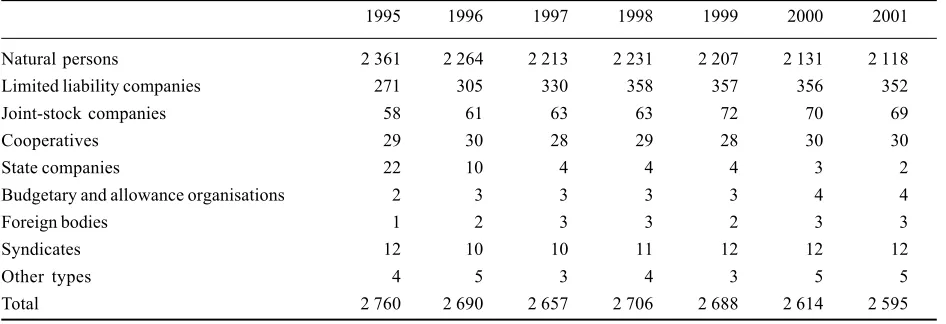
According to our research, the number of the agrarian services subjects in Slovakia was in the last years app. 2 600 (Table 1). Natural persons represented around 80% of the total number of the subjects of agrarian services. The number of the state companies and natural persons in the studied period decreased, the trade companies re-presented 15% of the total number. The structure of the agrarian services by their types has recently not signifi-cantly changed.
[image:3.595.56.529.582.744.2]We have evaluated also the numerousness of the agrarian service subjects from the point of view of their distribution within the regions of Slovakia (regions and districts). Till 1989, there was a group of specialized agrarian service companies in each region of Western Slovakia (Table 2). Nowadays, the share of the service
Table 1. Number of the subjects providing agricultural services by the types in the SR
1995 1996 1997 1998 1999 2000 2001
Natural persons 2 361 2 264 2 213 2 231 2 207 2 131 2 118
Limited liability companies 271 305 330 358 357 356 352
Joint-stock companies 58 61 63 63 72 70 69
Cooperatives 29 30 28 29 28 30 30
State companies 22 10 4 4 4 3 2
Budgetary and allowance organisations 2 3 3 3 3 4 4
Foreign bodies 1 2 3 3 2 3 3
Syndicates 12 10 10 11 12 12 12
Other types 4 5 3 4 3 5 5
Total 2 760 2 690 2 657 2 706 2 688 2 614 2 595
companies in this region (Bratislava, Trnava, Nitra, Trenčín) reaches almost 60%. The subjects providing services in the area of pesticides (63% from the total ser-vice companies number) and in the area of fodder and projection services are typical for the Bratislava region. Producers of the seed are concentrated in the highly productive regions of Slovakia (Nitra, Trnava, Bratisla-va). Their share is more than 65%, most of these sub-jects are concentrated in Nitra and Trnava regions. A very similar situation can be seen in the field of the sci-entific research. A more even distribution is that of the subjects of the plant services, as well as the agricultur-al building services. Most of the subjects providing veterinary and breeding services are located in the mar-ginal parts of Slovakia.
The development of the economic results of the agri-cultural service companies in Slovakia during the period 1995–2001 is given in the Figure 1–3.
[image:4.595.57.533.77.323.2]Economic results of the agrarian service subjects from 1994 to 2001 indicate, that the revenues and the costs are higher year by year, mostly in the limited lia-bility companies, which belong to the small and middle size companies. Revenues in 2001 increased in compar-ison to 1995 by 1.77%, costs increased by 1.12%. In spite of the low share of the joint-stock companies in the companies’ total number, this type reached 46 % share in the total re-venues and now less than 48% share in the total outputs of the services companies. In 1994, the agrarian service companies had the loss of 50 millions SKK. In 1995–1997 they managed to make a Table 2. Groups of the agricultural services in the Slovak Republic by regions
Service group Region Share in %
BA T T TN NR ZA BB PO KE
Services in the plant production 9 14 10 14 4 8 4 13 3.7
Seed producers 47 72 20 75 18 26 19 20 14.4
Services in the animal production 9 6 5 4 11 8 5 14 3.0
Veterinary services 17 30 26 88 26 72 72 38 17.9
Veterinary medicals 13 9 6 8 5 4 6 4 2.7
Technical services 4 11 7 13 13 17 7 11 4.0
Trade services 87 48 20 92 40 39 37 36 19.4
Building services 3 9 1 12 5 9 9 8 2.7
Projection services 41 8 6 7 3 7 7 12 4.4
Services in the fodder area 98 50 30 73 30 51 31 44 19.8
Services in the area of the pesticides 38 5 3 6 1 1 2 4 2.9
Data processing services 4 2 - 1 - 2 1 3 0.6
Scientific research base 7 3 2 3 1 1 1 2 1.0
Other services 37 7 2 11 6 4 4 1 3.5
Region in % 20.1 13.3 6.7 19.8 7.8 12.1 10.0 10.2 100.0
Source: Agrion, Agroregister, the Ministry of Agriculture of the SR, the Central Control and Testing Agricultural Institute, and the author’s calculations
Bratislava (BA), Trnava (TT), Trenčín (TN), Nitra (NR), Žilina (ZA), Banská Bystrica (BB), Prešov (PO), Košice (KE)
16,000,000,000 17,000,000,000 18,000,000,000 19,000,000,000 20,000,000,000 21,000,000,000 22,000,000,000
1995 1996 1997 1998 1999 2000 2001
[image:4.595.84.487.599.739.2]profit, but in 1998–2000 they got to the loss again. The most numerous is the group of physical persons. This group provides mainly biological services and during the time of the studied period, it reached positive eco-nomic results.
The foreign capital was present in approximately 60 subjects, while its highest representation was in the Ltd companies. The highest share of the subjects with the presence of the foreign capital was in the western regions of Slovakia.
During the last years, agricultural cooperatives and other companies farming on the land played a significant role in the area of mechanization services. New enterpris-ing subjects in the form of the above-company exploita-tion of the technology, mostly harvesting machines, supply of the specialized technological services for the sectors of plant production. Higher requirements are put on advisory services in all fields of economy, including agriculture. It is necessary to update and adapt them to new conditions and trends, which are related to the ex-ploitation of the EU funds.
CONCLUSION
Both market and non-market services are the biggest sector of the economy in the well-developed countries.
Demands on services are increasing with the increas-ing economic level. We notice also the connection of the agrarian services and other sectors of the national economy. Economics of the agrarian service subjects is determined by the agricultural production as a consumer of these services. Nowadays, even in Slo-vakia, there are more and more used progressive ap-proaches from the foreign countries. Agricultural farmers positively evaluate biological services for the plant and animal sectors as their consumer. In this sec-tor, we do not expect any significant changes. In the sector of services provided to the plant production, we assume, that new types of business subjects will pro-vide some specific technological activities. Some of the agrarian service companies will be probably integrated into combined business groups. The services for agri-cultural primary production will significantly influence the results of the agriculture and the development of the countryside. Agrarian services are related with local subjects assigning regional development activities. Accordingly to the demands of the producers of the raw plant and animal production, they may play a highly im-portant role and positively influence economic results of the primary sector subjects. It can be stated, that services for agricultural companies will be a significant specific part of agricultural sector even during the time of the European integration.
18,000,000,000 18,500,000,000 19,000,000,000 19,500,000,000 20,000,000,000 20,500,000,000 21,000,000,000 21,500,000,000 22,000,000,000
[image:5.595.80.482.62.217.2]1995 1996 1997 1998 1999 2000 2001
Figure 2. Development of the cost level in the agrarian service companies (in SKK)
-800,000,000 -600,000,000 -400,000,000 -200,000,000 0 200,000,000
1995 1996 1997 1998 1999 2000 2001
[image:5.595.77.473.274.375.2]REFERENCES
Bielik P., Gurčík Ľ. (2002): Structural changes in the Slovak agriculture. Economics, finances and management. Bratisla-va, EU: 112–116; ISBN 80-225-1616-3.
Blaas G. and coll. (1999): Analyses of the agricultural devel-opment and food industry in time period of 1990–1998. Bratislava, Research Institute for Agricultural and Food Economy, 194 p.
Kuzma F. (2002): Agrarian policy in the process of integra-tion. Nitra, Slovak Agricultural University: 1291–1295; ISBN 80-8069-031-6.
Green Report 2003. Bratislava, Ministry of Agriculture of the Slovak Republic.
Svatoš M, Bielik P., Hron J., Okenka I., Podolák A., Tvrdoň J. (1999): Economics of Czech and Slovak Agricultural Inte-gration with the EU. Praha, Czech Agricultural University, 248 p.; ISBN 80-213-0497-7.
Zoborský I.M. (2002): Agrarian services as a specific part of agricultural resort. In: Economics of Agriculture, III., pp. 3– 7; ISSN 1335-6186.
Zoborský I.M., Laclavík J., Stričík M. (2003): Agrarian ser-vices (scientific monograph). Nitra, Slovak Agricultural University, 170 p.; ISBN 80-8069-134-7.
Arrived on 22nd June 2004
Contact address:
Prof. Ing. Ivan Mojmír Zoborský, CSc., Slovenská poľnohospodárska univerzita v Nitre, Tr. A. Hlinku 2, 949 76 Nitra, Slovenská republika