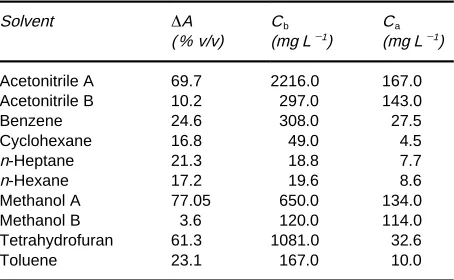
Table 2 Concentration of water and difference in absorbance for cut-off (A) of solvents before (Cb) and after (Ca) purification
Solvent A
( % v/v) Cb (mg L\1)
Ca (mg L\1)
Acetonitrile A 69.7 2216.0 167.0
Acetonitrile B 10.2 297.0 143.0
Benzene 24.6 308.0 27.5
Cyclohexane 16.8 49.0 4.5
n-Heptane 21.3 18.8 7.7
n-Hexane 17.2 19.6 8.6
Methanol A 77.05 650.0 134.0
Methanol B 3.6 120.0 114.0
Tetrahydrofuran 61.3 1081.0 32.6
Toluene 23.1 167.0 10.0
Reproduced with permission from Buszewski, Lodkowski and Trocewicz (1987).
methods have been utilized for measuring the charac-teristic parameters. Generally, chromatographic techniques such as gas chromatography (GC), LC, thin-layer chromatography (TLC) have been used, but ultraviolet (UV), infra-red (IR) and nuclear magnetic resonance (NMR) spectroscopy can also be applied. Water in many organic solvents is usually determined by Karl Fischer titration. On the basis of experimental data obtained before and after puriR ca-tion the efRciency of the clean-up procedure is determined. In general, the efRciency of puriRcation process, e.g. the recovery, is expressed by the coefRcient R. This parameter is deRned as the ratio of the volume or concentration of removed impurities to the volume or concentration of solvent before puriRcation:
R$"(Va$a)(Vb$b);100% (v/v) [1]
or:
R$"(Ca$a)(Cb$b);100% (v/v) [2]
whereVa,CaandVb,Cbdenote volume or
concentra-tion of the removed impurities and solvent samples, respectively, and ,a,b are individual standard
deviations.
Table 2summarizes the results of solvent puriR ca-tion by frontal analysis. In each case, puriRcation of the solvent improves its absorbance at the cut-off point (A).
The small improvement found in the case of the LC grade methanol B is as expected for this high-purity solvent. The high impurity (absorbance difference,
A"77.5%) of analytical grade methanol A pre-cludes its use in LC investigations. Similarly, tol-uene, benzene, tetrahydrofuran and acetonitrile A cannot be used in LC measurements without prior puriRcation.
Recovery values for the puriRcation of water, acetonitrile, alcohols, ketones, aliphatic and aromatic hydrocarbons obtained in distillation methods are usually in the range 85}95% (v/v). In the case of halogenated solvents this range is narrower, i.e. 75}80% (v/v). Utilizing membrane techniques for solvent clear-up, it is possible to obtain recovery in the range 90}97% (v/v).
See also: II/Distillation: Laboratory Scale Distillation.
Membrane Separations: Filtration. III/Flash Chromato-graphy.
Further Reading
Brock TD (1983)Membrane Filtration. Madison: Science Technology.
Buszewski B, Bleha T and Berek D (1985) UV detection of solvent peaks in liquid chromatography with mixed eluents. Journal of High Resolution
Chroma-tography and ChromaChroma-tography Communications 8:
860}862.
Buszewski B, Lodkowski R and Trocewicz J (1987) PuriR -cation of solvents for liquid chromatography.Journal of High Resolution Chromatography and
Chromatogra-phy Communications10: 527}528.
Hampel CA and Hawley GG (eds) (1973/74)Handbook of
Chemistry and Physics, 54th edn. Cleveland: CRC Press.
Minear RA and Keith LH (eds) (1984)Water Analysis, vol. III. Orlando: Academic Press.
Poole CF and Poole SK (1991) Chromatography Today. Amsterdam: Elsevier.
Riddick JA and Bunger WB (1970)Organic Solvents, 3rd edn. New York: Wiley Interscience.
SORBENT SELECTION FOR
SOLID-PHASE EXTRACTION
E. M. Thurman, US Geological Survey, Lawrence,
KS, USA
Copyright^ 2000 Academic Press
with a solvent appropriate for instrumental analysis. The mechanisms of retention include reversed phase, normal phase, size exclusion, and ion exchange. Solid-phase extraction was invented in the mid 1970s as an alternative approach to liquid}liquid extraction for sample preparation.
Initially, SPE was based on the use of polymeric sorbents, such as XAD resins, which were packed in small disposable columns for use on drug analysis. The early environmental applications consisted of both XAD resins and bonded-phase sorbents, such as C18. These precolumns were used for sample trace
enrichment prior to liquid chromatography and were often done on line, which means at the same time as liquid chromatography. However, these Rrst, steel, on-line precolumns were quickly replaced with an off-line column made of plastic, in order to be both inexpensive and disposable. Eventually, the term solid-phase extraction was coined for these low-pressure extraction columns.
SPE columns are now typically constructed of poly-propylene or polyethylene and Rlled with 40-m packing material with different functional groups. A 20-m polypropylene frit is used to contain from 50 mg to 10 g of packing material. A liquid sample is passed through the column and analytes are concen-trated and puriRed. The sample volume that can be applied ranges from 1 mL to over 1 L. The sample may be applied to the column by positive pressure or by vacuum manifold. After quantitative sorption of the analyte, it is removed with an appropriate elution solvent.
Therefore, SPE is a form of ‘digital’ liquid chromatography that removes the solute onto a solid-phase sorbent by various sorption mechanisms. The term ‘digital’ refers to the on/off mechanism of sorp-tion and desorpsorp-tion. The goal of SPE is to quan-titatively remove the analyte from solution and completely recover it in an appropriate solvent. PuriRcation consists of removing the analyte from interfering compounds and concentrating the analyte in a small volume of solvent. For example, pesticides are concentrated from a water sample by SPE into a small volume of organic solvent for analysis by gas chromatography/mass spectrometry. Interfering sub-stances, such as humic and fulvic acids, ionic metab-olites and salts are removed.
Typically, SPE replaces liquid}liquid extraction as a sample preparation tool and provides a method that is simple and safe to use. The beneRts of SPE include: high recoveries of analytes; puriRed extracts; ease of automation; compatibility with chromatographic analysis; and reduction in the consumption of organic solvents. As a result of theSexibility that SPE offers, it has found application in the preparation of
environ-mental, clinical, and pharmaceutical samples. The simplicity of the SPE procedure and the use of dispos-able SPE supplies have encouraged the design of auto-mated sample preparation stations, which decrease the time and cost of sample preparation. Finally, recent advances in on-line methods of SPE allow automation of sample preparation directly to both liquid and gas chromatography.
How to do SPE
Figure 1illustrates the four-step process of SPE. First the solid-phase sorbent is conditioned (step 1). This simply means that a solvent is passed through the sorbent to wet the packing material and to solvate the functional groups of the sorbent. Furthermore, the air that is present in the column is removed and the void spaces are Rlled with solvent. Typically, the condi-tioning solvent is methanol, which is then followed with water or an aqueous buffer. The methanol fol-lowed by water or buffer activates the column in order for the sorption mechanism to work properly for aqueous samples. Care must be taken not to allow the bonded-silica packing or the polymeric sorbent to go dry. In fact, if the sorbent dries for more than several minutes under vacuum, the sorbentmustbe reconditioned. If it is not reconditioned the mech-anism of sorption will not work effectively and re-coveries will be poor for the analyte.
Another cleaning step of the sorbent may also be added during conditioning, if necessary. Simply, the eluting solvent is passed through the column after the methanol wetting step to remove any impurities that may be present in the packing material. This cleaning step would then be followed by methanol and aque-ous buffer, which prepares the column for sample addition.
Next, the sample and analyte are applied to the column (step 2, Figure 1). This is the retention or loading step. Depending on the type of sample, from 1 mL to 1 L of sample may be applied to the column either by gravity feed, pumping, aspirated by vacuum, or by an automated system. It is important that the mechanism of retention holds the analyte on the col-umn while the sample is added. The mechanisms of retention include Van der Waals (also called non-polar, hydrophobic, partitioning, or reversed-phase) interaction, hydrogen bonding, dipole}dipole forces, size exclusion, and cation and anion exchange. Dur-ing this retention step, the analyte is concentrated on the sorbent. Some of the matrix components may also be retained and others may pass through, which gives some puriRcation of the analyte.
Figure 1 The four-step process of solid-phase extraction. Step 1, condition sorbent; step 2, apply sample and analyte; step 3, wash; step 4, analyte elution. (Reprinted from Thurman and Mills (1998) Copyright John Wiley & Sons, Inc.)
Figure 2 The three formats of SPE: (A) discs; (B) cartridges; and (C) syringe barrels. (Reprinted from Thurman and Mills (1998) Copyright John Wiley & Sons, Inc.)
remove the sample matrix from the interstitial spaces of the column, while retaining the analyte. If the sample matrix is aqueous, an aqueous buffer or a water/organic-solvent mixture may be used. If the sample is dissolved in an organic solvent, the rinse solvent could be the same solvent.
Finally, in step 4 an appropriate solvent is used that is speciRcally chosen to disrupt the analyte}sorbent interaction, resulting in elution of the analyte from the sorbent. The eluting solvent should remove as little as possible of the other substances sorbed on the column. This is the basic method of solid-phase extraction.
Columns and Apparatus for SPE
[image:3.568.138.436.504.684.2]treat-Figure 3 Disposable column and reservoir. (Reprinted from Thurman and Mills (1998) Copyright John Wiley & Sons, Inc.) ment of different types of sample and different sample
volumes.
Currently, the most commonly used format for SPE consists of a syringe barrel that contains 40-m sorbent material, with a 20-m polypropylene frit at the bottom and a 20-m polypropylene frit at the top of the syringe. The syringe barrel is typically poly-propylene with a male Luer-tipRtting and is dispos-able. Some vendors do make glass syringe barrels and TeSon frits, but these conRgurations are used less frequently. The glass and TeSon system is used when one is interested in the analysis of plasticizers or is concerned with the potential sorption of speciRc analytes onto the polyethylene tube.
Solvent reservoirs may be used to increase the vol-ume of the syringe barrel. Reservoirs are typically 50}100 mL in volume. CouplingRttings are used to join the reservoirs and syringe barrels between the Luer Rtting and the opening of the syringe barrel (Figure 3).
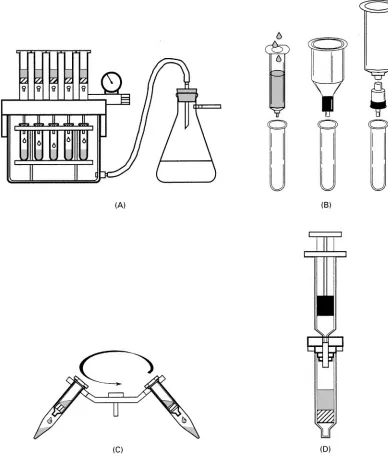
The barrel of the syringe terminates in a male Luer tip. The male Luer tip is the standardRtting on SPE cartridges, so that they are interchangeable with dif-ferent SPE vacuum manifolds. The vacuum manifold is used to draw the sample and eluting solvents through the syringe barrel under negative pressure by applying a vacuum to the manifold.Figure 4Ashows a typical vacuum-manifold system, which is Rtted with a small vacuum pump and a waste receiver. Stopcock valves are available to control the vacuum applied to each column. Other types of sample processing that may be used include centrifugation (Figure 4C) and positive pressure (Figure 4D), which forces the sample through the syringe barrel from above. Simple gravitySow through the syringe barrel or cartridge may also be used (Figure 4B).
A typical solid-phase extraction cartridge (see Fig-ure 2) consists of a polyethylene body with both a female and male Luer tip for positive pressure from a syringe, or negative pressure from a vacuum mani-fold. Polyethylene frits measuring 20m are placed at either end of the cartridge to hold the packing material in place. The packing material is packed and com-pressed to improve or optimizeSow characteristics.
The third type of SPE format is the disc, which is available in several styles by different manufacturers. One of the most popular extraction discs is the Em-pore威 extraction disc, which consists of 8}12m particles of packing material embedded in an inert matrix of polytetraSuoroethylene (PTFE)Rbrils. Be-cause the particles are suspended in PTFE, no binder is required to give structure to the disc and the matrix is essentially inert. The discs are not coated with PTFE so that they can interact with the solvent and sample during extraction. The discs are available in
[image:4.568.305.496.47.589.2]Figure 4 Techniques for processing SPE cartridges: (A) vacuum manifold; (B) gravity; (C) centrifugation; and (D) positive pressure. (Reprinted from Thurman and Mills (1998) Copyright John Wiley & Sons, Inc.)
a similar fashion to the packed columns, withSow of sample by negative pressure by vacuum.
A major advantage of the disc format is rapid mass transfer because of the greater surface area of the 8}12m particles, which results in highSow rates for large volume samples. This rapid Sow rate is espe-cially useful for environmental samples where 1 L of water may be processed in as little as 15 min. Rapid mass transfer owing to embedding of small particles into the disc also means that channelling is reduced and small volumes of conditioning and elution sol-vents may be used. For example, a 4-mm disc in syringe format (extraction disk cartridge) requires
only 100L of elution solvent, and a 7-mm disc uses only 250L. This volume is small compared with the millilitre amounts applied to a 3}5-mL syringe barrel that contains loose packing.
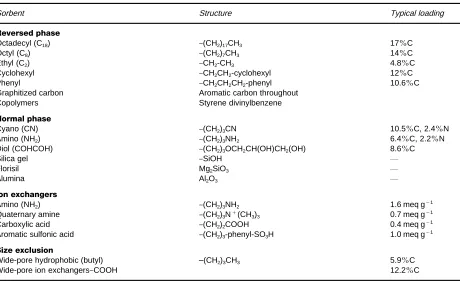
Table 1 Common sorbents available for SPE
Sorbent Structure Typical loading
Reversed phase
Octadecyl (C18) }(CH2)17CH3 17%C
Octyl (C8) }(CH2)7CH3 14%C
Ethyl (C2) }CH2-CH3 4.8%C
Cyclohexyl }CH2CH2-cyclohexyl 12%C
Phenyl }CH2CH2CH2-phenyl 10.6%C
Graphitized carbon Aromatic carbon throughout
Copolymers Styrene divinylbenzene
Normal phase
Cyano (CN) }(CH2)3CN 10.5%C, 2.4%N
Amino (NH2) }(CH2)3NH2 6.4%C, 2.2%N
Diol (COHCOH) }(CH2)3OCH2CH(OH)CH2(OH) 8.6%C
Silica gel }SiOH *
Florisil Mg2SiO3 *
Alumina Al2O3 *
Ion exchangers
Amino (NH2) }(CH2)3NH2 1.6 meq g\1
Quaternary amine }(CH2)3N#(CH3)3 0.7 meq g\1
Carboxylic acid }(CH2)2COOH 0.4 meq g\1
Aromatic sulfonic acid }(CH2)3-phenyl-SO3H 1.0 meq g\1
Size exclusion
Wide-pore hydrophobic (butyl) I(CH2)3CH3 5.9%C
Wide-pore ion exchangers}COOH 12.2%C
Sorbents and Modes of Interaction
The sorbents used for SPE are similar to those used in liquid chromatography, including normal phase, re-versed phase, size exclusion, and ion exchange. Nor-mal-phase sorbents consist of a stationary phase that is more polar than the solvent or sample matrix that is applied to the SPE sorbent. This means that water is not usually a solvent in normal-phase SPE because it is too polar. Normal-phase sorbents, therefore, are used in SPE when the sample is an organic solvent containing an analyte of interest. Polar interactions, such as hydrogen bonding and dipole}dipole interactions, are the primary mechanisms for solute retention.
Reversed-phase sorbents are packing materials that are more hydrophobic than the sample. Reversed-phase sorbents are commonly used in SPE when aqueous samples are involved. The mechanism of interaction is Van der Waals forces (also called non-polar, hydrophobic, or reversed-phase interactions) and occasionally secondary interactions such as hy-drogen bonding and dipole}dipole interactions. Size-exclusion sorbents utilize a separation mechanism based on the molecular size of the analyte. It is a method only recently being used in SPE, usually in conjunction with reversed phase or ion exchange. Ion-exchange sorbents isolate analytes based on the ionic state of the molecule, either cationic or anionic,
where the charged analyte exchanges for another charged analyte that is already sorbed to the ion-exchange resin. SPE applications in this case are es-sentially identical to classical ion exchange.
Thus, the mechanisms of interaction include: hydrogen bonding and dipole}dipole forces (polar interactions); Van der Waals forces (non-polar or hydrophobic interactions); size exclusion; and cation and anion exchange. Some sorbents combine several interactions for greater selectivity. The extensive line of sorbent chemical structures facilitates one of the most powerful aspects of SPE, which is selectivity. Selectivity is the degree to which an extraction tech-nique can separate the analyte from interferences in the original sample. The number of possible interac-tions between the analyte and the solid phase facili-tates this selectivity.
Table 1lists the common sorbents that are avail-able for SPE and their mode of action (i.e. reversed phase, normal phase, ion exchange, and size exclu-sion). Typically the sorbents consist of 40-m silica gel with approximately 60-A>-pore diameters. Chem-ically bonded to the silica gel are the phases for each mode of action. For reversed-phase sorbents, an octadecyl (C18), octyl (C8), ethyl (C2), cyclohexyl, and
phenyl functional groups are bonded to the silica. Typical loading of reversed-phase sorbents varies from approximately 5% for the C2phase to as much
as 17% for the C18phase. The per cent loading is the
amount of C2or C18phase that is present by weight of
carbon. The capacity of the sorbent in mg g\1 of
analyte that may be sorbed is related to both the chemistry of the phase and the loading weight of carbon. Polymeric sorbents, such as styrene divinyl-benzene and carbon, also are used for reversed-phase SPE. These sorbents were some of the classical rever-sed-phase sorbents introduced in the 1960s. They are currently produced in puriRed form and are useful for the isolation of more polar solutes that have low capacities on the C18reversed-phase sorbents.
For normal-phase SPE, cyanopropyl (CN), aminopropyl (NH2), and diol functional groups are
chemically bonded to the silica gel. The loading on the cyano, amino, and diol columns are sufRciently large (&6}10% as carbon) in that they may some-times be used for reversed-phase applications, espe-cially for the removal of hydrophobic solutes from water or other polar solvents. These hydrophobic solutes would otherwise sorb too strongly to a more hydrophobic C8or C18sorbent and would be difRcult
to elute. Straight silica gel is also used for normal-phase SPE along with Florisil (magnesium silicate) and alumina (aluminum oxide in neutral, basic, and acidic forms).
Ion-exchange sorbents usually contain both weak and strong cation and anion functional groups bonded to the silica gel (Table 1). Strong cation-exchange sorbents contain ion-cation-exchange sites consist-ing of sulfonic acid groups, and weak cation-ex-change sorbents contain sites consisting of carboxylic acid groups. Strong anion-exchange sites are quater-nary amines, and weak anion-exchange sites are pri-mary, secondary, and tertiary amines. Strong and weak refers to the fact that strong sites are always present as ion-exchange sites at any pH, while weak sites are only ion-exchange sites at pH values greater or less than the pKa, which determines whether a site contains a proton or not. The typical loading for an ion-exchange sorbent is expressed in meq g\1 of
sorbent, which is called the exchange capacity of the sorbent. The values vary from &0.5 meq g\1 to
1.5 meq g\1. These exchange capacities are
some-what less than a typical ion-exchange resin, which will have from 2 to 5 meq g\1 because of a higher
density of exchange sites. Also these SPE ion-exchange sorbents are not as rugged as the polymeric ion-exchange resins because of the silica matrix of the SPE sorbent, which is susceptible to dissolution by strong acid or base. The typical ion-exchange resin, however, consists of a cross-linked styrene-divinyl-benzene polymer.
Size-exclusion sorbents, called wide-pore sorbents (Table 1), use a silica-gel matrix with a large pore size (approximately 275}300 A>) rather than the 60-A>
pores of most bonded-phase silicas. The advantage of the larger pore size is that molecules of larger molecular weight ('2000 daltons) may enter the pore of the sorbent and sorb by hydrophobic, polar, or ion exchange interactions. Two examples are shown in Table 1. One is a hydrophobic sorbent of C4(butyl) with a carbon loading of almost 6%, and
the other is a weak cation sorbent using the carboxyl exchange site.
Another packing material, which is not listed in Table 1, was recently introduced for drug analysis. It is a mixed-mode resin. This packing material contains both a bonded reversed-phase group (typically a C8)
and a cation-exchange group on a silica gel or a poly-meric matrix. The combination of bonded groups is used so that both types of mechanisms retain the analyte at different times, or simultaneously, in the clean up of complex samples of urine and blood. The principle of the mixed-mode resin is that different wash solvents may be used to remove interferences, but that the solute is always retained by one or both of the interactions.
Applications of SPE
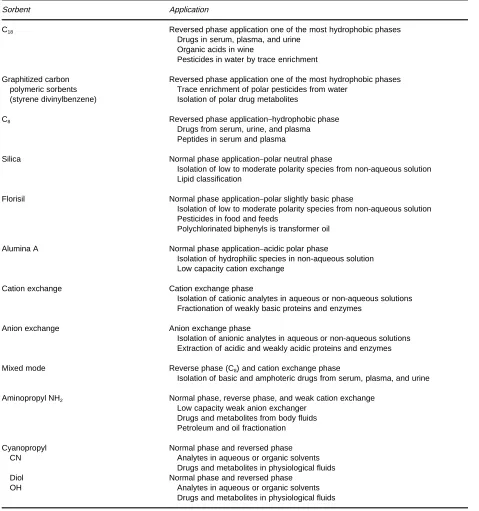
Table 2shows a general application guide for the use of SPE sorbents. The C18reversed-phase sorbent has
historically been the most popular packing material and has been used most frequently. The surface of the sorbent is one of the most hydrophobic and has a large capacity. Capacity is the amount of analyte sorbed (usually expressed in mg g\1) before
break-through occurs. Applications of C18 reversed phase
include: isolation of hydrophobic species from aque-ous solutions, such as drugs and metabolites from urine, serum, plasma, and other biological Suids; desalting of peptides and oligonucleotides; isolation of pigments from wine and beverages; and trace en-richment of pesticides from water for analysis by gas chromatography/mass spectrometry or high pressure liquid chromatography.
Graphitized carbon and reversed-phase polymeric sorbents are also frequently used in environmental applications, such as trace enrichment, for soluble molecules that are not isolated by reversed-phase sorbents, such as C18. Water soluble analytes require
a more hydrophobic sorbent with greater surface area per gram for complete retention. Carbon and poly-meric sorbents may also be used for polar metabolites of drugs and pharmaceuticals that are poorly retained on C18. Another advantage of the aromatic sorbents is
Table 2 Selected application guide for SPE
Sorbent Application
C18 Reversed phase application one of the most hydrophobic phases
Drugs in serum, plasma, and urine Organic acids in wine
Pesticides in water by trace enrichment
Graphitized carbon Reversed phase application one of the most hydrophobic phases polymeric sorbents Trace enrichment of polar pesticides from water
(styrene divinylbenzene) Isolation of polar drug metabolites
C8 Reversed phase application}hydrophobic phase
Drugs from serum, urine, and plasma Peptides in serum and plasma
Silica Normal phase application}polar neutral phase
Isolation of low to moderate polarity species from non-aqueous solution Lipid classification
Florisil Normal phase application}polar slightly basic phase
Isolation of low to moderate polarity species from non-aqueous solution Pesticides in food and feeds
Polychlorinated biphenyls is transformer oil
Alumina A Normal phase application}acidic polar phase
Isolation of hydrophilic species in non-aqueous solution Low capacity cation exchange
Cation exchange Cation exchange phase
Isolation of cationic analytes in aqueous or non-aqueous solutions Fractionation of weakly basic proteins and enzymes
Anion exchange Anion exchange phase
Isolation of anionic analytes in aqueous or non-aqueous solutions Extraction of acidic and weakly acidic proteins and enzymes
Mixed mode Reverse phase (C8) and cation exchange phase
Isolation of basic and amphoteric drugs from serum, plasma, and urine Aminopropyl NH2 Normal phase, reverse phase, and weak cation exchange
Low capacity weak anion exchanger Drugs and metabolites from body fluids Petroleum and oil fractionation
Cyanopropyl Normal phase and reversed phase
CN Analytes in aqueous or organic solvents
Drugs and metabolites in physiological fluids
Diol Normal phase and reversed phase
OH Analytes in aqueous or organic solvents
Drugs and metabolites in physiological fluids
speciRc pi-pi interaction. This sorption mechanism may selectively isolate aromatic compounds.
The C8reversed-phase sorbents (Table 2) are often
the most popular sorbent for drug analysis because of a shorter hydrocarbon chain than a C18sorbent. The
shorter chain length makes it much more easy for secondary interactions between the analyte and the silica gel which enhances retention of the analyte. This added interaction is useful in the puriRcation of drugs and metabolites from blood and urine because
they contain basic nitrogen atoms that may hydrogen bond to the silica gel.
used to remove polar species from non-aqueous solutions. Examples include vitamins in feeds and food, and antibiotics and other additives from feed. Normal-phase chromatography has been used for a number of years and most applications for normal-phase column chromatography may be easily trans-ferred over to normal-phase SPE.
Cation and anion exchange is used to isolate ionic compounds from either aqueous or non-aqueous solutions. Examples of applications are: isolation of weakly basic proteins; removal of acidic pigments from wines and fruit juices; and the removal of or-ganic acids from water. Many of the applications of classical ion exchange may be used in ion-exchange SPE; however, care must be exercised in the use of strong acids and bases with SPE ion-exchange sorbents that are based on a silica matrix. Further-more, care must be taken not to exceed the ion-exchange capacity of the sorbent.
Finally, sorbents such as aminopropyl, cyano-propyl, and diol can be used for both reversed-phase and normal-phase separations. Many manufacturers supply their sorbents in variety packs, which may be used for methods development. Also quality assur-ance reports are commonly available for the various sorbents, which is a good indication of their repro-ducibility.
Automation of SPE
Automation of a manual SPE method can provide many beneRts, which include safety, improved re-sults, and cost savings. Because automated work-stations are mechanical they can operate in environ-ments that are hostile, for example, noisy production locations or a refrigerated room. The use of automa-tion results in improved precision because of reduced operator errors compared with manual methods of SPE. For these reasons automation provides for better utilization of resources.
There are many types of automation equipment for SPE. They include semi-automated instruments, workstations that carry out the entire SPE operation without intervention, and robotic systems that carry out many activities besides SPE and are specially customized for the user. Finally, there are on-line SPE}HPLC systems that allow the user to merely add the sample to the autosampler and analyse the sample directly. The concept of on-line SPE is that a sample is pumped and processed onto the SPE cartridge while the liquid chromatograph or gas chromatograph is processing the preceding sample.
See also: II/ Chromatography: Liquid: Column Techno-logy. Extraction: Solid-Phase Extraction. III/ Solid-Phase
Extraction with Cartridges. Solid-Phase Extraction with Discs.
Further Reading
Fritz JS (1999) Analytical Solid-Phase Extraction. New York: John Wiley.
Hennion M and Pichon V (1994) Solid-phase extraction of polar organic pollutants from water. Environmental
Science and Technology28: 576A}583A.
Horack J and Majors RE (1993) Perspectives from the lead-ing edge in solid-phase extraction.LC-GC11: 74}90. McDonald PD and Bouvier ESP (1995)Solid Phase
Extrac-tion ApplicaExtrac-tions Guide and Bibliography,a Resource
for Sample Preparation Methods Development, 6th
Edition. Milford, Massachusetts: Waters.
Poole SK, Dean TA, Oudesma JW and Poole CF (1990) Sample preparation for chromatographic separations and overview.Analytical Chimica Acta236: 3}42. Simpson N and Van Horne KC (1993)Sorbent Extraction
Technology Handbook. Harbor City, CA: Varian.
Thurman EM and Mills MS (1998)Solid-Phase Extraction:
Principles and Practice. New York: John Wiley.
Varian Sample Preparation Products (1992)Applications
Bibliography. Harbor City, CA: Varian.
Zief M and Kiser R (1988)Sorbent Extraction for Sample
Preparation. Phillipsburg, NJ: J. T. Baker.
SPACE EXPLORATION:
GAS CHROMATOGRAPHY
R. Sternberg and F. Raulin,
Universite&s Paris 12 et 7, CNRS UMR 7583, Cre&teil cedex, France
C. Vidal-Madjar, CNRS UMR 7581,
Thiais, France
Copyright^ 2000 Academic Press