Abstract—Now a days the most important area of interest in
wireless sensor networks (WSNs) is energy preservation. Media access control MAC protocol plays a vital role in energy preservation. After the deployment of the sensor nodes in perilous, unreceptive or a remote area, they are generally unattended. The main objective of these sensors networks is energy efficiency. Media access control protocols deal with the energy consumptions of sensor nodes so that it controls the radio functionalities of node. Contention based MAC applications compete for the access to the medium. Contention based MAC protocols endure collision and control overheard while reducing the idle listening and escalating throughout. Currently proposed some of contention-based Mac protocols for energy efficiency are S-MAC, T-MAC, B-MAC, B-MAC+, X-MAC and D-MAC in a simulator. Analysis has been done and the simulation results of MAC protocols are based on CSMA. According to the simulation results and a environment, D-MAC protocols will be suitable in wireless sensor networks with respect to the energy efficiency. Our proposed algorithm minimizes energy dissipation while maximize network life time.
I. INTRODUCTION
ften a wireless sensor network can be described as a network of sensor in which all nodes converse with each other wirelessly. Within restricted sensing and computational capabilities, these sensor nodes may be installed in an environment which cannot be attended. Maintenance requirements can be done at very few levels, if these nodes are deployed in fault tolerant and reliable specifications [1]. Forest-fire monitoring and the structural health monitoring are such remote application environments in which sensor networks are often deployed, Due to the inaccessibility of the sensor nodes, the battery cannot be replaced frequently. In our lives wireless sensors networks are day by day gaining impact at an increasing rate. By
Manuscript received December 15, 2019; revised January 21, 2019. An Energy Efficient: Media Access Control Layer Protocols Based on Contention and Channel Polling in Wireless Sensor Network (WSN) Ahmed Mateen is with Computer Science Department, Chongqing University China. e-mail: [email protected]
Qingsheng Zhu is with Computer Science Department, Chongqing University China.
Salman Afsar is with Computer Science Department, University of Agriculture Faisalabad, Pakistan.
Safoora Thair is with Computer Science Department, University of Agriculture Faisalabad, Pakistan.
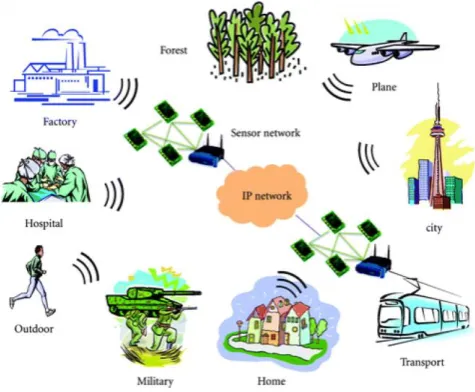
gathering the environment information and context of the surrounding a wireless sensor network plays an important role and the application of this field can be divided into three categories which are space monitoring objects monitoring and the interaction between the space and objects [2]. The first category includes environment monitoring. In a particular environment the wireless sensor networks are deployed, which may be mountains, glaciers and forests so that the environment information is collected over a long period of time [3].
[image:1.595.308.546.434.630.2]The center of observing of the second category is object monitoring and the one of the possible illustrations for this category is structural monitoring. Detection of mechanical modification of buildings or bridges, demonstrating latent structure’s breakages and sensing of sound emissions, vibration modes can be included in this category [4].
FIGURE. 1: Wireless sensor network applications
One of the important issues of the wireless sensor networks is that each sensor node uses the energy which should be reduced for the long life of the network due to the limited amount of energy which is operating in each sensor node. Energy preservation is utilized at three levels, which are computation, sensing and the most critical portion which consume a significant amount of energy is communication part [5]. The major protocol which is used in communication layer is medium access control so that the energy efficiency of MAC protocol is primary concern in
An Energy Efficient: Media Access Control
Layer Protocols Based on Contention and
Channel Polling in Wireless Sensor Network
(WSN)
AHMED MATEEN1(Member, IAENG), Qingsheng Zhu1, Salman Afsar2, and Safoora Tahir2
designing of the wireless sensor networks. There are four fundamental sources in which energy is wasted in WSN at MAC layer; idle listening(means that when the destination node is not yet ready the node is listening to idle channel and if packets are sent at this times, they are over-omitted, collision(which means its requires the collided packets should be re-transmitted),overhearing (in which a node receives a message which is transmit for another node)and control packet overhead which means the energy is used in control data transmission in exchange of control packets [6,38].
Energy waste due to collision and control overhead are highly depend on each other, energy waste due to collision is prevented by collision avoidance but it can lead to high control packet overhead [7, 36]. The mechanisms for handling the collision will reduce the control packet overhead but it will lead more energy wasting by using a number of collisions so in contention based MAC protocols, CSMA/CA (Carrier Sense Multiple Access with Collision Avoidance) a mechanism is used which is RTS(request to send) and CTS(clear to send)/DATA handshake for reducing the collision among the contending nodes. For the prevention and reduction of above energy wasting it is important to design a suitable MAC protocol [8]. To avoid idle listening there are four techniques; offline scheduling, preamble sampling, dynamic sleep scheduling and static sleep scheduling. Many MAC protocols based on these techniques are CSMA, TDMA, and hybrid and cross-layer optimization. Schemes based on contention are used by nodes working to acquiring the channel and the sensor nodes compete to get the channel with their neighbor [9].
II.PREVIOUS WORK
A group [10] told that the S-MAC protocol uses a periodic monitoring and sleep mechanism to keep the node in a dormant state so that the node can maintain a certain idle monitor power consumption. The idle listening time in the S-MAC is divided into synchronization time and data time. The node transfers information best at the time of fact, so the synchronization time belongs to manipulation overhead. On the basis of maintaining the S-MAC duration, the MAC (Timed MAC) protocol has changed, but the T-MAC has a problem of early sleeping, leading to sleep delays.
A team of Researchers [11] narrated that in order to solve this problem, a fate request sending (FRTS) strategy was proposed. However, FRTS packets will disrupt the conventional packet transmission and extra power values. It is based on the phenomenon that wireless sensor network packets usually flow into aggregation nodes [15].
Authors [12] explained that wireless sensor networks are functioning at an increasing rate. Through the collection of environmental information and the surroundings wireless sensor network plays an important role. The application of the field can be divided into three categories [13]. The first category is the space monitoring, second category is object monitoring and the third is the interaction between space and objects. The first category includes environmental monitoring and deploying wireless sensor networks in specific environments. These networks are mountains, glaciers and forests to collect environmental information over a long period of time [14].
A team [16,21] explained that Wireless sensor network need the less maintenance requirements, so it should be reliable and fault tolerant. Because of the sensor nodes inaccessibility, it is frequently a difficult task to alter the batteries repeatedly, the sensor nets are usually deployed in remote application such as structural health checking and forest-fire monitoring. To save energy in WSNs it important that the MAC protocols must be energy efficient [17].
Researchers [18] told that the protocols based on contention use the scheme of acquiring the channel. Before the data transmission starts the nodes sense the carrier in the communication process. To get the channel for transmission the node competes with its neighbor. The node will start its transmission when the carries setup is idle and the transmission will defer randomly for some time [19]. Back off algorithm is mostly used for this deferring. The resources which are used for processing consumption are reduced by using contention-based protocols in event-driven WSNs applications. Contention based MAC protocols are dynamic and flexible [20].
A group of Researchers stated that [22,31] in TDMA, each node is assigned a guaranteed time slot (GTS) to access the media. In this protocol, collisions are blocked; however, the energy intake of an idle country does not always decrease because the node maintains its radio state for the duration of its assigned GTS, even if it has no data to send [41-42]. This problem is solved in high-power TDMA (E-TDMA) [49-50]. E-TDMA is proposed for hierarchical networks where the entire network is divided into small clusters. In each cluster, a cluster head (CH) is selected, and all member nodes of the cluster transmit their information to their CHs by following E-TDMA. In ETDMA, a member node maintains its radio off, and there is no data to send during its assigned GTS [27, 44].
Authors [34,37,40] narrated that the poll-based MAC protocol is added to achieve energy efficiency by waking up the nodes independently and checking the channel's pastime. Dynamic polling is obviously the current technology deployed in some asynchronous protocols; this kind of polling can ensure that nodes stay in the energy of listening, idle listening, congestion and synchronization activities that may be misaligned [39]. The latest WSN MAC protocol is based on dynamic polling mechanism. This allows you to obtain better functionality and delay overall performance. The concept of polling interval distributions for researching and selecting the MAC protocol has been done in a mild assessment [46-47].
A team [28,33,45] told that Energy is a very important resource for the network to operate within a predetermined time. In fact, from the perspective of the communication protocol, there are actually several proposed energy-saving solutions. The main sources of energy consumption for wireless sensor networks are collisions, control of packet overhead, idle monitoring, and monitoring. All of these major parameters are directly related to the operating mode of the MAC (Media Access Control) protocol, which prompted us to study the various protocols proposed for this layer [29,35].
III. METHODOLOGY
In order to verify the performance of the proposed protocol, we have used GNU OCTAVE communication network simulator to simulate these protocols. The algorithm is mainly started from these nodes. Random nodes are positioned outside the DFS coverage area Because LEACH is cluster-based algorithm, sensor nodes in the network are organized. They themselves are divided into local clusters. One sensor in each cluster is randomly selected nodes as cluster heads (CH) and this the character is turned to evenly distribute the energy load to nodes in the network. The CH node compresses the arriving data sent from a node that belongs to the relevant cluster. CH then sends aggregate packets to BS to further reduce them. Therefore, the amount of information that must be transmitted to the BS reduce energy consumption and increase system life [48].
Maximize uniformity after a certain time interval network random rotation energy dissipation the role of CH proceeds. The sensor chooses itself to be local always cluster heads with a certain probability. LEACH use TDMA / CDMA MAC to reduce inter-cluster sum collision within the cluster. Because data collection is centralized regular execution, this algorithm is most suitable because the sensor network needs continuous monitoring [23,43].
Simulation scenario which we have followed are such as: The nodes are randomly distributed in the deployment in a square which have X-axis and Y-axis.
• The nodes are homogenous in type. • Energy power is limited
• Nodes have a cluster head which is responsible for communicate the nodes in a network to base station. • The nodes position or location is fixed after deployment. • The new node architecture is created using leach
algorithm and packets are sent from CHs to BS. • The node model is created randomly.
A. Description of Leach ALGORITHM:
The LEACH protocol provides the concept of rounds. Each round contains two states:
• Cluster setup status • Stable state.
The state is set in the cluster. Clustering is done in adaptive mode. Data is transmitted in steady state. The transmission status is usually longer than the setup status of the saved protocol payload.
In order to verify the performance of the proposed protocol, we have used GNU OCTAVE communication network simulator to simulate these protocols. Only two WSN nodes have limited energy or power.
A. Different Processes of LEACH for Cluster Head:
FIGURE. 3: GUI of GUN octave
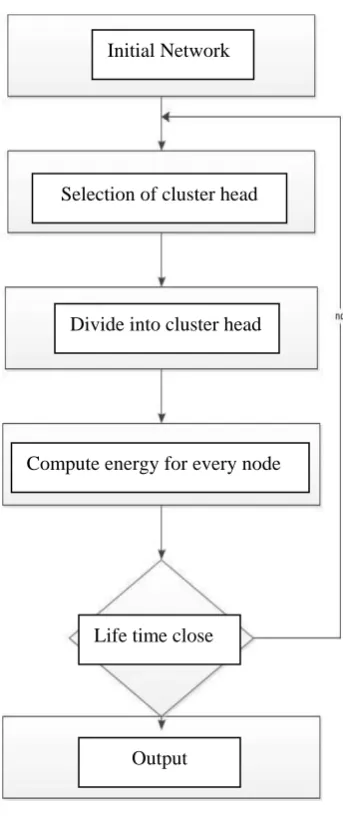
FIGURE. 4: Flow chart of LEACH
[image:4.595.46.218.264.674.2]that belongs to the relevant cluster and sends aggregate packets to BS to further reduce them. Therefore, the amount of information that must be transmitted to the BS is reduced and the result is energy consumption and increase in system life. LEACH use TDMA / CDMA MAC to reduce inter-cluster sum collision within the cluster. Because data collection is centralized regular execution, this algorithm is most suitable the sensor network needs continuous monitoring.
FIGURE 5: Different process of CH
B Interface of Simulator
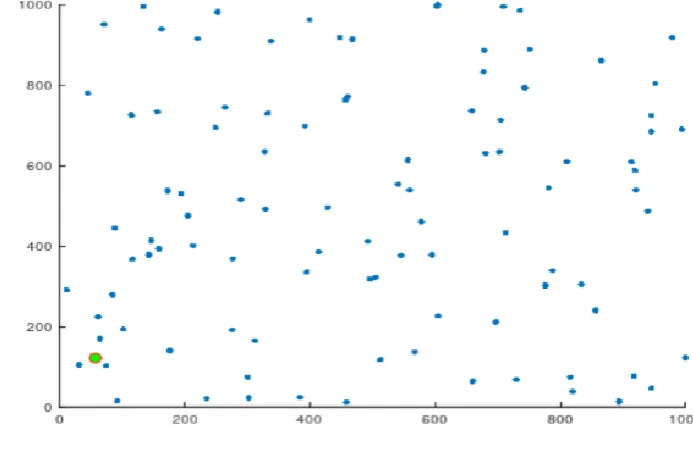
Simulation scenario which we have followed is such as: The nodes are randomly distributed in the deployment in a square which have X-axis and Y-axis. The nodes are homogenous in type. Energy power is limited. Nodes have a cluster head which is responsible to communicate between the nodes in a network and base station. The nodes position or location is fixed after deployment. The new node architecture is created using leach algorithm and packets are sent from CHs to BS. The node model is created randomly. The first parameter is Length, 2nd is Width, 3rd is sink node X position and 4th is sink Y position.
Initial Network
Selection of cluster head
Divide into cluster head
Compute energy for every node
Life time close
[image:4.595.313.537.265.600.2]IV. RESULTS
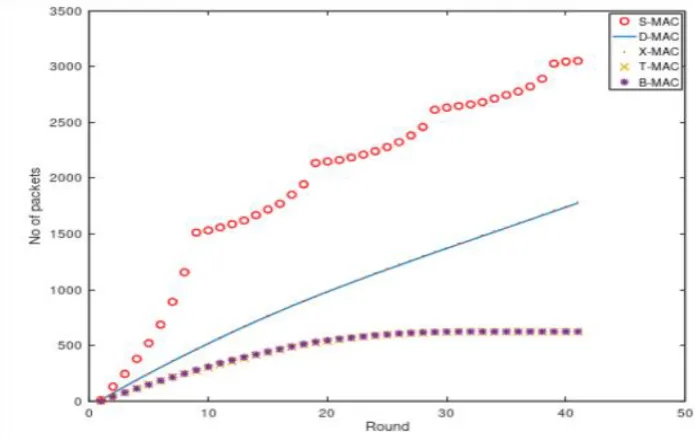
We use the simulator as a simulation platform to simulate the MAC protocol. The LEACH's improved algorithm aims to balance the total energy consumption of the nodes and extend the network's lifetime. So, we measure the improved protocol performance in three ways:
Throughput, number of dead spots and total network energy consumption. The life cycle of the network means the time from simulation to the death of the last node. As the wireless sensor networks have limited energy, so the energy consumption in their throughput is a meaningful indicator of their performance. At the level of deployed 100 nodes the
results of proposed protocol is such as that:
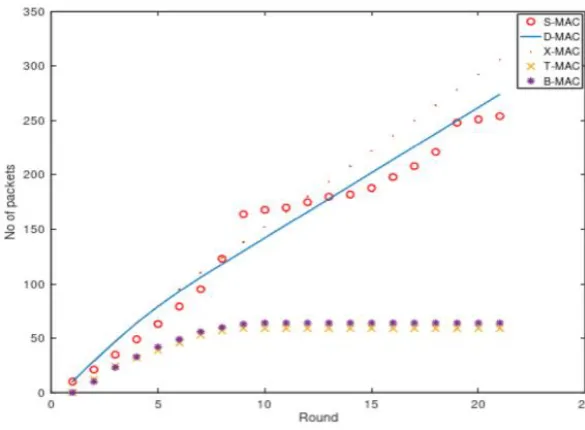
The energy efficiency at this level of B-mac is better as number of rounds increases the energy. The throughput or number of packets of the nodes is such that the B-mac save its energy as increasing the rounds. When 1000 nodes are deployed in the network the results of simulation are as follows:
[image:5.595.118.465.227.454.2]The energy efficiency of nodes in this scenario is such that the number of rounds increases, and the number of nodes increases, and the performance of B-mac is best. The throughput or number of packets in this scenario is such that B-mac saves more energy while others are losing their energy as the rounds are increasing.
[image:5.595.118.470.339.746.2]FIGURE.6: Number of deployed nodes 100
FIGURE. 8: Number of Packets or throughput
FIGURE. 9: Number of nodes 100
FIGURE. 11: Throughput or number of packets
V.CONCLUSION
In B-MAC, each sensor node goes to sleep and wakes up regularly and independently from others. When a node has to communicate with a neighbor, it first sends a long preamble lasting the entire work cycle (listening plus sleep time) and after this, it sends a message receiver detect the prologue which is long when it wakes up and stays awake in order to receive messages. As all neighbor nodes inadvertently heard long preambles and data messages (or RTS/CTS) if they are used because it is an optional feature, they can know when the transfer ends. The proposed protocol extends the B-MAC protocol. There is a advantage of local synchronization that all nodes inadvertently hear the transmission. As a result, many preamble sampling MAC solutions have been proposed. B-MAC is the first preamble sampling protocol to be introduced. The sending node sends a preamble sequence having a length equal to the periodic channel sensing time of the receiving node. The receiving node randomly polls the channel and, upon detecting the preamble, continues to listen to the preamble and receive data packets after the preamble. Since the preamble sequence is usually very long, both the addressing node and the non-addressed node consume a large amount of energy when receiving/hearing the preamble.
It divides the long monolithic preamble into small frames containing the destination address and data payload information. The random wake-up node can determine whether the data is intended for it after receiving a preamble frame and avoid listening to the rest of the preamble sequences that are not of interest. If it is an addressed node, it wakes up again in the data packet transmission after the preamble. The X-MAC divides the monolithic preamble into frames, each frame containing a target address.
REFERENCES
[1]. Akkaya, K. and M. Younis. 2005. A survey on routing protocols for wireless sensor networks. Ad hoc networks. 3:325-349.
[2]. Akyildiz, I.F., W. Su, Y. Sankarasubramaniam and E. Cayirci. 2002. A survey on the sensor to networks. IEEE Communications magazine. 40:102-114.
[3]. Althobaiti, A.S. and M. Abdullah. 2015. Medium access control protocols for wireless sensor networks classifications and cross-layering. Procedia Computer Science. 65:4-16.
[4]. Alvi, A.N., S.H. Bouk, S.H. Ahmed, M.A. Yaqub, M. Sarkar and H. Song. 2016. BEST -MAC: Bitmap-assisted efficient and scalable TDMA-based WSN MAC protocol for smart cities. IEEE. 4:312-322. [5]. Avvenuti, M., P. Corsini, P. Masci and A. Vecchio. 2006. Increasing the efficiency of preamble sampling protocols for wireless sensor networks. Mobile Computing and Wireless Communication International Conference, IEEE. 117-122.
[6]. Bachir, A., M. Heusse and A. Duda. 2008. Preamble MAC protocols with non-persistent receivers in wireless sensor networks. International Conference on Research in Networking. 36-47. [7]. Cano, C., B. Bellalta, A. Sfairopoulou and J. Barceló. 2009. A low
power listening MAC with scheduled wake up after transmissions for WSNs. IEEE. 13.
[8]. Corbellini, G., C. Abgrall, E.C. Strinati and A. Duda. 2012. Energy evaluation of preamble sampling MAC protocols for Wireless Sensor Networks. Personal Indoor and Mobile Radio Communications (PIMRC), IEEE. 387-392.
[9]. Dai, S., X. Jing and L. Li. 2005. Research and analysis on routing protocols for wireless sensor networks. Communications, Circuits and Systems, Proceedings. IEEE, 407-411.
[10]. Dash, S., A.R. Swain and A. Ajay. Reliable energy aware multi-token based MAC protocol for WSN. Advanced Information Networking and Applications (AINA), 2012 IEEE 26th International Conference on, 2012. IEEE, 144-151.
[11]. Demirkol, I., C. Ersoy and F. Alagoz. 2006. MAC protocols for wireless sensor networks: a survey. IEEE. 44:115-121.
[12]. Eaton, J.W. 2012. GNU Octave and reproducible research. Journal of Process Control. 22:14331438.
[13]. El-Hoiydi, A. and J.-D. Decotignie. 2004. WiseMAC: an ultra low power MAC protocol for the downlink of infrastructure wireless sensor networks. Computers and Communications, IEEE, 244-251. [14]. Fei, L.D.P. 2009. Energy-efficient MAC protocols for Wireless
Sensor Networks. information and communications technologies, Beihang University, Beijing. 100083.
[15]. Feng, H., L. Ma and S. Leng. 2010. A low of overhead wireless sensor networks MAC protocol. Computer Engineering and Technology IEEE. 4(128) .
[16]. Ghosh, S. and P. Veeraraghavan. 2007. Energy efficient medium access control with single sleep schedule for wireless sensor networks. Telecommunications and Malaysia International Conference on Communications, IEEE. 413-418.
[17]. Guerroumi, M., A.-S.K. Pathan, N. Badache and S. Moussaoui. 2014. On the medium access control protocols suitable for wireless sensor networks-a survey. International Journal of Communication Networks and Information Security. 6(89).
[19]. Heinzelman, W.R., A. Chandrakasan and H. Balakrishnan. 2000.Energy-efficient communication protocol for wireless microsensor networks. System sciences IEEE, 10(2).
[20]. Huang, P., L. Xiao, S. Soltani, M.W. Mutka and N. Xi. 2013. The evolution of MAC protocols in wireless sensor networks: A survey. IEEE communications surveys. 15:101-120.
[21]. Iala, I., M. Ouadou, D. Aboutajdine and O. Zytoune. Energy based collision avoidance at the MAC layer for wireless sensor network. Advanced Technologies for Signal and Image Processing (ATSIP), 2017 International Conference on, 2017. IEEE, 1-5.
[22]. Jayram, B.G. and D. Ashoka. 2014. MAC layer protocols for WSN-comparison and performance improvement strategy. International Journal of Engineering Research. 4:217-220.
[23]. Kredo Ii, K. and P. Mohapatra. 2007. Medium access control in the wireless to sensor networks. Computer networks.IEEE, 51:961-994. [24]. Kuntz, R., A. Gallais and T. Noël. Auto-adaptive MAC for
energy-efficient burst transmissions in wireless sensor networks. Wireless Communications and Networking Conference IEEE, 233-238. [25]. Law, Y.W., M. Palaniswami, L.V. Hoesel, J. Doumen, P. Hartel and
P. Havinga. 2009. Energyefficient link-layer jamming attacks against wireless sensor network MAC protocols. ACM Transactions on Sensor Networks . 5(6).
[26]. Lee, S. 2015. Stochastic polling interval adaptation in duty-cycled wireless sensor networks. International Journal of Distributed Sensor Networks. 11:486908.
[27]. Lu, G., B. Krishnamachari and C.S. Raghavendra. 2004. An adaptive energy-efficient and lowlatency MAC for data gathering in wireless sensor networks. Parallel and Distributed Processing SymposiumIEEE, 224.
[28]. Merlin, C.J. and W.B. Heinzelman. 2010. Schedule adaptation of low-power-listening protocols for wireless sensor networks. IEEE. 9:672-685.
[29]. Munadi, R., A.E. Sulistyorini and T. Adiprabowo. Simulation and analysis of energy consumption for S-MAC and T-MAC protocols on wireless sensor network. Wireless and Mobile (APWiMob), IEEE. 142-146.
[30]. Peng, F., B. Peng and V.C. Leung. 2012. An application oriented power saving MAC protocol for wireless sensor networks. Wireless Personal Communications. 67:279-293.
[31]. Polastre, J., J. Hill and D. Culler. 2004. Versatile low power media access for wireless sensor networks. Proceedings of the 2nd international conference on Embedded networked sensor systems. 95-107.
[32]. Prabhu, S.B. and S. Sophia. 2013. A review of energy efficient clustering algorithm for connecting wireless sensor network fields. International Journal of Engineering Research and Technology. 2. [33]. Rafsanjani, M.K. and H. Imani. 2015. Clustering algorithms for
wireless sensor networks. Journal of New Theory.20-29.
[34]. Ram, M. and S. Kumar. 2014. Analytical energy consumption model for MAC protocols in wireless sensor networks. Signal Processing and Integrated Networks. 444-447.
[35]. Ren, Q. and Q. Liang. 2005. An energy-efficient MAC protocol for wireless sensor networks. Global Telecommunications IEEE. (5) [36]. Roy, A. and N. Sarma. 2010. Energy saving in MAC layer of wireless
sensor networks: a survey. National Workshop in Design and Analysis of Algorithm (NWDAA), Tezpur University, India. [37]. Shah, R.C. and J.M. Rabaey. 2002.Energy aware routing for low
energy ad hoc sensor networks. Wireless Communications and Networking Conference IEEE. 350-355.
[38]. Siddiqui, S. and S. Ghani. 2016. Towards dynamic polling: Survey and analysis of Channel Polling mechanisms for Wireless Sensor Networks. Intelligent Systems Engineering (ICISE) IEEE. 356-363. [39]. Singh, H. and B. Biswas. 2012. Comparison of CSMA based MAC
protocols of wireless sensor networks. International Journal of AdHoc Network Systems. 2.
[40]. Singh, S.K., M. Singh and D.K. Singh. 2010. Routing protocols in wireless sensor networks–A survey. International journal of computer science and engineering survey (IJCSES). 1:29-31.
[41]. Srikanth, B., M. Harish and R. Bhattacharjee. 2011. An energy efficient hybrid MAC protocol for WSN containing mobile nodes. Information, Communications and Signal Processing (ICICS) IEEE. 1-5.
[42]. Stankovic, J.A. and T. He. 2012. Energy management in sensor networks. Phil. Trans. R. Soc. A.370:52-67.
[43]. Van Dam, T. and K. Langendoen. 2003. An adaptive energy-efficient MAC protocol for wireless sensor networks. International conference on Embedded networked ACM, 171-180.
[44]. Warrier, M.M. and A. Kumar. 2016. An energy efficient approach for routing in wireless sensor networks. Procedia Technology. 25:520-527.
[45]. Yadav, R., S. Varma and N. Malaviya. 2009. A survey of MAC protocols for wireless sensor networks. UbiCC journal. 4:827-833. [46]. Yahya, B. and J. Ben Othman. 2009. Towards a classification of
energy aware MAC protocols for wireless sensor networks. Wireless Communications and Mobile Computing. 9:15721607.
[47]. Ye, W., J. Heidemann and D. Estrin. 2002. An energy-efficient MAC protocol for wireless sensor networks.Conference of the IEEE Computer and Communications Societies IEEE. 15671576. [48]. Ye, W., F. Silva and J. Heidemann. 2006. Ultra-low duty cycle MAC
with scheduled channel polling. International conference on Embedded networked sensor systems, ACM, 321334.
[49]. Yigitel, M.A., O.D. Incel and C. Ersoy. 2011. QoS-aware MAC protocols for wireless sensor networks: A survey. Computer Networks. 55:1982-2004.
[50]. Zhang, F., J. Chen, H. Li, Y. Sun and X.S. Shen. 2012. Distributed active sensor scheduling for target tracking in ultrasonic sensor networks. Mobile Networks and Applications. 17:582593.
Ahmed Mateen is currently pursuing his Ph.D. Computer Science. From Chongqing university, china. He received the M.Sc. degree from The University of Lahore and M.S. degrees in computer science from the University of Agriculture Faisalabad, Faisalabad, Pakistan. He has an Outstanding Academic Carrier. His research interests are Query Optimization, Modeling and Simulation, Machine Learning, Big Data Analysis and Network Security and Management.