MOLECULAR IMPRINTS FOR
SOLID-PHASE EXTRACTION
P. A. G. Cormack, University of Strathclyde, Glasgow, UK
K. Haupt, INTS-INSERM, Paris, France
Copyright^ 2000 Academic Press
Among the most importantRelds in analytical chem-istry are medical, food and environmental analysis, where the target analytes are often present at very low concentrations in rather complex matrices. Methods currently used for analysis, such as liquid chromatog-raphy, gas chromatography or capillary electrophor-esis, must therefore be preceded by a selective isola-tion and concentraisola-tion step. Commonly used tech-niques for the extraction and clean up of analytes from environmental and biological samples are liquid}liquid extraction (LLE) and solid-phase ex-traction (SPE). Supercritical-Suid extraction (SFE) has also attracted interest, although it has not found widespread application thus far because of the spe-cialized equipment required. The advantages of SPE compared with LLE are that it is faster, more repro-ducible, cleaner extracts are obtained, emulsion formation is not an issue, solvent consumption is reduced, and smaller sample sizes are required. It may also be cheaper than LLE when the costs for solvent disposal are taken into consideration. Moreover, SPE can be easily incorporated into automated analytical procedures. For a detailed introduction to SPE, the reader is directed to the relevant chapters in the Encyclopedia.
Solid phases currently employed for SPE include polystyrene divinylbenzene resins and chemically modiRed silica with either hydrophobic or ion-exchange groups. These materials generally yield satisfactory results if the conditions for extraction, washing and elution are carefully determined accord-ing to the chemical characteristics of the analytes and the other components in the sample. Nevertheless, due to the non-speciRcity of hydrophobic or ionic interactions, a large number of contaminants are of-ten co-extracted, particularly if the sample matrix is very complex. A solution to this problem can be to use afRnity sorbents, thus taking advantage of the speciRcity of biological recognition.
Theoretically, biomolecules like antibodies or re-ceptors have the potential to meet the analytical de-mands for almost any target analyte since, with the
advent of phage display antibody libraries and recom-binant antibodies, a suitable recognition element can be found in many cases, even if a natural receptor does not exist. Unfortunately, biomolecules also have a major drawback, which is their poor stability, par-ticularly in the presence of organic solvents. ArtiRcial receptors have therefore been gaining in importance as a possible alternative to natural systems. Molecu-lar imprinting is becoming increasingly recognized as a versatile technique for the preparation of synthetic polymers bearing tailor-made recognition sites. These molecularly imprinted polymers (MIPs) are obtained by copolymerizing functional and cross-linking monomers in the presence of the analyte, which acts as a molecular template. The molecular imprinting technique is reviewed in more detail elsewhere in the Encyclopedia (see AfRnity Separation/Imprint Polymers). Molecularly imprinted polymers combine the advantages of biological antibodies or receptors (very speciRc binding) with those of synthetic poly-mers (high physical and chemical stability, compati-bility with both aqueous and organic solvents). Their use in sample preconcentration and clean up by solid-phase extraction is therefore highly attractive.
Analytical-Scale SPE
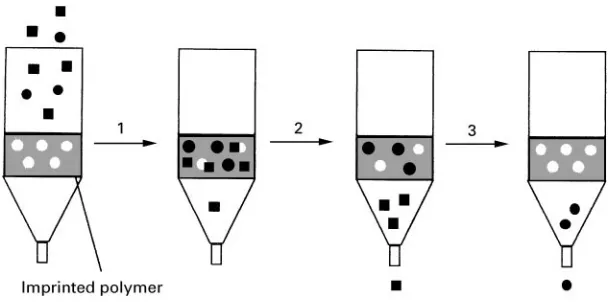
The applicability of imprinted polymers for SPE has been demonstrated on a number of compounds such as herbicides and drugs, which have been selectively extracted even from complex samples like beef liver extract, bile, blood serum and urine.Figure 1shows the principle of molecularly imprinted solid-phase extraction (MISPE). Typically, the sample is brought into contact with the imprinted polymer. This results in binding of the analyte and some impurities. Ad-sorption of the sample onto the polymer can be either from aqueous solution or from an organic or aque-ous/organic solution after a solvent extraction step. The latter is often necessary to recover the analyte from solid or semi-solid samples, for example, soil or tissue. In both cases, the adsorption step is followed by a Rrst elution step where impurities are washed away, whereas the speciRcally bound target analyte remains bound to the imprinted polymer. The last step is the elution of the analyte in concentrated and puriRed form using, for example, a competitor.
Figure 1 Principle of solid-phase extraction with an imprinted polymer. The sample is loaded onto the imprinted polymer, resulting in binding of both the analyte and some contaminants (step 1). A first elution step removes contaminants and the analyte remains in the
specific binding sites (step 2). The analyte is then eluted from the polymer (step 3).䢇, analyte;䊏, other sample components.
lowerg dm\3to the mg dm\3range. The lower limit is determined by the dissociation constant of the analyte binding to the polymer. The upper limit is set by the binding capacity of the polymer. If the quantity of polymer used for extraction is increased, more analyte will bind, although non-speciRc binding of contaminants will also increase considerably. It is therefore necessary to optimize the extraction proto-col for a speciRc application in terms of the amount of polymer used, the sample load, and the adsorption, washing and elution conditions, etc.
The quantiRcation of the herbicide atrazine in beef liver is a good example of the utility of imprinted polymers in SPE. In aRrst step, atrazine was extracted from liver tissue with chloroform. The imprinted polymer was then used to clean the chloroform ex-tract and to further concentrate the analyte prior to quantiRcation. In this speciRc example, the binding capacity of the polymer for atrazine in chloroform was found to be 19mol g\1. The analyte was eluted from the polymer with a suitable solvent (acetonitrile containing 10% acetic acid) and quantiRed, after drying and reconstitution in acetonitrile or buf-fer, by reversed-phase high performance liquid chromatography (RP-HPLC) or enzyme-linked im-munosorbent assay (ELISA). When comparing the puriRed with the non-puriRed chloroform extracts in RP-HPLC, the SPE step with the imprinted poly-mer considerably improved the accuracy and pre-cision of the HPLC method and lowered the detection limit from 20g dm\3 to 5g dm\3. This was achieved due to the removal of interfering compo-nents in the sample, resulting in baseline resolution of the atrazine peak. Furthermore, analyte recovery was increased from 60.9% to 88.7% (quantiRcation by HPLC) and from 79.6 to 92.8% (quantiRcation by ELISA).
Preparative-Scale SPE
What has been described thus far is, by and large, the use of molecular imprints as solid-phase extraction media inanalyticalapplications, where the inherent selectivity of the imprints enables efTcient clean up and/or preconcentration of samples prior to analyte quantiRcation. Imprinted polymers are well suited to this purpose, and their functional capacity (the mass of analyte that can be bound per unit mass of polymer) places no undue restrictions on their widespread usage. In contrast, capacity is an impor-tant consideration in preparative-scale SPE, even if the solid-phase can be regenerated many times. Bear-ing in mind that the functional capacities of imprinted polymers prepared thus far have been moderately low, it is relatively easy to appreciate why only a few reports describing their potential use in preparative-scale work have appeared. However, there are certain niche applications that could conceivably be serviced by state-of-the-art materials where the low capacity is more than compensated for by the additional beneRts that imprints confer, e.g. stability, selectivity, etc. In the long term it is certain that numerous opportuni-ties will exist for the use of imprinted polymers in preparative-scale SPE once the low capacity issue has been addressed satisfactorily. They are well suited to product recovery from fermentation broths, produc-tion waste streams, and during chemical and enzy-matic syntheses.
Figure 2 The chemical synthesis of-aspartame. (1)-aspartame, (2) Z-protectedL-aspartic acid anhydride, (3)L-phenylalanine
methyl ester, (4) Z--aspartame, (5) Z--aspartame.
product in preference to reactants, reagents, catalysts, etc., and is readily separated from the other compo-nents by virtue of its cross-linked insoluble character (the use of magnetic imprinted polymer particles or beads, which are available, would make this process even simpler). Alternatively, the crude reaction mix-ture can be passed through an appropriately sized SPE column, or the imprinted polymer can be placed in a product stream. Following selective adsorption, the product is washed out from the imprinted polymer and isolated. It can then be puriRed further if re-quired. Another possibility for simple, inexpensive, and large-scale separations using imprinted-polymer particles is adsorptive bubble fractionation. The tar-get compound is selectively adsorbed to the imprinted polymer in suspension within a cylindrical column containing a glass frit at the base of the column. Bubbles are formed when a gas is injected through the frit and they rise to the top of the column. Imprinted-polymer particles, which adhere to the gas bubbles, are transported to the top of the column where they accumulate and can then be easily recovered. It has been shown that enantiometric enrichment of L-phenylalanine anilide from a racemic solution can be achieved in this way, using an L-phenylalanine
anilide-imprinted polymer. Overall then, imprinted polymers appear to offer an efRcient general method for product isolation and puriRcation, at least in principle.
Figure 3 The enzymatic synthesis of-aspartame. (1)
-aspar-tame, (3)L-phenylalanine methyl ester, (4) Z--aspartame, (6)
Z-protectedL-aspartic acid.
reaction mixture was as follows: Z--aspartame, 59%; Z--aspartame, 19%; Z-L-aspartic acid, 22%. A polymer was imprinted against the by-product Z- -aspartame (5) and used in the SPE mode for the selective removal of the by-product from the crude reaction mixture. After Rve passes through a solid-phase extraction column, the product purity was in-creased from 59 to 96%. In a control experiment using a nonimprinted polymer, the Rnal purity achieved was only 86%.
It is also possible to use imprinted polymers ad-vantageously during chemical reactions, to drive chemical equilibria in particular directions and thus inSuence product distributions in a controlled fashion. To prove this concept, the enzymatic con-densation of Z-protectedL-aspartic acid (6) with L-phenylalanine methyl ester (3) using the enzyme ther-molysin was studied (seeFigure 3). The equilibrium for this reaction, which normally lies to the left thus favouring reactants, can be driven to the right, in the direction of products by working in a nonsolvent for Z--aspartame. Another way of achieving the same effect would be to use a product-trap (product-sink) in the reaction itself, for example, a polymer imprinted against the product Z--aspartame. Indeed, when the reaction was carried out in the presence of
a Z--aspartame-imprinted polymer, the reaction yield was found to increase from 15 to 63%.
Present Limitations and Remedial
Solutions
Any sorbent used in SPE must satisfy a range of performance criteria for a given application. Criteria that are of importance for imprinted polymers in-clude: (1) Strong, selective, and reversible binding to the analyte; (2) fast mass-transfer kinetics; (3) high functional capacity; (4) minimal interaction of analyte with polymer backbone; (5) effective dis-placers available; (6) zero bleeding of template; (7) compatible with many solvents; (8) pressure resistant; (9) batch-to-batch reproducibility; (10) physical form of imprinted polymer; and (11) economics. Whilst imprints perform very well in many respects, there are certain limitations that need to be overcome in speci-Rc applications.
One of the most unsatisfactory features associated with the application of imprinted polymers as SPE sorbents in ultra-trace analysis is template leakage. Generally, once an imprinted polymer has been pre-pared, it is exhaustively extracted to remove the tem-plate from the polymer matrix. The difRculty in extracting 100% of the template molecule from an imprinted polymer has long been recognized, al-though until relatively recently it was widely believed that the few per cent of template remaining within the polymer was permanently entrapped. Recent work clearly demonstrates that this is not necessarily the case. What can and does occur is slow leakage of a portion of the remaining template from the polymer matrix over a period of time, even after exhaustive (solvent) extraction of the polymer beforehand. This template leakage or bleeding can have serious im-plications when the polymer is being used as an SPE sorbent in ultra-trace analysis, although is of much less concern in trace analysis.
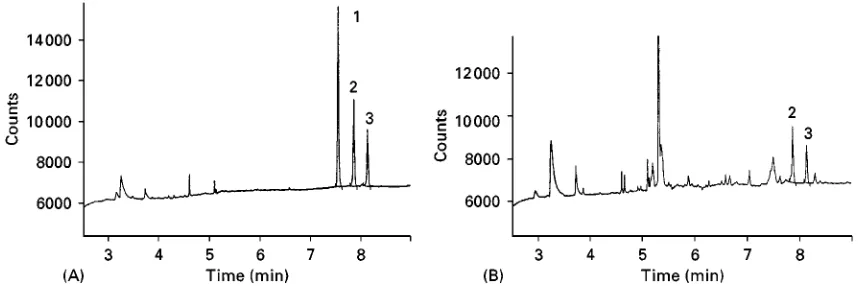
Figure 4 GC traces of human plasma samples spiked with sameridine and an internal standard, and subjected to (A) solid-phase
extraction with an imprinted polymer and (B) standard liquid}liquid extraction. The peaks are (1) the template molecule (a close
structural analogue of sameridine), (2) the analyte sameridine and (3) the internal standard. (Reproduced with permission from Andersson, Papricia and Arvidsson, 1997).
unacceptable because it led to large errors in the precision of the analytical measurement. Rather than take steps to minimize or eradicate leakage, a close structural analogue of sameridine (8) was used as the template molecule in the imprinting step, which yielded an imprinted polymer that still displayed a strong afRnity for sameridine.
Following solid-phase extraction of sameridine from human plasma using this polymer, leakage of the analogue from the polymer matrix did occur, but sameridine and the analogue were readily resolved using GC and the sameridine was subsequently quantiRed. The results obtained were as good as those obtained via a standard liquid}liquid extraction method, with the added advantage that the plasma sample contained fewer matrix contaminants with MISPE than for LLE, i.e. the sample for assay was much cleaner (Figure 4).
The template-analogue method does rely upon the availability of a close structural analogue of the analyte, and also a strong afRnity between the polymer imprinted against the analogue and the analyte. One or both of these criteria may not always be fulRlled, therefore new approaches are required to tackle the bleeding issue.
In a solid-phase extraction operation, one ideally wants strong binding of the analyte to the sorbent during the loading and washing steps, and rapid strip-ping of the analyte from the sorbent during the
elu-tion step, ideally in as small a volume as possible. EfRcient loading and washing is therefore fa-voured by a strong afRnity between the polymer and the analyte, whereas efRcient elution is ob-tained when the afRnity is moderate to weak. In some cases, MIPs can actually bind analytes too strongly, which means that stronger displacers or larger volumes of eluting solvent are required than would otherwise be considered ideal. In some circum-stances, therefore, having an MIP of lower afR n-ity but with the same selectivn-ity would be desirable. One way of achieving this goal might be via thermal pretreatment of the polymer at high temperature prior to use, which can have the effect of killing off a proportion of the high-energy binding sites.
&competitive’ environments. Although it is possible to imprint certain templates in polar environments, po-lar solvents (e.g. water) tend to interfere to an unac-ceptable level with the non-covalent interactions be-tween template and functional monomer that are often relied upon in imprinting protocols. What is more common and easier to deal with, however, is the use of imprints effectively in buffer and/or polar environments. Finally, the imprinting of larger templates (e.g. proteins) is rather challenging at pres-ent due to their ‘fragile’ nature. New synthetic devel-opments should lead to progress in this area also.
Conclusions
Molecularly imprinted polymers constitute a new class of sorbents which combine the robust character of cross-linked polymers with the attractive proper-ties of natural receptors. In sample clean up and concentration for trace and ultra-trace analysis, they offer distinct advantages over both liquid}liquid extraction and solid-phase extraction using classical sorbents and immunosorbents. Besides analytical ap-plications, imprinted polymers are being increasingly considered for preparative-scale SPE applications, even though their present low functional capacity sets a limit on their widespread utility. However, con-comitant with improvements in their capacity, it will become increasingly appealing to use imprinted poly-mers to remove products and/or by-products from reaction vessels/streams, and to inSuence directly the course of chemical reactions by &equilibrium shift-ing’. Finally, it is worth noting that the area of mo-lecular imprinting as a whole is undergoing rapid expansion at present. What this implies for MISPE is that one can expect tailored, high-performance im-printed polymers to become increasingly attractive and more widely available as methodologies improve and breakthroughs are made.
See also: II/Extraction: Solid-Phase Extraction. III/Im-munoaffinity Extraction. Selectivity of Imprinted Polymers: Affinity Separation:
Further Reading
Andersson LI, Papricia A and Arvidsson T (1997) A highly selective solid phase extraction sorbent for pre-concen-tration of sameridine made by molecular imprinting.
Chromatographia46: 57}62.
Amstrong DW, Schneiderheinze JM, Hwang YS and Seller-gren B (1998) Bubble fractionation of enantiomers from solution using molecularly imprinted polymers as collec-tors.Analytical Chemistry70: 3717}3719.
Bartsch RA and Maeda M (eds) (1998) Molecular and ionic recognition with imprinted polymers.ACS Symposium Series703.
Katz SE and Siewierski M (1992) Drug residue analysis using immunoafRnity chromatography. Journal of Chromatography624: 403}409.
Muldoon MT and Stanker LH (1997) Development and application of molecular imprinting technology of residue analysis. ACS Symposium Series 657: 314}330.
Muldoon MT and Stanker LH (1997) Molecular imprinted solid phase extraction of atrazine from beef liver ex-tracts.Analytical Chemistry69: 803}808.
RamstroKm O, Ye L, Krook M and Mosbach K (1998) Applications of molecularly imprinted materials as se-lective adsorbents: emphasis on enzymatic equilibrium shifting and library screening. Chromatographia 47: 465}469.
Reid E, Hill H and Wilson I (1998)Drug Development Assay Approaches,Including Molecular Imprinting and Biomarkers. Guilford: Guilford Academic Associates. Sellergren B (1994) Direct drug determination by selective
sample enrichment on an imprinted polymer.Analytical Chemistry66: 1578}1582.
Ye L, RamstroKm O and Mosbach K (1998) Molecularly imprinted polymeric absorbents for by-product removal.
Analytical Chemistry70: 2789}2795.
MOLECULAR RECOGNITION
TECHNOLOGY IN INORGANIC
EXTRACTION
J. D. Glennon, University College Cork, Cork, Ireland
Copyright^ 2000 Academic Press
Selective ion recognition, binding and transport are important processes in living systems. From the active