Dissertations
2012
The Impact of Process on Virtual Teams: A
Comparative Analysis of Waterfall and Agile
Software Development Teams
Sondra Ashmore
Iowa State University
Follow this and additional works at:https://lib.dr.iastate.edu/etd
Part of theBusiness Administration, Management, and Operations Commons,Engineering Commons, and theOrganizational Behavior and Theory Commons
This Dissertation is brought to you for free and open access by the Iowa State University Capstones, Theses and Dissertations at Iowa State University Digital Repository. It has been accepted for inclusion in Graduate Theses and Dissertations by an authorized administrator of Iowa State University Digital Repository. For more information, please [email protected].
Recommended Citation
Ashmore, Sondra, "The Impact of Process on Virtual Teams: A Comparative Analysis of Waterfall and Agile Software Development Teams" (2012).Graduate Theses and Dissertations. 12260.
software development teams
by
Sondra Ashmore
A dissertation submitted to the graduate faculty
in partial fulfillment of the requirements for the degree of DOCTOR OF PHILOSOPHY
Major: Human Computer Interaction
Program of Study Committee: Anthony Townsend (Major Professor)
Brian Mennecke Frederick Lorenz Samuel DeMarie Stephen Gilbert
Iowa State University
Ames, Iowa
2012
TABLE OF CONTENTS
LIST OF FIGURES ... iv
LIST OF TABLES ... v
ACKNOWLEDGEMENTS ... vi
ABSTRACT ... vii
CHAPTER 1. Introduction ... 1
1a. Introduction ... 1
1b. Literature Review ... 3
1c. Methodology ... 4
1d. Results ... 4
1e. Discussion ... 4
CHAPTER 2. Literature review ... 5
2a. Research Context ... 5
i) Defining Virtual Teams ... 6
ii) Technology Enabling Virtual Teams ... 8
iii) Best Practices and Challenges ... 10
2b. Process... 13
i) Software Development Processes ... 13
ii) Success Factors ... 18
iii) Challenges ... 21
2c. Adaptive Structuration Theory ... 23
2d. Propositions ... 30
CHAPTER 3. Methodology ... 35
3a. Context and Participants ... 35
i) Context ... 35
ii) Participants ... 36
3b. Design ... 40
3c. Procedure ... 41
CHAPTER 4. Results ... 52
4a. Study Results ... 52
i) Demographic Data ... 52
ii) Proposition Results ... 54
CHAPTER 5. Discussion ... 59
5a. Analysis ... 59
i) Proposition 1 ... 59
ii) Proposition 2 ... 65
5b. Limitations and Implications for Future Research ... 72
5c. Conclusions and Propositions for Future Research ... 73
APPENDIX B. Coder Training Materials ... 80
LIST OF FIGURES
LIST OF TABLES
Table 1: Nerur, Mahapatra, and Mangalaraj's (2005) traditional (waterfall) and agile
comparison ... 16
Table 2: Maznevski and Chudoba's (2000) seven global virtual team propositions ... 27
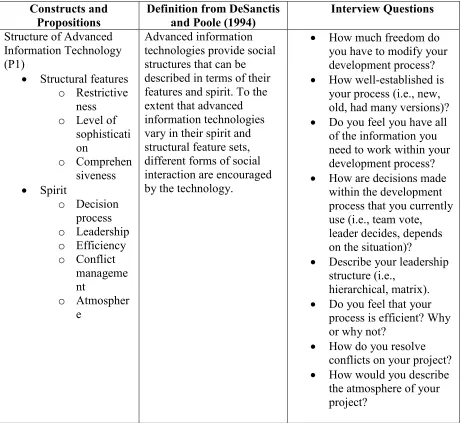
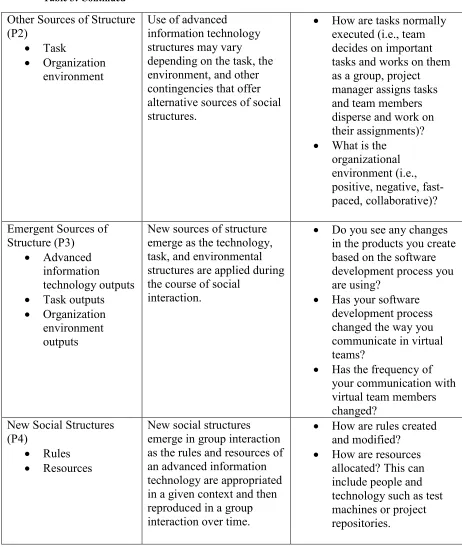
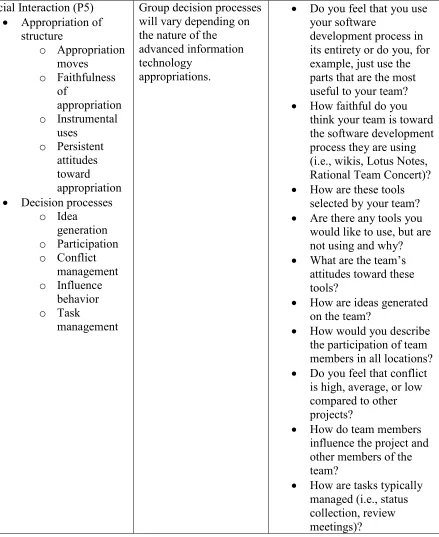
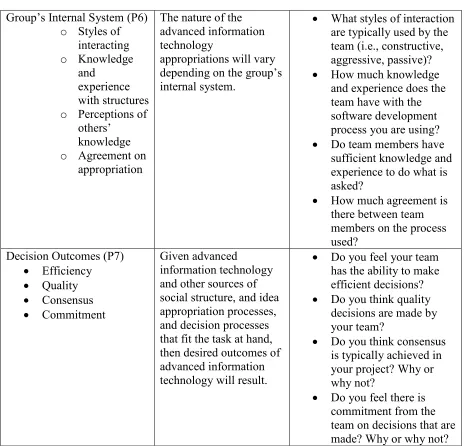
Table 3: Mapping of AST to interview ... 43
Table 4: Comparing waterfall and agile interviews inter-rater reliability ... 48
Table 5: Demographic data ... 52
Table 6: Proposition results ... 54
Table 7: Waterfall vs. Agile Responses ... 56
Table 8: Proposition results summary ... 71
ACKNOWLEDGEMENTS
I want to thank my husband, Brian, my sons, Drake and Dane, and my amazing
friends for their support throughout this journey. My sincere gratitude also goes out to my
very talented editor and aunt, Jean Davidsaver, for doing such a wonderful job editing my
writing. I also want to thank IBM Corporation for their commitment and encouragement of
my proposal to complete a Ph.D. program in Human-Computer Interaction. Last, but
certainly not least, I would like to acknowledge my Iowa State University colleagues,
doctoral committee, and especially my major professor, Dr. Anthony Townsend, for their
ABSTRACT
Studies have shown that task type, social context, and time mediates virtual teams
(Martins, Gilson, & Maynard, 2004; Townsend, Hendrickson, & DeMarie, 2002), yet no
studies have been conducted comparing the process that the virtual teams are using to
complete a task. Two global virtual teams from the same corporation who are using two
different software development methodologies, waterfall and agile, were compared to
understand the impact that process has on virtual teams. Interviews were conducted with
both teams and their responses were coded using the constructs in Adaptive Structuration
Theory. The results show that the software development process used by a virtual team does
impact the team’s culture, orientation toward change, and ultimately the quality of the
product they are developing. Careful consideration should be made by software development
organizations when deciding which development process they should deploy, given the
CHAPTER 1. INTRODUCTION
1a. Introduction
The study of virtual teams has been an important area of research that has spanned
many different disciplines, with the most prominent being Management, Computer-Mediated
Communication, and Computer-Supported Cooperative Work. Each group has used their
own unique lens to study the phenomena of virtual teams. These perspectives have added to
our current understanding of how this model of teaming has evolved, the challenges these
teams face, and the factors that lead to the success of a virtual team.
While significant progress has been made in virtual teaming research, there are still
opportunities to fill in gaps that exist today. These are important gaps to fill, given the
exponential growth of virtual teams in organizations worldwide. Martins, Gilson, and
Maynard (2004) did an extensive analysis on what has been learned about virtual teams and
the opportunities that remain to enhance our knowledge of these teams. They cite
deficiencies in the following areas: team inputs, team processes, team outcomes,
methodological and theoretical issues, planning processes, organizational context, action
processes (primarily compared to the same actions in face-to-face interactions), and
interpersonal processes such as affect management and group emotion. The present study
does not seek to answer all of the open questions that remain about virtual teams, but rather
will focus on the team processes and the methodological and theoretical aspects of virtual
team research. Powell, Piccoli, and Ives (2004) found similar gaps in virtual team research,
variables has not been addressed in previous research” (p. 14). The methodological and
theoretical issues that are highlighted include the over-emphasis on empirical research that
compares virtual teams to face-to-face teams, the abundance of studies that use small groups
of college students in laboratory settings, and the direct effects of “virtualness” on a team
which includes both mediating and moderating factors. Powell et al. (2004) argue that
overcoming these methodological limitations will yield a greater understanding of
organizational power, culture, and the structure that affects the functioning of virtual teams.
Using DeSanctis and Poole’s (1994) Adaptive Structuration Theory (AST) as a
theoretical model, this study takes team process one step further to not only look at team
process as the planning that is involved with achieving the team goal, but with the team
structure that prescribes how the planning for the project must be done.
This study investigated an organization that has two large virtual teams developing
enterprise software who have traditionally used the waterfall methodology. The first team is
continuing to use the waterfall approach that organizes the process in a sequential order with
each major phase completing before the next begins. The second team has moved toward a
contemporary approach that is based on the idea of iterative development phases called agile
development. While some similarities can be found between the two approaches, such as
their focus on quality, very different techniques and values are needed when executing
waterfall and agile development.
This study investigates the structure that a virtual team uses and the mediating and
moderating effects that this structure has on team dynamics. The use of AST as a structural
model provides an important framework for understanding the structural differences between
the two virtual teams and how these operational structures impact their team dynamics. AST
has been widely used in virtual team research (Raghuram, Tuertscher, & Garud, 2010) as
Ramesh, 2009; Majchrzak, Rice, Malhotra, King, & Ba, 2000). AST includes
“instrumentation choices” which take into account the computer-mediated communication
tools that influence the interaction.
The second important contribution of this study is to address some of the prevalent
methodological issues that have been pervasive in virtual team research. This study uses
organizational workers from a large information technology company who are working on
long-term virtual team projects. This study does not compare the virtual teams to face-to-face
teams, or teams of student subjects, but instead compares two similar professional virtual
teams that differ only in the team process structure they are using. The use of such teams
provides a better understanding of the organizational culture and the impact of structure on
the virtual team dynamics. This also allows for more generalized results that are beneficial to
a typical virtual team that would be found in an organizational setting.
Finally, this study is the first to directly compare the team dynamics of waterfall and
agile software development teams.
1b. Literature Review
This chapter explores three major areas of research--virtual teams, product
development processes, and AST. The chapter begins by defining virtual teams, and then
reviews the emergence of virtual teams and the technological advancements that made virtual
teaming possible. Currently accepted success factors for virtual teams are discussed as well
as the challenges that virtual teaming presents.
The chapter continues by reviewing the literature on product development processes.
The benefits of using a product development process are discussed as well as the differences
between the waterfall approach and the iterative agile approach. Best practices and key
Finally, AST is introduced as a theoretical framework for understanding how process
impacts virtual teams. The chapter concludes with a discussion of the propositions that are
generated based on the literature review.
1c. Methodology
The methodology used to carry out this study is described in this chapter. The
participants in this study work for a large information technology corporation. Two separate
virtual teams were studied--one using the waterfall approach and one using the agile
approach. A description of the case study approach and the procedures to collect and analyze
the data are outlined.
1d. Results
The results chapter shows the data collected from the case study interviews. The first
section is the demographic information collected about the participants from the study.
Second, an analysis of the interviews is presented, indicating if the interview responses
support, refute, or fail to support or refute the propositions.
1e. Discussion
Finally, the discussion chapter gives a detailed analysis of the findings with an
emphasis on support for findings in previous research as well as new contributions.
Unexpected findings and those worthy of continued investigation are highlighted.
Limitations to the current study and opportunities for future study are discussed. Real
world implications for the findings in this study are offered for teams that are seeking to
understand how the process they select will impact the dynamics of their virtual teams. Key
CHAPTER 2. LITERATURE REVIEW
2a. Research Context
As virtual teams have evolved, they have taken on a variety of names and focus areas.
Raghuram, Tuertscher, and Garud (2010) have identified six distinct terms used to refer to a
virtual team: ‘telework’, ‘telecommute’, ‘virtual work/team’, ‘distance work/team’,
‘distributed work/team’, and ‘computer-mediated work/team’. The term “virtual teams” was
the most highly cited term and connects most heavily to the key clusters in this body of
research. Johnson, Heimann, and O’Neill (2001) cited virtual teams as the high-tech office
term in the family of new virtual buzzwords which also includes virtual reality, virtual space,
and virtual organizations. This study will use the term virtual team to encompass all
variations of this type of work.
The field of virtual teaming has changed dramatically over the last twenty years.
Raghuram, Tuertscher, and Garud’s (2010) research suggests that the field has shifted from
an urban planning and transportation focus to a focus on the dynamics and outcomes of
virtual teams. The growth in research has been consistent with the growth of virtual teams in
organizations. Gartner (2006) estimated that 75% of knowledge-based global projects will be
performed by virtual teams by 2015. Powell, Piccoli, and Ives (2004) did a literature review
of virtual teaming literature from the mid-1990s to 2004 in terms of the inputs,
socio-emotional processes, task processes, and outputs. The key focus areas noted on virtual team
Figure 1: Powell, Piccoli, and Ives (2004) findings on early virtual team research
Powell, Piccoli, and Ives’ (2004) findings show there was significant focus on the
relational side of teams as well as matching the task with the technology for optimal team
performance. Raghuram, Tuertscher, and Garud (2010) results found the key clusters of
research disciplines that relate to virtual teams are dynamics of behavior and attitudes,
interpersonal relationships, and outcomes.
i) Defining Virtual Teams
Early definitions of virtual teams focused on how physically-distributed virtual teams
differ from face-to-face teams through their use of technology (Hertel, Geister, & Konradt,
2005; Martins, et al., 2004). For example, Townsend, DeMarie, and Hendrickson’s (1998)
early definition of virtual teams stated that they are “groups of geographically and/or
organizationally dispersed co-workers that are assembled using a combination of
telecommunications and information technologies to accomplish an organizational task” (p.
18). Similarly, Lipnack and Stamps (1997) differentiate virtual teams from face-to-face
boundaries with links strengthened by webs of communication technologies” (p. 7). Other
definitions focused on the physical distance of the virtual team members by defining “global
virtual teams” (e.g. Jarvenpaa, Knoll, & Leidner, 1998; Jarvenpaa & Leidner, 1999;
Kayworth & Leidner, 2002; Maznevski & Chudoba, 2000) and expanding traditional
definitions by including a focus on making or implementing decisions central to the
organization’s global strategy and the fact that team members reside in different countries.
Contemporary definitions of virtual teams weave together elements from definitions
presented in seminal works on virtual teams. Martins, Gilson, and Maynard (2004) state that
the focus has shifted from differentiating virtual from face-to-face teams and the technology
that enables them to the degree of “virtualness” that a team demonstrates. They define virtual
teams as “teams whose members use technology to varying degrees in working across
locational, temporal, and relational boundaries to accomplish an interdependent task” (p.
808). Powell, Piccoli, and Ives (2004) offer similar groups of geographically,
organizationally and/or time dispersed workers brought together by information and
telecommunication technologies to accomplish one or more organizational tasks (p. 7).
These definitions continue to focus on the geographic and temporal dispersion of a team that
has come together through technology to accomplish a task.
Global virtual teams include team members from more than one country (Jarvenpaa
& Leidner, 1999; Maznevski & Chudoba, 2000). These teams leverage geographically
dispersed expertise (Townsend, et al., 1998) and perspectives, while also allowing for
around-the-clock progress on tasks due to time zone differences. Some organizations have
made the strategic decision to move to global virtual teams due to lower cost resources
the globe (Snow, Snell, Davison, & Hambrick, 1996); however, research has shown that
global virtual teams show lower performance than co-located teams (McDonough, Kahnb, &
Barczaka, 2001).
ii) Technology Enabling Virtual Teams
The evolution of virtual teams has been strongly guided by technology advancements
that enabled remote work environments (Townsend, et al., 1998). One of the earliest
technologies that contributed to this movement was the telephone. Co-workers were no
longer required to be geographically located at their work place to discuss business issues
and participate in meetings. In the late 1990s, Townsend, DeMarie, and Hendrickson stated
that video conferencing, collaborative software, and the Internet/Intranet opened new
possibilities for geographically dispersed team members much in the same way that personal
computers changed day-to-day work patterns of the average workers in the 1980s and 1990s
(Townsend, et al., 1998; Townsend, et al., 2002). Recently, cellular phone and tablet
technology have further advanced the feasibility of virtual work (Suchan & Hayzak, 2001).
According to Maznevski and Chudoba (2000) the most effective communication technology
is shaped by the dimensions of the team’s task and context (p. 474).
Telecommunications devices are among the most important tools for virtual workers.
From the traditional land line phone to conference calls to cell phones, all play a central role
in the success of a virtual worker. Virtual team research has found that the richer the media
used in the interaction, the more cohesive the feeling of team (Fiol & O'Connor, 2005), the
more social presence the team member feels (Baker, 2002), and more trust develops between
team members (Warkentin & Beranek, 1999). Given that telecommunications devices rate
relatively high on the media richness scale, require little to no training, and are cost effective,
it is no surprise that they have remained one of the most popular forms of communication
reach someone by phone no matter where they are in the world. Cellular phone technology,
such as that found in the iPhone, even allow for real-time video communications which
serves to enhance the media richness.
Collaborative software covers a broad range of options for virtual teaming and is
studied extensively in the field of Computer Supported Collaborative Work (CSCW).
CSCW is a relatively new field that emerged in the mid-1980s as an area that was primarily
interested in the interdisciplinary nature of small group collaboration using technology
(primarily computers) (Galegher & Kraut, 1994). While CSCW often is cast as a special
interest area in the fields that have helped to evolve its research base such as social
psychology and organizational theory (Galegher & Kraut, 1994; Poltrock & Grudin, 1998), it
has subsequently established itself as a field worthy of standing on its own (Schmidt &
Bannon, 1992). There has been a significant shift toward collaboration using web and
mobile technologies since the late 1990s (Bellotti & Bly, 1996; DiMicco et al., 2008;
Wagstrom et al., 2011; Westerlund, Normark, & Holmquist, 2011); however, the basic
foundation of technology-based collaboration has remained intact. In the context of virtual
teams, collaborative software traditionally includes collaboration portals, team rooms, wikis,
instant messaging or chat programs, and video conferencing using programs such as Skype.
Studies involving virtual teams using collaborative software have found that teams tend to
use software that has “media stickiness”. Sticky software is difficult to transition away from
once it has been implemented (Huysman et al., 2003). Suchan and Hayzak (2001) found that
the tool that fit the company’s strategy tended to be the one most widely accepted by the
team.
The Intranet/Internet has also been a pivotal technology that has significantly
expanded the opportunities for virtual teams. The Internet has fundamentally changed the
way all team members communicate--offering e-mail, instant messaging, web-based
teams have engendered varying team preferences and results. Some have argued that e-mail
is the most predominantly used and effective medium for virtual teams for information
exchange, while insisting that video conferencing is the most valuable for helping build
social structures(Townsend, et al., 1998). Others have argued that it is less about the
technology choice, and more about how team members choose to communicate over these
mediums (Ashmore & Townsend, 2011; Jarvenpaa & Leidner, 1999; Montoya-Weiss,
Massey, & Song, 2001).
iii) Best Practices and Challenges
Extensive research has been conducted on factors that contribute to the success of
virtual teams. Similarly, the challenges introduced by the use of virtual teams have received
a significant amount of attention from the research community. Some of these factors have
changed with advances in technology, while others, such as social factors, have remained
relatively consistent.
One factor that has been noted consistently as a factor associated with a successful
virtual team is trust (Jarvenpaa, et al., 1998; Jarvenpaa & Leidner, 1999; Sarker, Lau, &
Sahay, 2001). One contributing factor to early trust in a virtual team is holding a face-to-face
meeting in the early stages of team development to allow team members to get to know one
another (Maznevski & Chudoba, 2000; Suchan & Hayzak, 2001). Developing trust early in
the team building process is important for virtual teams because it facilitates better
communication and equips them to more productively handle technical challenges and
uncertainty as they arise (Jarvenpaa & Leidner, 1999; Lipnack & Stamps, 1997). The concept
of swift trust developed from studies on virtual teams and suggests that teams develop a
faster and more fleeting form of trust in order to accomplish the task at hand (Coppola, Hiltz,
& Rotter, 2004; Iacono & Weisband, 1997; Jarvenpaa & Leidner, 1998). Developing the
faces. Many organizations are not willing to fund initial face-to-face meetings; therefore,
teams have to depend on regular communications or a team member’s reputation for
trustworthiness. Often it is difficult to quantify the level of trust for a team member that one
has yet to meet (McDonough, et al., 2001).
Working on a virtual team is not an innate skill, and research has shown that training
has positively impacted teams with virtual workers (Cascio, 2000; Tullar & Kaiser, 2000;
Van Ryssen & Godar, 2000). Training has proven to be most effective when it is provided
early in the team’s development and is offered consistently within the team. Common
outcomes of early training are increased trust between team members, greater commitment to
team goals and decisions, and increased satisfaction for individuals participating on the team
(Tan, Wei, Huang, & Ng, 2000; Warkentin & Beranek, 1999). Tan, Wei, Huang, and Ng
(2000) and Warkentin and Beranek (1999) advocate training in team communications to
improve outcomes, while others advocate mentoring as an effective training technique
(Kayworth & Leidner, 2002; Suchan & Hayzak, 2001).
Team cohesion is another important factor in establishing an effective virtual team.
Research suggests that building team cohesion is one of the biggest challenges a virtual team
may face (Kayworth & Leidner, 2000; Kirkman, Rosen, Gibson, Tesluk , & McPherson,
2002). Early findings showed that face-to-face teams were initially better at decision making
and appeared more cohesive, but midway through the project virtual teams began to show
more signs of cohesion and productive decision making (L. Chidambaram & Bostrom, 1993;
Laku Chidambaram, Bostrom, & Wynne, 1990-1991). Lind (1999) found that women
adapted to virtual teams better than men, lending credence to gender diverse teams.
Good leadership on a virtual team has been positively associated with team success
(Kayworth & Leidner, 2000; Lurey & Raisinghani, 2001). The topic of leadership in virtual
teams has taken on many focus areas from leadership style (Lurey & Raisinghani, 2001) to
(Ashmore & Townsend, 2011). Kaboli, Tabari, and Kaboli (2006) argue that leadership
should be defined differently in the virtual team setting. Different skills are critical to virtual
leaders, such as their need to be sensitive to cultural norms of global team members. Yoo
and Alavi (2004) investigated the traits of emergent leaders on virtual teams and found that
they tended to initiate communication, schedule more meetings, and integrate the virtual
team members.
The success factor that has received the most attention in the field of virtual teaming
is good communication (Powell, et al., 2004). In the 43 articles reviewed by Powell, Piccoli,
and Ives (2004), 24 of them focused their study on the way the virtual team communicated.
Studies have shown that co-located teams are better communicators than their virtual
counterparts (McDonough, et al., 2001), despite the fact that virtual teams communicate
more often (Galegher & Kraut, 1994). While communication is important when working on
a co-located team, virtual teams offer a new dimension because they involve so many
mediums with which to communicate. Each media option varies in terms of the amount of
nonverbal communication conveyed (J. B. Walther & Tidwell, 1995), sender-to-receiver
delays (Montoya-Weiss, et al., 2001), and relationship building opportunities (J. Walther,
1995). Successful virtual teams have done a better job of selecting the most appropriate
media option for communication (Maznevski & Chudoba, 2000). For example, a virtual
team that has been more successful would use a richer and more expedient form of
communication, such as a conference call, rather than e-mail to brainstorm ideas.
Global virtual teams face additional challenges due to language barriers, cultural
differences, and temporal discrepancies (Jarvenpaa & Leidner, 1998). Some techniques that
have been suggested to overcome these challenges include team building exercises and
training (Kayworth & Leidner, 2000) and exploiting collaborative technologies (Kerber &
2b. Process
i) Software Development Processes
Software development, also known as software engineering, is defined by the Software
Engineering Body of Knowledge (2004) as, “systematic, disciplined, quantifiable approach
to the development, operation, and maintenance of software, and the study of these
approaches; that is, the application of engineering to software” (p. 23) The field of software
development emerged in the 1950s with operating systems and became increasingly popular
in the 1960s and 1970s as software became a central focus in computing.
The first, and still the most popular, software development process is referred to as the
waterfall model. The waterfall model advocates sequential phases of development with each
stage completing before the next begins with a focus on structure. For example, all software
designs are completed before the coding phase begins. This methodology was first
introduced in the 1950s at a conference where a software development methodology for
SAGE and has continued to be predominant software development methodology (Benington,
1956; Craig, 2003). Despite the popularity of waterfall development, it has continued to be
criticized in the field for being process heavy and unresponsive to the inevitable changes that
arise during software development projects (McConnell, 2004).
At the turn of the century the world of technology became increasingly inundated with
requests for new features. This was particularly true for Web sites because society was
becoming more dependent on Internet conveniences such as electronic mail, e-commerce,
and real-time news updates. Product development teams needed a new way to respond
the form of agile development validating assertions by Whiteside and Bennett that software
development needs to become more of an iterative process (Whiteside, Bennett, & Holzblatt,
1988).
Agile development, also commonly referred to as “iterative development” is the
over-arching term for processes such as agile, lean, extreme programming, Scrum, and Rational
Unified Process (C. Larman, 2004). Each of these versions of agile development have their
own nuances, but they share the common goal of avoiding “a single pass sequential,
document-driven, gated-step approach” (Craig Larman & Basili, 2003, p. 47).
Including usability specifications into iterative development processes was introduced in
2002 when iterative development was starting to gain popularity (Carroll & Rosson, 2002).
Carroll and Rosson (2002) stated that usability designs should not be a static
recommendation or design, but rather should evolve and refine throughout the development
process. Larman and Basili (2003) claim that although iterative development has been the
new buzz in the IT industry in recent years, it is not a new concept. Researchers at IBM’s TJ
Watson Research Center published the first research publication that described a process that
had the most similarities to today’s agile or iterative development process (Zurcher &
Randell, 1968). This process was recommended to IBM executives in 1969 as “A model
becomes the system” (Lehman & Belady, 1985). IBM did not start adopting the
contemporary model of agile development until the turn of the present century.
What is agile development? What makes the agile development methodology and why is
it getting the reputation as the superior approach to the waterfall methodology? Agile is an
over-arching term that includes iterative approaches to software development that embrace
Cockburn (2003) and the evangelists who authored the “Manifesto for Agile Software
Development” (Beck et al., 2001), agile is a process for developing software that values:
“Individuals and interactions over processes and tools, working software over
comprehensive documentation, customer collaboration over contract negotiation,
responding to change over following a plan” (p. 39).
Doshi and Doshi (2009) suggest that agile development goes beyond the methodology a team
uses to create software and creates a culture of employees with common values.
One clear difference between agile development and waterfall development is how
project phases are scheduled. Table 1 shows Nerur, Mahapatra, and Mangalaraj’s (2005)
Table 1: Nerur, Mahapatra, and Mangalaraj's (2005) traditional (waterfall) and agile
comparison
In the waterfall methodology it is common for a project phase, such as the design
phase, to take several months to brainstorm, design, review, modify, review, and finally
approve the design. It is important to note that when approvals are secured, it means the
design for the entire project is locked and a formal change request must be made to
change the design after approval. A typical agile design phase is a matter of a week or
two, but the design is not considered locked down until all project phases are complete
(e.g. development, test) and the “iteration” or “sprint” is complete. Iterations or sprints
are the time a project team is allotted to complete a particular portion of a product from
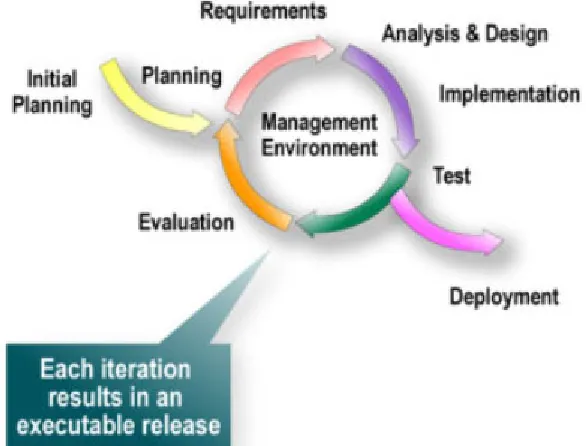
highlights the fact that the iterative or agile development process allows usability
professionals to be influential with the end product at all phases of the development
lifecycle rather than just at the beginning with the waterfall method (Bittner, 2004; Jacko,
[image:25.612.159.452.244.467.2]Düchting, Zimmermann, & Nebe, 2007).
Figure 2: Iterative product development process (Bittner, 2004)
Another interesting difference is that the customers and stakeholders provide feedback at
the end of each stage and designs are changed based on the feedback, which has proven to be
extremely valuable in enhancing the usability of the product. This feedback cycle is often
referred to as “participatory design or experiences” (Sanders, 2002). Team participation and
interaction take place in what is referred to as a “Scrum” which is the managing body in an
testers who are responsible for product delivery. Scrum teams typically meet daily to discuss
priorities, goals, and customer feedback (Woodward, Surdeck, & Ganis, 2010). This cadence
differs from the waterfall approach, which tends to hold weekly status meetings.
ii) Success Factors
Despite the general trend toward virtual teaming, iterative development teams
strongly advocate that co-location of team members is a key success factor. The Agile
Manifesto (Beck, et al., 2001) emphasizes this by stating, “The most efficient and effective
method of conveying information to and within a development team is face-to-face
conversation.” Co-location is not unique to iterative development and is regularly found with
teams using waterfall methodologies; however, traditional teams tend not to report that
co-location is critical to the success of their project. Co-co-location allows teams to use agile tools
such as the information radiator and whiteboarding; but, more importantly, it helps to build
trust and mutual understanding between team members (Cockburn, 2002). In development
environments where co-location is not possible, some best practices have been identified,
such as aligning the architecture of the product by geography (Coplien & Harrison, 2005),
including and assigning ownership to team members (Woodward, et al., 2010), and using
collaborative tools (Hunt, 2006).
Both waterfall and agile development approaches benefit from customer feedback
(Ferreira, Noble, & Biddle, 2007; Gruner & Homburg, 2000). The difference between the
two approaches is that traditional development advocates customer input before and after the
product has been developed, whereas companies who have successfully implemented agile
where customers are providing feedback and offering suggestions throughout the entire
development process. While some companies use stakeholders such as product managers as
surrogate customers (Ramesh, Cao, Mohan, & Xu, 2006), most partnered with customers
who provide regular feedback during development. It can be difficult for companies to find
customers willing or able to devote the time needed to make iterative development a success
(Nerur, et al., 2005), but those that do are more successful (Hanssen & Erlend F., 2006). The
Extreme Programming approach to agile even encourages the customer to be located on-site
with the developers (Fraser et al., 2004; Hunt, 2006). Cockburn (2002) contends that regular
communication between the development team and the customer must be present to ensure
the most benefit. Klein and Canditt (2008) also encourage customers to complete opinion
polls during the process to help measure the business impact.
Traditional development teams operate within an hierarchical or matrixed environment
(Nguyen, 2006). Such structures work within the traditional environment, but agile
development shifts the development process to empower the development team to have more
influence on the end product (Anderson et al., 2003), while the manager acts as more of a
facilitator. Likewise, team members need to understand the impact of their autonomy on the
project (Ramesh, et al., 2006). Successful agile teams have a management team that
embraces this shift and encourages the team to exert their influence and self-organize (Hoda,
Noble, & Marshall, 2010; Nerur, et al., 2005). The agile manager imposes less control, but
provides a safe environment for rapid change and encourages trust and collaboration between
team members (Augustine, Payne, Sencindiver, & Woodcock, 2005; Nerur, et al., 2005).
both the team members and the managers in the organization (Drew Procaccino, Verner,
Overmyer, & Darter, 2002).
Traditional and agile teams alike need to ensure that their team members have the
training and education necessary to be successful in their respective development
methodology (Shaw, 2000). Training can involve mentoring from team experts or coaches,
and it can also be more formal training such as classes or instructional books (Cockburn,
2002; Coplien & Harrison, 2005). Paired programming is an agile technique that involves
two programmers working together to write the code. The idea originated in Extreme
Programming (Beck, 2000) and it encourages programmers to cross-train, exchange real-time
ideas, and code faster with less defects (Succi & Marchesi, 2001). Large organizations
transitioning from traditional methods to agile methods can benefit from piloting agile with
smaller teams and projects, then having those teams coach other teams based on their
experiences (Cockburn, 2002).
It is also important that the team is equipped with the tools best suited to the
methodology they are using. Tools not only include development tools such as code
repositories and test trackers, but also tools that allow teams to interact and communicate
effectively. Cockburn (2002, 2004) has coined the terms “high-tech tools” for those that
assist with the development of software such as automated build systems and “high-touch
tools” for those that facilitate social and psychological needs such as e-mail or instant
messaging. He emphasizes it is more important to have the right mix of tech and
high-touch tools than to assume a tool that is the best fit for one team would also be the best fit for
another. If, for example, a team is co-located, they may benefit more from face-to-face tools
more useful. Hunt (2006) advocates that it is important to know when the appropriate tool is
needed and that team members should be properly trained on the tools their company
requires so they can reap the most benefit. Woodward, Surdeck, and Ganis (2010) suggest
that virtual whiteboards and multi-user chat servers help to remove barriers for virtual teams.
iii) Challenges
Neither traditional teams nor teams who have moved to iterative development are
immune to the challenges inherent in a software development project. Both approaches have
their unique challenges, as well as challenges which are pervasive to all software
development projects.
One of the biggest challenges for software development teams is distributed team
members (Damian & Zowghi, 2003). Many IT companies have made the move to distributed
and global team members to leverage around-the-clock development, worldwide talent, and
in some cases, lower resource costs (Prikladnicki, Audy, Luis, & Evaristo, 2003). Despite
the possible benefits, Damian and Zowghi (2003) found that distributed software
development teams find particular challenges with communication, knowledge management,
time zones, and trust. Companies using iterative methodologies and those who are moving to
such methodologies find virtual teaming particularly challenging due to the emphasis on
co-location and face-to-face interactions. Time zone differences make daily Scrums difficult,
less rigid rules make teams feel that they have less control over the process and quality, and
the lack of cohesion within the team hinders trust building (Nerur, et al., 2005; Ramesh, et
longer to move to an agile development methodology if many of their team members are
virtual, and more so if the team consists of a global workforce.
Another major challenge for software development teams is creating a quality
product. Coplien and Harrison (2005) contend that many of the quality issues in software
stem from the fact that quality is not designed into the product. They state that quality is an
afterthought that does not get attention until the team is in the testing or beta phase, when it is
too late to make changes to the product. Some teams also lack a quality assurance
professional who helps to keep the focus on quality and drives specific quality requirements
throughout the development process. Generally, development teams must compromise
schedule durations and endure additional costs to ensure a quality product is developed,
which many companies cannot afford in the competitive IT environment (Harter, Krishnan,
& Slaughter, 2000). Agile development has helped increased quality by introducing
test-driven development (Cockburn, 2002; Woodward, et al., 2010) and by receiving feedback
during iterations. Agile also imposes additional challenges for distributed teams who benefit
from specific quality guidelines because agile values quality guidelines that are more
malleable (Ramesh, et al., 2006).
Knowledge management is another aspect of software development that teams
struggle to master. Rus and Lindvall (2002) identified five major areas where software teams
are challenged with knowledge management; they include: 1) knowledge about new
technologies, 2) accessing domain knowledge, 3) sharing knowledge about local policies and
practices, 4) capturing knowledge and knowing who knows what, and 5) collaborating and
global teams are still deeply impacted by knowledge management issues (Ramesh, et al.,
2006), particularly those that are moving toward agile methodologies.
2c. Adaptive Structuration Theory
The concept of structuration as a theoretical model was originally developed by
sociologist Anthony Giddens in the mid-1970s as “an ontological framework for the study of
human social activities” (Bryant & Jary, 1991, p. 201). Giddens published extensively on
structuration theory; some of his most seminal works include: New Rules of Sociological
Method in 1976, Central Problems in Social Theory in 1979, and The Constitution of Society:
Outline of the Theory of Structuration in 1984.
According to Giddens (1977), structuration is the investigation of how and why
societal structures remain in some cases and dissolve in others. Structuration theory differed
from previous sociological theories in that it argued that human behavior is not based on the
actions of individuals or society as a whole, but rather the norms within unique structures.
These structures, and the rules that govern them, are malleable and can be expected to change
over time (Giddens, 1986). As an example, the structure of attending college exists today in a
similar form to the way it did in the 1950s, but many of the norms have changed. Classes are
often available online, notes are taken on a computer, and students can communicate through
their cell phones. Basic rules such as professors teaching classes, students studying at the
library, and grades being rewarded have remained the same. Students may behave by one set
of rules when they are at college, and adapt to a different set of rules when they return to the
structure that is their hometown.
Cohen (1989) suggests that the popularity of Structuration theory is based on the idea
that it “provides an account of the constitution of social life, the generic qualities of the
subject-matter with which social sciences at large are concerned” (p. 1). Others have
publications Giddens has written on the theory and the lack of concreteness that leaves it
open to interpretation as well as criticism (Bryant & Jary, 1991; Stones, 2005). As with
many seminal theories, Structuration theory has provided the groundwork for new theories.
One theory in particular, Adaptive Structuration theory, has gained significant traction in the
field of information technology.
Adaptive Structuration theory was initially introduced by DeSanctis and Poole in
1990 as a framework for studying the interaction of groups and organizations with
information technology (DeSanctis & Poole, 1990). Such a framework brought a new lens
with which to investigate information technology and change in organizations. Prior research
had focused on the technology itself rather than the social aspects the technology introduced
in a group or organization. Adaptive Structuration theory highlights that a group or
organization’s perceived utility and benefit of a technology drives its outcomes and future
use. This perception also influences how the technology changes over time for the group or
organization.
DeSanctis and Poole expanded on the Adaptive Structuration theory in 1994 when
they published Capturing the Complexity in Advanced Technology Use: Adaptive
Structuration Theory. The key components to Adaptive Structuration theory are Giddens’
(1977) model of structuration as well as Ollman’s (1971) concept of appropriation. Together
these concepts illustrate how the groups or organizations adapt the technology to meet their
goals and requirements. DeSanctis and Poole’s study used a group decision support system
tool to illustrate how the group’s social structure influenced the tool’s use and evolution.
The group’s adaption of the group decision support system was analyzed based on the
Adaptive Structuration model which DeSanctis and Poole (1994) describe as “an interplay
between advanced information technologies, social structures, and human interaction” (p.
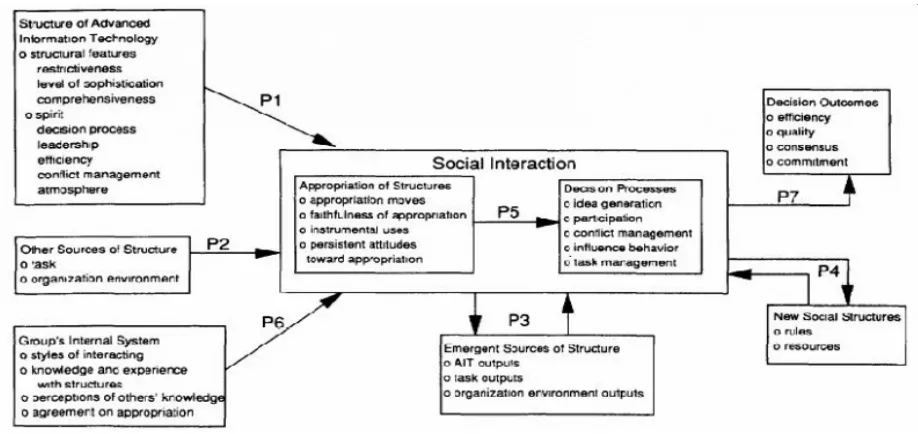
125). The model contains seven major components that influence the adaption of an
Figure 3: AST constructs and propositions
The first (P1) component is the structure of the advanced technology. These include
the structural features, which are the technical capabilities of the advanced technology, and
the spirit, which consists of the technology’s metaphor, visual representations, and user
assistance training. The second (P2) are any other sources of structure, such as the tasks that
need to be completed by the users of the technology as well as the organizational
environment that they are working within. Third (P3) are the new structures that emerge from
the structure of advanced information technology (P1) and other sources of structure (P2).
Fourth (P4) are the new social structures that result from the group or organization changing
based on technology use or other outside factors such as new people joining the team. Fifth
(P5) are the social interactions that occur as groups appropriate the new advanced technology
and subsequently make decisions based on these appropriations. For example, a software
development group may decide to adopt a new code repository, but decide that they are only
going to put code for the new release in the new repository because they do not have the
code to the new repository because maintaining two code repositories is too much of a
burden on the team. Sixth (P6) are the group’s internal systems which include the
interactional norms of the group, the experience level of the team, the confidence they have
in the knowledge of their teammates, and consensus on how best to appropriate the structure.
The seventh (P7) and final component of the model includes the decision outcomes. The
team or organization evaluates whether or not their appropriations and decisions have led to
positive outcomes, such as greater efficiency or higher quality. Returning to the example of
the new code repository, the team would evaluate if the new repository facilitated faster
defect resolution and, ultimately, higher code quality in the product they are delivering. If
the new repository resulted in more open complaints from customers, then they would need
to look how they are using the tool and if adjustments may be needed in their processes and
appropriations.
Adaptive Structuration theory has been used as a theoretical framework in both
virtual teaming (e.g. Majchrzak, et al., 2000; Raghuram, et al., 2010) and software
development research (e.g. Cao, et al., 2009; Ramesh, et al., 2006). In their comprehensive
analysis of virtual teaming research Raghuram, Tuertscher, and Garud (2010) found that the
virtual team cluster is commonly linked to Adaptive Structuration theory as a theoretical
framework.
Maznevski and Chudoba (2000) investigated the dynamics and effectiveness of global
virtual teams by using Adaptive Structuration theory to capture the categories and
propositions for team analysis. They used four components of the Adaptive Structuration
model as their major categories for the research design. These categories included structural
characteristics (P1, P2), technology appropriation (P5), decision processes (P5), and decision
outcomes (P7). Subcategories included some elements from the Adaptive Structuration
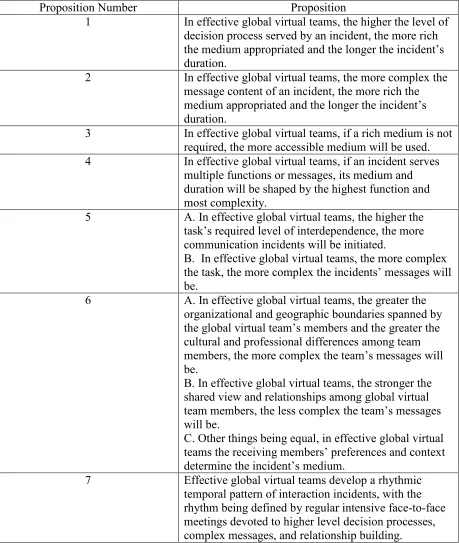
previous research. The findings of their study generated the seven propositions listed in Table
[image:35.612.87.546.174.717.2]2.
Table 2: Maznevski and Chudoba's (2000) seven global virtual team propositions
Proposition Number Proposition
1 In effective global virtual teams, the higher the level of decision process served by an incident, the more rich the medium appropriated and the longer the incident’s duration.
2 In effective global virtual teams, the more complex the message content of an incident, the more rich the medium appropriated and the longer the incident’s duration.
3 In effective global virtual teams, if a rich medium is not required, the more accessible medium will be used. 4 In effective global virtual teams, if an incident serves
multiple functions or messages, its medium and duration will be shaped by the highest function and most complexity.
5 A. In effective global virtual teams, the higher the task’s required level of interdependence, the more communication incidents will be initiated.
B. In effective global virtual teams, the more complex the task, the more complex the incidents’ messages will be.
6 A. In effective global virtual teams, the greater the organizational and geographic boundaries spanned by the global virtual team’s members and the greater the cultural and professional differences among team members, the more complex the team’s messages will be.
B. In effective global virtual teams, the stronger the shared view and relationships among global virtual team members, the less complex the team’s messages will be.
C. Other things being equal, in effective global virtual teams the receiving members’ preferences and context determine the incident’s medium.
Maznevski and Chudoba (2000) argue that the propositions generated from this study can be
adapted to specific teams and organizations. They also contend that extending Adaptive
Structuration theory to global virtual teams “provided the necessary descriptions of process
and structure, of technology and social systems, and the interaction of these dimensions over
time” (p. 489).
Majchrzak, Rice, Malhotra, King, and Ba (2000) applied the Adaptive Structuration
model to a team developing a new product. They used the technology (P1), group (P2), and
organizational environment structures (P2) to describe the pre-existing structures. From there
they examined the appropriations of the collaborative technology used by the team during the
initial phase of the project (P5) and again during the middle phase. Finally, they analyzed the
reasons for the change in structures (P5) and did an assessment of the positive and negative
outcomes of the project (P7). Their findings showed that initial structures were relatively
consistent across the three organizations that were studied. They also found that
misalignments in social structure and appropriation existed at the beginning of the project
and continued after adaptations had been made immediately following changes in structure.
Despite the misalignments, the team was still able to achieve project success, indicating that
misalignments are not a sign of eminent failure on the part of the group or organization.
Cao, Mohan, Xu, and Ramesh (2009) used Adaptive Structuration theory as a
framework for investigating how software development teams adapt to agile methodologies.
They argued that the following four sources of structure influence the appropriation of teams
to the agile development methodology: 1) agile methods defined through their structural
features and spirit; 2) software project characteristics; 3) organizational context; and 4) each
team’s internal system that includes their interaction style, knowledge, and expertise with
agile methods, and their perceptions about agile methods (p. 334). The research team
Structuration model. They continued consolidating like structure until the three dominant
structures of Extreme Programming as a source of structure, other sources of structure, and
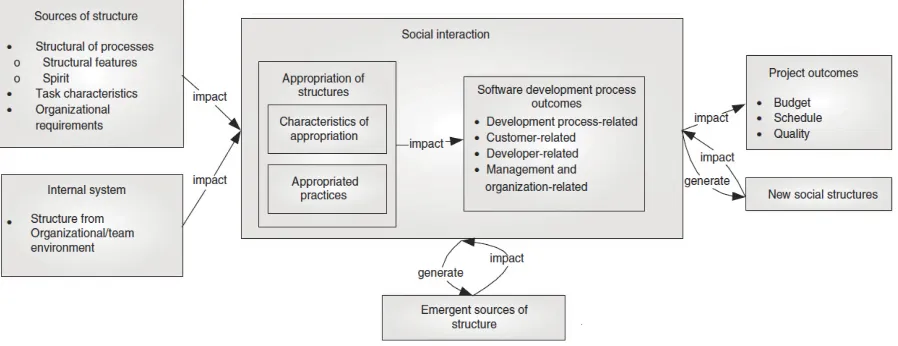
the team’s internal system were agreed upon. Four major appropriation practices were found:
development process related, developer related, customer related, and
organization/management related. The development process related appropriations included:
abstraction in architectural design, design by formalized agreement, minimal traceability,
post hoc documentation, and minimal documentation. The developer appropriations were
paired for overlaps and empowerment through shared expertise, which emphasized the
influence of the Extreme Programming agile approach. Customer related appropriations were
a shared understanding of the specifications and an agreement on quality. The
organization/management appropriations included upfront estimation and balanced formality.
Figure 4 shows the modified Adaptive Structuration model for agile software development
teams.
This study did not investigate adaption in terms of the appropriation of an advanced
technology, but rather focused on the software development process (agile) as the adapted
technology. The findings of this study add important new structures and appropriations that
[image:37.612.92.541.418.591.2]lend credibility to the idea that Adaptive Structuration theory can go beyond advanced
technology changes to adaptations in product development. The present study seeks to test
the findings by Cao, Mohan, Xu, and Ramesh (2009) in a new context by comparing global
virtual teams using waterfall and agile in the same organization.
2d. Propositions
Previous findings on virtual teams, software development processes, and Adaptive
Structuration theory provide a theoretical basis for the likely differences that will be found
between virtual teams using agile or waterfall software development methodologies. Cao,
Mohan, Xu, and Ramesh (2009) adapted the AST model from seven to six components
eliminating “other sources of structure” to make the model beneficial for the study of agile
development teams. Findings by Cao et al. (2009) suggest that the following structures will
be the most influential when waterfall teams move to the agile software development
methodology: 1) agile methods defined through their structural features and spirit; 2)
software project characteristics; 3) organizational context; and 4) each team’s internal system
that includes their interaction style, knowledge, and expertise with agile methods, and their
perceptions about agile methods (p. 334). These findings suggest that:
Proposition 1: Virtual teams using the agile methodology will demonstrate key differences
from a waterfall team in the major structures found in the Cao, Mohan, Xu, and Ramesh
(2009) model identified as the most influential while making waterfall to agile software
development appropriations.
DeSanctis and Poole (1994) define structural features as specific types of rules,
resources, or capabilities that are part of the system. They define spirit as the values and
goals of the structural feature. In this study the system is the software development process
and spirit is the values defined in the Agile Manifesto (e.g. collaboration, trust, minimal
documentation, embracing change, customer involvement). In their study of agile
the technologies, processes, and social action used by the team, while spirit is the general
intent of the features of agile. Finding by Cao et al. (2009) argued that the structural features
and spirit constructs under the “Sources of Structure” component were the among the most
important differentiating constructs for agile teams in their AST framework adapted for agile
teams.
1a. An agile team will demonstrate structural features and spirit that are different than
a waterfall team, given the differences in processes and values between the two
methodologies.
AST differentiates structural features from the organizational environment if the
organizational environment provides the contextual structures that structural features are
housed within (DeSanctis & Poole, 1994). Cao, Mohan, Xu, and Ramesh (2009) argue that
the organizational context of an agile environment is one of decentralized decision-making
and flattened organizational structures. Waterfall teams are usually hierarchical in structure
and require that changes be approved through a very specific set of stakeholders (Raccoon,
1997).
1b. An agile team will report that their structure is less hierarchical and their decision
processes are less centralized than a waterfall team.
An internal system in the AST model describes the nature of the members and their
relationships inside the group (DeSanctis & Poole, 1994). Members of an agile team have an
orientation toward collaboration, individual empowerment, trust, and knowledge-sharing that
differs from the command and control nature of waterfall teams (Cockburn & Highsmith,
2001). Global virtual teams will adapt to a new internal system as they move from a waterfall
to an agile methodology.
1c. An agile team’s internal system will be more collaborative than a waterfall team’s
AST defines attitude as the “the extent to which groups are confident and relaxed in
their use of the technology process, the extent to which the group perceives the technology is
of value to them, and their willingness to work hard and excel at using the system”
(DeSanctis & Poole, 1994, p. 130). In the context of this study, attitude toward the
development process rather than attitude toward a technology is used. Many teams moving to
the agile development model have had some level of training and become more comfortable
and confident with agile due to the regular use of retrospectives (lessons learned sessions
held at the end of each project sprint). Waterfall teams may have had training in agile
methodologies, but lack the experience to feel confident and relaxed with the process.
1d. An agile development team will have a more positive attitude about the agile
development methodology than a waterfall team.
Doshi and Doshi (2009) found that moving to an agile development methodology does
not just change the development process, it also changes the culture of the team. The Agile
Manifesto, created by practitioners frustrated with waterfall methodologies, states that agile
practitioners value “individuals and interactions over processes and tools, working software
over comprehensive documentation, customer collaboration over contract negotiation, and
responding to change over following a plan, “ (Beck, et al., 2001, p. 1). The Agile Manifesto
further emphasizes that such a fundamental shift in values can only be achieved by a
dramatic change in the attitudes and dynamics of the development team. Maznevski and
Chudoba’s (2000) findings also suggest that cultural composition of the global virtual team
(in this case the agile culture) is an influential structural characteristic.
Proposition 2:The appropriations by an agile team will create a culture that is unique and
distinct from a waterfall team.
The Agile Manifesto that was created and advocated by the early adopters of agile
development emphasized the importance of a collaborative environment when they listed
contract negotiation” (Beck, et al., 2001). Cockburn and Highsmith (2001) emphasize that
agile team focus on individual competencies and increasing collaboration levels.
2a. An agile team will describe their atmosphere as more collaborative than a
waterfall team.
Agile development requires that the team adopt new values and team dynamics (Beck,
et al., 2001; Doshi & Doshi, 2009) that will shift the social interaction constructs of the team.
Virtual team research has found that the richer the media used in the interaction, the more
cohesive the feeling of team (Fiol & O'Connor, 2005), the more social presence the team
member feels (Baker, 2002), and more trust develops between team members (Warkentin &
Beranek, 1999). This suggests that a global virtual team using the agile development
methodology will make more appropriations to media rich communication tools to overcome
their inability to use co-located team members as the agile software development
methodology advocates.
2b. Technology appropriation decisions by an agile team will report a greater
orientation toward technologies that support collaboration, team cohesion, and trust as
compared to a waterfall team.
Cockburn and Highsmith (2001) emphasize that an agile team empowers individual
team members to ultimately decide the fate of the product. This includes working with
customers and stakeholders to understand the most critical features or improvements that
need to be incorporated into the product as well as the quality of the product that is released.
Mnkandla and Dwolatzky (2006) argue that agile projects yield higher quality products.
2c. An agile team will state that they have more control over the quality and outcome
of the product they are creating than a waterfall team.
Agile teams, specifically those using the Scrum and paired programming techniques,
are encouraged to have regular interactions and most meet on a daily basis (Woodward, et al.,
people and developers must work together daily throughout the project,” (Beck, et al., 2001).
There are not specific rules in the waterfall methodology that state that the team should not
meet on a daily basis; however, waterfall teams traditionally meet less regularly and the
interactions are more formal in nature (Sawyer, 2004).
2d. An agile team will have more interactions between team members than a waterfall
team.
One important premise of agile development is that change is embraced rather than
discouraged through trusting relationships, team empowerment, and a focus on customer
satisfaction (Cockburn & Highsmith, 2001; Williams & Cockburn, 2003). Change is
possible for teams using the waterfall methodology, but the process is more time intensive,
formal, and is ultimately discouraged due to one cycle planning preferences (Raccoon, 1997).
2e. An agile team will be more likely to embrace project change and make
CHAPTER 3. METHODOLOGY
3a. Context and Participants
i) Context
The sample selected for this study was drawn from a large global IT company. This
company was selected because it has a long history of software development; it is
cutting-edge in virtual and global teaming, and it has a strong desire to move from the waterfall
development methodology to one that is agile and customer-focused. This company started
deploying agile projects in 2005 and they have invested heavily in training their development
organizations on agile best practices. Agile development was not required for all projects, but
it was strongly encouraged. There was a good mix of products that were using the waterfall
methodology only, using a hybrid of waterfall and agile methodologies, or had converted
completely to an agile approach.
The decision to use the waterfall development methodology or move to the agile
methodology was ultimately decided by the individual teams. Executive management
encouraged and enabled the adoption of agile development, but entrusted the team to select
the process that was best-suited for the project. This company deployed agile coaches to help
their development organizations transition seamlessly to agile. These coaches worked with a
wide variety of project teams and, therefore, brought a wealth of knowledge and best
practices to the teams they were coaching. Agile training was available for all employees
and, in many cases, was targeted toward specific job roles such as “Agile for Project
Managers” or “Agile for Software Developers”. Most of the training was available online,
ii) Participants
The waterfall and agile groups for this study are all employed by a global IT company
that has been in the software development business for many years. They reside in the same
organization, but work on global virtual teams on two distinct products. They report to the
same director, but have different first and second-level managers. Team members did not
self-select which project team they wanted to work on, but rather most had remained on the
same team for many project cycles. Both teams are working on software products that have
been on the market a number of years and have an established customer base. The waterfall
team is working on a product that backs up and recovers critical data for organizations. The
agile team is working on a product that monitors data centers and provides disaster recovery
solutions. Both teams have a long history of using the waterfall approach to develop
software and are working on projects of similar complexity. The defining difference between
the two teams is the software development process appropriations they have recently
deployed.
These two large globally-distributed teams using two different development
approaches offer the ideal opportunity to study AST differences associated with the two
software development approaches. This allowed the study to control for typical constraints,
such as the differences between companies, the nuances that could occur when developing
different types of products, or teams who are more virtually distributed than others. Despite
the differences between individual personalities of team members, the teams only differed in
the process (waterfall vs. agile) they were using to develop the product.
The first project team selected, the agile team, offered a good fit for this study
because they were undertaking a large agile project. They were also the first team in their
segment area of the company to move to agile. Extensive changes were needed in their team
dynamics, tooling, processes, and mindset to make their transition possible. These team