Terms and Conditions of Use of Digitised Theses from Trinity College Library Dublin
Copyright statement
All material supplied by Trinity College Library is protected by copyright (under the Copyright and
Related Rights Act, 2000 as amended) and other relevant Intellectual Property Rights. By accessing
and using a Digitised Thesis from Trinity College Library you acknowledge that all Intellectual Property
Rights in any Works supplied are the sole and exclusive property of the copyright and/or other I PR
holder. Specific copyright holders may not be explicitly identified. Use of materials from other sources
within a thesis should not be construed as a claim over them.
A non-exclusive, non-transferable licence is hereby granted to those using or reproducing, in whole or in
part, the material for valid purposes, providing the copyright owners are acknowledged using the normal
conventions. Where specific permission to use material is required, this is identified and such
permission must be sought from the copyright holder or agency cited.
Liability statement
By using a Digitised Thesis, I accept that Trinity College Dublin bears no legal responsibility for the
accuracy, legality or comprehensiveness of materials contained within the thesis, and that Trinity
College Dublin accepts no liability for indirect, consequential, or incidental, damages or losses arising
from use of the thesis for whatever reason. Information located in a thesis may be subject to specific
use constraints, details of which may not be explicitly described. It is the responsibility of potential and
actual users to be aware of such constraints and to abide by them. By making use of material from a
digitised thesis, you accept these copyright and disclaimer provisions. Where it is brought to the
attention of Trinity College Library that there may be a breach of copyright or other restraint, it is the
policy to withdraw or take down access to a thesis while the issue is being resolved.
Access Agreement
By using a Digitised Thesis from Trinity College Library you are bound by the following Terms &
Conditions. Please read them carefully.
Bubble Growth Dynamics in Nucleate
Pool Boiling with Liquid Subcooling
Effects
Muhad Rozi M at Nawi
Department of Mechanical and M anufacturing Engineering
Parsons Building
Trinity College
Dublin 2
Ireland
November 2014
I declare th a t this thesis has not been subm itted as an exercise fo r a degree at this or
any other university and it is entirely my own work.
I agree to deposit this thesis in the University's open access institutional repository or
allow the library to do so on my behalf, subject to Irish Copyright Legislation and
Trinity College Library conditions o f use and acknowledgement.
Muhad Rozi M at Nawi
November 2014
TRJNITY COLLEGE
ABSTRACT
Heat tra n s fe r in nucleate pool boiling has been characterized by very high
dissipated heat fluxes w h ils t requiring lo w drivin g te m p e ra tu re differences. The rate
o f bubble g ro w th and th e subsequent bubble m o tio n has a tre m e nd o us influ en ce on
th e heat tra n sfe r. In o rd e r to gain a deeper understanding o f th e m echanism s
responsible fo r this, basic know ledge o f bubble g ro w th dynam ics is required. To th is
end, single isolated bubble g ro w th dynam ics fro m an a rtificia l nucleation site in pool
boiling has been investigated e xp e rim e n ta lly in this study. An experim ental fa c ility has
been developed to p e rfo rm th e study. The experim ents have been conducted at
atm ospheric pressure w ith an e n viro n m e n ta l frie n d ly re frig e ra n t HFE-7000 as th e
w o rkin g flu id . A high speed video cam era w ith a co m b ina tio n o f p ow erfu l lens and a
tu b e extension has been used to capture th e bubble images during boiling. Image
processing in M a tla b has been used to process th e images and d ete rm ine relevant
param eters w hich characterize g ro w th and d eparture.
ACKNOWLEDGEMENTS
I would like to express my sincere thanks to my supervisor, Professor Anthony
Robinson fo r his trem endous guidance, patience, enthusiasm, understanding and
encouragement throughout my doctorate study. Also, thanks to Dr. Samuel Siedel fo r
his guidance, help and advice during this research work.
Apart from them , I would also like to express my appreciation to Gerry Byrne,
Mick Reilly, Gabriel Nicholson, Sean Doonan, Paul Normoyle and others in the
workshop fo r th e ir trem endous work, help, guidance and ideas. Thank you also to my
colleagues, David, Seamus, Gerrard and Rayhann fo r sharing ideas and support
thro ugho ut my tim e in college.
Thank you fo r the continuous support especially from my parent M at Nawi and
Mek Som, siblings and friends. To my lovely wife, Nor Hafeezah and my sons, Harith
and Hafeez, thank you fo r your continuing support and I am very grateful of your
presence in my life.
Special thanks to Hj Fauzi and Hjh Hamdah and families fo r th e ir great support
during my doctoral study.
I thank the Universiti Teknologi Mara (UiTM) fo r funding my doctoral studies
under the Young Lecturer Scheme. Last but not least, my sincere thanks, compliments
and regards to anyone who had helped and supported me in one way or another.
DEC LARATIO N... I
ABSTRACT... II
AC KN O W LED G E M E N TS...IV
TABLE OF C O N T E N T ... V
LIST OF FIGURES...IX
LIST OF T A B LE S ... XIV
N O M E N C LA T U R E ...XV
Latin Letters... XV
Greek Letters... XVII
Subscriptsan d Superscripts... XIX
Dimensionless Num bers...XX
CHAPTER 1 ...1
INTRO DUCTIO N... 1
1.1 B a c k g ro u n d...2
1 .2 M o t iv a tio n... 4
1 .3 O b je c tiv e s...5
1.4 Thesis O u tlin e s... 5
CHAPTER 2 ... 7
LITERATURE REVIEW ... 7
2.1.2 Bubble Departure...17
2.1.2.1 Bubble Departure Frequency... 26
2.1.3 Bubble Waiting T im e... 29
2.2 E x p e rim e n ta l Single B ub ble D y n a m ic s...31
2.3 S u b co o lin g Effects on B ub ble D y n a m ic s...32
2.3.1 Analytical Study...32
2.3.2 Experimental Investigations... 39
2.4 S u m m a ry...43
CH APTER S...45
EXPERIMENTAL DESCRIPTION AND DATA ANALYSIS... 45
3.1 E x p e rim e n ta l S e t-u p...46
3.1.1 Description of the Pool Boiling Facility... 46
3.1.2 Pool Boiler...47
3.1.3 Heating Element and Artificial Nucleation S ite ... 48
3.1.4 Measurement and Control E quipm ent... 50
3.2 E x p e rim e n ta l P rocedures...53
3.3 M e a s u re m e n t T e ch n iq u e s... 54
3.3.1 Heat Flux and Boiling Surface Temperature M easurem ent... 54
3.3.2 Image Processing... 56
3.3.3 Experimental Accuracy and U ncertainty...59
3.4 O p e ra tin g C o nd ition s...60
3 .5 D a ta A n a ly s is...61
3.5.4 Bubble growth curve...62
3.5.5 Non-dimensional parameter of shape and oscillation... 63
3.5.6 Forces acting on a grow/ing bubble... 63
3.5.6.1 Momentum variation... 65
3.5.6.2 Liquid inertia and added mass force... 66
3.5.6.3 Buoyancy force... 67
3.5.6.4 Triple line surface tension and adhesion forces... 68
3.5.7 Bubble Curvature... 69
CHAPTER 4 ... 71
RESULTS AND DISCUSSION...71
4.1 In tro d u c tio n...72
4.2 H eat Flux a t the H eated Surface... 75
4.3 W a itin g and G row th T im e s...77
4.3.1 Waiting tim e... 77
4.3.2 Grow/th tim e ...80
4.4 Bubble a t D e p a rtu re...82
4.5 V olum etric G ro w th...91
4.6 Energy Transfer a t Liquid-V apour In te rfa c e...95
4 .7 Bubble Shape and O scilla tio n s...98
4.7.1 Aspect ra tio ...98
4.7.3 Non dimensional description o f shape and oscillations... 105
4.7.4 Bubble tip and c u rv a tu re ... 107
4 .8 Contact Angle and Forces Analysis...1 09 4.8.1 Contact angle developm ent... 109
4.8.2 Forces acting on a growing b u b b le ...113
4 .9 Effects o f Liquid Subcooling...1 1 7 4.9.1 Isolated bubble: Inception, evolution and frequency of d e pa rtu re...118
4.9.2 Volum etric grovi/th and interface heat tra n s fe r... 124
4.9.3 Contact angle developm ent... 129
4.9.4 Forces acting on a growing b u b b le ...131
CHAPTERS...133
CO NCLUSIO N...133
Figure 1.1: Conceptual picture of pool boiling... 3
Figure 1.2: Typical boiling curve fo r w ater at 1 atm pressure [Faghri and Zhang (2006)]
... 4
Figure 2.1: Geometry of the growing bubble (Kiper, 1971)... 22
Figure 2.2: Relationship between dimensionless growth tim e and departure diam eter
(Yangetal., 2000)...26
Figure 2.3: Sketch fo r the growing bubble (Yang et al., 2000)... 26
Figure 2.4: One cycle of an individual bubble (Zhao and Tsuruta, 2 0 0 2 )...33
Figure 2.5: Dynamic microlayer (Zhao and Tsuruta, 2002)...34
Figure 2.6: Variation o f waiting and growing times w ith subcooling fo r bubbles form ing
at Site E [Ibrahim and Judd (1985)]...41
Figure 2.7: Superposition of the waiting tim e measurements fo r bubbles form ing at
site E fo r all levels o f heat flux investigated by Ibrahim and Judd (1 9 8 5 )... 41
Figure 3.1: Pool boiling fa c ility ... 47
Figure 3.2: Pool b o ile r... 48
Figure 3.3: Schematic of half slice of heating element and artificial nucleation site
(Unit: m m )... 49
Figure 3.4: Video camera s e tu p ... 52
Figure 3.5: Copper pipe coils fo r liquid subcooling...53
Figure 3.8: Sequence o f single bubble image processing fo r saturated b o ilin g ... 58
Figure 3.9: Sequence o f single bubble image processing fo r subcooled b o ilin g ...58
Figure 3.10: Estim ation o f te m p e ra tu re drop across th e layer o f A ra ld ite the rm al
cond u ctive adhesive... 60
Figure 3.11: Schematic o f c o n tro l v o lu m e ... 64
Figure 3.12: Schematic o f volum es, surfaces and lines in v o lv e d ... 64
Figure 3.13: Two principle radii at th re e selected points in a 3-dim ensional
re co nstru ctio n bubble[D i Bari and Robinson (2 0 1 3 )]... 70
Figure 4.1: Bubble g ro w th
a t A T w —
9.1 K w ith A t = 5 ms betw een the images...75
Figure 4.2: Heat flu x at various w all su pe rh e ats...76
Figure 4.3: N ucleate boiling versus natural convection correlated by Kobus and
W edekind (2001)at various w all s u p e rh e a ts ... 77
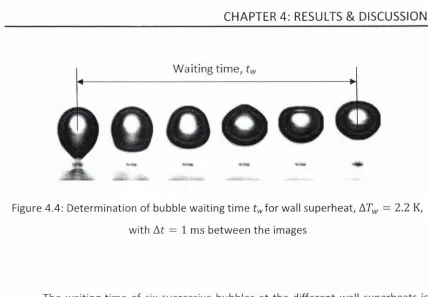
Figure 4.4: D e te rm in a tio n o f bubble w a itin g tim e f ^ f o r w all superheat,
A T w = 2.2
K,
w ith A t = 1 m s betw een th e im a g e s ... 78
Figure 4.5: W a itin g tim es,
o f six successive bubbles fo r th e range o f w all superheats
te s te d ... 78
Figure 4.6: W a itin g tim e , ti^ fo r th e average o f six successive bubbles at various w all
s u p e rh e a ts ...80
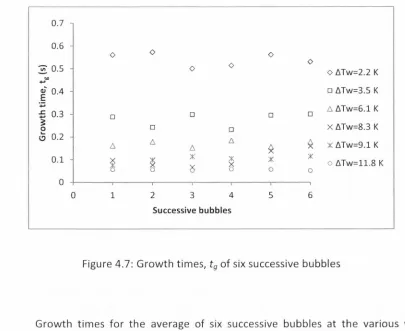
Figure 4.7: G row th tim es,
tg
o f six successive b u b b le s ... 81
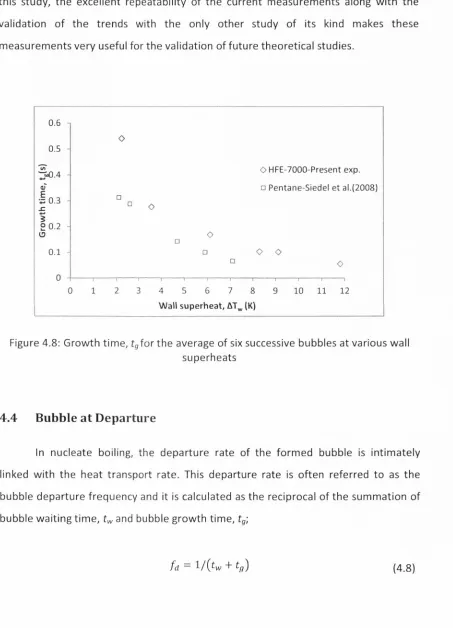
Figure 4.8: G row th tim e , tg fo r the average of six successive bubbles at various wall
su p e rh e a ts...82
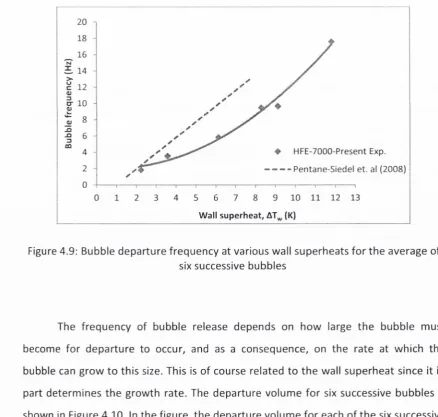
Figure 4.9: Bubble d ep a rture frequency at various w all superheats fo r the average o f
Figure 4. 11: D e p a r t u r e v o l u m e f or t h e a v e r a g e of six s uc c es s i v e b u b b l e s a t v ar io us
Vi/all s u p e r h e a t s ...86
Figure 4 . 12: Bubbl e d e p a r t u r e d i a m e t e r ,
Db
o f six s uc c e s s i v e b u b b l e s ... 8 8
Figure 4 . 13: D e p a r t u r e d i a m e t e r s for t h e a v e r a g e of six s u c c e s s i ve b u b b l e s a t v ar i o u s
wall s u p e r h e a t s ...8 9
Figure 4 . 14: R el at i on s hi p of e q u i v a l e n t b u b b l e d e p a r t u r e d i a m e t e r a n d b u b b l e
d e p a r t u r e f r e q u e n c y ... 9 0
Figure 4. 15: B ubbl e d e p a r t u r e f r e q u e n c y - d i a m e t e r a t v a r io u s wall s u p e r h e a t s ... 91
Figure 4. 16: G r o w t h c u r v e s o f six s u c c e s s i ve b u b b l e s a t A T w = 1 1 . 8 K ... 92
Figur e 4. 17: A v e r a g e of six b u b b l e s g r o w t h c u r v e s a t v a r i o u s wall s u p e r h e a t s ...94
Figur e 4. 18: A v e ra g e o f n o n - d i m e n s i o n a l six b u b b l e s g r o w t h c u r v e s a t v a r io u s wall
s u p e r h e a t s ...9 5
Figure 4. 19: Ra t e of b u b b l e v o l u m e c h a n g e ...97
Figur e 4. 2 0 : Bubbl e g r o w t h a s p e c t r a ti os
{ h /w )
a t v a r i o u s wall s u p e r h e a t s ... 99
Figur e 4. 2 1 : Early s t a g e of b u b b l e g r o w t h a f t e r d e p a r t i n g last b u b b l e f o r A7'w=2.2 K
w i t h A t = 1 m s ... 99
Figur e 4. 2 2 : Early s t a g e of b u b b l e g r o w t h a f t e r d e p a r t i n g last b u b b l e f o r
A T ^ - 1 1 . 8
K
w i t h A t = 1 m s ...100
Figure 4. 2 3 : Vertical c o a l e s c e n c e of t w o s u cc e s s i v e b u b b l e s f o r t h e c a s e
o f A T ^= 11.8
K
101
Figure 4.25: Bubble height o f th e centre o f gravity histories at non dim ensional tim e
fo r d iffe re n t w all s u p e rh e a ts ... 103
Figure 4.26: V elocity o f the centre o f gra vity
( d h c g / d t )o f bubble g ro w th fo r d iffe re n t
wall s u p e rh e a ts ...105
Figure 4.27: A cceleration o f th e c e n te r o f gra vity
( d ^ h c g / d t ^ )o f bubble g ro w th fo r
d iffe re n t wall su p e rh e a ts...105
Figure 4.28: Evolution o f non-dim ensional p aram eter
As
fo r various w all superheat 106
Figure 4.29: First derivative o f non-dim ensional param ete r
A ;
fo r various w all
superheats... 107
Figure 4.30: E volution o f bubble shape fo r low and high w all superheats... 108
Figure 4.31: Evolution o f radius at bubble tip fo r low, m o d erate and high wall
superheats... 109
Figure 4.32: D e fin ition o f co nta ct angle,
a
... 110
Figure 4.33: Calculation o f contact angle,
a
at the liq u id -va po u r in te rfa c e ...110
Figure 4.34: Contact angle histories fo r w all superheat,
[SJ^-2.2
K ...112
Figure 4.35: V ideo sequence o f bubble g ro w th fo r w all superheat,
hT^=2.2
K ...112
Figure 4.36: C ontact angle (corrected) histories fo r low, m o d erate and high w all
superheats...113
Figure 4.37: Various forces acting on a grow ing bubble at w all superheat AIiv=2.2 K:
(top) uncorrected contact angle, (b o tto m ) corrected co nta ct a n g le ... 115
Figure 4.38: Forces acting on a g ro w in g bubble at w all superheat, A7w=6.1 K ...116
ATsub
= 10 K w ith
A t — 1
ms between the im ages... 120
Figure 4.41: Evolution of a bubble in subcooled boiling w ith
ATsub
= 8 K fo r heat
flux,
q " =
36 k W /m 2 w ith
A t = 20
ms between the im ages... 121
Figure 4.42: Evolution of bubble shape fo r
ATsub
= 3 K and
ATsub
= 8 K ... 122
Figure 4.43: Comparative evolution of bubble shape fo r subcooled boiling
(ATsub
=
8 K) and saturated boiling
(ATw
= 2.2 K )... 122
Figure 4.44: Bubble departure frequency fo r various subcooling levels...123
Figure 4.45: Bubble volum etric growths fo r various subcooling levels...126
Figure 4.46: Rate of dimensional bubble volume chan ge...128
Figure 4.47: Rate of non dimensional bubble volume change... 129
Figure 4.48: Comparison of contact angle (corrected) histories of subcooled boiling
and saturated b o ilin g ...130
Figure 4.49: Vertical forces acting on a growing bubble in subcooled boiling fo r low
subcooling
{ATsu b-3
K)...132
LIST OF TABLES
Table 1: Properties of HFE-7000 at atmospheric pressure [3M (2014)]...61
Latin Letters
Symbol
N a m e
Units
rh
M a s s flow r a t e
kg.s’^
Ar e a
m^
A p a r a m e t e r in Eq. (2.6)
-a
A p a r a m e t e r in Eq. (2.49)
-B
A p a r a m e t e r in Eq. (2.10)
-b
A p a r a m e t e r in Eq. (2.49)
-C
A p a r a m e t e r in Eq. (2.13)
-c
A p a r a m e t e r in Eq. (2.49)
-Cp
Specific h e a t c a p a ci t y
J . k g ' . K '
D
A p a r a m e t e r in Eq. (2.20)
-D ,d
D i a m e t e r
m
Db
B u b b l e ' s d i a m e t e r a t d e p a r t u r e
m
Do
Base d i a m e t e r
Dt
T a t e ' s d i a m e t e r
m
F
Force
N
f
Body f o r c e
N.m'^
fd
B ub bl e d e p a r t u r e f r e q u e n c y
s'^
g
Gra vi ty a c c e l e r a t i o n
m.s-^
G(Q)
G eom etry o f bubble neck
h
Heat tra n s fe r c o e fficie n t
W.m'^.K'^
h
Enthalpy
J-kg'^
hcg
Height o f th e c e n te r o f gra vity
m
hfg
Latent heat o f vaporization
kJ.kg'^
h
Height o f th e bubble
m
I
rRobinson and Judd crite rio n
k
Therm al c o n d u c tiv ity
W .m '\K '^
K
Empirical constant in Eq. (2.54)
L
Length
m
Lc
Capillary length
m
Lo
Characteristics length scale in Eq. (2.57)
M
M o le cu la r w e ig h t
g.m ol'^
m
Mass
kg
n
N um ber o f m olecules
mol
n
Em pirical constant in Eq. (2.54)
P
Pressure
Pa
P
Power
W
Q
Heat
W
q "
Heat flu x
W .m '^
R
Radius
m
r
Length in the radial d ire ctio n
m
R
Therm al resistance
K.W'^
*
T
T e m p e r a t u r eK
t
T im e stw W a it in g t i m e ms
G r o w t h t i m e ms
t *
Dim ensio nle ss t im e-u
V e lo c ity m.s-^V V o lu m e m^
V * D im ensio nle ss v o lu m e
-X
Length in t h e x-d irectio n my
Length in t h e y -d ire ctio n mz
Length in t h e z-directio n mG reek Letters
a
C o n ta ct anele "a
T h e r m a l diffusivity m^.s'^P
T h e r m a l expansio n coe ffic ie n tP
B u bb le g ro w th p a r a m e t e r in Eq. (2.45)-P
C o n fig u ra tio n angle in Figure 2.5y
A p a r a m e t e r in Eq. (2 .1 6 )-6
Thickness o f liquid layer mu D yn a m ic viscosity k g .m '\s '^
u
K in em atic viscosity
m^.s'^
ijj
A p a r a m e te r in Eq. (2.63)
(2.57)]_______________-00
bulk
b
related to the bubble
B.buoy
buoyancy
base
relative to the base o f the bubble
C
capillary
c
cavity, condensation
cq
center of gravity
CL
contact line
CP
contact pressure
Ctin
tip curvature
Cu
copper
d
detachm ent or departure
duy
unsteady growth
D
drag
e
evaporation
eq
equivalent
f
fluid
q
growth
1
inertia
£
liquid phase
LI
liquid inertia
mac
macrolayer
mic
microlayer
mom
m om entum
r
radial direction
s a t
s a tu r a ti o n
s ub
s ubcooling
V
v a p o u r p h a se
v f
viscous forces
vs
viscous s tr es s
w
h e a t e d wall or surface
X
x-direction
V
y-direction
z
z-direction
Dimensionless Numbers
Bond n u m b e r ,
B o
=
aGrashof n u m b e r ,
Gy =
' ^ l92I I I , ,
PlCpliToo T^at^
Jakob n u m b e r , y a — —
---P v ^ f g
Nusselt n u m b e r ,
N u
= —
ilC r t
Prandtl n u m b er ,
P r
=
—
-ki
CHAPTER 1
INTRODUCTION
CHAPTER 1: INTRODUCTION
1.1
Background
Boiling is a complex process in which mass, m om entum , and energy are
transferred w ith in and between a solid wall, a liquid phase and vapour phase. When
liquid is boiled, a liquid-vapour phase change process occurs such th a t in some
situations/w all superheats, vapour bubbles are form ed either on a heated surface or
in a superheated liquid layer adjacent to the heated surface. This process is called
nucleate boiling and is known to be a highly effective mode of heat transfer and one
o f the most studied physical phenomena in therm al fluid science and engineering.
The form ation of bubbles w ithin superheated liquids is generally observed to
occur over a range o f tem peratures w ithin a metastable range o f superheats. Bubble
nucleation com pletely w ithin a superheated liquid is called homogeneous nucleation.
Meanwhile, bubble nucleation th a t occurs at the interface between a metastable
phase and another (usually solid) phase th a t it contacts is called heterogeneous
nucleation.
Liquid
Vapor
Heater
Figure 1.1: Conceptual picture o f pool boiling
[image:25.535.57.495.71.331.2]CHAPTER 1: INTRODUCTION
10
10^
10
10
Region 1
1
Region II
'
Maximum
1
(critical) heat |
Region IV
/
'
Nucleate
9 ^
flux
Q *
1
" X 1
Film
/
1
boiling /
1
1
/
1\ Transition
boiling /
Natural
1
/
1
\boiling
'
\
1
convection
boiling
1
b/
1
^
y / 1 Slugs and j
\
1
D|
/ Minimum
--- heat flux,<?'^jj,
L /
1
columns '
Isolated
|
I bubbles!
|
1 1
1
Region III
1
1
1
1
30
100
320
A r= 7 ’, , - 7 ’.„„CC)
1000
Figure 1.2: Typical boiling curve fo r water at 1 atm pressure [Faghri and Zhang (2006)]
1.2
M otivation
Since the early to mid 1900s, theoretical studies of boiling have been
conducted attem pting to understand the boiling process and define theories and
m athematical models to predict its performance. Even still, global theories and robust
empirical form ulations seem to be elusive. This is due to a lack o f a com plete
understanding of the fundam ental physics of bubble dynamics, flo w and heat transfer
at these small tim e and length scales. This is complicated by the fact th a t bubble
dynamics are sensitive to a vast array of interdependent parameters which makes
exhaustive experim entation and exact numerical sim ulations difficu lt to achieve.
Although this type of heat transfer process has been utilized over the ages,
knowledge about the phenomenon and its physical mechanisms o f heat transfer is still
restricted, mainly because the technology required to measure the tim e and length
scales of the phenomenon has only been developed recently. This being the case, the
[image:26.535.56.502.44.639.2]boiling phenomena w ithin the scope of isolated bubble dynamics from an artificial
nucleation site.
1.3
Objectives
The present study entitled
"Bubble Growth Dynamics in Nucleate Pool Boiling
w ith Liquid Subcooling Effects",
has the follow ing objectives:
• To design and construct an experimental test facility to allow the
visualization o f bubble dynamics fo r pool boiling from a single artificial
nucleation site at atmospheric pressure w ith the option of subcooling.
• To measure the bubble size more precisely using sophisticated modern
technique.
• To gain a deeper knowledge and understanding about the bubble
dynamics phenomenon in nucleate pool boiling under saturated
conditions.
• Evaluate
validity of classical
theories w ith
simple
controlled
experiments.
• To provide some initial understanding of the behaviour of single
isolated bubble growth during subcooled pool boiling.
1.4
Thesis Outlines
This thesis is divided into five chapters. It is organized as follows:
CHAPTER 1: INTRODUCTION
Chapter 2
- Analytical studies of bubble growth, bubble departure and
bubble waiting tim e are presented. It follow s by reviewing some o f the
experimental studies of single bubble dynamics. The effects of
subcooling on bubble grow th dynamics in both analytical and
experimental earlier studies will be presented in the last part in this
chapter.
Chapter 3
- The experim ent designed and b u ilt fo r the present study is
presented,
it
is
follow ed
by
the
experimental
procedures,
measurement techniques, operating conditions and data analysis.
Chapter 4
- Results from the experimental work are presented and
discussed fo r saturated conditions and subcooled conditions.
CHAPTER 2
LITERATURE REVIEW
Boiling heat transfer has received much attention fo r
about a century because o f the high heat transfer coefficients
associated w ith this mode of heat transfer. Numerous studies
have been carried out by many researchers attem pting to predict
boiling heat transfer rates since the first boiling curves produced
by Nukiyama (1934). This chapter is aimed at providing some
relevant inform ation regarding the research carried out pertaining
to the bubble dynamics and the effects of subcooling in nucleate
pool boiling from different researchers across the globe.
CHAPTER 2: LITERATURE REVIEW
2.1
Analytical Bubble Dynamics
The first im portant work on bubble dynamics was perform ed by Rayleigh
(1917). He form ulated the equation of m otion fo r spherical bubble expansion as a
problem of the dynamics of an incompressible and inviscid fluid, which was later to be
known as the inertia controlled growth regime. Integration of the momentum
equation in the liquid phase, neglecting surface tension influences, results in.
The surface tension term was later added by Plesset and Zwick (1954) by relating the
vapor and liquid pressures at the bubble interface through the Young-Laplace
pressure drop.
Eq. (2.2) is known as the extended or m odified Rayleigh equation. It relates the
pressure difference which drives growth to the inertial forces exerted by the liquid on
the bubble and surface tension forces at the interface.
2,1.1 Bubble Growth
Bubble growth in infinite superheated liquids was analytically investigated in the
1950s to the 1970s. Generally, the work has been divided into the follow ing tw o main
regions,
(i)
Inertia controlled growth
(ii)
Diffusion controlled growth
(
2.
1)
The region of bubble growth controlled by inertia forces was famously related to
the work of Rayleigh (1917). This region is restricted to the initial stages of rapid
grow th in which the bubble expansion rate is prim arily lim ited by its ability to 'push'
the surrounding liquid. During this stage, the rate of heat transfer to the interface is
assumed sufficiently high such that growth is not constrained by the resultant vapour
generation into the bubble. For the solution of this growth stage, the vapour pressure
is nearly constant and assumed to be near its maximum value of
~ f ’sat(T’oo)- Fof
bubbles large enough that the surface tension term is negligible [Eq. (2.1)], the
interface velocity can be calculated as.
By substituting the Clausius-Clapeyron equation to relate the vapour tem perature to
the saturation tem perature, the solution fo r inertial controlled growth is obtained
[Plesset and Zwick (1954), Mikic et al. (1970)],
From Eq. (2.4), it clearly shows that inertial controlled grow th is characterized by a
linear relationship between radius and tim e.
(2.3)
(2.4)
R(t) = A .t
(2.5)
w here
A
is.
CHAPTER 2: LITERATURE REVIEW
However, w ith no experim ental data existing at th a t tim e , th e a p p lica b ility o f Eq. (2.4)
was d iffic u lt to ascertain as it o nly becomes significant fo r very low system pressures.
Later, th e region o f bubble g ro w th co ntro lle d by th e rm a l diffu sio n was in tro du ce d ,
fo r exam ple in the works o f Forster and Zuber (1954) and Plesset and Zwick (1954). In
this case, th e bubble gro w th p re dictio n s was extended beyond th e in e rtia l co ntro lle d
g ro w th region by taking in to account th e fa ct th a t as th e bubble grows, th e la te n t heat
re q u ire m e n t o f evaporation depletes th e energy stored w ith in th e superheated layer
w hich has fo rm e d at the surface o f th e bubble [Plesset and Zwick (1954)]. As the
bubble grow s, its e qu ilibrium v a p o u r te m p e ra tu re decreases fro m
T^o
to its m inim um
value o f
Tsat (Poo)- As the in terfa cia l te m p e ra tu re and corresponding pressure drop,
bubble g ro w th becomes lim ite d by th e re la tive ly slo w e r diffu sio n o f heat to the
va p o u r-liq u id interface, causing th e g ro w th rate to c o n tin u a lly decrease.
Plesset and Zwick (1954) have obtained a so lu tio n fo r th e instantaneous
bubble radius prediction fo r th e case o f th e rm a l d iffu s io n co n tro lle d g ro w th by
supplying an approxim ate expression fo r th e liq u id te m p e ra tu re d is trib u tio n at the
interface. This approxim ate expression was fou n d u nd e r th e assum ption th a t th e drop
in te m p e ra tu re fro m Too to th e value o f
T at th e bubble boundary takes place in a
layer o f liquid adjacent to th e bubble w hich has a small thickness com pared w ith
bubble radius. This assum ption o f a 'th in th e rm a l b ou n da ry layer' resulted in an
a pp ro xim a te expression fo r th e liq u id te m p e ra tu re at th e m oving interface.
Then, by assum ing the rm al e q u ilib riu m betw een th e liq u id at th e in te rfa ce and the
va po u r and im p le m e n ting th e energy balance at th e in te rfa c e w hich relates th e rate o f
heat tra n s fe r to th e bubble to th e v a po u r mass balance, Plesset and Zwick d ete rm ine d
th a t.
/2
f t R \ d T / d r )
R(t) ~ 2 ^ / 3 J a ( ^ y ^
(2-8)
Here, Ja =
is the dimensionless superheat known as the Jakob number.
P v h f gAccording to Prosperetti and Plesset (1978), Eq. (2.8) predicts th a t the radius w ill
increase asym ptotically w ith tim e if growth is diffusion controlled and is valid only fo r
tim es large enough th a t the grow th velocity is much smaller than the inertia
controlled velocity. From the Eq. (2.8), it clearly shows that the growth is asymptotic;
(2.9)
w here the Plesset and Zwick solution,
B is
12aja
n
Vz
(
2
.10)Forster and Zuber (1954) perform ed a sim ilar analysis in which the interface
tem p e ra tu re was approxim ated by integrating the Green's function over the domain
o f the 'th in therm al boundary layer'. The Clausius-Clapeyron relation was once again
used in th e relationship between vapour pressure and tem perature to give the
asym ptotic expression,
CHAPTER 2: LITERATURE REVIEW
(
2.
12)
where fo r the Forster and Zuber solution, C is.
(2.13)
Meanwhile, w ith o u t the assumption o f a 'thin therm al boundary layer' as previously
used by Plesset and Zwick (1954) and Forster and Zuber (1954), Scriven (1959)
determined the exact solutions of the energy equation including the effects of radial
convection resulting from unequal phase densities to obtain an asym ptotic relation fo r
thermal diffusion controlled growth.
The constant
p
depends on the system pressure and the degree o f superheat. For the
case of moderate to high superheats or large Jakob numbers, Eq. (2.14) simplifies to,
When Eq. (2.15) is applied fo r common fluids and system condition in which
y
« 1, it
is identical to the solution given by Plesset and Zwick (1954) [Eq. (2.8)]. This implies
that fo r large enough Jakob numbers, the 'thin therm al boundary layer' assumption is
(2.14)
(2.15)
where.
valid [Robinson (2002)]. For th e case o f small Jakob num bers o r low superheats,
Scriven (1959) obtained,
(2.171
W hen applied to th e com m on flu id s and system c o n d itio n s (y « 1), it sim plifies to .
R ( t ) ^ y j 2 ] a . a t
(2.18)
It is also noticed fro m th e Eq. (2.18) th a t th e tim e take n to diffuse such a distance is
its e lf p ro p o rtio n a l to
R^,
/ ? « D . t V 2
(2.19)
w h e re the Scriven solu tion , D is,
D = yj2]a. a
(2.20)
From th e w orks o f Plesset and Zwick (1954), Forster and Zuber (1954) and
Scriven (1959) in th e case o f th e rm a l diffusion c o n tro lle d bubble expansion, it is
noticed th a t th e expressions given have th e same a s ym p to tic dependence on tim e
( ~ t ^ /
2) b u t a d iffe re n t dependence on th e Jakob n u m b e r. This im plies th a t fo r small
Jakob num bers, th e 'th in th e rm a l b ou n da ry layer' assum ption may no longer be valid
[Robinson (2002)]. It suggests th e fo llo w in g dependence on th e Jakob num ber,
R ~ Ja
(large Ja)
CHAPTER 2; LITERATURE R E V IE W
Postulation can be made from the above efforts that the early stage of bubble
grow th is inertia controlled and the later stage is diffusion controlled. A general
relation fo r bubble growth rates in a uniform ly superheated liquid which is applicable
fo r the entire range of the bubble growth, including inertia controlled and diffusion
controlled growth, was derived by Mikic et al. (1970). They used the Clausius-
Clapeyron equation fo r the vapour pressure curve, assuming therm al equilibrium in
the vapour bubble so that the vapour pressure corresponds to the bubble wall
tem perature as the bubble grows. The relation was compared w ith the existing
experimental data of Lien and G riffith (1969) fo r w ater over a wide range of systems
pressures, including low pressure data w ith a significant inertia controlled region and
it was found to be in good agreement. The relation fo r the variation of bubble radius
w ith tim e which spans both regions is,
R* = ^ [ ( t + + 1 ) ^ / 2 - ( f ) V 2 - i j ( 2 . 2 2 )
where the scaled variables are given by.
R * =
B ^ / A ’
t*
(2.23)
A =
'^ s a tP l
B =
12
n
(2.24)
in which,
b = 2/3 fo r bubble growth in an infinite medium;
b =
t i/7
fo r bubble growth on a surface
describe grow th over th e en tire range of superheats. By assuming a linear variation o f
vapour pressure w ith te m p e ra tu re , th ey obtained th e expression,
3/ 3/
/ 2 / I \ / 2
-
1
(2.25)
w h e re th e scaled variables are expressed as.
\ ( 2 ( s a \ l ' ^ P i h f a ^ ^
_i,
I.(T T
^ (Pi[P vaoo)-P oc])
(2.26)
3 \ n / k ( T ^ - T s a t ) '
[ P v ( T o o ) - P c o ? ^ ^
2ap_
V
2
Analytical bubble grow th studies in th e region of th e rm a l diffusion controlled
g row th w ere later extended to consider non-uniform te m p e ra tu re fields which
approxim ate th e conditions of heterogeneous nucleate boiling at a heating surface;
fo r examples th e works of Zuber (1 9 6 1 ), Han and G riffith (1 9 6 5 ), Cole and Shulman
(1 9 6 6 ) and Mikic and Rohsenow (1969). Zuber (1 9 6 1 ) in his study o f non-uniform
te m p e ra tu re field effects took into account th e heat flux from th e heated surface to
th e liquid. For a spherical bubble, th e rate o f evaporation was given by:
d R 'Pw T'sat
y i n a t
(2 .2 7 )
CHAPTER 2: LITERATURE REVIEW
R = b —Ja^ na t
1 —
(2.28)
n
2k(T^ - T,at)
w ith a co nsta nt factor,
b
fo r th e e ffe c t o f sphe ricity w hich lies betw een
1and
^f3
w ith
^ / 2
3*^ in te rm e d ia te value.
Han and G riffith (1965) to o k in to account th e th e rm a l boundary layer thickness
and a critical w all superheat re la tio n to th e cavity to o b ta in bubble g ro w th rates. The
th e rm a l layer thickness was o b ta in ed fro m th e co nsideration o f tra n s ie n t conduction
in to a layer o f liquid on th e surface. The Han and G riffith bubble g ro w th expression in
a n o n -u n ifo rm te m p e ra tu re fie ld is expressed as.
M ikic and Rohsenow (1969) considered bubble g ro w th in a n o n -u n ifo rm
te m p e ra tu re fie ld by using a one-dim ensional m odel corrected fo r sp h e ricity in ord er
to approach th e lim it fo r th e bub b le g ro w th in a u n ifo rm ly superheated liq u id when
th e w a itin g tim e ,
approaches in fin ity . They in tro d u ce d the assum ption th a t the
actual heat flu x can be expressed as.
^_(Ps(fc
k
\ 2 ( T „ - T s a t ) ^
1/^
( T ^ - T ^ )
fAat
S \
(2.29)
where.
cu rva tu re factor,
w h e re
1 <
<
3 ^ /2surface fa cto r,
cp^
=
2 n R ^ ( l + c o s 6)4 n R ^
1 + cos 6
2
vo lu m e facto r,
q)^ =
i( 4 7 r R 3 ) _ l[2 7 r /? 3 ( l- c o s 6 l) ]+ i7 r R 3 s m 0 c o s e _ 2+cos e{ 2+ si n ^ 6)1 ^
T'w-Tb
^
V
^ / { n a ( t + T ^
(2.30)
w here
A being area and c o rre ctio n fa c to r C was fo u n d to be V s . The second te rm in
Eq. (2.30) represents th e effects o f a n o n -u n ifo rm te m p e ra tu re fie ld . As th e g ro w th o f
th e v a po u r bubble is governed by th e heat tra n s fe r process, th e Eq. (2.30) can be
w ritte n as.
dR
p , h „ — = k ^
T ^ - T .
IV ‘ s a tTiu — Th
‘ w ‘ b(2.31)
By in te g ra tin g Eq. (2.31) using /? = 0 at t = 0 gives an expression fo r bubble g ro w th .
/? = - V 3 7 a V ^ l
n
T — T* s a t
Vz
n...^y2
(2.32)
2.1.2 Bubble D eparture
Perhaps th e firs t m odel fo r p redicting bub b le d e p a rtu re was in tro du ce d by
Fritz (1935). The Fritz e q u a tion , by utilizing th e co nta ct angle,
a and th e surface
tension,
a
gives th e bubble d ep a rtu re d ia m e te r as th e d ia m e te r th a t satisfies the
co n d itio n in w hich th e buoyancy force is balanced by th e capillary force,
tt
D
- ^ i P i - P v ) g = nDoa sin ao
(2.33)
CHAPTER 2: LITERATURE REVIEW
^ e q ~
6
^
7T
(2.34)
Here, it is supposed that the diam eter o f the bubble base is proportional to the
equivalent diameter of the bubble.
Do = CD,,
(2.35)
Then, by substituting Eq. (2.35) into Eq. (2.33) Fritz obtained.
- ^ ( P ; - P v ) 5 = CcTsinao (2-35 )
which gives the definition of bubble departure diam eter as.
a
a
where
C
is taken as 0.0208 and
is in degrees.
A similar method to predict the bubble departure diam eter has been proposed
by Chesters (1977). By using the same physical condition as Fritz (1935), he showed
that fo r small values of the shape factor defined as,
^
P.)sSj
,2.38)
where
R j
is the bubble radius at the apex, the bubble departure diam eter can be
(2.39)
The correction fa cto r
k < 1
was added to account fo r the over pressure inside the
bubble.
Kiper (1971) in his predictive study fo r determ ining the m inimum bubble
departure diam eter in saturated nucleate pool boiling, found that the m inimum
departure size varies w ith Jakob num ber only. In his work, the bubble is considered to
be o f spherical fo rm ending w ith a small neck which connects the bubble to the
heated surface as shown in Figure 2.1. He neglected both the drag force and the
vapour inertia force, though he considered the inertia of the fluid. Consistent w ith the
previous models o f bubble departure, individual bubbles w ill depart when the force
balance equation is satisfied, w ith the forces acting on the bubble defined as follows;
(i)
The buoyancy force
where
go
is a conversion constant. The contact area at the base of the bubble is small
w ith respect to the bubble size and the overpressure effect is negligible.
(ii)
The capillary force
Furthermore, if the geom etry o f the neck is known then the term
Dgcosa
can be
expressed as;
CHAPTER 2: LITERATURE REVIEW
Fq
— —a n G (6 )D
(2.42)
where G (0) is related to geom etry of the bubble neck.
(Hi)
The liquid inertia force
The inertial force of the apparent liquid mass surrounding the bubble was initially
derived by Keshock and Siegel (1964). They have included the affected mass of the
fluid which occupy the bubble volume by 1 1 /1 6 as suggested by Han and G riffith
(1962). The acceleration o f the fluid is approximated by the tim e rate of change of the
bubble growth velocity where the velocity is the change o f radius w ith tim e as
suggested by Clark and M erte (1963) and Adelberg (1963). Then, the inertia force
becomes,
d
— m u
=(2.43)
which can be rew ritten in the final form.
(2.44)
By substituting the bubble growth law, i.e.,
D
=
Kiper (1971) obtained the
inertia force as.
(2.45)
where /? is the bubble growth parameter.
This force is due to th e specific pressure d is trib u tio n on th e bubble surface w hich
te n d s to fla tte n the bubble and hold it against th e w all. This fo rce is defined as
Fo =
-O.OlSlTT —
( 2. 46)
do
The force balance can be re w ritte n as;
Fs + F, = Fc + Fo
(2.47)
By using the foregoing fo rce expressions at th e m o m e n t o f bubble d e p a rtu re , th e
fo rc e balance equation can be w ritte n as,
a D l + bD^ + c = 0
(2.48)
w h e re ;
a = - g - —
b = - a G ( B ) a ,
c = 0.0105 —
( 2. 49)
6
go
9o
The equation has several solu tion s th o u g h ju s t one was fo u n d to p re d ict th e
e x pe rim en ta l result w hich was;
Dfc =
2.7Ja
(2.50)
w h e re
J a
is the Jakob num ber. For o th e rw ise constant flu id p ro pe rtie s, this expression
p re dicts th a t th e bubble d e p a rtu re d ia m e te r increases lin e arly w ith superheat. As
CHAPTER 2: LITERATURE REVIEW
B u b b !e _ _ ^ _ \ / ' n e c k I
inr:!i!niiin{i!jh^H )iii!iin!iT7
Figure 2.1: Geometry of the growing bubble (Kiper, 1971)
Zeng et al. (1993) proposed a somewhat d iffe re n t model considering th a t the
dom inant forces leading to bubble detachment would be the unsteady growth force
and the buoyancy force by neglecting the surface tension terms, which were
previously considered by many earlier researchers. Under these circumstances the
detachm ent condition occurs when,
The second term is the unsteady growth force in the vertical direction. The author
modelled this force by considering a hemispherical bubble expanding in an inviscid
liquid. An empirical constant, C was introduced to account fo r the presence of a wall;
^ b u o y ^ d u y
^ ^
(2.51)
where the first term is the buoyancy effect which is equal to.
Fb
=y b ( p i - p v ) g
(2.52)
(2.53)
[image:44.535.38.495.33.303.2]The evaluation of the growth stemmed from knowledge of the bubble growth rate
R( t ) .
In general this follows a power law;
where
K
and
n
were determined empirically. The unsteady growth force can then be
defined as;
By balancing of the buoyancy and unsteady growth forces, the value of the
detachment diam eter was obtained as;
From Eq. (2.56) it is possible to observe that for gravity tending to zero, the vapour
bubbles will not depart the heating surface unless there is some external mechanism
to induce an inertial force, such as system vibration.
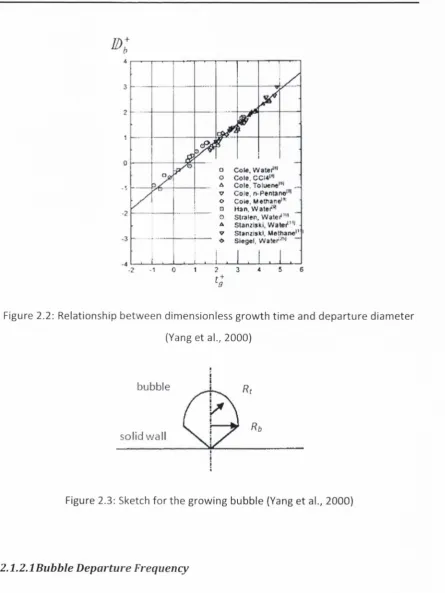
Yang et al. (2000) have predicted the bubble departure diameter by correlating
the bubble departure diam eter only with the bubble growth tim e. They determined
this after plotting the relationship between dimensionless growth tim e and departure
diameter for the various different liquids and wide range of pressures experimented
by Cole (1967), Han and Griffith (1965), Stralen et al. (1975) and Keshock and Siegel
2/ 3
(1964) as shown in Figure 2.2. The data was correlated in the form
The dimensionless departure diam eter and growth tim e are as follows:
R(t )
=
K q
(2.54)
r3
PiuK^^^ —Pn^ + n ( n — l )
(2.55)
CHAPTER 2: LITERATURE REVIEW
D+ = — =
= - ( - ]
t
(2 57)
Lo
0 U j
^
where
A =
;
B = J a
^PiTs
12
—
cci
;
7T
0 =
1 /
7T \ 2 / 3
^
2
j
6] a
(2.58)
By using the correlation proposed by Rohsenow (1951);
RehPr,
- ^ = W
P r p
(2.59)
where
Nuf,
=
2 /(c ) Dfe/1
3c^
a j a
Reu =0
(2.60)
According to Mei et al. (1995),
/ ( c ) ~ 1 - ^ 1 - V l - c^j + ^ [ l - V l -
(2.61)
where the parameters c =
Rb/Rt,
w ith
R^
and
R^
defined in Figure 2.3. Connbining
3 / TT n' "
= (2 .6 2 )
w h e r e
ih = --- (2 .6 3 )
Predic tion results o f Eq. (2 .6 2 ) w e r e t h e n c o m p a re d w ith t h e m e a s u re d d a ta o f b o th
organics liquids and w a t e r fo r t h e e n t ir e range o f e x p e r im e n t a l con d itio n s and
p ro d u ce d e x p o n e n ts o f m = 1.4 and n - 0 .8 . In tro d ucin g t h e valu es of m and n and Eq.
( 2 .5 8 ) into Eq. ( 2 .6 2 ) gives;
D , = 8 .0 3 5 1 X (2 .6 4 )
P v
hfg
r]CHAPTER 2: LITERATURE REVIEW
1^1
43
2
1
0
■2
-3
*4
[image:48.536.60.506.54.648.2]-2 -1 0 1 2 3 4 5 6
Figure 2.2: Relationship between dimensionless growth tim e and departure diameter
(Yang et al., 2000)
bubble
solid wa
Figure 2.3: Sketch fo r the growing bubble (Yang et al., 2000)
2.1.2.1B ubb le D e p a rtu re Frequency
Several models and correlations were found from the past analytical studies to
predict bubble departure frequency fo r pool boiling. In addition, bubble departure
frequency can be deemed as the reciprocal of the summation of bubble waiting tim e,
and bubble growth tim e,
tg,
fd =
(2-65)
Zuber (1959) proposed an equation describing the product of frequency and
departure diam eter in term s o f fluid properties. He suggested th a t it is related to the
velocity at which bubbles rise in a liquid, expressed as,
o g j P i - P v )
pf
V4
(
2
.6 6
)He then assumed that.
/ .
Du
a
(2.67)
and found an expression o f the form,
f . D ^ =
0.59
( ^a( Pi - Pv)
Pt
V4
(
2
.6 8
)However, Zuber's expression has been found to fit experimental data fo r only a
lim ited range of bubble boiling conditions. Im portantly, however, the Zuber
correlation predicts an inverse relation between bubble frequency and departure
diameter.
Later, McFadden and Grassmann (1962) assumed that the frequency-diam eter
product / .
Dfj
is a function o f Dj,,
a, pi
and Ap shown as follows.
CH A PT E R 2; LITERATURE R E V IE W
Eq. (2.69) describes the bubble frequency and bubble departure diameter in term s of
liquid and vapour properties. The le ft side of Eq. (2.69) represents the square root of
power o f the ratio of the buoyant force to the surface tension force. They found that
bubble departure frequency expression by McFadden and Grassmann is thus given as,
frequency w ith departure diameter. McFadden and Grassmann also considered the
case when bubble departure is acted upon by various oth e r forces, particularly at low
heat flux, where the bubble departure frequency can be expressed as.
Still, the functional relationship between the frequency and departure diameter
remains unchanged.
Soon after, Mikic and Rohsenow (1969) predicted a relationship between
bubble frequency and departure diam eter from th e ir bubble departure expression for
saturated boiling as follows.
inertial force to surface tension force ratio whereas the right side represents the
n
~
^/2 satisfactorily fitted most o f the available experim ental data at th a t tim e. The
(2.70)
This correlation predicts that /
a
which is an asym ptotic inverse relation of
(2.71)
4
y/SJa^natf.
1
+
(2.72)
V l/a V jr a
n
(2.73)
w here,
1
1
/ =
(2.74)
M ikic and Rohsenow stated th a t th e ra tio
fo r a given nucleation site is a fu n ctio n
o f pressure and w o u ld be d iffe re n t at d iffe re n t nucleus sites. From a w id e range of
In te re stin gly th e bubble fre q u e n cy is predicted to be a fu n c tio n o f
[(Tw-Tsat)/Dbf so
is a
fu n ctio n o f both superheat and d e p a rtu re diam eter.
2.1.3 Bubble W aiting Tim e
The bubble w a itin g tim e is th e interval b etw e e n w hen th e previous bubble
departs and th e next one nucleates. The w a itin g tim e ,
can be re la ted to the
p a rticu la r cavity size [M ikic and Rohsenow (1969) and Han and G riffith (1965)]. During
th e w a itin g tim e , when th e bubble is n o t grow ing, th e bubble te m p e ra tu re ,
has
been derived fro m the e quation o f a va po u r bubble in th e rm o d y n a m ic e q u ilib riu m .
/ th e y obta in ed th e sim p lified expression.
Di,./V2 ^
Qmja-Jna
(±10% )
(2.75)
CHAPTER 2: LITERATURE R E V IE W
which, after applying the Clasius-Clapeyron equation becomes,
r p _ r j . ,
^^T'sat
A hemispherical bubble of radius,
Rc
(located over a cavity o f the same radius)
w ill start to grow when the vapour tem p era ture is greater than
in Eq. (2.78). The
tim e required to achieve this tem perature is the w aiting tim e.
The expression fo r the tem perature distribution in the liquid was given by
Mikic and Rohsenow as follows:
T(y,
0 = T’oo + (7’w - 7’oo)erfc '
^
2yJ[a(t + t ^ ) ] j
(2.78)
- (T^^ - 7’oo)erfc I f o r t > 0By assuming that in a non-uniform tem perature field the tip of the considered bubble
(y =
Rc)
should be at 7^ fo r the beginning o f the bubble grow th, M ikic and Rohsenow
have an expression from the relations o f the Eqs. (2.77) and (2.78) as follows:
('
"
(2.79)
or:
erfc"
R r
In a sim ilar fashion, the earlier study of Han and G riffith (1965) have equated the
2.2
E xp e rim e n ta l Single Bubble Dynamics
Lee et al. (2003) perform ed an experiment o f nucleate pool boiling w ith
constant wall tem peratures to investigate single bubbles growing in saturated
conditions. They used R l l and R113 as w orking fluids. A microscale heater array was
used to maintain the constant wall tem perature. Each heater in the array had
dimensions of 0.27 x 0.27 mm, which is comparable w ith the diam eter of a typical
single bubble (0.25-0.7 mm). A high-speed CCD camera synchronized w ith the heat
flo w rate measurements was used to capture the bubble grow th images and the
geom etry of the bubble was obtained from those images. The captured images
showed a spheroidal-shaped bubble during growth. The images also showed an
asym ptotic bubble radius growth rate proportional to
which was much slower
than the previous analytical studies which show a
relationship. To analyse the data,
they used dimensionless parameters of tim e and bubble radius to characterize the
asym ptotic grow th behaviour irrespective o f the wall condition. The dimensionless
parameters were derived from the ratio of the corresponding latent heat transfer and
the conduction heat transfer rate through the bubble interface,
(q
l a t e n t / Q c o n d )-Quite recently, Siedel et al. (2008) have perform ed a nucleate pool boiling
bubble tem perature to the fluid tem p era ture at the distance of y =
^/2
Rc
from the
heating surface, consequently the w aiting tim e is obtained
times of the above
value in Eq. (2.80) as follows:
(Tw
CHAPTER 2: LITERATURE REVIEW
Pentane was used as a working fluid in this work. Bubble growth was recorded by a
high speed camera under various wall superheat conditions. They found that the
bubble volume at departure was independent of the wall superheat, whereas the
grow th tim e was dependant on the superheat. The bubble growth rate was found to
fo llo w non-dimensional growth laws;
V* =
fo r
t* >
0.2 and
V*
2 x
t* fo r
t* < 0.2. Furthermore, the bubbles growth tim es were found to be approxim ately
proportional to the wall superheat. However, the product ( / .
was found not to be
a constant, in contrast to many earlier models. This was due to the invariant bubble
departure diameter w ith wall superheat.
2.3
Subcooling Effects on Bubble Dynamics
2.3.1 Analytical Study
Based on the analytical study of waiting tim e
by Han and G riffith (1965) as
3
indicated in Eq. (2.81) fo r the consideration of y = -/?c, it clearly predicts that the
waiting tim e increases w ith the increasing liquid subcooling. In addition, the waiting
tim e also increases w ith increasing cavity radius,
The same trend fo r the waiting
tim e w ith changing liquid subcooling can be obtained from the proposed waiting tim e
theory of Mikic and Rohsenow (1969) as shown in Eq. (2.80) fo r the consideration of
y =
R c-Quite recently, relative to the earlier works, Zhao and Tsuruta (2002)
presented one of the more comprehensive models fo r bubble dynamics in subcooled
pool boiling. According to this study, one cycle of an individual bubble consists of tw o
parts; one is its lifetim e and the other is the waiting tim e. The lifetim e of the individual
bubble consists of three periods, i.e., an initial growth period (O < t <
tg),
a final
grow th period due to evaporation of a microlayer
{tg < t < tg +
tg ) and a
collapses as shown in Figure 2.4. Just after the individual bubble collapses and before
the next cycle begins, there is a waiting tim e,
tw-Waiting time
Activc nuclei
( d )
< e )
Figure 2.4; One cycle of an individual bubble (Zhao and Tsuruta, 2002)
(i)
Initial growth period
(O < t < t^)
During the initial growth of individual bubbles [Figure 2.4 (a)], semi-spherical bubbles
grow from an active site and a microlayer is form ed under the bubbles, as shown in
Figure 2.5 (a). The growth equation of individual bubbles was derived from the heat
balance between the latent heat of evaporation o f the liquid microlayer and the
conduction through the microlayer as follows,
- n R ^ p ^ h f g = 2 n k i f f
—
^ ^ r d t d r , 0 < t < t^
(2.82)
■ ' 0 ■ 'T g ^ m i c
CHAPTER 2: LITERATURE REVIEW
{ a )
The forming period ( b ) The evaporation perifxl
( c ) M icrolayer dryoui and niacrolayer
Figure 2.5: Dynamic m icrolaye r (Zhao and Tsuruta, 2002)
W hen th e w all su perheat is tow, th e fo llo w in g a p p ro xim a tio n was made,
^ r>3 u ' I r f f ' ^ s a t ) n ^ 4. ^ 4.
-nR^p^hfg
=
2nki
rdt dr ,
0 < t < t,
J(\ Jc\
' 0 Jo<^>111>
^ r a i c(2.83)
By using th e in itia l thickness of th e m icrolaye r
at any p o in t (radius r ) by Cooper
and Lloyd (1969) w hich is,
^mic ~ 0 . 8 y f ^ = yjca. t, w ith c =
0.64 Pr
0 < t < tg
th e bubble radius expression then was obtained.
(2.84)
^ _ 2 k i ( T ^ T^at)
A — --- t ' 2
p ^ h f g ^ f c a
At the end o f the initial growth phase of an individual bubble ( t =
tg),
the bubble
diam eter
d
was given by,
or the initial grow th duration of the individual bubble is given as.
(ii)
Final growth period (^tg < t < tg + tg)
Meanwhile, fo r the period of final growth due to evaporation of the microlayer
(tg < t < tg +
tg), the microlayer was reported not to expand and the shape o f the
bubble changes from semi-spherical to a spherical segment geometry due to the
evaporation of the microlayer as shown in Figure 2.5. At the same tim e, a liquid layer
thicker than the microlayer is form ed under the bubble outside the microlayer area
which was called the macrolayer. The evaporation tim e of the microlayer
tg
was
determ ined by the conduction equation o f the liquid microlayer w ith the condition.
(2
.8 6
<
![Figure 1.2: Typical boiling curve for water at 1 atm pressure [Faghri and Zhang (2006)]](https://thumb-us.123doks.com/thumbv2/123dok_us/933223.606176/26.535.56.502.44.639/figure-typical-boiling-curve-water-pressure-faghri-zhang.webp)