2.3 DISC SERVICE PROCESSOR (DSP)
OSP is an on-line interactive utility package for the debugging and servicing of processors and other files under IRIS. Any location in memory or any file on disc can be accessed by the use of OSP. The system manager may allow limited access to OSP for authorized accounts (see Section 5.l1.2.3l.
OSP is a powerful tool I Use with carel
2.3.1
nsp
ACCESS/EXITTo use OSP, first log on to the manager's account. accessed as follows:
DSP <CTRL-E>key<CTRL-E>
OSP is
where key is the password assigned by the system manager (the default password is Xl.
OSP may be exited either with <CTRL-C> or the X command •
.• If you exit OSP using <CTRL-C>, it may be reentered from the same terminal without a password. It will have retained the previously selected context (i
.e.,
file, disc block, or memory) •• To prevent unauthorized use of OSP, be sure to exit with an X command when leaving the terminal.
2.3.2 USING
nsp
Unless otherwise noted, a <RETURN> is required to activate the command string. The <RETURN> is not shown unless it is the only command required.
Any command which follows an F, G, or H command, examines and/or modifies data and operates either on real memory, on a file, or on a disc block.
Any address may be specified as a byte address by adding a hyphen to the address. For example, 03025- will dump bytes starting with the right-hand byte of word address 1412, and E17000- will allow entry of bytes sthrting at the left-hand byte of word address 7400. The contents of any byte address may not exceed 377 octal. If a byte address is given when an enabled driver file (i.e., $file) is selected, then that byte address in real memory is referenced; this eliminates the need to select real memory to examine the driver's buffers.
SM-OJO-0009-11
F$filename may be used to select an enabled drivel. The Dx' command may then be used to display the memory-resident copy of that driver including the current value of the local temporary cells.
where
x - the address in the disc file; corresponds to the
Assembly language listing
I _ (apostrophe) selects the memory-resident copy of the
driver instead of the disc file
The memory-resident copy of the driver does not reside at address x but address translation is handled by DSP automatically.
Similarly, FDISCSUBS allows x, to display the memory-resident copy of a memory-resident discsub.
When a symbolic instruction such as a user defined function is entered via an insert (x:v or E) or an append (Ax) command, the system translates it into Assembly language instruction format. For example, the user enters
SEQ 0,1
When the L command is used to check the entry. DSP displays
SUBt O,l,SZR
Commands may be entered in lower case letters with the exception of N in the LxN command which must be upper case.
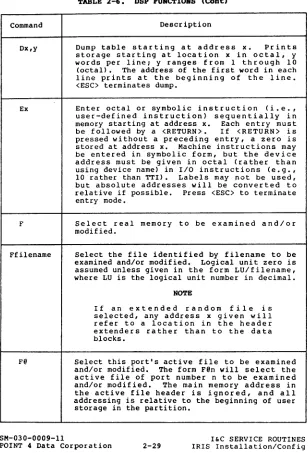
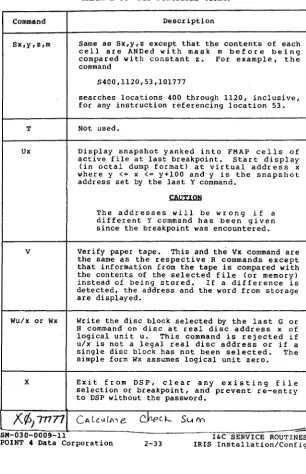
For a description of the commands used in DSP see Table 2-6.
TABLB 2-6. DSP FUNCTIONS
Command Description
XlV Insert the value v at address x. This is very
useful for entering into a single memory location. The value v may be either a symbolic instruction (i.e. , user-defined function) or an
octal number. I f v is omitted, a zero is
written into address x. See the E command for
more information.
Ax Append the block which is to contain address x
(x does not have to be on a block boundary) to
the file selected by the last F command. The
first memory address and the real disc address
of the appended block will be displayed. The
block is filled with 077377 halt instructions.
SM-030-0009-ll
POINT 4 Data Corporation 2-27
~ABLB 2-6. DSP FUNCTIONS (Cont)
Command Description
Bx
Bxcond'n
Ccommand
Dx
SM-030-0009-11
Insert a breakpoint at address x. This command
is meaningful only if the specified file is a
runnable processor. If that processor is then
used on the same port, and the breakpoint is encountered, control will revert to DSP, and the contents of the registers and carry
flip-flop are displayed. The breakpoint is
cleared when it is encountered, and i t is also
cleared by any F, G, H, or X command. It is
impossible to resume processor execution after encountering the breakpoint.
Insert a conditional breakpoint at address x. A breakpoint may be conditional on a register containing a specified value <indicated by Ar=v, where r is a register number 0 to 3, and v is an octal value), and/or conditional on a memory cell containing a specified value
<indicated by x=v, where x is a memory address), and/or the breakpoint may be activated only after executing the instruction at the breakpoint location a specified number of times <indicated by an octal value by
itself). For example
B7235,Al=260,225=16003,4
will breakpoint the fourth time location 7235 is reached with the value 260 in register Al and the value 16003 in memory location 225. The conditions may be given in any order, and the memory location may be specified indirectly; e.g., @37422=177723 means that the contents of location 37422 is used as a pointer to a cell that is to be checked for the value 177723.
The "command" given is passed on to SCOPE as a
system command. This is equivalent to pressing
<CTRL-C> and then entering the command.
Dump octal starting at address x. The contents
of storage starting at location x are printed in octal, eight words per line. The address of the first word of the line is printed at the
beginning of each line. Listing may be
terminated by pressing <ESC>.
TABLE 2-6. DSP POHCTIORS (COnt)
Command Description
Dx,y Dump table starting at address x. Prints
storage starting at location x in octal, y
words per line; y ranges from 1 through 10
(octal) • The address of the first word in each line prints at the beginning of the line. <ESC) terminates dump.
Ex Enter octal or symbolic instruction (i. e. ,
user-defined instruction) sequentially in
memory starting at address x. Each entry must
be followed by a <RETURN). I f (RETURN) is
pressed without a preceding entry, a zero is
stored at address x. Machine instructions may
be entered in symbolic form, but the device address must be given in octal (rather than using device name) in I/O instructions (e.g. ,
10 rather than TTl). Labels may not be used,
but absolute addresses will be converted to
relative i f possible. Press (ESC) to terminate
entry mode.
F Select real memory to be examined and/or
modified.
Ffilename Select the file identified by filename to be
examined and/or modified. Logical unit zero is
assumed unless given in the form LU/filename, where LU is the logical unit number in decimal.
NOTE
I f an extended random f i l e i s selected, any address x given will refer to a location in the header extenders rather than to the data blocks.
F@ Select this port's active file to be examined
and/or modified. The form F@n will select the
active file of port number n to be examined
and/or modified. The main memory address in
the active file header is ignored, and all addressing is relative to the beginning of user storage in the partition.
SM-030-0009-11
[image:4.396.56.364.42.495.2]~ABLB 2-6. DSP PUNCTIORS (Cont)
Command Description
F.
Gu/x or Gx
H
Ix:text
JX,y
Kx,y,z
Lx
SM-030-0009-11
Select the body of the file of the currently selected file header block (i.e., selected by an H command) for examination and/or modification. An error message is displayed if a file's header is not currently selected. Select, on logical unit u (where u is in octal), the disc block at real disc address x to be examined and/or modified. In this mode, only cells 0 through 377 (octal) will be accepted. The simple form Gx asumes logical unit zero.
Select the header block of the currently selected file to be examined and/or modified. In this mode, only addresses less than 400 octal will be accepted.
Input ASCII string, where "text" is any string of characters terminated by <RETURN>, starting at address x. The result is identical to use of assembler pseudo-op .TXTF with reverse packing (i.e., preceded by .TXTM 1). <RETURN> may be imbedded in the string as a <CTRL-Z>. Search for potential address errors. Scans from address x-200 through x+177 for all relative reference instructions spanning address x that are less than y words from maximum relative displacement; i.e., any place that an address error would be caused by inserting y lines of code at location x. Displays these instructions in octal and symbolic form.
Store the octal constant z in locations x through y, inclusive.
List both octal values and symbolic Assembly language instructions starting at address x. Output must be terminated by pressing <ESC>.
TABLB 2-6. DSP POIIC'l'IORS (COot)
Command Descr iption
LxN Same as Lx except only the Assembly language instructions are printed.
Mx,y,z Move the contents of locations x through y, inclusive, to locations starting at z. The destination will receive the contents of the original source, even if source and destination overlap.
Nx,y,z Search location x through y inclusively for a location not equal to the octal constant z. I f found, displays the location and its content in octal and symbolic form.
Nx,y,z,m Same as Nx,y,z but the contents of each cell are ANDed with mask m before being compared with constant z. For example, the command
N400,1120,53,101777
applies the mask, 101777, to the contents of locations 400 through 1120 and checks for any value not equal to octal 53.
Ox Output ASCII string starting at address x. Output terminates on any byte equal to 0, 200 octal, or if <ESC> is pressed. Control characters «40 octal> are displayed with a caret followed by the corresponding printable character.
Px,y Punch locations x through y, inclusive, on the high-speed paper tape punch in binary loader format. I f the system does not have a high-speed punch (no $PTP driver) then DSP attempts to use the master terminal ($PTM driver).
NOTE
Leader is automatically punched when the first Px,y command is given.
SM-030-0009-11
'fABLB 2-6. DSP PORC'rIORS (COnt)
Command Descr iption
Px Punch an end block with a starting address x,
which must be nonzero, then punch trailer. Must be preceded by at least one Px,y command.
P Punch an end block with no starting address,
then punch trailer. Must be preceded by at
least one Px,y command.
Qx Query cell continuously. Repeatedly displays
the contents of address x in octal, allowing a
swap after each display. May be used from one
terminal to monitor changes to a cell, either in memory or in a disc file, while executing tasks from another terminal to cause such changes. Terminate by pressing (ESC>.
R Read binary-format paper tape into the
destination selected by last F, G, or H
command. Each tape record (about four inches)
is read into a buffer and checksummed before
data is stored. The first 21 words octal of
the last breakpoint snapshot (see U and y
commands) will be lost because the same buffer area is used. I f the system does not have $PTR
enabled, then $PTM will be assumed. See ·Copy
Processor" in the IRIS R8 User Manual for restrictions on using $PTM.
Rx Same as R except that all addresses on the tape
are displaced the same amount so that the first word on the tape goes into address x, which must be nonzero.
Sx,y,z Search locations x through y, inclusive, for
the octal constant z. I f found, displays the
location and its content in octal and symbolic form.
SM-030-0009-11
POINT 4 Data Corporation 2-32
TABLE 2-6. DSP PUIIC'rIORS (COnt)
Command Description
sx,y,z,m Same as Sx,y,z except that the contents of each
cell are ANDed with mask m before being
compared with constant z. For example, the
command
S400,1120,53,101777
searches locations 400 through 1120, inclusive, for any instruction referencing location 53.
T Not used.
Ux Display snapshot yanked into FMAP cells of
active file at last breakpoint. Start display
(in octal dump format) at virtual address x where y
<=
x<=
y+lOO and y is the snapshot address set by the last Y command.CAlIl:IQH
The addresses will be wrong i f a different Y command has been given since the breakpoint was encountered.
V Verify paper tape. This and the Vx command are
the same as the respective R commands except that information from the tape is compared with the contents of the selected file (or memory)
instead of being stored. If a difference is
detected, the address and the word from storage are displayed.
Wu/x or Wx Write the disc block selected by the last G or
H command on disc at real disc address x of
logical unit u. This command is rejected if
u/x is not a legal real disc address or i f a
single disc block has not been selected. The
simple form Wx assumes logical unit zero.
X Exit from DSP, clear any existing file
selection or breakpoint, and prevent re-entry to DSP without the password.
X~)
771n
CA Lc:", 11\.
e
c..he(\:-
Su.
M--=
-
-
-SM 030 0009 11
POINT 4 Data Corporation 2-33
[image:8.399.56.363.45.520.2]'.rABLB 2-6. DSP FURC'l'IORS (Coot)
Command Description
Xx,y Compute and display a "rotating" checksum over
memory locations x through y. The checksum is
produced by an SUBL instruction in order to detect a change (e. g. , i f two words in memory are swapped) . Useful for testing i f a change has occurred anywhere in a section of memory or on disc.
Xx' ,y Checksum the memory-resident copy of a discsub
or driver as selected by a Ff ilename command.
Yx Set first address of 101 word (octal) memory
area to be yanked into the FMAP cells of the active file header as a memory "snapshot" when
a breakpoint is encountered. If x=O, do not
yank any area of memory.
Zx Search for relative reference. The 256 words
centered on location x are searched for any storage reference instruction that references
location x using relative addressing. Any such
instruction is displayed in octal and symbolic form.
Zx,y Same as Zx except a search is done for each
address x through y.
; Comment. Any line starting with a semi-colon
will be ignored by DSP. This is used mainly to include comments on patch tapes.
SM-030-0009-ll
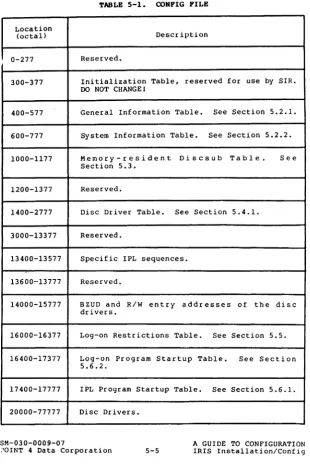
TABLE 5-1. COMFIG FILE
Location
(octal) Description
0-277 Reserved.
300-377 Ini tialization Table, reserved for use by SIR.
DO NOT CHANGEI
400-577 General Information Table. See Section 5.2.l.
600-777 System Information Table. See Section 5.2.2.
1000-1177 Memory-resident Discsub Table. See
Section 5.3.
1200-1377 Reserved.
1400-2777 Disc Driver Table. See Section 5.4.l.
3000-13377 Reserved.
13400-13577 Specific IPL sequences •
..
13600-13777 Reserved.
14000-15777 BZUD and RiW entry addresses of the disc
drivers.
16000-16377 Log-on Restrictions Table. See Section 5.5.
16400-17377 Log-on Program Startup Table. See Section
5.6.2.
17400-17777 IPL Program Startup Table. See Section 5.6.l.
20000-77777 Disc Drivers.
SM-030-0009-07
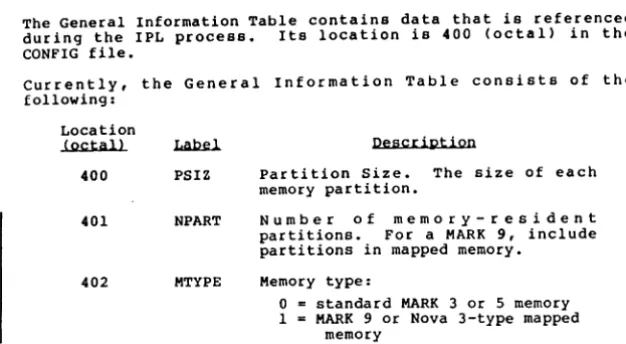
[image:10.398.57.367.43.508.2]5.2.1 GENERAL INFORMATION TABLE (PSII)
The General Information Table contains data that is referenced
during the IPL process. Its location is 400 (octal) in the
CONFIG file.
Currently, the General Information Table consists of the following:
Location (octal)
400
401
402
PSIZ
NPART
MTYPE
Description
Partition Size. The size of each
memory partition.
Number of memory-resident
partitions. For a MARK 9, include
partitions in mapped memory.
Memory type:
o
= standard MARK 3 or 5 memory1 = MARK 9 or Nova 3-type mapped memory
For information on BASIC program partition requirements, refer to Section 5.12.1.
5.2.2 SYSTEM INFORMATION (INFO) TABLE
The System Information (INFO) Table contains system parameters
starting at location 600 in the CONFIG file. Some of these
parameters are set at IPL time, others may be modified to reflect
the requirements of a particular system configuration. The
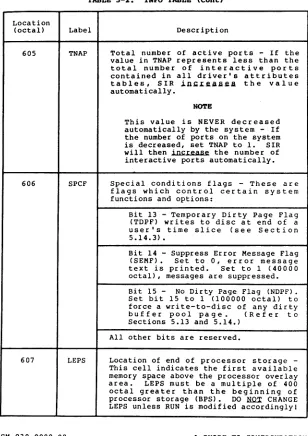
locations (in octal) of the various parameters are shown in Table 5-2.
SM-030-0009-ll
POINT 4 Data Corporation 5-6
[image:11.398.45.358.53.225.2]'l'ABLB 5-2. INFO 'l'ABLB
Location
(octal) Label Description
600 SDAT System creation date (hours after
BASEYEAR) • DO NOT CIIANGEI
601 SPED Average CPU speed in instructions per
millisecond:
Speed
Computer (octal!
POINT 4 MARK 9 2500
POINT 4 MARK 5 2000
POINT 4 MARK 3 1200
NOVA 302
NOVA 1200 or 0-116 653
NOVA 2 or D-116H 770
NOVA 800 1325
NOVA 3 770
SUPER NOVA 1255
SUPER NOVA SC 1762
602 MILU Maximum number of installed logical
units - The total number of physical
disc partitions defined in the Disc
Driver Table. See Section 5.4.1.
603 NDCH Number of data channels per port
-
Eachdata channel occupies eight words of
memory. NDCH is usually set to 12
(decimal 10) • Minimum NDCH is 2.
604 LPCA Location of port control area - Contains
the address of port control block (PCB)
for Port O. I t is automatically
modified by SIR if any driver's attributes table specifies a PCB location.
(Table continues on next page)
SM-030-0009-11
TABLE 5-2. INFO TABLE (Cant)
Location
(octal) Label Description
605 TNAP Total number of active ports
-
I f thevalue in TNAP represents less than the total number of interactive ports contained in all driver's attributes
tables, SIR .ini:LJUUi~.II. the value
automatically.
ROTE
This value is NEVER decreased automatically by the system
-
I fthe number of ports on the system is decreased, set TNAP to 1. SIR will then iD~t:Si:iiIU: the number of interactive ports automatically.
606 SPCF Special conditions flags
-
These areflags which control certain system functions and options:
Bit 13 - Temporary Dirty Page Flag (TDPF) writes to disc at end of a user's time slice ( see Section 5.14.3) •
Bit 14 - Suppress Error Message Flag
(SEMF) • Set to 0, error message
text is printed. Set to 1 (40000
octal), messages are suppressed.
Bit 15 - No Dirty Page Flag (NDPF) . Set bit 15 to 1 (100000 octal! to force a write-to-disc of any dirty
buffer pool pa ge. (Refer to
Sections 5.13 and 5.14. )
All other bits are reserved.
607 LEPS Location of end of processor storage
-This cell indicates the first available memory space above the processor overlay
area. LEPS must be a multiple of 400
octal greater than the beginning of
processor storage (BPS). DO NQ:r CHANGE
LEPS unless RUN is modified accordingly I
SM-030-0009-08
[image:13.396.54.362.43.479.2]TABLB 5-2. INFO TABLB (Cant)
Location
(octal) Label Description
610 TOPW Highest addressable word in memory
-IRIS ignores any memory above this
address. The memory available above
77777 octal is used for user partitions
and buffer pooling. Do not set TOPW
above 77777 unless the CPU and all disc controllers on the system use a 16-bit
memory address. All other devices use
lower (<32K) memory.
611 ABUF Size of auxiliary buffer area (number of
words)
-
Must be at least 1004 wordsoctal i f indexed data files are to be used.
612 UDSB Number of user discsubs
-
The minimumvalue is one greater than the largest subroutine number in the DISCSUBS.USER file.
613 NCQN Number of extra character queue nodes
-SIR allocates two nodes per interactive port plus this number of extra nodes. Extra nodes are required to handle peak
input rates i f extra heavy character
processing is required. Each node
occupies two words of memory. Minimum
value is two.
614 NNOD Minimum number of free nodes
-
Each nodeoccupies 32 words (decimal) •
615 NSIG Number of signal buffer nodes
-
This isthe maximum number of signals which can
be waiting to be received. Each node
occupies 4 words of memory. Minimum
value is 1.
616 SDSB Number of System discsubs
-
The minimumvalue is one greater than the largest subroutine number in the DISCSUBS file.
SM-030-0009-07
TABLB 5-2. INFO TABLB (Cont)
Location
(octal! Label Description
617 KTSL Time slice parameters
-
Used by thescheduler for determining the time slice
(Long Time Slice
*
400 + Short TimeSlice) • See Section 5.10.
620 Default (application) logical unit
-Used by the system when searching for a specified program.
If invoked from SCOPE, the system searches for the program in the following sequence:
• Lu/O • assigned LU • default LU
I f invoked from CHAIN, the system
searches for the program in the following sequence:
•
the default LU • assigned LU • LU/OValue of 177777 indicates no default LU.
621 Reserv£\d.
622 SZLNK Pseudo-device linkage table size
-
Apseudo-device has no device code (e.g. , $CTUS).
623 Reserved.
to 631
632 Reserved.
to 777
SM-030-0009-ll
POINT 4 Data Corporation 5-10
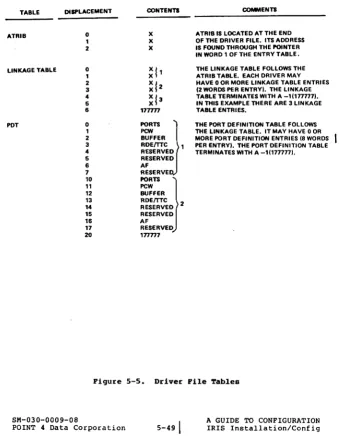
TABLE DISPLACEMENT CONTENTS COMMENTS
ATRIB 0 X ATRIB IS LOCATED AT THE END
1 X OF THE DRIVER FILE. ITS ADDRESS
2 X IS FOUND THROUGH THE POINTER
IN WORD 1 OF THE ENTRY TABLE.
LINKAGE TABLE 0
~
l'
THE LINKAGE TABLE FOLLOWS THE1 ATRIB TABLE. EACH DRIVER MAY
2
~12
HAVE 0 OR MORE LINKAGE TABLE ENTRIES3 (2 WORDS PER ENTRYI. THE LINKAGE
4
~13
TABLE TERMINATES WITH A -1(1777771.6 IN THIS EXAMPLE THERE ARE 3 LINKAGE
6 177777 TABLE ENTRIES.
PDT 0
~~
}
THE PORT DEFINITION TABLE FOLLOWS1 PCW THE LINKAGE TABLE. IT MAY HAVE 0 OR
2 BUFFER MORE PORT DEFINITION ENTRIES (8 WORDS
3 RDEmC 1 PER ENTRYI. THE PORT DEFINITION TABLE 4 RESERVED TERMINATES WITH A -1(1777771.
6 RESERVED
6 AF
7 RESERVED
10
_n }
11 PeW
12 BUFFER
13 RDEmC
14 RESERVED 2
15 RESERVED
16 AF
17 RESERVED
20 177777
Pigure 5-5. Driver Pile Tables
SM-030-0009-0B
POINT 4 Data Corporation 5-49\
[image:16.397.48.387.60.507.2]5.8.1.4 Po~t Definition Table (PDT)
The Port Definition Table (PDT) follows the Linkage Table's
terminator. POINT 4 recommends that the system configurator
(SETUP) be used to set up the PDT (see Section 6). PDT consists
of zero or more entries and must be terminated by 177777. It is
located at ATRIB+3+Linkage Table. If there is no PDT, there will
be a terminator at its location.
The Port Definition Table consists of eight words per entry as follows:
Word 0 - Number of ports (with the characteristics described in words 1-7).
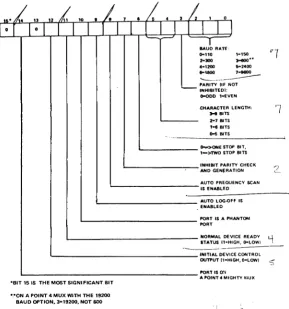
Word 1 - Port Control word (PCW) in the Port Definition Table (PDT) and in the port control block (PCB) controls various characteristics of the port such as baud rate, modem control, parity checking, etc., provided that the hardware allows these parameters to be controlled by
software. (For example, with the POINT 4 MARK 3, baud
rate is hardware controlled.) PCW should be zero for
any device which cannot control any of these
characteristics. The general format of the PCW is shown
in Figure 5-6. Values that may be entered into PCW for a MARK 3 System are shown in Table 5-8.
Word 2 - Input/output buffer size (bytes)
Word 3 - Return delay (ROE) and terminal type code (TTC)
RDE - Carriage return delay. For a port on a POINT 4
Mux, the delay is in fiftieths of a second. For
ports on all other devices, the delay is the number of null codes before the next character. RDE is given in the upper (left-hand) byte.
TTC - The number assigned to a Terminal Translation
Module (see Section 5.9). TTC is given in the
lower (right-hand) byte.
Word 4 - Reserved.
Word 5 - Reserved.
Word 6 Size of active file on disc in blocks. The recommended
size is 40 (octal) blocks.
Word 7 - Reserved.
The port entries must be terminated by a -1; the table may be
empty, but the -1 terminator is required. A Port Control Block
(PCB) is assigned for each port listed.
NO'l'B
PDT cannot extend over a block boundary.
SM-030-0009-07
, •• / . '3
.i
10.1.
rOT
1
0 1I
T
I
1
-BIT 15 IS THE MOST SIGNIFICANT BIT -,·ON A POINT 4 MUX WITH THE 19200
BAUD OPTION. 3-19200. NOT 600
1
.1.
•
I
T
T
I
-=,.--J
31
1 0I I I
I
BAU~
RATE'0-110 2-_
'-1200 S-2400
...
""'"
1-iN11O---..----
----L -~::II~EI~~: N OT0-000 '~EV EN
CHARACTER LENGTH:
Jo-8 BITS
l-7B1TS '-8 BITS
o-s Bns
~OHEST OP BIT, P BITS
1->TWO $TO
INHIBIT PARI TV CHECK
liON
AND GEN~RA
AUTO FREOU ENey SCAN
1$ ENABLEO
AUTO LOG-O Ff IS
ENABLED
PORT IS A PH ANTOM
PORT
NORMAL DE VICE READY
GH, G-lOW! STATUS I1-HI
'
-INITIAL DE VI CE CONTROL GH.O-LOW)
OUTPUT I1-HI
PORT IS O~~
A POINT .. MIGHTY MUX
2
Figure 5-6. Port Control Word Format
(Does Not Apply to MARK 3)
3M-030-0009-08
POINT 4 Data Corporation 5-51
[image:18.397.84.373.82.390.2]No. Data
7
7
7
7
8
8
8
8
TABLB 5-8. PCW VALUBS FOR A MARI 3 SYSTBM
of No. of
Bits Parity Stop Bits PCW Value
Even 2 140201
Odd 2 140205
Even 1 140211
Odd 1 140215
Inhibited 2 140221
Inhibited 1 140225
Even 1 14023l
Odd 1 140235
NOTB
The PCW value for a phantom port on a MARK 3 is 2000.
SM-030-0009-10 A GUIDE TO CONFIGURATION
IRIS Insta11ation/Config
I-t.
,.v.4h'e
~ 1~/7t73 1'{(,t.S{' II/liSt. 1f'33/1 /'/~!!(J!;" 0 0
, (SCH.t:'.,e/~e)
,
/r
:
t:I-;g,t!s
/1
z~/'t'$ .v/~#daJ ; / I'ldrf-:10-;11 _ CHa$ ,.",', ',' &l-.;l$ U A r
,
'
ilcc~/JIltkt~d
".t.:n-6
c-1Pd
-60 ).406//dt!~S:
~iI'.r ast!'.r&, ZJa.6e '
'", .,', . • e: /'¢IJ.;I./
V
.,
36",o;,,;er
;. . , If.'{j/'>tnt '.
1".;0/".;0,,'6
y, ,~~/,~
.. 6,
'.:
£<:1""qe~-
377 f . 'C4.C4/' . ",e ~ ~ -,&$0",.<,,0',
7
,It::.ur-A~amJ h'~$t6~ /5"-1'1 /J,R/i/L"",el /3-6 /It!C, a'-<>C(I/.;t!t 6"-0 tIlc"" p$t!,. .t:!.
.56 S,vdij
S(!O;t} 1." tI-C /!,A;"h~.:L
40-.07 l>l1s;r
1)~IU""'4-/ aa<!It-,»u./a~,.&ve
,.4,.e~(/$,.,/ &y. "yf,escrqI"N &0 Save t~Ao:. fS/J( l>/I- o"'-o//s tt-6- .sw~;c -ceu! eo -c-h¢6- -cA~y .. <U" 6<:,
~
;,
,~s&,,·~~
'.&y "liMb /(<:$'£" a..-6 '!'h II! .4eJfC- t5WQ,fJ ,tt'4,so;:£?
1J3~
-It~:s
",OL. ",...,./y.6y/.>;:S~ ~rV'"",<!
hOd<'5CO/' , . oCher~$P a/.:" usee: 1./17"/1 (-t/3) N,o;"S(-' IS') FHI{"o (ta4 7tJ-/7t;)