Abstract— A new hybrid Conjugate Gradient (CG) method that generates weighted search directions is proposed in this paper. The weighting matrix is a two-step quasi-Newton update matrix that approximates the inverse Hessian matrix using data from the two most recent iterates. Multi-step methods have demonstrated substantial gains over the standard methods that utilize updates satisfying the classical Secant equation. The actual matrix for the method developed in this paper need not be explicitly retained. Instead, our implementation requires a few additional vectors that need to be updated at each iteration. The numerical performance of the new algorithm is then assessed by comparing it to the other methods developed in a similar context. A set of 1941 unconstrained optimization problems were used to test the algorithm. Our results reveal substantial improvements over the other two methods at a reasonable computational and storage costs. Those gains are particularly observed as the dimension of the problem increases.
Index Terms— Weighted Conjugate Gradient methods, quasi-Newton methods, multi-step methods, unconstrained optimization.
I. INTRODUCTION
ONJUGATE gradient (CG) methods were originally devised for the solution of linear systems of equations. In addition to using the methods to to find the minimum point of a quadratic function, they can be used to minimize any unconstrained nonlinear continuous function of the form
𝑚𝑖𝑛𝑚𝑖𝑧𝑒 𝑓(𝑥), where 𝑓: 𝑅𝑛→ 𝑅,
for which the gradient can be computed. CG methods can be applied to a variety of optimization problems, such as nonlinear regression, neural net training and engineering design.
To minimize f, starting from an initial starting point 𝑥0,
the sequence of iterates {𝑥𝑖}generated is given as
𝑥𝑖+1= 𝑥𝑖+ 𝛼𝑖𝑑𝑖, (1)
where 𝛼𝑖 is a positive scalar that defines a step size on the
CG search direction 𝑑𝑖. In nonlinear CG, the residualvector is taken as the negative of the gradient vector of the objective function. As with the linear CG, a value of 𝛼𝑖 in
(1) is computed such that the gradient is orthogonal to the
Manuscript received January 17, 2018; revised July 25, 2018.
Issam A.R. Moghrabi is with the Gulf University for Science and Technology, Kuwait. He is currently a professor with the Department of Management Information Systems. phone: +965-94453637; e-mail: moughrabi.i@ gust.edu.kw).
search direction. Thus, the search direction 𝑑𝑖 is computed
using
𝑑𝑖= {−𝑔−𝑔𝑖, for 𝑖 = 0,
𝑖+ 𝛽𝑖𝑑𝑖−1, for 𝑖 ≥ 1, (2)
for some scalar 𝛽𝑖that is chosen to guarantee orthogonality and where 𝑔𝑖denotes the gradient of the function f evaluated at the point xi. Normally, whenever 𝛽𝑖 becomes negative, the
method is restarted by setting 𝛽𝑖 = 0 (see [29]), although other options have also been considered in the literature [2,515,17,21,29]. Some of those are adopted in our implementation and are mentioned later in this paper. The vector 𝑑𝑖 is usually required to satisfy the condition
𝑑𝑖𝑇𝑔𝑖< 0,
to ensure it is downhill at 𝑥𝑖. It has been shown in several papers [5,21,23,28] that in order to guarantee global convergence, 𝑑𝑖 may be required to satisfy the sufficient
descent condition
𝑑𝑖𝑇𝑔𝑖≤ −ƺ‖𝑔𝑖‖2,
for some constant ƺ.
Different choices of 𝛽𝑖in (2) lead to different CG
algorithms. Some well-known choices are
𝛽𝑖𝐹𝑅= ‖𝑔𝑖 ‖2
‖𝑔𝑖−1‖2, 𝛽𝑖
𝑃𝑅𝑃 =𝑔𝑖𝑇(𝑔𝑖−𝑔𝑖−1)
‖𝑔𝑖−1‖2 ,
𝛽𝑖𝐻𝑆=
𝑔𝑖𝑇(𝑔𝑖−𝑔𝑖−1) 𝑑𝑖−1𝑇 (𝑔𝑖−𝑔𝑖−1), 𝛽𝑖
𝐿𝑆=𝑔𝑖𝑇(𝑔𝑖−𝑔𝑖−1)
𝑑𝑖−1𝑇 𝑔𝑖−1 ,
𝛽𝑖𝐷𝑌=
𝑔𝑖𝑇𝑔𝑖
𝑑𝑖−1𝑇 (𝑔
𝑖− 𝑔𝑖−1).
The above methods are, respectively, due to Fletcher-Reeves [9], Polak–Ribiére–Polyak [22,23], Hestenes-Stiefel [16], Liu-Storey [17] and Dai–Yuan [5]. Many other choices have been considered in the literature (see, for example, [13,17,22,23,24]).
This paper derives a new CG algorithm that uses a weighted two-step update matrix in the computation of the search direction without having to explicitly retain the matrix in storage nor update it. The new method is inspired by the works of Anderi [2] and Ford et al. [13]. Anderi [2] applies updates to the identity matrix in order to build the conditioning matrix. Ford et al. [13] developed a multi-step CG method that does not directly involve any weighting matrix. Our derivation follows a hybrid approach that combines quasi-Newton and CG search directions. The conditioning matrix employed in our method exploits
two-Issam A. R. Moghrabi,
Member, IAENG
A New Preconditioned Conjugate Gradient
Method for Optimization
C
IAENG International Journal of Applied Mathematics, 49:1, IJAM_49_1_05
step iteration information and the result is a descent CG method which utilizes multi-step quasi-Newton updates.
The next section summarizes the multi-step methods idea. Section 3 presents the derivation of the new method. Finally, the numerical results are summarized and conclusions presented.
II. MULTI-STEP QUASI-NEWTON METHODS Quasi-Newton methods retain an approximation to the Hessian matrix that is updated at each iteration to reflect the most recent changes in the data [3,25]. Given Bi, the current
approximation to the Hessian ∇2f(xi+1), the new Hessian approximation, Bi+1 is updated to satisfy the standard Secant
equation:
𝐵𝑖+1𝑠𝑖= 𝑦𝑖, (3)
where
𝑠𝑖= 𝑥𝑖+1− 𝑥𝑖,
and
𝑦𝑖= 𝑔𝑖+1− 𝑔𝑖.
A family of secant methods is the Broyden family [3,6] in which the updates are defined by
𝐵𝑖+1= 𝐵𝑖−
𝐵𝑖𝑠𝑖𝑠𝑖𝑇𝐵𝑖
𝑠𝑖𝑇𝐵𝑖𝑠𝑖 +
𝑦𝑖𝑦𝑖𝑇
𝑠𝑖𝑇𝑦𝑖+ 𝜃𝑢𝑖𝑢𝑖 𝑇,
where 𝜃 is a scalar and
𝑢𝑖= √𝑠𝑖𝑇𝐵𝑖𝑠𝑖[𝑠𝑦𝑖
𝑖𝑇𝑦𝑖−
𝐵𝑖𝑠𝑖 𝑠𝑖𝑇𝐵𝑖𝑠𝑖].
The BFGS, DFP and SR1 updates are obtained by setting 𝜃 = 0, 𝜃 = 1 and = (1 − 𝑠𝑖𝑇𝐵𝑖𝑠𝑖/𝑠𝑖𝑇𝑦𝑖)−1 , respectively.
The BFGS formula [3,10,11] is the most popular rank-two update formula that satisfies equation (3), especially that, as much of published research [3,13,15] have reported, it works well with inexact line search. The BFGS update to the Hessian matrix approximation is given by
𝐵𝑖+1= 𝐵𝑖−
𝐵𝑖𝑠𝑖𝑠𝑖𝑇𝐵𝑖
𝑠𝑖𝑇𝐵𝑖𝑠𝑖 +
𝑦𝑖𝑦𝑖𝑇
𝑠𝑖𝑇𝑦𝑖.
In the standard Secant equation (3), a straight line L is used to find a new iterate xi+1, given the previous iterate xi,
while in the multi-step methods higher order polynomials are employed, as will be shown next.
Let {x(τ)} or X denote a differentiable path in
𝑅𝑛, whereτ ∈ R. The vector polynomial x(τ) thus satisfies
x(τ𝑗(𝑖−1)) = xi-m+j, for j = 0, 1,…,m,
for some distinct values {𝜏𝑗(𝑖−1)}
𝑗=0 𝑚
. The corresponding gradient points are interpolated by a similar polynomial z(τ) satisfying
z(τ𝑗(𝑖−1)) = gi-m+j, for j = 0, 1,…,m.
Then upon applying the Chain rule to the gradient vector g(x(τ)) in order to find the derivative of the gradient g with respect to τ, we get
𝑑𝑔
𝑑𝜏 = 𝐺(𝑥(𝜏)) 𝑑𝑥
𝑑𝜏 . (4)
Thus, at any point on the path X, the Hessian G must satisfy (4) for any value of τ. More specifically, for τ = τc, where τc∈ℛ. This will result in the following relation
𝑑𝑔 𝑑𝜏|𝜏=𝜏𝑐
= 𝐺(𝑥(𝜏))𝑑𝑥 𝑑𝜏|𝜏=𝜏𝑐
Thus, at any point on the path X, the Hessian G must satisfy (4) for any value of τ. More specifically, for some τ = τc, where τc∈ 𝑅 the resulting relation is given by
𝑑𝑔
𝑑𝜏
|
𝜏=𝜏𝑐= 𝐺(𝑥(𝜏))
𝑑𝑥 𝑑𝜏|
𝜏=𝜏𝑐.
By analogy with the Secant equation, the aim is to derive a relation satisfied by the Hessian at the new iterate xi+1. We choose a value for the parameter τ, namely τm,, that corresponds to the most recent iterate as follows
𝑔′(𝜏
𝑚) = 𝐵𝑖+1𝑥′(𝜏𝑚)
or 𝑤𝑖= 𝐵𝑖+1𝑟𝑖, (5)
where the vectors ri and wi are defined in terms of the m
most recent step vectors {𝑠𝑘}𝑘=𝑖−𝑚+1𝑖 and the m most recent gradient difference vectors {𝑦𝑘}𝑘=𝑖−𝑚+1𝑖 respectively, as follows
𝑟𝑖= ∑ 𝑠𝑖−𝑗{ ∑ 𝐿𝑘′(𝜏𝑚) 𝑚
𝑘=𝑚−𝑗
}
𝑚−1
𝑗=0
and
𝑤𝑖= ∑ 𝑦𝑖−𝑗{ ∑ 𝐿′𝑘(𝜏𝑚) 𝑚
𝑘=𝑚−𝑗
}
𝑚−1
𝑗=0
for
𝐿′𝑘(𝜏𝑚) = (𝜏𝑘− 𝜏𝑚)−1[
𝜏𝑚− 𝜏𝑗
𝜏𝑘− 𝜏𝑗] , 𝑘 < 𝑚
and
𝐿′𝑚(𝜏𝑚) = ∑ (𝜏𝑚− 𝜏𝑗)−1 𝑚−1
𝑗=0
are the standard Lagrange polynomials.
Ford and Moghrabi [10,11,12,18,19] examined several choices for the parameters {𝜏𝑘}𝑘=0 𝑚 . It was found that
different choices influence the structure of the interpolating curve and consequently the numerical performance of the multi-step methods.
The choices made for the parameters{𝜏𝑘}𝑘=0 𝑚 rely on
some metric of the following form
∅𝑀(𝑧1, 𝑧2) = [(𝑧1− 𝑧2)𝑇𝑀(𝑧1− 𝑧2)]1/2,
where M is a symmetric positive-definite matrix. The quantity ∅𝑀(𝑧1, 𝑧2) defines the distance between any two vectors 𝑧1 and 𝑧2, using some metric. For example, if M = I,
then ∅𝑀(𝑧1, 𝑧2) denotes the 2-norm.
Of the approaches considered in [12], the most numerically successful choice is selected in this work to derive our new algorithm. The choice is based on the
so-IAENG International Journal of Applied Mathematics, 49:1, IJAM_49_1_05
called Accumulative Approach. The Accumulative approach chooses one of the iterates, say xj, as a base-point and sets
the parameter τj corresponding to it to 0. Then, any value 𝜏𝑘,
corresponding to the point xi-m+k+1 for any k except for k=j,
is computed by distance accumulation (measured by the chosen metric ΦM) between each two consecutive pair of points in the sequence from xi-m+j+1 to xi-m+k+1. Therefore, any value 𝜏𝑘, for k = 0,1,...,m, is obtainable using
𝜏𝑘 = − ∑𝑗𝑝=𝑘+1∅𝑀(𝑥𝑖−𝑚+𝑝+1, 𝑥𝑖−𝑚+𝑝), 𝑘 < 𝑗,
= 0, k = j,
= − ∑𝑘𝑝=𝑗+1∅𝑀(𝑥𝑖−𝑚+𝑝+1, 𝑥𝑖−𝑚+𝑝), 𝑘 > 𝑗. (6)
This approach will yield values of τ that satisfy 𝜏𝑘< 𝜏𝑘+1, 𝑓𝑜𝑟 𝑘 = 0, 1, … , 𝑚 − 1,
under the assumption that no two consecutive points overlap.
Those values of the parameters {τk} are the ones used in
computing the vectors x′(τm) and g′(τm) in (5) (or,
equivalently, vectors ri and wi, respectively) needed to
compute the new Hessian approximation Bi+1. It should be
noted that different choices of the metric matrix M in ∅𝑀 will result in different methods. Choices investigated for M (see [11,12,18,19]), include M = I, M = Bi, and M = Bi+1.
The method derived in this paper uses the choice M = I. Ford and Moghrabi [11,12] indicate that values of m > 2 do not yield further substantial numerical gains in performance due to the non-smoothness of the interpolant. Thus, m = 2 is chosen here and such methods are termed two-step methods as they utilize data from the two most recent iterations to update the Hessian approximation.
The inverse Hessian approximation update generally satisfies:
𝐻𝑖+1(𝑦𝑖− 𝜇𝑖−1𝑦𝑖−1) = 𝑠𝑖− 𝜇𝑖−1𝑠𝑖−1 (7)
Or, equivalently
𝑤𝑖= 𝐵𝑖+1𝑟𝑖
where
𝜇𝑖−1=
𝛿𝑖−12
2𝛿𝑖−1+ 1.
and
𝛿𝑖−1=
𝜏2(𝑖−1)− 𝜏1(𝑖−1) 𝜏1(𝑖−1)− 𝜏0(𝑖−1).
For M = I in (6), the corresponding τ-values are given by 𝜏0= −(‖𝑠𝑖‖2+ ‖𝑠𝑖−1‖2), 𝜏2= 0, and 𝜏1= −‖𝑠𝑖‖2 .
This, hence, gives a value for 𝛿 in (7) as 𝛿 = ‖𝑠𝑖‖
‖𝑠𝑖−1‖. (8)
Equation (8) may be generalized by introducing a scaling factor, 𝛾 ≥ 0 (see [13]) that provides more control and is exploited for convenient switching to the standard one-step Secant equation update method, simply by setting the scalar to zero. Therefore,
𝛿 = 𝛾 ‖𝑠𝑖‖
‖𝑠𝑖−1‖. (9)
The multi-step B-version BFGS formula is given by
𝐵𝑖+1𝑀𝑆 = 𝐵𝑖+𝑤𝑖𝑤𝑖
𝑇
𝑤𝑖𝑇𝑟𝑖 −
𝐵𝑖𝑟𝑖𝑟𝑖𝑇𝐵𝑖
𝑟𝑖𝑇𝐵𝑖𝑟𝑖 . (10)
III. A NEW MULTI-STEP PRECONDITIONED CG METHOD (MSPCG)
The approach considered here is based on the preconditioning of the gradient in (2) in order to improve the convergence of the CG method. If the initial direction
d
0 is selected as 𝑑0= −𝑔0 and the objective function to beminimized is a convex quadratic function in the form of 1
( ) ,
2
T T
f x x Axb xc
and exact line searches are used, that is 𝛼𝑖= 𝑎𝑟𝑔𝑚𝑖𝑛𝛼>0 𝑓(𝑥𝑖+ 𝛼𝑑𝑖),
then the conjugacy condition is satisfied
𝑑𝑖𝑇𝐴𝑑𝑗= 0, ∀𝑖 ≠ 𝑗, (11)
where A is the positive definite Hessian matrix of f. Then, for general nonlinear twice differentiable function
f
,
and using the mean value theorem, there exists some 𝜔 ∈ (0,1] such that𝑑𝑖𝑇𝑦𝑖−1= 𝛼𝑖−1𝑑𝑖−1∇2𝑓(𝑥𝑖−1+ 𝜔𝛼𝑖−1𝑑𝑖−1)𝑑𝑖−1.
Thus, from (11), it makes sense to replace the quadratic conjugacy condition (11) with the following alternative
𝑑𝑖𝑇𝑦𝑖−1= 0
.
(12)Perry [21] extended the conjugacy condition (11) by utilizing second-order information. For the Hestenes-Stiefel conjugate gradient algorithm with 𝛽𝑖𝐻𝑆= 𝑔𝑖
𝑇(𝑔 𝑖−𝑔𝑖−1)
𝑑𝑖−1𝑇 (𝑔𝑖−𝑔𝑖−1) (see
[25]), Perry notes that the search direction (3) can be expressed as
di+1=-
[I-siyiT
yiTsi
] gi+1=-QHSi+1gi+1.
The matrix
Q
kHS1 resembles an approximation to the inverse Hessian though it is neither positive definite nor symmetric although the search direction obtained, namely, 𝑑𝑖+1, satisfies the conjugacy condition (11). Perry [21] notesthat, when the line searches are not exact, it is more appropriate to choose the approximation to the inverse Hessian to satisfy the Secant condition (3) than the conjugacy condition (11). Therefore, the following equality is used instead in [21]
-gi+1+βisi=-Bi+1-1 gi+1
where 𝐵𝑖+1 is as in (3). Consequently, Perry’s choice for 𝛽𝑖 is given by
IAENG International Journal of Applied Mathematics, 49:1, IJAM_49_1_05
𝛽𝑖 =
𝑦𝑖𝑇𝑔𝑖+1− 𝑠𝑖𝑇𝑔𝑖−1)
𝑠𝑖𝑇𝑦𝑖 .
The corresponding search direction is computed using
di+1=-
[
I-siyiT
yiTs i
+
sisiT
yiTs i
]
gi+1=-Qi+1P gi+1.If the line search direction is exact, than Perry’s algorithm is equivalent to the HS conjugate gradient method and satisfies the Dai and Yuan [5] conjugacy condition
di+1T yi=-u(siTgi+1),
with u1.
The above argument motivates our choice of the search direction in this paper which takes the general form
𝑑𝑖= −𝜎𝑖𝑔𝑖+ 𝛽𝑖𝑠𝑖−1, (13)
where 𝜎𝑖can be chosen to be some scalar or positive definite matrix. For example, if 𝜎𝑖= 1, then (13) is equivalent to (2).
If, however, 𝜎𝑖 is chosen to be some approximation to the
inverse of the Hessian matrix, then 𝑑𝑖 becomes a combination of the quasi-Newton and the conjugate gradient directions, as will be the case in the derivation to follow. The main feature of our method is that 𝜎𝑖 is chosen to be a conditioning matrix that exploits second order and two-step iteration information that is expected to improve the quality of the generated search direction. The result is a descent Conjugate Gradient method with multi-step quasi-Newton updates.
Following Perry’s argument [21] and given that the quasi-Newton search direction is given by 𝑑𝑖= −𝐻𝑖𝑔𝑖, the equality in (12) can be expressed by
𝑑𝑖𝑇𝑦𝑖−1= −𝑔𝑖𝑇𝑠𝑖−1. (14)
Now, using (3) and (14), we obtain 𝑑𝑖𝑇𝑦𝑖−1= −𝑔𝑖𝑇(𝐻𝑖𝑦𝑖−1).
From (7), we have
𝑑𝑖𝑇𝑦𝑖−1= −𝑔𝑖𝑇𝑟𝑖−1− 𝜇𝑖−1𝑔𝑖𝑇𝐻𝑖𝑦𝑖−2.
This yields
𝑑𝑖𝑇𝑤𝑖−1= −𝜖𝑔𝑖𝑇𝑟𝑖−1, (15)
for some 𝜀 ≥ 0 that serves as a scaling factor to impose conjugacy.
From (13) and (15), we have
−𝜎𝑖𝑤𝑖−1𝑇 𝑔𝑖+ 𝛽𝑖𝑤𝑖−1𝑇 𝑠𝑖−1= − 𝜖𝑔𝑖𝑇𝑟𝑖−1, (16)
which yields an expression for 𝛽𝑖 as follows
𝛽𝑖=𝑔𝑖
𝑇[𝜎
𝑖𝑤𝑖−1−𝜖𝑟𝑖−1]
𝑠𝑖−1𝑇 𝑤𝑖−1 . (17)
If 𝜎𝑖= 𝐻𝑖 and 𝜀 = 1, 𝛽𝑖vanishes and hence (17) reduces to the plain multi-step method search direction that satisfies
the relation in (7). If 𝜀 = 0, then (17) reduces to the choice of 𝛽𝑖 obtained in [13].
We proceed with our derivation with the choice 𝜎𝑖= 𝐻𝑖. To complete the implementation details of the algorithm, the quantity (see (13))
𝑑𝑖+1= −𝐻𝑖+1𝑔𝑖+1+ 𝛽𝑖+1𝑠𝑖,
needs to be computed efficiently without requiring that the update matrix is stored in explicit format. In specific,
𝑧𝑖+1= 𝐻𝑖+1𝑔𝑖+1 (18)
needs to be computed without having to store the matrix 𝐻𝑖+1 or having to carry out any matrix-vector multiplication,
thus adhering to the spirit of the CG methods.
The H-version of the multi-step BFGS formula, is given by
𝐻𝑖+1= 𝐻𝑖−𝑟𝑖𝑤𝑖
𝑇𝐻 𝑖+𝐻𝑖𝑤𝑖𝑟𝑖𝑇
𝑤𝑖𝑇𝑟𝑖 + (1 + 𝑤𝑖𝑇𝐻𝑖𝑤𝑖
𝑤𝑖𝑇𝑟𝑖 ) 𝑟𝑖𝑟𝑖𝑇
𝑤𝑖𝑇𝑟𝑖. (19)
It follows that
𝐻𝑖+1𝑔𝑖+1= 𝐻𝑖𝑔𝑖+1−𝑟𝑖
𝑇𝑔 𝑖+1
𝑤𝑖𝑇𝑟𝑖 𝑣𝑖+ [(1 + 𝑤𝑖𝑇𝑣𝑖
𝑤𝑖𝑇𝑟𝑖) (𝑟𝑖𝑇𝑔𝑖+1)
𝑤𝑖𝑇𝑟𝑖 − (𝑣𝑖𝑇𝑔𝑖+1)
𝑤𝑖𝑇𝑟𝑖 ] 𝑟𝑖, (20)
where
𝑣𝑖≅ 𝐻𝑖𝑤𝑖.
Using (19), we obtain an expression for 𝑣𝑖 in (20) as follows
𝑣𝑖= 𝑤𝑖− 𝑟𝑖−1(𝑤𝑖−1
𝑇 𝑤
𝑖) + 𝑤𝑖−1(𝑟𝑖−1𝑇 𝑤𝑖)
𝑤𝑖−1𝑇 𝑟𝑖−1
+ (1 +𝑤𝑖−1𝑇 𝑤𝑖−1
𝑤𝑖−1𝑇 𝑟𝑖−1)
𝑟𝑖−1(𝑟𝑖−1𝑇 𝑤𝑖)
𝑤𝑖−1𝑇 𝑟𝑖−1 , (21)
and
𝐻𝑖𝑔𝑖+1= 𝑣𝑖+ 𝛽𝑖𝑠𝑖−1− 𝑑𝑖+ 𝜇𝑖−1𝐻𝑖𝑦𝑖−1,
where 𝜇𝑖−1 is as in (7). To complete the derivation, we still
need to be able to compute the quantity 𝐻𝑖𝑦𝑖−1efficiently.
Using (3), we have
𝐻𝑖𝑦𝑖−1= 𝐻𝑖𝑔𝑖− 𝐻𝑖𝑔𝑖−1= 𝑧𝑖− 𝐻𝑖𝑔𝑖−1,
where 𝑧𝑖is as in (18). From (19), we get
𝐻𝑖𝑔𝑖−1= 𝑧𝑖−1 −
𝑟𝑖−1(𝑤𝑖−1𝑇 𝑧𝑖−1) + 𝑣𝑖−1(𝑟𝑖−1𝑇 𝑔𝑖−1)
𝑤𝑖−1𝑇 𝑟 𝑖−1
+ (1 +𝑤𝑖−1𝑇 𝑣𝑖−1
𝑤𝑖−1𝑇 𝑟𝑖−1)
𝑟𝑖−1(𝑟𝑖−1𝑇 𝑔𝑖−1)
𝑤𝑖−1𝑇 𝑟𝑖−1 . (22)
Hence, the derivation is complete.
Al-Baali [1] proved global convergence of the Fletcher-Reeves method on general functions with inexact line searches. Similarly, Dai and Yuan [5] developed a CG method that is based on the Secant condition and also proved global convergence of their method. In order to
IAENG International Journal of Applied Mathematics, 49:1, IJAM_49_1_05
guarantee the convergence of both the algorithms in [1] and [5], the step size 𝛼𝑖 in (1) should satisfy the Wolfe
conditions [31] (see [1,2,5,15]):
𝑓(𝑥𝑖+ 𝛼𝑖𝑑𝑖) − 𝑓(𝑥𝑖) ≤ 𝜌1𝛼𝑖𝑑𝑖𝑇𝑔𝑖, (23)
g(𝑥𝑖+ 𝛼𝑖𝑑𝑖)Tdi≥ 𝜌2𝑑𝑖𝑇𝑔𝑖, (24)
where 0 < 𝜌1≤ 𝜌2< 1.
We now present the following theorem that states the conditions that ensure the search direction is downhill and hence guarantee convergence by the argument presented in [1,2,5,29].
Theorem 1. Suppose that 𝛼𝑖 in (1) satisfies the Wolfe
conditions (23) and (24); If 𝑤𝑖𝑇𝑟𝑖> 0, then −𝐻𝑖+1𝑔𝑖+1 in (20) is a descent direction.
Proof. Given that 𝑑0= −𝑔0, it follows that 𝑔0𝑇𝑑0=
−‖𝑔0‖2≤ 0. For subsequent iterations,
𝐻𝑖+1𝑔𝑖+1= 𝐻𝑖𝑔𝑖+1−
𝑟𝑖𝑇𝑔𝑖+1
𝑤𝑖𝑇𝑟𝑖 𝑣𝑖
+ [(1 +𝑤𝑖
𝑇𝑣 𝑖
𝑤𝑖𝑇𝑟𝑖)
(𝑟𝑖𝑇𝑔𝑖+1)
𝑤𝑖𝑇𝑟𝑖 −
(𝑣𝑖𝑇𝑔𝑖+1)
𝑤𝑖𝑇𝑟𝑖 ] 𝑟𝑖.
Pre-multiplying (20) by −𝑔𝑖+1𝑇 gives −𝑔𝑖+1𝑇 𝐻𝑖+1𝑔𝑖+1
= 1
(𝑤𝑖𝑇𝑟𝑖)2[
−𝑔𝑖+1𝑇 𝐻𝑖𝑔𝑖+1(𝑤𝑖𝑇𝑟𝑖)2+ 2(𝑟𝑖𝑇𝑔𝑖+1)(𝑤𝑖𝑇𝑟𝑖)(𝑔𝑖+1𝑇 𝑣𝑖)
−(𝑔𝑖+1𝑇 𝑟𝑖)2(𝑤𝑖𝑇𝑟𝑖) − (𝑟𝑖𝑇𝑔𝑖+1)2(𝑤𝑖𝑇𝑣𝑖) ].
If the inequality 𝑢𝑇𝑞 ≤1
2(‖𝑢‖
2+ ‖𝑞‖2) is applied to the
second term above with 𝑢 = (𝑤𝑖𝑇𝑟𝑖)𝑔𝑖+1 and 𝑞 = (𝑟𝑖𝑇𝑔𝑖+1) 𝑣𝑖, we obtain
−𝑔𝑖+1𝑇 𝐻𝑖+1𝑔𝑖+1≥ −(𝑟𝑖
𝑇𝑔 𝑖+1)2
𝑤𝑖𝑇𝑟𝑖 .
Since (𝑟𝑖𝑇𝑔𝑖+1)2> 0, then if 𝑤𝑖𝑇𝑟𝑖> 0, it follows that
𝑔𝑖+1𝑇 𝐻𝑖+1𝑔𝑖+1 is positive and the direction -𝐻𝑖+1𝑔𝑖+1 is a
descent one for all i. Hence, the proof is complete.
Numerically speaking, the condition 𝑤𝑖𝑇𝑟𝑖> 0 is checked
every iteration to ensure it holds. Due to the approximation 𝑣𝑖≅ 𝐻𝑖𝑤𝑖 used in (21), the condition might fail to hold. In
that case, we resort to using 𝑣𝑖= 𝑤𝑖. By the above theorem
and for a line search parameter 𝛼𝑖 that satisfies conditions
(23) and (24), convergence is guaranteed. If the function f is strongly convex and Lipschitz continuous on the level set 𝐿0= {𝑥 ∈ 𝑅𝑛: 𝑓(𝑥) < 𝑓(𝑥0)}, then it becomes easy to
prove that if the search direction given by (13) with 𝛼𝑖 in (1) is computed to satisfy the Wolfe conditions (23) and (24), then it is the case that 𝑔𝑖= 0 for some i, or 𝑙𝑖𝑚𝑖→∞{𝑔𝑖= 0}. Theorem 1 and the restart procedure implemented both guarantee the convergence of the algorithm on general functions. So, under reasonable assumptions, the Wolfe relations and the Powell restart criterion (25) provide sufficient conditions to prove the global convergence of the algorithm.
We now present the algorithm steps as follows:
Algorithm MSPCG
Step 1. Choose the initial starting point x₀∈ Rⁿ and compute the gradient g(x₀) and d₀=-g(x₀); set the iteration counter i = 0; select a value for ε in (17). Set the stopping criteria parameter 𝜖.
Step 2. If ‖gi‖< 𝜖, then stop; otherwise go to step 3.
Step 3. Using the Wolfe line search conditions (23) and (24), determine the step length αi.
Step 4. xi+1 = xi +αidi
Step 5. Compute: g(xi+1) , si = xi+1 - xi, yi = gi+1 - gi, wi=
yi - μi-1yi-1, and 𝑟𝑖= 𝑠𝑖− 𝜇𝑖−1𝑠𝑖−1 (for 𝜇𝑖−1= 𝛿𝑖−1
2
2𝛿𝑖−1+1) [see
(8) and (9)].
Step 6. If 𝑤𝑖𝑇𝑟𝑖> 0, then compute 𝑣𝑖 in (20) using (21)
else set 𝑣𝑖= 𝑤𝑖.
Step 7. If the restart criterion of Powell (17) is satisfied, then set 𝑑𝑖+1= −𝑔𝑖+1 else compute 𝑑𝑖+1= −𝑧𝑖+1+ 𝛽𝑖+1𝑠𝑖, using the recurrence in (18)-(22).
Step 8. i++. Step 9.
IV. NUMERICAL COMPUTATIONS
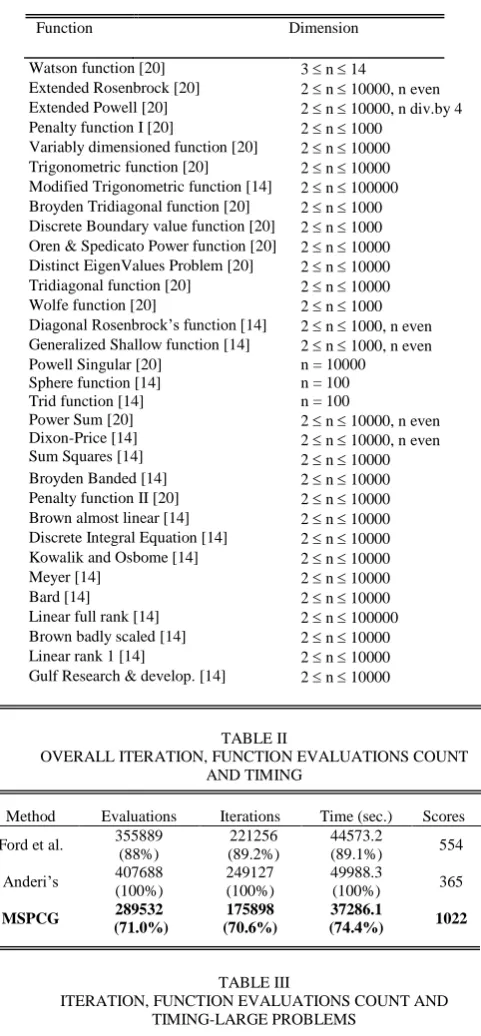
The numerical experiments were conducted on 32 different test problems with dimensions varying from 2 to 100000. The unconstrained optimization test problems used in our experiments are listed in Table I and are primarily found in [14] and [20]. A good portion of the test problems have been selected from the updated CUTEr unconstrained problem collection [14]. The collection has been updated with almost 200 new examples since its release. These include large collections of problems arising from real-life quadratic programming problems and linear complementarity. Each problem was tested on six different starting points. The total number of test problems obtained is 1941. The functions tested are grouped into four categories, low (2 ≤ n ≤20), medium (21 ≤ n ≤ 40), moderately high (41 ≤ n ≤1000) and high (n >10000). Our computational results are benchmarked against Anderi’s [2] SCALCG and the algorithm developed in [13]. Unlike the method in [13], Anderi’s [2] and our algorithm both utilize a weighting matrix in the computation of the CG direction vector. The results reported in Table II correspond to the collective totals obtained on all the test problems. The scores reported indicate iteration, function/gradient evaluations as well as the total execution times. In addition, the right most column (Scores) indicate the number of times a method outperformed the other two methods on a specific problem. In case of a tie, the methods involved in that tie all get a score of one. Tables III to VI report the results for each of the four dimension categories mentioned earlier (high, moderately high, medium and low). The parameter 𝛾 in (9) was chosen to be one in the results reported here as values other than zero, such as 0.5 and 1.2, did not introduce any significant changes in the outcomes. The coding was done using C++ on a 64-bit machine with i7-3770, 3.4 GHZ CPU.
IAENG International Journal of Applied Mathematics, 49:1, IJAM_49_1_05
TABLE I TEST PROBLEMS
Function Dimension
Watson function [20] 3 n 14
Extended Rosenbrock [20] 2 n 10000, n even Extended Powell [20] 2 n 10000, n div.by 4 Penalty function I [20] 2 n 1000
Variably dimensioned function [20] 2 n 10000 Trigonometric function [20] 2 n 10000 Modified Trigonometric function [14] 2 n 100000 Broyden Tridiagonal function [20] 2 n 1000 Discrete Boundary value function [20] 2 n 1000 Oren & Spedicato Power function [20] 2 n 10000 Distinct EigenValues Problem [20] 2 n 10000 Tridiagonal function [20] 2 n 10000 Wolfe function [20] 2 n 1000 Diagonal Rosenbrock’s function [14] 2 n 1000, n even Generalized Shallow function [14] 2 n 1000, n even Powell Singular [20]
Sphere function [14] Trid function [14] Power Sum [20] Dixon-Price [14] Sum Squares [14]
n = 10000 n = 100 n = 100
2 n 10000, n even 2 n 10000, n even 2 n 10000 Broyden Banded [14] 2 n 10000 Penalty function II [20] 2 n 10000 Brown almost linear [14] 2 n 10000 Discrete Integral Equation [14] 2 n 10000 Kowalik and Osbome [14] 2 n 10000
Meyer [14] 2 n 10000
Bard [14] 2 n 10000
[image:6.595.50.291.71.590.2]Linear full rank [14] 2 n 100000 Brown badly scaled [14] 2 n 10000 Linear rank 1 [14] 2 n 10000 Gulf Research & develop. [14] 2 n 10000
TABLE II
OVERALL ITERATION, FUNCTION EVALUATIONS COUNT AND TIMING
Method Evaluations Iterations Time (sec.) Scores
Ford et al. 355889 (88%)
221256 (89.2%)
44573.2
(89.1%) 554 Anderi’s 407688
(100%)
249127 (100%)
49988.3
(100%) 365
MSPCG 289532
(71.0%)
175898 (70.6%)
37286.1
(74.4%) 1022
TABLE III
ITERATION, FUNCTION EVALUATIONS COUNT AND TIMING-LARGE PROBLEMS
Method Evaluations Iterations Time (sec.) Scores
Ford et al. 171118 (87.4%) 109311 (89.3%) 3678.8 (89.8%) 188
Anderi’s 197955 (100.0%) 123011 (100.0%) 4112.7 (100.0%) 102
MSPCG 140118
(70.3%) 86039 (69.5%) 3041.7 (73.1%) 331 TABLE IV
ITERATION, FUNCTION EVALUATIONS COUNT AND TIMING- MODERATELY HIGH PROBLEMS
Method Evaluations Iterations Time (sec.) Scores
Ford et al. 118412 (87.5%) 70019 (89.4%) 8511.78 (86.8%) 171
Anderi’s 135411 (100.0%) 78388 (100.0%) 9855.6 (100.0%) 131
MSPCG 94612
(69.7%) 55617 (70.1%) 6911.4 (70.3%) 330 TABLE V
ITERATION, FUNCTION EVALUATIONS COUNT AND TIMING- MEDIUM PROBLEMS
Method Evaluations Iterations Time (sec.) Scores
Ford et al. 54518 (88.7%) 33311 (86.0%) 20891.1 (89.0%) 128
Anderi’s 61811 (100.0%) 38717 (100.0%) 23611.7 (100.0%) 91
MSPCG 44211
(70.6%) 26977 (69.6%) 17141.3 (72.5%) 268 TABLE VI
ITERATION, FUNCTION EVALUATIONS COUNT AND TIMING- SMALL PROBLEMS
Method Evaluations Iterations Time (sec.) Scores
Ford et al. 11841 (95.3%) 8611 (96.0%) 11490.7 (93.3%) 67
Anderi’s 12511 (100.0%) 9011 (100.0%) 12408.3 (100.0%) 41
MSPCG 10691
(85.0%) 7211 (80.2%) 10191.1 (82.1%) 93
The numerical evidence, reported in Tables II to VI, reveals that the new method MSPCG shows substantial improvements over Anderi’s [2] and over the method of Ford et al. [13] on the majority of the test problems. Compared to the algorithm in [2], the new method improves by an average of 29% overall and around 17% over the method in [13]. It has been observed that the merits of the new algorithm become more significant as the size of the problem increases. There are a few test problems on which either of the two other methods failed to converge (or took too long to do so) and on which our algorithm was able to reach a near optimal solution. Such failures were not included in the results reported in the above tables to maintain consistency of the benchmarking.
All methods use exactly the same line search implementation with choices 𝜌1= 0.0001 and 𝜌1= 0.88 in (23) and (24). The termination condition used is
‖𝑔(𝑥𝑖)‖ ≤ 10−5.
The methods were restarted periodically using Powell’s restart test to measure the degree of orthogonality (see [22,26,27,30])
|𝑔𝑖+1𝑇 𝑔𝑘| ≥ 0.2‖𝑔𝑖+1‖2. (25)
We used Anderi’s [2] restart search direction for SCALCG. As for MSPCG, the restart was done using 𝛽𝑖= 0 and 𝐻𝑖= 𝜎𝑖𝐼 in (16), for 𝜎𝑖= 𝑠𝑖
𝑇𝑠 𝑖
𝑠𝑖𝑇𝑦𝑖 (see [2,26,29]).
This situation was not been encountered very frequently in our tests. Wolfe’s conditions (23) and (24) ensure that 𝑠𝑖𝑇𝑦𝑖> 0 and hence guarantee that Anderi’s SCALCG [2]
search direction is downhill. In our case, by analogy, 𝑟𝑖𝑇𝑤𝑖> 0 ensures that the search direction is descent.
Nevertheless, due to the approximation used in (20), numerical safeguarding remains a must [24].
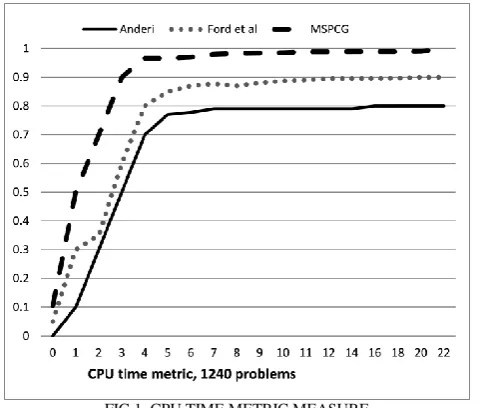
As a further means of assessment, We have introduced the CPU performance profile as was done in Anderi [2] as shown in the figure below.
IAENG International Journal of Applied Mathematics, 49:1, IJAM_49_1_05
FIG 1. CPU TIME METRIC MEASURE
V. CONCLUSION
In this paper, a new weighted descent Conjugate Gradient method with multi-step quasi-Newton updates is developed. The method generates search directions that are a combination of the two-step quasi-Newton and CG vectors in an attempt to utilize the advantages of both methods. The derived method requires a few additional vectors to be retained and updated, compared to SCALCG and the method in [3]. The reasonable savings in computational costs, especially on large problems, seem to present a good justification for that extra storage requirement. The conditioning matrix utilized in our method exploits iteration information accumulated from the two latest steps.
We are currently investigating other choices for the weighting matrix to determine whether the numerical performance of similar methods can be improved further. There also remains the issue of developing automatic restart criteria that provides appropriate switching among several options similar to what was done in [1]. The global convergence properties of such methods are also under consideration.
REFERENCES
[1] Al-Baali, M. “New property and global convergence of the Fletcher– Reeves method with inexact line searches”, IMAJ. Numer. Anal., 5, Feb. 1985, pp. 122–124.
[2] Anderi, N. “A scaled BFGS preconditioned conjugate gradient algorithm for unconstrained optimization”, Applied Mathematics Letters, 20, April 2007, pp. 645-650.
[3] Broyden, C.G. “The convergence of a class of double-rank minimization algorithms - Part 2: The new algorithm”, J. Inst. Math. Applic., 6, June 1970, pp. 222-214.
[4] Byrd, R.H., Schnabel, R.B., and Shultz, G.A., “Parallel quasi-Newton methods for unconstrained optimization”, Math. Programing, 42, April 1988, pp. 273-306.
[5] Dai, Y.H. and Yuan Y., “A nonlinear conjugate gradient method with a strong global convergence property”, SIAM J. Optim., 10, Dec. 1999, pp. 177–182.
[6] Dennis, J.E. and Schnabel, R.B., “Least change Secant updates for quasi-Newton methods”, SIAM Review, 21, Feb. 1979, pp. 443-459. [7] Fletcher, R., Practical Methods of Optimization (second edition),
Wiley, New York, 1987.
[8] Fletcher, R., “A new approach to variable metric algorithms”,
Comput. J. , 13, April 1970, pp. 147-322.
[9] Fletcher, R. and Reeves, C., “Function minimization by conjugate gradients”, Computer J., 7, Jan. 1964, pp. 149–154.
[10] Ford, J.A. and Moghrabi I.A.R., “Using function-values in multi-step quasi-Newton methods”, J. Comput. Appl. Math., 66, March 1996, pp. 201-211.
[11] Ford, J.A. and Moghrabi I.A.R., “Multi-step quasi-Newton methods for optimization”, J. Comput. Appl. Math., 50, Jan. 1994, pp. 305-323. [12] Ford, J.A. and Moghrabi I.A.R., “Alternative parameter choices for multi-step quasi-Newton methods”, Optimization Methods and Software, 2, June 1993, pp. 357-370.
[13] Ford, J.A., Narushima, Y. and Yabe, H., “Multi-step nonlinear conjugate gradient methods for unconstrained minimization”,
Comput. Optim. Appl., 40, Nov. 2008, pp. 191-216.
[14] Gould, N.I.M., Orban, D. and Toint, Ph.L., CUTEr and SifDec: Aconstrained and unconstrained testing environment, revisited," ACM Transactions on Mathematical Software, 29, 2003, pp. 373-394. [15] Hager W. and Zhang H.C., “A new conjugate gradient method with guaranteed descent and an efficient line search”, SIAM J.Optim., 16, Feb. 2005, pp.170–192.
[16] Hestenes, M.R. and Stiefel, E., “Methods of conjugate gradients for solving linear systems”, J. Res. Nat. Bur. Stan. Sec.B, 48, July 1952, pp. 409–436.
[17] Liu, Y. and Storey, C., “Efficient generalized conjugate gradient algorithms, part1:theory”, J. Optim. Theory Appl., 69, Feb. 1991, pp. 129–137.
[18] Moghrabi, I.A.R., “Numerical experience with multiple update quasi-newton methods for unconstrained optimization”, Journal of Mathematical Modeling and Algorithms, 6, Jan. 2007, pp. 214-238. [19] Moghrabi, I.A.R., “Implicit extra-update multi-step
quasi-newton methods”, Int. J. Operational Research, 28, August 2017, pp. 69-81.
[20] Moré, J.J., Garbow, B.S., Hillstrom, K.E., “Testing unconstrained optimization software”, ACM Trans. Math. Softw., 7, April 1981, pp. 17–41.
[21] Perry, A., “A modified conjugate gradient algorithm”, Oper. Res. ,26, Jan. 1978, pp. 1073-1078.
[22] Polak, E. and Ribiére G., “Notesurla convergence de directions conjuguées”, Rev. Francaise Infomat Recherche Operatonelle, 3e Année, 16, Dec. 1969, pp. 35–43.
[23] Polyak, B. T., “The conjugate gradient method in extreme problems”,
USSR Comp. Math. Phys., 9, March 1969, pp. 94–112.
[24] Powell, M.J.D., “Restart procedures for the conjugate gradient method”, Math. Program. , 12, Nov. 1977, pp. 241–254.
[25] Haelterman, R., Bogaers, A., Degroote, J. and Boutet, N., "Quasi-Newton Methods for the Acceleration of Multi-Physics Codes," IAENG International Journal of Applied Mathematics, vol. 47, no.3, pp 352-360, 2017.
[26] Salane, D. and Tewarson, R.P., “On Symmetric Minimum Norm Updates”, IMA Journal of Numerical Analysis, 9, 1, Jan. 1983, pp. 235-240.
[27] Shanno, D.F., “Conditioning of quasi-Newton methods for function minimization”, Math. Comp., 24, May 1970, pp. 647-656.
[28] Shanno, D.F. and Phua, K.H., “Matrix conditioning and nonlinear optimization”, Math. Programming ,14, May 1978, pp. 149-160. [29] Shanno, D.F., “On the convergence of a new conjugate gradient
algorithm”, SIAM J. Numer. Anal., 15, Jan. 1978, pp. 1247–1257. [30] Zhang, W., Qiu, D. and Dong, M., "Optimizations of Convex and
generalized Convex Fuzzy Mappings in The Quotient Space of Fuzzy Numbers", IAENG International Journal of Applied Mathematics, vol. 47, no. 4, pp 431-436, 2017.
[31] Wolfe, P., “Convergence conditions for ascent methods II: Some corrections”, SIAM Rev., 13, June 1971, pp. 185-188.
Issam A.R. Moghrabi is a Professor of M.I.S/C.S in the College of
Business Administration at Gulf University for Science and Technology. He laid the foundations of the M.B.A Program at GUST while serving as the MBA Director for the past five years. He is a Fulbright Scholar and did a post-doctoral research in Geographic Information Systems. The author got his B.Sc. in Computer Science, with distinction, from the Lebanese American University, his M.Sc, with distinction, and Ph.D. from Essex
IAENG International Journal of Applied Mathematics, 49:1, IJAM_49_1_05
University. His main research interests are in mathematical Optimization, Management Science and Information Retrieval and database systems. This author became a Member (M) of IAENG in 2000. He is also a member of the Non-Linear Analyst Group and a referee for several reputable journals [email: [email protected]].