Oscillation Properties for a Class of Delay Partial
Difference Equations with Three Parameters
Huili Ma
Abstract—The aim of this paper is to investigate the oscillato-ry properties of solutions for a class of delay partial difference equation with three parameters. In order to study the oscillation results, the regions of non-positive roots of its characteristic equation which is equivalent to the oscillation results are investigated. Some necessary and sufficient conditions by means of the envelope theory are derived.
Index Terms—delay partial difference equation, oscillation, envelope, characteristic equation.
I. INTRODUCTION
P
Artial difference equations are types of difference equa-tions that involve funcequa-tions of two or more independent variables. Delay partial difference equations have numerous applications as in molecular orbits, population dynamic with spatial migrations, image processing, random walk problems, material mechanics, etc[1-7].In recent years, the study of the qualitative analysis for the oscillatory property of delay par-tial difference equation has attracted considerable attention, see [8-12] and the references therein.In [8], by means of the z-transform, B. G. Zhang and R. P. Agarwal have investigated the following first order delay partial difference equation
Am+1,n+Am,n+1−pAm,n+ µ
X
i=1
qiAm−ki,n−li = 0,
wherep, q are real numbers,ki andli∈N0, i= 1,2, ..., µ, Nt ={t, t+ 1, ...}, and µ is a positive integer. They gave
some sufficient conditions for the equation to be oscillatory. In [12], Chunhua Yuan and Shutang Liu studied the following first order delay partial difference equation
um+1,n+aum,n+1+bum,n+cum−σ,n−τ = 0,
where a, b, c are real numbers with a2+b2+c2 6= 0, and m, n, σ, τ are nonnegative integers. By applying the envelope theory, they achieved the necessary and sufficient conditions for the equation to be oscillatory.
Motivated by the above research, this paper investigates the following second order delay partial difference equation
um+2,n+pum,n+2+qum,n+rum−σ,n−τ = 0, (1)
where p, q, r are real numbers with p2+q2+r2 6= 0, and m, n, σ, τ are nonnegative integers.
The purpose of this paper is to apply the envelope theory of the family of planes, to derive necessary and sufficient
Manuscript received July 30, 2019; revised October 03, 2019. This work is funded by the National Natural Science Foundation of China(11861059), Natural Science Foundation of Gansu Province(145RJZA232) and Promo-tion Funds for Young Teachers in Northwest Normal University (NWNU-LKQN-18-16).
H. Ma is an associated professor in the Department of Information Man-agement and Information System, Northwest Normal University, Lanzhou, Gansu, 730070 CN e-mail: [email protected]
conditions for the delay partial difference equation (1) to be oscillatory.
Before stating our main results, some definitions used in this paper are presented.
Definition 1 A solution of (1) is a real double sequence
{um,n} which is defined form≥ −σ,n≥ −τ and satisfies
(1) form≥0 andn≥0.
Definition 2A solution{um,n}of (1) is said to be eventually
positive (or negative) ifum,n>0(orum,n<0) form > M
and n > N, where M and N are some large integers. It is said to be oscillatory if it is neither eventually positive nor eventually negative. (1) is called oscillatory if all of its nontrivial solutions are oscillatory.
II. PRELIMINARIES
This section will give some lemmas that will be used in the proof of the main results in section 3.
Lemma 1[11] The following statements are equivalent: (i) Every solution of equation (1) is oscillatory. (ii) The characteristic equation of equation (1)
λ2+pµ2+q+rλ−σµ−τ = 0
has no positive root.
Lemma 2 [12] Suppose that f(x, y), g(x, y), h(x, y) and
v(x, y)are differentiable on(−∞,+∞)×(−∞,+∞). LetΓ
be a two-parameter family of planes defined by the equation
f(λ, µ)x+g(λ, µ)y+h(λ, µ)z=v(λ, µ),
whereλandµare parameters. LetΣbe the envelope of the familyΓ. Then the equation
f(λ, µ)a+g(λ, µ)b+h(λ, µ)c=v(λ, µ)
has no real root if and only if there is no tangent plane of
Σpassing through the point(a, b, c)inxyz-space.
Lemma 3[13] Suppose that f(x), g(x), h(x)andv(x)are differentiable on (−∞,+∞). Let Γ be the one-parameter family of planes defined by the equation
f(λ)x+g(λ)y+h(λ)z=v(λ),
whereλis a parameter. LetΣbe the envelope of the family
Γ. Then the equation
f(λ)a+g(λ)b+h(λ)c=v(λ)
has no real root if and only if there is no tangent plane of
Σpassing through the point(a, b, c)inxyz-space.
Lemma 4 [11] Suppose that f(x) is differentiable on
(0,+∞) such thatf(x) is not identically zero on(0,+∞)
andlimx→+∞f(x)>0 or limx→0+f(x)>0. Then
F(x, y) =y+f(x) = 0
IAENG International Journal of Applied Mathematics, 49:4, IJAM_49_4_32
has no positive root on (0,+∞)×(0,+∞) if and only if
f(x) = 0 has no positive root on(0,+∞).
Lemma 5 Assume that
f(λ, q, r) =λσ+2+qλσ+r,
where σ is a positive integer, q and r are real parameters. Then the equationf(λ, q, r) = 0 has no positive root if and only ifq≥0 andr≥0 orq <0and
r >(−1)σ+22 2σ
σ
2
(σ+ 2)σ+22
qσ+22 .
Proof Consider the family of straight lines defined by
Lλ:f(λ, x, y) = 0, whereλ∈(0,+∞). Since
fλ(λ, x, y) = (σ+ 2)λσ+1+σλσ−1x,
the determinant of the systemf(λ, x, y) = 0 =fλ(λ, x, y)is
−σλσ−1which does not vanish forλ >0. The characteristic
region of f(λ, x, y) which belongs to C\(0,+∞) is just the multiplicity-2 set with order 0 of the envelope G for the family {Lλ|λ ∈ (0,+∞)} ([13],Theorem 2.6). The
parametric functions of Gcould be given by ([13],Theorem 2.3)
x(λ) =−σ+ 2
σ λ
2, y(λ) = 2 σλ
σ+2, λ >0.
Actually, G can also be described by the graph of the functiony=G(x), where
G(x) = (−1)σ+22 2σ
σ
2
(σ+ 2)σ+22
xσ+22 .
Since
G0(x) = (−1)σ+22
σσ
2 (σ+ 2)σ2
xσ2,
G00(x) = (−1)σ+22
σσ+22
2(σ+ 2)σ2
xσ−22,
G(x) is a positive and strictly decreasing, strictly convex function on(−∞,0)such thatG(0−) = 0, G(−∞) = +∞.
From the property of the functionG(x), we can see that the equation f(λ, q, r) = 0 has no positive root if and only if
q≥0 andr≥0 orq <0 and
r >(−1)σ+22 2σ
σ
2
(σ+ 2)σ+22
qσ+22 .
The proof is complete.
III. MAIN RESULTS
In this section, some necessary and sufficient conditions for the oscillatory properties of equation (1) are established. To facilitate discussions, we divide nonnegative integers
σ and τ into four mutually exclusive cases: (i) σ≥ 1 and
τ ≥ 1, (ii) σ ≥ 1 and τ = 0, (iii) σ = 0 and τ ≥1, (iv)
σ= 0 andτ= 0.
Theorem 1 Assume that σ ≥ 1 and τ ≥ 1. Then every solution of equation (1) oscillates if and only ifp≥0, q≥0
andr≥0 orp >0, q <0, and
r >(−1)σ+τ2+2 2σ
σ
2τ
τ
2q
σ+τ+2 2
(σ+τ+ 2)σ+τ2+2pτ2
.
Proof Whenσ ≥1 and τ ≥1, the characteristic equation of equation (1) is
φ(p, q, r, λ, µ) =λ2+pµ2+q+rλ−σµ−τ= 0. (2)
Let
F(p, q, r, λ, µ) =λσµτφ(p, q, r, λ, µ)
=λσ+2µτ+pλσµτ+2+qλσµτ+r= 0. (3)
From (3), we can see that (2) has no positive root if and only if (3) has no positive root. Since we mainly discuss the oscillatory solutions of equation (1), by Lemma 1, attention will be restricted to the case where λ > 0 and
µ >0. We will consider (p, q, r) as a point in xyz-space, and try to search for the exact regions containing points
(p, q, r) in xyz-space such that (3) has no positive root. Actually,F(x, y, z, λ, µ) = 0can be regarded as an equation describing a two-parameter family of planes in xyz-space, wherex, yand z are the coordinates of point of the planes inxyz-space andλ, µare parameters.
According to the envelop theory, the points of the envelope of the two-parameter family of planes defined by (3) satisfy the following equations
F(x, y, z, λ, µ) =0,
Fλ(x, y, z, λ, µ) =(σ+ 2)λσ+1µτ+σλσ−1µτ+2x
+σλσ−1µτy= 0,
Fµ(x, y, z, λ, µ) =τ λσ+2µτ−1+ (τ+ 2)λσµτ+1x
+τ λσµτ−1y= 0,
(4)
whereλ >0 andµ >0. Eliminatingλandµ from (4), we get the function of the envelope
z(x, y) = (−1)σ+τ2+2 2σ
σ
2ττ2y
σ+τ+2 2
(σ+τ+ 2)σ+τ2+2x
τ
2
, (5)
wherex >0, y <0. Consequently, we have
∂z
∂x = (−1) σ+τ
2 σ
σ
2τ
τ+2 2 y
σ+τ+2 2
(σ+τ+ 2)σ+2τ+2x
τ+2 2
,
∂z
∂y = (−1) σ+τ+2
2 σ
σ
2τ
τ
2y
σ+τ
2
(σ+τ+ 2)σ+2τxτ2
,
∂2z
∂x2 = (−1) σ+τ+2
2 (τ+ 2)σ
σ
2τ
τ+2 2 y
σ+τ+2 2
2(σ+τ+ 2)σ+2τ+2x
τ+4 2
,
∂2z
∂y2 = (−1) σ+τ+2
2 (σ+τ)σ
σ
2τ
τ
2y
σ+τ−2 2
2(σ+τ+ 2)σ+2τx
τ
2
,
∂2z
∂x∂y = (−1) σ+τ
2 σ
σ
2τ
τ+2 2 y
σ+τ
2
2(σ+τ+ 2)σ+2τx
τ+2 2
.
When x > 0, y < 0, we have ∂2z/∂x2 > 0, ∂2z/∂y2 > 0, ∂2z/∂x2 · ∂2z/∂y2 −(∂2z/∂x∂y)2 =
σσ+1ττ+1yσ+τ
2(σ+τ+2)σ+τ+2xτ+2 >0andz(x, y)>0. Hence,z(x, y)is a
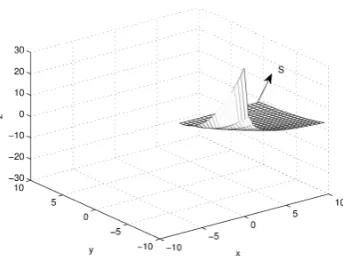
positive and strictly convex function on(0,+∞)×(−∞,0). Moreover, the envelope defined by (5) is a strictly convex surfaceS over(0,+∞)×(−∞,0)as described in Figure 1. Thus from Figure 1, it is clearly seen that when(p, q, r)is in the first closed octant, namely, p≥0, q ≥0 and r≥0, or when(p, q, r)is vertically above the envelopeS, namely,
p >0, q <0 and
r >(−1)σ+τ2+2 2σ
σ
2τ
τ
2q
σ+τ+2 2
(σ+τ+ 2)σ+τ2+2pτ2
,
IAENG International Journal of Applied Mathematics, 49:4, IJAM_49_4_32
there cannot be any tangent plane of the envelope S which passes through the (p, q, r). Since (2) is the same as (3)
Fig. 1. Envelope surface forσ= 1andτ= 1
for the existence of positive solutions. Lemma 1 implies the statement of this theorem. The proof completes.
Theorem 2 Assume that σ ≥ 1 and τ = 0. Then every solution of equation (1) oscillates if and only ifp≥0, q≥0
andr≥0 orp≥0, q <0 and
r >(−1)σ+22 2σ
σ
2
(σ+ 2)σ+22
qσ+22 .
Proof When σ≥1 andτ = 0, the characteristic equation of equation (1) is
φ(p, q, r, λ, µ) =λ2+pµ2+q+rλ−σ= 0. (6)
Whenp <0, it is obvious that (6) has positive solutions. We just need to consider two cases: (a)p= 0and (b)p >0
Case (a).p= 0. (6) can be written as
φ(p, r, λ) =λ2+q+rλ−σ= 0. (7)
Let
f(q, r, λ) =λσφ(p, r, λ) =λσ+2+qλσ+r= 0. (8)
Since (8) is same as (7) for the existence of positive solutions, from Lemma 5, (6) has no positive root if and only ifq≥0
andr≥0 orq <0and
r >(−1)σ+22 2σ
σ
2
(σ+ 2)σ+22
qσ+22 .
Case (b). p >0. (6) can be rewritten as
φ(p, q, r, λ, µ) =p(1 pλ
2
+µ2+q p+
r pλ
−σ
) = 0.
Let
f(1 p,
q p,
r p, λ) =
1 pλ
2+q p+
r pλ
−σ. (9)
Since limλ→+∞f(1/p, q/p, r/p, λ) > 0 with p > 0 and
f(1/p, q/p, r/p, λ) is differentiable with regard to λ > 0. By Lemma 4, (6) has no positive root if and only if (9) has no positive root. Let
F(1 p,
q p,
r
p, λ) =λ
σf(1
p, q p,
r p, λ) =
1 pλ
σ+2+q pλ
σ+r
p= 0. (10)
Then (9) has no positive root if and only if (10) has no positive root. Since we investigate oscillatory solutions of
(1), by Lemma 1, attention will be restricted to the case where λ > 0. We will consider (1/p, q/p, r/p) as a point in xyz-space and search for the exact regions including points (1/p, q/p, r/p) in xyz-space such that (10) has no positive root. Actually,F(x, y, z, λ) = 0 can be regarded as an equation describing a one-parameter family of planes in
xyz-space, wherex, yandzare the coordinates of point of the plane inxyz-space andλis a parameter.
According to the theory of envelope, the points of the envelope of the one-parameter family of planes described by (10) satisfy the following equations
(
F(x, y, z, λ) =λσ+2x+λσy+z= 0,
Fλ(x, y, z, λ) = (σ+ 2)λσ+1x+σλσ−1y= 0,
(11)
whereλ >0. Eliminating λ(>0)from (11), we obtain the function of the envelope
z(x, y) = (−1)σ+22 2σ
σ
2y
σ+2 2
(σ+ 2)σ+22 x
σ
2
, (12)
wherex >0 andy <0. Consequently, we have
∂z
∂x = (−1) σ
2 σ
σ+2 2 y
σ+2 2
(σ+ 2)σ+22 x
σ+2 2
,
∂z
∂y = (−1) σ+2
2 σ
σ
2y
σ
2
(σ+ 2)σ2x
σ
2
,
∂2z
∂x2 = (−1) σ+2
2 σ
σ+2 2 y
σ+2 2
2(σ+ 2)σ2x
σ+4 2
,
∂2z
∂y2 = (−1) σ+2
2 σ
σ+2 2 y
σ−2 2
2(σ+ 2)σ2xσ2
,
∂2z
∂x∂y = (−1) σ
2 σ
σ+2 2 yσ2
2(σ+ 2)σ2x
σ+2 2
.
Whenx >0 andy <0, we have z(x, y)>0,∂2z/∂x2 > 0,∂2z/∂y2>0and∂2z/∂x2·∂2z/∂y2−(∂2z/∂x∂y)2= 0.
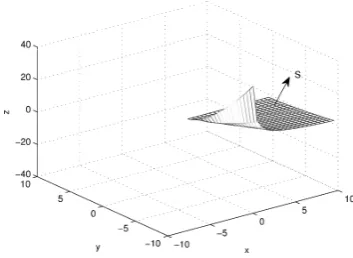
[image:3.595.350.529.534.663.2]Hence, the envelope defined by (12) is a convex surface
Fig. 2. Envelope surface forσ= 1andτ= 0
S over (0,+∞)×(−∞,0) as depicted in Figure 2. Thus we can easily see that there are two cases for the point
(1/p, q/p, r/p) through which there cannot be any tangent plane of the envelopeS which passes. The first case is that
(1/p, q/p, r/p)is in the first closed octant except on the pos-itive coordinate axis x= 0, namely, 1/p >0, q/p ≥0,and
r/p≥0, which are equivalent to p >0, q ≥0 and r≥0.
IAENG International Journal of Applied Mathematics, 49:4, IJAM_49_4_32
The second case is that(1/p, q/p, r/p)is vertically above the envelope S in the forth octant, namely, 1/p > 0, q/p <0
andr/p >(−1)σ+22 2σ
σ
2
(σ+2)σ+22
qσ+22 , which are equivalent to
p > 0, q <0 andr > (−1)σ+22 2σ
σ
2
(σ+2)σ+22
qσ+22 . Meanwhile,
if(1/p, q/p, r/p)is lied in somewhere else except the above two cases, such a tangent plane exists.
Since (6) is the same as (10) for the existence of positive solutions, combining case (a) and case (b), one can see that (6) does not have any positive root if and only ifp≥0, q≥0
andr≥0 orp≥0, q <0 and
r >(−1)σ+22 2σ
σ
2
(σ+ 2)σ+22
qσ+22 .
Lemma 1 implies the statement of this theorem. The proof completes.
Theorem 3 Assume that σ = 0 and τ ≥ 1. Then every solution of equation (1) oscillates if and only ifp≥0, q≥0
andr≥0 orp >0, q <0 and
r >(−1)τ+22 2τ
τ
2q
τ+2 2
(τ+ 2)τ+22 p
τ
2
.
Proof When σ= 0 andτ ≥1, the characteristic equation of equation (1) is
φ(p, q, r, λ, µ) =λ2+pµ2+q+rµ−τ = 0. (13)
When p <0, it is obvious that (13) has positive solutions. We just need to consider two cases: (a)p= 0and (b)p >0. Case (a). p= 0. In this case, it is easy that (13) has no positive root if and only if q≥0 andr≥0.
Case (b). p >0. In this case, let
f(p, q, λ, µ) =pµ2+q+rµ−τ = 0. (14)
Since limµ→+∞f(p, q, r, µ)>0 for p >0andf(p, q, r, µ)
is differentiable with respect to µ >0, from Lemma 4, we can see that (13) has no positive root if and only if (14) has no positive root. Let
F(p, q, r, µ) =µτf(p, q, r, µ) =pµτ+2+qµτ+r= 0. (15)
It is clear that (14) has no positive root if and only if (15) has no positive root. Since we investigate oscillatory solutions of (1), by Lemma 1, attention will be restricted to the case where µ >0. We will consider (p, q, r)as a point in xyz -space and search for the exact regions including (p, q, r)
in xyz-space such that (15) has no positive root. Actually,
F(x, y, z, µ) = 0can be regarded as an equation describing a one-parameter family of planes in xyz-space, where x, y
andzare the coordinates of point of the plane inxyz-space andµis a parameter.
From the theory of envelope, the points of the envelope of the one-parameter family of planes described by (15) satisfy the follow equations
(
F(x, y, z, µ) =µτ+2x+µτy+z= 0,
Fµ(x, y, z, µ) = (τ+ 2)µτ+1x+τ µτ−1y= 0,
(16)
whereµ >0. Eliminatingµ(>0) from (16), we obtain the function of the envelope
z(x, y) = (−1)τ+22 2τ
τ
2y
τ+2 2
(τ+ 2)τ+22 xτ2
, (17)
wherex >0 andy <0. From (17), we have
∂z
∂x = (−1) τ
2 τ
τ+2 2 y
τ+2 2
(τ+ 2)τ+22 x
τ+2 2
,
∂z
∂y = (−1) τ+2
2 τ
τ
2yτ2
(τ+ 2)τ2xτ2
,
∂2z
∂x2 = (−1) τ+2
2 τ
τ+2 2 y
τ+2 2
2(τ+ 2)τ2x
τ+4 2
,
∂2z
∂y2 = (−1) τ+2
2 τ
τ+2 2 y
τ−2 2
2(τ+ 2)τ2x
τ
2
,
∂2z
∂x∂y = (−1) τ
2 τ
τ+2 2 y
τ
2
2(τ+ 2)τ2x
τ+2 2
.
[image:4.595.369.502.75.223.2]When x > 0 and y < 0, we have z(x, y) > 0, and
Fig. 3. Envelope surface forσ= 0andτ= 1
∂2z/∂x2 > 0,∂2z/∂y2 > 0 and ∂2z/∂x2 ·∂2z/∂y2 − (∂2z/∂x∂y)2 = 0. Hence, the envelope defined by (17) is
a convex surfaceS over(0,+∞)×(−∞,0)as depicted in Figure 3. Thus we can easily see that there are two cases for the point (p, q, r) through which there cannot be any tangent plane of the envelopeS which passes. The first case is that (p, q, r) is in the first closed octant except on the positive coordinate axis x= 0, namely, p >0, q ≥ 0, and
r ≥0. The second case is that (p, q, r) is vertically above the envelopeSin the forth octant, namely,p >0, q <0and
r >(−1)τ+22 2τ
τ
2
(τ+2)τ+22
qτ+22 . Meanwhile, if(p, q, r)is lied in
somewhere else except the above two cases, such a tangent plane exists.
Since (13) is the same as (15) for the existence of positive solutions, it follows from case (a) and case (b) that (13) does not have any positive root if and only if p≥ 0, q ≥0 and
r≥0 orp >0, q <0 and
r >(−1)τ+22 2τ
τ
2q
τ+2 2
(τ+ 2)τ+22 pτ2
.
By lemma 1, the proof completes.
Theorem 4 Assume that σ = 0 and τ = 0. Then every solution of equation (1) oscillates if and only ifp > 0 and
q+r= 0.
Proof Whenσ= 0andτ= 0, one can rewrite equation (1) as
um+2,n+pum,n+2+ (q+r)um,n= 0. (18)
IAENG International Journal of Applied Mathematics, 49:4, IJAM_49_4_32
[image:4.595.351.528.274.403.2]The characteristic equation of equation (18) is
λ2+pµ2+ (q+r) = 0. (19)
It can be clearly seen that (19) does not have any positive root if and only ifp >0andq+r= 0. From Lemma 1, we can see that every solution of equation (1) oscillates if and only ifp >0 andq+r= 0. This completes the proof.
IV. ILLUSTRATIVE EXAMPLES
In this section, we give some examples to illustrate the results obtained in Section 3.
Example 1Consider the delay partial difference equation
um+2,n+ 0.5um,n+2+ 0.2um,n+ 0.3um−1,n−1= 0. (20)
Clearly, σ = 1, τ = 1, p = 0.5, q = 0.2 and r = 0.3.
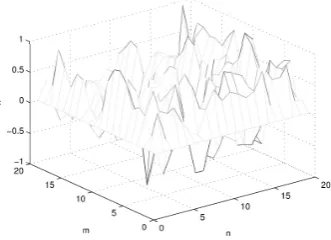
[image:5.595.351.515.178.299.2]Since p= 0.5 > 0, q = 0.2 > 0 and r = 0.3 > 0, by 1, every solution of equation (20) is oscillatory. The oscillatory behavior of equation (20) is demonstrated by Figure 4.
Fig. 4. Oscillatory behavior of equation (20)
Example 2Consider the delay partial difference equation
um+2,n+0.81um,n+2−0.1um,n+0.15um−1,n−1= 0. (21)
In this case,σ= 1, τ = 1, p= 0.81, q=−0.1andr= 0.15.
Since p= 0.81>0, q=−0.1<0 and
r= 0.15> 1
72 = (−1) σ+τ+2
2 2σ
σ
2ττ2q
σ+τ+2 2
(σ+τ+ 2)σ+2τ+2p
τ
2
,
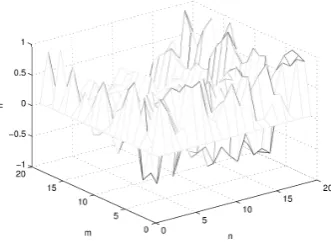
by Theorem 1, every solution of equation (21) oscillats. The oscillatory behavior of equation (21) is demonstrated by Figure 5.
Fig. 5. Oscillatory behavior of equation (21)
Example 3Consider the delay partial difference equation
um+2,n+ 0.7um,n+2+ 0.3um,n+ 0.1um−1,n= 0. (22)
Obviously, σ = 1, τ = 0, p= 0.7, q = 0.3 and r = 0.1.
[image:5.595.94.259.316.437.2]Sincep= 0.7>0, q= 0.3>0andr= 0.1>0,according to Theorem 2, every solution of equation (22) is oscillatory. The oscillatory behavior of equation (22) is demonstrated by Figure 6.
Fig. 6. Oscillatory behavior of equation (22)
Example 4Consider the delay partial difference equation
um+2,n+ 0.64um,n+2−0.1um,n+ 0.18um−1,n= 0. (23)
In this case,σ= 1, τ = 0, p= 0.64, q=−0.1andr= 0.18.
Sincep= 0.64>0, q=−0.1<0and
r= 0.18>
√
30
450 = (−1) σ+2
2 2σ
σ
2
(σ+ 2)σ+22
qσ+22 ,
according to Theorem 2, every solution of equation (23) oscillats. The oscillatory behavior of equation (23) is demon-strated by Figure 7.
Fig. 7. Oscillatory behavior of equation (23)
Example 5Consider the delay partial difference equation
um+2,n+ 0.8um,n+2= 0. (24)
Clearly,σ = 0, τ = 0, p = 0.8, q=−0.02 and r= 0.02.
Sincep= 0.8>0,andp+r= 0, according to Theorem 4, every solution of equation (24) is oscillatory. The oscillatory behavior of equation (24) is demonstrated by Figure 8.
ACKNOWLEDGMENT
The author would like to appreciate the editor and anony-mous reviewers for their valuable suggestions.
IAENG International Journal of Applied Mathematics, 49:4, IJAM_49_4_32
[image:5.595.348.517.493.612.2] [image:5.595.94.260.642.762.2]Fig. 8. Oscillatory behavior of equation (24)
REFERENCES
[1] J.C. Strikwerda, “Finite Difference Schemes and Partial Differential Equations,”Wadsworth and Brooks, Pacific Grove, 1989.
[2] B.E. Shi, L.O. Chua, “Resistive grid image filtering: input/output analysis via the CNN framework,”IEEE Trans. Circuits Syst, vol. 39, pp. 531-548, 1992.
[3] X. Li, “Partial difference equations used in the study of molecula rorbits,”Acta Chim. Sin., vol. 40, pp. 688-698, 1982.
[4] R.J. LeVeque, “Numerical Methods for Conservation Laws,”Birkhauser Berlin, 1992.
[5] P. Meakin, “Models for material failure and deformation,”Science, vol. 252, pp. 226-234, 1991.
[6] Q. Lin and J.G. Rokne, “Meshless Difference Methods with Adapta-tion and High ResoluAdapta-tion,”IAENG International Journal of Applied Mathematics, Vol. 38, no. 2, pp. 63-82, 2008.
[7] S. Zhou, F. Meng, Q. Feng and L. Dong, “A spatial sixth order finite difference scheme for time fractional sub-diffusion equation with vari-able coefficient,”IAENG International Journal of Applied Mathematics, Vol.47, no. 2, pp. 175-181, 2017.
[8] B. Zhang and R. P. Agarwal, “The oscillation and stability of delay partial difference equations,”Comput. Math. Appl., vol. 45, pp. 1253-1295, 2003.
[9] H. Ma and H. Wang, “Research on Oscillation Properties for a Class of the Second-order Mixed Partial Difference Equations,”Journal of Mathematics and Informatics, Vol. 8, pp. 19-24, 2017.
[10] H. Ma and H. Wang, “Some Oscillation Results for a Class of Delay Partial Difference Equations,”IAENG International Journal of Applied Mathematics, Vol. 48, no.4, pp. 412-415, 2018.
[11] B. Zhang and Y. Zhou, “Qualitative Analysis of Delay Partial Differ-ence Equations,”Hindawi Publishing Corporation, New York, 2007. [12] C. Yuan and S. Liu, “An envelope surface method for determining
oscillation of a delay 2-D discrete convection system,”J. Differ. Equ, 2014.
[13] S. Cheng and Y. Lin, “Dual Sets of Envelopes and Characteristic Regions of Quasi-Polynomials,”World Scientific Singapore, 2009.