On Shift-splitting Based C-to-R Method for
Singular Complex Linear Systems
Min-Li Zeng,
Member, IAENG
Abstract—Rewriting the complex-valued system to real-valued form (C-to-R) leads to a block two-by-two linear system of particular form. Axelsson et al. [Numer. Algorithm 66(2014)811–841]proposed the C-to-R method for nonsingular complex linear systems and illustrated its efficiency theoreti-cally and experimentally. In this paper, we will use the C-to-R method for solving the singular symmetric complex linear systems based on the shift splitting (SS) and obtain an SS-based C-to-R (SS-C-to-R) method. Eigenvalue properties of the SS-C-to-R preconditioned matrix are analyzed. Numerical experiments are also used to demonstrate the feasibility and effectiveness by comparing with the existing preconditioned methods.
Index Terms—Singular complex linear systems, C-to-R method, Shift splitting, Eigenvalue properties, Block Two-by-two linear system.
I. INTRODUCTION
C
ONSIDER the following complex system of linear equationsAu=b, (I.1)
where A ∈Cm×m is a large sparse complex symmetric
matrix of the form
A=W+iT,
with W,T ∈Rm×m being both symmetric positive
semi-definite matrices, b= f +ig with f,g ∈Rm being given
vectors, i=p−1 being the imaginary unit and u ∈Cm
being an unknown vector. We assume that A is a non-Hermitian matrix, or equivalently, T ̸=0. Let u =x+iy with x,y ∈Rm, then the complex linear system (I.1) can
be rewritten in a real form[2],[17]as
Az:=
W −T
T W
x y
=
f g
. (I.2)
There are a variety of scientific computing and engi-neering applications, such as structural dynamics [20], chemical oscillations and nonlinear waves [1], quantum mechanics [28], lattice quantum chromody-namics [21], FFT-based solutions of certain time-dependent PDEs[15] and so on. For more applications of this class of problems, see [2],[9],[13].
When W and T are symmetric positive semi-definite and at least one of them is positive definite, the coefficient matrix of (I.1) is nonsingular [9]. Many efficient iteration methods and preconditioning techniques can be used for
Manuscript received May 6th, 2019; revised September 24th, 2019. This work was supported by the National Natural Science Foundation of China (No.11901324 and No. 11626136), the Natural Science Foundation of Fujian Province (No. 2016J05016) and the Program for Innovative Research Team in Science and Technology in Fujian Province University. M.-L. Zeng is with the School of Mathematics and Finance, Putian University, Putian 351100, P.R. China and the Key Laboratory of Ap-plied Mathematics (Putian University), Fujian Province University, Fujian Putian, 351100, China. E-mail: [email protected]
solving the nonsingular system (I.1). For example, based on the Hermitian and skew-Hermitian splitting (HSS)[6] A = H+S, where H = W and S = iT, Bai et al. [9] designed the modified HSS (MHSS) iteration method and the preconditioned MHSS (PMHSS) iteration method in
[11]. Furthermore, Zeng and Ma[31]established a param-eterized variant of the single-step HSS (P-SHSS) iterative method. More efficient methods can be found in[18],[32],
[23] and references therein.
To fast solve the equivalent two-by-two block structure nonsingular linear system (I.2), many efficient method-s can be found in eximethod-sting referencemethod-s, e.g., the C-to-R method[3]by Axelsson, the preconditioned MHSS in[12], the preconditioned generalized successive over-relaxation (PGSOR) in [22] and so on. For more efficient methods, see[10],[34],[33],[4],[5].
When W and T are both symmetric positive semi-definite satisfying that null{T} ∩null{W} ̸= {0}, the co-efficient matrix of (I.1) is singular. For solving the non-Hermitian singular linear equations (I.1) efficiently, Bai et al.[8] investigated the semi-convergence property of the HSS iteration method. Recently, Chen et al.[16], Yang et al.[30]and Wu et al.[29]proposed the semi-convergence properties of the MHSS iteration method for solving sin-gular complex linear systems. There are also some recent studies on iterative methods for singular linear systems in
[25],[19],[24]. However, from the numerical results we can see that those iterative methods and the corresponding preconditioned Krylov subspace methods converge very slowly.
In this paper, to further investigate the efficient solvers for the singular complex linear systems, based on the shift-splitting (SS) strategy for the non-Hermitian positive definite matrices[7]and by making use of the efficient C-to-R method for nonsingular two-by-two linear system[3], we will construct an SS-C-to-R method for solving the two-by-two singular linear system (I.2). Then we will derive the eigenvalue properties of the preconditioned matrix.
The remainder of this paper is organized as follows. In Section II, the SS-C-to-R method and the corresponding preconditioner is proposed. Then some eigenvalue prop-erties of the preconditioned matrix are given in Section III. In Section IV, we will examine the feasibility and efficien-cy of the SS-C-to-R methods by numerical experiments. Finally, a brief conclusion will be given to end this work in Section V.
IAENG International Journal of Applied Mathematics, 50:1, IJAM_50_1_15
II. THE SS-C-TO-R METHOD
For the block two-by-two linear system (I.2), by making use of the following splitting[7]
A=1 2
αI+W −T
T αI+W
−1
2
αI−W T
−T αI−W
,
whereα >0 is a given constant andI is the identity matrix with proper dimension, we can obtain the corresponding preconditioner, denoted asPSS, as:
PSS=
1 2
αI+W −T
T αI+W
. (II.1)
Applying the SS preconditioner PSS within a Krylov
sub-space method, one needs to solve sequences of general-ized residual equations of the form
PSSz=r,
where r = [r1T,r
T
2]T with r1,r2 ∈ Rm and z = [zT1,z
T
2]T with z1,z2 ∈ Rm are the generalized and the current residual vectors, respectively. Therefore, one can use the following steps[33]to solve the above generalized residual equations,
Step 1: solve (αI+W)w=2r2 forw; Step 2: compute ˜w=2r1+Tw;
Step 3: solve (αI+W+T(αI+W)−1T)z
1=w˜ forz1; Step 4: solve (αI+W)v=−Tz1 forv;
Step 5: computez2=v+w.
It can be seen that the workload of Step 3 is heavy. To conquer the inconvenience, preconditioning technique should be used for the shift system (II.1). We will try the C-to-R preconditioner[3], which is very efficient for non-singular symmetric complex linear systems. By omitting the constant coefficient 12, which would not affect the iteration counts of the preconditioned Krylov subspace method[14], we obtain the SS-C-to-R preconditioner as,
P=
αI+W −T
T αI+W+2T
. (II.2)
Applying the preconditioner P within a Krylov subspace method needs solving the following linear matrix precon-ditioning equations
Pz=
αI+W −T
T αI+W+2T
x y
=
f g
. (II.3)
Adding the second to first equation in (II.3), the system can be rewritten in a equivalent form,
¨
(αI+W+T)(x+y) =f +g, T(x+y) + (αI+W+T)y=g,
i.e.,
Pz=
αI+W+T 0
T αI+W+T
˜ z y
=
f +g g
,
where ˜z = x+y. Hence, the algorithm to obtain the solution of (II.3) can be written as
⋄ Solve(αI+W+T)z˜=f +g;
⋄ Compute ˜f =g−Tz˜;
⋄ Solve(αI+W+T)y =f˜;
⋄ Computex=z˜−y.
III. THE EIGENVALUE PROPERTIES OF THE PRECONDITIONED MATRIX
One of the important aspects that affects the conver-gence property of the Krylov subspace methods is the eigenvalues distribution of the preconditioned coefficient matrix. Hence, in this section, we will concentrate on the eigenvalue properties of the preconditioned matrix P−1A. AsP−1A=1
2P− 1(2P
SS)PSS−1A. Firstly, we discuss the
spectral properties of the preconditioned matrixPSS−1A.
Letλ be an eigenvalue ofP−1
SS A and [uT,vT]T be the
corresponding eigenvector, then according to Theorem 2.2 in[33], we have the following theorem.
Theorem III.1. Assume W ∈Rm×m, T ∈Rm×m be
sym-metric positive semi-definite matrices. Letα be a positive constant. Then the nonzero eigenvalueλ of the precondi-tioned matrix PSS−1A satisfies
|λ−1|<1, ∀α >0.
Or equivalently, all nonzero eigenvalues of the precondi-tioned matrix PSS−1A cluster in the unit disk with center (1, 0). Besides, the dimension of the eigenvalue space for λ=0 equals n2
0, where n0=dim(null(W)∩null(T)) with null(X) being the null space of X .
Proof:Ifλ̸=0, then by making use of the conclusion in[33], we know that for any α >0, it holds |λ−1|<1.
Ifλ=0, then
W −T
T W
u v
=
0 0
leads to ¨
W u=T v, Tu+W v=0.
Hence, it must hold
u∈null(W)∩null(T), v∈null(W)∩null(T)
and
∥u∥2 2+∥v∥
2 2̸=0.
Therefore, the dimension of the zero eigenvalue space equalsn20, wheren0=dim(null(W)∩null(T)).
Next, we consider the spectral properties ofP−1(2P
SS).
According to Proposition 3.1 in[5], we acquire the follow-ing theorem immediately.
Theorem III.2. Assume P and PSS are defined previously.
Then the eigenvalue µ of the matrix P−1(2P
SS) satisfies
µ ∈ [1
2, 1]. The dimension of the eigenvalue space for µ = 1 equals to n+n1, where n2 = dim(αI+W) and n1=dim(null(T)).
Proof:See [5].
By combining Theorem III.1 with Theorem III.2, we can obtain the following theorem.
Theorem III.3. Assume W,T,P and A are defined previ-ously. Letα >0be a constant,γbe a generalized eigenvalue of P−1A, then it satisfies|γ| ≤1.
Proof:Suppose z to be the nonzero eigenvector cor-responds to the eigenvalueγ. If γ̸=0, then
P−1Az=γz, i.e., γ=zTP−1Az zTz .
IAENG International Journal of Applied Mathematics, 50:1, IJAM_50_1_15
Denote byH1=P−1(2PSS) andH2=PSS−1A, then P−1A =
1
2H1H2. Besides, it is known thatH 1 2
1 makes sense accord-ing to Theorem III.2, henceγcan be rewritten as
γ=1 2
zTH
1H2z
zTz =
1 2
yTy
zTz ·
yTH12 1H2H
−1 2 1 y
yTy =
1 2
zTH
1z zTz ·φ(y),
where y=H
1 2 1z and
φ(y) =yTH
1 2 1H2H−
1 2 1 y
yTy .
It is known that the matrix H
1 2 1H2H−
1 2
1 is similar to the matrix H2, hence they have the same eigenvalues. Then there existsy1 such that
φ(y) =y
T
1H2y1 yT
1y1 .
Therefore,
γ=1 2
zTH
1z zTz ·
yT
1H2y1 yT
1y1 .
It follows from Theorem III.1 that
|γ| ≤1
2λmax(H1)λmax(H2)≤1,
whereλmax(X) denotes the maximum eigenvalue in mod-ule ofX.
Remark III.4. Whenα→0+, according to the expression of P, we know that all the nonzero eigenvalues of PSS−1A will
cluster around 1. Hence, when α→ 0+, all the nonzero eigenvalues of P−1A cluster at [1
2, 1]. However, α → 0+ means the preconditioner P tends to be singular. Therefore, we should not use the tiny α in our experiments so as to reach the most effectiveness of the preconditioner P.
IV. NUMERICAL EXPERIMENTS
In this section, we will test the feasibility and effec-tiveness of the SS-C-to-R method for solving the singular complex linear systems in terms of both iteration counts (denoted as ‘IT’) and the computing times (in second, denoted as ‘CPU’). In our implementations, the initial guess is chosen to be zero vector and the iteration is terminated once the current iterateu(k) satisfies
RES=∥b−Au(
k)∥2 ∥b∥2 <
10−6.
All the computation results are run in MATLAB R2017a
[version 9.2.0.538062] in double precision, on a personal computer with 2.40GHz central processing unit (Intel(R) Core(TM) 2 Duo CPU), 4.00 GB memory and Windows 64-bit operating system. The sparse Cholesky factorization
[27] is used in solving each step of linear sub-systems in our experiments.
Example 1. [16]Consider the singular linear system Ax= b , with the coefficient matrix A=W+iT ∈Cm×m being
given by
W=tridiag(ci−1,ai,ci)∈Rm×m, T=I⊗Vc+Vc⊗I∈Rm×m,
TABLE I
THE EXPERIMENTAL OPTIMAL PARAMETERS USED INMHSSANDMHSS-GMRES METHODS.
m
Method 32 48 64 80 96
MHSS αe x p 0.62 0.42 0.32 0.25 0.21 MHSS-GMRES αe x p 0.39 0.4 0.38 0.3 0.25
with
Vc=V−(e1emT +eme1T)∈Rm×m,
V=tridiag(−1, 2,−1)∈Rm×m,
e1= (1, 0,···, 0)∈Rm, em= (0,···, 0, 1)∈Rm,
ei= (1, 3, 5, 7,···, 2m−3,m−1)∈Rm,
ci= (−1,−2,···,−(m−1))∈Rm−1.
The right-hand side vector b is defined as b=Ax⋆, with x⋆= (1, 2,···,n)T∈Rm.
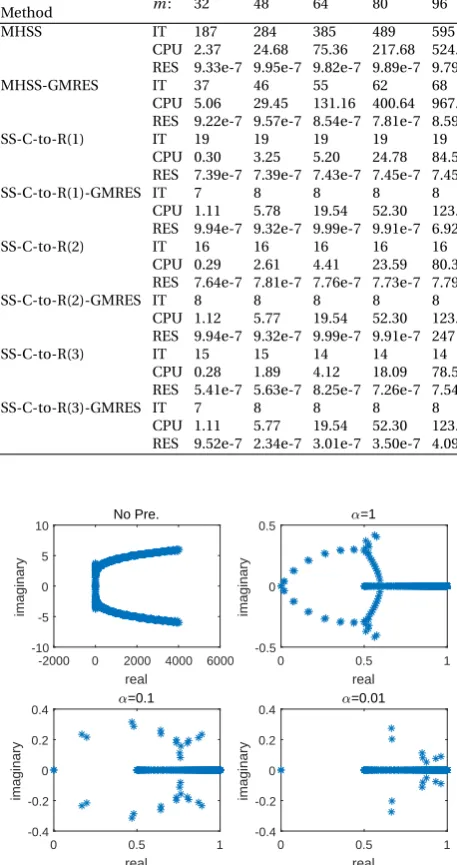
We will compare the SS-C-to-R method with the MHSS iteration method [16] and the corresponding precondi-tioned GMRES methods. Table I lists the experimental optimal parameters, which are found experimentally, of the MHSS iteration method and the MHSS preconditioned GMRES method. R(1), R(2) and SS-C-to-R(3) method in Table II refers toα=1, 0.1 and 0.01 in SS-C-to-R method. The sameαis used in the corresponding preconditioned GMRES methods.
The results corresponding to the experimental parame-ters shown in Table I are listed in Table II. It can be seen from Table II that the MHSS-GMRES method outperforms the MHSS iteration method in iteration counts, but the CPU times for the MHSS iteration method grow rapidly when the mesh grid increases. However, the SS-C-to-R method keeps the most efficient both in iteration counts and CPU times. It can also be found in Table II that the iteration counts of the SS-C-to-R method remain steady for all the mesh grids. Besides, it can be seen from Table II that the parameterαdoesn’t affect the iteration counts and computing times in the preconditioned GMRES meth-ods.
In order to better illustrate the effectiveness and con-firm the theoretical results for the SS-C-to-R method, we give Figure 1 to describe the eigenvalues distributions of the preconditioned matrices. We show the original matrix in the left top for m=32. The eigenvalues distributions of the SS-C-to-R preconditioned matrices forα=1, 0.1 and 0.01 are shown in the right top, in the left bottom and in the right bottom. From this picture, we can see that, when α=0.01, almost all the eigenvalues are clustered in [12, 1], which is in accordance with the result in Remark III.4. All the eigenvalues of the preconditioned matrix cluster tightly and their modulus are less than 1. Hence, the SS-C-to-R preconditioning techqniue should be a choice for solving the singular complex linear systems.
V. CONCLUDING REMARKS
In this paper, based on the shift splitting preconditioner
[7] and the C-to-R method [3], we propose an SS-C-to-R preconditioned method for solving a class of singular
IAENG International Journal of Applied Mathematics, 50:1, IJAM_50_1_15
TABLE II
NUMERICAL RESULTS FORMHSS, MHSS-GMRES, SS-C-TO-RAND
SS-C-TO-R-GMRESMETHODS.
m: 32 48 64 80 96
Method
MHSS IT 187 284 385 489 595
CPU 2.37 24.68 75.36 217.68 524.3 RES 9.33e-7 9.95e-7 9.82e-7 9.89e-7 9.79e-7
MHSS-GMRES IT 37 46 55 62 68
CPU 5.06 29.45 131.16 400.64 967.47 RES 9.22e-7 9.57e-7 8.54e-7 7.81e-7 8.59e-7
SS-C-to-R(1) IT 19 19 19 19 19
CPU 0.30 3.25 5.20 24.78 84.56 RES 7.39e-7 7.39e-7 7.43e-7 7.45e-7 7.45e-7
SS-C-to-R(1)-GMRES IT 7 8 8 8 8
CPU 1.11 5.78 19.54 52.30 123.32 RES 9.94e-7 9.32e-7 9.99e-7 9.91e-7 6.92e-7
SS-C-to-R(2) IT 16 16 16 16 16
CPU 0.29 2.61 4.41 23.59 80.38 RES 7.64e-7 7.81e-7 7.76e-7 7.73e-7 7.79e-7
SS-C-to-R(2)-GMRES IT 8 8 8 8 8
CPU 1.12 5.77 19.54 52.30 123.32 RES 9.94e-7 9.32e-7 9.99e-7 9.91e-7 247
SS-C-to-R(3) IT 15 15 14 14 14
CPU 0.28 1.89 4.12 18.09 78.56 RES 5.41e-7 5.63e-7 8.25e-7 7.26e-7 7.54e-7
SS-C-to-R(3)-GMRES IT 7 8 8 8 8
CPU 1.11 5.77 19.54 52.30 123.30 RES 9.52e-7 2.34e-7 3.01e-7 3.50e-7 4.09e-7
-2000 0 2000 4000 6000
real
-10 -5 0 5 10
imaginary
No Pre.
0 0.5 1
real
-0.5 0 0.5
imaginary
=1
0 0.5 1
real
-0.4 -0.2 0 0.2 0.4
imaginary
=0.1
0 0.5 1
real
-0.4 -0.2 0 0.2 0.4
imaginary
[image:4.595.55.284.110.543.2]=0.01
Fig. 1. The eigenvalues distributions of SS-C-to-R preconditioned matrices for m=32
complex linear systems. Detailed eigenvalue properties of the preconditioned matrix are analyzed theoretically. Numerical results show that the SS-C-to-R method and the SS-C-to-R preconditioned GMRES method are feasible and efficient for solving the proposed singular complex linear equations.
ACKNOWLEDGMENT
The author would like to thank the anonymous referees for his/her careful reading of the manuscript.
REFERENCES
[1] Aranson IS, Kramer L(2002)The world of the complex Ginzburg-Landau equation. Rev Modern Phys 74:99.
[2] Axelsson O, Kucherov A(2000)Real valued iterative methods for solving complex symmetric linear systems. Numer Linear Algebra Appl 7:197–218.
[3] Axelsson O, Neytcheva M, Ahmad B(2014)A comparison of iterative methods to solve complex valued linear algebraic systems. Numer Algorithms 66:811–841.
[4] Axelsson O, Farouq S, Neytcheva M(2017)A preconditioner for optimal control problems, constrained by Stokes equation with a time-harmonic control. J Comput Appl Math 310:5–18.
[5] Axelsson O, Luk ´asˇD(2018) Preconditioning methods for eddy cur-rent optimally controlled time-harmonic electromagnetic problems. J Numer Math 27:1–21.
[6] Bai ZZ, Golub GH, Ng MK(2003)Hermitian and skew-Hermitian s-plitting methods for non-Hermitian positive definite linear systems. SIAM J Matrix Anal Appl 24:603–626.
[7] Bai ZZ, Yin J, Su Y(2006)A shift-splitting preconditioner for non-Hermitian positive definite matrices. J Comput Math 24:539–552.
[8] Bai ZZ(2010)On semi-convergence of Hermitian and skew-Hermitian splitting methods for singular linear systems. Computing 89:171–197.
[9] Bai ZZ, Benzi M, Chen F(2010)Modified HSS iteration methods for a class of complex symmetric linear systems. Computing 87:93–111.
[10] Bai ZZ(2011)Block preconditioners for elliptic PDE-constrained op-timization problems. Computing 91:379–395.
[11] Bai ZZ, Benzi M, Chen F(2011)On preconditioned MHSS iteration methods for complex symmetric linear systems. Numer Algorithms 56:297–317.
[12] Bai ZZ(2015)On preconditioned iteration methods for complex linear systems. J Engrg Math 93:41–60.
[13] Benzi M, Bertaccini D(2008)Block preconditioning of real-valued iterative algorithms for complex linear systems. IMA J Numer Anal 28:598–618.
[14] Benzi M, Guo XP(2011)A dimensional split preconditioner for Stokes and linearized Navier-Stokes equations. Appl Numer Math 61: 66– 76.
[15] Bertaccini D(2004)Efficient preconditioning for sequences of para-metric complex sympara-metric linear systems. Electron Trans Numer Anal 18:49–64.
[16] Chen F, Liu QQ(2013)On semi-convergence of modified HSS itera-tion methods. Numer Algorithms 64:507–518.
[17] Day D, Heroux MA(2001)Solving complex-valued linear systems via equivalent real formulations. SIAM J Sci Comput 23:480–498.
[18] Dehghan M, Shirilord A(2019)Accelerated double-step scale split-ting iteration method for solving a class of complex symmetric linear systems. Numer Algorithms. https://doi.org/10.1007/ s11075-019-00682-1.
[19] Dou Y, Yang AL, Wu YJ, Liang ZZ(2019)Convergence analysis of modified PGSS methods for singular saddle-point problems. Com-put Math Appl 77: 93–104.
[20] Feriani A, Perotti F, Simoncini V(2000)Iterative system solvers for the frequency analysis of linear mechanical systems. Comput Methods Appl Mech Engrg 190:1719–1739.
[21] Frommer A, Lippert T, B Medeke B, Schilling K(2000) Numerical challenges in lattice quantum chromodynamics, lecture notes in Computational Science and Engineering. Springer Berlin 15:1105-1115.
[22] Hezari D, Edalatpour V, Salkuyeh DK(2015)Preconditioned GSOR iterative method for a class of complex symmetric system of linear equations. Numer Linear Algebr Appl 22:761–776.
[23] Hezari D, Salkuyeh DK, Edalatpour V(2016)A new iterative method for solving a class of complex symmetric system of linear equations. Numer Algorithms 73:927–955.
[24] Huang ZG, Wang LG, Xu Z, Cui JJ(2019)Modified PHSS iterative methods for solving nonsingular and singular saddle point prob-lems. Numer Algorithms 80: 485–519.
[25] Li CL, Ma CF(2019)On semi-convergence of parameterized SHSS method for a class of singular complex symmetric linear systems. Comput Math Appl 77: 466–475.
[26] Li CX, Wu SL(2012)A modified GHSS method for non-Hermitian positive definite linear systems. Jpn J Ind Appl Math 29:253–268.
[27] Saad Y(2003)Iterative methods for sparse linear systems. SIAM, Philadephia.
[28] Sulem C, Sulem PL(1999)The nonlinear Schrödinger equation. Appl Math Sci 139.
[29] Wu SL, Li CX(2014)On semi-convergence of modified HSS method for a class of complex singular linear systems. Appl Math Lett 38:57– 60.
[30] Yang AL, Wu YJ, Xu ZJ(2014)The semi-convergence properties of MHSS method for a class of complex nonsymmetric singular linear systems. Numer Algorithms 66:705–719.
IAENG International Journal of Applied Mathematics, 50:1, IJAM_50_1_15
[31] Zeng ML, Ma CF(2016)A parameterized SHSS iteration method for a class of complex symmetric system of linear equations. Comput Math Appl 71:2124–2131.
[32] Zhang J, Wang Z, Zhao J(2019)Double-step scale splitting real-valued iteration method for a class of complex symmetric linear systems. Appl Math Comput 353:338–346.
[33] Zheng QQ, Lu L(2017)A shift-splitting preconditioner for a class of block two-by-two linear systems. Appl Math Lett 66:54–60.
[34] Zheng Z, Zhang GF, Zhu MZ(2016)A note on preconditioners for complex linear systems arising from PDE-constrained optimization problems. Appl Math Lett 61:114–121.