
Communicating a crisis: the influence of stealing thunder and the type of crisis situation on customer perceptions towards financial institutions
74
0
0
Full text
(2) Samenvatting The relatie tussen financiële instanties en hun klanten is sterk afhankelijk van het wederzijdse vertrouwen tussen beide partijen. In het afgelopen decennium heeft deze wederzijdse vertrouwensrelatie echter behoorlijk wat tegenslagen te verduren gehad. De manier waarop financiële instanties zakelijk opereren en de omgeving waarin ze dit doen, zijn op korte termijn drastisch veranderd. Financiële instanties in de westerse cultuur hebben door een economische crisis serieuze tegenslagen te verduren gehad welke hebben geleid tot situaties waarin hun vertrouwenswaardigheid op het spel stond. Hiernaast is er binnen het bankwezen sprake van een continue introductie van nieuwe technologieën waar financiële instanties en hun klanten mee te maken krijgen. Deze continue aanvoer van nieuwe technologieën zorgt ervoor dat financiële instanties en hun klanten hier telkens over moeten leren en zich hier op moeten aanpassen. Om deze redenen is het gebleken dat financiële instanties gevoelig zijn voor het worden van het onderwerp in een crisis situatie waarbij hun vertrouwenswaardigheid op het spel komt te staan. De termen “crisis communication” and “trust repair” zijn door de jaren heen veel besproken in verschillende studies. Deze studies hebben verscheidene strategieën aangewezen ten behoeve van het onderhouden van positieve percepties richting organisaties in crisis situaties. De “stealing thunder” strategie is een wijze van crisis communicatie waarvan bewezen is dat deze efficient werkt in het creëren van “credibility” tijdens het bekendmaken van een crisis (Arpan, Roskos-Ewoldsen & David, 2005). Het is echter gebleken dat er weinig studies zijn welke de effecten van deze “stealing thunder” strategie binnen verschillende type crisis situaties uitlichten. Dit onderzoek heeft als doel om inzichten te verschaffen over de effecten van verschillende typen crisis situaties en de manier waarop ze bekend worden gemaakt. Hierbij zijn metingen gedaan onder klanten van financiële instanties welke betrekking hadden. op. de. waargenomen. vertrouwenswaardigheid. van. hun. bank,. hun. vergevingsgezindheid en hun intentie om klant te blijven. Hiernaast zijn ook de effecten van de aard van de verschillende typen crisis situaties op het vertrouwen, vergevingsgezindheid en intentie om klant te blijven meegenomen in het onderzoek. Deze studie omvat een 2 (crisis type: intern vs. extern) x 2 (crisis type: opzettelijk vs. onopzettelijk) x 2 (type bekendmaking: zelf bekendmaking vs. derde partij) betweensubjects factorial design (N = 247). Aan dit experimentele onderzoek hebben 126.
(3) mannen en 121 vrouwen deelgenomen door een online vragenlijst in te vullen en hierbij hun mening betreffende financiële instanties en verschillende vertrouwensgerelateerde situaties te geven. De resultaten van dit onderzoek laten zien dat het vertrouwen van klanten richting hun financiële instantie tijdens een crisis situatie word bepaald door de welwillendheid van diezelfde financiële instantie en de normen en waarden die het hanteert. Hiernaast is gebleken dat de competenties van een financiële instantie minder belangrijk zijn in het creëren van vertrouwen. Dit onderzoek toont aan dat de mate van opzettelijkheid in een crisis situatie pas effect heeft op de percepties van klanten richting een financiële instantie, wanneer deze crisis situatie zich in de interne omgeving van de instantie heeft plaatsgevonden. Tevens, is uit de resultaten gebleken dat wanneer een financiële instantie een crisis situatie zelf bekend maakt, dit het vertrouwen positief beïnvloedt..
(4) Table of contents Abstract. 6. 1. Introduction. 8. 2. Theoretical framework. 12. 2.1 Crisis situations. 12. 2.1.1 Defining a crisis. 12. 2.1.2 Consequences of a crisis. 13. 2.2 Customer perceptions. 14. 2.2.1 Trust. 14. 2.2.2 The factors of trust. 15. 2.2.3 Forgiveness. 16. 2.2.4 Customer Continuance Intention. 17. 2.3 Types of crisis situations. 18. 2.3.1 The Attribution Theory. 18. 2.3.2 Classifying crisis situations. 20. 2.4 Crisis response strategies. 23. 2.4.1 The self-disclosure strategy. 23. 2.4.2 Stealing thunder; how does it work?. 24. 2.4.3 The effects of stealing thunder. 25. 2.4.4 Stealing thunder vs. attribution theory. 26. 3. Methodology. 28. 3.1 Research design. 28. 3.2 Pre-test. 29. 3.2.1 Procedure. 29. 3.2.2 Participants. 29. 3.2.3 Results. 30. 3.3 Main study. 32. 3.3.1 Design. 32. 3.3.2 Procedure. 33.
(5) 3.3.3 Participants. 35. 3.3.4 Measurements. 37. 3.3.5 Factor Analysis. 38. 4. Results. 41. 4.1 Pre-MANOVA tests. 41. 4.2 MANOVA results. 42. 4.3 Main effects. 42. 4.3.1 Main effects disclosing party 4.4 Interaction effects. 44 45. 4.4.1 Interaction effects external control and intentionality. 45. 4.4.2 Interaction effects intentionality and disclosing party. 49. 5. Discussion 5.1 Conclusion. 51 51. 5.1.1 Types of crisis situations and their influence. 51. 5.1.2 The influence of the disclosing party. 53. 5.2 Practical implications. 55. 5.3 Limitations and implications for further research. 57. 6. References. 59. Appendices. 63. Appendix A; Stimulus materials. 63. Appendix B; Questionnaire. 67. Appendix C; Boxplots Shapiro-Wilks test of univariate normality. 73.
(6) 6. Abstract The relationship between financial institutions and their customers is strongly dependent on mutual trust between both parties. However, this mutual trust relationship has suffered some serious setbacks during the last decade. The way financial institutions operate and the environment in which they operate have altered tremendously within a short span of time. Financial institutions in western societies have suffered some serious setbacks due to an economical crisis which introduced them to trust-decreasing situations. Furthermore, the continuous introduction of new technologies in the banking business has ensured that financial institutions and their customers constantly need to learn about- and adapt to these new technologies. For these reasons, financial institutions appear to be susceptible for being the subject of crisis situations in which their trustworthiness is at stake. Over the years, “crisis communication” and “trust repair” are topics which have been discussed in various studies. Within these studies, multiple strategies for the maintenance of positive perceptions towards organizations during crisis situations have been defined. The stealing thunder strategy is a type of crisis communication which has been proven to be efficient in creating positive perceptions when disclosing crisis situations. However, studies which elaborate on the effects of the stealing thunder strategy in various types of crisis situations appear to be rare. This experimental research provides insights into the effects of various types of crisis situations and the way they are disclosed. Hereby, measurements regarding the perceived trustworthiness, forgiveness, and customer continuance intentions of customers towards financial institutions have been conducted. Also, the effects of the nature of the various types of crisis situations on the perceived trustworthiness, forgiveness and customer continuance intentions towards financial institutions have been incorporated. A 2 (type of crisis: internal vs. external) x 2 (type of crisis: intentional vs. unintentional) x 2 (type of disclosure: self disclosure vs. third party) between-subjects factorial design was conducted (N = 247). Within this experimental study, 126 males and 121 females participated by performing the online questionnaire and giving their opinions about financial institutions and various trust-related situations . The results of this study show that the trustworthiness of financial institutions during a crisis situation is determined by the character, standards & values of that.
(7) 7. institution. Hereby, it appeared that the competences and abilities of the financial institution are of less importance in establishing customer trust. This study shows that the extent of intentionality within an crisis situation only has effects on the customer perceptions towards an financial institution when this crisis has occured in the internal environment of the institution. Furthermore, the results show that when financial institutions disclose a crisis themselves, this will positively affect the trustworthiness of those institutions..
(8) 8. 1.. Introduction. The banking sector, or the financial sector, has always been a sector which is carefully monitored by society. This is mainly due to the fact that the financial sector is based on a mutual trust relationship between society and the financial institutions. This means that customers have to trust on the believe that their bank will maintain their assets properly and that financial institutions have to trust on the believe that their customers will continue in using their products and services which assures the continuity of the bank. Over the past years, a number of developments have altered the role of the financial sector in our contemporary society. These developments have caused that the trust towards financial institutions have decreased and that all of their activities are being put in an even bigger spotlight by the media then before. In 2008, the collapse of the Lehman Brothers bank introduced a global financial crisis. Lehman Brothers was one of the four largest banks in the United States of America. Therefore, many individuals see the collapse of the Lehman Brothers bank as the turning point in the global economic welfare. However, analysis on the causes of the financial crisis in 2008 revealed that an economic depression could have been foreseen for many years (Naudé, 2009). Although there were various factors which contributed to the financial crisis, the low interest rates on the loans of various financial institutions were a crucial factor (Naudé, 2009). This low interest rate has led to individuals and organizations buying a mortgage or lending money which they actually could not afford themselves. (Rijksoverheid, 2015) According to Naudé (2009), the interest rates of mortgages and loans started to increase again in the year of 2007. The result of this increase was that the individuals and organizations who had borrowed money to purchase houses and other items which they could not afford, were not able to pay off their debts. Eventually, this has led to a national economic crisis in the US. In the Netherlands, the collapse of the financial system in the US resulted in a decrease of the export trade, less employment, and thus a decrease of the disposable income amongst Dutch citizens (Rijksoverheid, 2015). According to the Maas Commission (commisie Maas), Dutch banks were not prepared for an economic crisis of this kind. Therefore, Dutch governments had to inject money in order to keep Dutch banks from falling completely apart. (Verhoef, Wesselius, Bügel, and Wiesel, 2010) Because of the badly executed financial policies of Dutch banks, customers have established distrust towards them on a large scale. According to Verhoef et al. (2010),.
(9) 9. banks are now looking for ways to recover their image and reestablish the trust of their customers. However, various developments within the banking sector are still creating situations in which financial institutions are often exposed to crisis situations which damage their trustworthiness. Possibly one of the most important developments in the banking sector, which makes financial institutions susceptible to situations in which their trustworthiness is jeopardized, is the continuous introduction of new technologies in the services of financial institutions. The constant introduction of technological developments in the services of financial institutions are due to the fact that the environment in which financial institutions operate, is constantly changing. Because of these constant changes, financial institutions are continuously in search of convenient and effective ways to provide their customers with new services. However, continuously providing customers with new and innovative services, will probably result in situations in which internal mistakes are easily made. Furthermore, the constant developments in the banking sector are also causing a constant development of new threats (e.g. phishing or personal identity fraud) in the external environment of financial institutions. Therefore, the constant developments in the banking sector are making financial institutions susceptible to situations in which the perceptions of their customers towards them could be compromised. Such situations can also be defined as crisis situations. This research attempts to define the influence of various crisis situations on the trust, forgiveness, and customer continuance intentions of financial institutions’ customers. In order to define this influence, it is of importance to make a clear distinction between the various crisis situations by categorizing them. In order to establish these categories, the factors that characterize crisis situations need to be defined in order to create and manipulate an effective experiment. When financial institutions find themselves in a crisis situation, two choices can be made concerning the communication of such a situation. First, financial institutions can nondisclose a crisis situation and let a third party disclose the situation. Second, financial institutions can disclose a crisis situation themselves instead of allowing a third party to publish the initial news about the situation. The strategic considerations of organizations to announce a crisis situation themselves or letting a third party announce it, is further explained in the study of Arpan and Pompper (2003) on stealing thunder. These strategic consideration of financial institutions to disclose a crisis situation.
(10) 10. themselves or letting a third party disclose it, arises curiosity about the influence of both strategies on the customers’ trustworthiness towards these institutions. This leads to the following research question: RQ1: To what extent can customers’ trust, intention to remain customer, and forgiveness towards financial institutions be influenced when these financial institutions reveal a crisis situation themselves instead of a third party? Due to the constant development of the banking sector and thus the services of financial institutions, these institutions are susceptible for getting involved in crisis situations as a result of failures in their services. In their study, Coombs and Holladay (1996) introduce The Attribution Theory in which they explain that crisis situations can be defined by the factors of external control and intentionality. External control refers to whether a crisis situation was caused in the internal- or external environment of an organization. The intentionality factor refers to whether or not a crisis situation was caused intentional or unintentional. When these two factors are getting combined, four distinct types of crisis situations will arise. For financial institutions, it is interesting to know how communicating these types of crisis situations will influence their customers’ perceptions towards them. Therefore, the following research question can be stated: RQ2: What is the influence of the relation between a crisis situation’s external control and intentionality on the customers’ trust, intention to remain customer, and forgiveness towards financial institutions? In order to be able to answer these questions, more insights need to be gained on the model of trust and the various types of crisis situations which are established by the use of The Attribution Theory (Coombs and Holladay, 1996). Furthermore, the crisis communication response strategy of stealing thunder, as explained by Arpan and Pompper (2003), needs to be examined in order to gain insights on effective crisis communication. By the use of these insights, this study provides information on the effects of various types of crisis situations in relation to crisis response strategies and.
(11) 11. their influence on the trust, forgiveness and customer continuance intentions of financial institutions’ customers. Financial institutions will benefit of this study by the provided practical implications which can contribute in analyzing a crisis situation and identifying its nature and characteristics. Subsequently, such an analysis can contribute in choosing the most effective response strategy in order to maintain the trust relationship between an financial institution and their customers. Also, the theories in this study can help in developing a proper understanding of the relationship between crisis situations’ nature and the customer perceptions on trust, forgiveness, and customer continuance intentions..
(12) 12. 2.. Theoretical framework. This section will provide insights on the various types of crisis situations and their characteristics, the concequences of such situations for organizations, and the influence of crisis situations on customer perceptions. Also, insights on stealing thunder as a crisis communication strategy will be provided.. 2.1. Crisis situations. In prior research, it is stated that crisis situations can negatively affect organizations in a short amount of time (Weick, 1988). Because crisis situations are of such great influence on organizations, it is of importance to examine the definition of a crisis and evaluate the consequences. 2.1.1 Defining a crisis By analyzing prior research, it can be stated that it is difficult to define one distinct description of a crisis. This is mainly due to the fact that organizations and the environment in which they operate vary from each other in behaviour and culture. In other words, what can be a crisis situation for organization “A” can be a minor incident for organization “B”. As stated in Park and Lee (2013), Hermann (1972) mentioned that the seriousness of a crisis can be determined by the amount of threat, the amount of time to make decisions, and the extent of surprise that comes along with it. A crisis can be seen as an occurrence which is not a common one and which appears rarely and unexpectedly. Coombs (1999) defined a crisis as “an unforeseen occurrence” and states that it poses a serious threat to an organization, an industry, or stakeholders if it is handled improperly. Fearn-Banks (1996) states that a crisis is a major occurrence with a potentially negative outcome affecting an organization, company, or industry, as well as its public, products, services, and reputation (As stated in Park & Lee, 2013). In his study, Weick (1988) stated that crisis situations can withhold serious consequences concerning the most fundamental goals of an organization. These fundamental goals appear to similar for various types of organizations..
(13) 13. 2.1.1 Consequences of a crisis When a crisis situation has occured within an organization, it is pursued to immediately evaluate the crisis and its possible threat and damage to the organization. In their research, Arpan and Pompper (2003) state that “crises threaten an organization’s ability to function and maintain its legitimacy and reputation” (pp. 292). Furthermore, Arpan and Pompper (2003) explain that crisis situations often negatively influence an organization’s reputation and image. Coombs (2007) explains that this threat of reputational damage is determined by the the extent to which an organization is perceived as responsible for the crisis. Furthermore, Coombs (2007) explains that the extent to which reputational damage is a genuine threat for organizations, depends on which aspect of the reputation is at stake due to the crisis situation. Within the banking business, reputational damage regarding the trustworthiness of financial institutions appears to be a major threat. According to Mukherjee and Nath (2003), whether or not a bank can be trusted is of great importance to customers as they need to trust their bank with sensitve and personal information. This ensures that the customers’ perceptions of the trustworthiness of a financial institution can not be underestimated..
(14) 14. 2.2. Customer perceptions. In various studies concerning organizational trustworthiness, the aspects of forgiveness and customer continuance intentions appear to be closely related to organizational trust (Keh and Xie, 2009; Kim, Hong, Min, and Lee, 2011). In prior research regarding trustworthiness, the aspect of forgiveness is mentioned as the initial phase in the establishment of a trust-relationship. In their study, Xie and Peng (2009) explain that trustworthiness and forgiveness are two concepts which positively affect each other during events in which organizations are exposed to negative publicity. Also, trustworthiness appears to be closely related to customer continuance intention. In the research of Vatanasombut et. al. (2008) on online banking, it is stated that when customers have trust in the services of their bank, they are likely to continue using the services of their bank. Also, Yang and Peterson (2004) state that brand loyalty or customer continuance intentions will only arise when customers are able to create positive perceptions towards an organization. Based on these findings, it can be stated that the willingness to forgive of individuals is essential in establishing trust towards an organization. Subsequently, the trustworthiness of an organization seems to be the foundation for brand loyalty or the intention to continue using the services of an organization. Therefore, it can be assumed that trustworthiness, forgiveness, and customer continuance intention are three concepts which are closely related to each other. 2.2.1 Trust Trust has been defined in various ways over the years. Moorman, Deshpande, and Zaltman (1993) have defined trust as “willingness to rely on an exchange partner in whom one has confidence” (as stated in Belanger, Hiller, and Smith, 2002, pp. 251), Morgan and Hunt (1994) defined trust as “when one party has confidence in an exchange partner’s reliability and integrity” (as stated in Mukherjee and Nath, 2003, pp. 6), and Giffin (1967) defined trust as “reliance upon the characteristics of an object, or the occurrence of an event, or the behavior of a person in order to achieve a desired but uncertain objective in a risky situation” (As stated in Gefen and Straub, 2004, pp. 409). Allthough a clear definition of trust is of importance in describing the context of the concept, the rationale behind the concept is even more important in order to define the effects of the various factors of trust. Suh and Han (2002), Gefen and Straub (2004), and.
(15) 15. Mayer, Davis, and Schoorman (1995) explained trust by the use of a model in which various factors, such as ability, benevolence, integrity, trustors propensity, and perceived risk, influence the establishment of trust and trust-relationships. 2.2.2 The factors of trust Within the model of trust, introduced by Mayer, Davis, and Schoorman (1995), it is explained that trust and trust-relationships are established by a conscious or unconscious evaluation of the three factors that determine the perceived trustworthiness of a certain party. Mayer, Davis, and Schoorman (1995) identified these three factors as ability, benevolence, and integrity. Ability Mayer, Davis, and Schoorman (1995) defined ability as “that group of skills, competencies, and characteristics that enable a party to have influence within some specific domain” (pp. 717). In other words, ability refers to the extent to which the trustor believes that the trustee can provide him with the service that needs to be executed. Within the context of financial institutions, ability refers to whether or not a bank is perceived as being competent in taking care of the assets of a customer. Furthermore, ability could also refer to whether or not customers experience the service of financial institutions as being sufficient or not. Benevolence Benevolence describes the extent to which a trustee is perceived to be egocentric and focused on profits instead of being focused on sincerely helping the trustor. Mayer, Davis, and Schoorman (1995) state that benevolence suggests that the trustee has a specific attachment towards the trustor. This means that the help of the trustee has some kind of added value to the performance of the trustor. However, the trustor needs to experience that the help of the trustee derives from intrinsically motivation. Integrity Integrity refers to the perception of the trustor that the trustee abides by a certain set of principles he or she finds acceptable. For instance, when a trustor finds honesty an important principle, he or she will perceive the trustee as having a high extent of.
(16) 16. integrity when the trustee also withholds strong values towards that principle. (Mayer, Davis, and Schoorman, 1995) According to Mayer, Davis, and Schoorman (1995), consistency, credible communication, a sense of justice, and the congruency between words and actions are important values within the aspect of integrity. Allthough these three factors are well known as the most important aspects in establishing trust, various studies explain that ability, benevolence, and integrity are not representative factors for trust in all situations. In his research, Lee (2004) states that there are various compositions of factors in establishing trust. Lee (2004) explains that trust is often decomposed into cognition-based trust (benevolence and integrity) and affect-based trust (ability), or competence-based trust (ability) and character-based trust (benevolence and integrity). Also, Ridings et al. (2002) explain that, in some specific situations, ability is seen as the factor that resembles the competences of an individual or organization and that benevolence and integrity both resemble an individuals’ or organization’s character. This means that the situation or context in which trust is measured, is determining for the factors of trust that need to be applied. 2.2.3 Forgiveness Forgiveness is defined by Xie and Peng (2009) as “the consumers’ willingness to give up retaliation, alienation, and other destructive behaviors, and to respond in constructive ways after an organizational violation of trust and the related recovery efforts” (pp. 578). Finkel et al. (2002) state that the concept of forgiveness can be perceived as the “restoration of harmony” within the relationship between an organization and their customers after this relationship is negatively influenced by various harmful actions. In other words, forgiveness provides a foundation for the repair of trust. The study of Xie and Peng (2009) indicates that when organizations are able to create a positive image of their integrity, competence, and benevolence when communicating a crisis, their customers are more likely to forgive and trust them again. Within the three aspects of trust, Xie and Peng (2009) state that ability, benevolence, and integrity have a comparable influence on the extent of customer forgiveness..
(17) 17. 2.2.4 Customer Continuance Intention In the literature, customer continuance intention and organizational loyalty are terms which are often used for the same purpose. This purpose is to define whether or not customers intent to continue using the service of an organization or continue purchasing their products. Customer continuance intention is defined by Hu et al. (2009) as “an individual’s intention to continue using a service in the post-acceptance stage” (pp. 297). Customer loyalty is defined by Oliver (1999) as “a deeply held commitment to rebuy or repatronize a preferred product/service consistently in the future, thereby causing repetitive same-brand or brand-set purchasing, despite situational influences and marketing efforts having the potential to cost switching behaviour” (pp. 34). Yang and Peterson (2004) state that alongside organizations, their loyalty or continuance intentions are also of substantial value for the customers themselves. Customer continuance intentions or loyalty are helpfull for customers in minimizing time which could have been expended to searching for and evaluating new products. Therefore, creating customer continuance intentions or loyalty is in the best interest of both parties. In their study, Yang and Peterson (2004) explain that there are four stages which can be defined in establishing customer continuance intentions or loyalty. The first stage is refered to as “congnitive loyalty”. This stage explains that customers only can create intentions to use the services of an organization by being provided with information about the organization. The second stage in establishing customer continuance intention is defined as “affective loyalty”. In this stage, customers will establish positive attitudes, such as trust towards an organization. The third stage is known as “conative loyalty” or “behavioural intention”. This stage refers to a customer’s intention to purchase a product or to use a service of an organization. In this stage, the intention to buy can be experienced either consciously or unconsciously. The fourth stage of customer continuance intention is the actual purchase of a product or the actual use of a certain service. This stage is refered to as “action loyalty” in which customers experience the need to overcome any obstacle in order to be able to buy a product or to use a service. (Yang and Peterson, 2004) In this research, the second stage in establishing customer continuance intentions or loyalty is most relevant as this study focuses on creating positive attitudes or positive perceptions towards financial institutions..
(18) 18. 2.3. Types of crisis situations. As stated earlier, Coombs (2007) explained that the amount of threat a crisis situation withholds for an organization, is influenced by the extent to which an organization is responsible for the crisis. In their research, Coombs and Holladay (1996) explain that the perceived severity and the perceived corporate responsibility of a crisis can be predicted by the situation in which the crisis occurs. This means that the type of situation in which a crisis occurs influences consumers’ perceptions on crisis responsiility towards the crisis. According to Coombs and Holladay (1996), the various types of crisis situations can be defined by The Attribution Theory. 2.3.1 The Attribution Theory Within the literature, “The Attribution Theory” can be found in various fields of expertise. According to Kelley and Michela (1980), this theory can be described as “the study of perceived causation” in which attribution refers to the perception or inference of cause (pp. 458). Because the Attribution Theory is applicable in various fields of research, the theory also has various meanings within these various fields. Within the field of crisis communication, the Attribution Theory is seen as a useful framework in explaining the relation between a crisis situation and response strategies. The Attribution Theory explains that the type of crisis situations determines the crisis response strategy that will be used to create or maintain a positive attitude towards a certain organization. Within this theory, McAuley, Duncan, and Russel (1992) identified four dimensions which determine the type of crisis situation an organization has to deal with. These dimensions can be defined as stability, external control, personal control, and locus. According to McAuley, Duncan, and Russel (1992), stability refers to whether or not the cause of the crisis occurs frequently (stable) or infrequently (unstable). Practically, this means that when an organization never had to deal with the occurence or crisis before, the situation will be considered as unstable. On the contrary, if an organization had to deal with a certain occurence or crisis on a regular base in the past, the situation will be considered as stable. Notice that whereas stable is refered to as positive and unstable is refered to as negative in most situations, it is the other way around when defining the dimension of stability in the context of crisis situations..
(19) 19. McAuley, Duncan, and Russel (1992) state that external control indicates whether or not a certain crisis can be controlled by an organization. This implies that a certain crisis situation could occur due to external factors which an organization can not control. According to Coombs and Holladay (1996), the extent to which external control had influence in a crisis situation, determines the perception of consumers towards the organization. Personal control is defined by McAuley, Duncan, and Russel (1992) as the extent to which an organization is able to control the crisis. This refers to the control the organization and its employees has to avert a certain crisis situation. The extent of personal control during a crisis situation, will determine how consumers will perceive the organization. A higher extent of personal control will stimulate a more negative perception of the organization. Locus indicates the extent to which the crisis has something to do with the organization or the situation (McAuley, Duncan, and Russel, 1992). This practically indicates the extent to which the crisis situation is in the field of expertise of the organization. A high extent of locus implies that an organization should be capable of averting the crisis. Therefore, a low extent of locus corrresponds with a negative consumer perception of the organization. In their study, Coombs and Holladay (1996) explain that the dimensions of personal control and locus show resemblances. Both dimensions reflect the aspect of intentionality of act. This means that personal control and locus are both dimensions which determine if a crisis situation occured because an organization just had no control over it (unintentionally) or because an organization had control but still did not avert it (intentionally). Therefore, Coombs and Holladay (1996) suggest to merge the dimensions of personal control and locus into one dimension of intentionality. The three identified dimensions of the Attribution Theory do not only define the situation of a crisis, they also predict the attitude, behaviours, and feelings of consumers towards an organization. Coombs and Holladay (1996) also state that the evaluations of organizational responsibility are influenced by these three dimensions. According to Coombs and Holladay (1996), perceived organizational crisis responsibility and attitudes towards organizations are most negative when a situation occurs in which the cause of a crisis is stable, the external control is low, and the extent of intentionality is high..
(20) 20. 2.3.2 Classifying crisis situations In order to determine the effects of the various types of crisis situations on the perceived trustworthiness of financial institutions, a distinct classification of crisis situations need to be established. As mentioned earlier, the Attribution Theory defines three dimensions which can be used in determining the attitudes of consumers and predicting the outcomes concerning the evaluation of organizational responsibility in crisis situations. However, according to Coombs and Holladay (1996), the dimensions of external control and intentionality can also be implemented in a 2 x 2 matrix in order to create four distinct types of crisis situations. Because stability reflects the aspect of prior organizational reputation instead of directly defining a crisis situation, this dimension is excluded from the situation defining matrix. Within the 2 x 2 matrix, external control will be divided into an internal dimension and an external dimension. Hereby, internal control refers to a crisis situation caused by the organization itself and external control refers to a crisis situation caused by a third party. As mentioned earlier, Coombs and Holladay (1996) explain that a crisis which is caused in the internal environment of an organization is perceived more negative compared to a crisis which is caused in the external environment of an organization. According to Coombs and Holladay (1996), this is due to the fact that a crisis situation, which has its origin in the internal environment, creates the image that an organization is not able to protect themselves from their own flaws. This leads to the following hypotheses: H2:. Individuals’ (a) trust, (b) willingness to forgive, and (c) customer continuance intention towards a financial institution are higher when the crisis experienced by the financial institution is caused internally compared to when it is caused externally.. On the other side of the 2 x 2 matrix, intentionality will be divided in intentional and unintentional. Intentional defines a crisis situation in which the crisis was caused on purpose and unintentional defines a crisis situation in which the crisis was not caused by purpose. In their research, Coombs and Holladay (1996) explain that a crisis situation which is caused intentionally, will be perceived as more negative in comparison to a crisis situation which is caused unintentionally. According to Coombs and Holladay.
(21) 21. (1996), this is due to the fact that individuals attribute an intentional crisis situation to a lack of character of the organization and an unintentional crisis situation to a lack of competence of the organization. Eventually, individuals perceive a crisis situation, which is due to a lack of character, as more severe and as a greater risk in comparison to a crisis situation which is due to a lack of competence. Therefore, the following hypotheses can be stated: H3:. Individuals’ (a) trust, (b) willingness to forgive, and (c) customer continuance intention towards a financial institution are higher when the crisis experienced by the financial institution is caused unintentionally compared to when it is caused intentionally.. When the dimensions of external control and intentionality are combined, four distinct types of crisis situations will emerge. According to Coombs and Holladay (1996), these four types of crisis situations can be defined as accidents, faux-pas, transgressions, and terrorism. Accidents The category of “accidents” resembles crises situations which were caused by an organization itself. However, the act which caused the crisis situation is not committed purposefully. This implies that a certain crisis is caused by an employee or a department within a certain organization. However, the respective employee or department of the organization did not intent to cause a crisis. This type of crises situation can also be assigned to a lack of competence of an employee or a department within an organization. Transgressions Transgressions are a type of crisis situations in which the crisis is caused within the organization. Also, this type of situation reflects crises of which the actor purposefully commited the act which caused the crisis. This implies that a certain crisis is caused by an intentional act in which an employee or a department within an organization chooses to do possible harm to its stakeholders. It can be stated that this type of crisis situation reflects a lack of character of the organization..
(22) 22. Faux Pas When a crisis situation can be characterized by the fact that it is caused by a third party and that the act which caused the crisis was not committed purposefully, it can be categorized as a faux pas. According to Coombs and Holladay (1996), this type of crisis situation is ambiguous as to whether or not the crisis really exists. This is mainly due to the fact that the audience of a financial institution will perceive them as the responsible party although they are just a victim of a third party’s mistake which leaves them with the concequences. Terrorism Crisis situations which are labeled as terrorism are characterized by two factors. First of all, the act that caused this type of crises situations are intentionally comitted in order to cause damage. Second, the act that causes this type of situation is committed by a third party..
(23) 23. 2.4. Crisis response strategies. Probably one of the most frightening thoughts for an organization, would be that they become the centre of a crisis which negatively affects their reputation and the way they are perceived by their customers. Especially nowadays, when all kinds of new media make it possible for any individual to send a story across the world within several minutes, a negative story will reach an extensive amount of people. Also, new media have provided news organizations with multiple channels which ensure that a certain story reaches individuals from various angles. According to Coombs (2006), a proper response strategy can be of great importance in guiding or altering stakeholders’ and customers’ perceptions towards an organization during a crisis situation. Arpan and Pompper (2003) explain that when an organization becomes the centre of a crisis, two choices can be made in the field of communication. First of all, an organization can non-disclose the occurrence and risk the possibility of a third party disclosing it. Second, the organization can disclose the occurrence themselves and maintain control over the initial news message concerning the crisis. This last option is also known as “stealing thunder” (Arpan and Pompper, 2003).. 2.4.1 The self-disclosure strategy In their research, Arpan and Pompper (2003) define stealing thunder as “the admission of a weakness, which usually characterizes itself as a mistake or failure, before that weakness is announced by another party, such as an interest group or the media” (pp. 294). According to Arpan and Pompper (2003), consumers’ perceptions of an organization caught in a crisis, are more positive when this organization has applied a self-disclosing strategy instead of letting a third party disclose the crisis. The essence of the stealing thunder strategy is to reveal any kind of negative information concerning oneself before another party is able to do so. Important effects of the stealing thunder strategy, can be defined as credibility enhancement and changing meaning (Arpan and Roskos-Ewoldsen, 2005). The aspect of credibility enhancement in the context of stealing thunder, explains that the usage of this crisis communication strategy increases an organization’s credibility and decreases the extent to which a crisis is perceived as severe (Fennis and Stroebe, 2013). Arpan and Roskos-Ewoldsen (2005) explain that changing meaning refers to the fact that the stealing thunder strategy influences recipients of a message to change the meaning of the negative information. This change.
(24) 24. of meaning can be established by discounting the importance of the message or by downsizing the extent to which the crisis should be perceived as severe. Although the aspects of credibility enhancement and changing meaning provide us with little insights on the effects of the stealing thunder theory, it does not explain the way the theory of stealing thunder works. Therefore, it is of importance to know the rationale behind the theory of stealing thunder in order to implement this theory in a communication strategy. 2.4.2 Stealing thunder; how does it work? In prior research, many explanations for the efficacy of the stealing thunder theory as a strategy in crisis communication have been given. In order to establish a clear image of the essentials and rationale behind the theory of stealing thunder, two theories with various perspectives on this self-disclosure strategy will be presented. These theories can be defined as the disconfirmation of expectancy theory and the inoculation theory. The disconfirmation of expectancy theory of Eagly, Wood & Chaiken (1978) as presented in Arpan & Pompper (2003), states that consumers and stakeholders expect organizations to withhold information about negative occurrences. When it becomes clear that an organization actually does so, they will be seen as less trustworthy and less persuasive. However, when organizations violate the expectancy of consumers or other stakeholders by confessing their mistakes and disclose a crisis, the opposite perception will arise in consumers’ and stakeholders’ minds. The disconfirmation of expectancy theory shows resemblances with the inoculation theory which is often used by lawyers in the court of law. The inoculation theory is defined by Easley, Bearden, and Teel (1995) as “a selfdisclosure method by which the effects of negative information disclosed by a third party may be lessened” (pp. 94). The rationale behind the inoculation theory is to establish an immune system for negative allegations of a third party by providing individuals with a weakened form or a small dosis of a negative occurrence. Dainton and Zelley (2010) compared the inoculation theory with getting a flu shot. When an individual is getting injected with a small dosis of a certain virus, his or her body is able to recognize and avert the virus when it tries to attack in a larger dosis. In a communications environment, this means that a negative occurrence or a crisis would.
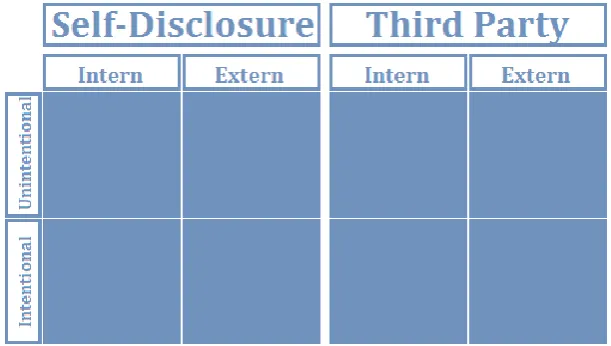
(25) 25. be perceived as less severe when an individual’s- or an organization’s audience is provided with a dosis of this occurrence or crisis before a third party will disclose it. 2.4.3 The effects of stealing thunder As stated earlier, the strategy of stealing thunder focuses on self-disclosure of any kind of negative information or incident that concerns an organization. Prior research has appointed the effects of the stealing thunder strategy as a positive influence on the credibility of the organization which has “stole the thunder”. In this research however, the focus lies on retrieving the effects of stealing thunder on the perceived trustworthiness, willingness to forgive, and customer continuance intentions in the environment of financial institutions. In organization-customer relationships, mutual trust between both parties is essential in order for organizations to survive in their business environment (Park and Lee, 2013). According to Fennis and Stroebe (2013), whether or not individuals decide to engage in a relationship, is determined by the belief of the other party’s competence, benevolence, and integrity. Fennis and Stroebe (2013) state that individuals perceive engaging in a relationship as taking a risk. This risk will only be taken when there is a certain amount of trust. Although it can be difficult for organizations to establish a trustrelationship with consumers, it could even be harder for organizations to maintain this trust-relationship with their customers. According to Park and Lee (2013), credibility is the most important factor that maintains a solid relationship between organizations and their customers. Park and Lee (2013) define credibility as “the believability of the productposition information contained in a brand, which entails consistently delivering what is promised” (pp. 217). As stated earlier, credibility is appointed by Fennis and Stroebe (2013) and Arpan and Roskos-Ewoldsen (2005) as a factor which will be positively affected in a crisis when the strategy of stealing thunder is used. However, according to Hovland, Janis, and Kelley (1953), credibility consists of two elements, namely trustworthiness and expertise. Also, Hilligoss and Rieh (2008) state that trustworthiness is a key factor in the assessment of credibility. The fact that it is proven that the stealing thunder strategy positively affects the perceived credility and that trustworthiness is a key factor in the establishment of credibility, leads to the following hypothesis concerning the stealing thunder strategy in the context of financial institutions:.
(26) 26. H4:. Self-disclosure of a crisis will result in more positive effects on (a) the perceived trustworthiness, (b) the willingness to forgive, and (c) the customer continuance intentions of financial institutions’ customers compared to a third party-disclosure of a crisis.. 2.4.4 Stealing thunder vs. attribution theory Although it is of great importance to know whether or not the stealing thunder strategy is applicable to the financial sector, it is even more interesting to know which types of crisis situations can and can not be affected by this strategy. Earlier, the study of Coombs and Holladay (1996) concerning the Attribution Theory, explained that by combining the dimensions of external control (internal vs. external) and intentionality (intentional vs. unintentional), four types of crisis situations emerge. Within the dimension of external control, it has been explained that crisis situations which have their origin in the internal environment of an organization, will evoke negative perceptions towards an organization. On the contrary, crisis situations which have their origin in the external environment of an organization, are likely to raise more positive perceptions towards an organization compared to internal crisis situations. When the dimension of external control (external control vs. internal control) is combined with the stealing thunder strategy, in which self-disclosure of a crisis situation is perceived as more positive compared to the disclosure of a crisis situation by a third party, the following hypotheses can be stated: H5:. Self-disclosure of an external crisis will result in more positive effects on (a) the perceived trustworthiness, (b) the willingness to forgive, and (c) the customer continuance intentions of financial institutions’ customers compared to self-disclosure of an internal crisis.. H6:. Third party-disclosure of an external crisis will result in more positive effects on (a) the perceived trustworthiness, (b) the willingness to forgive, and (c) the customer continuance intentions of financial institutions’ customers compared to third party-disclosure of an internal crisis..
(27) 27. Within the dimension of intentionality, prior research of Coombs and Holladay (1996) has explained that crisis situations which are caused intentionally will create negative perceptions and attitudes. However, unintentional crisis situations will be perceived as more positive because they are not caused deliberately. When the dimension of intentionality will be combined with the stealing thunder strategy, four situations will be created. One situation will be established by combining the stealing thunder strategy (positive) with an unintentional crisis (positive) and one situation will resemble the diclosure of an intentional crisis (negative) by a third party (negative). The other two situations are established by combining a negative aspect (third party or intentional crisis) with a positive aspect (stealing thunder or unintentional crisis). This results in the following hypotheses: H7:. Self-disclosure of an unintentional crisis will result in more positive effects on (a) the perceived trustworthiness, (b) the willingness to forgive, and (c) the customer continuance intentions of financial institutions’ customers compared to self-disclosure of an intentional crisis.. H8:. Third party-disclosure of an unintentional crisis will result in more positive effects on (a) the perceived trustworthiness, (b) the willingness to forgive, and (c) the customer continuance intentions of financial institutions’ customers compared to third party-disclosure of an intentional crisis..
(28) 28. 3.. Methodology. In this section, the used research design, the procedure of the study, the allocation of participants to the scenario’s, and the importance of various measurements will be explained.. 3.1. Research design. In order to find answers to the research questions, a 2 x 2 x 2 factorial design established an experiment in which eight various scenario’s were proposed. These scenarios were created by combining the independent variables concerning the party that disclosed the crisis situation (self-disclosure vs. third party), the intentionality of the crisis situation (intentional vs. unintentional), and the external control of the crisis situation (external vs. internal). The importance of combining these three independent variables lies within the fact that crisis situations needed to be categorized in order to compare their influence on the three dependent variables; trustworthiness, forgiveness, and customer continuance intention. Four types of crisis situations were established by combining the independent variables of external control and intentionality as explained in The Attribution Theory (Coombs and Holladay, 1996). Subsequently, these four types of crisis situations were combined with the two types of disclosure (self-disclosure vs. third party) as explained by Arpan and Pompper (2003). Establishing these eight scenario’s, which can be seen as manipulations within the experiment, resulted in the following research design:. Figure 1; Research design.
(29) 29. 3.2. Pre-test. Before starting the main study, a pre-test was conducted in order to ensure that the eight scenario’s or stimulus materials were interpreted correctly by the participants. Furthermore, the pre-test was used in order to measure whether the various sets of questions and scales were reliable or that adjustments needed to be made. 3.2.1 Procedure When the participants agreed to participate in the pre-test by clicking on the link towards the online questionairre, they were informed about the purpose of the test by a brief introduction text. After this text, the participants of the pre-test were randomly assigned to one of the eight scenario’s. After having carefully studied the scenario, the participants were asked to answer three control questions. These questions were incorporated in order to measure whether or not the three manipulations within the scenario’s were noticed, understood, and correctly interpreted. These three manipulations were created by the use of the three independent variables and can be defined as the disclosing party of the incident (stealing thunder vs. third party), the intentionality of the incident (intentional vs. unintentional), and the environment in which the incident was caused (internal vs. external). After answering the control questions which determined whether or not the participants correctly understood and interpreted the scenario to which they were exposed, the participants were asked to answer four single questions followed by seven sets of questions. The four single questions were focused on the extent to which the participant rated the severity of the incident, the importance of the incident, the extent of violation they experienced, and responsibility of the bank within the scenario’s. The seven sets of questions, which were all constructed with a five point Likert scale (1 = Completely agree, to 5 = Completely disagree), were focused on the concepts of trust, customer continuance intention, and forgiveness. The used constructs, their number of items, and their reliability can be observed in table 2. 3.2.2 Participants A total of 23 individuals participated in the pre-test of which 43,5% is male and 56,5% is female. From this total of 23 participants, 48% are in the age between 16 and 25, 48%.
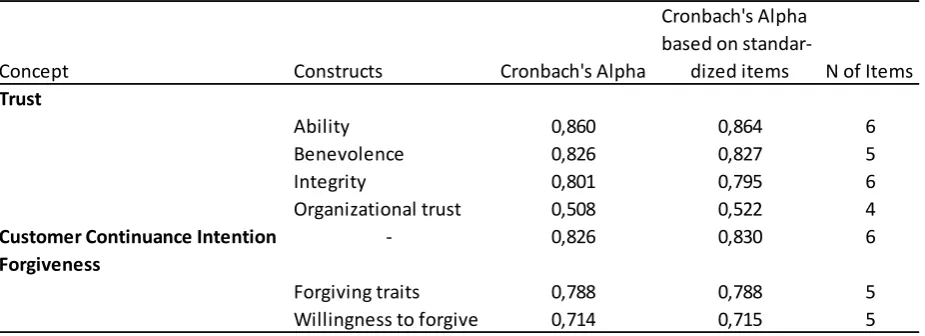
(30) 30. are in the age between 26 and 35, and 4% are in the age of 56 and 65. The participants were recruited in the personal social environment of the researcher. All of the participants were approached online via e-mail or social media. 3.2.3 Results The pre-test provided results concerning the reliability and correct interpretation of the questionnaire. Furthermore, results concerning the clear definition of the questions were obtained by asking the participants for their remarks. First of all, the results regarding the correct interpretation of the various scenario’s were analyzed. These results were obtained by analyzing the given answers to the three control questions. It appeared that two out of the three manipulations within the scenario’s were not understood by all of the participants. The results showed that 22% of the participants wrongly interpreted whether the incident was selfdisclosed (stealing thunder) or disclosed by a third party (thunder). Furthermore, 13% of the participants wrongly interpreted whether the incident was caused in the internal environment of the bank or in the external environment of the bank. In order to ensure that these misinterpretations will not occur during the main test, these two moderating aspects have been emphasized by creating subheads in the stimulus materials by which the situation is more clarified. The results of the control questions can be found in table 1. In order to measure whether or not the seven sets of questions regarding trust, customer continuance intention, and forgiveness are reliable, a reliability test was conducted. The reliability test, in which the Cronbach’s alpha was measured, showed that the construct of organizational trust, which measured the perceived trustworthiness of the financial institution with explicit and specific questions, was not reliable (α = .508). The trustworthiness of the financial institution was also measured by the use of the trust constructs of ability, benevolence, and integrity as presented by Mayer, Davis, and Schoorman (1995). These constructs measured the trustworthiness by the use of implicit questions regarding the perceived trustworthiness of the participants towards the financial institution. It appeared that the constructs of ability, benevolence, and integrity were tested as reliable along with the constructs of customer continuance intention, forgiving traits, and willingness to forgive (α > .70). Further elaboration on the construct of organizational trust showed that the removal of items.
(31) 31. would not improve its reliability. Therefore, it could be concluded that measuring trust with explicit and specific questions would not provide a reliable resemblance of trust. Thus, the construct of organization trust was deleted from the questionnaire. In order to ensure that the questionnaire was clear and easy to understand, the participants were asked about their difficulties in interpreting the questionnaire. The main results in the feedback of the participants were focused on the fact that it was not clear that the sets of questions regarding trust, customer continuance intention, and forgiveness were solely concerning the presented scenario. The participants mentioned that the questionnaire implied that the participants’ opinions should also be based on their prior experiences with their bank. In order to ensure that this assumption would not be made by the participants in the main test, additional information texts were implemented in the questionnaire which explained the purpose of the questions. Table 1; Results of controlquestions # 1. 2. 3.. Controlquestion. Who has initially disclosed the incident in which the bank is involved? Who has caused the incident? Is this crisis caused intentionally or unintentionally?. % of % of correct answers wrong answers 78% 22% 87% 13% 100% 0%. Table 2; Cronbach’s alpha of constructs. Concept Trust. Constructs. Ability Benevolence Integrity Organizational trust Customer Continuance Intention Forgiveness Forgiving traits Willingness to forgive. Cronbach's Alpha based on standarCronbach's Alpha dized items N of Items 0,860 0,826 0,801 0,508 0,826. 0,864 0,827 0,795 0,522 0,830. 6 5 6 4 6. 0,788 0,714. 0,788 0,715. 5 5. Note: the constructs were measured by the use of a 5-point Likert scale (1 = Completely agree, 5 = completely disagree).
(32) 32. 3.3. Main study. The pre-test of this study illuminated some flaws in the initial design of the study. This resulted in a number of practical implications which improved the study on the aspects of reliability, feasibility, and correct interpretation by the participants. 3.3.1 Design As mentioned earlier, the 2 x 2 x 2 factorial design presented eight various scenario’s in which four types of crisis situations were disclosed by two different parties (financial institution vs. news organization). In all of the eight scenario’s, the bank of which the participant is customer was the subject of the crisis situation. This choice was made in order to create a more realistic crisis situation for the participants in which they perceived the crisis situation as credible. Furthermore, in the scenario’s in which the crisis situation was initially disclosed by a third party, a fictive news channel (Financieel Nederland) was used. This choice was made in order to exclude the possibiliy that prior judgements regarding an existing news institution or organization would have been of influence on participant’s perceived trustworthiness. The four types of crisis situations were defined by the dimension of external control (internal vs. external control) and the dimension of intentionality (intentional vs. unintentional). This means that the characteristic of the crisis situations in the stimulus materials were defined by a combination of these dimensions. As mentioned earlier, this led to the establishment of four types of crisis situations; namely accident, faux-pas, transgression, and terrorism. The stimulus materials were all designed as the website of the fictive news channel “Financieel Nederland”. In the stealing thunder situations, the news messages concerning the four crisis types were formulated as an official statement of the bank, published by “Financieel Nederland”, in which they confessed the crisis situation. In the situations in which the fictive news channel “Financieel Nederland” disclosed the crisis situation, the news messages concerning the four crisis types were formulated as a statement of the bank published by Financieel Nederland” after they announced the crisis. The four types of crisis situations were all similar to each other in terms of subject and content. All of the stimulus materials disclosed a crisis situation in which personal information of the bank’s customers have been uploaded to a national database which is publicly accessible. The content differences in the various stimulus materials were solely.
(33) 33. based on whether the crisis was caused by the bank itself or by a third party (internal vs. external control), whether the crisis was caused intentionally or unintentionally, and whether the crisis was disclosed by a third party or by the bank itself (stealing thunder). In figure 2, a news item concerning the crisis type “accident” which is disclosed by a third party can be found as an example of the stimulus materials. All of the eight stimulus materials, with the Rabobank as subject of the crisis situation, can be found in Appendix A.. Figure 2; Example of stimulus material (Accident, third party). 3.3.2 Procedure In order to conduct the study, an online questionnaire (provided and designed with Qualtrics) was presented to the participants of the study. When they agreed to participate by clicking on the link of the online questionnaire, the participants were introduced to the study by presenting them with an introductory message which explained the nature of the study. After reading this introduction message, the participants were directed to two single questions. The first question “Of which bank are you a customer?” had thirteen different options and was directly linked to the stimulus.
(34) 34. materials. The answers of the participants determined which of the thirteen different sets of stimulus materials (a set contained the 8 possible crisis situations and every set differed in which bank was the subject of the crisis) should be enabled for them. This ensured that the participants were confronted with a scenario in which the bank, of which they are customer, was the subject. After this question, the participants were asked to rate their current trust in the bank of which they are customer. This was specifically asked before the participant would have been confronted with the stimulus material. In order to measure whether or not a specific individual is a forgiving person, the participants were asked to answer a set of five questions which concerned their forgiving traits. The measurements regarding these questions were conducted by the use of a 5-point Likert scale (1 = Completely agree, 5 = Completely disagree). The set of questions regarding the forgiving traits (5 items) were followed by a scale in which the participants needed to indicate the extent to which they attach value to their privacy (1 item). Both, the questions concerning the forgiving traits and the value of privacy, were incorporated in order to conduct a baseline assessment. After having answered the first four questions which were incorporated to conduct a baseline assessment, the participants were assigned to one of the eight scenario’s in which “their bank” is the subject. Before being exposed to the scenario, the participants were confronted with an informational text in which they were asked to carefully read the scenario. Furthermore, this informational text informed the participants that their answers to the following questions should be solely based on the information they have read in the scenario. After being exposed to the scenario, the participants were again confronted with the request to continue the questionnaire by answering questions that would follow based only on the information provided in the scenario. After having carefully studied the scenario, the participants were asked to answer three control questions. These questions were incorporated in order to measure whether or not the three manipulations within the scenario’s were noticed, understood, and correctly interpreted. These three moderating aspects can be defined as the disclosing party of the incident (stealing thunder vs. third party), the intentionality of the incident (intentional vs. unintentional), and the environment in which the incident was caused (internal vs. external). Subsequently, the participants were confronted with.
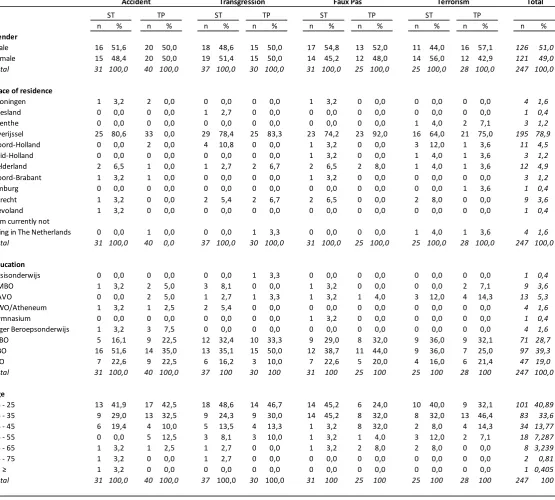
(35) 35. four single questions which were focused on the extent to which the participants rated the severity of the incident, the importance of the incident, the extent of violation they experienced, and the responsibility of the bank within the scenario’s. Subsequently to the three control questions and the four single questions after the scenario, the participants of the sample were asked to answer five sets of questions. These five sets all varied in their structure by the use of five or six items. The first three sets were measuring the constructs of ability, benevolence, and integrity which represented the concept of trustworthiness. The fourth set of questions concerned the concept of customer continuance intention in which the participant was asked about their loyalty to their bank. The fifth and last set of questions concerned the extent to which the particpants were willing to forgive the bank for their involvement in the crisis situation. All of these five sets of questions were constructed with a 5-point Likert (1 = Completely agree, 5 = Completely disagree). The questionnaire ended with four demographic questions. First of all, the participants were asked to indicate their gender. Second, the participants needed to place themselves in one of the seven age categories. Subsequently, the level of education was asked followed by the place of residence. The questionnaire can be found in Appendix B (Dutch). 3.3.3 Participants A total of 332 individuals participated in the study. However, 85 of the 332 participants gave an incorrect answer to at least one of the three control questions. Therefore, only 247 of the 332 responses could be used in this study. From these 247 respondents, 126 (51%) are male and 121 (49%) are female. Most of the participants are in the age category of 16 to 35 (n = 184, 74,5%) and have a MBO or HBO education (n = 168, 68%). Also, the majority of the participants lives in The Netherlands, Overijssel (n = 195, 78,9%). A complete overview of the participants’ demographics per crisis situation, can be found in table 3. The participants were approached to fill in the questionnaire via online channels (e.g. social media and e-mail). They were presented with an URL-link which led them to the online questionnaire that was designed with the online questionnaire service of Qualtrics. Also, a few participants were approached in a face-to-face conversation. In this.
(36) 36. face-to-face setting, the use of a laptop and tablet made it possible for the participants to immediately participate in the study. Within the questionnaire, the participants were randomly assigned to one of the eight scenario’s. Because a total of 85 responses were deleted due to incorrect answers on the control questions, the distribution of the participants among the eight scenario’s is not completely equal. Table 3; Demographic statistics of the sample per scenario Accident ST n Gender Male Female Total. Transgression TP. %. n. ST %. n. Faux Pas. TP %. n. ST %. n. Terrorism TP. %. n. ST %. n. Total TP. %. n. %. n. %. 16 51,6 15 48,4 31 100,0. 20 50,0 20 50,0 40 100,0. 18 48,6 19 51,4 37 100,0. 15 50,0 15 50,0 30 100,0. 17 54,8 14 45,2 31 100,0. 13 52,0 12 48,0 25 100,0. 11 44,0 14 56,0 25 100,0. 16 57,1 12 42,9 28 100,0. 126 51,0 121 49,0 247 100,0. 1 0 0 25 0 0 2 1 0 1 1. 0 0 0 25 0 0 2 0 0 2 0. 1 0 0 23 1 1 2 1 0 2 0. 0 0 0 23 0 0 2 0 0 0 0. 0 0 1 16 3 1 1 0 0 2 0. 0 0 2 21 1 1 1 0 1 0 0. 4 1,6 1 0,4 3 1,2 195 78,9 11 4,5 3 1,2 12 4,9 3 1,2 1 0,4 9 3,6 1 0,4. Place of residence Groningen Friesland Drenthe Overijssel Noord-Holland Zuid-Holland Gelderland Noord-Brabant Limburg Utrecht Flevoland I am currently not living in The Netherlands Total. 3,2 0,0 0,0 80,6 0,0 0,0 6,5 3,2 0,0 3,2 3,2. 2 0 0 33 2 0 1 1 0 0 0. 0,0 0,0 0,0 0,0 0,0 0,0 0,0 0,0 0,0 0,0 0,0. 0 1 0 29 4 0 1 0 0 2 0. 0 0,0 31 100,0. 1 40. 0,0 0,0. 0 0,0 37 100,0. 1 3,3 30 100,0. 0 0,0 31 100,0. 0 0,0 25 100,0. 1 4,0 25 100,0. 1 3,6 28 100,0. 4 1,6 247 100,0. Education Basisonderwijs VMBO HAVO VWO/Atheneum Gymnasium Lager Beroepsonderwijs MBO HBO WO Total. 0 0,0 1 3,2 0 0,0 1 3,2 0 0,0 1 3,2 5 16,1 16 51,6 7 22,6 31 100,0. 0 0,0 2 5,0 2 5,0 1 2,5 0 0,0 3 7,5 9 22,5 14 35,0 9 22,5 40 100,0. 0 3 1 2 0 0 12 13 6 37. 1 0 1 0 0 0 10 15 3 30. 3,3 0,0 3,3 0,0 0,0 0,0 33,3 50,0 10,0 100. 0 1 1 0 1 0 9 12 7 31. 0,0 3,2 3,2 0,0 3,2 0,0 29,0 38,7 22,6 100. 0 0 1 0 0 0 8 11 5 25. 0,0 0,0 4,0 0,0 0,0 0,0 32,0 44,0 20,0 100. 0 0 3 0 0 0 9 9 4 25. 0,0 0,0 12,0 0,0 0,0 0,0 36,0 36,0 16,0 100. 0 2 4 0 0 0 9 7 6 28. 0,0 7,1 14,3 0,0 0,0 0,0 32,1 25,0 21,4 100. 1 9 13 4 1 4 71 97 47 247. 0,4 3,6 5,3 1,6 0,4 1,6 28,7 39,3 19,0 100,0. Age 16 - 25 26 - 35 36 - 45 46 - 55 56 - 65 66 - 75 75 ≥ Total. 13 41,9 9 29,0 6 19,4 0 0,0 1 3,2 1 3,2 1 3,2 31 100,0. 17 42,5 13 32,5 4 10,0 5 12,5 1 2,5 0 0,0 0 0,0 40 100,0. 18 48,6 9 24,3 5 13,5 3 8,1 1 2,7 1 2,7 0 0,0 37 100,0. 14 46,7 9 30,0 4 13,3 3 10,0 0 0,0 0 0,0 0 0,0 30 100,0. 14 14 1 1 1 0 0 31. 45,2 45,2 3,2 3,2 3,2 0,0 0,0 100. 6 8 8 1 2 0 0 25. 24,0 32,0 32,0 4,0 8,0 0,0 0,0 100. 10 8 2 3 2 0 0 25. 40,0 32,0 8,0 12,0 8,0 0,0 0,0 100. 9 13 4 2 0 0 0 28. 32,1 46,4 14,3 7,1 0,0 0,0 0,0 100. 101 83 34 18 8 2 1 247. 40,89 33,6 13,77 7,287 3,239 0,81 0,405 100. 0,0 2,7 0,0 78,4 10,8 0,0 2,7 0,0 0,0 5,4 0,0. 0,0 8,1 2,7 5,4 0,0 0,0 32,4 35,1 16,2 100. 0,0 0,0 0,0 83,3 0,0 0,0 6,7 0,0 0,0 6,7 0,0. 3,2 0,0 0,0 74,2 3,2 3,2 6,5 3,2 0,0 6,5 0,0. 0,0 0,0 0,0 92,0 0,0 0,0 8,0 0,0 0,0 0,0 0,0. 0,0 0,0 4,0 64,0 12,0 4,0 4,0 0,0 0,0 8,0 0,0. 0,0 0,0 7,1 75,0 3,6 3,6 3,6 0,0 3,6 0,0 0,0.
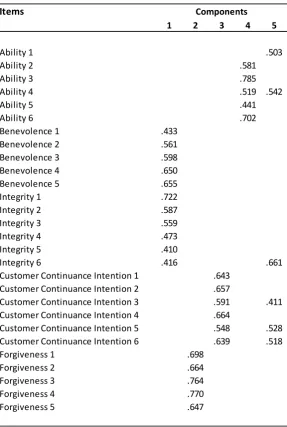
(37) 37. 3.3.4 Measurements Additional to the main measurements of trustworthiness, this study also measured the aspects of customer continuance intention and forgiveness in order to get a better understanding of the participants’ attitudes towards an organization in the various crisis situations. The various measures in this study were based on the measurement scales of several other studies. Scales have been found for the measurements of consumer trustworthiness, customer continuance intention, forgiving traits and forgiveness. Trustworthiness. The trustworthiness of the participants towards the financial institution which is the subject of the stimulus materials, were measured using the three factors of the model of trust. The used measurement scales were based on the studies of McKnight, Choudhury, and Kacmar (2002), Mayer, Davis, and Schoorman (1995) and Mayer and Davis (1999). First of all, ability was measured by confronting the participants with statements regarding the extent to which the fictive financial institution is perceived to be competent and skilled in what it has done. Second, benevolence was measured by confronting the participants with statements that will reflect whether or not the fictive financial institution is perceived to be sincerely and altruistic in their behavior towards their customers. And third, integrity was measured by confronting the participants with statements concerning the perceived honesty of the fictive financial institution. In order to measure the opinions of the participants concerning these statements, a 5-point Likert scale was used (1 = strongly agree/5 = strongly disagree). Hereby, ability was assessed using six items (α = .739), benevolence was assessed using five items (α = .792), and integrity was assessed using six items (α = .812). Customer Continuance Intention. Customer Continuance Intention was measured in order to assess the loyalty of the participants in the various crisis situations. The measured data was gathered by using a scale which was based on the customer continuance intention scale of Yang and Peterson (2004) and Bhattacherjee (2001). This scale consists of statements in which participants for example should declare if they say positive things about the organization, if they would recommend the organization to their family, and if they intent to continue doing business with the organization. In order to measure the opinions of the participants concerning these statements, a 5-point Likert scale was used (1 = strongly agree/5 = strongly disagree). The scale consisted of six items (α = .866)..
Figure
+7
Outline
Related documents
The folding of most newly synthesized proteins in the cell requires the interaction of a variety of protein cofactors known as molecular chaperones. These molecules
The cumulative effect of the increased ability of incumbents to target insurgents, increased insurgent targeting of civil- ians, insurgent infighting, and the general process of
All in all, these findings challenge the rationale of social welfare policy which identifies social security (social insurance and social grants) as vital for
Speci…cally, rational expectations models with standard (time-separable) preference assump- tions are largely unable to explain: why the price dividend ratio of stocks is so
Advisory Commission unanimously recommends that the Board of Regents approve an initial operating license for New Horizons Computer Learning Center of Shreveport, located
Set as a longitudinal case study, it uses participatory research, while performing IREAD activities in Lakhnu Junior School and the community over the period 2011–2019 to
In a controversial analysis of population-wide lead poisoning rates and crime rates, Nevin (2007) indicated that blood lead levels early in life are proportionally associated
