FACULTY OF BEHAVIOURAL, MANAGEMENT AND SOCIAL SCIENCES DEPARTMENT OF PSYCHOLOGY OF CONFLICT, RISK AND SAFETY
November 2017
Explaining Risk Perception of Climate Change in Indonesia through Cultural Dimension of Uncertainty Avoidance, Collectivism, and Long-term Orientation
Master Thesis
VICTOR MATANGGARAN
1
Abstract
Risk perception of climate change is believed to be the first step to tackle climate change problems around the world. There are many factors to cause people being aware of climate change risks but research on cultural dimensions is rarely conducted. This research examines the correlation of cultural dimension uncertainty avoidance, collectivistic, and long-term orientation with risk perception of climate change. The research was conducted in Indonesia as the country with the high score in uncertainty avoidance, collectivistic, and long-term orientation. Data was collected using online survey and shared in several cities in Indonesia, in three largest Islands, Sumatera, Java, and Sulawesi. It was found that risk perception of climate change is positively correlated to the cultural dimensions of uncertainty avoidance, collectivistic, and long-term orientation. Demography variables such as age, gender, education level and disaster experiences have found not related to the risk perception of climate change. The result enriches the contribution of cultural dimensions in shaping risk perception especially risk perception of climate change, and the description of Indonesia’s cultural dimensions and risk perception of climate change.
2
Introduction
Risk perception is an individual evaluation of the possibility of hazard’s negative consequences to affect personal life. There are many factors to cause the risk perception to occur and explaining only one factor is never enough. For instance, Knuth, Kehl, Hulse, & Schmidt (2014), found that the ability to perceive the risk of particular disaster is correlated to the experience of similar disaster previously, the risk perception of a flood would be triggered by the flood experience in the past precisely. There is a limitation of cross-over effect of disasters; previous experience of the flood does not necessarily lead to the perceived risk of fire in the future due to the different context of the emergency. Hence, explaining risk perception of hazards as consequence of previous experience is not enough.
In this study, researcher would like to examine cultural dimensions by Hofstede to influence risk perception especially the risk of climate change. Apart from political and economic situation, cultural value is an interesting variable to investigate. The cultural aspect of human life is already believed to determine the way people interpret risk (Oltedal, Moen, Klempe, & Rundmo, 2004). Not many research provide plenty explanation about risk perception of climate change and its correlation with cultural dimensions. Besides, study of risk perception of climate change in eastern world countries such as Asia is still limited thus perspective of climate change is dominated by western world countries such as US, UK, and Europe. This research will discuss cultural dimensions in Indonesia and its correlation to the risk perception of climate change in this country. It provides another perspective of study in risk perception of climate change and the application of cultural dimensions in particular country, Indonesia.
The cultural dimensions of this study are uncertainty avoidance, collectivism, and long-term orientation (Hofstede, 2011). Those three cultural dimensions are chosen as the construct’s items are self-assessment questions while the three others; power distance, masculinity versus femininity, and indulgent versus restraint dimensions are more likely observing the social situations. For example, power distance would ask about how people see the government or leader in a company, whether or not the power is hierarchical is very difficult to judge as everyone has a different level of knowledge and experience. In addition, masculinity versus femininity dimension is not about personal characteristics rather a distribution of value in society such as how male or female should act or take a role, and indulgence versus restrain dimension measures the safety rate in a country, number of obesity and sexual norms (Hofstede, 2011) which also not possible to be generated individually. Therefore, those three dimensions are not applicable to this research because it would be difficult for respondents making a judgement without enough knowledge or data.
On the other hand, in terms of face validity, uncertainty avoidance, collectivistic, and long-term orientation are more relevant to the study of risk perception of climate change. It is because these three cultural dimensions items could reveal the psychological constructs which related to the preparedness towards disasters such as climate change. Uncertainty avoidance, collectivism, and long-term orientation are easily measured in individual level as its items asking personal preferences, for instance how tolerant people to uncertainty situations (uncertainty avoidance), whether or not individual values his/her group more than himself/herself (collectivistic), and whether or not someone has a long-term plans, sacrifices his/her fun today for success in the future (long-term orientation) (Yoo, Donthu, & Lenartowicz, 2011).
3
the most economically influential countries in the world and has massive development programs in many sectors, including in the industrial sector. Further, Indonesia can be viewed as representative of the Southeast Asian region’s socio-cultural situations in order to understand the impact of cultural values on risk perception regarding climate change in the eastern world. It is assumed that different levels of climate change awareness, risk perception, and precaution plans to face the hazards of climate change are determined by the cultural values of the society.
Regarding world economic challenges nowadays, every nation competes in many aspects to ensure they are not left behind. Unfortunately, the way people prosper economy should sacrifice environmental stability. US President Donald Trump has announced the withdrawal of US commitment from the Paris Agreement, the international commitment to reduce emission and the impact of climate change, owing to the climate change policy being unfavorable to the US economy (ABCNews, 2017). Climate change has become a serious problem today. Some countries perceived the climate change as a serious threat but some other countries even do not believe in climate change. Many people are seemingly still skeptical about its risk. The slow impact of climate change might be one reason for people being skeptical and not prioritizing it as high as other issues, such as terrorist attacks. It seems that people are biased to calculate the objective risk of climate change.
Pertaining to the environmental issue, there is a high demand for Indonesia’s palm oil products and others agricultural products leading to massive deforestation, which has been garnering serious attention lately. Indonesia, as an archipelago state, will mostly be victimized by the sea level rising as an effect of climate change. Many research have already been conducted about the geographic impact of climate change on Indonesia. For instance, it is predicted that in 2100, around 1.1 meters of the risen of sea level will make the coastal area and small islands (approximately 90.260 km2 of land) disappear (Susand, Herlianti, Tamamadin, & Nurlela, 2008). Other serious issues, such as the sinking of the Java Island, has been receiving national attention.
Several socio-economic and education factors have been proved to affect the risk perception regarding climate change in several countries. In this research, the cultural dimensions that is rooted in the daily life culture is assumed to be able to determine how people perceive and react to the risk situation. A research in the field of climate change perspectives and values has found that the egalitarian culture is an indirect predictor of people supporting climate change policy in the US (Leiserowitz, 2006). Gallup World Poll conducted a survey in 2007–2008 to explore climate change awareness and risk perception of it harming personal and family life in 119 countries (Lee, Markowitz, Howe, Ko, & Leiserowitz, 2015).
4
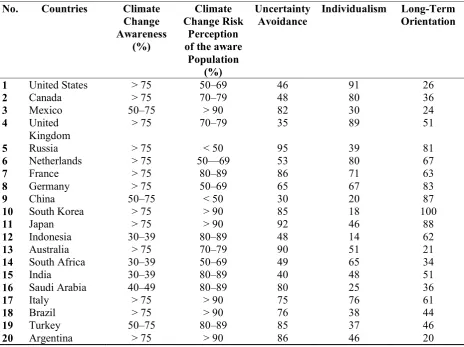
Table 1. Risk Perception of Climate Change (2007–2008) and Percentage of Cultural Dimensions
No. Countries Climate
Change Awareness
(%)
Climate Change Risk
Perception of the aware
Population (%)
Uncertainty Avoidance
Individualism Long-Term Orientation
1 United States > 75 50–69 46 91 26
2 Canada > 75 70–79 48 80 36
3 Mexico 50–75 > 90 82 30 24
4 United Kingdom
> 75 70–79 35 89 51
5 Russia > 75 < 50 95 39 81
6 Netherlands > 75 50—69 53 80 67
7 France > 75 80–89 86 71 63
8 Germany > 75 50–69 65 67 83
9 China 50–75 < 50 30 20 87
10 South Korea > 75 > 90 85 18 100
11 Japan > 75 > 90 92 46 88
12 Indonesia 30–39 80–89 48 14 62
13 Australia > 75 70–79 90 51 21
14 South Africa 30–39 50–69 49 65 34
15 India 30–39 80–89 40 48 51
16 Saudi Arabia 40–49 80–89 80 25 36
17 Italy > 75 > 90 75 76 61
18 Brazil > 75 > 90 76 38 44
19 Turkey 50–75 80–89 85 37 46
20 Argentina > 75 > 90 86 46 20
The score of cultural dimension index is a collective score of a whole nation which not necessarily applicable to a personal or individual level. As the results are the collective score of society, particular persons might act or think differently. That previous surveys (Table 1) indicated that there is a relationship between the cultural dimensions of a country and perception of risk towards climate change. The western countries (North and South America, Europe and Australia) in the survey were mostly aware of the climate change issues (more than 75% of the population) but very few of them perceived the risk it harming them and their families. Only 80–89% of the population of France, the leading country of World Climate Change Summit (COP21) in 2015, was aware of the threat of climate change. US, Canada, United Kingdom, Russia, Netherlands, and Germany only had 50–69% awareness and appraisal of the seriousness of the issue among the population.
5
(14%), Egypt, and Saudi Arabia (25%). Interestingly, China and Russia also scored higher in long-term orientation but less than 50% of the population was worried about the risk of climate change and therefore we need to identify more.
A 2011 survey by Natural Climate Change showed that flooding in the United Kingdom had a significant correlation with the perception of climate change and indirect effect on behavioral intentions (Spence, Poortinga, Butler, & Pidgeon, 2011). There is not sufficient information in the context of Indonesia on matters such as whether the people’s perception of regular flooding in big cities is correlated to climate change. In addition, despite the fact that forest fires have been classified as emergency situations that cause health problems every year and contribute to 10% of average annual emissions, palm farmers are still burning forests in some parts of Indonesia, especially in Sumatera Island (Foley, 2017).
The experience of disasters supposedly changes people’s perspectives and behaviors towards environmental sustainability. There is an expectation that people around the world will take action as soon as possible to address the climate change issue, especially in countries where it is most catastrophic. Efforts towards climate change mitigation, which is triggered by sense of susceptibility and severity of the issue, can be seen in people reducing their energy consumption despite not having encountered the severity directly. On the other hand, individual adaptation, such as switching off lights or driving less, is motivated by awareness and concern regarding climate change, which can be obtained with sufficient information about its impact (Semenza, Ploubidis, & George, 2011). These risk perceptions, mitigations, and adaptation intentions will also be examined in this study.
Risk Perception
Risk perception manifests in the perception of threat, which includes perception of efficacy. There are many factors that affect the perception of risk, such as the source of the risk, familiarity of people towards the risk, and frequency of an event occurring (Oltedal et al., 2004). Perception of efficacy is more likely to bring about protective motivations (acceptance), while perception of threat leads to rejection or defensive motivations (Gore & Bracken, 2005).
The more people are susceptible to hazards, the more they perceive threat and risk. The way the climate change issue is communicated leads to different interpretations by nations. The tendency to accept or reject the risk messages can be mediated by cultural or adopted values of people. American citizens, in general, perceive climate change as a moderate risk due to climate change concerns being a worldwide issue and not at a local level, and it is also imagined as ice caps melting and being of a non-human nature (Leiserowitz, 2006). Some countries perceive climate change as different conditions, such as high temperatures, melting icebergs, raised sea levels, extinction of some animals, contagious diseases, etc. The climate change orientation is not necessarily something close or something that has rapid effects and direct impacts on small communities or at a personal level. Thus, a majority of citizens perceive the risk of climate change as less serious.
6
disasters while people do not really believe it is related to climate change (Frondel, Simora, & Sommer, 2017). Therefore, it is very important to communicate the ultimate risks of several damages pertaining to climate change.
In the risk communication study, for example, the increasing perception of risk and self-efficacy triggers people to seek more information about the risk to prevent negative effects of hazards (Kievik & Gutteling, 2011). With risk communication, it is important to motivate people to do something by helping them increase their efficacy. Inducing self-efficacy or the belief to be able to do something is likely to increase the followers’ inclination to take action as a precaution for climate change. Effective risk communication is motivating people by involving them in a promoted issue, explaining how it is relevant and how it will affect them personally (Gass & Seiter, 2014). By doing so, the listener will think about messages and consider changing their attitudes for a long time.
To effectively communicate the risk of climate change, authorities should take part in persuading the society to take preventive action as soon as possible. Research in the risk communication field previously explained the correlation of trust to risk perception as both explained probability (Das & Teng, 2004). Trust has been found to be a construct of self-efficacy and institutional trust, which refers to trust in the capability of people to avoid risk. Hence, the more we trust, the more we feel that our information about the risk is sufficient followed by fewer negative emotions toward risks (ter Huurne & Gutteling, 2009). When people trust, the level of risk or risk perception becomes low (Das & Teng, 2004). This clearly implies that trust triggers the confidence level of the addressed party to handle a problem and tackle a hazardous situation.
Cultural Dimensions
There are six cultural dimensions that have been introduced by Geert Hofstede, small versus large power distance, weak versus strong uncertainty avoidance, individualism versus collectivism, femininity versus masculinity, short-term versus long-term orientation, and indulgence versus restrain. These cultural dimensions are mostly applied in the context of organization and management. Not all dimensions are suitable for this research, and the researcher decided to select the three most influential dimensions, namely weak versus strong uncertainty avoidance, individualism versus collectivism, and short-term versus long-term orientation. Those cultural dimensions are very close to research conducted by Oltedal, Moen, Klempe, and Rundmo (2004) which stated that cultural adherence (hierarchical, individualistic, egalitarian and fatalistic) is the best predictor of risk perception, particularly in the case of environmental sustainability. Hierarchical, individualistic, egalitarian and fatalistic are the cultural values that Oltedal, Moen, Klempe, and Rundmo explained to have influenced the way people perceive risk. According to that finding, researcher ellaborated the proximity of that four cultural values explained by Oltedal, Moen, Klempe, and Rundmo with cultural dimensions by Hofstede and found that hierarchical culture is identical with the dimension of uncertainty avoidance, individualistic culture is the same as individualistic vs collectivistic dimension and fatalistic culture is the opposite of long-term orientation dimension.
7
regulation, following absolute truth, and having zero tolerance towards deviant opinions (Hofstede, 2011). People in hierarchical cultures believe that nature has limits in order to preserve itself, and thus humans should not exploit nature beyond nature’s ability to repair the damage. While perceiving risk, as long as the risk is justified by experts or authorities, people in this culture will accept the risk (Oltedal et al., 2004).
Individualistic, as opposed to collectivistic culture, exalts freedom more; and hence, people in this culture will accept risk if it does not limit people’s freedom. In contrast, the collectivistic culture integrates individuals with their group and there is exchange of loyalty among the members (Hofstede, 2011). Individualistic culture does not particularly care about how people treat nature owing to the belief that nature is self-preserving and will be able to regain homeostasis (Oltedal et al., 2004).
Fatalistic cultures stand in opposition to the cultural dimension of long-term orientation. Long-term orientation encourages people to always have a precaution plan while fatalistic cultures just face problems without preparation as they believe in fate. Fatalistic cultures perceive risk indifferently and prefer to not worry about unavoidable hazards due to the belief that people do not have the ability to tackle the risk. Nature has never clearly reacted to people, and therefore, people in fatalistic cultures do not make any judgement of whether exploitation of nature is right or wrong (Oltedal et al., 2004).
Indonesia is positioned at high collectivism, moderate long-term orientation and moderate uncertainty avoidance level, as depicted by indices of 14 (individualistic index), 62 and 48 respectively (Hofstede, 1984). Climate change is still believed as being uncertain for many people and the weak and strong dimension of uncertainty avoidance would have an impact on different levels of societal comfort towards the ambiguity of climate change. Table 1 shows some countries that scored highly on uncertainty avoidance also do so on risk perception of climate change, such as France, South Korea, Japan, and Australia (Hofstede Insight, 2017). Furthermore, the consequences of climate change is gradual damage to the environment and needs preparatory or precautionary actions to be take. Thus, long-term versus short-term orientation distinguishes people’s reactions and preparation with regard to facing this issue. Lastly, individualism versus collectivism has been included due to climate change adaptation, and mitigation should not only be seen as large societal actions but also personal actions such as energy saving.
Uncertainty Avoidance is the degree of tolerance for new or different situations, which are uncommon or unstructured. When this cultural dimension is high, people believe in absolute truth and reduce possibilities of being in uncertain situations, such as with very tight regulation (Hofstede & Mccrae, 2004). There is an emotional need for formalization of structure, standardization of procedure, and ritualization of behavior (Hofstede, 1984). There is a strong emotional need for rules and belief religion, philosophy, and science as ultimate truths (Hofstede, 2011). In terms of strategic planning, cultures with less uncertainty avoidance have better fundamental goals and organization activities but do not necessarily adapt to environmental changes effectively.
8
Lastly, Long-term orientation is a situation where people perceive important events in life as occurring in the future and not just now or in the past (Hofstede, 2011). The perception involves the importance planning for the future and how far the preparation of the future vision extends, instead of focus on the quality of the plan (Mai, 2015). This culture perceives success as a result of hard work and sets their important goals to be thrift and persevering (Hofstede, 2011). A high score in long-term orientation also implies that the society is capable of change conditions by adapting to traditions and believing that the truth depends on the context, time, and situation (Hofstede Insight, 2017).
Cultural value is one of the strongest antecedents of human behavior, including the way people perceive risk (Oltedal et al., 2004). Risk perception of climate change is the initial factor that triggers mitigation of climate change, which is a pivotal aspect of reducing the dangers of climate change in the future by taking precautionary actions from now. This research aims to answer whether the three cultural dimensions identified by Hofstede (uncertainty avoidance, collectivistic, and long-term orientation) affect risk perception towards climate change in Indonesia. The hypothesis is as follows: Cultural dimensions of uncertainty avoidance, collectivism, and long-term orientation are positively correlated to risk perception and adaptation of climate change.
Method
This research is conducted in Indonesia owing to the socio-cultural conditions and disaster experiences of the people. This study will focus on cities that have been damaged by flooding and forest fires, namely the three main of Sumatera, Java, and Sulawesi. The cities have been chosen in order to observe variation of cultural background, demography, and catastrophes to affect the risk perception regarding climate change. This study used online survey forms. Data collection regarding risk perception and adaptation to climate change and cultural dimensions was done using online survey form in Qualtrics. The online survey was distributed to participants in the duration of three weeks by way of the researcher visiting universities and organizations in several major provinces in Indonesia, such as Riau in Sumatera Island and South and West Sulawesi in Sulawesi Island, and West Java, Jakarta, East Java and Jogjakarta in the Java Island. Besides, the survey also undergoes promotion through the researcher asked participants to voluntarily share the survey link to their social media platforms like Facebook, Whatsapp, and Line to reach more respondents from other provinces. Sharing information through internet or social media is very promising in Indonesia as 96 million of population are actively using social media and become fourth largest population using social media in the world after China, India and USA (Katadata Indonesia, 2017).
Measurement Instruments
The risk perception of climate change survey form was adapted from Semenza, Ploubidis, and George (2011). It enquires about extent to which people perceive the severity, susceptibility, self-efficacy, mitigation, and adaptation of climate change. Hofstede’s Cultural Dimensions (uncertainty avoidance, collectivism, and long-term orientation) was used with the survey questions developed by Yoo, Donthu, and Lenartowicz, (2011). The survey was administered in Bahasa Indonesia and used 5-point Likert Scale.
9
what extent they consider their acts will affect their group. For long-term orientation, questions revolved around how respondents perceived the necessity of a future. These questions were related to planning, persistence, and working hard for a better future. Besides, risk perception and adaptation to climate change are compiled from several aspects, such as perceived susceptibility, perceived severity, perceived benefits, perceived barriers, cues of action, self-efficacy, mitigation, emergency plan, and emergency kit. These aspects are represented as a 9-item questionnaire. For instance, one of the items is ―I believe climate change could affect my way of life or lifestyle if I do not prepare adequately‖. Details of cultural dimensions, risk perception, and adaptation of climate change are in the appendix.
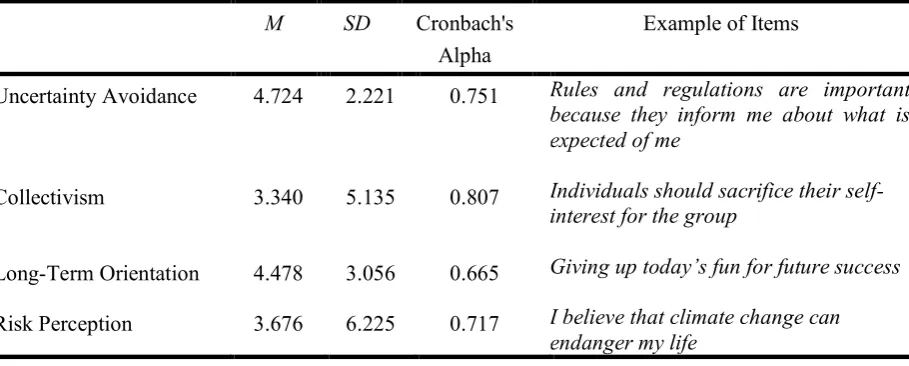
[image:10.595.71.526.359.542.2]Previously, survey questions regarding risk perception of climate change were never administered in the Indonesian language and were conducted as yes or no answer questions. The researcher decided to modify the questions into Bahasa Indonesia and the ―yes-no‖ response to a 5-point Likert Scale to measure the degree of concession towards climate change conscientiously. From Table 2, Cronbach’s Alpha analysis for risk perception and adaptation inventory shows 71% reliability score for measurement of risk perception after survey-format modification, which means that it is a compatible tool to measure risk perception of climate change in Indonesia. Moreover, the cultural dimension depicts no lower than 60% reliability score, consists of 75% the uncertainty avoidance, and 80% and 66% of collectivism and long-term orientation respectively.
Table 2. Descriptive Statistics and Reliability Dependent and Independent Variables
M SD Cronbach's Alpha
Example of Items
Uncertainty Avoidance 4.724 2.221 0.751 Rules and regulations are important
because they inform me about what is expected of me
Collectivism 3.340 5.135 0.807 Individuals should sacrifice their
self-interest for the group
Long-Term Orientation 4.478 3.056 0.665 Giving up today’s fun for future success Risk Perception 3.676 6.225 0.717 I believe that climate change can
endanger my life
Sample Characteristics
10
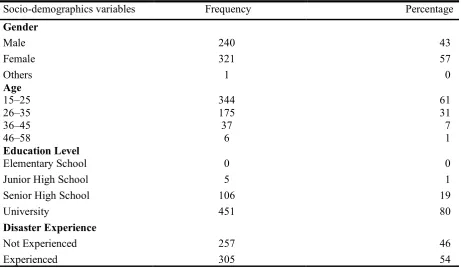
Table 3. Socio-Demographic Profile
Socio-demographics variables Frequency Percentage
Gender
Male 240 43
Female 321 57
Others 1 0
Age
15–25 344 61
26–35 175 31
36–45 37 7
46–58 6 1
Education Level
Elementary School 0 0
Junior High School 5 1
Senior High School 106 19
University 451 80
Disaster Experience
Not Experienced 257 46
Experienced 305 54
The respondents ages ranged between 15 to 58 years old (M = 26, N = 562). Most respondents were in the early adulthood stage, 61% were between the age range of 15–25, and 31% between the age range of 26–35 years old. According to latest national census in Indonesia (2010), 63.55% of Indonesian population is in productive age, from 15 to 59 years old. Almost 30 million (8.79%) of Indonesian population comes from age range 15-19 years old, 8.37% from age range 20–24 years old, 8.97% from age range 25-29 years old and 8.34% from age range 30-34 years old (Badan Pusat Statistik, 2017b). Around 41% of respondents in this survey are from Java Island which also well-known as the most congest area in Indonesia by more than 1000 km2 followed by Sulawesi Island 32% respondents with congestion 100-499 km2 (BPS-Statistics Indonesia, 2017). This can be seen as representation of Indonesian population in terms of age range and population distributions geographically.
More than half (57%) of the respondents were female while 43% is male respondents. A vast majority of the respondents were highly educated, as 80% (n = 451) of them had graduated from university or were undergoing their studies at different level at a university. Furthermore, most importantly, it can be seen that more than 50% respondents had experienced disaster, floods or forest fires. In terms of educational background, national census in Indonesia indicated that more than 30% of Indonesian population above 15 years old were graduated from senior high school or university level while 54.36% populations just finished their primary and junior high school (Badan Pusat Statistik, 2017a). From the census data, it seems that the education level was not properly represented in this study.
11
representative in terms of cultural background, age distribution and geographic distribution of the population.
Results
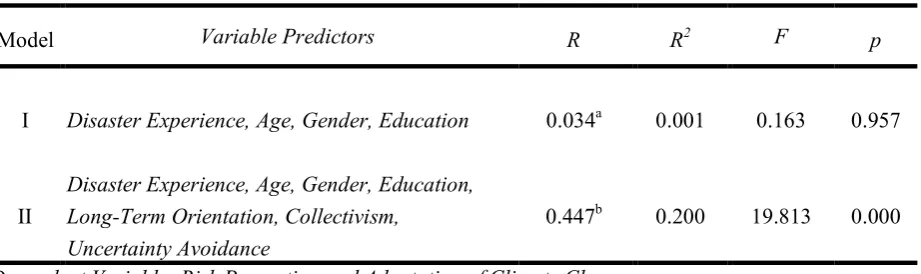
The first step to analyze the data is conducting hierarchical multiple regression analysis to test how the demography variable (age, education level, gender and disaster experience) affects the dependent variable (risk perception of climate change). The analysis model (Table 4) shows no significant change of risk perception and adaptation by controlling the demography variable (R2 = 0.001, p = 0.957), meaning that there is no contribution of the demography variable to the rise of risk perception of climate change.
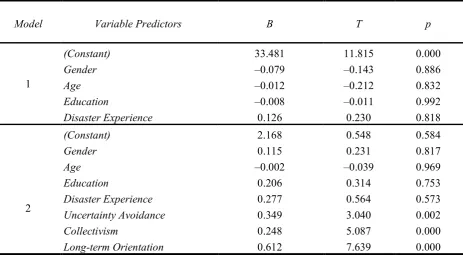
Each demographical variable’s contribution can be seen in Table 5, which amplifies that there is no significant correlation between gender (p = 0.749), age (p = 0.553), education level (p = 0.800), and even disaster experience (p = 0.652) towards risk perception of climate change. Interestingly, education level and disaster experiences are not significantly correlated to trigger risk perception of climate change in this study. This finding can be explained by the previous study of risk perception by Pádua, Santos, & Horta, (2013) which found that education level is not a predictor of people perceive the risk especially the risk of health (diabetes) and the higher education should be related to a particular environmental issue (e.g. climate change) to adequately increase the awareness of climate change (Eren Durmuş-Özdemir & Sevinç Şener, 2016). Another study of disaster’s cross-over effects found that significant correlation of experience to cause people perceive the risk of particular disaster can be triggered by the similar disaster previously or at least required similar context of experience. The current survey’s results indicating that the appraisal of climate change impact is not manifested in flood or forest fire experiences thus the risk perception of climate change is not related to disaster experience.
There are some domains of risks and one of them is the health risks domain. Although health risks is related to the environmental risks, it has been found that people from different age group have similar risk perception towards environmental risks domain (Bonem, Ellsworth, & Gonzalez, 2015). The older people have more concern about the health risks domain than younger people but in terms of environmental risks, both older and younger people have no difference of risk perception. This is because age range only makes difference in risk perception if the risk was related to whether or not someone has ability to avoid the risk. Risk of the environment are unable to control while health risks are avoidable (Bonem et al., 2015). Current survey’s result also found that there is no correlation of age differences and risk perception of climate change.
[image:12.595.74.535.238.375.2]In terms of gender, some researches previously have found that female perceived risk higher than male. Morioka (2014), found that fathers in Japan were less concerned about the
Table 4. Hierarchical Regression Model of Demographic and Independent Variables
Model Variable Predictors R R2 F p
I Disaster Experience, Age, Gender, Education 0.034a 0.001 0.163 0.957
II
Disaster Experience, Age, Gender, Education, Long-Term Orientation, Collectivism,
Uncertainty Avoidance
0.447b 0.200 19.813 0.000
12
risk of nuclear radiations towards their family health than the mothers. Mothers in Japan dominated the movement of asking government to reduce the nuclear radiation impact after the explosion of Fukushima Daiichi Nuclear Power Plant. In contrast, there was no significant difference of risk perception of female and male towards social risks domain (risks related to the relationship with others) (Harris, Jenkins, & Glaser, 2006) and gender has no significant effect on fear appealing process (Witte & Allen, 2000).
The different domain of risks has different effect on risk perception of particular group of people. This explains why the demography variables have no significant effect on risk perception of climate change, as risk of climate change is in domain of environmental risks. The result clarifies that the demography variable does not confound to the alteration of risk perception to climate change in Indonesia.
[image:13.595.76.540.335.590.2]On the other hand, Table 5 shows significant contribution of each cultural dimension variable towards the dependent variable, risk perception of climate change. Certainly, uncertainty avoidance (p =0.002), collectivism (p < 0.001), and long-term orientation (p < 0.001) are good predictors of risk perception of climate change. Long-term orientation has a higher impact on perception of climate change with the coefficient B = 0.612 followed by uncertainty avoidance (B = 0.346) and collectivism (B = 0.245).
Table 5. Significant Contribution Each Variables
Model Variable Predictors B T p
1
(Constant) 33.481 11.815 0.000
Gender –0.079 –0.143 0.886
Age –0.012 –0.212 0.832
Education –0.008 –0.011 0.992
Disaster Experience 0.126 0.230 0.818
2
(Constant) 2.168 0.548 0.584
Gender 0.115 0.231 0.817
Age –0.002 –0.039 0.969
Education 0.206 0.314 0.753
Disaster Experience 0.277 0.564 0.573
Uncertainty Avoidance 0.349 3.040 0.002
Collectivism 0.248 5.087 0.000
Long-term Orientation 0.612 7.639 0.000
Dependent Variable: Risk Perception and Adaptation
13
is a positive correlation between cultural dimensions and risk perception of climate change in Indonesia. Therefore, the hypothesis of this research is accepted.
Discussion and Conclusion
There is positive correlation of cultural dimensions of uncertainty avoidance, collectivism, and long-term orientation with the risk perception of climate change in Indonesia (p < 0.001).
The result supports the hypothesis of this research about positive correlation of risk perception and cultural dimensions, specifically in Indonesia.
This finding is strengthened by previous findings about risk perception of climate change and the cultural dimensions survey, where risk perception mostly occurred in long-term oriented countries, such as France, South Korea, Japan, and Indonesia (Lee et al., 2015). Moreover, Lee et al. (2015) stated that above 80% of the populations in Mexico, France, Germany, South Korea, Japan, Australia, Egypt, and Saudi Arabia perceived the risk of climate change and also scored highly in uncertainty avoidance (above 60%). Mexico, South Korea, Japan, Indonesia, Egypt, and Saudi Arabia are countries with low individualism who perceived climate change as a serious threat.
Although uncertainty avoidance, collectivism, and long-term orientation in Indonesia are highly scored by the survey, the collectivism variable has a lowest contribution to the model (B = 0.245). This explains why some countries with higher score of long-term orientation and uncertainty avoidance and lower scores in collectivism (individualist) still perceive the risk of climate change as high, for instance Australia, Netherlands, France, and Germany. Nonetheless, the current results indicate that high scores in uncertainty avoidance, collectivism, and long-term orientation positively correlated with higher risk perception of climate change, meaning that the hypothesis of this research is accepted.
As clearly seen from the 2007–2008 survey, even people aware of the climate change issue do not necessarily increase the level of risk perception and mitigation of climate change. Therefore, deliberating socio-cultural condition is undeniably a pivotal aspect of forming the perception of severity in society. Using cultural values as indicators of risk perception of climate change is also supported by the finding in Latino populations in the US, who believed that climate change is happening and 78% of them are more worried about the impact of climate change than the American population as a whole (Leiserowitz, Rosenthal, & Cutler, 2017). Although living in the same country, the Latino-American population is very supportive towards climate change policies as compared to the American.
From Table 2, it is clearly visible that the current level of uncertainty avoidance is pretty high (M = 4.724), while scores from the previous survey by Hofstede (1984) in his official website is completely distant. The survey conducted by Hofstede shows 48 of the score index for uncertainty avoidance while the recent survey found that at least 292 (52%) respondents agreed to the favorable items of the uncertainty avoidance survey. There must have been substantial changes in the years in between, thus resulting in the different scores of uncertainty avoidance in Indonesia.
More than half the respondents agreed to the uncertainty avoidance items, meaning that the score of uncertainty avoidance is actually higher in Indonesia recently. Considering the mean of both collectivism and long-term orientation, it was scored higher as compared to previous and recent surveys that consistently describe the actual scores of both cultural dimensions. Generally, the score of three cultural dimensions; uncertainty avoidance, collectivism, and long-term orientation from this research are interpreted as high.
Risk perception of climate change on the previous survey (2007–2008) is pretty much related to question number one and two of the current survey: ―I believe climate change could affect my way of life or lifestyle if I do not prepare‖ and ―I believe that climate change can endanger my life‖. The score of both the first and second questions indicate that most respondents in this survey agree to the risk of climate change. For instance, the question
14
about perceived severity, approximately 45% of respondents in Indonesia answered that they are agree to the severity of climate change and around 20% responded that they somewhat agree. The result fortifies the fact that the risk of climate change is known by more than half of respondents, about 65% in the current survey as also depicted by previous survey in 2007– 2008, around 80–89% of Indonesian respondents. Recently, the result confirms that the risk perception of climate change in Indonesia are still high, above 60% of total respondents.
According to Hofstede, high uncertainty avoidance is the condition where society tries to control a future that cannot be predicted. The consequence of the high uncertainty avoidance is that people tend to prevent the negative consequences of behavior by ruling strictly towards their deeds. The higher score of the uncertainty avoidance also triggered one country to design a great plan and structure for their nation to face the threat (Hofstede, 2011). In terms of precautions for climate change, the issue has been made very clear by media reports and research publications, and therefore, society is likely to consider it as a serious problem that needs extra attention. Society with high uncertainty avoidance strongly believed truth in science, the scientific report of climate change around the world could be the powerful trigger that leads to very futuristic plans and regulations being put in place to prevent theconsequences of climate change.
In terms of long-term orientation, societies with high scores in this dimension will carefully plan the future and should be able to adapt to particular contexts or situations (Hofstede, 2011). Climate change is a real threat of the earth temperature rising in the long-term, and hence, after accepting the issue as serious, the society must take preventive action as their adaptation to a new circumstance. Another strong point of long-term orientation is thrift and perseverance (Hofstede, 2011). Thrift and perseverance could trigger the society to be committed to the energy saving program and reduce the pollution, for example.
Furthermore, the collectivism culture is the culture where people consider the society for their actions and thoughts and where members of group or society are highly interdependent each other (Hofstede Insight, 2017). People with high collectivism also try to protect the member of their group and receive respect and loyalty from the members as exchange. When the common goal is to tackle climate change problems, all members of the group or the collectivistic society will regard it as their concern. In the situation where people appraise climate change as a serious societal problem, collectivistic society will carefully consider their actions as not harming their group by violating the common rules. They care about future generations and the people who will be victimized by their deeds, and thus, tend not to be egoistic and act according to personal preferences as lone individuals. Therefore, being situated in a collectivistic culture could result in supportive actions related to the group’s well-being.
15
Appendix
Appendix 1. Risk Perception Survey Constructs
No. Construct Questions Mean SD
1 Perceived susceptibility
I believe climate change could affect my way of life or lifestyle if I do not prepare appropriately
4.4 0.8
2 Perceived severity I believe that climate change can endanger my life 3.9 1.2
3 Perceived benefits Personal preparation for climate change can save my life
3.9 1.1
4 Perceived barriers There are serious obstacles and barriers to
protecting myself from the negative consequences of climate change
3.6 1.1
5 Cues to action I have the necessaryinformation to prepare for the impacts of climate change
3.4 1.3
6 Self-efficacy I have the ability and power to protect myself from the dangerous events that may occur due to climate change
3.2 1.2
7 Mitigation I have reduced my energy consumption in response to what I have heard about global climate change
3.9 1.1
8 Emergency plan My household currently has a plan for what to do to protect ourselves in the event of a disaster or emergency. Such a plan includes how I would evacuate my home or how I will stay in contact with other family members.
3.1 1.4
9 Emergency kit Some households have an emergency kit that includes items such as a first aid kits, thermometers, flashlights and batteries, food that won’t spoil, sufficient drinking water, and other essentials people need to live for at least three days in the event of a disaster or emergency. My household also has this kind of emergency kit
3.2 1.4
Appendix 2. Cultural Dimension Survey Questions
No Variables Questions M SD
1 Uncertainty Avoidance
It is important to have instructions spelled out in detail
so that I always know what I am expected to do 4.72 0.64 It is important to closely follow instructions and
procedures. 4.71 0.61 Rules and regulations are important because they
inform me about what is expected of me. 4.68 0.66 Standardized work procedures are helpful. 4.71 0.64 Instructions for operations are important. 4.77 0.53 2 Collectivism
Individuals should sacrifice their self-interest for the
group. 3.39 1.09
Individuals should stick with the group despite
difficulties. 3.51 1.25 Group welfare is more important than individual
reward. 3.69 1.19 Group success is more important than individual
16
Individuals should only pursue their goals after
considering the welfare of the group. 2.64 1.19 Group loyalty should be encouraged even if individual
goals suffer. 3.24 1.28 3 Orientation Long-term
17
References
ABCNews. (2017). Donald Trump announces US withdrawing from Paris climate deal. Retrieved June 2, 2017, from http://www.abc.net.au/news/2017-06-02/donald-trump-announces-us-withdrawing-from-paris-climate-deal/8580980
Badan Pusat Statistik. (2017a). Population 15 Years of Age and Over by Educational Attainment and Last Week Activity. Retrieved November 22, 2017, from
http://sp2010.bps.go.id/index.php/site/tabel?search-tabel=Penduduk+Berumur+15+Tahun+Keatas+Menurut+Pendidikan+Tertinggi+yang+
Ditamatkan+dan+Kegiatan+Seminggu+yang+Lalu&tid=332&search-wilayah=Indonesia&wid=0000000000&lang=id
Badan Pusat Statistik. (2017b). Population by Age Group and Sex. Retrieved November 22, 2017, from http://sp2010.bps.go.id/index.php/site/tabel?search- tabel=Penduduk+Menurut+Kelompok+Umur+dan+Jenis+Kelamin&tid=336&search-wilayah=Indonesia&wid=0000000000&lang=id
BBC. (2017). Indonesia Country Profile. Retrieved October 28, 2017, from http://www.bbc.com/news/world-asia-pacific-14921238
Bonem, E. M., Ellsworth, P. C., & Gonzalez, R. (2015). Age Differences in Risk: Perceptions, Intentions and Domains. Journal of Behavioral Decision Making, 28(4), 317–330. https://doi.org/10.1002/bdm.1848
BPS-Statistics Indonesia. (2017). STATISTCAL Yearbook of INDONESIA 2017.
Das, T. K., & Teng, B. S. (2004). The risk-based view of trust: A conceptual framework.
Journal of Business and Psychology, 19(1), 85–116. https://doi.org/10.1023/B:JOBU.0000040274.23551.1b
Eren Durmuş-Özdemir, & Sevinç Şener. (2016). The Impact of Higher Education on Environmental Risk Perceptions. China-USA Business Review, 15(9). https://doi.org/10.17265/1537-1514/2016.09.005
Foley, R. (2017). Wet and Wild: Indonesian Forest Fires. Retrieved June 2, 2017, from http://blog.cifor.org/49656/wet-and-wild-indonesian-forest-fires?fnl=en
Frondel, M., Simora, M., & Sommer, S. (2017). Risk Perception of Climate Change: Empirical Evidence for Germany. Ecological Economics, 137, 173–183. https://doi.org/10.1016/j.ecolecon.2017.02.019
Gass, R. H., & Seiter, J. S. (2014). Pearson new international edition: Persuasion, social influence and compliance gaining. Edinburgh: Pearson.
Gore, T. D., & Bracken, C. C. (2005). Testing the Theoretical Design of a Health Risk Message: Reexamining the Major Tenets of the Extended Parallel Process Model.
Health Education and Behaviour, 32 (1)(Ohio), 27–41. https://doi.org/DOI: 10.1177/1090198104266901
Harris, C. R., Jenkins, M., & Glaser, D. (2006). Gender Differences in Risk Assessment : Why do Women Take Fewer Risks than Men ? Judgment and Decision Making, 1(1), 48–63.
Hofstede, G. (1984). Cultural Dimensions In Management And Planning. Asia Pacific Journal of Management, (January), 81–99.
18
Hofstede, G., & Mccrae, R. R. (2004). Personality and Culture Revisited : Linking Traits.
Cross-Cultural Research, 38(1), 52–88. https://doi.org/10.1177/1069397103259443 Hofstede Insight. (2017). Compare Countries. Retrieved October 29, 2017, from
https://www.hofstede-insights.com/product/compare-countries/
Inouye, J. (2014). Risk perception: Theories, strategies, and next steps, 1–11. Retrieved from http://www.nsc.org/CambpellInstituteandAwardDocuments/WP-Risk Perception.pdf Katadata Indonesia. (2017). 2022, Pengguna Media Sosial Indonesia Mencapai 125 Juta.
Retrieved November 22, 2017, from https://databoks.katadata.co.id/datapublish/2017/08/22/2022-pengguna-media-sosial-indonesia-mencapai-125-juta
Kievik, M., & Gutteling, J. M. (2011). Yes, we can: Motivate Dutch citizens to engage in self-protective behavior with regard to flood risks. Natural Hazards, 59(3), 1475–1490. https://doi.org/10.1007/s11069-011-9845-1
Knuth, D., Kehl, D., Hulse, L., & Schmidt, S. (2014). Risk Perception, Experience, and Objective Risk: A Cross-National Study with European Emergency Survivors. Risk Analysis, 34(7), 1286–1298. https://doi.org/10.1111/risa.12157
Lee, T. M., Markowitz, E. M., Howe, P. D., Ko, C.-Y., & Leiserowitz, A. A. (2015). Predictors of public climate change awareness and risk perception around the world. https://doi.org/10.1038/NCLIMATE2728
Leiserowitz, A. (2006). Climate change risk perception and policy preferences: The role of affect, imagery, and values. Climatic Change, 77(1–2), 45–72. https://doi.org/10.1007/s10584-006-9059-9
Leiserowitz, A., Rosenthal, S., & Cutler, M. (2017). Climate Change in The Latino Mind: May 2017. Yale University, (New Haven, CT: Yale Program on Climate Change Communication).
Mai, N. P. (2015). Hofstede’s five value dimensions of culture (pp. 1–19).
Morioka, R. (2014). Gender difference in the health risk perception of radiation from Fukushima in Japan: The role of hegemonic masculinity. Social Science and Medicine,
107, 105–112. https://doi.org/10.1016/j.socscimed.2014.02.014
Oltedal, S., Moen, B.-E., Klempe, H., & Rundmo, T. (2004). Explaining risk perception: an empirical evaluation of cultural theory. Risk Decision and Policy (Vol. 85). https://doi.org/10.1080/135753097348447
Pádua, M., Santos, J., & Horta, H. (2013). Is there a link between education , risk perception , and health outcomes in diabetes in the context of primary intervention among the elderly population ? ALTAC Conference Journal, 2013, (October). Retrieved from http://www.altec2013.org/programme_pdf/1589.pdf
Semenza, J. C., Ploubidis, G. B., & George, L. A. (2011). Climate change and climate variability: personal motivation for adaptation and mitigation. Environmental Health. https://doi.org/10.1186/1476-069X-10-46
Spence, A., Poortinga, W., Butler, C., & Pidgeon, N. F. (2011). Perceptions of climate change and willingness to save energy related to flood experience. Nature Climate Change, 1. https://doi.org/10.1038/NCLIMATE1059
19
12(Bandung).
ter Huurne, E. F. J., & Gutteling, J. M. (2009). How to trust? The importance of self‐efficacy and social trust in public responses to industrial risks. Journal of Risk Research,
12(783016864), 809–824. https://doi.org/10.1080/13669870902726091
The World Bank. (2017). The World Bank in Indonesia. Retrieved October 28, 2017, from http://www.worldbank.org/en/country/indonesia/overview
Witte, K., & Allen, M. (2000). A meta-analysis of fear appeals: Implications for effective public health caampaigns. Health Education & Behavior, 27(5), 591–615. https://doi.org/10.1177/109019810002700506