University of Warwick institutional repository: http://go.warwick.ac.uk/wrap
A Thesis Submitted for the Degree of PhD at the University of Warwick
http://go.warwick.ac.uk/wrap/35714
This thesis is made available online and is protected by original copyright. Please scroll down to view the document itself.
The Changing Role, Functions and Status
of the
HRD/Training Function in UK Public Sector Organisations
Randhir K. Auluck
Thesis submitted for the degree of PhD
in the
Warwick Business School
University of Warwick
Declaration
I hereby declare that this thesis is my own work. Some of the preliminary
findings have been published in two journal articles and one set of
conference proceedings, as listed in the bibliography.
I also confirm that the thesis has not been submitted for a degree at
another University.
Signed:
Contents
Abstract...1
Chapter 1 Introduction...2
2. The Context...3
3. Background to & Scope of the Study ...7
4. Public Sector and Academic Research ...13
5. Key Concepts and the Definitional Challenge...18
4. Structure of the Thesis ...27
6. Summary & Concluding Comments...29
Chapter 2 Literature Review: Concepts, Concerns and Challenges...31
1. Introduction...32
2.The Changing Context of HRD/Training ...33
3. Public Sector HRD...36
4. HRD/Training's role at an organisational ……… 40
5. Strategic HRD/Training: balancing aspiration and application ...42
6. Constraints facing Strategic HRD...46
7. Historical Context of Changing Role of HRD/Training ...50
8. Other Contextual Changes affecting Role of HRD/Training...51
9. HRD’s Organisational Status...54
10. HRD’s Occupational status...60
11. Concluding Comments...68
Chapter 3 Research Approach & Methodology...70
1. Introduction...70
2. Research Aim...71
3. Research Questions & Hypotheses ...72
4. Research Philosophy...73
5. Conceptual Framework ...78
6. Research Method: Tools & Techniques...84
7. Job Advertisements Analysis...86
8. The Questionnaire Survey...96
9. Focus Group Meetings and Interviews ...110
11.Dissemination of Findings ...115
12.The Research Process: strengths & limitations...116
Chapter 4
HRD/Training Job Advertisements Data Analysis...121
1. Introduction...121
2. Scope of Data...122
3. Number of HRD/Training Posts ...122
4. Analysis of HRD/Training Posts by Sector ...123
5. Indicators of HRD/Training Role ...125
6. Indicators of HRD/Training Role as Strategic...132
7. Contextual Factors as indicators of HRD/Training role ...134
8. Indicators of HRD/Training Status ...135
9. Summary & Concluding Comments...138
Chapter 5 Data Analysis: Pre-Survey Focus Groups & Interviews...140
1. Introduction...140
2. Composition of Focus Groups ...141
3. Interviews...143
4. Focus Group & Interviews Findings...144
5. The State & Status of the HRD/Training function...159
6. Summary & Concluding Comments...169
Chapter 6 Survey Data Analysis...170
1. Introduction...170
2. Survey Sample ...170
3. Sector/Type of Organisation ...173
4. Respondents’ Gender ...175
5. Respondents’ Qualifications ...176
6. Reporting Line ...177
7. The Status of the HRD/Training Function...178
8. Non-Response to Rankings Section...188
9. Factors Influencing HRD/Training’s Status ...191
10.Top Management Support for the HRD/Training Function ...193
11.Partnership between HRD/Training and Managers ...196
12.Stakeholders' Perceptions of HRD/Training Function...199
13.HRD/Training as Strategic...203
14.Perception of Changes in HRD/Training Role ...207
Chapter 7
Post-Survey Interviews & Discussion Groups Findings...228
1. Introduction...228
2. Post-Survey Interviews & Discussion Groups...228
3. The Question of HRD/Training’s Role...229
4. HRD/Training’s Organisational Status ...233
5. HRD/Training’s Occupational Status ...238
6. General Responses to Study...240
7. Summary & Concluding Comments...241
Chapter 8 Discussion of Findings and Emerging Themes...244
1. Introduction...244
2. The Organisational Status Void ...245
3. Strategic HRD/Training: exposing the faulty wiring...250
4. Measures for Improving Organisational Status ...257
5. Competing for Professional Status: the pitch and the pitfalls...259
6. Competing for Status: a shared concern ……… 265
7. The Triumph of Continuity over Change...266
8. Summary and Concluding Comments ...272
Chapter 9 Conclusions, Implications and Future Directions...275
1. Introduction...275
2. Re-Thinking the Concept and Practice of Strategic HRD/Training ...276
3. Contribution to Reframing Strategic HRD/Training ...289
4. Contribution to Mapping the Agenda for the HRD/Training Industry ...290
5. The HRD/Training Research Agenda – Further Issues & Future Directions? ...293
6. Final Conclusions...295
Bibliography ...298
List of Abbreviations Used
E- Electronic based
HC Human Capital
HCM Human Capital Management
HCD Human Capital Development
HR Human Resource
HRM Human Resource Management
HRD Human Resource Development
IiP Investors in People
L&D Learning and Development
NHS National Health Service
NPM New Public Management
T&D Training and Development
Chapter 1
Introduction
“Without increased skills, we would condemn ourselves to a lingering decline in
competitiveness, diminishing economic growth and a bleaker future for us all… Our
nation’s skills are not world class and we run the risk that this will undermine the UK’s
long-term prosperity”. (Leitch 2006 pp:1).
1. Introduction
Developing employee capability is presented as being vital to UK business success and
economic prosperity (Leitch, 2006) and, in this context, at the level of the organisation,
the human resource development/training function (HRD/T) is seen as playing an
important part in this process. Given its importance in developing employee capability,
this study seeks to examine the role and status of HRD/Training as an organisational
function. It attempts to examine the function’s role in UK public sector organisations and
determine to what extent, if any, its role and status has changed, and specifically, become
strategic, during the five to ten year period prior to this study. As part of this process, the
study aims to explore perceptions of HRD/Training’s organisational and occupational
status as well as the factors that contribute to this state.
This chapter sets the scene for this study by introducing its context, aims and purpose and
its scope. Additionally, the chapter will outline the study’s methodological approach and
attempts to identify this study’s specific contribution to the body of work on
HRD/Training. However, before discussing its specific purpose and scope in detail, and
by way of explaining why the role and status of HRD/Training is an important area of
study, this chapter considers, briefly, the broader context in which this study, and
specifically, UK public sector HRD/Training, is located.
2. The Context
2.1 Employee Development as a Policy Concern
Employee skills development and its impact on the UK labour market is an issue of
significant debate within academia (Keep & Mayhew 1996, 1999; Grugulis et al 2004;
Grugulis 2007; Eraut et al 2000; Felstead et al 2002) as well within the national policy
arena (DfEE 1997; Leitch 2006). It has been widely argued that in a world where
technology and financial capital move across national boundaries with speed and ease,
employees and, moreover, skilled employees are the main, if not only, source of
competitive advantage (Leitch 2006; Rothwell & Kazanas 2003; Gratton 2000).
As an example, the Leitch Review (2006), which was commissioned by Government to
assess the UK’s long-term skills needs, makes the case for the need for the UK -
Government, employers and individuals – to invest in raising the levels of employee
skills, and specifically emphasises the potential benefits to be gained from investing in
skills development such as increased productivity and improved economic and social
conditions. The Review states that unless the UK can make strengthen its skills base,
“In the 19th Century, the UK had the natural resources, the labour force and the
inspiration to lead the world into the Industrial Revolution. Today we are witnessing a
different type of revolution…In the 21st Century, our natural resource is our people –
and their potential is both untapped and vast. Skills will unlock that potential. The prize
for our country will be enormous – higher productivity, the creation of wealth and social
justice”. (Leitch 2006 pp: 1).
According to the Learning and Skills Council, employers are investing in developing the
skills of their employees and their National Employers Skills Survey 2005 (LSC, 2006),
reports that 45% of UK employers indicated training 90% or more of their current
workforce and 74% reported training half or more of their employees. However, the
Leitch Review (2006) shows that employer investment in skills varies significantly by
type of employee, type of employer and sector of the economy, and that training by
employers is disproportionately focused on highly-skilled workers, who are five times
more likely to be trained at work than low skill workers. Around one third of firms do no
training at all, and this varies between 50 per cent of employers in some sectors to just
under five per cent in the best performing sectors.
In term of levels of financial investment in workforce development, as Keep argues, it is
not possible to be precise about total level of annual expenditure on human resource
development activities in the UK (Keep 2005). This is, in part, because, levels of
spending figures are usually estimates and can vary considerably depending on the actual
data gathered and how it is reported. For example, according to the Leitch Review, UK
employers spend around £2.4 billion on direct course costs and up to £17.4 billion in
estimates of employer spend on training given in the National Employers Skills Survey
2005 (LSC 2006). Keep estimates that typical spending estimates range from £4.5 billion
to £35 billion a year (Keep, 2005).
Some of difference in the figures of national employer training spend is due to different
surveys gather and report different types of data. Some fail, in surveys, to distinguish
between cost and expenditure, some focus on cash budgets and direct costs while others
include overheads and even learners’ salaries, and some cases, it is a matter of how the
figures are presented. For example, the upper £17.5 billion figure cited in the Leitch
Review (Leitch 2006) excludes the salary costs for employees whereas the National
Employers Skill Survey 2005’s (LSC, 2006) figure of £33. 3 billion of annual training
spending includes the salary costs of learners. Further, as the Learning and Skills
Council’s report indicates, their estimates of training spend need to be treated with
caution at an absolute level because of, in the case of their study, the limitations of
collecting information on training spend by means of a single question and using a
telephone methodology (LSC, 2006).
In terms of the public sector, a Government Skills study (2007) indicates that the UK
civil service spends between £500 million and £1 billion training and development, and
that 43% of the government departments surveyed reported spending less than £500,000
on job related training and 48% reported spending more than £500,000. Again, however,
and as the report acknowledges, these are only estimates because of the absence of
consistent data on training spend in central government. Further, the report identifies the
that reported by the New Zealand State Services Commission (New Zealand State
Services Commission, 2002). This report identifies three reasons for the lack of robust
data on public sector training spend being: 1. the devolved public management system; 2.
the lack of central agency emphasis on gathering training information, and 3. the lack of
Ministerial demand for such information. All this suggests that figures on the level of
investment in training and development need to be treated with some caution.
2.2 Employee Development as an Organisation Concern
As well as being an issue of policy interest, improving the level and quality of employee
capability through improving skills and knowledge is a significant business and
management concern (Rothwell & Kazanas 2003; Gilley & Maycunich 1998; Wright et
al 1994). For example, Bassi et al, writing about the state of the training and
development industry and identifying trends in HRD/Training practice, argue that in
high-wage, developed countries employee development is increasingly important to an
organisation’s long-term success ((Bassi et al 1997, 1999). This has invariably placed the
contribution of human resource development/training and development, the focus of this
study, in the spotlight. Having made these introductory comments, what follows is a
3. Background to & Scope of the Study
3.1 Scope of Study
Although the subject of HRD/Training has been written about extensively, a considerable
amount of the literature tends to be focused on the practice of designing and delivering
HRD and training interventions (Veale 1996, Arkin 1993; Duggett 1996; Merchant 1995;
Drew & Davidson 1993; Kempton 1995). As the recent National Audit Office report on
learning in government indicates, there are numerous publications focused on delivery
methods and ‘how-to’ tool-kits (NAO, 2009) and many others on benchmarking the
HRD/Training operation its level of expenditure, the range of programmes provided (see
the ASTD State of Industry report 2009 which, based on member organisations
participating in a training and development benchmarking survey, takes a comprehensive
look at the HRD/Training practices and trends for 2008). Further, while there are many
analyses of the role of HRD/Training practitioners (McLagan, 1989; O’Brien &
Thompson, 1999; Valkeavaara, 1998; Carter et al, 2002; Sloman, 2009), much less has
been written about the role and status of HRD/Training as an organisational function and
area of professional practice. Rainbird’s 1994 paper is one of the few empirically based
analyses of the changing role of the training function (Rainbird, 1994). This study aims to
bridge this gap. Specifically, this study aims to examine the role and status, and
Also, various studies have suggested that the HRD/Training role has been subject to
significant change (McCracken & Wallace 2000; Garavan 1991; Rainbird 1994; CIPD
2001; Carter et al 2002; Valkeavaara 1998). Further, while the changing role of
HRD/Training has been the subject of study for many decades, many previous studies
have tended to approach its changing role in terms of the types of the methods and tools
used by those engaged in HRD/Training delivery (Gane 1972; Rainbird 1994; CIPD
2001; Carter et al 2002; Veale1996), routes and pathways to learning and development
(Forrester et al. 1995; Garavan et al. 2002; CIPD 2001; Gibb 2003; Eraut 2000), and
delivery mechanisms and arrangements such as outsourcing and the devolving of greater
responsibility for learning to line managers (Wustemann 2002; Richbell 2001; Gibb
2003 ). This study questions the extent of such change and examines some of the ways in
which it is perceived as having changed. This study specifically draws on analyses of the
perceptions of the function of HRD/Training practitioners, HR/Personnel specialists and
managers in the public sector.
In terms of change, it has been suggested that the role of the HRD/Training function has
become increasingly strategic and that this is the key to the function strengthening its
organisational status (Buckley and Caple 1995; Horowitz 1999). However, as this thesis
will show, this perspective is not unproblematic. One of the problem lies with the
definitional boundaries of the concept ‘strategic’ and how it is used in practice. This issue
This thesis will not examine the historical roots of the HRD/Training function in any
detail; others have already adequately covered this ground (Gane, 1972; Swanson &
Holton, 2001; Alagaraja & Dooley, 2003). Neither will provide a detailed account of
HRD/Training tools and methods or an analysis of the HRD/Training role based on the
types of programmes practitioners – these have been well documented elsewhere
( Harrison, 1997; Buckley & Caple, 1995; Reid & Barrington, 2001; Sloman, 2009).
This study will touch upon but not deal with in any depth the role of outsourcing and
contracting-out, and the impact of technology in re-shaping HRD/Training function – this
would constitute a significant subject of investigation in itself and is not within the main
scope of this study. Instead it will focus on examining the role of the HRD/Training
function and the ways in which it has been perceived to have changed in terms of its
tasks, skill and approaches, over the past decade. Another area of concern to this study is
the status of the HRD/Training, specifically how those in the function and its partners
(HR/Personnel specialists and managers) perceive its value to the organisation.
3.2 The Status of HRD/Training
While much of the human resources literature presents a reasonably encouraging picture
of HRD/Training’s contribution to employee development and performance improvement
(Burrow and Berardinelli, 2003; Becker and Huselid, 2003; Purcell et al, 2003), another
emerging strand in the literature concerns HRD/Training status as an organisational
function and occupational standing (Key Note 2000; Gold et al 2002). Given this, one
objective of this study is to examine the perceptions of HRD/Training’s status as an
Occupational status is a well established field of sociological study (Dingwall and Lewis
1983; Abbott 1988; Esland 1980), and there is an abundance of studies of many other
occupations (Adkins & Swan 1981; Turner 2001; Chung & Whitfield 1999; Conway
2001; Willumsen 1998; Horobin 1983; Davies 1983; Johnson & Bowman 1997).
However, as Gold et al argue, systematic and empirically based analyses of the
occupational status of HRD/Training are limited (Gold 2002). Whilst there are a few
conceptual and anecdotal pieces on the subject of HRD/Training as a profession (Gold et
al 2003; Hatcher, 2006; Zahn 2001), there do not appear to be any substantial,
empirically based analyses of the HRD /Training ‘profession’. It is hoped that this study
might contribute in filling this gap. This study critically reviews established studies and
analyses of occupations and professions and from these extracts a set of core features
commonly accepted as characterising professional occupations with a high social
standing. These, together with the findings of a ranking exercise used to assess
perceptions of the organisational and occupational status HRD/Training, are employed as
a means of examining HRD/Training’s perceived value as a function, as well as for
analysing the robustness of the claim made by some that HRD/Training ‘has arrived as a
profession’ (Zahn 2001).
3.3 HRD/Training in the Public Sector
This study is particularly focussed on the HRD/Training function in public sector
organisations, and here, it is worth making a few observations about the public sector
context and what makes it an interesting sector in which to examine the role and status of
HRD/Training. To begin with, the UK government has a major stake in workforce
such has a keen interest and declared in HRD/Training’s potential to improve employee
capability including of those working in the public sector (NAO, 2009; Government
Skills Report 2007). Specifically, in its role as a major employer, the UK government, as
part of its modernisation and reform effort, has placed significant emphasis on the
importance of the building public sector capacity and capability including encouraging
the acquisition of professional skills and qualifications (HC 2007; Cabinet Office 1996;
2004a; OECD 2005; Government Skills 2007). For example, as the Public
Administration Committee Report 2007 (HC 2007) points out, there is recognition within
government that the civil service needs to build its level of skills in order to be seen as
delivering effective services:
“The work of the Civil Service affects every British citizen. It performs many of its tasks
admirably, despite enormous challenges of delivery in a world of increasing public
expectations. Civil servants are extremely committed. Yet there remains a perception
that it is not effective enough for the tasks it faces…The Government clearly agrees that
the skills of the service need to be improved.” (HC 2007 pp: 3).
Even after three decades of reform, the challenge of reforming the public sector remains
on the agenda. According to Lindquist, most governments, including the UK, have
embraced the rhetoric of ‘managerialism’’ and new public management. That is, as he
explains, few governments disagree about the need to increase efficiency and to reduce
deficits and debt, to improve service delivery, to improve accountability and to focus
public servants on effective policy making and performance management (Lindquist,
government emphasizes the need and urgency of the public sector strengthening its
capability:
“Citizens’ expectations and demands of governments are growing, not diminishing: they
expect openness, higher levels of service quality delivery, solutions to more complex
problems… For the next 20 years policy makers face hard political choices. Since most
governments cannot increase their share of the economy…this will require leadership
from officials with enhanced individual technical, managerial and political
capacities….” (OECD 2005 pp: 205-6)
This context makes public sector organisations, in their role as employers with the
explicit pressure for them to strengthen their workforce capability to respond to the array
of internal and external demands, interesting as a focus of study of the role and status of
HRD/Training.
4.
Public Sector and Academic Research
This study has relevance to the current debate within academia about ‘knowledge
production and between academic research and the practice of public services
management’ (Currie 2007; Pettigrew 2005; Shapiro and Rynes 2005). Specifically, it
has been suggested that academic, organisational and management researchers could do
more to bridge the academia-public sector divide (Mavin & Bryans 2000; Ferlie 2007),
including by undertaking more public sector based research (Hagen & Liddle 2007):
“Extraordinarily, the management community’s peripheral vision has not taken into
good or bad, has a direct impact on society and the economy.” (Hagen & Liddle 2007 pp:
326).
In making a case for the value of public sector research for the broader field of
management, Kelman argues that historically, public organisations have served as a base
for generating organisational knowledge from Weber onwards:
“Much of the pioneering work in organization theory was written about public
organizations, or with public organizations in mind. When Weber wrote about
bureaucracy, he was thinking of the Prussian civil service. Philip Selznick began his
scholarly career writing about the New Deal Tennessee Valley…. Herbert Simon’s first
published article (1937) was on municipal government performance
measurement….Michel Crozier’s classic, The Bureaucratic Phenomenon (1954), was
about two government organizations in France.” (Kelman, 2005 pp: 967)
Building on this perspective, some scholars have suggested that UK universities and
specifically Business Schools increasingly have an important role to play in public sector
knowledge production (Mavin & Bryans 2000; Ferlie 2007). Ferlie argues that, for
example, that if Business Schools are to take on a public interest function then they
cannot ignore government (Ferlie 2007).
While there are some obvious differences between the public and private sectors (Boyne
el al 1999; Boyne 2002; Lavender 2006), in some respects, their management and
organisational approaches may be converging (Blackburn 2006). Specifically, there is
further defence of the decision to focus on the public sector, Boyne’s comparative study
of human resources practice in the public and private sector showed that there was a
higher level of involvement in employee training and development in the public than the
private sector (Boyne et al 1999). This would suggest that the public sector would be a
good sector to look to for shifts and development in HRD/Training practice.
This section set out the context of and rationale for this study. It specifically identified
what will and will not be covered by this study. The next section will briefly introduce
the main features of the research approach.
4. The Research Approach
4.1 Mixed Methods Approach
This study takes an empirical, mix methods approach to assessing the role and status of
HRD/Training in UK public sector organisations. The aim was use to a number of
different research tools to construct a multi-dimensional perspective of the issues of being
examined. The intentions was to use methods that would combine a certain degree of
preciseness and scope for replicability as well as not being too far removed from the ‘real
world’ (Hoskin 2002) and enrich the analysis of the HRD/Training function.
The specific intention of this research was to examine how the HRD/Training function
role and status is perceived by those working in and with it, namely, HRD/Training
practitioners, HR/Personnel specialists and managers. Also, the study aimed to examine
the ways in which its role was perceived as having changed over time, and specifically, if
4.2 Research Tools
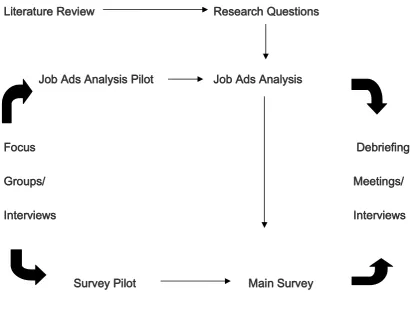
Operationally, this study used several different research tools to examine the role and
status of the HRD/Training function. These included analysis of HRD/Training job
advertisements, a questionnaire survey, focus group discussions and interviews. In
addition, the survey incorporated a set of occupational ranking exercises which were
employed, in conjunction with existing analyses of professional occupations, to identify
the factors that were likely to affect HRD/Training’s organisational and occupational
status.
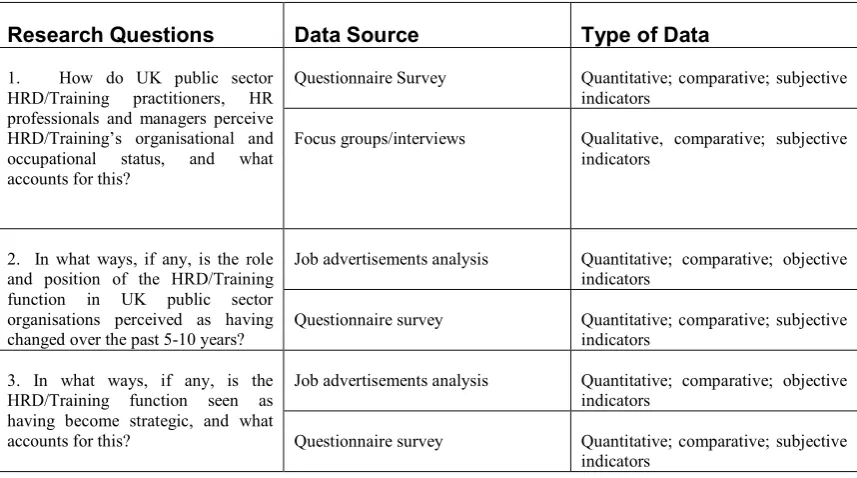
In terms of research tools this study made use of the following:
1. an of 743 analysis of HRD/Training job advertisements in the specialist HR
publication People Management magazine in two seven month periods in 1996-7
and 2003-4 to assess the types of change taking place in terms of how the
HRD/Training role was described at the point of recruitment. Job advertisements
were chosen as a source of data because they were in the public domain and easy
to access, especially those from 1996-7. Accepting the limitations of job
advertisements such as the limited amount of information they offer, the job
advertisements did provide some useful information about how the role is
described at the point of entry, and the ways in which this was different in the two
periods. However, although the study is primarily concerned with the
HRD/Training function in UK public sector organisations, job advertisements
2. A questionnaire survey of 305 public sector HRD/Training practitioners,
HR/Personnel specialists and managers was employed as a means of examining
their perceptions of the HRD/Training function’s role and status. The survey had
a 16% response rate, which is disappointing but nevertheless, it shows that,
allowing for some difference of perception about aspects of HRD/Training, there
is a broadly consistent view of its role and status. In terms of respondents, there
were more from local government (56%) than central government (36%) and
there were nearly two-thirds of the HRD/Training specialists who responded
worked in local government. It is interesting to note that of the 110 respondents
from civil service organisations, the largest number, 47%, were managers and
27% were HRD/Training practitioners and the same number were in
HR/Personnel roles.
In terms of findings, these indicate that the role of the HRD/Training function has
been seen as changing, and more specifically, improving across a number of
dimensions. However, there were differences in the perception of the extent of
such change and improvement, with HRD/Training specialists, more so than
managers, indicating a positive view of the changes to and within the
HRD/Training function. In contrast to the overall relatively positive perceptions
of the role of HRD/Training, the reported perceptions of its organisational and
occupational status were poor. Further, and surprisingly, these poor status
perceptions were generally consistent across the three categories of respondent
3. Pre- and post-survey focus group discussions and a small number of interviews
were used as a means of contextualising and testing the survey findings. The
pre-survey discussions were useful in informing the development of the pre-survey and
the post-survey discussions were helpful in helping with the interpretation of the
findings.
Each of these methods presented a number of challenges including, for example,
technical difficulties such as designing a template for recording the job advertisements
data, and methodological dilemmas such as deciding whether or not to include the
ranking section in the survey. We will return to these issues in later chapters. The next
section outlines some of the conceptual challenges encountered in this study, particularly
in terms of the issue of the boundaries of the concepts underpinning this study, namely,
HRD, strategic HRD, and status.
5.
Key Concepts and the Definitional Challenge
5.1 Overview
Methodologically, this study encountered several challenges, as described in Chapter
Three: Research Methodology. The first of these concerned the three main concepts
around which this research is framed: human resource development (HRD), strategic
HRD, and occupational status. As Chapter Two: Literature Review shows, each is
complex, multi-dimensional, and subject to much debate. The following section
illustrates this by briefing discussing the three main concepts starting with the concept of
5.2 The Concept of Human Resource Development (HRD)
There is much debate about the concept of HRD and its conceptual boundaries.
Specifically, according to Garavan ((Garavan 1997; 1995) and many others (for example,
Garavan, Heraty and Barnicle 1999; McGoldrick, Stewart and Watson 2001; McLean &
McLean 2001; Walton, 2003; Stewart 2005) there is no single, unified or precise
definition of the concept HRD. Walton (1999) and Lee (2001) suggest that part of the
problem that HRD an inherently vague, nebulous and loosely bound concept. Similarly,
Bates et al (2002) and Holton (2002) argue that the concept HRD is prone to definitional
broadness, vagueness and complexity which contribute to an unhelpful lack of clarity
about what it is and is not, and Blake (1995) states:
“…the field of human resource development defies definition and boundaries. It’s
difficult to put into a box.” (Blake, 1995 p.22).
What adds to the definitional problem is, as Weightman (1998) suggests, as with many
other areas of organisational management, the vocabulary is not static and changes over
time so that the same term can be taken to refer to different things at different times or a
particular practice that continues largely unchanged can be given a new label:
“The difficulty is that sometimes it is because of changes of style, at other times because
of a change in substance. Distinguishing the two is not always easy until later”
Not only is there a debate about the term HRD and its relationship with other related
concepts such as training and learning, there is even a debate about the value of trying to
define HRD. For example, Bates et al (2002) claim that attempts to define HRD have had
a limited return. They argue that, despite the at times fervent discourse around describing
what HRD is or should be, “…little has been accomplished in terms of generating
consensus …” (Bates et al 2002 p.229). Ruona and Lynham (1999) agree with Bates et al
(2002) and describe the existing discourse as a self-serving loop:
“[it is]…a conversation that is ongoing and becomes the prominent focus such that little
else actually happens except the having of the conversation. Very few new thoughts are
generated, positions are defended, tradition weighs heavy, and very little progress is
made in understanding and creating new meaning.” (Ruona and Lynham 1999 p.215)
In fact, even the very process of defining HRD is subject to debate. Many analysts have
observed and commented on the problems of defining HRD (Walton, 2003, Metcalfe and
Rees, 2005; Stewart 2005; Lee 2003) and several have argued against even attempting to
do so (Lee, 2001, Mankin, 2001; Holton 2003). Some go as far as arguing that trying to
define HRD, in fact, does a disservice to the discipline and to HRD professionals:
“My fear is that we will find ourselves spending so much time defining our discipline that
we will forget to do the enormously important work our discipline needs to do… Our
constituents and customers have many questions that we cannot answer very well…Will
the fact that we have 1 definition or 20 definitions make any difference in how well we
According to Lee (2001), attempts to define HRD have limited value because most
definitions try to ‘fix’ HRD as a permanent state, whereas the practice itself is more of a
‘becoming’ than of a ‘being’: “I examined promotional literature aimed at HRD
professionals and found four different ways in which the word ‘development’ was used:
development as maturation, as shaping, as a voyage and as emergent.” (Lee 2001 p.331)
Mankin (2001) makes a plea for HRD academics and practitioners to ‘embrace’ HRD’s
ambiguity:
“The current debate is characterized by a view that HRD is too amorphous a concept.
Yet, if HRD has a role to play in helping organizations develop in an era of rapid and
continuous change, then there is a need….to accept that HRD itself is a continuously
evolving, adaptive concept…The HRD of tomorrow will be different from the HRD of today, and it is this process of fluidity that most aptly captures the unique characteristic
of the concept itself, and thus helps to identify its unique contribution to organisational
development” (Mankin 2001 p. 67-8).
Despite these expressed reservations, many others have continued undeterred in their
efforts to define the concept. Torraco defines HRD as “…the integrated use of training
and development, organisation development, and career development to improve
individual, group and organizational effectiveness” , “transdisciplinary”, and with the
potential to “…not only develop work skills, [but also] instil values, enable change, and
advocate for diversity, equity, social responsibility and spirituality in work.” (Torraco
Similarly, Reid and Barrington have described HRD as “…anything relating to the
development of people, including promotion polices, career development and advice,
staff appraisal, skills definition, forward organisational planning, and ethical policies…”
(Reid and Barrington 2001 p. 3).
Some take an even broader perspective and define HRD as any organised learning
experience (Nadler 1984; Harrison 1997; Walton 1999; Lee 1996). Yet others have
broadened this out even further to include both formal, and informal and incidental
learning experiences (Eraut 2000).
As will be discussed in the literature review in Chapter Three, in some instances, HRD is
presented as being synonymous with training, with the HRD ‘badge’ merely replacing the
old training one. In other cases, it is presented as the organisational function that
promotes and facilitates the delivery of a wide range of employee and organisation
development, and organisational culture change activities of which training is one set of
activity (Nadler, 1981). According to Buckley and Caple (1995) and McGoldrick et al
(2001), the two labels, training and HRD, co-exist and continue to be used
interchangeably, both in the literature and in practice, and indeed, in this thesis. This
definitional complexity increases where the literature conceptually weaves ‘HRD’ and
‘Training and Development’ together with an ever increasing number of other, related
concepts such as ‘learning’ (Zwick 2002; Suff 1998 ), ‘workplace learning’ (WPL)
(Rothwell, 1999) ‘education’, ‘human capital management’, ‘talent management’, and
‘knowledge management’(Stiles and Kulisechana 2003; Foong and Yorston 2003;
This all adds to the perception of the concept HRD being almost borderless. It is worth
noting that a few see as its strength (Mankin 2001; Lee, 2001) while many others see this
as its inherent weakness (McGoldrick et 2001; Zahn, 2001; Regabulto 1991; Truss et al
2002; Weightman 1998; Reid and Barrington 2001). Some point out this apparent
‘definitional mess’ has negative consequences for not just a conceptual understanding of
HRD but also for its very identity as a profession. For example, Regalbulto (1991)
argues that this lack of a clear definition reflects the absence of a unified identity within
HRD as a profession, which itself serves to undermine the status of HRD.
The existing conceptual complexity has been further complicated by the fact that over the
past decade there has been an additional shift from the use of the label ‘training’ being
substituted with the idea of ‘learning’ (CIPD 2006a; Segrue & Rivera 2005; Garavan
1997; Garavan et al 1999), and the introduction of affiliated concepts such as ‘talent
development’ (CIPD 2006b) and ‘human capital development’ (ASTD 2003; PWC
2006).
In this thesis, the terms ‘training’ (instead of learning) and HRD will be used throughout
for consistency. Specifically, the hybrid term ‘HRD/Training’ will be employed to reflect
the interchangeable nature of the two individual concepts.
5.3 The Concept of Strategic HRD
Like HRD/Training, the concept of strategic HRD/Training is essentially contested. The
concept has been variously defined and there is an absence of a single unifying definition
(Garavan et al. 1995; McCracken & Wallace 2000; CIPD 2001; Raey 1994). Part of
‘strategic’ is variously interpreted. Ansoff (1987), a leading thinker on strategy, describes
strategy is being about mapping out the future directions that need to be adopted against
the resources available to the organisation. Other definitions on offer include
“Strategy is the direction and scope of an organisation over the long terms which
achieves advantage for the organisation through its configuration of resources within a
changing environment, to meet the needs of markets to fulfil stakeholder expectations.”
(Johnson & Scholes, 1999 p.10)
“[Strategy is] …developing a broad formula for how an industry is going to compete,
what its goals should be, and what policies will be needed to carry out those goals.”
(Porter, 1980 p.xvi)
Some argue that many existing analyses and typologies of strategy, located in the private
sector context, do not transfer entirely to the public sector (Boyne & Walker, 2004;
Joyce, 1999). Other definitions on offer and claiming to be better suited to the public
sector with its specific politically driven policy context prone to short-termism and the
pressure to come up with ‘quick-fix’ solutions (Joyce, 1999) include:
“Strategies help organisations think through what they want to achieve and how they will
achieve. Putting strategies into practice and acting strategically ensures that they are
focused on the things that really matter – not buffeted by events or short-term distractions
– and are able to allocate their resources accordingly.” (Cabinet Office, 2004c p.5)
“[It is] … a pattern of action through which [organisations] propose to achieve desired
However, as Boaz and Solesbury (2007) in Fischer et al (2007), writing about the use of
the terms ‘strategy’ and ‘strategic’ in political life, illustrate, the terms are used
indiscriminately and attached to a wide variety of activities and frequently used only to
denote importance and seriousness. The concepts of strategy and strategic are used
inter-connectedly, as shown in the work of Boaz and Solesbury (2007) with the concept
‘strategic’ being taken as meaning, at a broad level, the act, position or process which
belonging to, useful or important to strategy (The Shorter Oxford English Dictionary,
1973).
Others such as Berlinski et al (2005) suggest there is added complexity of applying the
concepts of strategy and strategic to the government context. For example, they argue
that although governments seek to achieve long term improvements for their citizens, and
political leaders have a vested interest in ensuring that these improvements are achieved,
the pressures of their political working lives are such that they tend to demand – and
receive – advice from officials that helps them perform at a sprint rather than over a
marathon. The most senior officials, who often make up the management board, tend to
behave in similar ways they too are under pressure to focus on the immediate pressures of
running the department – its budgets, staffing, managing risk – and on delivering policy
objectives and rather less on the broader outcomes the department is pursing. This
situation lends itself to a level of short-termism and demand for immediacy in terms of
solutions to given problem, all of which leads to questions about government
organisations’ capacity to work and remain working strategically.
As applied to HRD/Training, the concept ‘strategic’ has been variously defined. For
as a non-core provider of training to that of a core, strategic business partner. The
‘evidence’ frequently cited in support of this assertion includes the claim that it is no
longer simply being ‘immersed in routine training programmes’, is better integrated with
corporate goals and priorities, and is an agent for change (Horwitz 1999; Garavan et al
1995). Noel & Dennehy (1991) indicate that strategic HRD/Training refers to those areas
of practice where function connects to corporate strategy and where it is taking a
proactive approach to aligning its plans and programmes with corporate objectives
(Harrison 1997), and thereby ensuring its work forms part of a comprehensive and
integrated approach to employee and organisation development (McCracken & Wallace
2000). McCracken and Wallace stretch this definition even further and stress that
strategic HRD needs to contribute to shaping rather than to simply respond to corporate
strategy (McCracken & Wallace 2000).
However, as some point out, there are concerns about the concept strategic
HRD/Training. The literature suggests that while strategic HRD/Training has been
conceptually defined and is widely used as a label within the academic community,
evidence of how well it has been translated into practice is patchy (Reid & Barrington
2001; Keep 1989). This divergence of perspectives provides, in part, the impetus for this
study. It is examines various perspectives on offer and uses these to develop a
framework for analysing the extent to which the HRD/Training function in UK public
sector organisations can reasonably be considered as strategic. It is anticipated that this
study will be of both conceptual value in terms of proposing an adapted model of
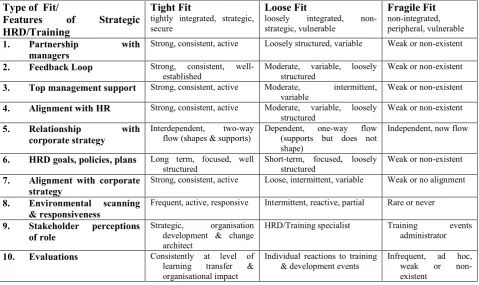
In terms of the exploring the strategicness of the HRD/Training function, Miles and
Snow’s concept of ‘strategic fit’ (Miles & Snow 1990) and Garavan et al’s concept of
‘strategic HRD’ (Garavan 1991 were particularly useful. The concept of ‘strategic fit’
refers to the relationship between business strategy and organisational structure. For an
organisation to be economically viable, there needs to be alignment between its business
strategy and its structure (Miles & Snow, 1990). In this study, the types of strategic fit
described by Miles and Snow and the dimensions of ‘strategic HRD’ presented by
Garavan (Garavan 1991) informed the development of a framework used together to
assess the ‘strategicness’ of the HRD/Training role as perceived by those responding to
the questionnaire survey. Both the two original frameworks, Miles and Snow’s and
Garavan’s, will be discussed in the literature chapter and their conceptual value will be
explored in Chapter 6 that deals with the results of the questionnaire survey.
5.4 The Concept of Occupational Status
As is the case with the previous two concepts, ‘occupational status’ is complex and
multi-faceted concept, and as the literature review chapter will show, it is a well established
field of sociological study as illustrated by, for example, the classic work of Elliot (1972),
Dingwall and Lewis (1983), Abbott (1988), Guppy and Goyder (1984) Hodge et al
(1966), Turner (2001), Freidson (1986), Freidson (1973), Macdonald (1995), Goldthorpe
and Hope (1974) and Esland (1980). At one level, occupational status refers to the
distinct, symbolic value attributed to a particular area of work; at another level, it can
refer to the comparative, specific privileges and power afforded to an occupation.
occupation as a profession’ and its status and prestige (Johnson and Bowman,1997;
Willumsen, 1998; Hatcher, 2006).
Drawing on such literature, this study assesses the organisational and occupational status
of HRD/Training and suggests its status is determined by the complex interplay of a
variety of interconnected factors including its perceived level of power and influence, its
career potential, the level of qualification of those who work in the function, and its
perceived value to the organisation.
Having considered some of the conceptual and methodological issues underpinning this
research, the next section offers a short overview of the structure of the thesis as a whole
and an outline of each of the chapters.
4. Structure of the Thesis
Figure 1.2 Outline of Thesis
Chapter 1
Introduction |
Chapter 2
Literature Review |
Chapter 3
Research Approach & Methodology |
Chapter 4
Job Advertisements Data Analysis |
Chapter 5
Pre-Survey Focus Groups & Interviews |
Chapter 6
Survey Data Analysis |
Chapter 7
Post-Survey Focus Groups & Interviews
| Chapter 8
Discussion of Findings |
Chapter 9
Conclusions, Implications and Future Directions
6.
Summary & Concluding Comments
Although HRD/Training, as an area of organisational practice, attracts a lot of
practitioner oriented analyses, it is of increasing academic interest with, for example, the
launch of university-led Masters programmes in human resource development and the
appointment of Professors of HRD (Iles, 1994). Further, some have called for a greater
level of bridge-building between academic research and professional practice (Hamlin et
al 1998; Swanson & Holton 1997; Hambrick 1994; Currie 2007), and this study is seen as
an opportunity to make a contribution to such bridge-building.
This chapter has outlined the aims and research questions underpinning this study. It has
highlighted the study’s mixed methods research approach and introduced the specific
research tools employed. Further, it has raised some of the conceptual challenges facing
HRD/Training as a field of study, which apply to this study as well. In terms of
contribution, it is hoped that this work adds, in however small a way, to the field of
human resource development research, and specifically, to an understanding of how its
role is perceived not only by HRD/Training practitioners but also by those in a related
function, HR/Personnel, and managers an one important group of stakeholders, and how
perceptions of its role affect perceptions of its status as an organisational function.
Additionally, it is hoped that, given this study incorporates an analysis of HRD/Training
as organisational function and as an occupational activity, it makes a contribution to the
Specifically, it hopes to revitalise debate around a number of critical HRD/Training
issues including questioning the extent to which the representation of HRD/Training as
strategic is part of current reality as opposed to still remaining more of an aspirational
goal. Additionally, it is hoped that this study’s will contribute to the HRD/Training
community’s understanding of the challenges it continues to face, particularly in relation
to its status as an organisational function. Finally, as highlighted earlier in the chapter,
HRD/Training plays an important role in developing people and organisations – therefore
it matters to business, the public sector and the UK economy. As such it owes it to itself
and its stakeholders to be self-reflexive about its role, status and contribution to
Chapter 2
Literature Review: Concepts, Concerns and Challenges
"It could be said that one doesn't have to make the case for training. In fact, many who occupy senior and executive positions have publicly endorsed the claims that can be attributed to training and extol the competence and the contribution of their own training departments. However, this leaves us with something of a riddle because a close examination of the staffing, function and status of training departments very often does not reflect the apparent views and attitudes of organizational chiefs”.
(Buckley and Caple, 1995 P.17).
1. Introduction
Human resource development (HRD)/Training and development is a broad subject rooted
in a variety of disciplines and as such, to produce a focused yet representative and
comprehensive review of its literature is challenging. While this chapter does make an
attempt to reflect the breadth and multidisciplinary nature of HRD/Training, for practical
purposes, it intends to concentrate on the main themes, concepts and issues of concern to
this study, that is, the role, position and status of the HRD/Training function, with a
Accordingly, this chapter confines itself mainly to three main types of literature,
specifically, that dealing with:
1. human resource development (HRD) and workplace education, learning and
development
2. analyses of occupations and professions, and
3. analyses of public sector reform and management
What follows next is an examination of literature dealing with HRD/Training’s changing
context, role and position within organisations. This includes specific consideration of the
literature dealing with strategic HRD/Training and its organisational and occupational
status.
2. The Changing Context of HRD/Training
One important theme in human resources management and development literature relates
to the role of HRD/Training needs to play in order to survive in its changing context (Suff
1998; Rothwell et al 1999; Morton and Wilson 2003; CIPD 2001; Bassi et al 1997), and
specifically the need for the function to demonstrate its strategic relevance (McCracken
& Wallace, 2000a). This theme is located in the broader interest in the organisational and
management literature around issues of organisational excellence and organisational
failure. Miles and Snow explain that this ranges in focus on specific concerns such as the
very survival of aging industries, the pursuit of excellence in mature industries or the
preparation of organisations for rapidly changing global markets and advancements in
While recognising that it is not convincing to offer easy explanations that account for
organisational success or failure, Miles and Snow propose that the concept of strategic fit
as an important and useful starting point. To elaborate, their basic premise is that
successful organisations are those that achieve strategic fit with their market environment
and support their strategies with appropriately designed structures and management
processes. By contrast, less successful organisations achieve poor fit externally and/or
internally. Building on this, they offer a conceptual framework incorporating four levels
of fit, as follows:
1. Minimal fit between strategy, structure and process which is essential to all organisations operating in a competitive environment. Miles and Snow (1990)
suggest that if a misfit occurs for a prolonged period, the result is usually failure.
2. Tight fit, both internally and externally, which Miles and Snow associate with sustained excellence in business performance.
3. Early fit, which is described as the discovery or articulation of a new pattern of strategy, structure and process frequently resulting in performance records, which
in sporting circles would merit Hall of Fame status. The invention or early
application of a new organisation form may provide a more powerful, competitive
advantage than a market or technological breakthrough.
The concept of strategic fit, is a process as well as a state, and refers to a dynamic pursuit
of alignment between the organisation and its environment and to arrange resources
internally in support of that alignment. Miles and Snow argue that tight fit provides the
conditions for performance excellence, however, they accept that in a rapidly changing
environment it can be difficult to maintain a tight fit between the major components of an
organisation and suggest that the ‘perfect fit’ is most often a state to be striven for rather
than accomplished. Further, they explain that minimal fit is a state required for
organisational survival.
In the case of HRD/Training, there is consensus it too needs to be aligned to its changing
environment (Rothwell et al 1999; Bassi et al 1997). This includes alignment with
developments at a national policy level as well as at the local, organisational level. For
example, particular links are made between employee skills and learning and productivity
as illustrated by government driven Leitch Report, published in December 2006. This
argues for investment in workforce skills, indicating that skills development and
increased productivity go hand in hand. It states that in order for UK businesses need to
compete in a global, knowledge-based economy, they will need to have a workforce that
can match or beat the best in the world. Further, Leitch pointed out that 70% of the 2020
workforce has already completed their compulsory education. Therefore, there is a need
to continue to raise skill levels by focusing on those who are working and those now
looking for work or have who have been affected by the recent job losses. In the context
of such perspectives equating productivity in the context of the knowledge driven
strategy and the maintenance of competitive advantage” (Keep 2005 p. 215) and as such needs to demonstrate its alignment with the national skills agenda.
In keeping with reports asserting the need for a national skills investment strategy, there
has been an increasing emphasis on learning and development in the public sector as
articulated in the recent publication of the NAO report Helping Government Learn
(NAO, 2009) and the Government Skills report (Government Skills, 2007) on levels and
types of investment in public sector learning. These reports start from the shared premise
that in order to achieve value for money in public services, public service organisations
need to become better at learning. The NAO 2009 report (NAO, 2009), based on an
analysis of multiple case examples of approaches to training in government departments,
emphasizes the role training can play in developing new skills and knowledge. It is
interesting to note that the report identified silo structures, ineffective mechanisms to
support learning, a high turnover in the workforce and a lack of time for learning as the
main barriers to effective learning, and states that there is scope for senior leaders in
departments to give greater priority to learning. The Government Skills 2007 report
indicates that its research identified the two main barriers to training in government
departments were concerns about the time learners spent away from work, and financial
costs both direct (expenditure on training) and indirect, the cost of the learner being away
from work (Government Skills, 2007). The following section looks at position of
3. Public Sector HRD
This section will consider the specific role and status of the HRD/Training function
within the public service sector, the sector in which is of concern to this study. One
perspective strongly represented in the public administration literature concerns the
increasing pressure, brought about by globalisation, on governments to improve the
competitiveness of their national economies (Lamond 1998; World Bank 1997; OECD
2000). Within this context, the main thrust of papers on UK public sector reform seems
to be that the UK government, in keeping with public reform programmes in other
countries, is under pressure to improve its performance, make better use of all its human
resource potential and strengthen the quality of its policy making and service delivery
(Cabinet Office 2004; 1999, 1996, 1994; Metcalfe and Rees, 2005; OECD, 2000b;
Gershon 2004; O’Toole 2006; Romzek, 2000).
These trends, which serve as the backcloth as well as driver for some of the change
affecting the human resources functions itself, have been attributed in part to the
influence of the New Public Management (NPM) model. This model, which emerged in
the early 1990s, is based on the premise of private sector practices as a solution to solving
the problems of poor public administration and has had a dramatic impact on the
functioning of public services worldwide (Osborne and Gaebler, 1993; Hood 1991;
Giauque, 2003; McLaughlin, 2002; Monteiro, 2002; Pollitt & Bouckaert 2000;
Lane, 2000; Rhodes, 1991; Ferlie, et al. 1996). Compared to the so-called ‘Traditional
Bureaucracy’ model (with its emphasis on rule and procedures), the defining features of
NPM are seen as promoting greater levels of professionalism, skill and efficiency. NPM
the conversion of large government departments into smaller, semi-autonomous, delivery
focused Executive Agencies), performance based accountability (with the use of
performance contracts at the level of the organisation and the individual), and
competitive mechanisms (with the use of compulsory competitive tendering and
outsourcing) - see Hood, 1998; Borins 1996; Larbi, 1999; Giauque, 2003; Herne, 2005;
Lane, 1997). However, it is interesting to note there is little research that explores the
impact of NPM on the role of HRD/Training in any systematic way. Koch is one of the
few to analyze the challenges NPM places on HRD/Training, and examines the extent to
which the latter has been a tool for facilitating NPM reform’s article is one of the few
(Koch 1999). .
There appear to be an increasing number of papers and documents put together by public
sector agencies emphasising the importance of HRD/Training’s role within public service
organisations (OECD, 2000a; UNDESA, 1998, 2005; Cabinet Office, 1996; 1999; HC
2007; Warrington 2004). In the context of public sector reform, HRD/Training is seen as
a lever for facilitating both performance improvement and organisational change (OECD
2000a). According to Goslin (1975), in addition to skills development, government
organisations use it as a means of disseminating information about new policy initiatives,
new methods of service delivery, or changes in internal developments, for example, by
the use of mandatory equal opportunities training to ensure adherence to equality policies
and practices at work. The latter is illustrated by Clements (2000) in his account of how
the equality training is deployed in the police service, and by Auluck (2001) who
not just structures and HRD/Training has a part to play in enabling this to happen.
HRD/Training can be used as a means of communicating organisational values, norms
and standards - and can be, over time, a tool for organisational change (Mankin 2001;
Duggett 1996; Pattanayak, 2003).
Further, The OECD report identifies HRD/Training as having the potential to support
communication strategies that are essential to the effective implementation of public
service reform programmes, on the assumption that ‘informed employees make informed
choices’. The report refers to the concept of the ‘learned government’ and argues that:
“Learning is the much-sought attribute of adaptive and strategic organisations. This is the imprint that separates the winners and losers in the knowledge race. Our current management lexicon overflows with hyphenised applications: life-long learning strategies, learning organisations, learning companies, learning societies, learning cultures, learning individuals…” (OCED 2000a p. 105).
Human resource development in the UK public sector would appear to mirror this
generalised picture, including it being subject to the myriad of related “hyphenated
applications”. That is, a series of ‘learning’ and performance improvement initiatives
have been adopted by large parts of the UK public sector, including the Investors in
People standard, the Business Excellence framework and the principles of the Learning
Organisation (Raper, 1997; Berry, C. & Grieves, 2003; Davies 1998; Hill 1996; Hill &
Stewart 1999; Jackson 1999; PWC 2000; Smith, 2000; Smith and Taylor 2000; Swain,
1999; Seifert & Tegg 1998). For example, Investors in People (IiP), an established