1
Master Thesis
What does HRM look like at a Crowdsourcing Platform?
An Explorative Case Study
University of Twente
Faculty of Behavioral, Management and Social Sciences
Human Resource Management Business Administration
Date: 02-08-2018
Irene Hagens
2
Abstract
The aim of this study was to gain more insight into what HRM practices are used to manage crowd-workers at crowdsourcing platforms and who is responsible for the implementation of these HRM practices. Crowdsourcing can be defined as: outsourcing a task in the form of an open call to an undefined group of individuals, also named the crowd. An explorative case study was executed at crowdsourcing platform PlatformCo. PlatformCo is a British internet service company where riders (crowd-workers) deliver food of restaurants to a requestor at their house by bicycle or scooter. They make use of a self-learning algorithm to regulate processes in the crowdsourcing ecosystem. Via interviews, participatory observation and document-analysis is tried to gain more comprehensive insights in what such an HRM system looks like and what HRM practices are exchanged between the actors in the so called ‘crowdsourcing ecosystem’ at crowdsourcing platform PlatformCo.
3
Content
Introduction ... 4
Theoretical Background ... 6
Definition crowdsourcing and crowdsourcing tasks ... 6
Actors in the Service (Eco)system ... 8
Crowdsourcing Tasks ... 9
HRM Practices ... 10
Ability-enhancing HRM of crowd-workers ... 12
Motivation-enhancing HRM of crowd-workers ... 12
Opportunities-enhancing HRM of crowd-workers ... 14
The current study ... 14
Method ... 15
Research design ... 15
Data collection & Sample... 16
Data-Analysis ... 18
Results ... 19
Case Description ... 19
Overview of the exchanges of HRM practices ... 20
New crowdsourcing ecosystem PlatformCo ... 28
Conclusion and Discussion ... 31
Discussion ... 31
Practical implications ... 33
Limitations and Future research ... 34
Conclusion ... 36
4
Introduction
To cope with the pressures of efficiency and flexibility, companies are increasingly examining the use of different forms of employment to assign work (Rousseau, 1995; Tsui, Pearce, Porter, & Hite, 1995). The interest to make use of external workers, for example temporary employees, rises with the time. Following this tendency companies are, besides ‘investing’ in the skills of their own internal employees (human capital), also more focused on external employees on the market to ‘buy’ their capacities. The latter is also referred as outsourcing. In addition to the increased use of outsourcing tasks to external employees, attention for the use of so-called ‘crowdsourcing’ via the internet arises. This labor-form is defined by Howe (2006) as: outsourcing tasks to a large network of undefined workers in the form of an open call. In recent years this labor-form increased enormously (Afuah and Tucci, 2012; Bayus, 2013; Howe, 2008). The undefined workers, often named ‘crowd-workers’, are not formal employees of the organization.
Crowd-workers are offering a service to a requestor that wishes to outsource an activity in this labor form, with both parties being brought together by the so- called (crowdsourcing) platform firm. In most cases the platform firm is the owner of the key technology and the regulator of the interaction between the requestor and the crowd-worker. There is stated that there can be a huge different in the function, the interaction and the way of organizing a crowdsourcing platform (Kuhn & Maleki, 2017). Referring to the interaction function, a typical aspect is that a crowdsourcing platform firm can be seen as a ‘third party’ in the relation of the crowd-worker and the requester. The platform regulates and facilitates the interaction and transaction of the service between the crowd-worker and the requestor. An example of such a crowdsourcing platform is Amazon Mechanical Turk. At this crowdsourcing platform applicants for tasks and crowd-workers who perform it come together.
Crowdsourcing organizations differ in several aspects from traditional work organizations. An important difference is the way in which crowd-workers might be managed in a different way that ‘regular’ employees are managed. Whereby employees in traditional organizations might rely on HRM practices as pay and promotion to get motivated, members of crowdsourcing organizations are not formal employees of the organization and therefore not able to rely on these HRM practices (Doan, Ramakrishnan & Halevy, 2011; Howe, 2008).
5 comparison to traditional labor-forms. there is little known about which HRM practices are used to manage crowd-workers at the platform at this moment. From a theoretical point of view, it is therefore interesting to study which HRM practices are used to manage crowd-workers, provided that they have different employment relationships. Another point is that the importance of HRM practices may still apply to these platforms, even if the employment relationship is assumed to be different from regular workers. This is most likely to occur when platform firms have to attract and retain crowd-workers as well (Boons, Stam, Barkema, 2015) and ensure they are evaluated to guarantee that future requesters are provided with good services. It might be assumed that even in this employment relationship HRM practices are important, because crowdsourcing platforms rely supposable heavily on the retainment and the commitment of the crowd-workers. Therefore, the chosen focus to study HRM practices, is also relevant from a practical point of view.
A second manner how crowdsourcing differs from regular employment relationships concerns a difference in stakeholders that bear the responsibility of executing the HRM practices for crowd-workers. It is known that for regular workers most often the direct supervisor plays a key role in executing different HRM practices (Bos-Nehles, Van Riemsdijk & Looise, 2013). Crowd-workers however do not have a direct supervisor. It is currently unknown who is involved in executing HRM practices for crowd-workers. Therefore, it is interesting to study who is responsible for HRM practices at a crowdsourcing platform from a theoretical point of view. In order to examine the practical relevance, this second research question gives the opportunity to gain insight to what extent the identified persons are implementing the HRM practices in a good or bad manner in a latter research stadium.
6
Theoretical Background
Definition crowdsourcing and crowdsourcing tasks
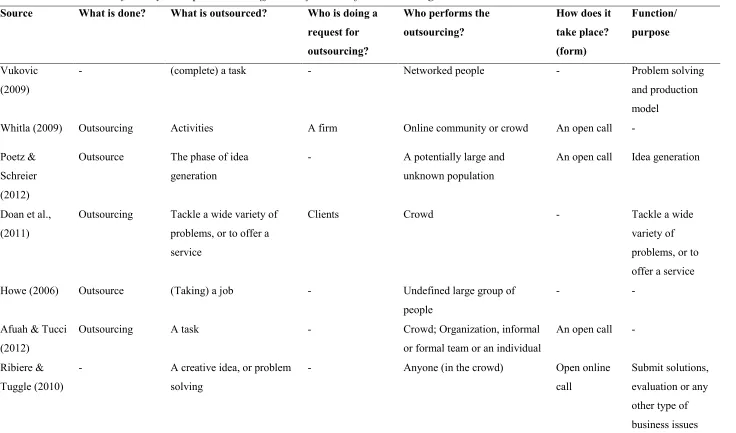
Before going into detail about HRM practices that may be used for managing crowd-workers, I will define the concept of crowdsourcing first. Nowadays crowdsourcing is often treated as an umbrella term, since the definition and the scope of crowdsourcing varies heavily among different studies and in practice. If you look at this positively, the broad scope of the definition contributes to the adaptability of these platforms. This adaptability allows crowdsourcing to be a very powerful practice. However, it leads to difficulties in classifying crowdsourcing practices (Estellés-Arolas & González-Ladrón-de-Guevara, 2012). A concrete example, while Huberman, Romero and Wu (2009) perceive Wikipedia as a crowdsourcing platform, Kleemann, Voß and Rieder (2008) do not. Because of these difficulties with classifying and definition, I will first present and discuss a concrete definition of crowdsourcing which will be used in the current study. To frame a clear definition of crowdsourcing for this study, I have developed an overview in table 1 which shows both the similarities and distinctions between the key concepts in crowdsourcing definitions.
7 Table 1. An overview of the key concepts in seven different definitions of crowdsourcing
Source What is done? What is outsourced? Who is doing a request for outsourcing?
Who performs the outsourcing?
How does it take place? (form) Function/ purpose Vukovic (2009)
- (complete) a task - Networked people - Problem solving
and production model
Whitla (2009) Outsourcing Activities A firm Online community or crowd An open call -
Poetz & Schreier (2012)
Outsource The phase of idea generation
- A potentially large and unknown population
An open call Idea generation
Doan et al., (2011)
Outsourcing Tackle a wide variety of problems, or to offer a service
Clients Crowd - Tackle a wide
variety of problems, or to offer a service Howe (2006) Outsource (Taking) a job - Undefined large group of
people
- -
Afuah & Tucci (2012)
Outsourcing A task - Crowd; Organization, informal
or formal team or an individual
An open call -
Ribiere & Tuggle (2010)
- A creative idea, or problem solving
- Anyone (in the crowd) Open online
call
8 Actors in the Service (Eco)system
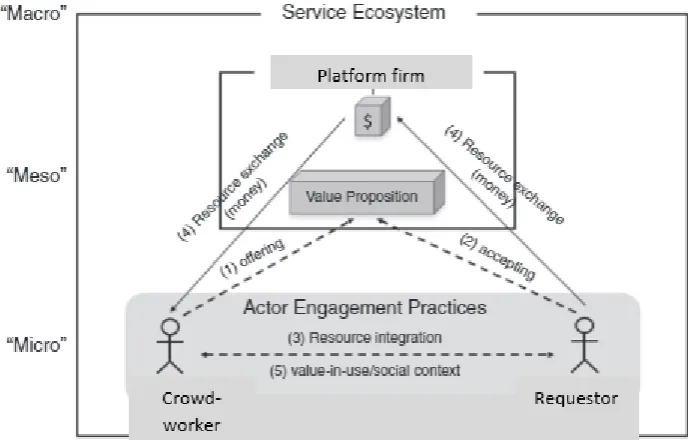
To describe which actors are involved in the crowdsourcing process in more detail, the key concepts shown in table 1 and the framework of Breidbach and Brodie (2017) about the actors in the system of crowdsourcing processes will be used, see figure 1.
Figure 1. Adapted theoretical framework of service ecosystems, engagement platform, and actor engagement practices in the sharing economy context (Breidbach & Brodie, 2017)
[image:8.595.89.438.173.393.2]9 called: the requestor. The last actor in the systems concerns the crowdsourcing platform. In figure 1 this is displayed as the ‘platform firm’. The platform is a firm that uses technology to facilitate the needs of the requestors by the supply of labor/services of the crowd-workers (Kuhn & Maleki, 2017). Overall, the main function of the platform might be described as serving the exchange of physical and digital resources between the crowd-worker and the requestor in the system (Breidbach & Brodie, 2017).
These three different actors function together in a system that enables and sustains the crowdsourcing process. The interaction and exchange of various resources by the actors in the system contributes to the co-creation of value, which is indirectly beneficial for all actors in another form (Breidbach & Brodie, 2017). In figure 1 there is already displayed how money as a resource is exchanged within system. It is shown that from left to right the crowd-worker is offering a labor task to the platform and that the requestor might accept this offered labor task of the platform. By accepting the task, the requestor pays the platform money (resource), while the platform pays the crowd-worker for performing the task.
Crowdsourcing Tasks
Table 1 shows that the definition of the sort and the function of crowdsourcing tasks that are exchanged between the actors varies, but also includes some communalities. In almost all the definitions there is described that there has to be a concrete task which is asked to be performed. This given, internet sites which have the opportunity to share content with each other, like Wikipedia, do not belong to crowdsourcing. In these kind of applications there is not a concrete task which is asked of the crowd, so therefore these applications are excluded as crowdsourcing platforms (Nakatsu, Grossman & Iacovou, 2014; Estellés-Arolas & González-Ladrón-de-Guevara; 2012, Kleeman et al., 2008). The study of Nakatsu et al. (2014) researched multiple sorts of crowdsourcing tasks and identified three dimensions by which a crowdsourcing task can be described more in detail.
10 to work together to complete a task. However other studies argue that the outsourced tasks are performed by individuals. The last dimensions is about task commitment, which refers to the amount effort and resources that is required to perform or solve the task.
To illustrate examples and different functions of crowdsourcing tasks, a couple approaches of Nakatsu et al. (2014) will be outlined. They divided crowdsourcing in different sort of approaches. The first example is contests, this is like open competitions where the best idea will be rewarded. A second example is called ‘crowd-sharing applications’. A well-known example is Airbnb, which allows individuals to rent their homes or apartments to vacationers or tourists. A third example is customer-driven innovation. For example, Starbucks, it seeks answers from the crowd for new and better ideas for their services. To compromise the different functions of crowdsourcing, you could state that in essence it mainly serves to generate ideas, complete tasks or to solve problems. These three general functions are questioned to the crowd in the form of an open call. These open calls are answered by the crowd-workers for financial rewards.
Based on the dimensions of Nakatsu et al. (2014), the task studied in the current research can be described as well structured, low in task interdependence and low in task commitment. Concerning the approaches of Nakatsu et al. (2014), the task in this study does not met a contest, crowd-sharing application or customer driven innovation approach. However, the task in this study is characterized on the completion of a task whereby an individual crowd-worker is performing the task, the requestor does the open call for the completion of the task and the platform firm is regulating and facilitating the exchange of resources and services between the crowd-worker and requestor.
HRM Practices
11 HRM practices in organizations are used to manage employees and are often focused on the skills, knowledge, motivation and opportunities of employees (Jiang, Lepak, Han, Hong, Kim & Winkler, 2012). Well implementing these practices might contribute to organizational effectiveness and improve firm value (Edmans, 2012; Harter, Schmidt, & Hayes, 2002). There is chosen to use the framework of Jiang et al. (2012) to study the HRM practices in the current study, because they studied HRM practices together as part of an HRM system. The current study is also focusing on an HRM system at a crowdsourcing platform, so therefore Jiang et al. (2012) is most appropriate to use as a framework. Jiang et al. (2012) identified three HR policy domains in their study. These domains include: ability-enhancing HRM practices, motivation-enhancing HRM practices and opportunity-motivation-enhancing HRM practices. There is argued that all three domains together contribute to employee performance and every single domain consists of one or more HRM practices.
The three HR domains and the corresponding HRM practices are shown in table 2. I will shortly describe each domain based on the study of Jiang et al. (2012). First, ability-enhancing HRM refers to the collection of HRM activities that serve to develop and uphold the competencies of employees. Recruitment and selection of job applicants might contribute to getting the right competences in an organization. Competencies might be further developed or influenced by practices as training and development. Second, motivation-enhancing HRM concerns practices as compensation that influence the motivation and effort of employees by monetary and non-monetary rewards. Another motivation-enhancing HRM practice is performance management. This might be understood as an integrated approach to evaluate and appraise employee performance to ensure employees are focusing their work efforts in a way that contributes to organizational outcomes.
At last, opportunity-enhancing HRM includes practices that gives employees the possibility to use their skills and knowledge in their work. The first indicator, job design, might be understood as the degree of autonomy present in a job. The degree of involvement is a second indicator for opportunity and gives insight into practice aspects as empowerment, information sharing and to what extent employees have a voice.
12 Table 2. Identified HRM practices
Abilities Motivation Opportunities
Recruitment & Selection Performance management – appraisal/evaluation and feedback
Involvement
Training & Development Compensation, Incentives Job design – autonomy
Ability-enhancing HRM of crowd-workers
In the HRM domain of abilities there is for example known that there are platforms which use specific recruitment and selection practices. An example of this is crowd-workers who have to meet a required skill-level before they can register as workers to the platform (Kuhn & Maleki, 2017). Some labor platforms have strong incentives to inspect crowd-workers before allowing them any work opportunities. These processes are more or less comparable to those of ‘regular’ employers. For example, DePillis (2014) reports that labor platform firms might have a hiring process comparable to those of employers. This might include requiring background checks, face-to-face interviews, and/or basic skill assessments such as a test drive, and some have even claimed to reject the majority of applicants. In most cases, the platform is selecting a crowd-worker for a task. However, there are also platforms whereby the final decision for a crowd-worker takes place by the requestor (Kuhn and Maleki, 2017). These examples show that selection of a crowd-worker for a task might take place both via the platform as well as the requestor. So, there might be assumed that HRM practices as recruitment and selection within the HR domain of abilities are present in crowdsourcing processes, and that both the platform as the requestor play important roles in this process.
Literature shows there is not much attention for the training and development for crowd-workers. It is known that platform Uber routinely sends messages to their drivers with tips on how they can improve their passenger ratings and earnings (Kuhn & Maleki, 2017). However, this form might better be described as an advice to the crowd-workers instead of as practice of training and development.
Motivation-enhancing HRM of crowd-workers
13 assessment of performance takes among other place at the platform Mechanical Turk, whereby the crowd-workers are assessed by their proportion of completed tasks for which the requestor chose to compensate them (Kuhn and Maleki, 2017). Requestors of Mechanical Turk have the opportunity to select a cut-off score in the acceptance rate so crowd-workers below this cut-off are not able to assign for the task. In addition, requestors might use their own criteria and algorithms, so the platform presents the most appropriate choices of crowd-workers to the requestor. Requestors are at some platforms able to develop their own preferred lists of used crowd-workers (Kuhn and Maleki, 2017). Besides this, crowd-workers are also rated via electronical feedback on their performance. If a crowd-worker has higher ratings at platform Wonolo, then he or she gets new job postings earlier and has the opportunity to react firstly compared to other, lower rated crowd-workers (Kuhn and Maleki, 2017).
From the platform PlatformCo there is known that crowd-workers receive monthly performance reports that show their average delivery time metrics compared to an algorithm calculation. This report informs the crowd-worker how quickly they should have been able to complete orders (Kuhn and Maleki, 2017). At platform Task Rabbit, specified performance criteria are set up. If crowd-workers fulfil these criteria, they will be awarded in the form of an ‘Elite badge’, which in turn will lead to higher chances of being selected for a new task. In all, there might be stated that performance evaluation stems from two sources to the crowd-worker. Both the platform and the requestor are highly involved.
Compensation in the crowdsourcing process takes mostly place in the form of payment in monetary rewards, whereby the platform is the facilitator and determines the pay-rate for the task (Breidbach & Brodie, 2017; Kuhn and Maleki, 2017; Nakatsu, 2014). This means that the requestor pays the platform and the platform in turn pays the crowd-worker (Breidbach & Brodie, 2017). At some platforms, for example at Wonolo and Mechanical Turk, the requestor has the possibility to set their own pay-rate for a task. Crowd-workers have the possibility to react on the tasks if they are appealing to them (Kuhn & Maleki, 2017).
14
Opportunities-enhancing HRM of crowd-workers
About the HR domain opportunities there is known that Uber informs their crowd-workers of passengers requesting transportation, the expected time of arrival and fare estimates (Breidbach & Brodie, 2017). All these aspects might contribute to the involvement of the crowd-workers to their task. Beside this, it is also known that Uber gives the opportunity of safety checks to the crowd-workers. The autonomy level of crowd-workers is mostly dependent on the kind of platform and the task. Kuhn and Maleki (2017) describe that at some platforms the workers can apply for tasks which are appealing to them. In these cases, the autonomy is often high, because crowd-workers might choose their own tasks and the way in which they want to perform that task. However, there is outlined that some platforms started to set up short time-limits for crowd-workers to choose an appealing task, which is experienced as a decrease in their autonomy (Weber, 2014; Kessler, 2015).
The current study
In the previous section is described what HRM practices at different crowdsourcing platforms in general might look like. However, this information is found as separate HRM practices and stems from different sources and platforms. In all, this does not give a comprehensive view on how an HRM system at a crowdsourcing platform functions and which actors are involved in the implementation of these HRM practices. The current study will therefore focus on a comprehensive HRM system, whereby more in-depth insight might arise about what HRM practices are used to manage crowd-workers and who is responsible for the implementation of the HRM practices.
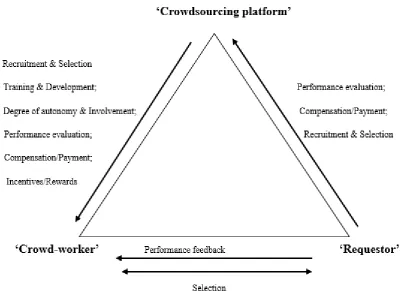
15 Another example of an arrow is the HRM practice performance evaluation. Requestors are appraising the crowd-workers on their performance. Other requestors might benefit of this, by choosing in the future the best appraised crowd-worker. The platform also benefits of this, while the crowd-workers are controlled and monitored, which might result in a better performance.
Figure 2. Conceptual framework of the exchange of HRM practices in the crowdsourcing ecosystem.
Method
Research design
[image:15.595.99.500.194.485.2]16 each other. This system of exchanges was also called the actor service ecosystem and was in this study identified as the phenomenon (case) to study more in-depth in its own natural setting. In-depth knowledge is needed in order to explore in more detail what HRM practices are exchanged between the actors in the service ecosystem and who is responsible for the implementation of these HRM practices.
The case study was conducted at crowdsourcing platform PlatformCo. PlatformCo is a fictive name. PlatformCo was approached for this study because it was in line with the formulated definition and in agreement with the actors as shown in the developed conceptual framework in figure 2. From an HRM perspective this platform was interesting, because it gave the opportunity to study the exchanges of HRM practices between the crowd-worker, the platform and the requestor in depth.
PlatformCo is a British internet service company where riders deliver food to a requestor at their house by bicycle or scooter. Restaurants can connect to PlatformCo, so requestors can order food of connected restaurants via the PlatformCo website or via the app. PlatformCo aims to deliver the order within 30 minutes at the requestor’s place (PlatformCo, 2018). PlatformCo is established in 2013 and located in several European countries and in Asia. The current study is focused on the PlatformCo company in the Netherlands, which headquarter is based in Amsterdam. PlatformCo is active in 14 different cities in the Netherlands and it made a transfer from riders as employees in salaried employment to riders as freelancers in 2017 (PlatformCo, 2018; Wikipedia, 2018).
Data collection & Sample
The data was collected via three different data collection techniques. These were: interviews, document-analysis and observation.
Interviews
17 practices in the actor crowdsourcing ecosystem. Therefore, it is valuable to interview both the crowd-workers as well as platform representatives as actors, to gain insight in what HRM practices are exchanged between the actors and who is involved in these processes.
An interview scheme was set up separately for both actors. In both interview schemes, several questions were set up to gather information for nine different HRM practices. In the HRM domain of ability, training and development was for example measured by: What does the platform do to ensure that you (crowd-workers) have the skills needed and develops your skills to do your job well? Secondly, in the HRM domain of motivation, performance evaluation was for example measured by: Are the performances of crowd-workers judged based on selected criteria? Thirdly, in the HRM domain of opportunities, job design was for example measured by: To what extent do you (crowd-worker) have the opportunity to determine by yourself how and when you want to perform your task? The complete list of interview questions for the crowd-workers and platform employees are shown in appendix A and B. The interview schemes served to us as a guideline to gain more information of about the exchange of several possible HRM practices.
18
Observations
The second manner of data collection took place via participatory observation. This instrument was chosen, because we assumed that we might observe some HRM practices by ourselves. In addition, the observation contributed to our research goal by studying the actors of the service ecosystem in their natural setting and observe which actors are involved in the exchange of HRM practices. The observation was done by applying ourselves for a rider session via the PlatformCo app. We delivered food one session by ourselves as a rider and completed two different orders in the city center of Amsterdam. In this participatory observation we studied mainly the HRM practices performance evaluation and job design.
Document analysis
Moreover, there was also done document-analysis at the platform of PlatformCo. This choice was made, because it might give the opportunity to identify HRM practices via the information present in the different applications. We focused thereby on the HRM practices: selection, compensation, incentives, performance evaluation, job design and job involvement. The analysis was done on the application procedure where we pass through to become a rider and on the Rider app, which was downloaded by us. The application procedure gave us more insight to analyze the HRM practices selection, compensation and job design. The Rider app gave us mainly insight in the HRM practices performance evaluation and job design. In addition, the website of PlatformCo was analyzed wherein all above HRM practices were examined. This was done by focusing on the website page ‘how to become a rider’. Mainly the FAQ’s page gave useful information about the HRM practices for crowd-workers.
Data-Analysis
19 We separately code the biggest interviews of one platform employee and calculated Cohens’s Kappa to judge the intercoder-reliability. The value was 0,852, which indicates that there was almost a perfect agreement (Landis & Koch, 1977). Most differences in coding were present at the HRM domain of opportunities. Therefore, we had some discussion and reached an agreement how to code this in the remaining transcriptions. All the interviews were code deductive and after this an inductive way of coding was used to explore the data more in relation to current literature about HR at crowdsourcing platforms. This inductive way of coding was done separately by both coders.
Results
Case Description
In the next section the case of the study, the actor service ecosystem, will be described in its own natural setting. Firstly, the primary process and service exchanges of the actors in the crowdsourcing ecosystem will be clarified. Crowdsourcing platform ‘PlatformCo’ (1st actor) is a firm that facilitates the process of delivering food and drinks from restaurants (2nd actor) to requestors (3rd actor) by the deployment of riders (4th actor, crowd-workers). The riders are humans who are applied to PlatformCo as freelancers. Requestors have the opportunity to order food/drinks via the PlatformCo app or website of restaurants who are connected to PlatformCo. This order will be delivered by riders of PlatformCo. Riders are every week able to sign up for sessions of the next week via the rider app. If the rider is online during a signed-up session, then he or she will receive the order of a requestor via the rider app. The rider will pick up the order at the restaurant and deliver it to the requestor. The order of a requestor is assigned to the rider via the calculation of an algorithm. In all, these are the four main actors and the primary process at PlatformCo.
In this primary process, all four actors serve each other by the exchange of providing services. Mainly, PlatformCo is the actor who is serving the restaurant and the crowd-worker by creating work and compensation. Beside this, PlatformCo is offering a service to the requestor by assigning a crowd-worker who is in turn serving the requestor by picking up and transporting the order to them. However, the restaurant is also serving the requestor by producing well qualified food and serving the platform and riders by enlarging the production and more work opportunities. This is in summary an overview of some services exchanges that are taking place between the actors in the system. Later, the exchanges of HRM practices between the above described actors will be in depth described.
20 orders as a side-business or to generate extra income. PlatformCo does not have specific personal information of the riders, like education or experience. As noted by PlatformCo’s operation manager, PlatformCo is often trying new HRM practices or adapting existing HRM practices and evaluating which practices are effective to the riders. In addition, PlatformCo is very dynamic in their operations and therefore HRM is also continuously changing at PlatformCo:
'Yes, that is a characteristic of PlatformCo it is not the same here for almost a week. We also just try something. You want the perfect system. We are looking at data all the time, okay: so many orders and so many riders and then we will fit again’ (Performance manager PlatformCo)
The riders of PlatformCo were employees until the end of 2017. However, this employment relationship has changed. Nowadays the riders are connected as freelancers to PlatformCo. Multiple PlatformCo representatives told that this choice was made chiefly, because it would increase the flexibility for both PlatformCo as riders. This change in employment relationship leads to developments and restrictions in HRM. One important aspect is that legally PlatformCo is no longer the employer of the riders. For HRM, this means that PlatformCo is not allowed to require specific behavior of riders in how the tasks has to be performed. So, PlatformCo must consider that applied HRM practices do not implicate an employee and employer relationship between the rider and PlatformCo, as described by one engagement manager of PlatformCo:
‘... that is legal a very grey area, because as a client we are not allowed to give instructions to freelancers, because they are independent, so they are allowed to decide for themselves how they interpret the assignments, so we cannot say you should do your job in such a way, so everything in terms of instructions is not allowed' (Engagement manager PlatformCo)
Nowadays, there is a lot of discussion in the NL’s about PlatformCo’s method concerning the absence of a real self-employment relationship of riders. The Dutch government is examining and criticizing PlatformCo’s policies regarding false self-employment of riders.
In the next section, the HRM practices will be described and the involved actors in the exchanges of these HRM practices will be identified. In the end of this section a new developed crowdsourcing ecosystem for this case is shown.
Overview of the exchanges of HRM practices
Ability enhancing practices – Recruitment: Broad public
21 described that there is a referral program whereby current riders can suggest new riders and receive both a bonus for referring and starting as a rider at PlatformCo:
‘Hiring a friend, so if I give someone my referral code, then I get 200 euros and after 30 orders, he gets 100 euros.’
(Rider PlatformCo)
As noted by a supply manager of PlatformCo, the target group for new PlatformCo riders are mainly students and they use an external bureau to receive information about the location of this group, so promotion can take place at these locations:
'... often it is in consultation with the agency, who specialize in it, and they know that well. That target group can indeed be found on the Boelelaan and very often there and there, so there will then be targeted.' (Supply
manager PlatformCo)
In addition, Riders themselves are recruiting new applicants by the PlatformCo clothes and PlatformCo thermal bag that riders might use during their work. In all, recruitment of riders is done very broadly, because a large amount of people is able to perform this job.
Ability enhancing practices – Selection:Fast onboarding!
The selection procedure to become a rider is dependent of the city where a rider will deliver orders. Whereby riders in Amsterdam are invited to come at the office to complete the selection process face to face with an employee of PlatformCo, riders in the other cities complete their selection process online. Riders are only selected by PlatformCo on mastering the Dutch or English language, possessing a Netherlands Citizens Number, a Chamber of Commerce (CoC) registration and an age elder than 18, because they will work as a freelancer. This information is checked by PlatformCo. Selection of riders is not taking place based on personal information as for example their skills or experience:
‘We only need some standard data, purely to draw up an agreement, and indeed a CoC registration and an ID, which also has to do with a legal status. You do not have to share private things. We do not have a screening or something.’ (Support manager PlatformCo)
22 experienced rider. However, due to the legal issues concerning self-employment it is not allowed anymore to onboard the riders via this manner. A test ride to instruct new riders is implicating an employment relationship.
In the end of the selection and onboarding process a contract has to be signed by the rider. This contract is mainly focused on the earning per order and insurances and is used by PlatformCo to give some conditions about working at PlatformCo. The contract can be dissolved without any reason by both parties. In all, the selection and onboarding procedure is in such a way designed that riders can start as fast as possible with their job at PlatformCo: '.. the registration process is basically online, and that should be arranged so that if you log in tomorrow, that you basically could work tomorrow and it is really meant, that you alone, you can do it yourself.’ (Supply manager PlatformCo)
Ability enhancing practices – Training and Development: Legal issues and external parties Riders at PlatformCo are not formally trained by PlatformCo. PlatformCo is not allowed to train the riders in performing their job, because riders are employed as freelancers:
'Now we say, no, they may know for themselves how they will do that, so it is no longer relevant to give such a training, in fact, that would detract from how they by themselves fill in being a deliverer. ' (Operation manager PlatformCo)
‘.. So everything that has to do with learning and development we have to do through an external party, so we cannot provide training ourselves ....’ (Engagement manager PlatformCo)
However, an engagement manager of PlatformCo noted that they do receive some suggestions of restaurants via PlatformCo what might for example lead to a better experience at the restaurants:
‘...we cannot impose them, but we can give them in an e-mail, just advice, that is appreciated by the restaurants ...’ (Engagement manager PlatformCo)
Beside this, PlatformCo has an engagement department who organizes workshops and clinics via external parties wherefore riders can sign up. There is made a distinction between clinics which are related to the task of the rider, for example a cycle clinic or safety briefing, and clinics which are unrelated to the tasks and serve for the self-development of a rider, for example a language course or cookery course.
In addition, riders argued that they also train themselves by learning at which location they have to cycle in a certain zone, so they will receive the most orders, how to react on fault client addresses in the app and roadblocks and what the best time is to open the app to sign up for new sessions:
23 In all, these findings might implicate that due to legal issues, training and development is mostly done via external partners and are initiated by the riders themselves.
Motivation enhancing practices – Compensation: Variable Compensation
Riders receive for their service a standard compensation of €5,- per delivery. Approximately riders can do 2 or 3 orders in one hour. However, this is dependent of the traffic, the waiting time at the restaurants and how many clients are ordering food in a session. PlatformCo strives to a sufficient wage per session for a rider by keeping an eye on the number of riders and the number of orders per hour:
'.. because we have some kind of periods and say in this period are so many places and people can reserve then we hope so, I cannot guarantee, because you do not know how many orders are going to be done. you never know that. but you hope they have at least a decent wage.’ (Performance manager PlatformCo)
'Yes, on average, we try that riders can deliver 2 orders per hour. That is the aim we have. Everything that is above this is super, then they have more income and that's perfect.’ (Performance manager PlatformCo)
Riders do receive their compensation every month via PlatformCo or via an external payroll company, for example Verloning.nl. Riders applied at this payroll company don’t have their own CoC number and their salary administration is done for them by the payroll company. Requestors pay the order and the service of delivery via the app and this payment will go indirectly via the headquarter of PlatformCo in London to the restaurant and the rider. In addition, requestors can pay tips via the app to the rider at the moment they place an order, or they can give it cash to the rider when the food is delivered. One rider described he receives the full tip, so no percentage has to be handed off:
‘In this sense nowadays you can see if someone has given a tip. People can give a tip in cash or via the app. And when I arrive at the customer, I see tip 1 or 2 euros on the screen. So then you know all that customer has given a tip…' (Rider PlatformCo)
In summary, the compensation of riders is variable due to external factors.
Motivation enhancing practices – Incentives: Do More Orders
PlatformCo uses bonusses on top of the basis payment of €5,- per delivery. These incentives are applied if there are circumstances where there is a need for more riders in a session. These circumstances are: a bad weather forecast, national holidays or new cities to attract riders:
24 The compensation per order rises around €7,- per delivery. Moreover, riders receive a new bonus every two weeks for a certain amount of deliveries which is called the ‘Do X Get Y bonus’. All these kinds of bonuses are established by PlatformCo and are monitored and changed continuously by the operation team who are analyzing the data:
'We have an incentive, called Do X get Y. Do an X number of orders and get Y in amount. That is our biggest incentive, every two weeks it is determined again. We look at the number of orders that have been made and how many Riders have earned. And on that basis our incentive changes. So that a good income can always be earned.’ (Support manager PlatformCo)
The way incentives are used to motivate riders, illustrate more in detail the continuously change of HRM practices at PlatformCo. Overall, the above incentives are directed to let the crowd-workers execute more orders when PlatformCo is in need of more riders. Beside incentives in the form of monetary rewards, PlatformCo also has partnerships with other companies. PlatformCo riders can receive some extra advantages. These are for example discounts at some restaurants which are applied to PlatformCo and discount at cycle firms. This last partnership is related to the task of PlatformCo riders and established to support them directly in their job:
‘We have a partnership, for example with the bicycle mechanic. If you have something with your bike and it needs to be repaired, you can do so via one of our partners with a discount. We do not rent electric bikes ourselves, but we do have a partnership with Urbee. Urbee leases e-bikes. And then we have a discount code with which you can try the bike for free the first time. And then per hour you get a euro discount if you do that via PlatformCo.’
(Support manager PlatformCo)
All these kinds of incentives are shown via a notification in the app, the newsletter via the mail or at the PlatformCo community website. This last one is an internet page where riders can find all the basis information, an explanation of how PlatformCo works, FAQ’s and some actualities.
Motivation enhancing practices – Performance evaluation Supply Chain Performance
Management
A supply manager of PlatformCo described that performance evaluation of riders is taking place based on: the attendance rate, the amount of sessions worked in the peek-hours (evening and weekend) and no cancellations before 24 hours of the start of a session. If riders have good statistics, then they will be rewarded for this by getting earlier access to book sessions:
‘... How you can work on that, that are three things, firstly, just present, so if you book, that you are there, work during the peak, especially in the weekend, Friday, Saturday, Sunday between 18.00 and 20.00 or so, then it's really the busiest, and if you're there often, we find that very nice and last is late cancelling, so people can always cancel their shift, that's no problem, but do you do it shorter than 24 hours in advance, your statistics will be
25 In principle, sessions for the next week can be booked on Monday at 17 o’clock. However, if a rider has good statistics, he or she gets the opportunity to book the sessions at 15 o’clock or 11 o’clock. The statistics are shown to the rider in the app with a percentage. In addition, riders themselves can rate the delivery in the app via thumbs up or down and can place a notification in the app or sent an email. This information is forwarded to Rider Support who will take further steps.
The requestor can also give feedback to the rider or the restaurant in the Rider app via thumbs up or down and a specification in a type-form if it concerns the food or the delivery. This information is also forwarded to Rider Support and dependent of the kind of feedback they will contact per telephone the rider to ask what was happened or proceeds the message to the account managers of PlatformCo who are managing the restaurants:
‘Yes, the customer, also gets a thumbs up and thumbs down and he can indicate again: Is the complaint or dissatisfaction
about something which is food related or it is about the rider and that comes back to us. If that is about a rider then we will call again. When it comes to food, the account managers go back to it.’ (Support manager PlatformCo)
Beside this, performance evaluation is also taking place for the restaurant. This evaluation is based on the quality of the food which is judged by the requestors, and the preparation time for the food which is monitored via data performance at PlatformCo. The last aspect is important for riders, because they get paid by delivered order:
‘.. Another tip, sometimes you come to restaurants and then they start cooking. That can be very difficult to earn more .... I would like the restaurant to prepare it in advance so that I can take it in time or wait 2 minutes and then take it, then I can also earn more. There is no thought about us. There is also a feeling that the restaurants have no respect for the deliverer. We are also part of the team, we work together to bring something to the customer.’ (Rider PlatformCo)
Riders are allowed to reject an order. It occurs that riders, who have a previous experience to wait for a long time at a certain restaurant, have a higher intention to reject the next order of this restaurant. Consequently, this leads to a higher delivery time of an order, because a new rider has to be appointed for the delivery and has to accept it. It is very imaginable that the experience of the requestor is negatively influenced concerning using PlatformCo if the delivery time takes longer than is communicated to the requestor. As noted by a performance manager of PlatformCo, these relations uncover the supply chain management between the four actors in the crowdsourcing ecosystem:
‘... but if riders continue to refuse and what [Name] just said of those three minutes, for a rider who refuses, if then the next one refuses, and the next also refuses, then the chances are very high that the rider who has accepted the order arrives too late at the restaurant, causing the restaurant to complain again, your riders do not arrive on time. So we have to keep that circle complete, so my job was to go to account managers, guys, this is really wrong with these restaurants.’ (Performance manager PlatformCo)
26 This supply chain process must be carefully managed. PlatformCo has account managers employed who are managing the performance of the restaurants and also give them feedback based on the available data. Restaurants with good statistics on established preparation time and food quality are rewarded for his by a higher place in the ranking list of restaurants. This list is shown to requestors when they want to order food and drinks. Restaurants also have the opportunity to give feedback about the riders by contacting the account managers, who will send this message further to Rider Support.
Opportunity enhancing practices – Job Involvement: Forums and Talks
Job involvement of riders is mainly organized by the engagement department of PlatformCo. This department is traveling to the different cities to get in contact and gather feedback of the riders. Beside this, they are organizing PlatformCo talks and meetings with PlatformCO forum. The PlatformCo talks are meetings in a cozy manner, for example a café, whereby some employees of PlatformCo are present. In these meetings riders can talk with each other and riders can talk, give feedback or can ask questions to employees of PlatformCo. The PlatformCo forum is established to get feedback from riders and to involve them by PlatformCo in the process of adapting the task and future steps. Per city a rider is elected to take place in the PlatformCo forum and once in the three months there is a meeting. In most of the cities, these PlatformCo riders meet each other at an informal gathering place in the zone. At this place they are waiting with each other to receive orders and therefore also have the opportunity to gather information from other riders as input for the PlatformCo forum:
‘They are then themselves riders, most of them are in apps, or they meet each other regularly at the restaurants and in every city you have the center of a zone so that's really in the middle of the city, and they always wait there with each other on an order. […] These are riders who are super engaged, so they generally speak a lot of other riders, so they generally know what's going on and they're supposed to come here once a quarter to discuss these topics, to see what we can change to better meet
their needs.’ (Engagement manager PlatformCo)
Moreover, some rider groups in cities have informal WhatsApp groups to communicate with each other. Formerly with employees, every city had a WhatsApp group wherein, beside PlatformCo, a lead rider was present. This lead rider had experience with the task and sent messages with important information for riders in the app. In addition, the riders were able to ask questions about the task to the lead rider in the WhatsApp group. A couple of riders argued that this personal communication led to a feeling of job involvement at that time. After PlatformCo quit with the lead rider WhatsApp groups, a clearer separation between the rider and PlatformCo was present:
27 So in the end I have the feeling, no you do not have that much influence on your work, that bond with your employer is not that close.' (Rider PlatformCo)
In all, job involvement is created by organizing PlatformCo talks and PlatformCo forums. However, riders argued that the job involvement declined and they feel less involved after PlatformCo stopped with the lead rider WhatsApp groups.
Opportunity enhancing practices – Job Design: An algorithm as your boss
The gear the rider needs to perform the task, is the rider’s own responsibility. They need to have access to a telephone with an operating system of Android or iOS to download and install the rider app and a bicycle or scooter as vehicle. In addition, the rider gets the opportunity to order some (extra) gear. The rider can order a PlatformCo thermal bag at the online web shop, wherein food and drinks have to be transported, and a PlatformCo jacket. Both are paid by PlatformCo via a 100 percent discount code. Riders can also use or buy their own thermal bag or wear their own jacket. These aspects are indicating an autonomous job design.
PlatformCo riders have the autonomy to cancel a session without consequences and are not obliged to do a specific amount of deliveries in a certain week or month. Formerly riders were obliged to work at least one shift in the weekend, however this is changed after they started with the self-employment relationship. Furthermore, riders are able to work in every city where PlatformCo is active:
‘Yes you can, provided that of course PlatformCo is active there. Of course, that is possible. You can switch between cities. Then we just transfer you, then there are probably other incentives for you, that automatically will be sent to you. That is very flexible.’ (Support manager PlatformCo)
On the other hand, the job is in such a way designed that riders have to subscribe themselves for sessions every week. A session has a certain number of places for riders and the amount free places is predominantly determined by the performance department of PlatformCo:
‘Yes, we take that. That does not do the algorithm, but we do that ourselves. Then someone looks real time of so many orders are then and then done, and every two weeks we look at all those averages and we book sessions that riders can book.’ (Support manager PlatformCo)
To determine this, they use mainly data based on the amount of orders of the last two weeks and the weather forecast. Therefore, one might conclude that the flexibility to work is twofold. Riders do have the autonomy to subscribe themselves every week for different sessions and have the freedom to cancel sessions and orders, however they are not able to perform the task at every moment they prefer due to the amount of sessions and their statistics.
28 taken into account. Based on this data, orders are divided to riders. At the PlatformCo office, the department order control is involved in this process by monitoring and if needed allocating orders to riders. Riders receive instructions of the restaurant and the requestor how to pick up and deliver the order during the execution of the task. Restaurants have the opportunity to make a notification about how for example the order has to be transported and where the rider has to wait. One rider described this by the following quote:
‘That is clearly told in the app. Then you will receive a notification, under the name of the restaurant you will find exactly what you have to do, where you have to wait and things. [...]. And if you have picked up the order and you have to cycle to the customer, there is also a requirement from the customer, for example you have to call me or walk to the 6th floor and that is also clearly stated.’ (Rider PlatformCo)
The restaurant and requestor are partly designing the job for the rider instead of PlatformCo itself. PlatformCo is not allowed to instruct their riders how they have to perform their job, because of the self-employment relationship. Instructions about how to perform the job are legally an indication of an employee-employer relationship. This taken together, the job of riders is mainly designed by the algorithm, the restaurants and requestors.
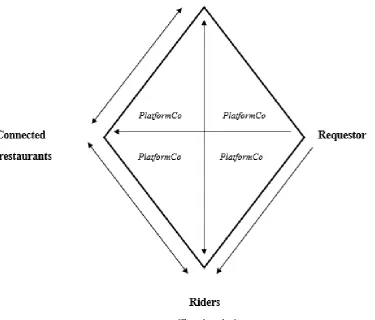
New crowdsourcing ecosystem PlatformCo
29
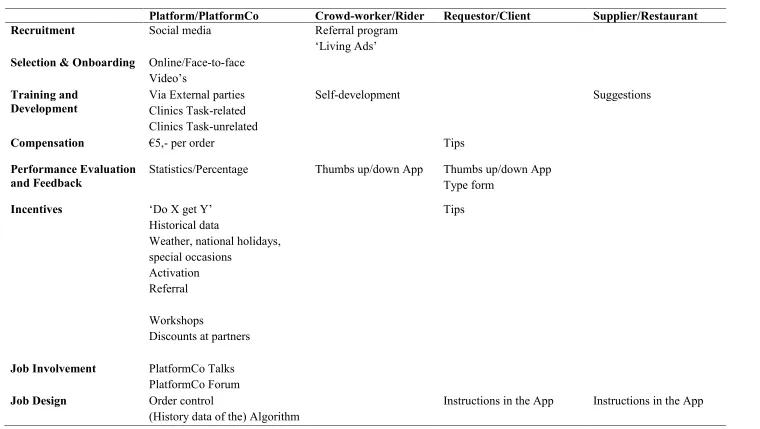
30 Table 3. Overview of HRM practices to manage crowd-workers
Platform/PlatformCo Crowd-worker/Rider Requestor/Client Supplier/Restaurant
Recruitment Social media Referral program
‘Living Ads’
Selection & Onboarding Online/Face-to-face Video’s
Training and Development
Via External parties Clinics Task-related Clinics Task-unrelated
Self-development Suggestions
Compensation €5,- per order Tips
Performance Evaluation and Feedback
Statistics/Percentage Thumbs up/down App Thumbs up/down App Type form
Incentives ‘Do X get Y’
Historical data
Weather, national holidays, special occasions
Activation Referral
Workshops
Discounts at partners
Tips
Job Involvement PlatformCo Talks
PlatformCo Forum
Job Design Order control
(History data of the) Algorithm
31
Conclusion and Discussion
The goal of this research was to gain more insight in what HRM practices are used to manage crowd-workers and who is responsible for the implementation of these HRM practices. This is done by an in-depth explorative case-study of the actors in the crowdsourcing ecosystem at PlatformCo NL. In the next section, the results are discussed with literature, practical implications are described, the limitations of this study and ideas for future research are given and in the end a conclusion is made.
Discussion
From literature of regular employment relationships is known that HRM practices together are often used as a system to manage the employees (e.g. Lepak, Liao, Chung & Harden, 2016; Delery, 1998). Based on the results of this study, a comparison can be made between what is known of HRM systems in regular employment relationships and an HRM system in a crowdsourcing self-employment relationship.
The AMO framework is often used to develop an HRM system for employees in regular employment relationships. The current study uses this framework too as a guideline to examine HRM at a crowdsourcing platform. One main difference is found in the ability-enhancing HRM practices between a crowdsourcing platform and regular employment. Recruitment is mainly focused on the (needed) skills in an organization, selection is done by interviews and assessments, training is given to onboard employees and to further develop the right competences in regular employment (Jiang, Lepak, Hu and Baer, 2012). The practices in this domain are all directed to enhance the skills, knowledge and abilities of employees. At a crowdsourcing platform these kinds of practices hardly take place. The results showed that a wide range of people are recruited to perform the tasks. A selection is made by checking ID’s, onboarding is realized via a few videos and training is not executed by the platform caused by legal issues. In addition, all the above mentioned HRM practices are not aimed to enhance the skills of the crowd-workers. The few HRM practices that are executed are directed to onboard the crowd-workers in a time frame that is as short as possible. The ability enhancing HRM domain as known from regular employment does not fit HRM practices a crowdsourcing platform would use. Following this comparison, one might conclude that the AMO framework is not applicable to HRM at a crowdsourcing platform. This is one reason why new HRM perspectives are needed for crowdsourcing platforms particularly.
32 ecosystem works in line with the algorithm of the platform. For example, performance evaluation is applied to crowd-workers and fourth-party providers, because the platform needs to be sure that these actors perform the task as specified by the notifications in the app. If this is not the case, the algorithm might become disrupted, which eventually might lead to negative and unsatisfied requestor experiences. Beside this, incentives are used to be sure that a sufficient number of crowd-workers are performing the task at a certain moment, through which the algorithm is working optimally. Traditional HRM perspectives, e.g. the AMO framework, are not suitable to analyze an HRM system at a crowdsourcing platform. It does not give us guidelines or principles to understand the needed balance between actors in a crowdsourcing ecosystem.
Altogether, these findings might change our understanding of HRM and emphasize the need for a new HRM concept at crowdsourcing platforms. The current study shows that HRM practices are mainly developed and used to manage the risks that go together with a crowdsourcing platform. Crowd-workers do have a relatively high amount of freedom in comparison to regular employees, e.g. freedom to cancel a task. In addition, crowd-workers and fourth-party providers (e.g. the restaurants) are not directly supervised by the platform. Therefore, HRM practices as performance evaluation and incentives are used in such a way that the risks of freedom are managed, because the algorithm has to be in balance, as described above. Another aspect whereby the risk management in HRM becomes clear concerns the legal issues, that goes hand in hand with a crowdsourcing platform that is using freelancers. A crowdsourcing platform has to take the restrictions of self-employment into account in their HRM practices. For example, the platform is not allowed to give instructions and to train the crowd-workers, because that would imply an employee-employer relationship. To avoid this risk, the platform is outsourcing HRM practices (e.g. training and development and job design) to other actors in the crowdsourcing system or external partners. Based on this theoretical reflection, one can conclude that it might be valuable to use the principle of ‘risk management’ as a new HRM concept to analyze HRM at a crowdsourcing platform.
33 (DiMaggio and Powel, 1983). Remarkable is that the current study shows a different effect of coercive institutional pressures on the HRM system. Namely, outsourcing HRM practices to external parties and other actors in the service ecosystem. Traditional HRM research is focusing mainly on how institutional pressures influence the content of HRM practices and how this might lead to similarity in HRM practices between organizations. However, the current study shows that these coercive institutional pressures also influence the HRM function in an organization. It shows that the coercive institutional pressures determine who is responsible for what HRM practice.
Outsourcing HRM practices to other actors is something that is also used in traditional work systems/organizations. However, outsourcing HRM practices in traditional work is based on a different theory and other motives. For regular employment, the transaction cost theory argues that HRM practices should be outsourced if it is not core business of the firm and outsourcing the activity, e.g. recruitment, is cheaper than executing the HRM activity internally (Williamson, 1979; Lepak and Snell, 2002). This way of outsourcing HRM practices is based on a financial and strategic value motive in relation to the organization. In comparison, the outsourcing of HRM practices to other actors in the crowdsourcing ecosystem or to external partners was done because of the legal issues of the self-employment relationship. This theoretical reflection shows that the rationale to outsource HRM practices differs between a regular employment relationship and a self-employment relationship in a crowdsourcing platform.
Practical implications
34 background and the results, the assumption is made that being flexible as a platform and providing crowd-workers a large amount of flexibility are main goals of crowdsourcing platforms in general. However, based on the results of this study, one might have doubts about the high amount of flexibility that is assumed at a crowdsourcing platform. The behavior of crowd-workers is continually monitored and goes together with consequences set up by the platform. For example, crowd-workers are flexible to cancel a task or unsubscribe themselves for a session, however they are not able to work at every moment they prefer, and their personal statistics affects the execution of possible future tasks. Following this, a practical implication for platforms might be to keep evaluating the alignment of flexibility, between the content of HRM practices and the organizational strategy. This evaluation might avoid a conceivable misfit between the content of the HRM practices and the organizational strategy.
The influence of legal requirements on HRM at a crowdsourcing platform with a self-employment relationship has already been described in the discussion. The coercive institutional pressures are the main reason why crowdsourcing platform are outsourcing activities. Other crowdsourcing platforms might learn from this study that outsourcing HRM activities creates the opportunity to stand out as a platform and to serve crowd-workers in several different manners. The institutional pressures of a self-employment relationship lead to the development and creation of new ways to serve and manage crowd-workers. In the examined platform this was for example done by setting up new partnerships based on the preferences of crowd-workers, e.g. cookery course or language course. This manner of implementing HRM practices might be used by other platforms in the future to serve the crowd-workers in new ways.
Limitations and Future research
35 A second aspect for future research might lie in the variability of HRM practices at crowdsourcing platforms. The results of this study show how dynamic HRM is used to manage crowd-workers at PlatformCo. Both the content (e.g. the variability in incentives) as who is implementing what HRM practice (e.g. the use of external partners) is found variable at a crowdsourcing platform. This finding could have as a result that it might be hard to find similarities what HRM practices are used to manage crowd-workers at such platforms in future research. To tackle this aspect, it is recommended to execute longitudinal or logbook research. These methods could give more opportunities to detect similarities and distinctions in what HRM practices are used to manage crowd-workers and make it clearer in which HRM policies or practices variability is taking place. The variability in HRM practices might be an opportunity for future research as well. There is some theoretical knowledge about the implementation of HRM practices from regular employment relationships. Bowen and Ostroff (2004) state in their study that the way of how HRM practices are implemented is of high value for the organizational effectiveness. The current study shows the dynamicity and variability in HRM practices implemented at a crowdsourcing platform. For a regular employment relationship is argued that a lack of consistency in the stability of HRM messages might be a decline in impact of an HRM practice and on organizational effectiveness (Bowen & Ostroff, 2004). This decline is mainly caused by a lack of shared understanding of the HRM practices, which might elicit confusion and negative attitudes about the HRM practice by employees. It is possible that the identified variability in HRM practices might lead to inconsistency and unstable signals to crowd-workers at a platform, through which effectiveness of HRM practices might be negative influenced. Future research could examine if this variability in HRM influences crowd-workers (e.g. a lack of shared understanding or negative attitudes) and the effectiveness of HRM practices.
36 it is recommended to study future crowdsourcing platforms whereby the crowdsourcing task has one or more differences in the dimensions of Nakatsu et al. (2014) in comparison to the current studied crowdsourcing task. This creates the opportunity to gain more insight to in what extent the crowdsourcing task is of influence on how crowd-workers are managed via HRM practices.
Conclusion
One important result that appeared in the analysis, is that crowd-workers are managed via several actors within and outside the crowdsourcing ecosystem. First of all, beside the platform, crowd-worker and the requestor, fourth-party providers are also part of the crowdsourcing ecosystem (e.g. restaurants). These providers play a role in the exchange of HRM practices within the crowdsourcing ecosystem. For example, they are involved in the job design by giving instructions to crowd-workers on how to perform the task. A second manner of managing the crowd-worker is done via providers who are deployed by the platform, for example the compensation administration via ‘verloning’ and training via external partners. These fourth-party providers are partly managing the crowd-workers via HRM practices. In all, fourth-party providers are connected to and used by a platform, because an official employment relationship is lacking. In order to manage the crowd-workers properly, other actors in the crowdsourcing ecosystem and external partners are used to execute HRM practices.
Moreover, one might conclude that beside the crowd-workers, fourth-party providers are managed via HRM practices in the crowdsourcing ecosystem as well. A platform serves a fourth-party provider (e.g. the restaurants) by monitoring their performance and giving feedback. Performance appraisal on specific criteria are evaluated by the platform. The platform rewards the fourth-party providers with for example a higher position in the ranking list of all providers, if they receive high scores on the evaluated performance criteria. So, the platform also serves fourth-party providers via rewards and providing information about their performance. Thus, HRM practices are exchanged between the platform and the fourth-party providers. Based on the above-mentioned results, one can conclude that the crowdsourcing ecosystem of a platform is more inclusive regarding the amount of actors than originally drawn in the theoretical section, which was based on the literature. In addition, the exchanges of HRM practices in the crowdsourcing ecosystem are not only used to manage the crowd-workers, but they are also used to manage the fourth-party providers.
38
References
Afuah, A., & Tucci, C. L. (2012). Crowdsourcing as a solution to distant search. Academy of Management Review, 37(3), 355-375.
Bayus, B. L. (2013). Crowdsourcing new product ideas over time: An analysis of the Dell IdeaStorm community. Management science, 59(1), 226-244.
Boons, M., Stam, D., & Barkema, H. G. (2015). Feelings of pride and respect as drivers of ongoing member activity on crowdsourcing platforms. Journal of Management Studies, 52(6), 717-741.
Bos‐Nehles, A. C., Van Riemsdijk, M. J., & Kees Looise, J. (2013). Employee perceptions of line management performance: applying the AMO theory to explain the effectiveness of line managers' HRM implementation. Human resource management, 52(6), 861-877.
Bowen, D. E., & Ostroff, C. (2004). Understanding HRM–firm performance linkages: The role of the “strength” of the HRM system. Academy of management review, 29(2), 203-221.
Breidbach, C. F., & Brodie, R. J. (2017). Engagement platforms in the sharing economy: conceptual foundations and research directions. Journal of Service Theory and Practice, 27(4), 761-777.
Delery, J. E. (1998). Issues of fit in strategic human resource management: Implications for research. Human resource management review 8(3), 289-309.
Delery, J. E., & Doty, D. H. (1996). Modes of theorizing in strategic human resource management: Tests of universalistic, contingency, and configurational performance predictions. Academy of management Journal, 39(4), 802-835.
DePillis, L. (2014). At the Uber for home cleaning, workers pay a price for convenience. Washington Post, p. B1.
DiMaggio, P.J. and Powell, W.W. (1983). `The iron cage revisited: institutional isomorphism and collective rationality in organisational fields’. American Sociological Review, 48, 147-160.
Doan, A., Ramakrishnan, R., & Halevy, A. Y. (2011). Crowdsourcing systems on the world-wide web. Communications of the ACM, 54(4), 86-96.