University of Warwick institutional repository: http://go.warwick.ac.uk/wrap
This paper is made available online in accordance with publisher policies. Please scroll down to view the document itself. Please refer to the repository record for this item and our policy information available from the repository home page for further information.
To see the final version of this paper please visit the publisher’s website. Access to the published version may require a subscription.
Author(s): Dunya Ahmed Abdulla Ahmed, Gillian Lewando Hundt, Clare Blackburn
Article Title: Issues of Gender, Reflexivity and Positionality in the Field of Disability: Researching Visual Impairment in an Arab Society
Year of publication: 2010 Link to published article:
1 Accepted for publication in Qualitative Social Work: Research and Practice 2010
Issues of Gender, Reflexivity and Positionality in the Field of
Disability: Researching Visual Impairment in an Arab Society
___________________________________________________________________________
Dunya Ahmed Abdulla Ahmed, Gillian Lewando Hundt, Clare Blackburn
Abstract
This article examines how the social and cultural context influence the way in which field research methods are utilised. Research methods need to be modified to meet the sensibilities and sensitivities of particular social groups and settings. Through a reflexive analysis of a
research study on the lives of visually impaired young people and adults in Bahrain, this paper discusses how gender, religion and culture need to be taken account of. It also discusses how the research process needed to take account of the participants’ disabilities. It
examines the issues of research access, informed consent, researcher’s dress, confidentiality, research location, and time. It highlights how the gender of the researcher was constraining in
some gender segregated educational settings in a Muslim society. The paper engages with the researcher’s positionality through reflexive discussion.
Keywords
Muslim Society Disability Gender Reflexivity
2
Introduction
This article focuses on how the social and cultural context of field research shapes and
modifies the use of qualitative research methods through a reflexive analysis of a research study on the lives of visually impaired young people and adults in Bahrain. Research methods
need to be modified to meet the sensibilities and sensitivities of particular social groups and settings. The paper examines the how the gender, culture and religion of the researcher and of the research participants shaped the research process in this study.. It discusses issues of
research access, informed consent, researcher’s dress, confidentiality, space and time. The female Bahraini researcher (DAA) conducted a qualitative research study utilisng interviews
and observation. There were some constraints owing to her gender in the gender segregated educational settings of a Muslim society. The paper engages with the researcher’s positionality through reflexive analysis.
Background
Reflexivity is the process of looking both inward and outward with regard to the positionality
of the research and the research process (Shaw and Gould 2001). It is also part of the production of knowledge (Blaxter, Hughes and Tight 2006; Hammersley and Atkinson 2002).
Clearly, researchers will always have an effect on the setting and the people they are studying since they have their own knowledge about these and data collection may be modified by their presence. They also play an important part in analysing and interpreting the data that is
produced. In short, researchers cannot avoid having an impact on the process of research (Kosygina 2005).
Ribbens (1989) states that the researcher’s ability may be limited when interviewing friends by having a responsibility in terms of the friendship to generate information from the
3 interviewing, since a conversation between friends is not conducted using a tape-recorder or with one person asking questions and listening carefully with only the other answering the
questions.
In addition, body language is an important consideration in an interview. However, this
differs between cultures (Green and Thorogood 2004). Gender is particularly important within a socio-cultural context where patriarchy and segregation by gender are the norm. Gender issues need to be considered in all research and appropriate methods and processes
choosen since cultural and social norms elicit certain expectations from researchers and participants in terms of gender (Jarviluoma, Moisala and Vilkko 2003). Being a female
researcher may encourage female interviewees to be more open as they may assume shared assumptions and experiences (Riessman 1994). This is derived mainly from cultural notions regarding women’s roles (Dahlgren 2005; Seif 2005; Seikaly 1997; Seikaly 1998).
Thus, female researchers may well gather different data from male researchers and vice versa with men interviewing men. When the researcher and participant are of the same sex and
culture this can mean that communication is easier since both gender and culture are then brought into clearer focus, making more sense of the data that is produced (Gill and Maclean 2002; Labaree 2002).
Being of the same gender allows both the interviewer and the interviewee to share their common experiences as females (Finch 1984; Oakley 1981). Additionally, Finch (1984)
states that sharing the same gender reduces the social distance between the interviewer and interviewee as well as facilitating talking and possibly providing a therapeutic and a positive experience. However, it is not always the case that sharing the same gender will allow
women to talk freely to a female interviewer as Cotterill (1992) discovered in her research. This paper discusses how issues of positionality, gender and culture shaped a study of
4 country. The fieldwork reported here was conducted by a female Bahraini social work
researcher (DAA) who was both an insider through researching her own society and an
outsider through not being visually impaired. An important issue that affected the research, as were her gender.
Setting
The Kingdom of Bahrain is an archipelago in the Arabian/Persian Gulf and covers a
total area of 741,32 square kilometres. A recent study showed that the population has reached around one million, with an increase in the number of non-citizens; Bahraini citizens account
for only around one third of the total population (Al-Abduly 2008).
Most Bahrainis practise Islam, of which the two main sects are Shi‘a (57%) and Sunni (25%). There is a Christian minority (8.5%) and some others of unspecified religious
allegiance (9.5%). It is widely acknowledged that the Sunni sect hold more influential positions in Bahraini society than the Shi‘a sect (Crawfurd Homepage 2002; Encarta 2007;
Merriam-Webster 2001; U.S. Department of State 2007; US Embassy Bahrain 2006). The social position of men and women in Bahrain is strongly influenced by culture as well as religion. Bahrain is a Muslim country, but it is generally considered to be more liberal in its
interpretation of Islam than adjacent countries (Dahlgren 2005; Seif 2005; US Embassy Bahrain 2006).
Bahraini people with a disability account for less than 1% of the total population according to the 2001 census (Central Statistics Organisation 2001). The total number of people with a disability in Bahrain in 2001was 4,229 of which 460 (0.07%) were visually
impaired. The teachings of Islam in relation to people with disabilities has two main strands. It is emphasised that those with disabilities should be looked after and cared for. In addition,
5 the behaviour of an observant Muslim (Ahmed 2007). These practices support many charities who in the main provide segregated specialist provision for people with disabilities. Other
teachings in Islam, encourage the social independence and inclusion of people with disabilities (Rispler-Chaim 2007, Bazna & Hatab 2005).
Bahrain mainstream state education is provided free from the age of 6-17 and schools are segregated by gender in terms of both students and staff (Ministry of Education 2003;
Shirawi 1989). There is a special education system for children and young people with disabilities, were introduced in the 1970s and heavily influenced by Western models of
service provision. As a result, the schools are specialised by disability but not segregated by gender , unlike mainstream schools (Shirawi 1989; Turmusani 2003).
The Saudi-Bahraini Institute for the Welfare of the Blind (hereafter referred to as the
Institute) is the Bahraini special school for boys and girls who are visually impaired. Students who complete their secondary level courses are transferred to mainstream sixth form
schools which then provide them with special support. These schools are segregated by gender but not by disability (Shirawi 1989). They can attend the main Government University in Bahrain which is for both sexes but students with visual impairment can only study
subjects in the Humanities.
Research Design
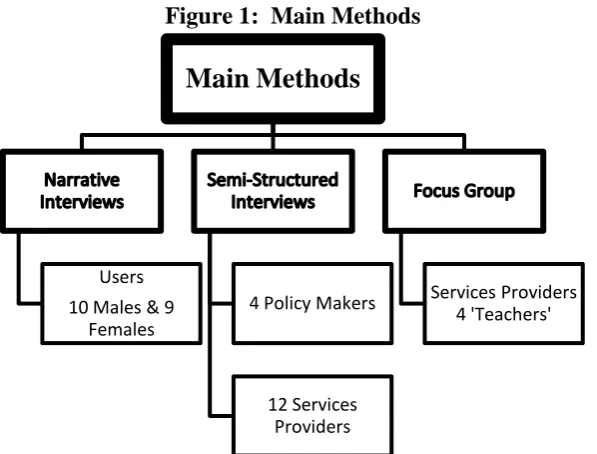
This research adopted a case study approach that used a mixture of qualitative methods including semi-structured individual narrative and focus group interviews, as well as some
6
Figure 1: Main Methods
Pope and May (1999) suggest that researchers employ more than one method to collect
data in order to obtain a valid, holistic and systematic picture when using an interpretative approach. This triangulated approach made it possible to consider how the views of people in different positions, such as policy makers, service providers and service users, coincided or
differed.
F
Fiigguurree22::SSuupppplleemmeennttaarryyMMeetthhooddss
Main Methods
Users 10 Males & 9
Females
4 Policy Makers
12 Services Providers
Services Providers 4 'Teachers'
Supplementary
Methods
Institute
Friendship Society of the Blind
Girls Sixth Form School
Government Documents and
7 It was decided not to use quantitative methods for a survey was not feasible as the number of young people in Bahrain with a visual impairment was small. According to the
Friendship Society of the Blind (FSoB) records, there were 24 possible interviewees aged 16-26. Of these, 19 young people were interviewed, in addition to one pilot interview (20/24).
The 19 visually impaired interviewees were encouraged to talk about significant events in their lives. Using stories is a valuable way of encouraging interviewees to talk about their lives (Graham 1984; Green and Thorogood 2004) as autobiographical narratives in their own
right (Riessman 1994). Portelli (1997) makes the point that oral history is a science, but it is also the art of the individual. The interviews in this research were based around the stories
and experiences of visually impaired young people with a special focus on culture, religion, education, employment, services and policies. The interviews were conducted in Arabic, recorded and then transcribed and translated into English. Analysis was conducted using
Nvivo 2.
Four focus groups and were conducted with teachers of young visually impaired people each
with 4-8 people to achieve diversity of opinion(Krueger (1994). An interview guide was used (Gibbs 1997) to ensure that the main topics are covered, the interviews were tape-recorded for later transcription.
Reflections on Positionality
This section reflects on DAA’s positionality in relation to this study. DAA was a native
researcher thus an insider in relation to the interviewees. This gave her the privilege of having insights into their perspectives and understanding of the literal and body language of the participants that other researchers may not have (Gilgun and Abrams 2002; Labaree 2002).
Her insider role helped participants to interact freely and encouraged them to share problems (Gibson and Abrams 2003). The interviewees and interviewer shared a culture, religion and a
8 The researcher was careful about her social and cultural identity, especially in cross-gender interviews (Pini 2005). As a sighted Bahraini female researcher she was both an
insider and an outsider. She was regarded as an insider because she was from the same country as the participants although she was more of an insider with the Sunni group of
Muslims as when they talked to her they used ‘we’ for Sunni and ‘they’ for Shi‘a. Sunnis had more comments to make about Shi‘as than Shi‘as had to make about the Sunnis. This may be because Shi‘as perceived DAA as a Sunni and did not want to make comments in front of her,
even though she told them that her mother and brother-in-law were Shi‘a. For some, it did not appear to change the way they talked to her while for others it did. This is currently a
sensitive issue in Bahrain because of the conflict in Iraq and political issues between the
Sunni and Shi‘a in several Muslim countries.
In addition, females talked to DAA as an insider of the same gender. They said ‘we’ for females and ‘they’ for males. It was also evident that DAA was also an outsider by not
having a visual impairment as all the visually impaired interviewees talked to her as an outsider by saying ‘us and you’ locating her as a non-disabled person. In addition, she was
an outsider as she was conducting research and studying abroad.
DAA had worked as a volunteer with both the Institute and the FSoB, so she knew most
of the service providers and users and this helped her to be accepted (D'Cruz and Jones 2004; Labaree 2002). This technique can be used as a strategy to connect with the gatekeepers of
the population of the study and to build up trust with participants (Gibson and Abrams 2003; van Heugten 2004).
In some research, such as that of Cotterill (1992), it may be difficult to know when to
switch on the tape-recorder and start the proper interview when working with friends. This is because, in such a situation, the informal talk will continue within the interview although it is
9 difficult to talk to strangers because they cannot be natural, have to be more formal or try to give ideal answers and hide their own views as they think these may not be accepted. They
may not mean to do this or they may be used to adopting such behaviour with strangers. Interviewees may respond differently to the same question when they know the interviewer
better and trust the interviewer more. In such cases, there are advantages to interviewing people you know. On the other hand, Cotterill (1992) explains that when the researcher is a stranger, it may be easier for interviewees to talk as the relationship between interviewer and
interviewee will cease with the end of the interview, which can make disclosure more comfortable (Cannon 1989).
A key factor that shapes the kind of data generated in any study is the relationship between interviewer and interviewee (Green and Thorogood 2004). One of the important aspects emphasised by Ryen (2004) concerning interviews is trust. She noted that ‘Trust is the traditional magic key to building good field relations’ (2004:234). Where there is trust,
for some interviewees, the interview can be a positive experience as they get the opportunity
to talk about their lives, personal experiences and stories. However, interviewees will not talk in this way unless they trust the interviewer (Green and Thorogood 2004). Green and Thorogood have noted that although such relationships can have advantages such as making
access easier, they will also have certain disadvantages such as assumptions of shared meaning. DAA was trusted by the interviewees, because of her previous work in Bahrain,
and this assisted the interview process.
When DAA went to Bahrain, shortly before starting the fieldwork, her brother and herself were involved in a car accident, which resulted in her brother having his leg
amputated. Her experiences as a relative and carer of a disabled brother inevitably shaped her views on disability, and in particular, services for disabled people. As a result of her brother’s
10
Contextualising and Modifying Research Methods
Impact of Gender
At the time of the field research, DAA was 28 and single. In Arab Muslim societies, a woman has more freedom once she is married and as she gets older. Before marriage women have to be careful about mixing with unrelated men (Lewando-Hundt 1984).
Discussion of gender issues is not easy in Bahraini society. Although it is a relatively liberal country compared to many Muslim Arab states, some traditional cultural and religious
views about gender exist and shape relationships between men and women. Policy makers, service providers or users would not always talk about gender issues freely, especially when the interviewees were male and the interviewer was an unmarried female. Some issues related
to gender were discussed, such as gender segregation and integration in education, whereas issues related to sexuality and marriage or even men talking about their position in the society
were often not fully, freely or directly discussed. It was often necessary to pose questions in different ways and to use several prompts to elicit fuller responses.
These limitations of access and discussion in relation to gender could have been
partially overcome if some participant observation had been undertaken in the field to observe relations between pupils in the Institute. A limited amount of observation was
undertaken after interviewing the Head of the Institute and some notes were written. More extensive participant observation was not carried out owing to the cultural unacceptability of a female observing in a single sex boys school (Pini 2005). Furthermore, the research focused
on young people and interviewees describing their experiences at the Institute retrospectively. Thus, the interviewees were not the same as those students who would have been observed,
attending the Institute.
Access to particular locations was also affected by gender issues. It was not
11 school. Culturally, this would be viewed by the students and staff as breaking normal cultural conventions. Access to the girls’ sixth form however, was not a problem thus it was possible
to carry out teacher interviews there and to observe the setting.
As an unmarried young female researcher DAA, utilised the device of fictive kinship to
neutralise cross gender relations. DAA used fictive kinship terms such as ‘brother’ or ‘sister’ when speaking with participants, especially with male interviewees who were closer to her age. This is a common practice in Arab Muslim society because it means that each one deals
with the other with respect and as socially neuter (Krenawi and Graham 2000; Al-Makhamreh and Lewando-Hundt 2008; Hudson 2005; King 2005).
In Bahrain, body language will differ depending on gender. For example, shaking hands or any type of bodily contact between different genders is not common for religious reasons. However, the issue is slightly different with visually impaired people as people from different
genders make physical contact with the visually impaired in order to guide them and this is accepted.
Green and Thorogood (2004) point out the connection between eye contact and listening in an interview. In this research, however, this was not effective when interviewing visually impaired people and so was replaced with physical contact such as touching a hand
on some occasions. Although male interviewees were not touched, DAA had to guide some of the visually impaired interviewees of both genders to the room allocated for the interview.
DAA lowered her voice when talking to males, a common practice when women are talking to men in Muslim countries.
It was necessary to pay attention to issues of dress and to dress differently in different places. For example, in the boys’ schools DAA wore a cloak (‘abāya /dafah) and went
without makeup. She could not walk straight into the school but went first to the
12 necessary to wear the cloak (‘abāya /dafah). DAA however, always wore Islamic dress ( ) and therefore had more freedom to walk around and observe. In the Institute, the
FSoB , the University and at the Ministries there is no ‘women only’ provision. Therefore, since these places are mixed gender, there was not issue with DAA being there, unlike at the boys’ school.
For the focus group interview in the university, all of the lecturers were males, but they were used to a mixed gender environment so there was less of a gender difficulty.
Nevertheless, because they let DAA sit at the head of the meeting table, she felt awkward because she was the youngest person present and this seating arrangement is unusual in
Bahrain. This interview was further complicated by the fact that interviewees were very tense following a difficult discussion about work organisation that had arisen in a meeting they had attended prior to the interview. As a result, interviewees were reluctant to talk to each other
during the focus group.
Finch (1984) makes a simple comparison between interviewing men and women. She
states that women are more used to being interviewed and talk about their private life more easily while men find it more difficult to talk about such a topic. In short, it is easy to get women to talk. Additionally, she explains that when both the interviewer and the interviewee
are female, the setting becomes a more informal one and is more like a meeting between friends. This point was borne out in this research as the interview setting with men to some
extent was more formal since more attention was paid to dress, the physical distance between the parties and even the words that were used. These factors originated from the religion and culture and were more evident when interviewing conservative men.
In this study women’s interviews lasted longer and produced more information. This
may be the result of women being more talkative than men, or may be related to both
13 researchers from different cultures (Lee 1997; Maccoby 1990; Rafoth, Macauley, Stoltenberg, Housenick, Brown and Baran 1999; Verdurme and Viaene 2003).
Conversely, it has been suggested that having an interviewer and an interviewee of different genders may have a positive effect in a research study as some people might find it
preferable to talk to a person of the opposite sex (Mckee and O'Brien 1983). Another study by Padfield and Proctor (1996) made the generalisation that the gender of the interviewer was less important than being skilled. This is not the case in Bahrain because of the practice of
gender segregation (Dahlgren 2005; Seif 2005; Seikaly 1997; Seikaly 1998). Sharing the same gender is not enough to guarantee that the interviewee is at ease as shared culture may
also be important and may reduce some barriers between the interviewer and the interviewee (Lee 1997). As discussed earlier, sharing a religion and culture with participants assisted DAA’s fieldwork .
Requesting Oral Informed Consent
People with disabilities are a vulnerable group and may have less feelings of autonomy
concerning taking part in research. It can be helpful if the research is introduced to them by professionals who work with them (Valentine, Butler and Skelton 2005), and this approach
was used in this research. Professionals were able to introduce the possibility of taking part in the research to the visually impaired people without informing the researcher of actual names and identities until participants had given their consent to be approached.
There are both advantages and disadvantages to this approach. Firstly, it may make interviews easier as the interviewee has already agreed to be interviewed. However, it may
14 an intermediary key informant who was a visually impaired woman, who had been on the FSoB board for a long time and had good relations with all members. This person told
interviewees what the study was about and reassured them that they could accept or refuse to be interviewed.
At the beginning of each interview the purpose of the study, what would be done with the research data and recordings was explained by the researcher to interviewees (Costley 2000). Burgess (1982) asserted in his work that a number of advantages could be gained from
offering this explanation since it results in discussion that could itself be considered as feedback. It was emphasised that the interview could be stop at any time and that they did
not have to answer any questions they did not want to.
The researcher asked for oral informed consent from each interviewee. Written consent was not sought as signing to indicate consent is not an acceptable custom in Bahrain and in
many other Arab cultures. The spoken word carries more weight than signing a contract. Many business deals are completed with oral not written contracts. Besides, people do not
like to sign papers for political reasons. In these situations, requesting oral consent and recording that it has been given is considered a substitute for the written signature (Gordon 2000). Oral consent is used in sensitive research such as with homeless people, or drug users
and researchers usually sign a form with the date of interview to signify that oral consent has been requested and given by the interviewee ( )
Confidentiality Issues
Some of DAA’s interviewees were known to her previously since Bahrain is a small country and she had worked as a volunteer. She felt uneasy discussing sensitive issues and
15 need to give details. Sometimes they may have been reticent because they knew her and did not want to share their views.
DAA tried to deal with this is in a number of ways. First, participants were reassured about confidentiality and by saying at the beginning that they should assume that the
researcher did not know anything about them. Second, she tried to choose a suitable way to ask questions and kept sensitive issues until the end of the interview when participants were more relaxed. She also used prompts such as ‘Tell me more’ or ‘Can you explain this more fully?’ Sensitive topics were personal issues relating to aspirations of marriage, family
matters, religious political Sunni/Shiite differences or particular views about service
providers they both knew.
It was important to ensure that DAA clarified her identity as a researcher rather than as a colleague, student or acquaintance. As Filstead (1970) advises, the researcher must be
certain that she is not viewed as the representative of any group. To ensure confidentiality and anonymity, it was proposed that fictitious names would be used. Nevertheless, most of
the sample said that DAA could use their actual names, which may be acceptable in some circumstances (Green and Thorogood 2004). However, services users names were changed and service providers’ and policy makers’ were identified by their positions. Bahrain is a
small country and people can be easily be identified by their positions so that full confidentiality and anonymity was not achieved.
The Social Configuration of Space and Time for Interviews
As Schillmeier (2008) discusses, there is ‘a temporal construction of everyday spaces’
16 meant that they were able to choose spaces where they and the interviewer were more socially and physically independent.
With one exception, interviews with users took place in the FSoB as users could get
there on the FSoB bus. Interviews with young people attending school were not held at school, since the time available was short and schooling was one of the topics within the interview. Additionally, carrying out the interviews at the boys sixth form would not be very
comfortable as it was a male environment.
The interviews could have been carried out in the home however, there would have
been less control over privacy as other members of the household would want to participate (Green and Thorogood 2004) and also provide hospitality. From the cultural and religious point of view, it was not socially acceptable for an unmarried female to visit a male,
especially a single male, in his home and ask to be alone. In general, female interviewers may be concerned about meeting male interviewees in private places and may prefer interviewing
men in public places because of issues of safety, reputation and culture (Lee, 1997).
Therefore, from both the researcher’s and visually impaired young people’s point of view, the FSoB was a neutral place to carry out interviews, with easy access. These could be
done at any time in the morning and was open two afternoons a week with transport available. It was a known environment for visually impaired young people who could move
around there safely, having developed their own ‘memory map’ of the place (Allen, Milner and Price 2002). One interview with a female university student was carried out in the University Library in a special room for the visually impaired at a time that no one was there
and when the door was closed. The interviewee chose this location in preference to the FSoB.
17 past and future as users discussed memories, current experiences and future aspirations. For the DAA, time was not just a matter of timekeeping, but of finding time within the socially
configured landscapes of the interviewees that allowed for a reflective retrospective interview.
Interviewing people with disabilities may take more time in order to understand their experiences and perspectives (Beresford 1997). In this research, interviewing visually impaired people may have had fewer difficulties than interviewing people with other
disabilities because visually impaired people generally have good communication skills in the absence of other impairments.
It was important to be flexible when interviewing, adjusting interview timings and lengths to the circumstances of individual participants. If an interviewee was tired or needed to end the interview because of other commitments, another appointment was arranged. This
only happened twice when the bus came and the interviewees had to leave. Most interviewees enjoyed talking and wanted the interviews to last longer as they said they had
never talked to anyone about these issues before.
Gillham (2000) suggests that ideally, researchers should spend time with the interviewee before the interview takes place to establish a relationship. Beresford (1997)
suggests that it may be helpful to involve a familiar person in the interview. In this research, however, DAA and the interviewees were already known to each other and it was felt that
another person present might affect the responses of the interviewees, especially if this person was in a position of power, such as a teacher. As the sample consisted of young people aged 16-26 years, they could be interviewed without involving anyone else.
There were difficulties with time in the focus group interviews with teachers owing to their different timetables and also the social construction of time in Bahrain. In Bahrain, time
18 people are punctual, they must be English.. Puncutality is valued for religious purposes and very important events, while for normal events, it is less observed. In Bahrain, daily
temporality is socially constructed by the five times for daily prayer so that meeting times are mostly arranged depending on prayer times (e.g. meet after the noon prayer), and as Bahrain
has two religious sects – Sunni and Shi‘a Muslims – with different prayer times, this makes it more complicated.. In this study, people left the interview to pray without asking permission as is accepted practice in Bahraini culture.
The staff of the Institute for the Blind chose to have the interview at the end of the day after classes. However, most of them went to pray before they came which took up some
time. When the bell rang, they all wanted to leave to catch the Institute bus. Ideally, another interview to gather more information would have been arranged but this was not possible owing to Ramadan occurring. Ramadan, a period of fasting from sunrise to sunset for thirty
days occurred during data collection and as in many Arab countries, working hours were shortened in the afternoon to allow people to rest and break fast together at sundown.
For focus group interview with staff at the University of Bahrain, DAA had to search for the teachers who were teaching visually impaired students. The university has two campuses, in two cities with teachers based in different departments. Getting access was
complicated as each department needed a separate letter. DAA focused on the Social Work department where staff had more experience of teaching visually impaired students than in
other departments. Negotiating access to them was straightforward, because DAA had been previously a student and research assistant in the department. Arranging times was easier, because the interview was conducted after a departmental meeting finished, which meant all
19
Conclusions
This paper addresses how the social and cultural context of social work research affects the research methods and process of data collection iin different social and cultural settings. In this case study of young people with visual impairment in an Arab society, issues
of informed consent, gender, the social configuration of space and time modified the way in which the research was carried out.
The gender of the researcher and of the research participants was of particular significance in this study, due to the study being conducted in a gender segregated Muslim society. The device of using fictive kinship terms to neutralize gender differences
(Almakhamreh & Lewando Hundt 2008), as well as suitable dress, and sensitive use of space and time, was important in the data collection stage of this study.
There is general literature published on how personal status and gender influence topics that are acceptable to talk about, and the ways in which access may be limited (Finch 1984; Gill and Maclean 2002; Jarviluoma, Moisala and Vilkko 2003; Labaree 2002; Oakley
1981; Pini 2005). But this paper has also shown how the positionality of the researcher is key.with insider – outsider insider requiring reflexive reflection (Blaxter, Hughes and Tight
2006; Gibson and Abrams 2003; Hammersley and Atkinson 2002; Kosygina 2005; Shaw and Gould 2001). There are particular issues of positionality in relation to gender when conducting research in an Arab society that need to be considered.
Informed consent is a major issue in research. It is accepted by many ethics committees
20 appropriate in research in countries were verbal agreements have more weight than written agreements and when interviewing people with particular disabilities (Beresford 1997;
Costley 2000; Valentine, Butler and Skelton 2005).
Culture, religion and gender are relevant in all social work research but have
particular resonance for research with visually impaired people in a small Muslim Arab state. These issues needed to be actively engaged with during fieldwork. There is to date little qualitative social work research on issues of disability and gender in Muslim societies and it
is hoped that this will be addressed in the future.
References
Ahmed, Dunya Ahmed Abdullah (2007) Gender, Disability and Islam: Living with Visual
Impairment in Bahrain, PhD thesis, University of Warwick
Al-Abduly, Ahmed (2008) 'The identity of Bahrain is facing a serious dilemma', in, AL-Waqt
(Bahrain.
Al-Krenawi, A. and Graham, J. R. (2000) 'Culturally Sensitive Social Work Practice with Arab Clients in Mental Health Settings', Health and Social Work 25: 9.
Al-Makhamreh, Sahar Suleiman and Lewando-Hundt, Gillian (2008) 'Researching `at Home' as an Insider/Outsider: Gender and Culture in an Ethnographic Study of Social Work Practice in an Arab Society', in: 9-23.
Allen, Chris, Milner, Jo and Price, Dawn (2002) Home is where the start is: the housing and urban experiences of visually impaired children (Bristol: Policy Press for the Joseph
Rowntree Foundation).
Anderson, K and Jack, D (1991) 'Learning to listen: Interview Technique and Analyses', in S Gluck and D Patai (eds), Women's Words: Feminist Practice of Oral History (London: Routledge).
21 Beresford, Bryony (1997) Personal accounts: involving disabled children in research
(Norwich: SPRU).
Blaxter, Loraine, Hughes, Christina and Tight, Malcolm (2006) How to research (Milton Keynes: Open University Press).
Burgess, Robert G. (1982) Field research: a sourcebook and field manual (London: Allen & Unwin).
Cannon, Sue (1989) 'Social research in stressful settings: difficulties for the sociologist studying the treatment of breast cancer', in: 62-77.
Central Statistics Organisation (2001) 'Basic Result Population, Housing, Building & Establishment Census ', in Central Statistics Organisation (ed): Minister of Cabinet Affairs, Bahrain).
Costley, D (2000) 'Collecting the views of young people with moderate learning difficulties', in A Lewis and G Lindsay (eds), Researching Children's perspectives (Buckingham: Open University Press).
Cotterill, Pemela (1992) 'Interviewing Women: Issues of Friendship, Vulnerability and Power', Women Studies International Forum 15/5-6 (September-December 1992): 593-606. Crawfurd Homepage (2002) 'The Crawfurd homepage, Bahrain- A country Study,' in: http://crawfurd.dk/jcjfilm/bahrain.htm).
D'Cruz, Heather and Jones, Martyn (2004) Social work research: ethical and political contexts (London: Sage).
Dahlgren, Susanne (2005) 'Law: Modern Family Law, 1800- Present: Gulf, Saudi Arabia and Yemen ', in Suad Joeph, Afshaneh Najmabadi, Julie Peteet, Senteney Shami, Jacquline Siapno and Jane I.Smith (eds), Encyclopedia of Women and Islamic Cultures (Leiden-Bostn: Brill): 265-467.
Encarta (2007) 'Bahrain Facts and Figures', in.
Filstead, William J. (1970) Qualitative methodology: firsthand involvement with the social world (Chicago: Markham Pub).
Finch, Janet (1984) '"It is great to have someone to talk to": The ethics and politics of interviewing women', in Colin Bell and Helen Roberts (eds), Social researching: politics, problems, practice (London: Routledge and Kegan Paul): 70-78.
Gibbs, A. (1997) 'Focus Groups', Social Research Update /19: http://www.soc.surrey.ac.uk/sru/SRU19.html.
22 Gilgun, Jane F. and Abrams, Laura S. (2002) 'The Nature and Usefulness of Qualitative Social Work Research: Some Thoughts and an Invitation to Dialogue', Qualitative Social Work 1/1 (March 1, 2002): 39-55.
Gill, Fiona and Maclean, Catherine (2002) 'Knowing your Place: Gender and Reflexivity in two Ethnographies', Sociological Research Online 12/2 (17/02/2007):
http://www.socresonline.org.uk/7/2/gill.html.
Gillham, Bill (2000) Case study research methods (London: Continuum).
Gordon, Elisa J. (2000) 'When Oral Consent Will Do', Field Methods 12/3 (August 1, 2000): 235-38.
Graham, Hilary (1984) 'Surveying through stories', in Bell Colin and Roberts Helen (eds),
Social researching: politics, problems, practice (London: Routledge and Kagen Paul): 104-24.
Green, Judith and Thorogood, Nicki (2004) Qualitative Methods for Health Research
(London: SAGE).
Hammersley, Martyn and Atkinson, Paul (2002) Ethnography: principles in practice
(London; New York: Routledge).
Hudson, Leila (2005) 'Network: The Ottoman Empire Kinship', in Suad Joeph, Afshaneh Najmabadi, Julie Peteet, Senteney Shami, Jacquline Siapno and Jane I.Smith (eds),
Encyclopedia of Women and Islamic Cultures (Leiden-Bostn: Brill): 529-31.
Irving, Andrew (2005) ' Life made Strange: an Essay on the Re-inhabitation of Bodies and Landscapes pp.317-329 Eds: Wendy James and David Mills The Qualities of Tiem: Anthropological Approaches ASA Monographs 41, Oxford, New York, Berg Publishers
Jarviluoma, Helmi, Moisala, Pirkko and Vilkko, Anni (2003) Gender and qualitative methods
(London: Sage).
King, Diane E. (2005) 'Kinship and State: Arab States', in Suad Joeph, Afshaneh Najmabadi, Julie Peteet, Senteney Shami, Jacquline Siapno and Jane I.Smith (eds), Encyclopedia of Women and Islamic Cultures (Leiden-Bostn: Brill): 347-49.
Kosygina, Larisa V. (2005) 'Doing Gender in Research: Reflection on Experience in Field',
The Qualitative Report 10/1: 87-95.
Krueger, R. (1994) Focus groups: a practical guide for applied research (London: Sage). Labaree, Robert V. (2002) 'The risk of 'going observationalist': negotiating the hidden dilemmas of being an insider participant observer', Qualitative Research 2/1 (April 1, 2002): 97-122.
23 Lewando-Hundt, Gillian (1984) 'The Exercise of Power by Bedouin Women', in Emanuel Marx and Avshalom Shmuelli (eds), The Changing Bedouin (New Jersey: Transaction Inc): 83-124.
Maccoby, Eleanor E. (1990) 'Gender and Relationships: A Development Account', American Psychologist 45/4 (April 1990): 513-20.
Mckee, Lorna and O'Brien, Margaret (1983) 'interviewing men: Taking gender seriously', in Eva Gamarnokow, Daivd Morgan and June Purvis Daphne Taylorson (eds), The public and the private (London: Heinemann): 147-61.
Merriam-Webster (2001) 'Bahrain', in, Geography.
Ministery of Education (2003) 'General Information', in (Bahrain.
Oakley, Ann (1981) 'interviewing women: A contradiction in terms', in Helen Roberts (ed),
Doing feminist research (London: Routledge and Kegan Paul): 30-61.
Padfield, Maureen and Proctor, Ian (1996) 'The effect of interviewer's gender on the interviewing process: A comparative enquiry', Sociology 30: 355-66.
Pini, Barbara (2005) 'Interviewing men: Gender and the collection and interpretation of qualitative data', Journal of Sociology 41/2 (June 1, 2005): 201-16.
Pope, Catherine and Mays, Nicholas (1999) Qualitative research in health care (London: BMJ books).
Portelli, A (1997) The battle of Valle Giulia: Oral History and the Art of Dialogue (New York: University of Wisconsin Press).
Rafoth, Ben, Macauley, Bil, Stoltenberg, Kristin, Housenick, Steve, Brown, Jerome and Baran, Beth (1999) 'Sex in the Centre: Gender Differences in Tutorial Interactions', The Writing Lab Newsletter 24/3 (November 1999): 1-5.
Ribbens, Jane (1989) 'Interviewing--An "unnatural situation"?' Women's Studies International Forum 12/6: 579-92.
Riessman, C (1994) 'Narrative Approaches to Trauma', in Catherine Kohler Riessman (ed),
Qualitative Studies in Social Work Research (London: SAGE).
Rispler-Chaim V. (2007) Disability in Islamic Law, Dordrecht, Springer
Ryen, Anne (2004) 'Ethical issues', in Clive Seale, Giampietro Gobo, Jaber F Gubrium and David Silverman (eds), Qualitative Research Practice (London: SAGE).
Schillmeier, Michael (2008) 'Time-Spaces of In/dependence and Dis/ability' Time and Society 17;2-3:215-231
Seif, Huda (2005) 'Human Rights: Arab Gulf and Yemen ', in Suad Joeph, Afshaneh Najmabadi, Julie Peteet, Senteney Shami, Jacquline Siapno and Jane I.Smith (eds),
24 Seikaly, May (1997) 'Bahraini women in formal and informal groups: the politics of
identification', in Dawn Chatty and Annika Rabo (eds), Organizing women: formal and informal women's groups in the Middle East (Oxford; New York: Berg): 125-46.
Seikaly, May (1998) 'Women and Religion in Bahrain: An Emerging Identity', in Yazbeck Haddad Yvonne and John Esposito (eds), Islam, Gender, & Social Change (New York; Oxford: Oxford University Press): 169-89.
Shaw, Ian and Gould, Nick (2001) Qualitative research in social work (London: Sage). Shirawi, May Al-Arrayed (1989) Education in Bahrain: Problems and Progress (Oxford: Ithaca).
Turmusani, Majid (2003) Disabled people and economic needs in the developing world: a political perspective from Jordan (Aldershot: Ashgate).
U.S. Department of State (2007) 'Background Note: Bahrain', Background Notes on Countries of the World: Bahrain: 1-8.
US Embassy Bahrain (2006) 'Human Rights: Bahrain', in, Arabic Reports (Bahrain: US Embassy Bahrain).
Valentine, Gill, Butler, Ruth and Skelton, Tracey (2005) 'The ethical and methodological complexities of doing research with 'vulnerable' young people', in Kieron Sheehy (ed), Ethics and research in inclusive education: values into practice (London; New York: Routledge Falmer): 76-82.
van Heugten, Kate (2004) 'Managing Insider Research: Learning from Experience',
Qualitative Social Work 3/2 (June 1, 2004): 203-19.
Verdurme, Annelies and Viaene, Jacques (2003) 'Exploring and modelling consumer
attitudes towards genetically modified food', Qualitative Market Research: An International Journal 6/2: 95-110.
Dunya Ahmed Abdulla Ahmed – Assistant Professor is a Lecturer of Social Work in the Department of Social Sciences, University of Bahrain is the main author of this paper which is derived from her PhD research in Bahrain. She has her PhD in Social Work from the University of Warwick. She is the first PhD holder of Social work in Bahrain and work mainly with people with disability.
Address: Department of Social Sciences, College of Art, University of Bahrain, P.O.Box 32038, Kingdom of Bahrain. [e-mail: [email protected]]
Gillian Lewando Hundt – Professor of Social Sciences in Health, School of Health and Social Studies, University of Warwick, is an applied medical anthropologist, who has carried out ethnographic research in the Middle East, the UK and East and Southern Africa and was one of DAA’s supervisors and discussed the data and the ideas at different stages of design, collection, and development with DAA reading and editing successive drafts of this paper.
25
Clare Blackburn – Associate Professor, School of Health and Social Studies, was one of
DAA’s supervisors, and discussed the data and writing up of the thesis and read and edited this paper.