University of Warwick institutional repository: http://go.warwick.ac.uk/wrap
This paper is made available online in accordance with
publisher policies. Please scroll down to view the document
itself. Please refer to the repository record for this item and our
policy information available from the repository home page for
further information.
To see the final version of this paper please visit the publisher’s website.
Access to the published version may require a subscription.
Author(s): Neil Davis; Jeff Jones; Les Warrington
Article Title: A Framework for Documenting and Analyzing Life-Cycle
Costs Using a Simple Network Based Representation. Proceedings
Annual Reliability and Maintainability Symposium.
Year of publication: 2003
Link to published version:
A Framework for Documenting and Analysing Life-Cycle Costs Using a Simple Network
Based Representation
.
Neil Davis; University of Warwick, Coventry
Jeff Jones; University of Warwick, Coventry
Les Warrington; University of Warwick, Coventry
Keywords: Life Cycle Costing, Cost Benefit Analysis, Integrated Modular Avionics, New Product Introduction
SUMMARY AND CONCLUSIONS
The introduction of high reliability systems combined with new ways of operating complex systems, particularly in aircraft design and operation has received much attention in recent years. Some systems are now being introduced into service, however, justifying such systems on a financial basis is difficult and may act to limit the rate of introduction on new products.
Conventional life cycle costing based on a hierarchical cost breakdown structure is poor at recording and analysing the cost implications of introducing new technologies that have effects that span more than one phase in the life cycle. There is a risk that too much emphasis is put on ‘faith’ that a candidate technology will reduce cost because the cost analysis methods lack descriptive and analytical power.
We describe an approach to representing the costs associated with introducing new technologies and evaluating their total cost. Our aim was to facilitate the comparison of different technological choices in new product development, with a particular interest in how the perceived benefits of enhanced reliability systems can be shown in a way that is inclusive, objective and easy to understand.
1.0 INTRODUCTION
The operational opportunities afforded by the use of Mfop and URA technologies have been shown in previous work[1,2]. These technologies do however tend to add cost at certain critical stages, particularly during design, and affect the headline capital cost of acquisition. Of particular concern, is the impact that improved reliability will have on spares business – commonly the area in which equipment manufacturers make the bulk of their profit. Manufacturers are faced with a dilemma: if they develop a reliable product that reduces the operational cost then they will jeopardize their profitability, at the same time their product will cost more to acquire and so they may come under more pressure to discount, or lose business. Consequently, this may lead to a failure to adopt novel technologies when, in fact, they may have been cost effective when viewed from a life cycle perspective, costing more to acquire but less to operate [3].
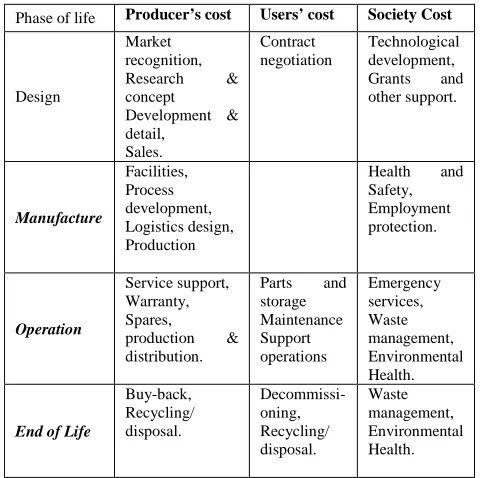
The Life Cycle Cost Analysis technique [4] aims to include all relevant costs associated with a product so that a systematic and balanced view of cost versus benefit can be achieved. As shown in Table 1, Life Cycle Cost includes the costs to the producer, user and society [5]; a wider definition than earlier definitions that focused more on user perspective and closer to the concept of Total Cost of Ownership. Total cost is the result of summing the costs associated with life cycle phases.
Phase of life Producer’s cost Users’ cost Society Cost
Design
Market recognition, Research & concept Development & detail,
Sales.
Contract negotiation
Technological development,
Grants and
other support.
Manufacture
Facilities, Process development, Logistics design, Production
Health and
Safety, Employment protection.
Operation
Service support, Warranty, Spares, production & distribution.
Parts and
storage Maintenance Support operations
Emergency services, Waste management, Environmental Health.
End of Life
Buy-back, Recycling/ disposal.
Decommissi-oning, Recycling/ disposal.
[image:2.612.318.558.324.563.2]Waste management, Environmental Health.
Table 1 Life Cycle stages and costs adapted from Atling (6)
Acronyms
Mfop Maintenance free operation URA Ultra-reliable Aircraft LCC Life Cycle Cost
CBS Cost Breakdown Structure IMA Integrated Modular Avionics RIMA Re-configurable IMA
2.0 PROBLEM STATEMENT 2.1 Widespread Applicability
A simple life cycle cost analysis based on a CBS is restricted in its ability to represent the root causes and effects of design opportunities. Where a root cause has many effects in possibly different phases, these are not represented in a way that aids comprehension, review and analysis, nor that captures the logic so that it can be re-used.
Our model seeks to:
Document the casual factors that lead to costs and benefits.
Identify the effects of each technology factor and the extent to which they modify costs.
Analyse the total cost implications of introducing a technology factor.
3.0 THE LCC-NET MODEL
We assume that costs and benefits either have inherently, or can be assigned, numeric values that reflect a financial value. We denote a cost as having a + value, signifying that it represents an additional expenditure. We denote a benefit as having a – value, signifying that it represents a reduction in expenditure. We assume that there is some existing design that has been costed.
We retain the concept of a Cost Breakdown Structure as this is simple to understand and provides a link to existing approaches to life cycle cost analysis. We do not, however, use the CBS nodes as placeholders for cost information. The role of the CBS is to specify analysis criteria. In this role a CBS node becomes an element in a query on the network. The physical system and its operation are represented by Items. Each item represent an object in the physical world that has costs associated with it. Items may correspond to the product and its components or to the supporting activities and resources used in its construction and operation, or anything else that causes expenditure. Items may form aggregates in a hierarchical manner. In this way the model can represent systems of systems and components.
As assumed, the starting point for an analysis is an existing design. This is represented as a prototype for costing purposes.
If a new design introduces no changes to the existing model then there will be no cost implications. We instantiate a copy of the existing prototype and then modify this by making additions and deletions.
New designs and methods of operation are introduced in the form of technology factors. Each factor represents a root cause of changes to life cycle costs. There may be many consequences that arise from the introduction of a new factor and each of these may have its own consequences in various phases and at various levels of the CBS. Each factor has a CBS phase that is expected to be most affected by it, this may not be where the analysis ultimately indicates the most benefit will be felt, however.
We term the consequences that arise from factors Effects. Each effect may in turn generate its own effects and in this way effects form the basis for our network view of life cycle cost analysis. Effects carry costs that are represented using + or – values as previously described. These values act as modifiers to the costed values held against the prototype items. Each effect is linked to a single instance item and a single CBS element.
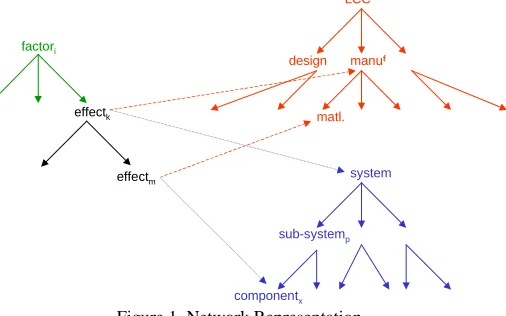
factori
effectk
effectm
design LCC
manuf
matl.
system
sub-systemp
[image:3.612.317.570.307.465.2]componentx Figure 1. Network Representation.
Figure 1 shows how factors have consequences that are effects and how effects are linked to both CBS elements and system items. Effects may influence costs at any level.
4.0 APPLICATION EXAMPLE
Our work was motivated by an interest in evaluating the total cost benefits of introducing Integrated Modular Avionics (IMA) systems. Examples of such systems are beginning to appear, for example in the F22-Raptor aircraft and in the engine management systems for the Boeing 777. We and others [3,7] are also concerned with the way in which the next generation of IMA – Reconfigurable IMA (RIMA) - can be justified at a total cost level rather than at a purely functional level [8].
is self contained with its own power supply, processing capability, and input/output possibly to a common data-bus. This leads to much duplication, additional weight, more space consumed and leads to a proliferation of dedicated equipment for specific types of aircraft. There are significant management and cost issues for the producer in managing change control and for the operator in supporting the equipment and carrying out maintenance.
[image:4.612.43.303.402.575.2]IMA systems break down the physical barriers between equipment allowing resources to be shared; they may employ multi-purpose hardware, and should offer increased flexibility. IMA, used properly, should reduce the count of line replaceable units thus providing economies of scale for the manufacturer and simplifying and cheapening the costs during operation and end of life phases. RIMA systems add the ability to reconfigure modules between or even during operation in order to maintain critical levels of availability in the presence of system faults.
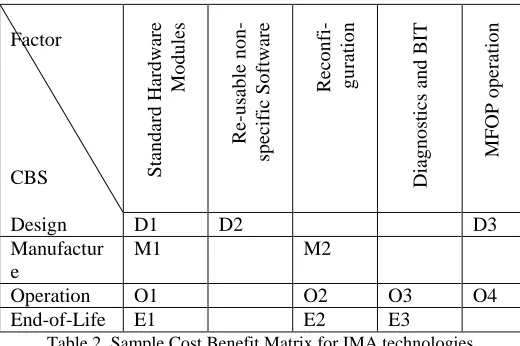
Table 2 identifies the effects of introducing certain IMA and RIMA technological factors against the major life cycle phases. Each cell in the table denotes a reference to the following paragraphs that list the suggested effects. Each effect cross references a root factor and a CBS element (although only the 4 high levels are shown here, any lower level CBS element could be referenced). Some effects are consequences of other effects rather than directly influenced by a factor. For example, reduced cost of purchasing spares is a consequence of a smaller number of parts that itself is a consequence of adopting standard hardware modules.
Factor
CBS Sta
n d a rd H a rd w a re M o d u le s R e -u sa b le n o n -sp e c if ic S o ft w a re R e c o n fi -g u ra ti o n D ia g n o st ic s a n d B IT M F O P o p e ra ti o n
Design D1 D2 D3
Manufactur e
M1 M2
Operation O1 O2 O3 O4
End-of-Life E1 E2 E3
Table 2. Sample Cost Benefit Matrix for IMA technologies.
D1: Reusable design; reduced hardware development cost D2: increased software development cost; reduced on-going code maintenance
D3: better design focus
M1: economies of scale in supply and production; downward pressure on price through opportunities for increased competition.
M2: reduction in emergency parts despatch
O1: reduced costs of spares holding, space requirements, technical support, improved familiarity and hence faster and
more accurate fault-finding and repair, improved despatch service level.
O2: reduce duplication and redundancy, weight and space savings, improved despatch levels leading to reduced delays and cancellations and better customer service, fault tolerance. O3: improved No Fault Found levels, reduction in quantity of
test equipment or opportunity to distribute test equipment more widely, elimination of 2ndline maintenance. O4: better timing of logistics, reduced need for 1stline support
(out-stations), reduced need for stand-by systems, better dispatch level, reduced maintenance error, reduced spare parts holdings at out-station and at base.
E1: higher residual value, improved resale opportunity E2: extended life operation (+ and -), cheaper upgrades E3: reduced unnecessary disposals.
5.0 LIFE CYCLE COST ANALYSIS
We regard the development of life cycle cost as a dynamic process. Rather than keep a running total of cost against each CBS element and each CBS phase, cost modifiers in the form of effect values are accumulated when needed in the form of a report.
The process of generating a cost figure starts with a definition of the scope of the system being evaluated followed by defining the span of the life cycle to be investigated. A total life cycle cost figure – a single figure – will encompass all items and all CBS elements.
Analysis can be performed from many perspectives, however, two in particular stand out: in common with the way in which projects are managed we suggest analysis by item for which cost targets have been specified; secondly, analysis by technological factor.
Defining the scope for analysis by item requires the analyst to select an item from the item hierarchy. Care must be taken to ensure that the analysis that follows includes all relevant effects that stem from the root cause of a change. The proposed model assists the analyst in understanding the consequences of selecting a particular scope by providing the ability to trace what effects influence the item, where these effects were originated and then what else is influenced, at what level and in what phase of the life cycle.
Analysis by factor is straightforward as these are the root causes of a propagation of effects throughout the system hierarchy and CBS. There is no need for the analyst to trace network relationships prior to generating a result.
The analysis is performed tracing the network links in a forward only direction. As each effect is encountered the effects are summed arithmetically. The sum of effects can be recorded for specified or all CBS elements. When all network links have been traversed, the resulting sums can be reported and used to assist decision makers in justifying the introduction of new technological factors.
6.0 SOFTWARE IMPLEMENTATION
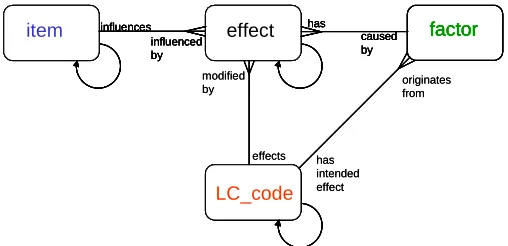
The LCC-NET model can be represented in relatively straightforward manner in a relational database for which we provide an Entity Relationship model in Figure 2.
originates from modified by has intended effect effects effect factor item influences influenced by has caused by LC_code originates from modified by has intended effect effects effect factor item influences influenced by has caused by LC_code effect factor item influences influenced by has caused by LC_code effect factor item influences influenced by has caused by LC_code LC_code
Figure 2. Entity Relationship model for LCC-NET.
Item, effect and LC_code entities are shown with recursive relationships or ‘pig’s ears’ that define a hierarchy of arbitrary depth. The effect entity embodies a ternary relationship between factors, the CBS (via LC_code) and the system items. Every factor has an intended effect and every CBS element may originate from one or more factors, however in the implementation this final relationship is not included.
LCC-NET has been developed using Microsoft Access®. Various queries and reports have been developed to support the approach to performing LCC analysis described in Section 5 of this paper.
Figure 3 shows the result of a cross-tab query on the Effects table as a Report. For each factor and effect the sum of the effects is calculated and reported showing the item influenced and where in the life cycle costs and benefits are indicated.
Detail & Summary for all
factor Description Item Total Of Design Operat Spares
Influenced effect ion Distributio
Economies of MyAvionics 0
enhanced Spares Cost 0 0
Fewer spares MyAircraft -100000 -100000
H/W MyAvionics 0 0
reduced base 1stLine Costs 0
Simplified Line 1stLine Costs 0 0
Speed of Projection of 0 0
Summary for 'factor' = (7 detail records)
Sum -100000 0 0 -100000
1
Fewer different MyAvionics 0 0
Reusable MyAircraft 0 0
Summary for 'factor' = 1 (2 detail records)
Sum 0 0 0
[image:5.612.314.559.60.213.2] [image:5.612.48.302.203.326.2]Grand Grand Grand Grand Grand
Figure 3 Sample Summary Report
Work continues in developing the LCC-NET model, in particular we shall be considering ways to attach cost models to relationship that will allow us to propagate costs throughout the network under program control thus reducing the amount of data entry and speeding up the evaluation of the potential for introducing new technologies into future designs and operations.
REFERENCES
1. J. Jones, L. Warrington, N. Davis, “The use of discrete event simulation to model the achievement of maintenance free operating time for aerospace systems”, Proc Ann. Reliability & Maintainability Symp, 2002, pp170-175.
2. C.J. Hockley, “Design for Success”, Proc Inst Mechanical Engineers, Vol212, Part G, 1998, pp371-378.
3. D.M. Johnson, T.A. Omiecinski, “The feasibility and benefits of dynamic reconfiguration in integrated modular avionics”, The Aeronautical Journal, February 1998 , pp99-105.
4. W.J. Fabrycky, W.R. Simpson, J.W. Sheppard, Life-Cycle Cost and Economic Analysis, 1991, Prentice Hall.
5. Y. Asiedu, P. Gu, “Product life cycle cost analysis: state of the art review”, Int. Jnl. of Production Research, Vol. 36, No. 4, 1998, pp883-908.
6. L. Atling, “Life-cycle design of products: a new opportunity for manufacturing enterprises”,
Concurrent Engineering: automation, tools and techniques(ed A. Kusiak), 1993, Wiley, pp1-17. 7. J.F. Moore, “Civil integrated modular avionics – a
longer-term view”, AEAT, Vol. 71, No. 6, 1999, pp550-557.
BIOGRAPHIES Neil Davis, PhD, Senior Research Fellow Warwick Manufacturing Group,
International Manufacturing Centre, Department of Engineering, University of Warwick,
Coventry, CV4 7AL , United Kingdom E-mail:[email protected]
Neil Davis is a Senior Research Fellow in the Warwick Manufacturing Group (WMG), University of Warwick. He received a BSc in Production Technology and Production Management from the University of Aston in Birmingham in 1984, and a PhD in Engineering from the University of Warwick in 1997. He has worked as an engineer and project manager in aerospace, automotive and automation companies before joining WMG in 1989. His current research interests include applications for discrete-event simulation, modelling methodology, and simulator design. He is a course leader for Operations Planning and Control in the School of Engineering and for Simulation of Production Systems within WMG. Jeff Jones, Senior Research Fellow
Warwick Manufacturing Group, International Manufacturing Centre, Department of Engineering, University of Warwick,
Coventry, CV4 7AL, United Kingdom E-mail:[email protected]
Jeff Jones is a senior research fellow with Warwick Manufacturing Group at the University of Warwick where he is involved in research into the improvement of aircraft reliability. He has a first degree in electronic engineering and physics and MPhil in reliability engineering. He is an expert and project leader on IEC/TC56. He is also an active member within the UK dependability standards community. He is a Chartered Physicist, a Chartered Engineer and holds memberships of the IEEE, the Institute of Physics, ASQ, The safety and reliability society, and the Society of Aerospace Engineers
Mr Les Warrington, Senior Fellow Warwick Manufacturing Group, International Manufacturing Centre, Department of Engineering, University of Warwick,
Coventry, CV4 7AL, United Kingdom E-mail:[email protected]
Les Warrington holds degrees in modern history and aeronautical engineering. He was an engineering officer in the Royal Air Force before joining the University of Warwick in 1992 to develop reliability & maintenance teaching and research. He jointly founded the Warwick Quality & Reliability MSc programme and is course leader of reliability modules in this and other Warwick MSc programmes