
Towards efficacious groupware development: an empirical modelling approach
328
0
0
Full text
(2) Towards efficacious groupware development: an Empirical Modelling approach by. Zhan En Chan. A thesis submitted to. in partial fulfilment for the admission to the degree of. Doctor of Philosophy in Computer Science. Department of Computer Science University of Warwick. July 2009.
(3) Towards efficacious groupware development: an Empirical Modelling approach. i. Table of Contents TABLE OF CONTENTS .........................................................................................................I LIST OF FIGURES AND TABLES...........................................................................................V ACKNOWLEDGEMENT ...................................................................................................VIII DECLARATION .................................................................................................................IX ABSTRACT ........................................................................................................................X ABBREVIATIONS..............................................................................................................XI. CHAPTER 1 INTRODUCTION...................................................................... 1 1.1. Thesis aim and scope.............................................................................................3. 1.2. Related work ............................................................................................................5. 1.3. Research Contribution ..........................................................................................7. 1.4. Overview of the thesis ...........................................................................................8. CHAPTER 2 GROUPWARE DEVELOPMENT IN THE HUMAN CONTEXT ...... 10 2.1. Supporting group work...................................................................................... 11 2.1.1 2.1.2 2.1.3 2.1.4 2.1.5 2.1.6. 2.2. Taxonomy of group work...................................................................................................11 Awareness and Coordination ...........................................................................................13 Articulation work...................................................................................................................14 Creativity ...................................................................................................................................16 Experimentation ....................................................................................................................17 Knowledge sharing and knowledge construction ...................................................18. Issues in groupware development................................................................. 19 2.2.1 Groupware and CSCW..........................................................................................................20 2.2.2 The socio‐technical challenge ..........................................................................................21 2.2.3 Brooks’s “No Silver Bullet” argument ...........................................................................28. 2.3. Contemporary groupware development paradigm ................................. 30 2.3.1 The iterative process............................................................................................................30 2.3.2 Ethnomethodology and Ethnography...........................................................................31 2.3.3 Participatory design .............................................................................................................34. 2.4. Accommodating evolving human activity ................................................... 35 2.4.1 Evolving nature of human activity .................................................................................36 2.4.2 Evolution of groupware ......................................................................................................37. 2.5. Towards efficacious groupware development .......................................... 43 2.5.1 From group‐centred to human‐centred for groups................................................44. Department of Computer Science, University of Warwick, United Kingdom. Zhan En Chan.
(4) Towards efficacious groupware development: an Empirical Modelling approach. ii. 2.5.2 The notion of participation................................................................................................49 2.5.3 The efficacious disposition perspective.......................................................................52. CHAPTER 3 THE PARTICIPATION PROBLEM: ROLES, PARTICIPATION, AND THE CONFLATION OF CONTEXTS IN GROUPWARE DEVELOPMENT .................................................................... 55 3.1. The coevolution between the developer’s understanding and the artifact.............................................................................................................. 58. 3.2. Reconceptualising the developer and the user ......................................... 63 3.2.1 3.2.2 3.2.3 3.2.4. 3.3. The tension between the developers and the users ...............................................64 Broadening the conception of user................................................................................67 Broadening the conception of developer ....................................................................70 Reconsidering the conception of developer and the user: a role or a person?.......................................................................................................................................73. The roleshifting phenomena .......................................................................... 76 3.3.1 Role‐shifting in group work ..............................................................................................77 3.3.2 Role‐shifting in systems development .........................................................................78. 3.4. Participatory development .............................................................................. 83 3.4.1 3.4.2 3.4.3 3.4.4. 3.5. Who is the participant? .......................................................................................................84 Participation and the conflation of contexts..............................................................86 Participation and the conflation of roles .....................................................................88 Participation, co‐construction, and co‐evolution.....................................................88. Implications for groupware development .................................................. 91 3.5.1 3.5.2 3.5.3 3.5.4. Co‐evolution.............................................................................................................................92 Role‐shifting.............................................................................................................................93 Participation ............................................................................................................................94 Conception................................................................................................................................96. CHAPTER 4 EMPIRICAL MODELLING IN A NUTSHELL ............................... 98 4.1. Concepts of Empirical Modelling .................................................................... 99 4.1.1 The ODA framework.............................................................................................................99 4.1.2 The EM process.................................................................................................................... 106 4.1.3 The EM artifact..................................................................................................................... 109. 4.2. The philosophical foundation of Empirical Modelling......................... 112 4.2.1 The notion of observation and theory building..................................................... 113. 4.3. Characteristics of practical EM..................................................................... 116 4.3.1 4.3.2 4.3.3 4.3.4 4.3.5 4.3.6. The tkeden tool.................................................................................................................... 116 Conceptual constructs ...................................................................................................... 119 Instant feedback.................................................................................................................. 123 Dialogical interaction ........................................................................................................ 125 Openness and flexibility................................................................................................... 128 Experimentation ................................................................................................................. 129. Department of Computer Science, University of Warwick, United Kingdom. Zhan En Chan.
(5) Towards efficacious groupware development: an Empirical Modelling approach. iii. CHAPTER 5 EMPIRICAL MODELLING FOR COLLABORATIVE MODELLING ....................................................................... 132 5.1. Defining collaborative modelling................................................................ 133 5.1.1 Five degrees of engagement in collaborative modelling ................................... 134 5.1.2 The relationship between modellers and agents in collaborative modelling................................................................................................................................ 137 5.1.3 The modes of interaction in collaborative modelling ......................................... 141 5.1.4 The dynamic nature of collaboration......................................................................... 150. 5.2. Why is Distributed Empirical Modelling not good enough? ............... 151 5.2.1 Historical development in Empirical Modelling for collaboration................ 151 5.2.2 Issues with the DEM framework and its tool support ........................................ 153. 5.3. How EM might support collaborative modelling ................................... 157 5.3.1 5.3.2 5.3.3 5.3.4 5.3.5. Coordination ......................................................................................................................... 158 Collaboration ........................................................................................................................ 159 Cooperation........................................................................................................................... 160 Co‐construction ................................................................................................................... 161 Co‐evolution.......................................................................................................................... 162. CHAPTER 6 CASE STUDIES: PRACTISING EMPIRICAL MODELLING IN COLLABORATIVE CONTEXTS ............................................... 164 6.1. Case study I: the Virtual Electronic Laboratory project....................... 169 6.1.1 6.1.2 6.1.3 6.1.4. 6.2. Case study II: the development of a distributed Jugs model .............. 180 6.2.1 6.2.2 6.2.3 6.2.4 6.2.5. 6.3. The background of the case study............................................................................... 196 Method of study and approach to data analysis.................................................... 196 Limitations............................................................................................................................. 198 Discussion .............................................................................................................................. 199. Case study IV: the cricket project ................................................................ 206 6.4.1 6.4.2 6.4.3 6.4.4 6.4.5. 6.5. The background of the case study............................................................................... 180 Method of study and approach to data analysis.................................................... 181 Limitations............................................................................................................................. 186 The collaborative modelling process ......................................................................... 188 Discussion .............................................................................................................................. 192. Case study III: collaborative Sudoku .......................................................... 196 6.3.1 6.3.2 6.3.3 6.3.4. 6.4. The background of the case study............................................................................... 169 Method of study and approach to data analysis.................................................... 171 Limitations............................................................................................................................. 175 Discussion .............................................................................................................................. 176. The background of the project...................................................................................... 206 Method of study and approach to data analysis.................................................... 208 Team 11’s cricket simulation project......................................................................... 211 Limitations............................................................................................................................. 218 Discussion .............................................................................................................................. 219. Concluding Remarks ........................................................................................ 222. Department of Computer Science, University of Warwick, United Kingdom. Zhan En Chan.
(6) Towards efficacious groupware development: an Empirical Modelling approach. iv. CHAPTER 7 EFFICACIOUS GROUPWARE DEVELOPMENT THROUGH EMPIRICAL MODELLING ..................................................... 224 7.1. Groupware development as collaborative modelling .......................... 226. 7.2. EM for humancentred development ......................................................... 227 7.2.1 7.2.2 7.2.3 7.2.4. EM for genuine participation......................................................................................... 228 Integrating the human and the technological ........................................................ 232 Enabling flexibility and evolution................................................................................ 234 Supporting diverse interaction and communication .......................................... 234. 7.3. GroupPIE – a framework for efficacious groupware development.. 235. 7.4. Limitations for the GroupPIE framework................................................. 241. 7.5. Towards efficacious groupware development: vision for GroupPIE.............................................................................................................. 243. CHAPTER 8 CONCLUSIONS.................................................................... 249 8.1. Research summary........................................................................................... 249. 8.2. Further work ...................................................................................................... 253. 8.3. Concluding remarks......................................................................................... 257. BIBLIOGRAPHY ............................................................................................................. 259 APPENDIX A ................................................................................................................. 284 APPENDIX B ................................................................................................................. 286 APPENDIX C ................................................................................................................. 289 APPENDIX D ................................................................................................................. 292. Department of Computer Science, University of Warwick, United Kingdom. Zhan En Chan.
(7) Towards efficacious groupware development: an Empirical Modelling approach. v. List of Figures and Tables Figure 1.1 – Relationships between this thesis and other doctoral theses on EM ................................................................................................................................4 Figure 1.2 – Relationships between chapters in this thesis ...........................................8 Figure 2.1 – Tang’s iterative process for groupware development .......................... 31 Figure 2.2 – A model for groupware evolution ................................................................ 42 Table 2.3 – Summary of the intended focus and actual focus of contemporary systems development approaches ................................... 45 Figure 2.4 – Gasson’s dualprocess model ......................................................................... 47 Figure 3.1 – The coevolution between the developer’s understanding and the development of an artifact ........................................................................ 59 Figure 3.2 – The spectrum of user participation in systems development ............ 85 Figure 3.3 – A model of systems development with broader conceptions of developer and user ............................................................................................. 89 Figure 3.4 – A conceptual model for participatory development.............................. 90 Figure 4.1 – Three views of agent and agency in EM................................................... 103 Figure 4.2 – External observer vs. internal observer in EM ..................................... 104 Figure 4.3 – The relationship between the definitive script, the screen, and its referent in the jugs model (EMPA: jugsBeynon1988) .................... 105 Figure 4.4 – Exploring ritualised definitions in EM ..................................................... 108 Figure 4.5 – Sensemaking and ritualisation in EM ..................................................... 108 Figure 4.6 – The EM perspective on artifact, construal, model, program ............ 112 Figure 4.7 – The tkeden modelling environment loaded with the Jugs model (EMPA: jugsBeynon2008) .............................................................................. 117 Table 4.8 – Conceptual constructs in EM versus the closest conceptual constructs in other programming paradigms......................................... 120 Figure 4.9 – Cascading definitions and cyclic definitions in EDEN......................... 121 Figure 4.10 – Triggered action in EDEN........................................................................... 122 Figure 4.11 – The difference in feedback cycles between the interpretation and compilation ................................................................................................ 124 Figure 4.12 – Logo script vs. Donald script .................................................................... 124 Department of Computer Science, University of Warwick, United Kingdom. Zhan En Chan.
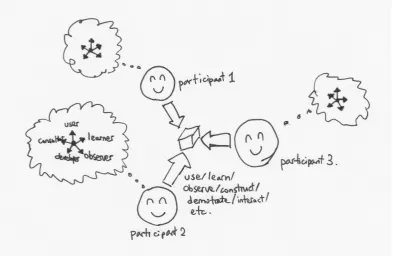
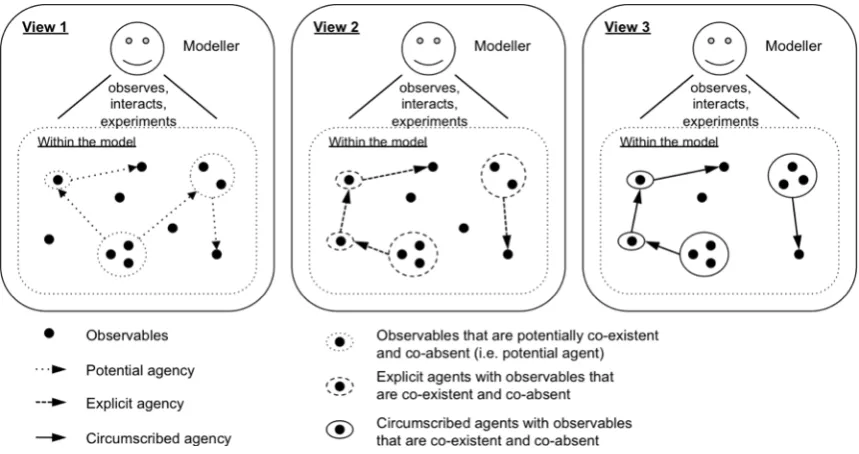
(8) Towards efficacious groupware development: an Empirical Modelling approach. vi. Figure 4.13 – The difference between definitive notation and procedural programming ..................................................................................................... 128 Figure 4.14 – Potential influence between instant feedback, dialogical interaction, experimentation, openness and flexibility ...................... 130 Figure 5.1 – Collaborative modelling scenarios ........................................................... 138 Figure 5.2 – The relationships between modellers and agents in the model..... 139 Figure 5.3 – Private mode of interaction ........................................................................ 143 Figure 5.4 – Peertopeer mode of interaction.............................................................. 143 Figure 5.5 – Broadcast mode of interaction ................................................................... 144 Figure 5.6 – Blackboard mode of interaction ................................................................ 146 Figure 5.7 – Interference mode of interaction .............................................................. 148 Figure 5.8 – Supporting diverse modes of interaction in collaborative modelling............................................................................................................. 149 Table 6.1 – Considerations that the case studies have addressed ......................... 167 Figure 6.2 – A screen capture of the VEL model (EMPA: velShethDOrnellas1998) within the dtkeden modelling environment....................................................................................................... 171 Figure 6.3 – Cooperation between Sheth and D’Ornellas in the VEL project ...... 178 Figure 6.4 – Triggered actions graph after Matrix A is changed in the VEL model .................................................................................................................... 178 Figure 6.5 – The room configuration of the distributed jugs modelling case study...................................................................................................................... 182 Figure 6.6 – The room configuration of the collaborative modelling workshop............................................................................................................. 182 Figure 6.7 – A glimpse of the interaction between two modellers in a distributed jugs modelling ............................................................................ 187 Figure 6.8 – Collaborative modelling of a pair of jugs at the early stage ............. 187 Figure 6.9 – A glimpse of the development of the distributed jugs in a collaborative modelling environment....................................................... 188 Figure 6.10 – Screen capture of the distributed Jugs model constructed in the second distributed jugs modelling session ...................................... 192 Figure 6.11 – A screen capture of King’s Sudoku model (EMPA: sudokuKing2006) with the tkeden modelling environment ............. 195 Figure 6.12 – Coconstruction of the check rules in the collaborative Sudoku model .................................................................................................................... 200. Department of Computer Science, University of Warwick, United Kingdom. Zhan En Chan.
(9) Towards efficacious groupware development: an Empirical Modelling approach. vii. Figure 6.13 – Evolution of a set of check rules in the collaborative Sudoku model .................................................................................................................... 201 Figure 6.14 – A little helper agent ‘wcs’ used in the collaborative Sudoku modelling............................................................................................................. 201 Figure 6.15 – Modeller S queried the ‘checkstatus’ observable before defining the initial version of the little helper agent ‘wcs’ ................. 202 Table 6.16 – The distribution of expertise in team 11 (extracted from the minutes attached in Team’s 11 FTR). ........................................................ 211 Figure 6.17 – The dependency graph for the team model of Team 11 ................. 212 Figure 6.18 – Colour coded team’s model and individuals’ models listed side by side................................................................................................................... 215 Table 6.19 – Contribution by the members in Team 11 ............................................ 216 Figure 7.1 – Factors surrounding participatory development ................................ 228 Figure 7.3 – The participation perspective in the GroupPIE framework............. 237 Figure 7.4 – The interaction perspective in the GroupPIE framework................. 240 Figure 7.5 – The evolution perspective in the GroupPIE framework.................... 240 Figure 7.6 – The scope of efficacious groupware development in relation to ACMP ..................................................................................................................... 241 Table 8.1 – Similarities between Empirical Modelling and Participatory Design ................................................................................................................... 253. Department of Computer Science, University of Warwick, United Kingdom. Zhan En Chan.
(10) Towards efficacious groupware development: an Empirical Modelling approach. viii. Acknowledgement I would like to thank my supervisor, Dr Meurig Beynon, who has been guiding me and sharing my emotions throughout my research journey at University of Warwick. I am indebted to him for substantial assistance in correcting language mistakes during the writing of this thesis. I am also indebted to Dr Meurig Beynon for his enthusiasm, patience, and invaluable help in all aspects during the writing of this thesis. Special thanks goes to Dr Steve Russ and Dr Mike Joy, who have given me invaluable insight on early ideas in forming the structure of this thesis. I am also grateful to Prof Erkki Sutinen, who has given insightful comments about the overall orientation of this thesis and possible future research directions. I would like to thank my parents who have been taking care of my poor health, and sharing my stress, depression, and joy since I was born. They are patient and encouraging. Without their support, I would never been able to realise this thesis. I would also like to thank Dr Roger Packwood and the IT Services for their help in setting up equipment for the case studies. Lastly but not least, thank you to the present and the past members of the Empirical Modelling group who have been participating in the group seminars and provoked valuable ideas in relation to my research: Dr Charles Care, Dr Ashley Ward, Dr Antony Harfield, Dr Chris Roe, Russell Boyatt, Karl King, George Efstathiou, Nick Pope, Timothy Heron, Sunny Chang, Amanda Wright, Chris Brown.. Department of Computer Science, University of Warwick, United Kingdom. Zhan En Chan.
(11) Towards efficacious groupware development: an Empirical Modelling approach. ix. Declaration This thesis is presented in accordance with the regulations for the degree of Doctor of Philosophy. It has been composed by myself and has not been submitted in any previous application for any degree. The work in this thesis has been undertaken by myself except where otherwise stated. The discussion of the process of co-evolution of the developer’s understanding and the artifact in section 3.1 draws on the ideas presented in a paper (Beynon et al., 2008) published in the “The 20th Annual Psychology of Programming Interest Group Conference (PPIG 2008)”. The discussion of the role-shifting phenomena discussed in section 3.3 draws on a presentation (Chan, 2006) in the “Warwick Postgraduate Colloquium in Computer Science (WPCCS ‘06)”, and a workshop paper (Beynon and Chan, 2006) presented in the Distributed Participatory Design (DPD) workshop that was held in conjunction with NordiCHI 2006. The preliminary results from the case study on the cricket project in section 6.4 were presented in the “Warwick Postgraduate Colloquium in Computer Science (WPCCS ‘08)” (Chan, 2008). Part of the data used in the case study on the distributed jugs construction in section 6.2 was jointly collected by Antony Harfield and myself. The role-shifting phenomenon observed in section 6.2 and section 6.3 was briefly presented in the DPD 2006 workshop and in WPCCS ’06. The discussion of the case study on the cricket project draws on the technical research report CS-RR-444 (Beynon and Chan, 2009). The ideas behind practising an EM approach to collaborative modelling presented in this thesis were also inspired by the reworking of the Clayton Tunnel railway accident model, the related presentation in the “Warwick Postgraduate Colloquium in Computer Science (WPCCS ‘05)” (Chan, 2005) and the poster presented in the EU TEL Kaleidoscope Network of Excellence Showcase 2005 in Oberhausen, Germany (Harfield et al., 2005).. Department of Computer Science, University of Warwick, United Kingdom. Zhan En Chan.
(12) Towards efficacious groupware development: an Empirical Modelling approach. x. Abstract Groupware development can be conceived as one particular branch of software systems development. Research into groupware development faces both methodological challenges as in classical software development, and socio-technical issues as identified in the CSCW literature. On the one hand, the paradigm needs to accommodate the changing context for use, facilitate the effective communication between developers and users, and maintain the conceptual integrity of the system. On the other hand, it has to deal with the dynamic nature of groups and the emerging work practices during the development process. As Grudin (1988) pointed out, the social and organisational aspects within the groupware development (and use) often lead groupware to fail. Individual differences make it unlikely that two groups are in reality identical. Consequently, groupware development should be seen and treated as an organic process, in which the groupware is grown by the owners with the aid of professional developers rather than constructed by professional developers alone. In this thesis, I propose a new conception of efficacious groupware development which draws on the ancient Chinese philosophical notion of shi (as interpreted by Jullien (1995)). In this thesis, I argue that Empirical Modelling (EM) potentially offers a conceptual framework well-suited for efficacious groupware development. In the process, I propose a new conceptual framework for practising an EM approach in a groupware development context. EM is a body of principles and tools which embraces an experimental, interactive, and open approach towards systems development through the exploration of observation, dependency and agency. The proposed conceptual framework, known as GroupPIE, is based on the principles of EM. This is built upon previous research into EM, particularly Sun's Distributed Empirical Modelling (DEM). In contrast to DEM, this thesis focuses on the micro-level of collaborative modelling. In particular, it considers how EM might facilitate the collaboration amongst the modellers and interaction between the modellers and the evolving artifact which takes place in groupware development. The thesis draws on various case studies from undergraduate projects and research projects which have practised an EM approach to collaborative modelling. The case studies suggest that the participants' knowledge of the situation co-evolves with the artifact under construction and that there is role-shifting behaviour through the collaborative modelling. Drawing on the case studies, this thesis argues that an EM approach to collaborative modelling potentially facilitates genuine participation. This challenges the accepted ideas about the role of participants (or actors) and the relationship between them in the groupware development process. It also suggests that EM potentially facilitates a notion of participatory development which is “more” human-centred. On this basis, I argue that EM is potentially better-suited for realizing the vision of efficacious groupware development. Department of Computer Science, University of Warwick, United Kingdom. Zhan En Chan.
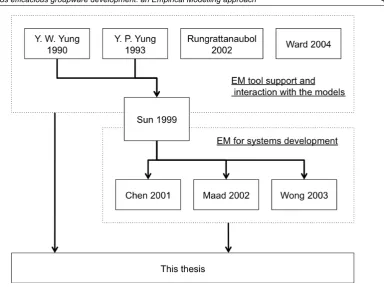
(13) Towards efficacious groupware development: an Empirical Modelling approach. xi. Abbreviations ADM. Abstract Data Machine (in the EM context). AT. Activity Theory. CM. Collaborative modelling (cf. chapter 5). CSCL. Computer Supported Collaborative Learning. CSCW. Computer Supported Cooperative Work. DCog. Distributed Cognition. DEM. Distributed Empirical Modelling. DPD. Distributed Participatory Design. EGD. Efficacious Groupware Development (cf. chapter 7). EM. Empirical Modelling (cf. chapter 4). FOSS. Free and Open Source Software. GD. Groupware development. HCD. Human-centred design. HCI. Human-Computer Interaction. IS. Information System. IT. Information technology. ICT. Interaction and Communication Technologies. LSD. LSD Notation (in the EM context). ODA. Observables, dependencies, agents, and agencies (in the EM context). PD. Participatory Design. UCD. User-centred design. Department of Computer Science, University of Warwick, United Kingdom. Zhan En Chan.
(14) Towards efficacious groupware development: an Empirical Modelling approach. 1. Chapter 1 Introduction Prior to postgraduate studies, I worked in a few organisations as a systems developer and a 1. systems administrator . As an on-site systems developer, like many other systems developers, my main duty was to write software for my organisation. But, interestingly, I occasionally found myself involved in other organisational operations which a ‘normal’ systems developer would not perform (e.g. promoting products in the public space). Equally, the users were sometimes more than just users – they could develop ‘simple programs’ for themselves. This is particularly true in small and medium sized enterprises (SMEs), where there tends to be a more flexible organisational structure. Reflection on these personal experiences suggests some interesting questions. On the one hand, it could be argued that fulfilling non-technical roles is part of the systems developer’s duty. On the other hand, I may ask “what is the boundary of the systems developer’s duties?”, “can systems developers in reality only work as ‘developers’?” and “can users in reality only work as ‘users’?”. Another interesting reflection from my industrial experience is that, despite the fact that there were off-the-shelf (and open source) alternatives, organisations that employed on-site developers tend to build and re-build software of similar kinds over and over again. The interesting question to ask is thus “why would the organisations have to reinvent the wheel over and over again?” One reason is that the organisation process is always situated and evolving at all times. It is unclear how an off-the-shelf component (or system) can be. 1. The difference between a systems developer and a systems administrator is that the former requires knowledge in. software construction and the latter requires knowledge in computer hardware. As a systems developer, I mainly wrote software using generic programming languages such as Java and C, and as a systems administrator, I mainly monitored and maintained computer equipment (e.g. servers, routers) using little system-level programming with programming languages such as C and Perl. Department of Computer Science, University of Warwick, United Kingdom. Zhan En Chan.
(15) Towards efficacious groupware development: an Empirical Modelling approach. 2. customised to suit the organisational needs until the on-site developers and the real users get their hands on it. In SMEs, with limited resources to spend, evaluating off-the-shelf components could be a time-consuming activity carrying a degree of risk. This is partially due to the fact that seemingly well-suited off-the-shelf components might prove to be unsuitable after the evaluation, so that the evaluation effort would be wasted, and partially due to the fact that there is no guarantee that off-the-shelf components can be customised to 2. fit new requirements . An economic factor, namely, the cost-to-develop vs. the cost-to-buyand-customise, could be relevant in this situation. In labour-intensive countries, e.g. China, the labour cost to develop software from scratch is most likely cheaper than the cost of buying an off-the-shelf component and customising it. These considerations all suggest that, to some extent at least, systems development is not merely a technical, but also a sociotechnical process. This thesis studies the development of one particular species of software – groupware – and is motivated by my own experience in groupware development. Groupware development is often a part of a larger systems development project and the developers are working very closely with the other stakeholders (in some cases sharing the same open office space). In contrast to other species of software, groupware is more sensitive to the socio-technical challenge (cf. Grudin, 1994a). Consequently, I argue that groupware development should be seen and treated as an organic process, in which the groupware is grown by the owners with the aid of professional developers rather than constructed by professional developers alone. To realise this perspective, this not only requires the development and proper use of technology, but also harmonious design between the human and the technological. As de Vreede and Guerrero (2006) observed: “… It appears that technology alone seldom is the answer. What is needed is the conscious and harmonious design of collaboration processes and technologies.” (ibid, p.571). 2. The work practices are more frequently changing in SMEs, especially young SMEs.. Department of Computer Science, University of Warwick, United Kingdom. Zhan En Chan.
(16) Towards efficacious groupware development: an Empirical Modelling approach. 3. 1.1 Thesis aim and scope Empirical Modelling (EM) research was initiated by Meurig Beynon at University of Warwick more than 20 years ago. It has been developed as an approach to computer-based modelling which can be linked to William James’s Radical Empiricism – a philosophical foundation that is radically different from that upon which mainstream computer science is based (Beynon, 2005). Over the past two decades, more than 100 peer-reviewed papers and more than a dozen doctoral research theses related to EM have been published. For more details, see chapter 4 and the EM website (http://www.dcs.warwick.ac.uk/modelling). The aim of this thesis is to show that EM is an alternative and potentially a better conceptual framework for groupware development that accommodates the dynamic nature of group work that the groupware aims to support. More precisely, it tackles three research questions: i). What are the main challenges in human-centred groupware development?. ii). How can EM be practised in a groupware development context?. iii). Why does EM potentially offer a better conceptual framework?. To answer these questions, I draw on literature on groupware development, humancomputer interaction (HCI), computer supported cooperative work (CSCW), participatory design (PD), and Empirical Modelling (EM) in the broader context. In respect of EM, I draw on two strands of previous research: i). research that concerns EM tool support and the interaction between the modeller and the model, and. ii). research concerned with the potential of EM as a systems development approach (cf. figure 1.1).. Y. W. Yung (1990), Y. P. Yung (1993), P-H. Sun (1999) A. Ward (2004) were the main contributors to the principal tool support (tkeden and dtkeden) for EM. The theses by the brothers Y. W. and Y. P. Yung are both concerned with the low-level differences between EM and other programming paradigms. In particular, Yung (1993) gives a detailed account of the differences in various aspects: state, dependency, agent, and definitive notations.. Department of Computer Science, University of Warwick, United Kingdom. Zhan En Chan.
(17) Towards efficacious groupware development: an Empirical Modelling approach. 4. Figure 1.1 – Relationships between this thesis and other doctoral theses on EM. In her doctoral thesis “A treatise on Modelling with definitive scripts”, Rungrattanaubol (2002) improved our understanding of the core activity of EM: Modelling with Definitive Scripts (MwDS). In particular, she considered in depth how a modeller interacts with states through the (re)definitions of observables, dependencies, agents, and agencies in EM. Ward (2004) explained the difficulty in supporting dependency – a key concept in EM (cf. §4.1.1) – on the sequential von Neumann machine hardware. Sun (1999) introduced a conceptual framework for practising EM in a distributed environment, namely Distributed Empirical Modelling (DEM), in his doctoral thesis: “Distributed Empirical Modelling and its Applications to Software System Development”. His work improved our understanding the potential of EM in distributed modelling contexts. Since DEM is based on distributed cognition theory (Hutchins, 1995), DEM is evidently more concerned with structured organisations rather than the dynamic structured organisations that might be found in the collaborative modelling context. Sun (1999) also presented a Situated Process of Requirements Engineering (SPORE) to show the potential of the DEM framework. Based on the DEM and the SPORE frameworks, some researchers had shown the potential of practising an EM approach in various domains. For example, Chen (2001) Department of Computer Science, University of Warwick, United Kingdom. Zhan En Chan.
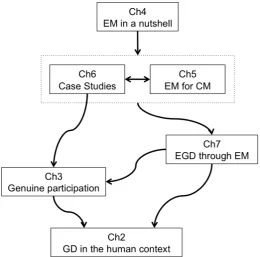
(18) Towards efficacious groupware development: an Empirical Modelling approach. 5. showed the potential of EM for participative development in business process reengineering. Maad (2002) showed how the SPORE framework could be used in a financial domain. More recently, Wong (2003) consolidated the EM principles in a Definitive Modelling Framework (DMF). He showed how the developers and the users might interact through the 3. construction of EM models within a SICOD framework in ubiquitous computing.. 1.2 Related work In this section, I briefly discuss a few research works that have a similar outlook with this thesis in the broader context. The Evolving Artifact Approach One of the key aspects in groupware development is to co-construct a shared knowledge of the future work practices that will be facilitated by the developing artifact through the development process. Ostwald (1996) argues that the knowledge of future work practices can neither be elicited by observing nor by analysing how the users get their work done within the current work practices. For this reason, Ostwald (1996) proposed the Evolving Artifact Approach (EVA), an evolutionary and participatory approach that “operationalizes the idea of knowledge construction for system development” (ibid). This thesis shares a common interest in the entire lifecycle of systems development (discussed in section 2.5). However, this thesis argues that the users should have equal opportunities to get their hands on co-constructing the artifact within the same modelling space as the developers through EM (discussed in chapter 3, 5, and 7). The philosophical foundation behind EM is rather different from that behind traditional programming. In particular, as will be discussed in 4. chapter 4, EM is based on observation, experimentation, and experience . Meta-design The idea of viewing systems development as a continual process can also be found in the meta-design conceptual framework (Fischer and Scharff, 2000). Fischer and Scharff (2000). 3 4. SICOD stands for “Soft Interfaces for the Control of Devices” The term ‘experience’ is used in the sense of William James’s (1912) Radical Empiricism.. Department of Computer Science, University of Warwick, United Kingdom. Zhan En Chan.
(19) Towards efficacious groupware development: an Empirical Modelling approach. 6. observe that it is difficult to design a closed system, and assert that, however well such a system is designed, the user will nevertheless discover “mismatches between their problems and the support a system provides”. They suggest that the meta-designer should underdesign (Brand, 1995) the system and let the end-users extend and evolve the system in an open-ended manner, which aligns with the “Seeding, Evolutionary Growth, Reseeding Model” (Fischer et al., 1994). The outlook of the GroupPIE framework (cf. chapter 7) and the efficacious groupware development perspective (cf. chapter 2) are quite similar to the metadesign framework: both evolutionary and participatory. However, “design” in meta-design refers to “[the] activities in which a person wishes to act as an active participant and contributor in personally meaningful activities”, which does not necessarily involve the lower level development activities, e.g. system implementation. Therefore, despite the fact that developers and users can be thought as designers in the meta-design framework, the imbalance of influence to the artifact construction potentially remain there (cf. chapter 3). Participatory programming Research into human-oriented systems development is not new; it was part of the early movement in Participatory Design (PD) (Gasson, 2003; also cf. §2.5.1). While PD, the notion of participation, and the issues surrounding participation will be described in detail in chapter 2 and 3, one particular work in PD is worth mentioning here. Letondal and Mackay (2004) reported a participatory design project with a group of bioinformatics practitioners who had received professional training in both biology and computer science. The primary aim of their project was to explicitly support end-user programming through PD. The project became interesting as they found two types of bioinformaticians: i) those who maintain a strong interest in biology but are also interested in creating tools for other biologists and themselves to use; ii) those who are “seduced” by the computing tools and are forced to create tools for their problems. This motivated Letondal and Mackay to define the term participatory programming as “a logical extension of participation design, in which users participate in the creation of software tools that they can ultimately tailor and program themselves.” Whereas no assumption is made about the technical competence of the participants in EVA Department of Computer Science, University of Warwick, United Kingdom. Zhan En Chan.
(20) Towards efficacious groupware development: an Empirical Modelling approach. 7. or meta-design, the bioinformaticians in Letondal and Mackay’s study were trained to be professional software developers (through their interdisciplinary education). In other words, the bioinformaticians were the developers as well as the users. As the popularity of 5. interdisciplinary programmes, such as the Computer and Business Studies undergraduate course at University of Warwick, increases, we shall see more cases like Letondal and Mackay’s. Though there have been some similar findings in other fields, e.g. in free and open source software (FOSS) (Nakakoji et al., 2002) development, only a few researchers (such as (Letondal and Mackay, 2004)) have considered such highly conflated roles in systems development to be possible. Although in fact EM is not the same as programming (cf. chapter 4), participatory programming is certainly related to the broader context of this thesis, particularly to the GroupPIE framework that I am going to discuss in chapter 7.. 1.3 Research Contribution The main contribution of this thesis, firstly, is that it identifies a promising configuration for practising an EM approach to groupware development that may lead to efficacious groupware development. Secondly, this thesis provides an account of the interplay among the conceptions and issues surrounding participation that leads to a better understanding of the problems in supporting human-centred groupware development. Thirdly, it improves our understanding of the potential of EM in a collaborative modelling context. This is supported with four case studies that cover a range of situations that may frequently occur in a collaborative modelling context. The work provides a promising foundation for further development of EM principles and tool support for collaborative modelling. Lastly, the efficacious groupware development perspective is itself a contribution, which provides a unified organic process view of groupware development based on Jullien’s interpretation of ancient Chinese philosophy in his book “The Propensity of Things”.. 5. These students are trained with programming knowledge and business knowledge. They can develop their career. in both directions: software development or business management. In the latter case, they may become hidden professional programmers. Department of Computer Science, University of Warwick, United Kingdom. Zhan En Chan.
(21) Towards efficacious groupware development: an Empirical Modelling approach. 8. Figure 1.2 – Relationships between chapters in this thesis. 1.4 Overview of the thesis In relation to the aforementioned research questions, this thesis can be divided into three sections (cf. figure 1.2). The first section (chapter 2 and 3) reviews research into groupware development and argues that several conceptions behind its development are problematic. It answers the question “What are the main challenges in human-centred groupware development?”. In chapter 2, I argue that support for co-evolution between the groupware and the group activities is the main issue in integrating groupware into its human context harmoniously. This challenges accepted ideas about the scope of development and the nature of participation. Towards the end of chapter 2, I propose a unified organic process view – the efficacious groupware development perspective – that views the development activities as finding an efficacious disposition, which does not distinguish contexts and roles of participants throughout the development and evolution of groupware. In chapter 3, I argue that the contexts of development and use, the roles of participants, and the nature of participation are interdependent concepts. Instead of re-conceptualising them, I argue for the support of genuine participation which conflates contexts and roles, and see participants Department of Computer Science, University of Warwick, United Kingdom. Zhan En Chan.
(22) Towards efficacious groupware development: an Empirical Modelling approach. 9. as human-beings. This creates a conceptual orientation for the rest of the thesis. The second section (chapter 4, 5, and 6) discusses EM principles and tools, and explores EM potential in collaborative modelling. It answers the questions “What is EM?” and “How can EM be practised in a collaborative modelling context?”. EM is a modelling approach which is based on experience, interaction, observation, and experimentation. In chapter 4, I explain the principles, the philosophical outlook, and the practical EM tool support. Drawing on various previous research into EM (cf. figure 1.1), I argue that the EM process is open and flexible, and that EM artifacts (or models) are provisional, situated, tacit, interactive, and ostensive (in the sense of Gooding’s construal). In chapter 5, I define what I mean by collaborative modelling. I argue that collaborative modelling involves diverse configurations that can neither be prescribed nor framed easily. A better approach to support collaborative modelling is to take this heterogeneous nature into account and allow flexible reconfiguration. I also examine the potential of EM in a collaborative modelling context, and explain why DEM is not good enough for collaborative modelling. In chapter 6, I demonstrate the potential for practising an EM approach in the context of collaborative modelling with four case studies. These case studies cover situations that may occur frequently in the context of collaborative modelling. The last section (chapter 7) considers EM in the context of groupware development. It answers the questions “Why does EM potentially offer a better conceptual framework?” and “How can EM be practised in a groupware development context?. Based on the principles of EM and the case studies, I argue that EM is a human-centred development approach when it is practised in a collaborative modelling context. Therefore, I argue that the potential of EM in collaborative modelling can be exploited in groupware development. Such an orientation potentially yields a better conceptual framework that gives a holistic account of groupware development from its first conception to its eventual disposal. This is a step towards realising efficacious groupware development.. Department of Computer Science, University of Warwick, United Kingdom. Zhan En Chan.
(23) Towards efficacious groupware development: an Empirical Modelling approach. 10. Chapter 2 Groupware development in the human context In the past few decades, since the intervention of personal computers, computational artifacts have been proliferating dramatically. Computer technology has entered our daily lives in many aspects, from organized to unstructured ad-hoc activities, from office to home, from formal work to entertainment, and it is playing an essential role in human communication and collaboration. Yet, the diverse, pervasive and ubiquitous use of computer technology poses new challenges to research into the development of computer technology when seamless integration to human activities and context are the primary concerns. Research communities such as Human Computer Interaction (HCI), Computer Supported Cooperative Work (CSCW), Participatory Design (PD), and Information Communication Technology (ICT) focus on different facets in the development of computer technology and yet share a broader common concern: how can computer technology support human activities efficaciously. In CSCW, the challenge is referred to as the socialtechnical gap: the gap between what we can support technically and what we must support socially (Ackerman, 2000). It is this socio-technical challenge that frames the broad context for this chapter. Instead of studying the broader context, this chapter focuses on the development of groupware, a kind of computer system which is more sensitive to the sociotechnical challenge than other species. This chapter develops an argument that there is no silver bullet for groupware development. Successful groupware development requires insightful understanding of how work is carried out in practice, and contemporary research does not offer a unified coherent theoretical framework for this purpose. Beginning with a taxonomy of group work, section 2.1 discusses the five important aspects of group work. That is, group awareness and coordination of work, Department of Computer Science, University of Warwick, United Kingdom. Zhan En Chan.
(24) Towards efficacious groupware development: an Empirical Modelling approach. articulation. work,. creativity,. experimentation,. knowledge. 11. sharing. and. knowledge. construction. These are the basic aspects that successful groupware has to support. Groupware is a socio-technological system and its development is unusually challenging due to the dynamic nature of groups and the evolving environment for group work. Section 2.2 discusses the socio-technical problem and the issues that are at the centre of concerns in groupware development. Contemporary paradigms for groupware development are reviewed in section 2.3. Due to the differences among groups and the dynamic nature of group work, a generic approach to groupware development is unlikely to suit all types of group work or all groups. Section 2.4 discusses the evolving nature of human activity, current theoretical influences on groupware development, and paradigms to evolve groupware. Indeed, in supporting human activities, the groupware must be able to evolve, allowing re-configuration throughout its lifecycle. Section 2.5 discusses a novel perspective on groupware development that is efficacious in the sense discussed by Jullien (1995) with reference to the notion of disposition.. 2.1 Supporting group work In order to provide effective computer support for group work, it is vital that groupware developers and groupware methods developers recognize the different types of group work and their nature. It is also essential to know that all successful groupware has some common features. In this section, a taxonomy of group work will be derived from the classification of groupware and five common features of successful groupware will be discussed.. 2.1.1 Taxonomy of group work Classifications of groupware such as (Johansen, 1988), (Teufel et al., 1995) and (Ellis et al., 1991) provide useful information to help users of off-the-shelf software to understand the kind of support that a specific groupware is offering and therefore help them to select the appropriate tool according to their needs. These classifications also provide a shared reference point, which eases the communication among groupware researchers, developers and other participants who are involved in the development process. Indeed, each Department of Computer Science, University of Warwick, United Kingdom. Zhan En Chan.
(25) Towards efficacious groupware development: an Empirical Modelling approach. 12. classification scheme reflects a facet of the whole spectrum of group work. Johansen (1988) proposed a two dimensional taxonomy for groupware. He suggests that groupware can be conceived to support collocated or distributed groups in the space dimension, and asynchronous or synchronous work in the time dimension. Most of the groupware classifications are derived from Johansen’s space/time classification. For example, Grudin (1994b) has extended Johansen’s taxonomy to take account of the predictability of space and time constraints, which results in a 3x3 matrix, and the impact this has on the way in which group work is organised. Andriessen (2003 p.12) combines Johansen’s classification with five functions of ICT in the group process. Recently, Penichet et al. (2007) produced a more complicated 7-dimensional matrix, which combine CSCW characteristics (i.e. information sharing, communication, and coordination) with a modified space/time dimension matrix. Johansen’s and Grudin’s classification were popular in 1990s and remain highly cited amongst CSCW researchers. There are other classifications of groupware which do not follow Johansen’s dimensional perspective. For example, the 3C model (Teufel et al., 1995) reflects a triangular relationship among communication, coordination and cooperation (cf. Borghoff and Schlichter, 2000), but such reflection may contradict the four-level of communication perspective (Borghoff and Schlichter, 2000, p.110). Ellis et al. (1991) differentiates groupware according to which application features they support. In Ellis et al’s classification, different groupware may share common features. Because of this, compared to Johansen’s classification and its derivatives, these classifications reflect less useful perspectives for understanding the characteristics of group work. Apart from space, time, predictability, and CSCW characteristics, group work can also be classified as structured or unstructured, planned or ad-hoc, data centric or process centric, and according to other dimensions such as group size (cf. Johansen, 1988; van der Aalst, 2007). Moreover, CSCW characteristics can be extended into a full spectrum of degrees of engagement (which will be discussed in chapter 5). There is endless possibility in classifying group work. Certainly, we can enrich the taxonomy in an open-ended way with additional dimensions through further analysis of group work, but more significantly, we shall recognise Department of Computer Science, University of Warwick, United Kingdom. Zhan En Chan.
(26) Towards efficacious groupware development: an Empirical Modelling approach. 13. that group work in practice is usually dynamic. It rarely settles into one particular mode of interaction. Actual human collaborations are fluid and do not usually follow a single pattern of work.. 2.1.2 Awareness and Coordination Awareness of other people’s work is crucial in a group work setting. As Dourish and Bellotti (1992) describe: “awareness is an understanding of the activities of others, which provides a context for your own activity. This context is used to ensure that individual contributions are relevant to the group’s activity as a whole, and to evaluate individual actions with respect to group goals and progress. The information, then, allows groups to manage the process of collaborative working.” (ibid) This understanding is an ongoing interpretation of both one’s own and others’ activities and artifacts involved in the process of group work (Chalmers, 2002), and it enables an individual to make conscious decisions (Borghoff and Schlichter, 2000) that promote a harmonious interaction, which eventually improves the productivity of the group (Kirsch-Pinheiro et al., 2003). Dourish and Bellotti’s (1992) notion of awareness is generally referred to as “group awareness” (Gutwin, 2004). In sociology, awareness is referred as shared cognition or team knowledge (Andriessen, 2003; Cannon-Bowers and Salas, 2001). In terms of computer support, awareness can be further categorized according to the nature of information it discloses and supports, e.g., presence awareness, emotion awareness, workspace awareness (Gutwin, 1997), change awareness (Tam and Greenberg, 2004), activity awareness (Hayashi et al., 1999; Carroll et al., 2006), gaze awareness (Ishii and Kobayashi, 1992). According to Dourish and Bellotti (1992), awareness has dual roles in group work: a highlevel of awareness of other people’s work helps to avoid redundancy of work, while a lowlevel awareness allows “fine-grained shared working and synergistic group behaviour”. (Dourish and Bellotti, 1992) The support to awareness is important for coordinating group Department of Computer Science, University of Warwick, United Kingdom. Zhan En Chan.
(27) Towards efficacious groupware development: an Empirical Modelling approach. 14. work (Dourish and Bellotti, 1992) and this inevitably involves division-of-labour. Lack of support to awareness in some situations may have unpleasant consequences, e.g. presence disparity in mixed-presence groupware (Tang et al., 2004). Although the impact of awareness on group work is clear, implementing awareness support in groupware remains challenging. As Chalmers (2002) pointed out “representation and interpretation affect the degree and character of awareness afforded by computer systems: awareness of people and of information artifacts”. This highlights the complexity and the socio-technical nature (cf. §2.2.1) of the issue. Further, awareness information can overload the recipient if not carefully designed (Kirsch-Pinheiro et al., 2003). In some situations, it may become a disturbance and significantly degrade the performance of an individual and the system (Dourish and Bellotti, 1992). It is difficult to maintain a balance between the amount of information to be disclosed and the degree of awareness of other people’s work. This is because different activities and different group, with few exceptions, require different kind of awareness support (Kirsch-Pinheiro et al., 2003). This makes it hard to generalize approaches to providing support for awareness and groupware developers often have to build this support from scratch (Kirsch-Pinheiro et al., 2003).. 2.1.3 Articulation work Research into articulation work has gained much attention in CSCW since Schmidt and Bannon (1992) observed that the lack of focus of the field “may hinder its further development and lead to its dissipation”, and suggested that “CSCW should be conceived of as an endeavor to understand the nature and requirements of cooperative work with the objective of designing computer-based technologies for cooperative work arrangements” (ibid, p.5, italics in original). The notion of articulation work was first introduced by a sociologist, Anselm Strauss, in 1985 (Strauss, 1985; Fjuk et al., 1997). It is used as a framework to study the interwoven nature of the division-of-labour and the interdependence among individuals in group work (Fjuk et al., 1997). Articulation work refers to the interaction between individuals that is necessary to, e.g. coordinate, align, schedule, and integrate interdependent activities which occur during the course of cooperative work (Schmidt and Simone, 1996; Lee, 2005). Strauss (1993) Department of Computer Science, University of Warwick, United Kingdom. Zhan En Chan.
(28) Towards efficacious groupware development: an Empirical Modelling approach. 15. defines: “Articulation stands for the coordination of lines of work. This is accomplished by means of the interactional process of working out and carrying through of work-related arrangements. Articulation varies in degree and duration depending upon the degree to which arrangements are in place and operative.” (Strauss, 1993, p.87) Articulation work is different from cooperative work. While the former is concerned with coordinating individual tasks taking into account the distributed nature of group work, the latter merely concerns the distribution of tasks to individuals who shared a common workspace, as Schmidt and Simone (1996) pointed out: “Cooperative work is constituted by the interdependence of multiple actors who interact through changing the state of a common field of work, whereas articulation work is constituted by the need to restrain the distributed nature of complexly interdependent activities.” (Schmidt and Simone, 1996, p.158) The relationship between cooperative work and articulation work is recursive since the management of an articulation work can invoke another articulation work or cooperative work, which again may yield another articulation work (Star and Strauss, 1999, Schmidt and Simone, 1996). This recursion, in theory, can be infinite, but, as Schmidt and Simone (1996) have pointed out, real world work practices usually terminate such recursions before they degenerate into chaos. Supporting the ongoing articulation work is one of the key issues in CSCW (Schmidt and Bannon, 1992). Central to articulation work is the concern for informal interactions, that are not explicit in the formal description of work, to bring the work back on to track when there are unexpected contingencies and breakdowns (Fjuk et al., 1997; Star and Strauss, 1999; Evans et al., 2001). Schmidt and Simone (1996) observe that articulation work may become intuitive and remain invisible in collocated group work where actors can interpret others’ activities through their bodily actions. Unfortunately, articulation work becomes “extremely complex and demanding” in a real world complex group work setting (Schmidt and Bannon, 1992; Schmidt and Simone, 1996). Providing computer support for articulation work remains Department of Computer Science, University of Warwick, United Kingdom. Zhan En Chan.
(29) Towards efficacious groupware development: an Empirical Modelling approach. 16. difficult due to the situated characteristics of the work activity (cf. Suchman, 1987; Grinter, 2000). Indeed, it may entail a thorough analysis of the culture and politics of the work, if the work is to be made visible (Star and Strauss, 1999; Schmidt and Bannon, 1992).. 2.1.4 Creativity Creativity has been a topic for research in sociology and psychology, but only recently has it caught the attention in HCI and CSCW, e.g. collaboratories (Sonnenwald, 2003; Farooq et al., 2005). Despite the fact that human creativity has the characteristics of being "inventive, wily, sly, cunning, and crafty" (Spinuzzi, 2003, quoted by Kaptelinin and Nardi, 2006), individual creative contributions are essential in group work because they involve "an instant restructuring of the whole representation of a problem" (Kaptelinin and Nardi, 2006; also cf. Wertheimer, 1966). Although this process is entirely internal to an individual, Kaptelinin and Nardi (2006, p.210) also acknowledge that "a subject can reframe a representation to successfully solve a problem", and the importance of this framing of a problem in problem solving has already been stressed by Jackson (2001). Although creativity is still by-and-large viewed as a quality of an individual and is sometimes viewed as a gift endowed at birth, there is no doubt that many creative ideas are the result of collaborative work (Nijstad et al., 2006). Fischer (2005) echoes this view by saying: “Much human creativity is social, arising from activities that take place in a social context in which interaction with other people and the artifacts that embody collective knowledge are essential contributors.” (ibid) A similar perspective can also be found in (Kaptelinin and Nardi, 2006), in which the authors argue that "[t]here is no lone genius" (ibid, p.214). Group creativity is not merely a sum of individuals' creative work as if they are working alone, but it is an emerging property of the group (Stahl, 2006; Kaptelinin and Nardi, 2006). However, there is much evidence in sociology suggesting that groups are far less productive and creative than the sum of their individual talents might indicate, e.g. (McGrath, 1984; Mullen et al., 1991; Nemeth and Nemeth-Brown, 2003; Paulus et al., 2006). It is not unusual to find that groups are making poorer decision than individuals (Nemeth and Nemeth-Brown, Department of Computer Science, University of Warwick, United Kingdom. Zhan En Chan.
(30) Towards efficacious groupware development: an Empirical Modelling approach. 17. 2003). Nijstad et al. (2006) observed that this reduced productivity is due to 3 reasons: i) group members must express their ideas in turn; ii) group members are unwilling to share 6. their ideas , iii) high-performing individuals tend to match their effort to that of their lowperforming colleagues. While there is seemingly little computer technology can do in case (ii) and (iii) (Nijstad et al., 2006), there is certainly a role that computer technology can play in supporting creativity in group work. In tackling (i), Nemeth and Nemeth-Brown (2003) stress the benefits of allowing different perspectives in the group. This proposal is strengthened by Nijstad et al’s (2006) observation that if individuals could express their ideas simultaneously through e.g. typing and writing, though not verbal communication, there would be less productivity loss (2006). Similar thinking along these lines can be found in (Farooq et al., 2005), in which they propose to give support for i) divergent and convergent thinking, ii) the development of shared objectives, and iii) reflexivity. It is worth noting that the development of computer support for creativity is still at an early stage. As Kaptelinin and Nardi (2006) point out, there is still no framework for analyzing how effects at an individual level can cause effects at the group level.. 2.1.5 Experimentation Following the creativity thread that has been discussed in the previous section, there are situations in which one may wish to explore an innovative idea further, e.g. to explore a configuration to see if it fits the situation at hand. This can be due to uncertainties about the problem at hand, the desire to gain further understanding about the current situation, or imperfect knowledge that necessitates learning by doing. I refer to this kind of problem solving related activity as everyday experiment. Everyday experiment is different from a controlled experiment that is usually carried out in a. 6. In some situations, individuals may be reluctant to share their perspectives because it may conflict with the. group’s perspective. In order to maintain a consensus, they usually drop their perspectives silently (Baron et al. 1992; Paulus et al. 2006). Janis (1982) refers to this phenomenon as ‘Groupthink’. This usually results in reduced creativity for the group (Nemeth and Nemeth-Brown 2003). Department of Computer Science, University of Warwick, United Kingdom. Zhan En Chan.
(31) Towards efficacious groupware development: an Empirical Modelling approach. 18. 7. laboratory . In contrast to laboratory experimentation, everyday experiment is informal and casual in nature, e.g. it is subject to fewer safety regulations. In the broad sense, experiments can be classified as exploratory experiments or post-theory experiments, depending on whether “there is a reliable basis for prediction, or criterion for successful outcome, drawn from theory or previous experience” (Beynon and Russ, 2008). 8. Experimentation has been seen as significant in innovative work , e.g. product design (Thomke, 1998), because “all experiments yield information that comes from understanding what does work and what does not work” (Thomke, 2003, p.20). Although Thomke (2003) is more concerned with the systematic experimentation involved in the use of computer simulations, models, and prototypes in controlled environments, I believe that the lessrigorous everyday experiment can also stimulate new ideas in group work.. 2.1.6 Knowledge sharing and knowledge construction As Divitini et al. (1993) observe, knowledge is crucial for group learning and its continuous development: “The knowledge generated and used by the members of an organization in their cooperative work is a fundamental context for the effective accomplishment of their on-going activities as well as a basic background for the future ones.” (ibid) Knowledge sharing and knowledge construction are two closely related concerns that are sometimes regarded as one concern under the umbrella term of knowledge management. Knowledge sharing can be conceived as part of the collaborative knowledge construction process (cf. Stahl, 2006). It concerns the exchange of information, i.e. knowledge, among individuals in groups, and it is one of the basic group processes (Andriessen, 2003). Sharing knowledge, like sharing awareness information (cf. §2.1.2), also suffers from similar social. 7 8. In the narrow sense, an experiment can only be carried out in a laboratory environment, in a controlled fashion. There is a subtle distinction between creativity and innovation. Amabile et al. (1996) define "… creativity as the. production of novel and useful ideas in any domain [and] innovation as the successful implementation of creative ideas within an organization. In this view, creativity by individuals and teams is a starting point for innovation; the first is a necessary but not sufficient condition for the second” (ibid). Department of Computer Science, University of Warwick, United Kingdom. Zhan En Chan.
Figure
+7
Outline
Five aspects of the socio-technical challenge
Contemporary groupware development paradigm This section describes the contemporary approach to groupware development This includes
The efficacious disposition perspective
Agent and Agency
Characteristics of practical EM
Dialogical interaction
Empirical Modelling for collaborative modelling
Co-construction
Discussion
Case study II: the development of a distributed Jugs
Related documents
[r]
I would be able to make payment through PayPal, i find it the easiest way to use my credit card safely and is a safe and reliable method of payment.... Let me know your price
examined the effect of high (1.5 g/kg body weight) and low doses (0.75 g/kg body weight) of Tualang honey in 20 female athletes that were involved in different competitive sports;
http://www.ffg.at/content.php?cid=1046 ; however, its only function is to assist in the preparation of a con- sortium agreement. Technical feasibility studies are studies
The state-wide law also did not benefit counties with the least woodland: the improved fraction of farmland declined by 9 (5) percentage points from 1890 to 1900, while settlement
The blacksmithing craft training provides the youth with skills to design, manufacture and install artist blacksmith architectural wrought iron work, including
The mission statement, goals, and objectives of legal counsel should be in place and functioning to ensure the organization and the lawyers representing the organization share
Dean contends installing the skylight protections described in the standard would expose its employees to the fall hazard for longer than the time Quinn was working on the roof
