1
1 INTRODUCTION
In the past decades, many attempts were made to reduce failure costs in the construction industry. Inspite of these attempts, facts tell us that there is still much to be gained considering the current situation of approximately 10% failure costs, against a profit of only 2% (Wal, 2016). The construction industry is a large spender of government funds and therefore has a responsibility towards taxpayers in this matter. A large part of these failure costs is due to escalating conflicts in construction projects that cause stagnation and legal disputes. This study aims to contribute to seeking a solution to these problems and continues on former research by Klein Woolthuis, Hillebrand & Nooteboom (2010) and by Roehrich & Lewis (2010), which describe the need and possible solutions on this matter regarding the need of Relational Contracting (RC). In addition, this study continues on the findings of Helen, Pena-Mora & Tamaki (2007) which describes possible solutions on conflict management by the use of Dispute Avoidance and Resolution Techniques (DARTs).
Due to the nature of lengthy and complex construction industry projects - which are subject to constant changing environments and developments - inherently situations occur in which discussions take place on whether or not the contract still fits the current situation or needs modification. In such a situation, contract elements need to be added or removed in order to fit the current conditions. These post contractual negotiations often trigger conflicts which can easily escalate into difficult disputes.
Kamminga (2016a) states that this problem is solved by creating a better balance between the economical, juridical and relational components of the contract. However, it is difficult to realise such a balance and to gain evidence for such a balance. A balance is therefore counterfactual, hence, there is a lack of balance when an imbalance is experienced.
Much research has been conducted to improve collaboration in the construction industry (Bresnen & Marshall, 2000). Collaboration is needed to achieve good project results and is regarded as a vital ingredient for project success in lengthy and complex construction projects (Eriksson, 2010). Collaboration and partnering in construction is considered a relevant issue in current research processes (Hong, Chan, Chan, & Yeung, 2012). Observing contiguous literature on collaboration many success factors can be identified, to name a few: establishment and communication of conflict resolution strategy, willingness to share resources among project participants, a clear definition of responsibilities, commitment to a win-win attitude and regular monitoring of partnering processes (Chan, et al., 2004). From the perspective of previous literature, two dominant paradigms can be recognised: Transaction Cost Economics (TCE) and Relational Contracting (RC).
TCE aims to create a balance between economical and juridical elements of the contract. This is done by trying to find an equilibrium in the amount of pre-contractual effort in order to reduce post contractual conflicts (Winch, 2001). Basic principle of this method is to reduce the transaction costs as much as possible (Williamson, 1979).
Towards flexibility in complex construction
projects through contractual collaboration
S. Griffioen*
University of Twente – Drienerlolaan 5 7522 NB Enschede
*[email protected]
ABSTRACT: In the past decades, many researches on improving collaboration of the client-contractor relationship in the construction industry have been conducted. However, deeper insights into the dynamics of conflict escalation as the driving factor of collaboration failure, is rare. This study examines from Glasl’s escalation theory perspective the driving factors behind conflicts that often lead to legal disputes. Multiple in-depth interviews were carried out to attain a clear understanding of these dynamics. By means of a system-dynamics analyses a coherent view of the causalities was formed. The study results show that due to the competitive ambience in the current construction industry and because of the way this is stimulated by the manner in which current tendering procedures are organised, less emphasis is placed on relational aspects in the contract. As a consequence, when issues arise, this study shows that parties tend to dive into a cold strategic conflict, hence, opportunism. Based on the insights obtained in this research, a three-step conflict intervention model consisting of awareness, identification and fitting interventions is suggested. This model can be used as a toolbox in order to put more emphasis on the relational aspects in the procurement phase of construction projects. Thereby creating more flexibility so that possible complex issues can be prevented which helps safeguard future collaboration over the course of long-term complex construction projects.
2
The model assumes that the contract sets the basis for good collaboration. Hence, in this approach contract precedes trust and can therefore be seen as a necessity for collaboration (Klein Woolthuis, Hillebrand, & Nooteboom, 2005). From a social scientists’ perspective, a different opinion on how good collaboration can be achieved is suggested. It argues that the need for detailed contractual agreements contradicts trust (Klein Woolthuis, Hillebrand, & Nooteboom, 2005).
Relational Contracting (RC) is based on noticing possible mutual benefits and thinking in win-win scenarios by which collaboration between parties is accomplished (Rahman & Kumaraswamy, 2002). Relational Contracting is a way to control long term and complex relationships by creating a more open, tailored and adaptable contract (Macneil, 1978). Instead of nailing down all future possible scenarios, RC considers contracts as a promise towards a flexible attitude in the future. Because initial circumstances change, RC enables the possibility to adapt to an ever-changing environment, construction projects need to cope with.
Regarding these two approaches, there is an ongoing discussion between the juridical certainty and the flexibility you wish to extract from a contract (Kamminga, 2016b). Construction projects often take multiple years to complete and are known for their complexity, need for tailored solutions and uncertainties (Kadefors, 2004). Traditionally there is a focus to create comprehensive contracts. Incomplete and unclear risk allocation contributes to unnecessary claims and disputes (Rahman & Kumaraswamy, 2002). Despite the possibility to cover all the risks, in general, parties choose to nail down these uncertainties by the use of ‘juridical certainties’ (Macher & Richman, 2008). As a result, contracts become more and more detailed and thereby tend to create the possibility of becoming the issue within the conflict instead of mitigating it. As a consequence, the contract will likely form a barrier and thereby cause further negotiations to be more complicated, thus creating rigidity of contracts whereas more flexibility in the contract during the construction process in projects is desirable. However, there is a potential conflict between the flexibility and the juridical certainty a contract needs to offer. Hence, especially non-legal enforceable intentions can lead to opportunistic behaviour (Roehrich & Lewis, 2010). Klein Woolthuis, (2005) describes two projects in which equality and trust were the bases on which the contracts were agreed upon. Unregarded the extensiveness of the contracts both projects were successful. This is supported by Suprapto, Bakker, Mooi & Hertogh (2016) who state that the effectiveness of good project results only relies on a good relational attitude and collaboration irrespective of the contract type or contractual incentives.
Context
In the previous section a difference has been made between two paradigms with the one more focussed on juridical aspects and the other more focussed on the relational aspects of the contract. From a procurement perspective, wherein complex construction projects in the Netherlands are often put to tender by a ‘Competitive Dialogue’ (PIANOo, 2017a), it is generally noticed that there is a strong focus on juridical and economical components of the contract. Inspite of the complexity of the project which needs to be dealt with, the emphasis is placed on the juridical and economical aspects of the contract. Therefore, insufficient time is taken for the relational aspects of the contract which are important for the agreement. The project complexity is caused by internal and external environmental aspects, the stakeholders, the tendering procedure, procurement law et cetera. The manner in which the assignment is issued has a large impact on the contracting phase. Thus, the more interests of stakeholders and the more conditions which need to be dealt with, the more difficult it becomes to pay attention to the relational aspects in the dialogue. When certain environmental aspects are important, this strongly influences the content of the contract. Furthermore, in this phase, due to the competition between the tendering parties the relationship is under great tension. This makes the procurement phase crucial for later phases of the project and influences the possibility of the further successfulness of the collaboration. Due to this often-negative start, a setting with a big probability for later clashes and conflicts is created. Due to communicational problems, the mutual conditions between parties can be jeopardised which creates the possibility for project conflicts to escalate. When this is the case it is difficult for parties to find the best solution. As changing environments are inherent to construction projects, parties need to make sure it is rather easy to change contractual conditions when necessary.
In the context of this paper, flexibility is defined as the possibility the contract offers to the Project Management to negotiate adjustments in the contract instead of restraining this possibility. The escalationladder is a conflict-escalation-model described by Glasl (2015), which can be used as a thermometer to determine the severity of an ongoing conflict. A hot or cold conflict describes the difference between the two dominant ways conflicts, as described by Glasl, (2015) appear. An archetype is used to describe certain recurring behaviour and is able to be used to reduce the complexity of behavioural patterns to usable proportions (Schaveling & Goodman, 2012). Strategic behaviour refers to the hidden agendas played out by parties in conflicts.
3
often results in unnecessary issues and escalating conflicts, which lead into collaboration problems in the client-contractor relationship. This research examines how conflicts in the construction industry occur and what the underlying dynamics are that cause conflicts to escalate. This study aims to find and target effective interventions in order to prevent or correct ongoing conflicts. Managing these risks, that come with escalating conflicts, helps safeguarding good collaboration which results in more flexibility in lengthy and complex construction projects. Leading questions regarding this goal are, “what are signals that indicate conflicts” and “what should be done in order to solve the conflict so that good collaboration between parties can be restored”. In the next section, the outline of this research design is given. This is followed by the introduction of the theoretical framework. The paper continues with the interview results. Then a system-dynamics analyses is presented, after which a concept-intervention-model is suggested. In order to test the validity this model was reviewed by an expert panel. The paper finishes with a discussion followed by some concluding remarks.
2 METHOD
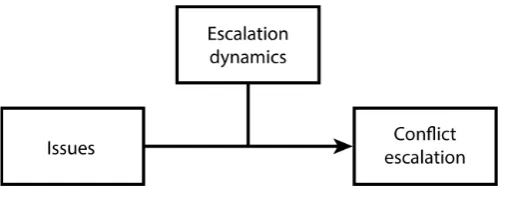
[image:3.595.319.526.90.235.2]This section explains the research design and which steps have been taken in order to reach the goal of this study. In keywords this can be summarised as a qualitative and empirical research (Verschuren & Doorewaard, 2007). In this qualitative research approach this study uses an explorative conceptual model, see figure 1. The goal is to improve the model after the problem has been further analysed so that possible useful recommendations can be suggested in order to mitigate escalating conflicts in construction projects.
Figure Explorative Conceptual Model
In the first section, as a starting point, an introduction on the problem and two dominating paradigms was given. From this, a general outline was drawn up of what we think happens, hence model “0”, see figure 2. This perspective marks the point of departure regarding the exploration of the dynamics of escalating conflicts. In order to get a better understanding of these dynamics two steps are taken. In the first step, model “1”, from a theoretical perspective the used theoretical framework is explained. The framework helps to get a better
[image:3.595.36.289.530.629.2]understanding of possible different dimensions of escalating conflicts.
Figure Research outline
4
the imposed recommendations were validated by an Expert panel in an interactive session. In this session, the results were discussed and imposed recommendations tested in a hypothetical case study. Finally, in the discussion a retrospective of the research goal and the findings of this research is explicated and followed by some concluding remarks.
Theoretical framework
This section explains the theoretical framework used in this study which forms the basis on how the problem of conflict escalation is examined. In order to get a better understanding of the dynamics of conflict-escalation, a literature study on conflict management (Glasl, 2015) was performed. Glasl (2015) explains the different dimensions (archetypes) of the conflict-escalation and gives a general idea on how certain social conflicts can become more intensified (escalation). Further, the theory elaborates this idea by introducing the conflict escalationladder, which can be used as a thermometer to measure the hypothetical level or category the relationship or conflict is in. Furthermore, Glasl’s theory explains the two dominant manners on how the escalation of a conflict can appear; a hot and cold appearance.
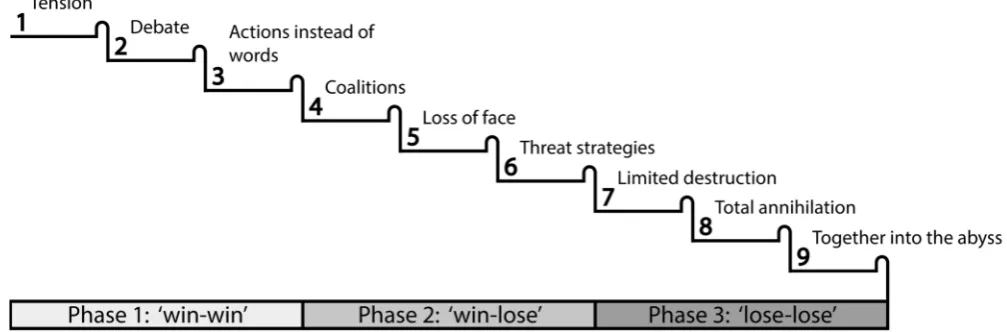
The escalationladder (Glasl, 2015) as can be seen in figure 3, shows a hypothetical model that represents the way a conflict can become more and more severe (escalation). The model shows how a starting conflict in de upper left deteriorates from a win-win attitude and slowly descends down the stairs into a more severe conflict in which a lose-lose attitude is present. In every day terms we say, ‘we are sliding down the stairs’. By this, it is meant that a conflict is escalating. In theory, Glasl argues that when nothing is done about an ongoing conflict, due to the underlying dynamics (archetypes) within the conflict, the conflict becomes more severe over time. From a broader perspective, the model can be divided into three phases, 1) ‘win-win’, 2) ‘win-lose’ and 3) ‘lose-lose’. In the first phase both parties tend to
maintain a situation in which solutions are tried to be found in which both parties win. In the second phase the parties’ focus of the conflict has shifted from the technical issue towards the counterparty itself. Thereby a personalisation of the conflict has taken place. In the third phase the conflict has escalated towards a level where all reasons to cooperate have disappeared. In this phase, the conflict is not about the technical issues nor about the personal gains, but aims on the destruction of the counterparty’s resources. When zooming in more closely towards the ladder onto the individual steps, various levels can be recognised. The steps are explained below and describe the appearance of a hot conflict-escalation. The steps are clarified in a chronological story-form using keywords, characteristics and thresholds so that the level of a conflict can be analysed.
1. Tension: perspectives tend to crystallise, tension causes cramp. However, the difference in opinion can still be solved by talking. When one party loses faith in finding a neutral solution the conflict escalates down towards the next step.
2. Debate: controversy and discussions change into verbal confrontations, growing competition and verbal violence. Parties try to strengthen their own position by using third parties. When one party loses faith that a common solution can be found, the conflict escalates down towards the next level.
3. Actions instead of words: because parties lose faith that problems can be solved by means of negotiations, they start to take matters into their own hands. In this, parties start considering strategic behaviour in order to strengthen their own positions. Further, a social inner group cohesion and the development of a mutual tactical defence line occurs.
[image:4.595.44.548.611.777.2]4. Coalitions: threshold for this step is the change towards a win-lose attitude. Instead of focussing on the technical issues, resentment is pointed at each other, hence, personification. There is formation of stereotypes and clichés. Group dynamics become more present as parties tend to gain recognition and
5
support by neutral bystanders to create a coalition, hence, social contamination’.
5. Loss of face: threshold for this step is when the actions of one party lead towards a loss of the counterparties’ reputation. Assaults are targeted and are played out in the public arena with the purpose to humiliate the other party. This interaction leads to parties ignoring each other and increasing contemptive communication.
6. Threat strategies: arise when ultimatums are set and serious threats are made. Actions in previous steps are considered insufficient, consequences should be added. Increasing extortion, threats and sanctioning.
7. Limited destruction: threshold is when threats from previous step are executed. By entering this step, the conflict entered the third phase, lose-lose. This means that the conflict is in the beginning state of war.
8. Total annihilation: threshold is when attacks are targeted on striking the counterparty in its heart. Total destruction is demanded with little self-damage.
9. Together into the abyss: threshold is when the motive for own survival is gone. This is the worst stage of a conflict, there is no way back. Total destruction, even when it costs the destruction of themselves.
Hot versus Cold conflict-escalation dynamics.
Glasl (2015) explains two dominant expressions of a conflict: Hot or Cold. The situation explained above in the nine steps of the escalationladder, elaborates on the occurring behaviour by that of a hypothetical escalation in a hot appearance. Hot conflicts occur in an atmosphere of overactivity and oversensitivity while cold conflicts express themselves in an increasing decline of visible activities (Glasl, 2015). When a conflict escalates in a cold fashion, the dynamics are different. Despite this difference, cold conflicts are at least as harmful to the dynamics of conflict escalation. This is due to the nature of cold conflicts in which disagreements are being concealed and ignored. Although apparently ‘normal’ behaviour is visible, there is an increasing negative subtle part, which is played out in a tactical manner, hence, hidden agenda. Tactical, thus invisible i.e. important information is withheld, while on paper the communication is kept infallible. Another aspect, by which the strategic behaviour that fits a cold conflict can be recognised, is the recording of liabilities and a list of mistakes made by the counterparty in order to strengthen one’s own position in a potential negotiation. When a conflict goes past the fifth step, loss of face, the conflict exposes itself into the public arena, hence, back into a hot appearance. This move often occurs in an aggressive
manner. This is due to the sudden utterance of withheld resentment. By nature, a cold conflict tends to become more and more rigid. Because of this, cold conflicts build up tension and become more and more difficult to solve. Furthermore, due to the invisible nature of cold conflicts, as these conflicts evolve, they become more difficult to recognise.
Glasl’s conflict-theory explains two main appearing forms on how an escalation can take place: hot or cold. In order to identify the dynamics that cause conflicts to escalate, Glasl groups recurring behaviour into five archetypes. The theoretical archetypes Glasl (2015) introduces are:
1. Increasing projection: parties are searching for their counterparties causality for potential personal gain.
2. Social contamination: group thinking, mutual discrimination and expansion of supporters.
3. Expansion of conflicting issues: improve the negotiation position by adding (non) related issues.
4. Cold war: further expansion of conflicting issues due to the fear of a counterparty’s dominant position.
5. Mutual interdependence: due to an increased complexity, discussions grow regarding the causality.
The theoretical archetypes introduced above, were used in the interviews as a topic list in order to identify the driving factors within escalating conflicts and give the possibility to structure the results. To summarize the theoretical perspective introduced by Glasl the following conclusions can be drawn. First, conflicts cannot be blamed on specific causes but originate due to personal and interpersonal misconceptions and misplaced communication. Second, conflicts are dynamic and contain core driving dynamics (archetypes) which cause conflicts to escalate. Third, due to the complexity of conflicts, the results should not be analysed for its causes but system-dynamically, thus by the mapping the internal causality.
3 RESULTS
6
panel in an interactive session.
Interviews
This section shows the results obtained in the interviews that where conducted regarding the clarification of conflict dynamics from an empirical perspective. In order to structure the interviews a topic list was used. The topics used are the five archetypes introduced above. The theoretical archetypes are further elaborated on and clarified by presenting the brief results from the interview supplemented by quotes.
Archetype 1: Increasing projection
Increasing projection at a growing self-frustration is the first archetype and forms the basis for the bulk of conflicts in the construction industry. It forms the number one cause of irritations that grow into a conflict. It seems that parties tend to ignore the mistakes made by themselves and try to twist the truth in order to lay the blame somewhere else.
Contracting Consultant: “Somehow this is what we do, over and over, not to admit the mistakes we make. Somehow, we never say: this is something I should have done differently. Nor do we complement each other when things are done well. Does this have to do with shame, or hypocrisy, thus suggesting that we are better than we actually are?”
This behaviour can be seen as the origin of opportunistic behaviour. Concealing behaviour, in order to find ways to make sure that personal mistakes can be charged on the counterparty’s expenses.
Contract Manager: “At the start of the request for a scope change, the adversarial tone is set. A request is considered a claim from the outset. Therefore, in advance the cause is blamed on the opponent in order to recover for the expenses”.
Contracting Consultant: “Stereotype is that we tend to do each time when something goes wrong is that we try to conceal our own mistakes and search for mistakes outside ourselves”
Archetype 2: Social contamination
This archetype is about the expansion of the social arena in order to strengthen the personal position. In this process, the conflict changes perspective in a way that the discussion shifts from the conflict itself towards each other, hence, personification. Due to gossip and other forms of negative provocation, the group of persons affected grows. More and more people become involved and due to group thinking and increasing discrimination,
the separation between parties increases.
Project Manager: “When there are irritations in the collaboration between client and contractor a major pitfall is to spout and gossip about this with colleagues and thereby indirectly place a wedge between the teams.”
This expansion of the social arena is the effect of the interaction that takes place in the meso-social-arena. In this setting, the group’ leaders represent the parties in the negotiations. The leaders are backed by their own organisation and feel the urge to ventilate frustrations on the counterparty towards their own colleagues. Because of encouragement from behind the hostile behaviour of the group’ leaders will intensify. This interaction causes group thinking and growing distrust and therefore sets parties further apart.
Contracting Consultant: “Question is whether they are aware of this behaviour. No discussion takes place questioning themselves if it is right, it is natural behaviour, something like a them versus us rhetoric.”
Archetype 3: Expansion of conflicting issues
Expansion of conflicting issues at a continue reduction of cognitive complexity is in short about the urge to strengthen the own negotiation position. This is a direct follow up of the first archetype which sparked this behaviour. Where ‘increasing projection’ was about trying to find causes to blame the other party, this archetype is about finding or creating other (non) relating issues in order to complexify the conflict. This behaviour was widely recognised in the interviews. What can be seen is that when the conflict intensifies, small problems are turned into issues when there is actually no issue.
Contracting Consultant: “When the client-contractor relation gets bitter, it can be seen that parties are looking for all of the smallest errors to comment on, in order to maximise the pile of issues.”
It is clear that this behaviour is used as a ‘bargaining chip’ for other interests in negotiations. As a follow up, due to the increasing complexity the conflict becomes unnecessary difficult. The essential issues are being covered up while minor issues are being piled up.
Project Manager: “The goal of the client is to focus on the continuation and the progress of the project, and therefore, make use of no different manner of conflict management other than to cover up issues. Can the daily tasks proceed then there is no problem, right?”
7
Contract Manager: “Above all, a client-contractor relation gets bitter when no decisions are made. Make sure issues do not stay in a point of discussion for a long period, whereby a good relation can needlessly deteriorate. For instance, the contractor has an issue, it is still not decided whether the claim is legit. However, a contractor needs a cash flow in order to continue the works. In such a situation, a contractor is almost forced into committing opportunistic behaviour...”
Archetype 4: Cold war
As follow-up of the previous archetype the tension grows. Due to this tension, parties tend to accelerate the pessimistic anticipation, hence, ‘cold war’. Because the fear of a possible more dominant position of the counterparty, the expansion of (non) related issues continues. The manner in which counterparties continue to interact sets them further apart.
Mediator: “The way parties work together already sets them apart. In negotiations, the focus should be on the soft side of the issue, hence, technical best-for-project aspects. Apart from the money, what are important interests. Source of these kind of conflicts is because of the way we divide the liability, your/my interest, juridical terms.”
This is due to the fact that when problems occur, parties tend to immediately study the contract, looking for possibilities in order to shift liability. It seems that this increasing tension in interaction is an accepted culture.
Contract Manager: “Somehow a recurring behavior is that, from a culture or tradition, in negotiation tactics the limit is tested. Thereby the parties show that they mean business.”
In this culture, it seems to be necessary for a competition to take place between parties before important decisions can be taken. This continues till it becomes clear to both parties that continuing the competition will bring both parties into an unfavourable situation. The result is that tension increases and that the tone in communication changes. While first a personal preamble was used, the tone now changes towards a more juridical tone in which strong language and threats are used in order to persuade one’s interest. However, due to the increased complexity of the problem, parties involved no longer know the ins and outs of the conflict. This is where a conflict also shows signs of the fifth archetype.
Archetype 5: Mutual interdependence
Mutual interdependence of causes and effects at a simultaneous simplification of casualties’, is the archetype that is the result of the continual exacerbation
of the conflict. Due to the already increased complexity of the issues, finding a solution has become very difficult. And due to the human cognitive limit, participants are urged to reduce the complexity of the issue in order to regain understanding of the issue which would make it possible to determine a central cause.
Contracting Consultant: “A large infrastructure project was put to tender with special reward for a tight initial planning. A small part of the project was a collective part to which both client and contractor were liable. Contractor used this part in the planning by cutting the slack and therefore make it crucial for the rest of the planning. By doing this it gave the contractor the opportunity to lay the blame of delays made in other parts of the project onto the delays of this mutual component. Hereby the small mutual component became the key component in the issue.”
However, due to the difference in interests a discussion arises on the origin of the problem. Due to the over-complexity of the problem and the possible over-reduction by hindsight, an asymmetric development of the causality may occur. Furthermore, due to the (over)reduction of the problem, more space is created in which adding new conflicting issues is made possible. This will enable a recurring pattern with more discussion as a result.
Project Manager: “In a well-meant decision for a best-for-project solution, a juridical and financial blunder was made by a member of the Project Management. This turned out to be a big financial upside to the contractors involved. This changed the attitude of the Contract Manager towards the approval of additional claims made by the contractors. However, this juridical blunder had nothing to do with the ongoing issues, it became the central issue in the contractual discussion.”
Holistic perspective
8
At first, a recurring subject is the concealing behaviour in order to cover up tracks so that no blame is to be found. Related to that characteristic is the denial a certain conflict is ongoing.
Contracting Consultant: “It has to do with several reasons. Perhaps personal because of embarrassment due to failing to comply to the status quo, and when taking responsibility for it, thus have to bear the cost, but I don’t have the money for it. Main cause is therefore concealing behaviour. This is when a party chooses to play out the conflict strategically.”
Another characteristic of this strategic behaviour is the recording of mistakes and a growing claim culture. This results from the fear of the counterparties’ better negotiating position as was recognised in the fourth archetype ‘Cold war’ above.
Contracting Consultant: “At a certain moment a culture was born in which all possible mistakes, derogations from the initial design or deviations from the initially provided information were used as ‘fuel’ to draw up claims. Which were then used as a bargaining chip in future negotiations.”
Furthermore, an important recurring characteristic, but also misconception, is that the strategic behaviour that fits a cold conflict is not seen as part of an escalation. Generally, the interviewees responded: “The tension can become high, but the conflict doesn’t have to escalate”. By this, the interviewees mean to say that a difficult issue does not have to end in a dispute. In this expression, a confusion occurs. This confusion is due to the fact that conflicts mainly appear in a cold manner. Wherein conflicts certainly do escalate i.e. become more severe. However, due to the nature of cold conflicts this is not seen as an escalation. This comes down to the fact that cold conflicts tend to ‘freeze’ i.e. become more rigid. The escalation dynamics of the conflicts that can be recognised in the interviews, are about conflicts that are played out in a cold, strategic and tactical manner. This low-profile property ensures that the escalation is difficult to recognise. And therefore, it is not seen as a problem. Further, due to ambiguity in the parties’ expressional behaviour there is often denial that a certain conflict is ongoing. Denial is one of the causes the issue aggravates regarding the non-recognition of this problem. Seemingly parties tend to appear most willing to cooperate and express that things are going well, saying: “look, planning is fine, we have no issues”. This behaviour works as a cover-up for other issues i.e. hidden agenda. The fact that parties are busy doing other things behind the scenes remains uncertain. Meanwhile, the strategic cold conflict escalates further and as a result creates a more tense and rigid understanding.
Analysis
In this section, the insights from the literature study and the results from the interviews are analysed. Firstly, this is done by placing the results of the holistic perspective from the interviews in the perspective of the Escalationladder (Glasl, 2015). This perspective displays how, a hypothetical conflict, as was recognised in the interviews, develops over time. Secondly, the results will be analysed through the method of System thinking (Schaveling & Goodman, 2012). The results of this analyses are presented in the CLD, see figure 4. This figure shows which internal variables cause the conflict to develop and the collaboration to deteriorate.
Escalationladder’s perspective
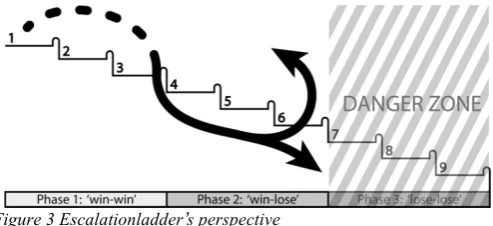
[image:8.595.310.557.338.451.2]When placing the interview results, as explained above, into the escalationladder’s perspective, the following process shown in figure 3 can be recognised. The figure shows the progression of a hypothetical escalating conflict which can be distilled from the ‘holistic perspective’ elaborated on in the results.
Figure 3 Escalationladder’s perspective
9
situation, there are two possibilities: first, parties are forced together into a sort of horse-trading situation and argue till an agreement is met, or when parties cannot find an agreement the conflict escalates further into the lose-lose phase. Though it seems that through a horse-trading-like negotiation the conflict has ended, due to ongoing dissatisfaction levels, a high probability of recurring strategic cold conflicts is eminent.
Causal Loop Diagram (CLD)
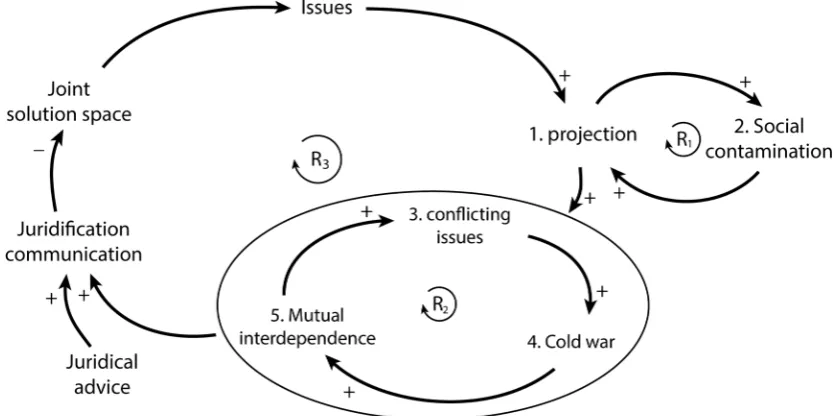
When analysing the process as explained above from a system-dynamic’s perspective the following causal relations were elaborated on, see figure 4. The CLD gives insights into the key variables in the dynamics of a cold strategic conflict. It shows, by the causal relations, recognised in the results, how the conflict and underlying conflict-dynamics create a reinforcing loop which causes the relationship to deteriorate. In the diagram three reinforcing loops can be recognised that cause this build-up of tension to occur.
The starting point of the cycle (R3) begins when a certain issue or when multiple issues occur. When a simple solution cannot be found, due to the pressure of the continuation of the project, issues are being ignored. Referring to the concealing behaviour elaborated on in the holistic perspective, this is a trigger for cold strategic behaviour to arise. This behaviour expresses itself in the occurrence of the five archetypes which form the two vicious cycles.
The first loop (R1) is about the social and meso-social interaction between the parties. The first two archetypes tend to influence and reinforce each other. Because of the ‘social contamination’, group-thinking and the growing “them” and “us” rhetoric, a breeding ground for mutual blackening is created. As a follow-up, this is fuelled by the urge to find possible accusations towards the counterparty. As was elaborated on by the Interview results, this interplay creates a vicious cycle where
offensive behaviour whereby agonising hostilities grow.
The second loop (R2) is about the complexification of the conflict. It consists of an interaction between the archetypes three, four and five. Together the archetypes ensure that the complexity of the conflict grows. Due to the interaction, more and more (non) related issues are lumped together. This happens when parties behave following key archetype three, expansion of conflicting issues. In this, parties aim to have a bargaining chip in order to get a better negotiation position. This is further amplified by the fear of a stronger bargaining position by the counterparty. Till at a certain point, due to over-complexity and the limit of human cognitive thinking, no one knows how or why the conflict initially started. In this process, a growing urge arises to simplify the conflict. However, due to a difference in interests a discussion arises about the causes of the conflict. Referring to the fifth archetype, this can spark a new discussion and an asymmetric development of the conflict’s causality. Furthermore, as a side effect, due to the reduction of the complexity, a possible breeding ground for adding new non-related issues is created, which results in the possible recurrence of this vicious cycle (R2).
[image:9.595.87.504.52.260.2]Because the fuelling effect of the five archetypes the overall vicious cycle (R3) reaches a point where, due to the turn of events, the growing tension exceeds a sustainable level. This is when the pressure is turning parties into making serious threats towards each other. Hence, the sixth step, as can be recognised in figure 3. Furthermore, due to juridical influence the communication shifts from normal towards a formal tone. Given this shift in the communication, only tactical information is shared which eventually leads to a decreasing joint solution space. As a result of this, the common ground for collaboration has become marginal, whereby the probability for new issues is enabled, hence, the recurrence of a vicious loop situation.
10
Conceptual recommendation
Referring to the key variables in the dynamics, as can be seen in figure 3 and 4, parties must be aware of the possible risks that come with cold strategic conflicts. In order to cope with these risks, they first need to be able to identify whether or not they are in a vicious loop situation, know what elements or strategies they have to stop this and then implement them. Thereby, the solution space in order to mitigate the risk of conflict escalation lies especially at the start of the collaboration.
Based on the knowledge that conflicts occur in a cold fashion, as elaborated on in the analysis, it is possible to adopt suggested intervention angles from Glasl (2015). Given the cold appearance that was recognised, it is clear that ‘escalating interventions’ are needed in order to keep issues warm, see table 1. On the one hand this means, preventive, thus preclude a conflict from freezing, hence, become more rigid. On the other hand, corrective, a controlled ‘break-up’ when a conflict has already frozen up. Thus, when such a conflict is recognised, a pre-determined dispute arrangement can be executed.
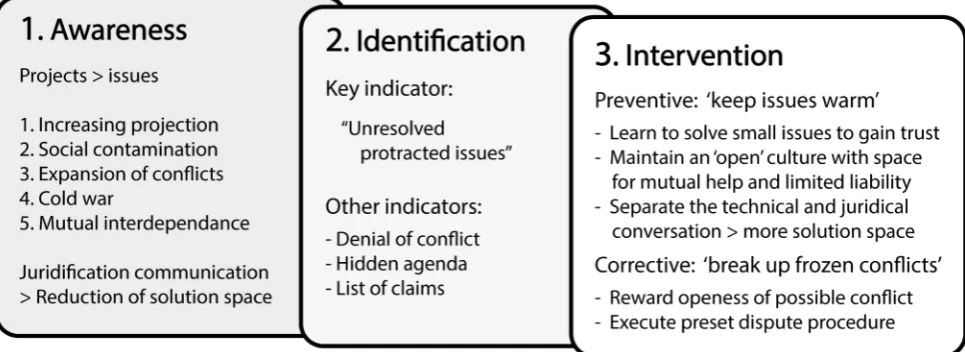
In order to make this knowledge applicable, the following three-step conceptual-intervention-model (CIM) is recommended, see figure 5. In summary:
1. Awareness: regarding the insights of this paper, an awareness of the occurring vicious cycles and the risks that come with that, needs to be created. In this light, project managers are inspired to intervene when necessary.
2. Identification: ‘unresolved protracting issues’. Acknowledging the indicators for possible conflicts helps safeguarding the risk of a strategic conflict escalation.
3. Intervention;
Preventive: ‘keep issues warm’
Corrective: ‘break up frozen conflicts’
The suggested model is intended to be used as guidance in contractual negotiations during the procurement phase. It is not a clear-cut profile with guaranty for success. However, the model is meant to be used as a toolbox during contractual negotiations in order to be able to emphasise the relational aspects in the contract. As the risk exists for cold strategic conflicts, and thereby the good collaboration to deteriorate, proper tools in case of such a conflict should be provided and agreed upon in the contract beforehand. This is because when a conflict has already escalated towards a breaking point, parties are unlikely to be able to come up with a proper dispute arrangement. Therefore, it is necessary to have a pre-determined dispute arrangement.
[image:10.595.24.552.37.163.2]In order to cope with the risks of a cold strategic conflict, the intervention part of the three-step model is divided into two areas, preventive and corrective. Reflecting on the dynamics described in the CLD, the interventions aim to reduce the possible recurrence of the vicious loop situations to occur. Key subject in the vicious cycles are unresolved protracting issues. To prevent the strategic
Figure 5 Conceptual intervention model (CIM)
… interventions Deescalating… Escalating…
Preventive…
Prevent a hot conflict by means of rules and training
Effective communication
Discussion of irritations
Controlled ‘defrosting’ of a starting cold conflict
Corrective…
Explain the course of escalation, the dynamics and potential risks.
Clarify (unintended) effects of communication
Controlled ‘break down’ of an already frozen conflict.
[image:10.595.73.556.601.777.2]Role play helps to clarify buried irritations.
11
behaviour, regarding these issues, parties need to focus on one issue at a time. By solving the small issues one at a time, parties gain trust and confidence. Second, an open culture in which mistakes can be made should be created. This open culture should also include openness in parties’ secondary interests, which are often the cause for a hidden agenda. Further, admitting mistakes gives parties the possibility to offer mutual help. With this behavioural attitude, projection and social contamination can be mitigated and thereby reduce the risk of opportunistic behaviour, hence, ‘keep issues warm’. However, when strategic behaviour and an increasing complexification of (non) related issues is detected, corrective measures need to be taken. Key objective in this should be to ‘break up the conflict’. This is a difficult endeavour, hence the possibility for a sudden utterance of withheld resentment. When during this process, coming to mutual terms is not possible, parties should be able to execute a pre-determined dispute arrangement in order to resolve the adversarial situation.
In order to improve the reasonable value of this recommendation, the three-step CIM was discussed and validated by an Expert Panel. In this session, the model was tested in a hypothetical case study.
Validation: Expert panel
A validation session was organised in order to test the practical usage by an Expert panel. This was done by the use of a hypothetical case study in which the CIM was put into practice. The case implied the procurement phase of a large, complex and prolonged infrastructure project.
Experts were asked to use the knowledge of the CIM as a guidance in order to give a practical interpretation for the future collaboration in the project. This was done during the Competitive Dialogue, as the project was in this phase. In the session, the group was divided into two groups. Group one containing experts with a civil engineering background and group two containing mainly lawyers. The first group was asked to propose a practical specification of preventive measures and the second group to specify a pre-determined legal dispute policy.
Although both groups were asked to specify interventions from each specific approach, in both cases, emphasis was laid on the interface between the preventive and corrective measures, hence, a broad technical solution space. Recurring measures in this ‘solution space’ were: a shared facts identification, an easy accessible and impartial meeting, and need for a separation of the technical (best-for-project) and juridical conversation. Furthermore, it was emphasised that the term ‘escalation’ – in the sense that when parties cannot come to terms within their mandate – should not be seen as a negative term. When it is not possible to come to an
agreement, actors should pragmatically be able to decide that the decision should be taken by superior managers, with prejudice that covering up and postponing of difficult issues eventually leads to opportunism. Another valuable result was the acknowledgement of the aim to find solutions for one case at a time. This withholds actors from colluding and enlarging the conflict with non-related issues. And thereby enhances the possibility for better technical best-for-project solutions. From the preventive perspective, focus was most on the learning side, hence, the awareness part. For example, rehearse conflict resolution in a simulation game and help define the different escalation levels in order to recognise a deterring conflict in the future.
From the corrective’ perspective, with the awareness of the risks involved and due to strategically escalating conflicts, it was confirmed by the experts that the need for a pre-set conflict escalation policy is necessary. When such a conduct has not been agreed upon first hand, finding a well-functioning dispute resolution technique, when already tangled in a conflict, can be difficult to realise. Further, it was argued that in this policy a preset dispute resolution procedure is necessary. Moreover, it is possible to realise this within the boundaries of the usual legal conditions e.g. UAV-GC 2005.
Although the model creates awareness - and when used to draw up an escalation strategy – creates a possible increased level of trust, the expected successfulness of the model, when applied in practice, still needs to be examined.
4 DISCUSSION
12
validation. During this session, the plausibility and the probable practical usability were assessed and found applicable.
Although the results and findings of the analyses can seem like stating the obvious, the recognition also proves the plausibility of the findings. As generally acknowledged in the context earlier, the manner in which parties are forced together starting from the procurement-phase at the start of the project, the competitive atmosphere ensures that the relationship is edgy. Hence, due to the manner in which a relationship is formed in the context of the Competitive Dialogue, from the beginning, a potential urge or breeding ground for opportunism has been created. Due to this competitive start, it seems that parties anticipatory choose for strategic behaviour when a situation becomes tense later on in the project.
Due to the manner in which cold strategic conflicts are played out in practice, a cold conflict is difficult to recognise. Furthermore, due to the withheld resentment and the way cold conflicts tend to suddenly erupt into a fierce debate, with which the conflict has returned back into a hot conflict. In that situation, resolving such a conflict can be a difficult endeavour.
Therefore, cold conflicts should be identified as early as possible in order to prevent such an outbreak to occur. When taking into account the guiding artefacts presented in this paper, it is more possible to clarify the recognition of such a strategic conflict. The key guiding artefact and recurring subject in this matter were the ‘unsolved protracting issues’ within a conflict. Such unsolved issues are often difficult issues which indirectly represent parties’ secondary interests. In the ‘Conceptual Recommendation’ it was argued that an open culture is necessary. Without the knowledge of secondary interests and due to often complicated circumstances, it makes these issues difficult to resolve and difficult to come to an agreement. It is these principle issues that build up tension between parties and stimulates them to enter a strategic conflict. By doing this, parties avoid the difficult or complex issues, cover them up and try to move on, in order to protect the projects’ progress. In this regard, the ‘unsolved protracting issues’ can be recognised as a guiding artefact of a cold conflict escalation. Therefore, prolonged and unsolved issues with regard to the findings of this study, were labelled as key indicator for strategic conflicts to recognise.
The proposed three-step CIM aims at reducing the consequences of the vicious cycles by first creating awareness of the possibility of such recurring behaviour. Second, by being able to identify such behaviour and finally impose a guidance for a proper escalation conduct, regarding the safeguarding of the good collaboration. The imposed CIM is not to be seen as a preset solution for all projects but should be used as an
instrument and guidance in the process of developing such a conduct in the procurement phase. As argued in the context earlier, this should help give emphasis to the relational aspects in the agreement.
Although the Dutch legal conditions for integrated contracts (UAV-GC 2005) encourage the use of dispute avoidance and resolution techniques e.g. the use of a dispute resolution board. In much construction projects the use of such a board is rejected in the contractual terms (Vong, 2011). It is therefore suggested that regarding the findings of this research, in which the emphasis was on understanding the dynamics of ongoing conflicts, regarding this perspective possible adoption in the procurement phase should be further examined. In this, from Glasl’s escalation theory perspective, the possible breeding ground for future strategic conflicts should be examined further. By adopting this perspective, and the findings of this research, the suggested CIM when put to practice, could help prevent and mitigate future post contractual conflicts in the construction practice.
Limitations and future research
Since only a relative small number of interviewees and experts contributed to the findings of this research, in terms of generalising the results, future research is needed to further elaborate on the identified problems by further investigating relevant case studies. Furthermore, in order to prove the effectivity of the opposed three-step-model, the use of the model should further be tested and examined in real-world use cases. In terms of validity of the results, the risk of a selection bias of the interviewees that contributed to the findings of this research should be noticed. Also, other similar or opposing social conflict escalation theories, other than Glasl, should be examined in order to further develop a more advanced and proven intervention model. Furthermore, Glasl’s escalation theory perspective should be used to examine the collaboration dynamics during the procurement phase. And thereby, allowing further improvements on placing more emphasis on the relational aspects in the procurement phase. Therefore, further research on the possible insights using Glasl’s theory within the procurement phase is needed.
5 CONCLUSION
13
these failures. Based on a thorough literature review and a system-dynamics analyses, a coherent view of the different influencing factors was formed. The results confirm that due to the competitive nature of the current construction industry practice, and due to the manner in which current tendering procedures are organized, mainly the juridical and economical elements of the contract are emphasized (Kamminga, 2008). Furthermore, although the interviewees widely acknowledged the problem of this culture, it was still classified as normal behavior and sometimes even considered necessary in order to be able to firmly negotiate. However, the findings of this study show that in continuance of the need for the definition of the relational aspects in complex and lengthy construction projects is necessary, and although it becomes more-and-more important that by this implementation it creates more flexibility in the decision-making and problem-solving process by project managers, much awareness of the possible risks regarding coldstrategic conflicts is yet needed (Klein Woolthuis, 2005; Helen, 2007; Suprapto 2016). This study contributes to this prerequisite by giving insights into the driving dynamics of conflict escalation in the construction practice and proposes a three-step model, which can be used by parties to define a cooperation and escalation agreement in the procurement phase. By using this model and gained knowledge of the insights obtained in this research, it is believed that the awareness, identification and interventions regarding cold strategic conflicts should help safeguard future collaboration and thereby help prevent unnecessary transaction costs.
6 REFERENCES
Bleeker, M. R. (2014a). UAV-GC 2005 (deel 1) Over de uitleg van enkele conflictgevoelige paragrafen. Tijdschrift voor Bouwrecht(nr. 7), 602-612. Bleeker, M. R. (2014b). UAV-GC 2005 (deel 2) Over de
uitleg van enkele conflictgevoelige paragrafen. Tijdschrift voor Bouwrecht(nr. 8), 709-716. Bresnen, M., & Marshall, N. (2000). Partnering in
construction: a critical review of issues, problems and dilemmas. Construction Management and Economics 18, 229-237.
Chan, A. P., Chan, D. W., Chiang, Y. H., Tang, B. S., Chan, E. H., & Ho, K. S. (2004). Exploring Critical Success Factors for Partnering in Construction Projects. Journal of Construction Engineering and Management 130.2, 188-198. Chen, Y. (2000). Promises, Trust and Contracts. The
Journal of Law, Economics and Organization, V16 N1.
CROW. (2005). Toelichting bij Model Basisoovereenkomst en UAV-GC.
CROW. (2005). UAV-GC. Model Basisovereenkomst en
Toelichting.
Dubois, A., & Gadde, L.-E. (2002). The construction industry as a loosely coupled system: implications for productivity and innovation. Construction Management and Economics No. 20, 621–631. Eriksson, E. (2010, September). Partnering: what is it, when
should it be used, and how should it be implemented? Construction Management and Economics, 905–917.
Fu, Y., Chen, Y., Zhang, S., & Wang, W. (2015).
Promoting cooperation in construction projects: an integrated approach of contractual incentive and trust. Construction Management and Economics Vol. 33 No. 8, 653–670.
Gadde, L. E., & Dubois, A. (2010). Partnering in the construction industry - Problems and opportunities. Journal of Purchasing & Supply Management No. 16, 254 – 263.
Gebauer, A., & Kiel-Dixon, U. (2009). High Reliability Organizing, Managing the Unexpected by Building up Organizational Capabilities.
Glasl, F. (2015). Handboek Conflictmanagement. Uitgeverij SWP.
Groton, J. (1997). ADR in the Construction Industry. Dispute Resolution Journal Vol. 52 (3), 48-57. Helen, S., Pena-Mora, F., & Tamaki, T. (2007). Dynamic
Conflict Management in Large Design and Construction Projects. JOURNAL OF
MANAGEMENT IN ENGINEERING 32(2), 52-66. Hong, Y., Chan, D. W., Chan, A. P., & Yeung, J. F. (2012).
Critical Analysis of Partnering Research Trend in Construction Journals. Journal of Management in Engineering 28(2), 82-95.
Kadefors, A. (2004). Trust in project relationships - inside the black box. International Journal of Project Management 22, 175–182.
Kamminga, P. (2008). Towards Effective Governance Structures for Contractual Relations. Tilburg University.
Kamminga, P. (2016a, November 14). Bouwcontract creëert schijnzekerheid. Retrieved from Cobouw.nl:
http://www.cobouw.nl/artikel/1649116-bouwcontract-cre-ert-schijnzekerheid
Kamminga, P. (2016b, November 17). Het ideale contract bestaat niet. (I. Koenen, Interviewer) Cobouw. Klein Woolthuis, R., Hillebrand, B., & Nooteboom, B.
(2005). Trust, Contract and Relationship Development. Organization Studies 26(6), 813– 840.
Laan, A. T. (2008). Building Trust. Dissertation.
Laan, A. T., Voordijk, H., & Dewulf, G. (2011). Reducing opportunistic behaviour through a project alliance. Construction Management and Engineering Vol. 4 No. 4, 660-679.
14
in the Social Sciences. Business and Politics, 1-63.
Macneil, I. R. (1978). Contracts: adjustment of long-term economic relations under Classical, neoclassical and relational contract law. Northwestern University Law Review, 72(5), 854–905. NEC3. (2013). targetcontract ECC-C.
Pena-Mora, F., Sosa, C., & McCone, D. (2002). INTRODUCTION TO CONSTRUCTION DISPUTE RESOLUTION.
PIANOo. (2017a). Concurentiegerichte dialoog. Retrieved from pianoo.nl:
https://www.pianoo.nl/inkoopproces/fase-1- voorbereiden-inkoopopdracht/mogelijke- aanbestedingsprocedures/europese-specifieke-procedures-4
Rahman, M., & Kumaraswamy, M. M. (2002). Joint risk management through transactionally ef cient relational contracting. Construction Management and Economics 20, 45–54.
Rijkswaterstaat. (2009). Concurentiegerichte dialoog, handleiding.
Rijkswaterstaat. (2015). Samenwerken & Best Value. Rijkswaterstaat. (2016, April). Inschrijvings- en
beoordelingsdocument Niet-openbare procedure Best Value projecten.
Roehrich, J. K., & Lewis, M. A. (2010). Towards a model of governance in complex (product–service) inter
-organizational systems. Construction Management and Economics, 28 (11), 1155-11641.
Schaveling, B. J., & Goodman, M. (2012). Systeemdenken.
Suprapto, M., Bakker, H., Mooi, H., & Hertogh, M. (2016). How do contract types and incentives matter to project performance? International Journal of Project Management 34, 1071-1087. van Bijnen, R. (2005). Aanvullend Contractrecht.
Verschuren, P., & Doorewaard, H. (2007). Het ontwerpen van een onderzoek.
Vong, D. (2011). Effectieve geschiloplossing in de bouw. afstudeerscriptie.
Wal, L. v. (2016, Januari 11). 10 procent faalkosten, 2 procent winst. Retrieved from Cobouw Williamson. (1979). Transaction-Cost Economics: The
Governance of Contractual Relations. The Journal of Law & Economics, Vol. 22, 233-261.
Williamson, O. E. (1975). In Markets and hierarchies: Analysis and antitrust implications: a study in the economics of internal organization. New York: Free Press.
Williamson, O. E. (1998). Transaction Cost Economics: How it works; where it's headed. DE
ECONOMIST 146, 1998.