Title: Effect of debriefing with serious games on learning in an EFL classroom
Running head: Effect of debriefing with serious games on learning
Researcher: Yue Ge
Student Number: s1697927 Email: [email protected]
1st Supervisor: Dr. Henny Leemkuil Email: [email protected]
Acknowledgments
Thanks to Dr. Henny Leemkuil, and Dr. Hans van der Meij for supervising this master thesis by providing advice and encouragement.
Contents
Summary ... 4
Introduction ... 5
Conceptual framework ... 6
Definition of serious games ... 6
Definition of debriefing ... 7
Definition of learning outcomes ... 8
Research questions ... 9
Method ... 9
Participants ... 9
Serious Game ... 10
Tests ... 12
Questionnaire for motivation ... 12
Treatment ... 13
Procedure ... 14
Analyses ... 14
Results ... 17
Effect of serious games on learning gains ... 17
Effect of serious games on motivation for learning English ... 17
Effect of debriefing with serious games on learning gains ... 18
Effect of debriefing with serous games on retention ... 18
Effect of the written debriefing on learning ... 18
Discussion ... 19
Research findings and further research ... 19
Effect of serious games on learning and motivation ... 19
Effect of debriefing with serious games on learning ... 20
Limitations ... 24
Conclusion ... 24
Reference ... 26
Effect of debriefing with serious games on learning in an EFL classroom
Keywords: Debriefing, serious games, EFL classroom, motivation, learningSummary
The last decade has witnessed growing interest in the potential application of computer games for learning and instruction which often referred to serious games (Hays, 2005; Wouters, Van der Spek, & Van Oostendorp, 2009; Wouters, Van Nimwegen, Van Oostendorp, & Van Der Spek, 2013). Recent literature reviews have shown that regarding cognitive learning and retention, serious games have the same effect as traditional methods (Ebner & Holzinger, 2007) or even can be more effective than conventional instruction methods like lectures (Sitzmann, 2011; Wouters et al., 2013). Besides, serious games are also hypothesized to address affective learning issues and have potentials to provide motivation for learning (Malone, 1981; O'Neil, Wainess, & Baker, 2005). Researchers believed that serious games could be appealing and evoke learners’ intrinsic motivation because of the key characteristics of games, namely fantasy, goals/rules, sensory stimuli, challenge, mystery, and control (Garris, Ahlers, & Driskell, 2002; Malone, 1981). However, there are still many questions about how to use serious games in classroom and harness the motivational appeals to enhance learning (Garris et al., 2002; Hays, 2005).
especially novices, to be overwhelmed by all the information, focus on irrelevant information and then perform learning process incorrectly (De Jong, 2010; Wouters & Van Oostendorp, 2013). Hence, it is important to pair serious games with appropriate support in order to help learners to understand what happened in the game and how these events achieve the instructional objectives (Hays, 2005; Leemkuil & De Jong, 2012). Then, the question about what kind of support should be given and the effect of support with serious games is raised.
Debriefing is proposed as a strong support (Garris et al., 2002; Hays, 2005). It is regarded as the critical link between game activities and the application of game experience to the real situation (Garris et al., 2002). In serious games combined with debriefing, learning usually happens in three levels by playing the game, debriefing in discussion, and writing in a journal (Petranek, Corey, & Black, 1992). By participating in serious games, learners process all types of information unconsciously such as facts, emotions, outcomes and so forth. After using serious games, learners move to the second level of learning through having a session which is designed to help them to reflect on what they learn in serious games. It refers to the oral debriefing. The third level of learning is journal writing. It is a supplement of the oral debriefing, which extends the learning process in serious games and gives insights into individual aspects of the whole experience. By this way, debriefing offers opportunities for learners to explore and understand what happened in games, and then learn how to apply these in a real situation, namely transforming the game experience into learning (Gardner, 2013). However, knowledge about the effect of combining debriefing with serious games is little. Hence, the objective of this study is to investigate the effect of debriefing with serious games on learning.
In the following sections, the conceptual framework will be introduced first, including definitions of serious games, debriefing, and learning outcomes as well as the research questions for this study. Subsequently, research method, results, and discussion will be explained respectively.
Conceptual framework
This section includes the definitions of serious games, debriefing, and learning outcomes respectively. Subsequently, the research questions for this study will be introduced.
Definition of serious games
In this study, serious games are interactive, entertaining environment based on an underlying model, in which challenging goals need to be reached under certain rules and constraints (Leemkuil & De Jong, 2012). Moreover, the objective of serious games is to use the entertaining elements of games for instruction and education (Zyda, 2005).
1981). It means that serious games can offer students opportunities for experiential learning to discover new rules and concepts.
In EFL classrooms, motivation is an essential tool to acquire a language, especially for students whose mother language is different from English (Anyaegbu et al., 2012). The motivation aspect of serious games has the potential to solve this kind of problem. Besides, serious games are proven to increase learning outcomes such as self-efficacy, declarative knowledge, procedural knowledge and retention (Sitzmann, 2011). All these benefits show that serious games can be considered a promising teaching method in EFL classrooms.
The serious game in this study is based on a drill and practice learning mode. The nature of drill and practice games is action-based, which may lead to behavior based on trial and error (Kiili, 2005). Although in this kind of games, players just change their actions until their scores improve (Chiu, Kao, & Reynolds, 2012), it is indirectly assumed that the drill and practice elements in the games have advantages on transferring facts and support skills (Garris et al., 2002). In addition, it is suggested that drill and practice learning teaches the “what” and the “when” and helps students to memorize facts (Deen, Van den Beemt, & Schouten, 2015). These are necessary for English learning. Besides, drill and practice games are reported to encourage students’ engagement in repetitive learning exercise and increase intrinsic motivations (Deen et al., 2015). Therefore, the drill and practice learning mode is chosen in this serious game.
Definition of debriefing
The use of debriefing in the education is the main focus of this study, which is also named as postexperience analysis. In the educational setting, debriefing is usually applied after an experiential activity such as a simulation or game (Lederman, 1992).
Lederman (1992) identified seven structural elements of the debriefing process, which are the debriefer, participants to debrief, an experience, the impact of the experience, recollection, report and time. The debriefer is a facilitator, teacher or instructor during the process of debriefing, who is to help the participants learn from the experience in which they have engaged in. Participants are people who engage in the experience and they are debriefed. In the experimental contexts, the experience is generally preplanned, designed, and conducted to achieve some specific learning objectives. In this study, the experience refers to the experience in serious games. And the experience that the participants have come through have some impact on them. After having serious games, participants are able to report on their experiences, their recollections of the experiences and the impacts of the experiences on them in the debriefing session. The report part refers to a debriefing session in which participants report their experiences, their memories of those experiences and impacts of those experiences on the participants. Normally, the reporting of events, namely the debriefing session, refers to an oral discussion after experiential activity. In this situation, students are guided by teachers and go through a reflective process about their learning (Lederman, 1992; Petranek, 1994, 2000; Petranek et al., 1992). At last, time refers to the time to process any experience including the serious games and debriefing process.
Debriefing could also be written or through the way of completion of a formal questionnaire (Petranek, 2000). Petranek et al. (1992) pointed out that games with debriefing provide three levels of learning, through participating, debriefing, and writing. He also claimed that the assumptions of oral debriefing are that all students learn the same lessons at the same time and in the same manner. However, with an oral debriefing, it is hard to assess individual learning, and there is so little time to reflect on their actions and emotions (Petranek, 2000). Hence, debriefing in this study is the combination of the oral and the written ones. The oral debriefing occurs after the game experience with the guidance of the debriefer, and the written debriefing happens after the class.
Definition of learning outcomes
Wouters et al. (2009) proposed a taxonomy of learning outcomes consisting of four categories: cognitive, motor skills, affective and communicative. In this study, the learning outcomes mainly refer to the cognitive and affective aspects.
Cognitive learning outcomes can be divided into knowledge and cognitive skills. Knowledge can be subdivided into declarative knowledge and procedural knowledge. A cognitive skill is related to more complex cognitive processes in which learners need to apply knowledge and rules in a new situation. In the context of EFL classrooms, cognitive learning outcomes refer to knowledge gained through game experiences and debriefing.
refers to internal states that influence the choices or actions. It can pertain to a change from a negative to positive learning attitude towards subjects at school. Motivation refers to the willingness to pay attention to learning material and to spend cognitive resources to process information.
Besides, retention will also be regarded as another learning outcome, which is a delayed measurement of declarative knowledge (Sitzmann, 2011). It can indicate learners’ memory of the factual information which is taught in classroom.
Research questions
Based on the relationship between serious games and learning as well as motivation. The first two research questions of this study are whether serious games could yield learning gains and whether serious games could increase the motivation for learning English. Based on the benefits of embedding debriefing into serious games, the third research question is whether serious games supplemented with debriefing could yield higher learning gains than serious games as the sole instruction. And the fourth question is whether serious games complemented with debriefing could yield a higher level of retention than serious games as the sole instruction.
Method
In order to investigate the effect of serious games on learning and motivation as well as the effect of debriefing with serious games on learning gains and retention, an intervention-based, quasi-experimental study with pre- and posttests was conducted. The participants, the serious game used in this experiment, measurements, treatment, and procedure will be introduced in this section.
Participants
This research was undertaken with two normal classes of 101 sixth grade primary school students, 12 or 13 years of age, and one primary school teacher from a primary school. This primary school locates in a rural-urban fringe zone area in China. The pupils took an intensive English class which was designed to review the use of tense and some phrases that they had learned before. It was because at the end of the sixth grade, students would have a final test about what they have learned in the last six years. In the last month, the teacher would review all the contents including the use of tense and phrases. This study was conducted after students have finished all new courses. And this was the first time that the teacher started to review.
Science in the third grade. Besides, the participating teacher had taught English for approximately five years and was teaching these two classes at the same time. It meant that the average English level of these students had little difference and they had gotten used to having English class with this teacher. Serious Game
The serious game used in this study was Shangxue Cartoon Exercises which has several game animations to choose. This is a game based on synchronous exercises from primary schools, aiming at improving English teaching and learning. Teachers could input different exercises into the game according to the content of the class and the several animations could be chosen. The animation named
A Frog Crossing a River was chosen in this study.
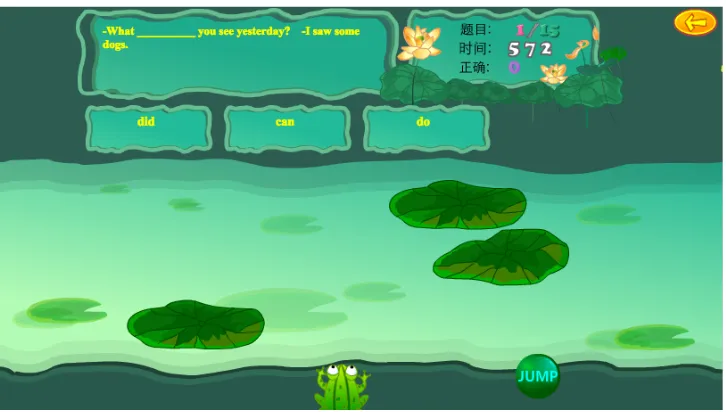
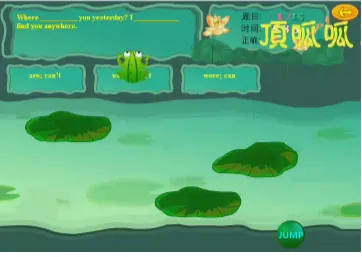
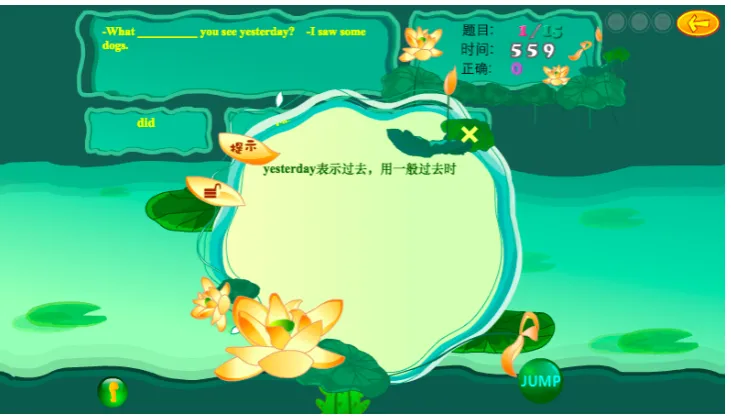
[image:10.595.73.436.537.743.2]There are two modes in this game, including the play mode and the practice mode. When a learner enters the game for the first time, he/she has to have the play mode first. In this mode, a question about the use of tense or phrase in English will be shown on the screen and three choices will be given. The learner need to read the questions carefully and consider the answer of this question. Then, he/she can choose the answers and then gets different feedback to know whether the choice is correct or not. For instance, when the learner enters the game and has one exercise, he/she will have the original animation (see Figure 1 as an example). He/she can click the “JUMP” button at the bottom of the right corner to make the frog jump on the moving leaves and then get to the answer that he/she wants to choose. If the learner chooses the right answer, the texts “excellent” (in Chinese) will be shown (see Figure 2 as an example). Otherwise, the texts “The answer is wrong” (in Chinese) will be shown (see Figure 3 as an example). In this mode, the learner can only play each exercise once and gets final results after finishing all exercises within limited time. Then, he/she can choose to replay the play mode, or have the exercise mode, or review the whole exercises with hints.
Figure 2: Sample of the Serious Game with the Right Answer
Figure 3: Sample of the Serious Game with the Wrong Answer
button on the left of the tip page. The other is that the learner can play the same exercise as many time as he/she wants within limited time or skip this exercise. After finishing all exercises, the learner can also choose to have the play mode, or replay the practice mode, or review the whole exercises with hints.
Figure 4: Sample of the Serious Game with Tips in the Practice Mode Tests
Learning gains were measured by comparing the scores on one pretest and two posttests. Each test was paper test, consisting of 15 multiple choice questions about the use of tenses and phrases. For example, the question was like “What did your father ______ yesterday?” Three answers will be given to choose such as “do” “did” “does”.
As students had already learned the use of tenses and phrases, the pretest (see Appendix 1) was applied to test students’ English level before the class. All exercises in the game were the same as questions in the pretest so that students could get familiar with the game and choose answers quickly. Hence, students could know the answers and final score of the pretest in the serious game. The first posttest (see Appendix 2) was conducted immediately after the game for the control group in order to evaluate the learning outcome after the class. As for the experimental group, the first posttest was conducted after the game and having the oral debriefing. Students would know the final score of the first posttest after class. One week after the game class, the second posttest (see Appendix 3) was implemented in both groups to evaluate the retention about what has been reviewed in that class. The final score of the second posttest would be told after class.
Questionnaire for motivation
Rheinberg, 2006): challenge (C), interest (I), probability of success (P), anxiety (A) and flow (F). The scales’ reliability is sufficient (for challenge Cronbach’s alpha between .66 - .81, for interest Cronbach’s alpha between .71 - .90, for probability of success Cronbach’s alpha between .68 - .88, for anxiety Cronbach’s alpha between .72 - .85, for flow Cronbach’s alpha .90). Challenge is used to assess whether learners accept the situation as an achievement situation where they want to succeed, consisting of four items (e.g., ‘Learning English through games is a real challenge for me’). Interest refers to what degree leaners are interested in the topic of the learning material, which includes six items (e.g., ‘I like learning English through game’). Probability of success is learners’ belief that they can succeed in this task (four items, e.g., ‘I think I can master all contents that I learned from the English game’). Anxiety is described as fear of failure in a specific situation, which incorporates the negative incentive of failure. It has five items like ‘I feel under pressure to learn English through games’. Flow means the learners’ state of concentration and engagement/absorption while they are working with the learning material, which consists of four items (e.g., ‘I am completely lost in thought’).
This questionnaire was translated into Chinese when being used. Students were asked to fill in these questionnaires with a five-point Liker-scale, from 1 for “strongly disagree” to 5 for “strongly agree” before as well as after the class. Students would have the questionnaire immediately after finishing the paper test.
Treatment
Debriefing was the intervention in this study, which referred to the combination of the oral debriefing after the serious game and the written debriefing after the class. After the serious game, the experimental group received an oral debriefing. This was an instructor-led debriefing, aiming at reflecting what students experienced in the game and helping to focus on the instructional information. Due to a large number of students in a class, it would be easy to conduct the debriefing as a group led by the teacher. Besides, it is found that the traditional instructor-led team debriefing has the same effectiveness compared with within team debriefing (Boet et al., 2013). During the oral debriefing, the teacher explained why and how to choose the correct answers as well as gave knowledge about tenses. Students were required to take notes about what the teacher said in debriefing during this process. This oral debriefing lasted 10 minutes.
Procedure
These two classes had their English classes respectively with the same teacher, and the control group had the class first in case that students might discuss the content of the debriefing process. The natural English class lasted 40 minutes.
As for the control group, they did the pretest and finished the motivation questionnaire in the first 10 minutes. Because of the simplicity of this game and exercises, students only had 10 minutes to play this game. In this ten minutes, students were requested to complete the play mode first and then they could play the practice mode. After this game, they were asked to finish the first posttest as well as the motivation questionnaire and then they could play other computer games until the class was over. After one week later, they were given the second posttest to evaluate retention.
As for the experimental group, they were also required to finish the pretest and the motivation questionnaire in the first ten minutes. Then, they had 10 minutes to play the game. They also needed to complete the play mode first and then they could play the practice mode. After the game, the oral debriefing was given, which was led by the teacher. The debriefing process lasted for 10 minutes, and then they were asked to finish the first posttest followed by the motivation questionnaire in the last ten minutes. Besides, after the class, students in this group were asked to write a short composition by using past tense. And the compositions were evaluated by the teacher individually with judgment. This is the process of written debriefing. After one week, students were given the second posttest to evaluate the retention.
Analyses
Before analysing the results, the reliability and validity of the questionnaire were checked. Confirmatory factor analysis (CFA) was performed in the questionnaire after the class to test how well measured variables represent a smaller number of construct (Hair, Black, & Babin, 2010). The x2/df
value was 2.32, which was below 3. It reflected good model fit of this measurement model.
The results of CFA suggested that the measurement model provides a reasonably good fit. After that, the internal consistency coefficient was calculated for the reliability. Internal consistency coefficient for each construct is presented in Table 1. Although the Cronbach’s Alpha of probability of success and challenge were lower than .7, the reliabilities for these two subscales in the original instrument was high enough. Hence, all subscales were considered reliable and could be used for further analyses.
Table 1: Cronbach Alpha of Construct
Construct Number of items Cronbach’s Alpha
Probability of success 4 .431
Anxiety 5 .817
Challenge 4 .318
Flow 4 .724
[image:15.595.74.496.327.455.2]At last, to test the reliability of construct, Construct Reliability (CR) and Average Variance Extracted (AVE) were checked. AVE refers to a summary measure of convergence among a set of items representing a latent construct (Hair et al., 2010). And the value of AVE should be .5 or greater to indicate adequate convergent validity. CR is measure of reliability and internal consistency of the measured variables representing a latent construct, which should be .7 or higher to show adequate convergence or internal consistency. The results of CR and AVE (see Table 2) indicated that the scale of this questionnaire had a good convergent validity and reliability.
Table 2: Convergent Validity of Constructs
Construct Construct reliability Average variance extracted
Interest 0.677 0.652
Probability of success 0.832 0.732
Anxiety 0.732 0.732
Challenge 0.832 0.621
Flow 0.762 0.612
Based on the above analyses, this questionnaire had an adequate reliability and validity to be used in this study and could be calculated for further analysis.
To test the first research question whether serious games could yield learning gains, a paired samples t-test was performed between the average scores on the pretest and the first posttest for the control group. Before conducting the paired t-test, the assumption of normality for distributed difference of mean scores was checked. The skew and kurtosis values (-.25 and -.05, respectively) were less than the maximum allowable values for a t-test, namely skew < |2.0 |and kurtosis < |9.0| (Schminder, Ziegler, Danay, Beyer, & Bühner, 2010). This indicated that the assumption was considered satisfied. Also, the correlation between the two conditions was estimated at r = .55, p<.001. It indicated that the dependent samples t-test was appropriate in this study.
at r = .94, p<.001, suggesting that the paired samples t-test was appropriate in this study.
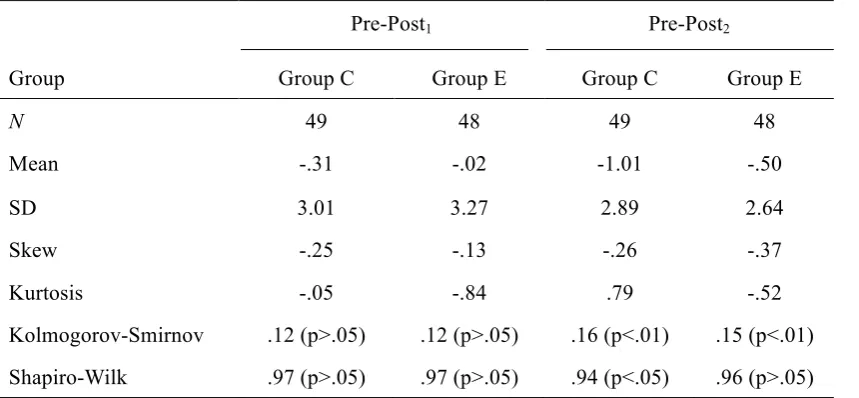
[image:16.595.72.502.283.482.2]To test the third research question whether serious games supplemented with debriefing could yield higher learning gains than serious games as the sole instruction, the difference of average scores from the pretest to the first posttest between the control and experimental groups was compared by an independent samples t-test. The assumption of normality for an independent t-test was satisfied, as results of the Kolmogorov-Smirnov test were not significant (see Table 3), suggestion normality. Besides, the values of Skew and Kurtosis indicated that the distributions normality was also assumed (see Table 3). Additionally, the assumption of equality of variances was tested and satisfied via Levene’s F test with F (95) = 1.03, p = .31.
Table 3: The Normality of Distributed Difference
Pre-Post1 Pre-Post2
Group Group C Group E Group C Group E
N 49 48 49 48
Mean -.31 -.02 -1.01 -.50
SD 3.01 3.27 2.89 2.64
Skew -.25 -.13 -.26 -.37
Kurtosis -.05 -.84 .79 -.52
Kolmogorov-Smirnov .12 (p>.05) .12 (p>.05) .16 (p<.01) .15 (p<.01) Shapiro-Wilk .97 (p>.05) .97 (p>.05) .94 (p<.05) .96 (p>.05)
Note. Pre-Post1 refers to the difference of mean scores between the pretest and the first posttest immediately after the class; Pre-Post2 refers to the difference of mean scores between the pretest and the second posttest after one week later; Group C means the control group; Group E means the experimental group.
To check the fourth research question whether serious games with debriefing could yield a higher level of retention than serious games as the sole instruction, an independent samples t-test was performed in the control and experimental groups. It was to investigate the difference of average scores from the pretest to the second posttest between two groups. Although the Kolmogorov-Smirnov tests were significant, indicating non-normality, the values of Skew and Kurtosis (see Table 3) showed that normality was considered satisfied. After that, the assumption of homogeneity of variances was tested. The results showed that this was satisfied with F (95) = .12, p = .73.
scores satisfied, as the skew and kurtosis levels were estimated at .31 and -. 05, respectively, which is less than the maximum allowable values for a t-test, namely skew < |2.0 |and kurtosis < |9.0| (Schminder et al., 2010). Also, the correlation between the two conditions was estimated at r = .49, p<.001, suggesting that the paired samples t-test was appropriate in this study.
In conclusion, all assumptions for paired samples and independent samples t-test were satisfied and further analyses could be conducted.
Results
The purpose of this study is to check the effect of debriefing with serious games on learning. At the same time, the effects of serious games as the standalone instruction on learning and motivation were also tested. Results for each research questions were explained respectively in this section.
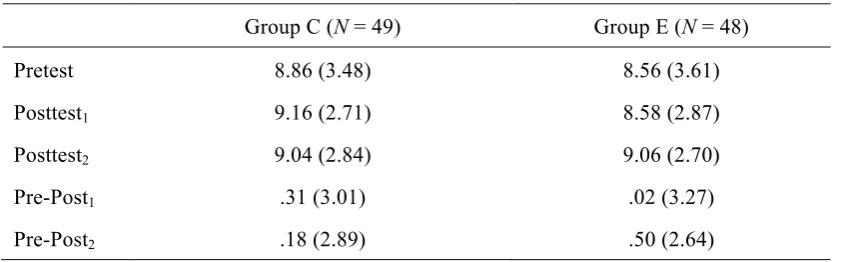
Table 4 showed all average scores and standard deviations of the pretest, the first posttest immediately after the class, and the second posttest after one week for the control and experimental groups.
Table 4: Average Scores (and Standard Deviations) of the Pretest and Posttests for the Control and Experimental Groups
Group C (N = 49) Group E (N = 48)
Pretest 8.86 (3.48) 8.56 (3.61)
Posttest1 9.16 (2.71) 8.58 (2.87)
Posttest2 9.04 (2.84) 9.06 (2.70)
Pre-Post1 .31 (3.01) .02 (3.27)
Pre-Post2 .18 (2.89) .50 (2.64)
Note. The maximum score for all tests is 15. Posttest1 refers to the first posttest, namely the posttest immediately after the class; Posttest2 refers to the second posttest, namely the posttest after one week; Pre-Post1 refers to the difference of mean scores between the pretest and the first posttest immediately after the class; Pre-Post2 refers to the difference of mean scores between the pretest and the second posttest after one week; Group C means the control group; Group E means the experimental group. Effect of serious games on learning gains
Comparing the scores on the pretest and the first posttest for the control group, the average scores increased by .30. However, there was no statistically significant difference between these scores (t = -.71, df = 48, p = .48, Cohen’s D = .10).
Effect of serious games on motivation for learning English
[image:17.595.70.494.387.518.2]Cronbach’s Alpha of probability of success and challenge were lower than .7, the reliabilities for them in the original questionnaire was high enough. Hence, all subscales are considered reliable. All average scores of the pre- and posttests for all subscales in the motivation questionnaire were shown in Table 5. Table 5: Summary of Average Score (and Standard Deviation) of Motivation Questionnaire
Pretest Posttest
Interest 3.40 (.96) 3.43 (1.01)
Probability of success 3.24 (.48) 3.43 (.77)
Anxiety 2.39 (1.01) 2.46 (1.02)
Challenge 3.38 (.91) 3.45 (.80)
Flow 2.93 (.98) 2.99 (.99)
It is indicated that all average scores of the posttest were higher than those of the pretest. However, only for the probability of success, the difference was statistically significant (t = - 2.39, df = 48, p < .05, Cohen’s D = .34). In terms of the interest, the increase from the pretest to the posttest was not significant (t = - .55, df = 48, p > .05, Cohen’s D =. 07). Besides, the differences for anxiety, challenge, and flow were not significant with t = - .76, df = 48, p > .05, Cohen’s D =. 11, t = - 1.44, df = 48, p > .05, Cohen’s D =. 22, and t = - .87, df = 48, p > .05, Cohen’s D =. 12, respectively. Therefore, from the pretest to the posttest, only the subscale of probability of success increased significantly.
Effect of debriefing with serious games on learning gains
From the pretest to the first posttest, the mean scores of both groups improved. However, the average score of the experimental group (N= 48) increased less than that of the control group (N=49) (M= -.02, SD= 3.27; M= -.31, SD= 3.01, respectively). The independent samples t-test was associated with a non-statistically significant effect with t (95) = .45, p > .05. It is showed that in the control and experimental groups, the difference between the improvement from the pretest to the first posttest was not significant.
Effect of debriefing with serous games on retention
From the pretest to the second posttest, the average score of the experimental group (N= 48) increased by .50 (SD = 2.64). It was more than the increase of the average score for the control group (N = 49), which was .18 (SD = 2.89). However, the difference was not significant with t (95) = -.56,
p > .05. The results showed that there was no significant difference in the increase from the pretest to the second posttest for the control and experimental groups.
Effect of the written debriefing on learning
average scores from the first posttest to the second posttest was not significant (t = - 1.18, df = 47, p = . 25, Cohen’s D = -.17). The result indicated that as for the experimental group, the increase from the first posttest to the second posttest was not significant.
Discussion
This study investigated the effect of serious games on learning gains as well as motivation for learning English in an EFL classroom. Besides, one class receiving serious games as the standalone instruction was compared with the other class who had serious games with debriefing to study the effect of serious games with debriefing on learning gains and retention. The main research findings and further researches are discussed, which are followed by limitations of this study.
Research findings and further research
Effect of serious games on learning and motivation
Results of the pretest and the first posttest for the control group showed no significant improvement of the learning gains after serious games. One explanation could be due to a distraction that the innovative environment produced on the learners (Wrzesien & Raya, 2010). In this study, serious games are considered to be an interactive, entertaining environment with instructional and educational aims. Also, learners are novices to this game, which means that they may easily be attracted by focusing on irrelevant information (Wouters & Van Oostendorp, 2013) and involving themselves in pursuit of pure entertainment (Ke, 2008). In the past, pupils were used to having English class in a normal classroom instead of having English class through games in a computer room, which is new for students in the Chinese primary schools. It is easy for students to be attracted by irrelevant information such as the totally different environment to have class and the new way to have the class. Besides, in this case, students might just have fun with making the frog jump and getting the answer instead of achieving the learning goals which refers to knowing why and how to choose this answer. The second reason could be the intuitive learning due to the “drill and practice” approach in this game. In the practice mode, students simply change actions until their scores improve without knowing the reason (Chiu et al., 2012). This is consistent with Wouters et al.’s (2013) statement that serious games should be combined with other instructional methods. The third reason might be related to the short time to play the game. In ten minutes, students were requested to accomplish the play mode first and then they could play the practice mode. In such a short time, learners did not have enough time to consult all tips in this game. This could lead to non-significant improvement from the pretest to the posttest.
ensure learners engage in the learning experience repeatedly. Results of this experiment are consistent with their findings since the results showed that motivation for learning English was improved significantly after having the serious game. This can be explained by a cyclical relationship from Garris et al., (2002). It includes the trainees’ enjoyment of game play, intrinsic motivation, and the decision to continue playing. The enjoyment of game play increases the motivation for learning.
Among the five subscales to be measured in the questionnaire, the probability of success was reported to increase significantly after the serious game. Although the Cronbach’s Alpha of probability of success was low, the reliability for it in the original questionnaire was high enough. Hence, this subscale was considered reliable. Probability of success refers to learners’ belief that they can be successful in the task. Before taking the task, leaners are assumed to calculate the possibility of success by considering their ability and the perceived difficulty of the task (Vollmeyer & Rheinberg, 2006). Results indicate that after having this class, learners believe that their ability can handle the difficulty of the task, namely learning English through the serious game. One reason could be that this serious game was easy to play with. The other reason could be that learners’ confidence in their ability to apply the information taught before is increased by engaging in the game cycle repeatedly (Sitzmann, 2011).
The combination of the first two research questions means that there is a positive effect caused by serious games since learners are motivated to learn English though serious games and achieve at least as equal learning results. A high level of motivation is considered a prerequisite for success (Ebner & Holzinger, 2007). However, it has to be acknowledged that motivation alone does not ensure achievement (Annetta, Minogue, Holmes, & Cheng, 2009). In Garris et al.’s (2002) model, extensive time to engage in game play is essential for the game cycle to occur. Vollmeyer & Rheinberg (2006) agreed on this by pointing out that duration and frequency of the learning activity can mediate the effect of motivation on learning. They state that learners with high motivation will spend more time on a learning task and hence to acquire more knowledge. In this study, the reason for higher motivation and no learning gains could be due to the lack of duration, namely lack of enough time to play the game.
Effect of debriefing with serious games on learning
have a positive effect on learning outcomes. However, results of this study showed that serious games with debriefing were not better than serious games as the standalone instruction regarding learning gains and retention.
As for the non-significant difference of the learning gains between these two groups, it could be explained from four aspects according to Lederman’s (1992) seven structural elements of the debriefing process.
The first aspect is concerned with the debriefer and the participants. The debriefer acts as a facilitator, teacher or instructor during the process of debriefing, who aims to help the participants learn from the experience in which they have engaged (Lederman, 1992). Participants are people who engage in the experience and they are debriefed. The debriefer is required to skillfully engage all participants and encourage them to speak up and ask question in order to optimize learning during debriefing (Gardner, 2013; Raemer et al., 2011) . This requires the debriefer to have a deep knowledge about the debriefing process and know when, where and how to debrief. In addition, the role of the teacher during the debriefing is different, whose aim is to guide and direct rather than to lecture by encouraging to offer opinions (Fanning & Gaba, 2007; Petranek et al., 1992). And this is hard to achieve if the participants are passive. However, in this study, it is difficult to have learners involved in debriefing discussion in China due to cultural differences (Chung, Dieckmann, & Issenberg, 2013). It has been shown that non-western students are more passive since they are fearful of giving incorrectly answering questions. Also, teaching in the primary school level emphasizes memorization over critical thinking due to the entrance examination. Students tend to wait for the instructor to give answers and solutions instead of participating actively and reflecting during learning. In this kind of educational system, students usually do not have the habit or courage to challenge or question authorities who are teachers. Therefore, it is important for the debriefer to create a trustful and supportive learning environment to overcome these. Fanning & Gaba (2007) propose to have a prebrief session in which the facilitator explains the aim of the serious game, the learning objectives, the process of debriefing, and what it entails. In this session, participants could learn what is expected from them. Also, the ground rules for the serious game learning experience could be set. Further research could focus on the way to debrief based on different cultural backgrounds. For instance, questions like how different methods of debriefing affect different cultures in serious games and how to conduct debriefing to get more learning gains according to different cultures.
this study, the experience refers to the serious game itself. Participants in this study are around 12 or 13 years old who have plenty of time to play computer games at home. And there is no competition about the final scores in the game. This could lead student to consider that the game used in this study is too simple and does not have challenge. This caused no impact on them. They might simply play the game without critically think why to choose this answer and how to get higher scores. Some of students might play other computer games when the teacher did not pay attention to them. In addition, the drill and practice learning mode only focus on the transfer of content knowledge and facts (Deen et al., 2015). And the experience in this kind of serious game is merely based on trial and error. It provides few opportunities for learners to explore the experience and use language in the game. Also, it makes the debriefer to have few content to debrief based on the experience in the serious game. Further researches could be conducted about how to make the serious game interesting enough with enough challenges both for learners and debriefers.
reflecting and understanding. One the other hand, it would be easy to let students play the game one their own and have the debriefing on their own in school. In this case, scripted debriefing might be beneficial since most participants have little in debriefing (Raemer et al., 2011) and a set of questions could be provided to have an effective self-debriefing (Van Der Meij et al., 2013). In future, questions about the way to debrief or the debriefing strategy that can have a positive effect on learning gains can be researched. It will be very helpful to research how to conduct an effective debriefing in a large group since in China, there are usually 40 to 50 students in a class.
The last perspective is related to the time to process any experience. It could be how much time that has been spent on the serious game before debriefing. It could also be the length of the debriefing. In this experiment, due to intensive arrangement of the class, time to play the serious game and to debrief are 10 minutes respectively, which are not long enough to make students really get involved in both experiences. And the experience will be seen differently based on the time that has passed before the debriefing (Fanning & Gaba, 2007). And 10 minutes are shorter than suggested in other researches (Raemer et al., 2011), which are not long enough for all students to express their opinions. In addition, the debriefing in this study happens after the serious game. It would be interesting to study whether it would be more effective to improve learning gains when the debriefing is interspaced during the serious game than when the debriefing occurs after the serious game. Besides, study about how to allocate time to the serious game and the debriefing in a natural class would also be interesting.
After having the oral debriefing during the class, a written one was requested for the experimental group. The advantage of the written debriefing is to force participants to organize and process what they have learned in the serious game and the oral debriefing. And in the oral debriefing, there is so little time to process the information (Petranek, 2000). Hence, the combination of the oral and written debriefing is assumed to have a positive effect on retention.
defensive nor try to guess what the debriefer’s critical judgment is. It values the expert opinion of the debriefer as well as the unique perspective of the learners. One way to implement the “debriefing with good judgement” is through the correct style of speaking used by the debriefer, which pairs advocacy with inquires. The debriefer starts by stating in the advocacy his or her hypothesis, and then testing the hypothesis with an inquiry. For instance, the debriefer could have a private speaking with the learner and might say, “I noticed that you used past tense to describe things that will happen in future. I was thinking you might want to write something that will happen in future (advocacy). So I’m curious: how do you think about the tense when describing things that haven’t happened? (inquiry)” This could also be conducted in written way.
Limitations
There are two limitations in the present study. One limitation is the design of the experiment. Due to the length of a natural class, the students could not have enough time to play the game and it could not be guaranteed that all students were able to participate in the debriefing session. The other limitation is about the generalization of the research findings. Participants in this study come from a primary school in a rural-urban fringe zone. In China, there is a huge gap on the teaching quality between rural and urban areas. This leads to a big gap of the English ability in students. Hence, the findings of this study are hard to apply to all areas in China.
Conclusion
The purpose of the present study was to investigate the effect of debriefing with serious games on learning in an EFL classroom.
It is concluded that serious games as the sole instruction did not yield learning gains. However, it was indicated that serious games with the drill and practice learning mode had a positive effect on motivation toward learning English for learners whose native language is different from English. It is proposed that to harness the motivation appeal of serious games and have effective learning, debriefing is suggested to be a useful support in serious games. However, results of this study showed that serious games supplemented with debriefing could not yield higher learning gains than serious games as the standalone instruction. Further investigations about how to make debriefing with serious games lead to effective learning are needed.
Reference
Annetta, L. A., Minogue, J., Holmes, S. Y., & Cheng, M.-T. (2009). Investigating the impact of video games on high school students’ engagement and learning about genetics. Computers & education, 53(1), 74-85.
Anyaegbu, R., Ting, W., & Li, Y. (2012). Serious game motivation in an EFL classroom in Chinese primary school. TOJET: The Turkish Online Journal of Educational Technology, 11(1). Bakker, M., van den Heuvel-Panhuizen, M., & Robitzsch, A. (2015). Effects of playing mathematics
computer games on primary school students’ multiplicative reasoning ability. Contemporary Educational Psychology, 40, 55-71.
Boet, S., Bould, M. D., Sharma, B., Revees, S., Naik, V. N., Triby, E., & Grantcharov, T. (2013). Within-team debriefing versus instructor-led debriefing for simulation-based education: a randomized controlled trial. Annals of surgery, 258(1), 53-58.
Chiu, Y. h., Kao, C. w., & Reynolds, B. L. (2012). The relative effectiveness of digital game-based learning types in English as a foreign language setting: A meta-analysis. British Journal of Educational Technology, 43(4).
Chou, M.-h. (2014). Assessing English vocabulary and enhancing young English as a Foreign Language (EFL) learners’ motivation through games, songs, and stories. Education 3-13, 42(3), 284-297. Chung, H. S., Dieckmann, P., & Issenberg, S. B. (2013). It is time to consider cultural differences in
debriefing. Simulation in healthcare, 8(3), 166-170.
De Jong, T. (2010). Cognitive load theory, educational research, and instructional design: some food for thought. Instructional science, 38(2), 105-134.
Deen, M., Van den Beemt, A., & Schouten, B. (2015). The Differences between Problem-Based and Drill and Practice Games on Motivations to Learn. International Journal of Gaming and Computer-Mediated Simulations (IJGCMS), 7(3), 44-59.
Ebner, M., & Holzinger, A. (2007). Successful implementation of user-centered game based learning in higher education: An example from civil engineering. Computers & education, 49(3), 873-890. Fanning, R. M., & Gaba, D. M. (2007). The role of debriefing in simulation-based learning. Simulation
in healthcare, 2(2), 115-125.
Gardner, R. (2013). Introduction to debriefing. Semin Perinatol, 37(3), 166-174. doi:10.1053/j.semperi.2013.02.008
Garris, R., Ahlers, R., & Driskell, J. E. (2002). Games, motivation, and learning: A research and practice model. Simulation & gaming, 33(4), 441-467.
ed., global edition. ed.). Upper Saddle River, NJ: Pearson.
Hays, R. T. (2005). The effectiveness of instructional games: A literature review and discussion. Ke, F. (2008). Computer games application within alternative classroom goal structures: cognitive,
metacognitive, and affective evaluation. Educational Technology Research and Development, 56(5-6), 539-556.
Kiili, K. (2005). Digital game-based learning: Towards an experiential gaming model. The Internet and higher education, 8(1), 13-24.
Lederman, L. C. (1992). Debriefing: Toward a systematic assessment of theory and practice. Simulation & gaming, 23(2), 145-160.
Leemkuil, H., & de Jong, T. (2011). Instructional support in games. Computer games and instruction, 353, 370.
Leemkuil, H., & De Jong, T. (2012). Adaptive advice in learning with a computer-based knowledge management simulation game. Academy of Management Learning & Education, 11(4), 653-665. Malone, T. W. (1981). Toward a theory of intrinsically motivating instruction. Cognitive science, 5(4),
333-369.
O'Neil, H. F., Wainess, R., & Baker, E. L. (2005). Classification of learning outcomes: Evidence from the computer games literature. The Cirriculum Journal, 16(4), 455-474.
Petranek, C. F. (1994). A maturation in experiential learning: Principles of simulation and gaming.
Simulation & gaming, 25(4), 513-523.
Petranek, C. F. (2000). Written debriefing: The next vital step in learning with simulations. Simulation & gaming, 31(1), 108-118.
Petranek, C. F., Corey, S., & Black, R. (1992). Three levels of learning in simulations: Participating, debriefing, and journal writing. Simulation & gaming, 23(2), 174-185.
Raemer, D., Anderson, M., Cheng, A., Fanning, R., Nadkarni, V., & Savoldelli, G. (2011). Research regarding debriefing as part of the learning process. Simulation in healthcare, 6(7), S52-S57. Rudolph, J. W., Simon, R., Dufresne, R. L., & Raemer, D. B. (2006). There's no such thing as
“nonjudgmental” debriefing: a theory and method for debriefing with good judgment.
Simulation in healthcare, 1(1), 49-55.
Ruphina, A., & Liu, M. (2011). Digital games: Potential integration of Mingoville games in learning English as a foreign language. Paper presented at the Society for Information Technology & Teacher Education International Conference.
European Research Journal of Methods for the Behavioral and Social Sciences, 6, 147-151. Sitzmann, T. (2011). A meta-analytic examination of the instructional effectiveness of computer-based
simulation games. Personnel Psychology, 64(2), 489-528.
Van Der Meij, H., Leemkuil, H., & Li, J.-L. (2013). Does individual or collaborative self-debriefing better enhance learning from games? Computers in human behavior, 29(6), 2471-2479. Vollmeyer, R., & Rheinberg, F. (2006). Motivational effects on self-regulated learning with different
tasks. Educational Psychology Review, 18(3), 239-253.
Wouters, P., Van der Spek, E. D., & Van Oostendorp, H. (2009). Current practices in serious game research: A review from a learning outcomes perspective. Games-based learning advancements for multi-sensory human computer interfaces: techniques and effective practices (pp. 232-250). London: IGI Global.
Wouters, P., Van Nimwegen, C., Van Oostendorp, H., & Van Der Spek, E. D. (2013). A meta-analysis of the cognitive and motivational effects of serious games. Journal of Educational Psychology. doi:10.1037/a0031311
Wouters, P., & Van Oostendorp, H. (2013). A meta-analytic review of the role of instructional support in game-based learning. Computers & education, 60(1), 412-425.
Wrzesien, M., & Raya, M. A. (2010). Learning in serious virtual worlds: Evaluation of learning effectiveness and appeal to students in the E-Junior project. Computers & education, 55(1), 178-187.
Appendix Appendix 1
Pretest
姓名(Name): 学号(Student Number):
1. -Did you learn English last year? -________
A. Yes, I do. B. Yes, I did. C. Yes, you did. 2. Last weekend we _____ in the park.
A. climb the mountains B. sing C. read books 3. What did your father ______ yesterday?
A. do B. did C. does
4. Where ________ you yesterday? I ___________ find you anywhere. A. are; can’t B. were; can C. were; didn’t 5. I _________ last week.
A. went swimming B. go swimming C. went swimming 6. -Did you read books last night?
-No, ________
A. I did B. I didn’t C. I don’t 7. When did you ________ these pictures? A. took B. taking C. take 8. -What _________ you see yesterday? -I saw some dogs.
A. did B. can C. do 9. I _____ fishing last Sunday.
A. went B. go C. am going to 10. -What did you do yesterday?
-I _____ a horse
A. ride B. rode C. riding 11. What ____ Amy ______ last weekend?
A. did; do B. do; do C. does; do 12. Mike ______ his clothes every day.
A. camp B. camps C. camping 14. Two hours _____, the film was over.
Appendix 2:
First Posttest
姓名(Name): 学号(Student Number):
1. Tomorrow she will _____ to a park.
A. go B. went C. goes 2. They went to Beijing ________.
A. tomorrow B. yesterday C. now 3. I ______ buy a gift for my sister last weekend. A. didn’t B. don’t C. doesn’t 4. -What did Sarah do last weekend?
-She _________.
A. went there by train. B. climbed a mountain. C. takes pictures. 5. I _____ with my friends yesterday afternoon.
A. talk B. are talking C. talked 6. I _______ with a lot of good friends yesterday.
A. took pictures B. takes pictures C. take pictures 7. We played games _____ Tuesday.
A. last B. before C. later 8. Look ____ the picture and talk ______ it.
A. of; in B. at; to C. at; about 9. I ________ TV last night.
A. saw B. watched C. looked
10. Ten years ago, I couldn’t _____ a horse. But I can _______ a horse now. A. rode; ride B. ride; ride C. riding; rode
11. -Where is your brother? -He _____ food in the kitchen.
A. eats B. ate C. is eating 12. Sarah never ______ homework after dinner. A. don’t B. does C.do 13. How can I ______ there?
A. get to B. got to C. get 14. Ten years ago, we _____ babies.
15. -__________ he go ice-skating yesterday? -__________, he did.
Appendix 3:
Second Posttest (one week later)
姓名(Name): 学号(Student Number):
1. I was very hungry, so I ________ some bread. A. has B. had C. have 2. Tomorrow, I’ll _____ back home.
A. am B. are C. be 3. We went to a restaurant ________.
A. every day B. tomorrow C. yesterday 4. -What did you do last night?
-I _______. A. play football B. watched cartoons C. go hiking
5. What did Jack do _____?
A. last weekend B. tomorrow C. now 6. What does she usually do _____?
A. on the weekend B. last weekend C. next weekend
7. I _____ my aunt clean her room last Monday. A. help B. helped C. helping 8. -Did you read books yesterday evening? -Yes, I _________.
A. do B. am C. did
9. Mr. Zhang ______ basketball in the playground last Sunday. A. plays B. played C. playing
10. My sister ______ books in every evening, but she _____ books yesterday evening. A. reads; didn’t read B. reads; read C. read; read
11. I ______ to school when I _______six.
13. I ______ home last Saturday.
A. stayed B. stayed in C. stayed at 14. Where did you ______ with your family last Sunday? A. go B. to go C. going to
Appendix 4
Motivation Questionnaire
Sex:
1. I like learning English. (I)
2. I like learning English through games. (I)
3. I think I can master all contents that I learned from the English game. (P) 4. I probably won’t get a good grade in the English game. (P-)
5. Having English classes in the form of games, I will be enjoyable to learn English in the class. (I) 6. I feel under pressure to learn English through games. (A)
7. Learning English through games is a real challenge for me. (C)
8. Learning English through games seems to be very interesting to me. (I) 9. I am eager to see how I will perform in the English game. (C)
10. I am afraid I will make mistakes in the English game. (A)
11. I am really going to do my best to learn English more through playing the game. (C)
12. When I learn English by games, I can get a lot of fun through it and do not need a reward. (I) 13. It would be embarrassing to have a low score in the English game. (A)
14. I think everyone could do well in the game. (P) 15. I think I won’t get a good score in the game. (P-)
16. If I can play the game and get a good score, I will be proud of myself. (C)
17. When I think about learning English through games, I feel somewhat concerned. (A) 18. I would learn English through games even in my free time. (I)
19. I feel petrified by the demands of the English game. (A) 20. I don’t notice time passing during the English class. (F) 21. I have no difficulty concentrating. (F)